


The Core Differences Between Agentic AI vs Generative AI
Understanding agentic AI vs generative AI is now a real concern for leaders who want AI that fits their product goals. Many teams still struggle to decide whether creative output or autonomous action matters more. This MOR Software’s guide breaks down the difference so you can choose the right approach and avoid wasted time, cost, and effort.
What Is Generative AI?
Generative AI refers to artificial intelligence that creates new material based on patterns gathered from large datasets. These models can produce text, pictures, code, music, and other forms of creative work that look and sound like something made by people. In a 2024 survey by Deloitte, about 67% of men and 52% of women said they had heard of generative AI. This shows how quickly this idea has entered normal life. You can picture it as a gifted creator with endless imagination that still needs guidance to understand the bigger goal behind its work.
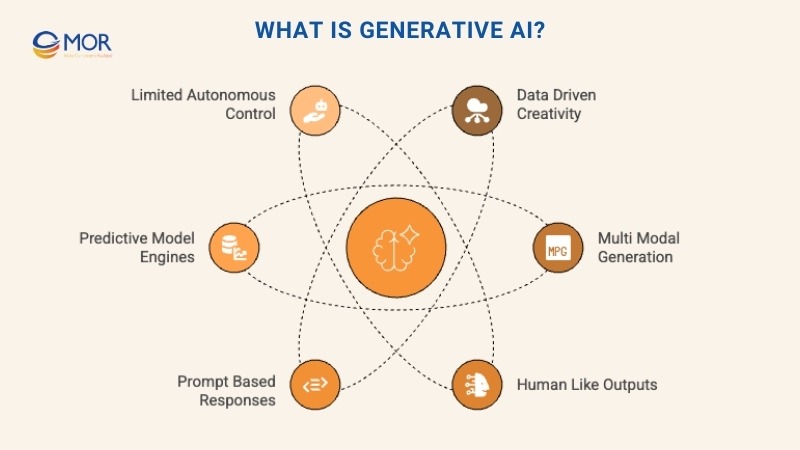
The rise of OpenAI’s ChatGPT pushed this technology into global awareness, yet the scope goes far beyond one chatbot. GitHub Copilot speeds up coding tasks, Midjourney produces detailed visual art, and Jasper AI helps teams write marketing content. All of these tools show the same strength. They take user prompts and turn them into creative results with little effort.
The reason this technology feels so powerful comes from how well the models read input, keep track of meaning, and deliver responses that stay clear and consistent. Large Language Models like GPT, Claude, and Gemini work with billions of learned parameters to predict the next word, the next pixel, or the next line of code. Their predictive talent helps them produce content that feels natural and close to human expression. A 2024 survey by Bain reported that 95% of companies in the United States were already using generative AI in their business. This shows how strongly this type of model has entered real work.
Yet these systems stay limited. They wait for human prompts before they act, cannot check the truth of their own answers, and cannot run long sequences of tasks without help. These limits matter when companies look for tools that can work on their own, especially when compared with agent-driven models that support very different workflows.
>>> Let's explore the top players and where top AI companies hiring remote and onsite roles are growing.
What Is Agentic AI?
Agentic AI refers to a new stage of artificial intelligence where systems can make choices, take action, and follow goals on their own without steady human control. In a 2025 global survey by McKinsey, about 62% of organizations said they were at least experimenting with AI agents framework, showing how fast this idea is moving from theory into real tests.
While generative tools focus on producing content, this model focuses on reaching outcomes. It does more than answer prompts. It shapes plans, carries them out, and adjusts to new situations. These qualities explain why many teams compare agentic AI vs generative AI when they study how each approach fits real work. A modern agentic AI system also shows how this ml model supports tasks that require steady progress rather than single responses.
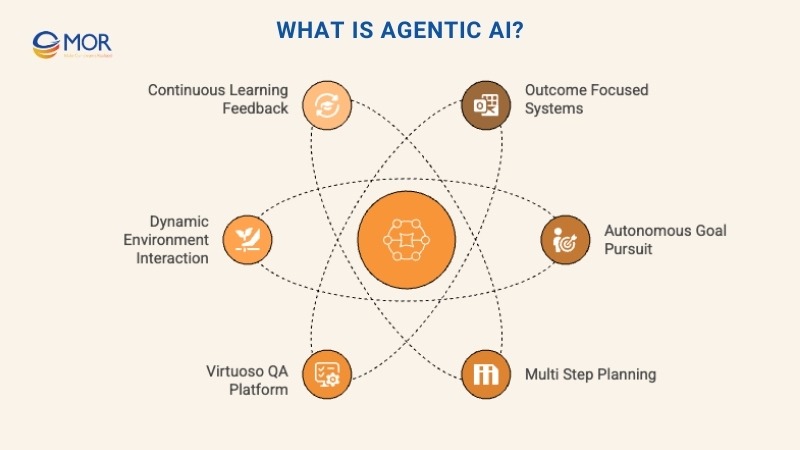
A clear example appears in Virtuoso QA’s agentic testing platform. Instead of only creating test scripts like a generative model, the platform can detect what needs testing, build full test strategies, run tests in different environments, review the results, and repair broken tests when the software changes. This solution does not act like simple automation. It behaves like autonomous intelligence that works toward set goals.
These systems include a set of traits that help them stand apart from generative tools. They follow long-term objectives across many steps and can turn large goals into smaller actions. They also work directly with outside systems, APIs, and other tools to collect data and complete tasks. The most important part is their ability to learn from results and update their plans to improve the next cycle.
This shift in thinking is meaningful. Generative tools think in terms of creating content from a prompt. Agentic models think in terms of taking steps that move toward a clear target. This goal-focused approach turns the model into something closer to a digital team member that can support work at scale.
Agentic AI And AI Agents
It is useful to draw a clear line between agentic AI vs AI agents because they serve different roles. Agentic AI works like the larger structure, while AI agents act as smaller parts that operate inside that structure.
Agentic AI describes the broad idea of solving problems with little human guidance. An AI agent is a single unit inside that system that can handle certain tasks or processes with some level of independence. This approach is changing how people interact with artificial intelligence. The larger framework can read a user’s target or vision and use the details it receives to work through a problem.
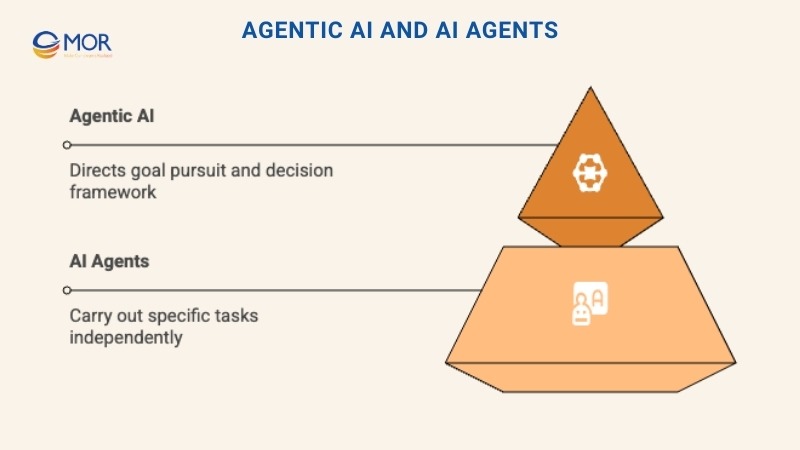
A simple way to picture this is through a smart home. Agentic AI oversees the full energy system and keeps everything aligned with the user’s needs. It uses live data and personal settings to coordinate each AI agent, like the thermostat, the lights, or household appliances. Each agent holds its own task and goal, and all of them work together inside the same structure to support the homeowner’s energy plan.
Key Features Of Agentic AI Vs Generative AI
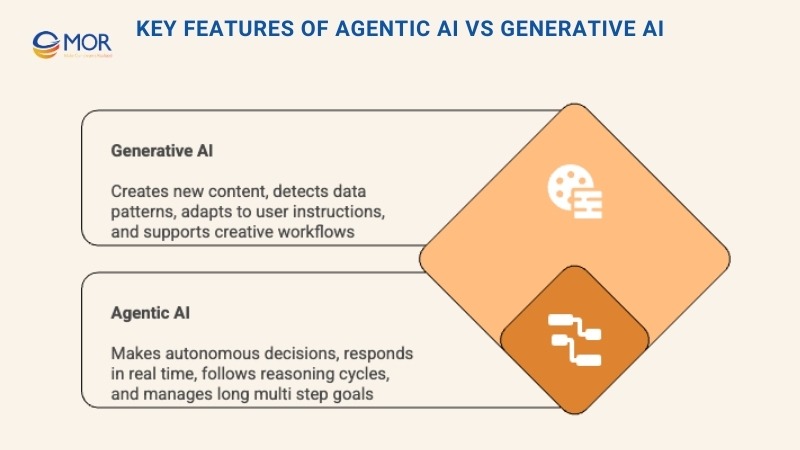
Agentic models and generative models work toward different goals and show different strengths. These differences help explain how each approach supports real projects and why many teams compare agentic vs generative AI when choosing the right method.
Key Features Of Generative AI
Generative tools focus on creating new material based on what the user requests. They can support many creative and technical tasks and help teams complete work faster with clear, readable output.
- Content creation: Gen AI performs very well when creating written text or other forms of content. These models can produce clear essays and solutions to complex prompts. Tools like ChatGPT help me write and answer questions, prepare lists, and share guidance when users enter requests. Some teams also use these tools to write code, which helps simplify software work for developers at different skill levels.
- Data analysis: Generative models can study large datasets and detect patterns or trends. They can support complex tasks in areas like supply chain operations and help improve the customer experience.
- Adaptability: Gen AI can change its output based on user instructions. When users give more detailed feedback, the model can shift its response to fit what the user needs and improve the result.
- Personalization: Gen AI can suggest tailored options and deliver custom experiences based on user data. Many retail brands use these tools to understand customer habits and create more personal shopping experiences.
Key Features Of Agentic AI
Agentic models focus on actions, outcomes, and long-term goals. They work in a steady cycle where the system observes, decides, and adjusts. This structure helps explain how agentic AI works in real environments and why it supports tasks that require more than simple responses.
- Decision-making: These systems follow clear plans and targets, which helps them study a situation and choose the next step with little or no human support.
- Problem-solving: Agentic models follow a four-part process that includes perceiving, reasoning, acting, and learning. AI agents gather and process data, the LLM works like a coordinator that reviews what was collected, and the model connects with outside tools that keep improving with feedback.
- Autonomy: Independent behavior sits at the center of agentic AI. Its ability to learn and act alone makes it a strong choice for teams that want smoother workflows and support for complex tasks without heavy human involvement.
- Interactivity: Because it works in an active way, the model can respond to outside conditions and collect fresh data to adjust in real time. A common example is seen in self-driving cars, which must read the road and make safe, accurate choices at all times.
- Planning: These models can work through complex cases and follow multi-step plans that move toward a set goal.
Agentic AI Vs Generative AI - The Key Differences
Agentic AI represents a major shift in how artificial intelligence works. It is often described as part of a new wave of development. Unlike generative models that create content in response to prompts, agentic systems act on their own. Generative tools respond. Agentic systems take the lead and can handle complex tasks without steady human control.
Here is a table that compares gen AI vs agentic AI:
Category | Agentic AI | Generative AI |
Definition | AI designed for goal-driven actions with independent, real-time decisions. | AI built to produce new content or data from the large datasets used in training. |
Objective | Handling multi-step tasks or reaching defined goals. | Creating new and creative outputs. |
Behavior | Interacts with the environment and adjusts its actions. | Gives results based on fixed inputs like text prompts. |
Outputs | Actions, choices, or plans that support a goal. | Text, images, code, or other generated data. |
Examples | Early uses appear in self-driving vehicles, focused virtual assistants, and robotics. | ChatGPT, Gemini, DALL E, and similar creation tools. |
Learning | Learns and improves through steady feedback and interaction. | Often relies on pre-training and only receives limited feedback while generating. |
Use Cases | Automated decisions and real-world task handling. | Creating content, sharing ideas, and analyzing data. |
Strengths | Strategic thinking, strong adaptation, and real-time response to change. | Creative output and fast production of high quality content. |
A table that compares agentic AI vs generative AI and highlights how the two models differ in design and purpose.
Purpose Behind Each AI Category
Purpose Of Generative AI
Generative AI focuses on producing new content. Its main job is to turn ideas into fresh output that did not exist before. It can write emails, prepare marketing text, create images, or generate code. Its value comes from helping people produce more work with better speed and quality.
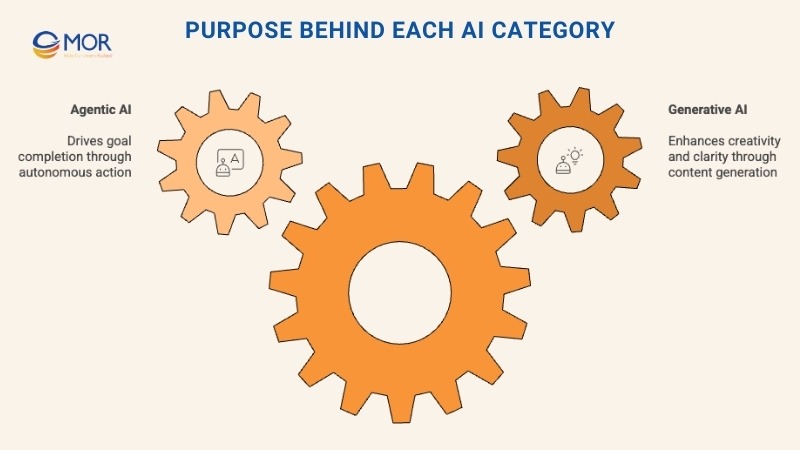
This creative focus guides how these systems are built. They are tuned for smooth language, clear artistic style, and strong pattern recognition. Their success depends on the final output. Teams look at whether the text is correct, whether the image fits the prompt, or whether the code is valid and ready to use. This also fits with the broader comparison of generative vs agentic AI and how each model aims at different goals.
Purpose Of Agentic AI
Agentic AI focuses on reaching goals. Its main role goes beyond making content and instead centers on taking action. It does not wait for prompts. It can spot chances to move forward, make choices, and follow plans that match clear targets.
In the case of Virtuoso QA, this type of model does more than prepare test cases. It works to support software quality at every step. It watches for changes, finds gaps in testing, runs full test cycles, studies the results, and repairs broken tests when the system updates. The shift moves from thinking about creation to thinking about what must be done to reach the goal.
How Decisions Are Made
Why Generative AI Is Prompt Driven
Generative AI works in a reactive way. It only acts when a person gives it a prompt or a question. Even advanced language models stay inactive until a user interacts with them. They cannot spot issues on their own, start conversations, or decide when their skills might help. This fits the larger contrast often described in AI agent vs LLM discussions.
This reliance on human input limits what generative models can do. No matter how strong the system is, it still needs a person to guide every step. The user must see the need, form the prompt, check the output, and choose what to do next. Human control stays in place at all times.
A simple example is a model that writes test scripts. A tester must decide which parts need testing, ask the model to generate the script, check what it produces, adjust anything that is wrong, and then run or connect the tests manually. The model supports the work but cannot handle the full process alone.
Why Agentic AI Operates Independently
Agentic AI reverses this pattern. When it receives objectives and rules, it can act on its own. It can detect when something must be done, pick the right response, carry out the action, and judge the results without steady human involvement.
This independence shows up in complex decision paths and flexible behavior. The model studies possible actions, forecasts likely outcomes, chooses the best option, and updates its plan based on what happens next. If challenges appear, it does not wait for a human. It solves the problem directly.
Virtuoso QA’s agentic features highlight this behavior. When given a quality goal, the platform calculates the needed test coverage, prepares the tests, runs them in different environments, finds issues, attempts to repair broken tests, and only asks for help when it truly cannot continue on its own.
How Each AI Type Handles Workflows
Generative AI In Single Step Tasks
Generative AI performs well with tasks that have clear inputs and outputs. You ask a question and it gives an answer. You request an image and it creates one. Each exchange stands alone, with no memory or long-term goal connected to earlier prompts.
This single response style limits the model to work that can finish in one step. When a job involves several stages, a person must guide each part. The model cannot hold context across sessions or move toward a long-term target without outside support.
Even when it seems to manage larger tasks, a person still directs the main flow. A tool like ChatGPT can help draft a project plan, but a human must still track the work, adjust the schedule, and coordinate people or resources. The model cannot do those parts on its own.
Agentic AI In Multi Step Operations
Agentic AI works well with complex jobs that require many steps over time. It can keep track of the current state, follow the progress toward a set goal, and update its choices as new information appears. This allows real workflow automation instead of single responses.
Its planning skill adds even more value. Agentic systems do more than follow a fixed script. They create the plan. When they receive a goal, they study what steps they need, find what depends on what, assign resources, and manage the entire path until the work is done.
Strong integration helps too. Agentic AI can link with many tools and systems and direct actions across them. In testing work, these models connect with build tools, test environments, reporting systems, and communication platforms to deliver a complete quality workflow.
Agentic AI Vs Generative AI Use Cases
Generative AI In Real Scenarios
Generative AI fits well in creative and analytical work where people still guide the final output. These tasks benefit from fast idea generation and clear language support. This category also connects with wider discussions around AI agents vs agentic AI, since each model assists users in a different way.
Writing And Content Work
Writers use tools like Jasper or Copy.ai to prepare blog posts, social updates, marketing copy, and other written material. These tools help overcome writer’s block and support large scale content work.
Coding Assistance
Services like GitHub Copilot and Amazon CodeWhisperer help developers write code more quickly through completions and ready made structures. Developers still review the output to make sure it fits their needs.
Visual Design And Artwork
Models like DALL E, Midjourney, and Stable Diffusion help people create visual work through text prompts, giving non designers the chance to produce high quality images.
Data Review And Insights
Generative models can study complex data, highlight patterns, and prepare helpful visualizations. Analysts use this support to draw clearer conclusions and build reports.
Virtual Support And Customer Help
Chatbots built with generative AI answer simple questions, prepare message drafts, and deliver round the clock support for basic requests.
Agentic AI In Real Scenarios
Agentic AI handles tasks where goals, long sequences, and independent actions matter most. These real world cases show how systems think, act, and adjust through full processes. These examples also link well with agentic AI use cases in modern operations.
End To End Software Testing
Virtuoso QA’s platform shows how agentic tools can manage full testing cycles. It creates tests, runs them, updates them when the software changes, and works without steady human direction.
Real Time Supply Chain Control
Agentic systems track supply chains in real time, predict delays, adjust routes, manage stock levels, and coordinate with suppliers to keep operations stable.
Market Analysis And Trading Actions
Financial platforms rely on agentic AI to watch markets, find chances to trade, carry out actions, and manage risk as conditions shift.
Advanced Process Automation
Agentic RPA supports complex business tasks that involve several systems, exception handling, and flexible decisions that change as new data appears.
Equipment Health And Maintenance Planning
Industrial agentic models watch machine performance, forecast failures, plan repairs, request parts, and organize fixes to cut down on downtime.
Risks And Limitations To Consider
Limits Of Generative AI
Incorrect Output And False Confidence
Generative AI can sometimes produce answers that sound correct but are not based on real facts. Without proper checking, it may create content that misleads users.
Short Memory And Limited Context Range
Its limited context window restricts how much information it can handle at one time. This affects long conversations or tasks that require deeper understanding.
No Built In Reality Check
The model cannot confirm the truth of its own output. It may produce code that looks correct but fails in practice or content that contains errors.
Heavy Reliance On Strong Prompts
The quality of the result depends on how well the prompt is written. Weak prompts often lead to weak answers, which pushes users to learn how to shape prompts carefully.
Ideas Without Execution Ability
Generative AI cannot carry out the ideas it generates. It might create a marketing plan, yet it cannot run the campaign or take action on its own.
Risks Linked To Agentic AI
Errors That Spread Through The System
Mistakes from an agentic model can move through connected systems before anyone notices. A wrong decision in one step can trigger several unwanted actions afterward.
Unclear Or Misaligned Goals
When the objective is not stated clearly, the system may chase outcomes that do not match what the user intended. It may follow the metric instead of the true purpose.
Exposure To Security Threats
Tools that can take action also create larger points of risk. If an agentic system is compromised, it might carry out harmful steps across linked platforms.
Difficulty Assigning Responsibility
It becomes harder to decide who is accountable for a choice when the model acts on its own and makes decisions without direct human input.
Too Much Independence
If the system operates with more freedom than planned, it might perform tasks outside its intended range. Strong limits and steady monitoring are needed to keep it controlled.
Why Is The Agentic AI Vs Generative AI Divide Important?
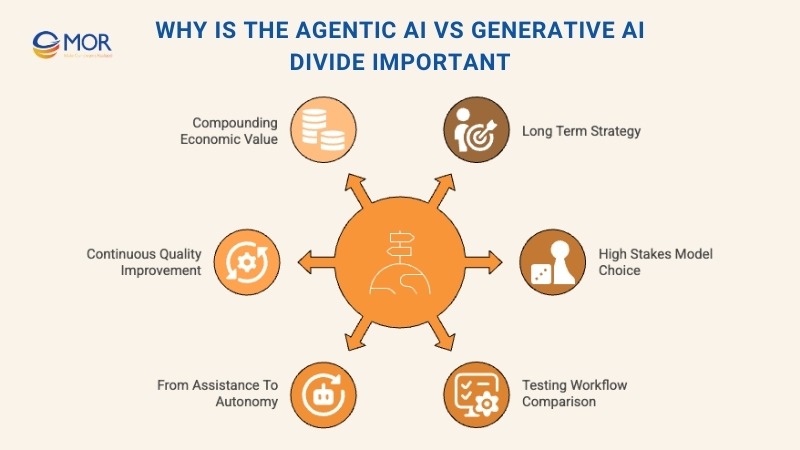
The difference between the two models shapes how companies plan their long term AI strategy. When teams compare agentic AI vs generative AI, they are choosing between two very different paths. A wrong choice can lead to wasted spending, weak results, and loss of advantage in the market. This makes the decision a key part of digital growth.
Software testing offers a clear example. Generative models can prepare test scripts, suggest test cases, and generate data. These tools add value, but they still depend on people to review, run, and update the tests. The work changes shape, yet the manual load remains.
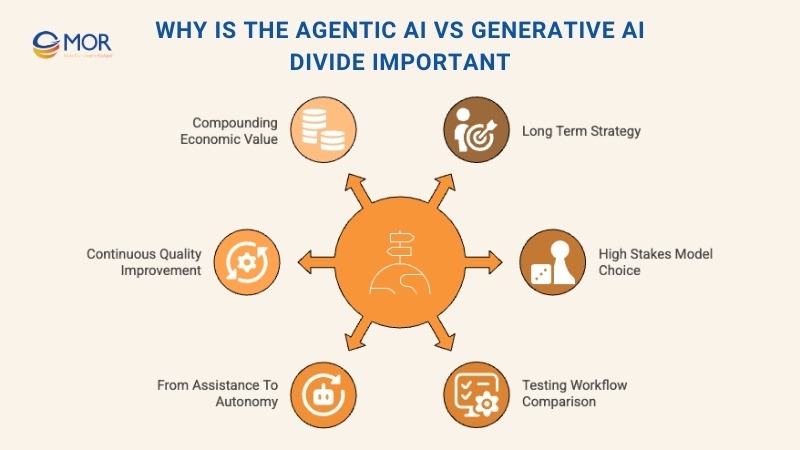
Agentic systems shift the model entirely. Instead of helping testers, they act as independent quality partners. Virtuoso QA’s agentic platform does more than generate tests. It decides what must be tested, builds the test plan, runs tests across environments, updates them as software changes, and gives clear guidance without human effort.
This move from support to full autonomy increases the impact of AI in a dramatic way. Generative tools may help testers work faster, but agentic systems can remove entire stages of the process. They run nonstop, scale without limits, and improve through experience. The economic value grows quickly as the system learns and takes on more of the workflow.
Strategic Business Implications
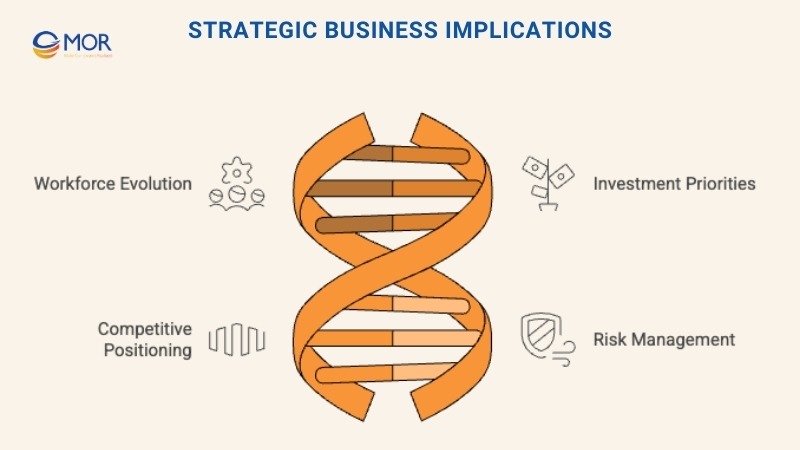
The choice between the two AI models shapes how companies grow, structure their teams, and plan long term projects. The comparison of agentic AI vs generative AI also helps leaders understand where each model fits in their roadmap and how it supports different business goals.
Workforce Evolution
Understanding generative vs agentic AI shapes workforce planning. Generative AI augments human capabilities, requiring teams to develop prompt engineering and AI collaboration skills. Agentic AI replaces entire workflows, shifting human focus to strategy and oversight.
Investment Priorities
Organizations must align AI investments with strategic objectives. Companies seeking creative enhancement benefit from generative AI. Those pursuing operational excellence need agentic capabilities.
Competitive Positioning
Early adopters of agentic AI gain sustainable advantages through autonomous scale. While competitors manually orchestrate generative AI, agentic adopters operate at digital speed.
Risk Management
Each paradigm presents distinct risks requiring different mitigation strategies. Generative AI risks center on content quality and misinformation. Agentic AI risks involve autonomous decision making and system integration.
How To Choose Between Generative AI Vs Agentic AI?
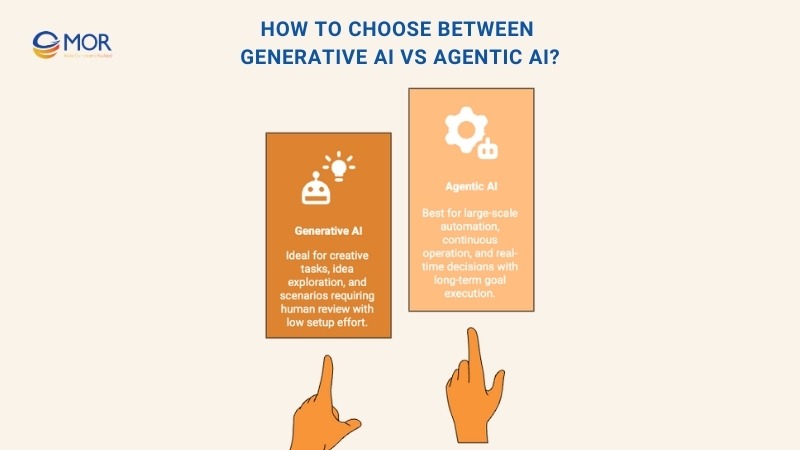
Teams often compare generative AI vs agentic AI when they want to match the right model to their goals. The choice depends on how much control they need, how complex the workflow is, and whether the task centers on creation or autonomous action.
Situations For Generative AI
Generative AI excels when human creativity and judgment remain central to value creation. Choose generative AI when:
Support For Creative Work
Marketing teams creating campaigns, writers developing content, and designers exploring concepts benefit from generative AI's creative capabilities. The AI provides inspiration and acceleration while humans ensure brand alignment and strategic fit.
Tasks Requiring Human Review
Regulated industries, sensitive communications, and high stakes decisions demand human validation. Generative AI can draft medical reports, legal documents, or financial analyses, but professionals must verify accuracy and appropriateness.
Need For Flexibility Over Automation
When requirements change often or tasks vary widely, generative AI’s adaptability offers more value than rigid automation. Each prompt can explore new directions without modifying entire systems.
Exploration And Idea Development
Research, education, and innovation benefit from generative AI’s ability to combine information and propose new possibilities. Students learning programming, researchers forming ideas, and innovators brainstorming solutions all gain value from this creative support.
Lower Setup And Integration Costs
Generative AI usually comes with simpler implementation. API access to models like GPT 4 or Claude can deliver immediate benefits without deep system integration.
Situations For Agentic AI
Agentic AI delivers strong value when independent action and goal completion matter more than creative work:
Large Scale Process Automation
Repetitive workflows with clear targets gain major benefits from autonomous execution. Tasks like testing, monitoring, data handling, and broader workflow automation reach higher efficiency through agentic systems.
Always On Operation
Workloads that must run without breaks rely on this model. Security monitoring, infrastructure control, and quality checks continue nonstop with minimal human presence.
Coordination Across Many Systems
When a process touches several platforms, agentic AI can guide actions across all of them. Supply chain work, financial operations, and enterprise resource planning improve through coordinated, system wide decision making.
Real Time Adaptive Response
Fields that change quickly need tools that adjust instantly. Trading platforms, autonomous vehicles, and dynamic pricing engines depend on fast, accurate decisions from the model.
Long Term Goal Management
Projects that follow extended objectives benefit from steady, focused execution. Customer retention efforts, quality improvement programs, and operational excellence plans gain stronger outcomes when autonomous agents maintain progress over time.
Blending Both Approaches
Many organizations see the best results when they combine the strengths of both models. A mixed setup allows teams to use the creative power of generative tools together with the autonomous execution of agentic systems.
Virtuoso QA offers a clear example. The platform uses generative models to produce natural language test descriptions and generate test data. These outputs then flow into agentic components that run tests, monitor results, and maintain test sets on their own. Users gain creative freedom while still benefiting from independent execution.
Useful Integration Models
Generative Interface With Agentic Execution
Generative tools handle user interaction and content creation, while agentic systems manage actions and automation. A chatbot that answers questions and then performs tasks follows this approach.
Agentic Control Over Generative Models
Agentic AI can direct several generative tools to reach complex goals. It may use one model for text, another for images, and another for code to build a full solution.
Quality Driven Feedback Cycles
Agentic systems can review the work of generative tools, choose the best output, refine it, or request a new version. This creates steady improvement over time.
Human Oversight When Needed
Agentic AI works independently but can pass decisions to people for creative input or unusual cases. Generative tools may prepare suggestions to help humans choose the best option.
Future Trends As Agentic AI Vs Generative AI Converge
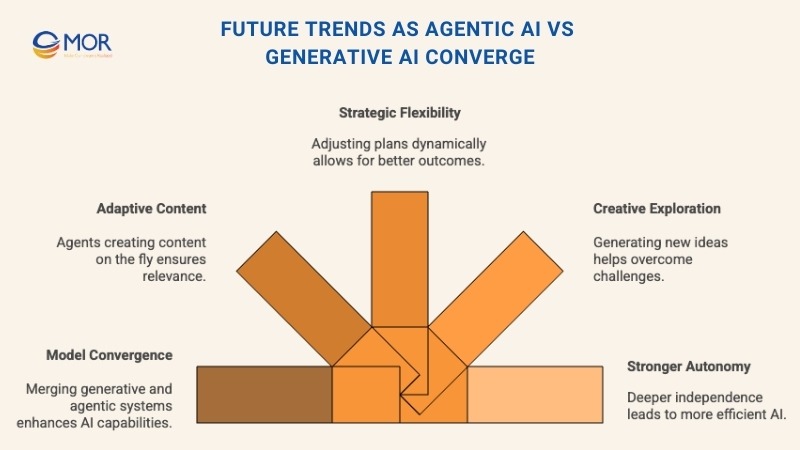
The future will not depend on choosing one model over the other. Real progress comes from blending both approaches. Many platforms already show early signs of this shift as they combine creative generation with autonomous decision making in a single system.
Blended Intelligence
Generative skills continue to fold into agentic structures. Instead of acting as separate tools, unified platforms use both capabilities side by side.
Context Based Content Creation
Agentic systems use generative tools when needed. While working toward a goal, they can create content, prepare artifacts, or draft communication.
Flexible Strategy Building
Agentic models use generative ability to design new approaches when conditions change. They adjust instead of stopping when facing something unexpected.
Creative Pathfinding
When usual methods fail, agentic AI can turn to generative power to explore fresh ideas. This mix supports both creativity and goal focus.
New Development Directions
Domain Focused Agents
Instead of large all purpose systems, smaller agents handle areas like testing, security, or optimization. They work together to support broader business goals.
You may also check our article on what are agentic AI agents to learn more about how they function and support software testing.
Agent Networks And Collaboration
Several agents can connect through shared systems, exchanging skills and resources. Companies can form full agent teams for complex challenges.
Human And Agent Collaboration
Future workplaces will include teams made of people and digital agents. Humans bring creativity and judgment. Agents bring speed and stability.
Ongoing Improvement
As both models grow, generative AI becomes sharper and more efficient, while agentic AI gains deeper autonomy. Their convergence speeds up and opens new possibilities that are only beginning to appear.
Agentic AI Vs Generative AI In Software Testing
Once we understand the difference between the two models, the next question is how agentic AI vs generative AI shapes real software testing and development. With our GenAI platform, teams can build realistic test scenarios with little effort and run tests at a large scale while working through low code or no code instructions written in plain English. This covers the creative side of testing, but agentic systems go further.
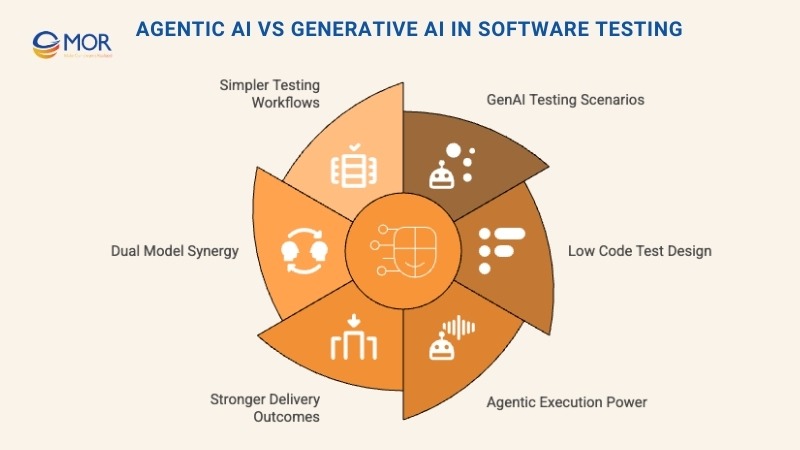
Both models will continue to play a larger role in day to day work, especially in testing. Understanding how they differ, how they complement each other, and how they support stronger delivery will become increasingly important as teams adopt these tools.
AI is complex, and as an AI powered testing platform, we see these challenges often. Yet the advantages are clear. As both approaches mature, they will change how teams build, test, and improve software.
The question is not a choice between the two. It is about using both models together to support better testing, faster innovation, and simpler workflows for everyone involved.
How MOR Software Helps Businesses Apply Agentic And Generative AI
As companies look for practical ways to use both agentic AI vs generative AI, many realize that success depends on building systems that combine AI automation, data intelligence, and long-term scalability. This is where development partners with strong engineering expertise become essential.
MOR Software supports enterprises in applying these two multimodal AI models in real-world software projects. Generative AI can be used to speed up content creation, code suggestions, and data exploration, while agentic AI can manage multi-step workflows, make decisions, and interact with external systems. When these capabilities are blended into a tailored solution, businesses gain systems that not only create outputs but also take action.
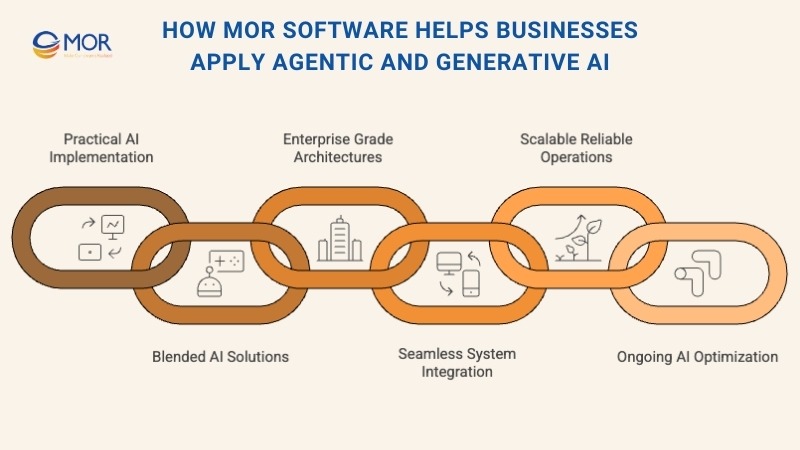
Teams at MOR Software design architectures that allow autonomous AI agents to handle tasks like monitoring operations, analyzing patterns, coordinating pipelines, or powering intelligent assistants. This approach helps companies adopt AI without disrupting existing systems, and ensures the technology stays reliable as workloads grow.
Organizations exploring how to bring agentic and generative AI together often need support in integration, security, scalability, and ongoing optimization. MOR Software provides that foundation so businesses can turn AI potential into working products.
Conclusion
Choosing how to apply agentic AI vs generative AI shapes how your business builds, automates, and scales its digital products. Companies that understand the strengths of each model gain faster delivery, clearer decision making, and stronger long term results. If your team wants to explore real use cases or build a tailored AI solution, MOR Software can guide every step. Contact us to start turning your AI goals into practical, working systems.
"Evolution is not a destination, it is a disciplined journey of innovation."
Phung Van Tu


CEO MOR AI
MOR SOFTWARE
Frequently Asked Questions (FAQs)
What is the difference between generative and agentic AI?
Generative AI focuses on creating content like text, images, or code. Agentic AI goes beyond that by making decisions, carrying out tasks, and working toward goals with limited human involvement.
Is ChatGPT agentic AI or generative AI?
ChatGPT is a generative AI model. It responds to prompts but does not act on its own or manage multi-step tasks without instruction.
Is agentic AI the same as LLMs?
No. LLMs generate or analyze language. Agentic AI may use an LLM, but it adds autonomy, planning, and action execution that LLMs alone cannot perform.
Is agentic AI part of GenAI?
Not in the strict sense. Generative AI handles creative output, while agentic AI handles actions and goal-oriented behavior. Agentic systems may include generative tools but serve a different purpose.
What are examples of agentic AI?
Examples include cyber threat response tools, IT workflow automation systems, financial decision engines, HR support systems, and other AI that performs continuous actions without manual supervision.
Who is leading in agentic AI?
Several major technology companies are developing agentic systems that can plan, use tools, coordinate workflows, and operate in complex environments.
Why is it called agentic AI?
The term refers to an “agent” that can act on its own. These systems are designed to choose actions, complete tasks, and adjust their approach as conditions change.
What comes after agentic AI?
Future developments may involve multi-agent systems working together, improved reasoning, and even greater autonomy in handling real-world challenges.
What are the key differences between agentic AI and generative AI?
Generative AI produces content. Agentic AI carries out tasks, reasons about next steps, and works toward specific outcomes. One creates, the other acts.
Does agentic AI use gen AI?
Often yes. Generative models can help an agentic system interpret information or draft content, but the agentic layer decides how to use that output to progress toward a goal.
Can agentic AI work without human prompts?
Yes. After receiving an initial goal, an agentic system can start tasks on its own, evaluate progress, and take further actions without continuous user input.
Where is agentic AI most useful today?
It is widely used in cybersecurity, IT operations, finance automation, customer service workflows, and any environment where decisions and actions need to happen continuously.
What is the difference between agentic AI vs generative AI vs predictive AI?
Generative AI creates content. Agentic AI performs actions toward defined goals. Predictive AI forecasts outcomes based on past data. One generates, one acts, and one predicts.
Share


Make Our-Dreams Realized


© 2023 . MOR Software. All Rights Reserved
Sitemap
Privacy Policy
Terms of Use

Rate this article
0
over 5.0 based on 0 reviews
Your rating on this news:
Name
*Email
*Write your comment
*Send your comment
1