


AI Development Cost: Complete Cost Breakdown for 2026
Businesses planning new AI projects often struggle to predict their AI development cost, especially when prices vary across tools, data needs, and system complexity. Many teams also face hidden spending during deployment, which raises the total AI pricing far beyond early estimates. In this guide, MOR Software will help you understand the real costs and make smarter budget decisions.
Why Is Estimating AI Development Cost Important?
Over recent years, AI has appeared everywhere in the media, and companies across many fields have shown strong interest in using this technology. Yet the truth is simple. It remains a young field. There is still limited information that helps teams forecast budgets or plan ahead for artificial intelligence spending. Even with that gap, careful artificial intelligence cost estimation still plays a key role in smart planning.
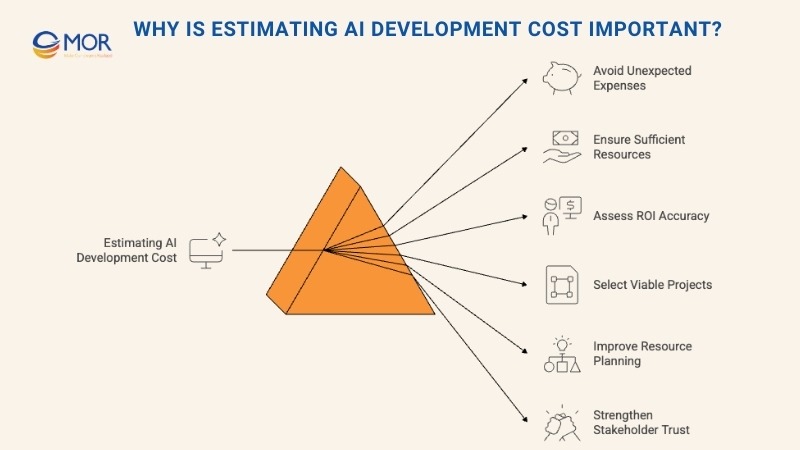
It takes extra effort at the start, but understanding your AI development cost early gives you several clear advantages:
- Avoid unexpected expenses that could slow down the project or force a temporary pause.
- Confirm that the team has enough resources to support the full project lifecycle.
- Estimate potential ROI with greater accuracy and see whether the benefits are worth the investment.
- Make better choices about which AI automation idea should move forward and which ones should wait.
- Improve resource planning by spotting areas where spending can be lower or processes made more efficient.
- Strengthen trust with stakeholders by showing a clear view of the project’s costs and expected outcomes.
AI Development Cost In 2026 Overview
The worldwide AI market is projected to grow to $301B by 2028, with an annual growth rate of 29.4%. This rapid rise shows strong interest from many sectors, yet the field is still very young, and AI pricing continues to shift. Tools evolve fast, and the cost of development or consulting often varies a lot. Many industries also differ in their readiness to use multimodal AI models inside their operations, which creates wide gaps in overall spending.
So what does that tell you? What ranges should you expect in 2026?
The numbers can spread out quite far. Some young companies start with free tools and spend almost nothing to add AI to their daily tasks. Other teams choose fully custom systems that start near fifty thousand dollars, and extra fees for expert guidance often push the cost even higher.
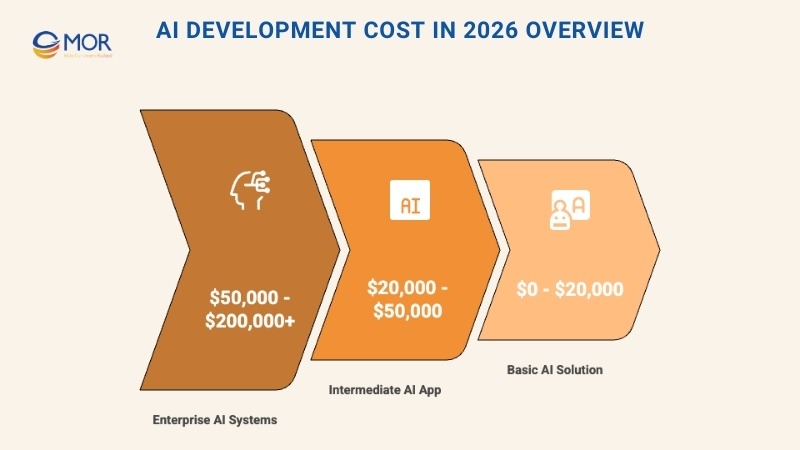
For a simple view, you can divide AI development cost into three main groups, giving you a clear AI development cost breakdown to compare:
AI Type | Initial Development Costs | Monthly Maintenance Costs |
Basic AI solution | $0 - $20,000 | $0 - $1,000 |
Intermediate AI app | $20,000 - $50,000 | $1,000 - $5,000 |
Enterprise AI systems | $50,000 - $200,000+ | $5,000 - $20,000 |
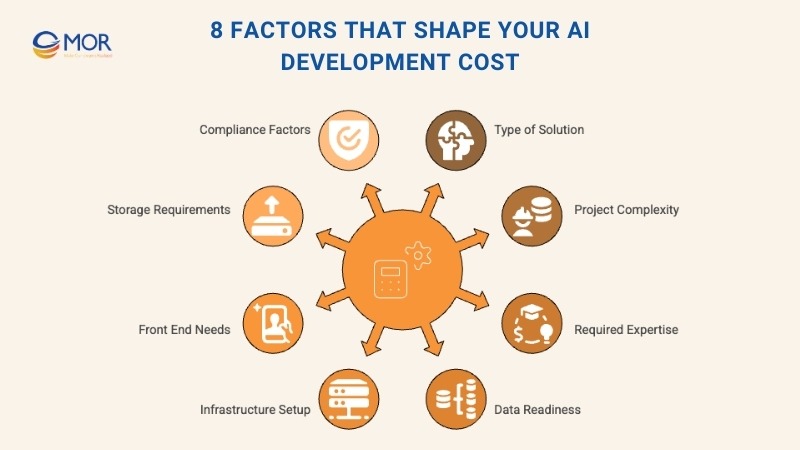
8 Factors That Shape Your AI Development Cost
As shown earlier, the price of AI can shift a lot. This wide range, combined with the early stage of the industry, makes it hard for companies to predict the full budget of an AI project. Teams often face many unknowns, which adds extra pressure when planning their AI development cost.
Here, you will find the eight factors that influence the total cost most. These points can guide you when building your own artificial intelligence cost estimation plan for any new AI project.
Type Of Solution You Plan To Build
AI work can involve simple setup tasks for free tools or advanced training for large models. The kind of product you want to build has a major effect on price. When we talk about AI solutions, they usually fall into four basic groups:
- Free, third party AI software: ChatGPT and other free AI automation tools make it easy for teams to start experimenting. They give public access to advanced chat systems at no charge. Using these tools is a simple and low-cost way to learn and test ideas. The main cost here is the time your staff spends learning and adjusting the tool for daily use.
- Subscription, third party AI software: Many companies pay for ready-made AI tools that run out of the box. These tools can work inside your tech stack or link with your systems through APIs. Prices are very different across providers, but monthly fees usually range from ten dollars to several thousand dollars.
- Customized AI solutions: Some platforms allow teams to build custom workflows on top of an existing system. You save money because you are not building a full platform from zero. You also get more control than you would with a basic tool. Costs usually include the license plus the development or consulting hours needed to fit the solution into your current setup.
- Fully custom AI solutions: This option costs the most. A custom build is tailored for a very specific business need. It can involve gathering unique training data or designing new models to handle key workflows. These systems offer high control and flexibility but come with higher AI app development cost due to the level of work required.
PRO TIP: Each path has its own limits and tradeoffs:
- If you want the lowest cost, you will likely use third party tools, which may not give the same level of security as a custom build.
- If security matters most, you may lean toward a custom system that keeps your data fully protected, but this increases both the budget and timeline.
- If you want the fastest setup, ready-made tools can speed up the start, although they may lack some of the controls that a custom design provides, or you may need to hire experts to support safe deployment.
Every project has choices to weigh. It helps to sit with your main stakeholders and review business goals and priorities to find the path that fits best.
How Complex The Project Is
The level of complexity in an AI project can change the total cost in many ways. A more advanced solution may need a larger data set, stronger computing power, extra side tasks, more hours from the team, and higher skills, which all increase the overall AI development cost. Below are some of the main elements that make a project more complex:
- Amount and quality of data required: Handling large data sets can take a lot of time and money. Your current data setup often shows how prepared you are for AI. If your information is clean and easy to access, like in a stable IT system, the work becomes simpler. If your data comes in huge volumes from many sources and lacks structure, the project becomes far more complex.
- Structure of the AI solution: The way the system is built also affects complexity. Many teams now break big tasks into smaller parts, and each part is handled through AI before passing results to another tool. A simple AI product for one narrow task is easier to build than a full chain of AI features that connect into one large platform. This also increases overall AI software development cost.
- Complexity of the algorithms used: Creating and tuning complex models takes time and special skills. These algorithms often require more computing power for training and daily use, which makes the infrastructure harder to manage.
- User experience required: Any product that faces users brings extra work. You need thoughtful design, strong testing, and checks for accessibility and compliance. Many teams also add third party tools to support the human interface part, which can raise both effort and cost.
- Level of integration required with other systems or platforms: Connecting an AI product to several existing tools adds layers of testing and development. You must consider compatibility, data flow, and security across all linked systems.
PRO TIP: A complex setup affects both early research and the final deployment. When a model is advanced, you may need a full ML Ops team to move it into a live business environment. This often includes data experts, analysts, engineers, risk specialists, and IT operations staff. The process can take days or even weeks depending on how complex the model is.
Level Of Expertise The Project Requires
The amount of skill needed for an AI project can change the total AI development cost, since AI consulting as a service and technical experts must understand the tools, the data, and the business flow to deliver a strong result. This level of talent is not easy to find, and the rates for these roles are often high. Many teams also face rising AI rates when they need very specialized roles.
Key areas of expertise you may need include:
- Expertise in data science or AI development: Complex tasks or any work that needs advanced AI knowledge often requires senior data scientists or well-trained offshore AI developers. These specialists know how to source, test, and combine different solutions on the market, so hiring them usually increases the budget.
- Domain expertise in a specific industry or field: Some industries come with strict rules or compliance requirements. A good AI product must match these rules and also fit the daily workflows inside the business. In fields that demand very specific knowledge, it can be hard to find experts, which adds extra cost and sometimes extends the hiring timeline.
- Experience with specific technologies or platforms: Certain tools call for deep technical skill. Complex models, natural language systems, or advanced cloud platforms need people who already know how to manage them. Training existing staff or hiring new specialists often raises the total cost and affects the schedule for the project. This is also where teams may face higher AI agent development cost due to the skill required to build and operate agent-style systems.
Key questions to ask to assess costs:
- Do we already have the right knowledge in-house to build this solution, or do we need outside help?
- Does this project need special AI skills, and if so, do our current team members understand the tasks well enough to run the project smoothly?
- Does the work call for industry experts who know the rules, workflows, or technical needs of our field?
- Are there certain tools or platforms we must use, and do we have people who know how to handle them at a high level?
- Have we reviewed how these expertise requirements will influence the budget and overall timeline?
Data Readiness And Data Accuracy
The amount and quality of data can strongly affect your AI development cost. One part of this involves the scale of the data you must gather. Collecting information from many sources, especially when the volume is large, may require a data scraping service or extra internal effort to gather and sort everything.
The second part relates to how clean and reliable your data is. Good data is usually complete, clear, consistent, trustworthy, and suited for the task you want the system to handle. When the data is messy or incomplete, your team must spend more time cleaning or preparing it, which increases the total cost for AI work.
It is important to run quality checks during both the build phase and the maintenance period to make sure the data stays usable. At the same time, you need to set a reasonable limit on how much oversight is required. Too much checking can overwhelm the engineering team and cause delays or false alarms.
To review data availability, ask:
- Is the required data easy to access?
- Do we need more data, and what will it cost to collect it?
- Is the data structured or unstructured, and will we need extra labeling or cleaning?
To review data quality, ask:
- Is the current data accurate and dependable, and what checks are needed to confirm that?
- Will more cleaning or preparation be needed to raise the quality?
- What will it cost if extra cleaning or preprocessing is required?
- Do we need support from data analysts or subject experts to keep the quality strong?
PRO TIP: A product like DeCube can support your team during ML workflows and maintenance. It helps data engineers work faster, cut debugging time, and lower the cost of handling data issues without heavy manual work.
Hardware And Software Setup
The hardware and software setup you choose has a strong effect on your total AI development cost. Several parts of the infrastructure can influence the final number, and each part needs careful review to avoid surprises later. These are the main points to consider:
- API calls: Many external tools, including IBM Watson, Google Cloud AI, and the OpenAI API, charge based on how many requests your system sends. A larger number of calls leads to higher spending, and this can become a major cost if your solution depends heavily on outside services. This is also common with modern generative AI development costs platforms 2025, where usage often scales with traffic.
- SaaS subscription costs: Using a third party agentic AI solution development services can lower custom build expenses, yet monthly or yearly subscription fees still apply. These costs usually depend on how many users you have or how much activity the system handles.
- Licensing fees: Some tools or frameworks require paid licenses. Systems like TensorFlow or PyTorch may be free at the base level, but certain advanced features or enterprise functions can add extra costs that affect your planning.
- Hardware: Hardware spending usually increases when you train your own model. High-performance GPUs and CPUs can be very expensive, and large training jobs may require strong machines to run smoothly. These costs only apply if you build and train your own solution from scratch while developing AI software.
Key questions to ask to assess costs:
- Which development tools and frameworks will we use, and do they require paid licenses?
- How many API calls should we expect each day, month, or year?
- How much data must we store or process, and will we need extra computing power to handle it?
- Will we start with an MVP, and if yes, will the hardware or software setup change once we scale?
Front End Requirements For The AI System
AI projects always need to consider the human side of the product. Teams must decide how people will interact with the system and how they will work with the data it produces. If your solution depends on a visual interface, the cost of UI work must be part of your AI development cost. Below are the main points to keep in mind:
- UI design: A simple and clear interface is important for any AI-driven product. The design must support easy navigation and smooth data review. A full UI design process can be costly, especially when the design starts from zero and involves many screens.
- UI features: Your team must define what the interface needs to support, such as data checks, data processing tools, or labeling functions. Think about how users will interact with the system and what information they must access. This helps decide whether you need a custom UI or whether a ready-made product will meet your needs.
- Data integration: The interface must connect well with data sources and processing steps. If the data flow is complex, the cost of developing the front end may increase due to extra engineering effort.
- User testing: Real users must test the interface to confirm that it is simple to use and meets their needs. Testing takes time and requires resources, but it plays an important part in the project’s success. This is also where teams often look at expected AI chatbot development cost, since chat-based interfaces need strong user testing.
Key questions to ask to assess costs:
- How will users interact with the AI system?
- What information must appear on the interface, and in what layout?
- Do we need extra resources for front end design and development?
- Will we build a custom UI or use a third party product to meet the needs?
- What resources are needed to build and test the front end?
Data Storage Costs
The more information your system collects, the more your AI development cost will rise. Companies must review how much data the project will generate and confirm that they have enough storage space and enough budget to support it. Below are common areas where storage spending can grow:
- Cloud storage costs: Many teams use cloud services to store and manage project data. These providers charge based on storage size and data transfer. Prices can range from only a few cents to several dollars per gigabyte each month. This becomes a key part of the overall cost for AI when data volume increases.
- Data center costs: Large AI projects may need their own data center setup. Building these systems can cost anywhere from thousands to millions of dollars, depending on scale and complexity. After the initial build, ongoing maintenance and management also add to the total budget.
- Backup and archival costs: Long-term storage or keeping records for compliance rules can increase expenses. Most companies must purchase backup tools, archival systems, and the services needed to maintain them.
Key questions to ask to assess costs:
- How much data will the system produce, and what will it cost to store and process it?
- Are there rules or limits around where this data must be stored?
- Do we need to include backup and archival costs for this project?
- What level of ongoing maintenance will the data require?
- As the project expands, have we reviewed future data growth and the extra storage or processing needs that come with it?
Regulatory And Compliance Factors
Companies must review all rules and compliance standards that apply to their AI project, since meeting these requirements can add extra cost. Ignoring them can lead to serious financial penalties or legal issues. This makes it important to plan ahead and include every requirement in the full AI development cost. Many strict regulations also affect the cost of implementing AI in business, especially in fields that handle sensitive data.
Below are key points to consider when reviewing the impact of compliance on your budget:
- Industry and region-specific rules that govern how the system must be built and used
- Adjustments needed in the development process to meet these rules
- Added spending for data protection and security controls
- Possible penalties or legal risks if the business does not follow the required standards
Key questions to ask to assess costs:
- What compliance rules apply to this AI project, and what penalties or legal risks exist if we fail to meet them?
- What changes must be made to our development plan to meet these standards?
- What will it cost to store and secure the data in a way that matches the required rules?
- Are there any special industry or regional requirements that must be considered for this project?
- Have we reviewed how future changes in rules may raise the total cost as the system grows?
Best Practices To Keep Your AI Development Cost Under Control
After looking at all the factors that influence your AI development cost, you may want practical ways to bring the total budget down. Lowering expenses while keeping strong business value takes planning and clear direction. These points can help you start with a smarter approach:
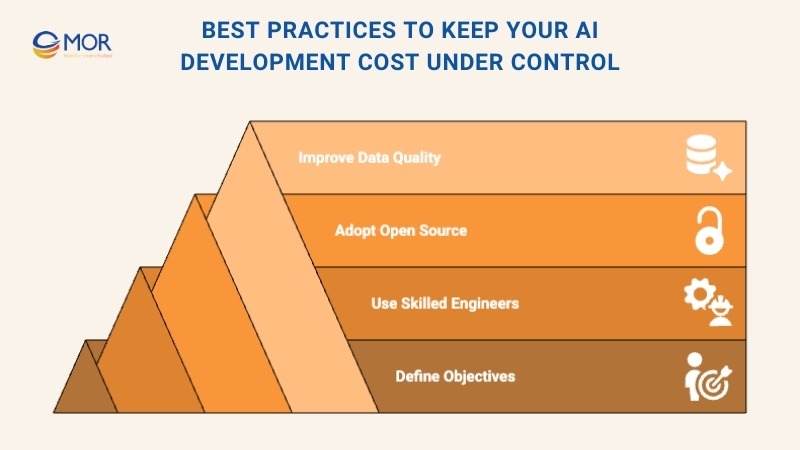
- Narrow in on a clear objective: A clear goal helps you avoid scope creep and limits the chance of extra spending during the build. Write down your objectives and project rules, then share them with everyone involved to prevent confusion or shifting requirements.
- Work with experienced AI engineers: A skilled team can help you avoid mistakes that raise costs and delay progress. Strong developers guide you toward smarter choices and help you find solutions that fit your budget. This is important for controlling the cost to develop AI chatbot solutions or any complex AI system.
- Utilize open source AI solutions: Open source tools help cut licensing fees and give you a low-cost way to test ideas before building a full system. This helps you explore options without committing to a large build or custom model from the start.
- Focus on data quality and accuracy: Reliable data leads to better results and helps reduce long-term spending. Good practice includes:
- Making sure all data is clean, accurate, and ready for use.
- Using automated labeling tools to raise quality and lower manual work.
- Removing data errors to increase system stability.
- Setting up clear quality checks to confirm that the model performs as planned.
These steps help you stay in control of your budget while still gaining real value from AI.
Real Examples To Understand AI Development Cost In Practice
It can be helpful to learn from real cases, especially when you want a clearer view of your AI software development cost, so we collected several AI projects with different scales and levels of complexity.
Note: Some figures below are estimated based on available public information. For exact numbers, you would need to contact the companies involved.
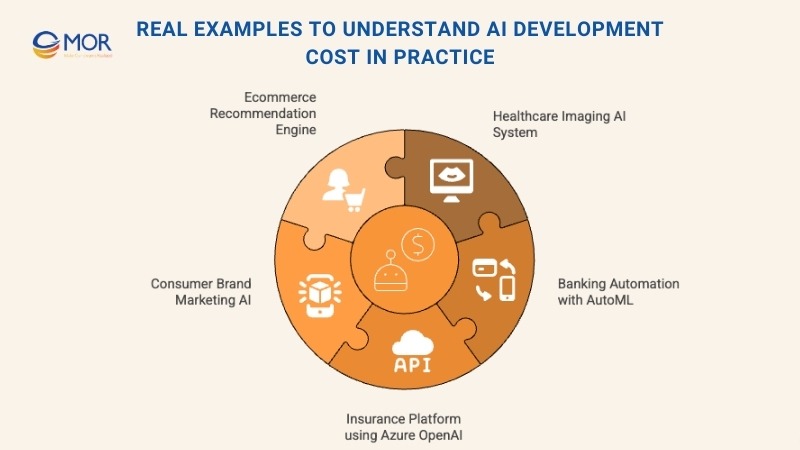
Case 1: Healthcare Imaging AI System
Source: BHM Healthcare Solutions
Investment: $950,000 (software licensing: $500,000, hardware upgrades: $200,000, staff training: $100,000, integration: $150,000).
Duration: 18 months.
Outcome: yearly savings of $1.2 million, an $800,000 rise in revenue, and patient outcome improvements valued at $500,000.
Case 2: Banking Automation With Automl
Source: research AIMultiple, “100 AI Use Cases with Real-Life Examples in 2025”
Overview: Sumitomo Mitsui Banking Corporation, one of Japan’s major banks, adopted dotData’s AutoML 2.0 platform to strengthen its AI and machine learning work. The goal was to support faster, data-driven decisions across different banking operations.
Investment: The exact spending for SMBC was not shared publicly. Based on common pricing for enterprise AutoML tools, large companies often spend between $500,000 and $2 million per year for software, cloud services, and ongoing support. The bank likely also added $200,000 to $500,000 for upgrades to its data infrastructure and for training its data science team during the early setup phase.
Duration: 6 to 12 months.
Output and Results: AI model development became 48 times faster, cutting the build and deployment time from months to only a few days. The bank created more than 100 ml models each year, compared to just 2 to 5 with older methods. These improvements led to an estimated ROI above 400 percent due to better efficiency, lower manual effort, and stronger business results.
Case 3: Insurance Platform Using Azure Openai
Source: Microsoft Blog, 2025.
Overview: AXA, a major global insurance group, created AXA Secure GPT, a generative AI system built on Microsoft’s Azure OpenAI Service. The platform was designed to support safe and controlled use of AI across the company.
Investment: Around 1 to 3 million dollars, covering Azure OpenAI licensing, cloud setup, and staff training.
Duration: 9 to 12 months.
Output:
- Built AXA Secure GPT, giving more than 30,000 employees safe access to generative AI
- Cut the time spent on data analysis and report work by 25 percent
- Raised staff productivity for administrative tasks by 15 percent
- Reached an estimated ROI of about 200 percent in 18 months
- Improved data protection and compliance through the custom AI platform
Case 4: Consumer Brand Using AI For Marketing
Source: AdWeek, 2024.
Overview: Coca-Cola, one of the biggest names in the beverage and consumer goods market, used the Blackout Platform to run AI-powered digital marketing campaigns. The goal was to improve targeting and create more personalized customer experiences.
Investment: Around 2 to 5 million dollars, covering the platform build, AI tools, and marketing system integration.
Duration: 12 to 18 months.
Output:
- Campaign engagement increased by 20 percent
- Sales conversions from targeted ads rose by 15 percent
- Predictive analytics helped cut wasted ad spending by 30 percent
- The brand achieved an estimated 300 percent ROI within two years thanks to better marketing performance
- More than 10 million personalized customer interactions were delivered each month
Case 5: Ecommerce Recommendation Engine
Source: Forbes, 2024.
Overview: Bookshop.org, an online marketplace that supports independent bookstores, introduced an AI-powered recommendation engine to improve the shopping experience and guide customers toward titles they may like.
Investment: Around 100,000 to 300,000 dollars.
Duration: 6 to 9 months.
Output:
- Average order value grew by 18 percent due to personalized book suggestions
- Customer retention increased by 25 percent thanks to tailored recommendations
- Conversion rates on product pages rose by 12 percent
- The platform reached an estimated 200 percent ROI within one year through higher sales
- More than 500,000 monthly users received personalized book recommendations
How MOR Software Supports Businesses In AI Development
MOR Software plays a practical role in helping companies move from early AI ideas to real, working solutions. Our team brings hands-on experience across different industries, which allows us to guide businesses through every stage of an AI outsourcing project.
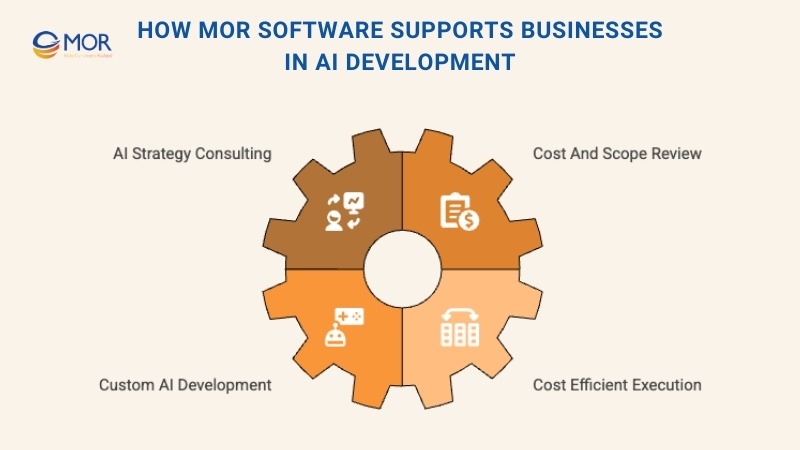
We support organizations in several key areas:
- AI strategy consulting to help businesses identify the right use cases and set clear project goals.
- Cost and scope assessment so teams understand the budget, timeline, and resources needed before they start.
- Custom AI solutions tailored to the business model, data readiness, and long term vision of each client.
- Cost-efficient execution powered by a skilled engineering team in Vietnam that helps companies achieve high-quality results while keeping budgets manageable.
This approach ensures that businesses can adopt AI in a way that is realistic, scalable, and aligned with their goals.
Conclusion
Understanding your AI development cost helps you plan smarter, avoid hidden spending, and build solutions that truly support your business goals. When you know what drives the cost and how to control it, AI becomes a real advantage instead of a financial risk. If you want expert support for planning or building your next AI project, the MOR Software team is ready to help. Contact us to explore the best path forward for your organization.
"Evolution is not a destination, it is a disciplined journey of innovation."
Phung Van Tu


CEO MOR AI
MOR SOFTWARE
Frequently Asked Questions (FAQs)
How much does AI development cost?
AI development can start around ten thousand dollars for a simple tool and rise to more than two hundred thousand dollars for complex systems. Costs depend on scope, data needs, model complexity, and the amount of engineering involved.
How much would it cost to build your own AI system?
Basic systems usually fall between twenty and eighty thousand dollars. Mid-level builds range from one hundred to five hundred thousand dollars. Enterprise-grade or highly customized systems can exceed one million dollars due to larger datasets and longer development timelines.
Why is AI so costly?
AI requires strong infrastructure, high-quality data, and skilled engineers. These elements raise the price. Some teams lower expenses by using cloud tools, pre-trained models, or development support from more affordable regions.
Can I build an AI for free?
Yes. Certain platforms allow you to create simple AI assistants without paying. These free tools usually work for small or personal projects. More advanced systems still require paid models, cloud compute, or custom development.
How much did GPT-4 cost to train?
Training GPT-4 required significant compute power and data, which pushed the training cost into tens of millions of dollars. This level of expense is typical for large-scale language models.
How much did DeepSeek R1 cost to develop compared to ChatGPT-4?
DeepSeek R1 was reported to cost about five and a half million dollars to build. ChatGPT-4, on the other hand, was estimated at more than seventy million dollars. The difference reflects variations in architecture, scale, and compute requirements.
How much do AI developers cost?
Developer costs vary by location and experience. Entry-level machine learning engineers cost far less than senior specialists who handle advanced neural networks or large-scale cloud systems. Rates can swing widely based on expertise and project needs.
Which factors influence AI development cost the most?
The biggest cost drivers are project complexity, data preparation needs, model type, infrastructure, and the level of expertise required. When these elements grow in scope, the total development cost rises quickly.
Does the quality of data affect AI development cost?
Yes. Clean, well-structured data lowers development time and reduces the amount of preprocessing needed. Poor data quality often leads to extra cleaning, labeling, or restructuring, which increases the overall budget.
Is custom AI more expensive than using pre-built tools?
Custom AI usually costs more because it requires tailored models, deeper testing, and full integration with existing systems. Pre-built tools are cheaper to start with, but they may offer limited flexibility compared to a solution designed specifically for your business.
Share


Make Our-Dreams Realized


© 2023 . MOR Software. All Rights Reserved
Sitemap
Privacy Policy
Terms of Use

Rate this article
0
over 5.0 based on 0 reviews
Your rating on this news:
Name
*Email
*Write your comment
*Send your comment
1