


Crypto Prediction Market Explained and Top Market List 2026

The crypto prediction market is transforming how people forecast events, turning opinions into tradable, blockchain-backed assets. As traders seek smarter ways to speculate, these markets are redefining the connection between data, finance, and technology. In this MOR Software’s guide, we’ll explain how they work, spotlight leading platforms for crypto market cap prediction 2026, and reveal why this trend is gaining momentum this year.
What Is Crypto Prediction Market?
A crypto prediction market is a decentralized platform where traders buy and sell tokens tied to the outcomes of future events. A prediction market involves turning collective opinions into tradable contracts, allowing users to profit from correctly forecasting what will happen next.
Instead of traditional stocks, users trade outcome-based tokens that represent real-world scenarios like “Will Bitcoin reach $100,000 this year?” or “Who will win the next global championship?” Each token price reflects the market’s belief about how likely that event is to occur. That crowd signal now moves real money at scale. In 2024, Polymarket alone handled about $9 billion in trades and ended the year with roughly 314,000 active traders in December.
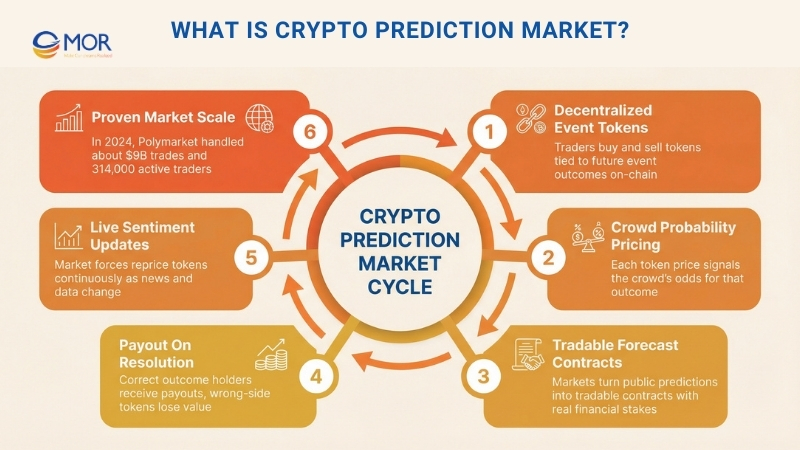
When the event concludes, holders of the correct outcome tokens receive their payout, while the losing side’s tokens lose their value. This system transforms speculation into measurable probabilities. It allows market forces to continuously adjust as new information appears, making these platforms a reliable indicator of public sentiment and data-driven forecasting.
Through blockchain transparency, the crypto prediction market eliminates centralized control and ensures fairness in settlement. It demonstrates how digital assets can turn public opinion into a tradable, dynamic source of truth, fueling smarter insights across finance, sports, politics, and beyond.
How Does Crypto Prediction Market Work?
A crypto prediction market functions as a blockchain-based exchange where traders stake tokens on the outcome of future events. These events can cover anything that sparks global interest, from election results and sports finals to cryptocurrency milestones or policy decisions. The topics often mirror whatever dominates public discussion at the time.
Take the Bitcoin ETF case as an example. A popular market asked: “Will the Bitcoin ETF be approved by January 15, 2024?” Traders who believed it would happen before that date purchased “Yes” tokens priced at $0.50, implying a 50% chance of approval. Those skeptical of an early approval bought “No” tokens.
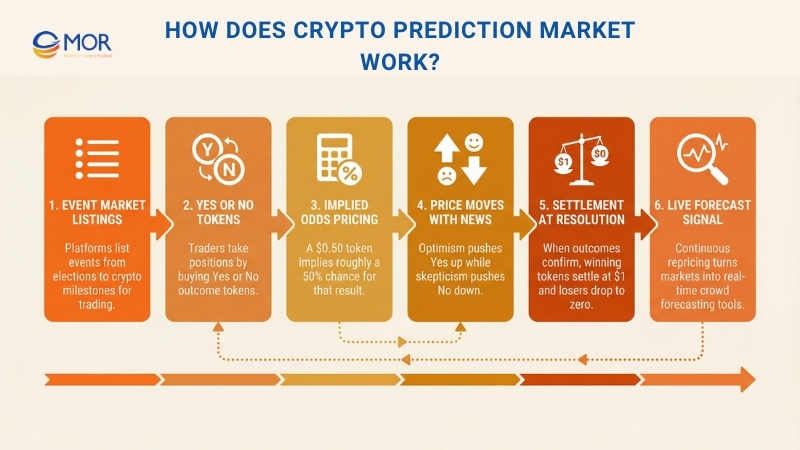
As optimism grew with positive regulatory signals, the value of “Yes” tokens climbed while “No” tokens dropped. When approval arrived on January 10, 2024, the SEC cleared 11 spot bitcoin ETPs, and the market settled instantly with “Yes” paying out at $1. Those holding “No” tokens lost their full stake.
This live pricing mechanism allows the crypto prediction market to act as a continuous forecasting tool. Prices shift with sentiment and news, making prediction market betting a real-time reflection of crowd expectations and capital flow.
Why Are Crypto Prediction Markets Important?
The crypto prediction market plays a growing role in how people interpret data, gauge sentiment, and forecast outcomes across industries. Beyond speculation, it offers real value in information gathering, risk management, and transparency.
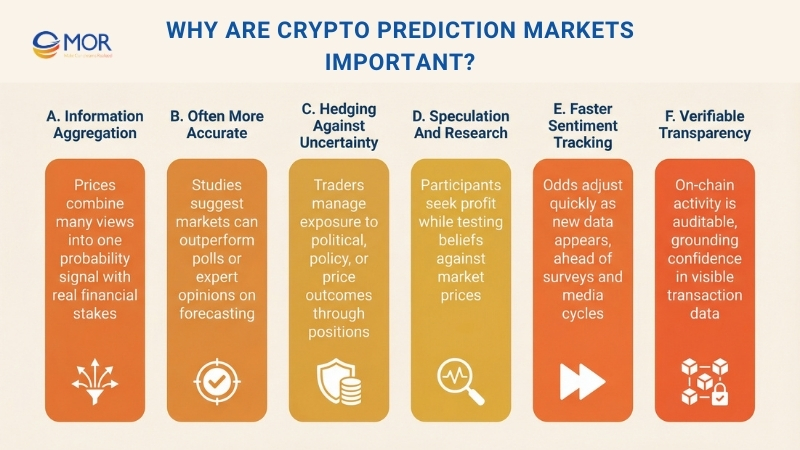
- Information Aggregation: These markets crowdsource collective intelligence by attaching real financial stakes to predictions. When traders invest based on what they know or believe, market prices start reflecting the probability of real-world outcomes. Studies have shown that this mechanism often delivers more accurate forecasts than polls or expert opinions, turning public sentiment into measurable insight.
- Hedging and Speculation: For investors, organizations, and even policymakers, crypto prediction markets provide a way to hedge against uncertainty. Traders can manage exposure to political results, policy changes, or price movements while seeking profit from accurate forecasting. This dual purpose makes them both a research tool and a strategic financial instrument.
- Transparency: Because prices move in real time as new data appears, prediction markets serve as live indicators of public confidence. They react faster than traditional media or surveys, offering a clear window into shifting opinions and expectations. With blockchain’s open ledger, every transaction is verifiable, ensuring that this transparency is backed by data, not assumptions.
Core Mechanisms Behind Crypto Prediction Markets
Two main systems shape how a crypto prediction market operates. The first, often called Web2.5, uses cryptocurrency mainly for payments while functioning much like traditional betting exchanges. Transactions occur in crypto, but the backend structure still relies on centralized servers for trade management and resolution.
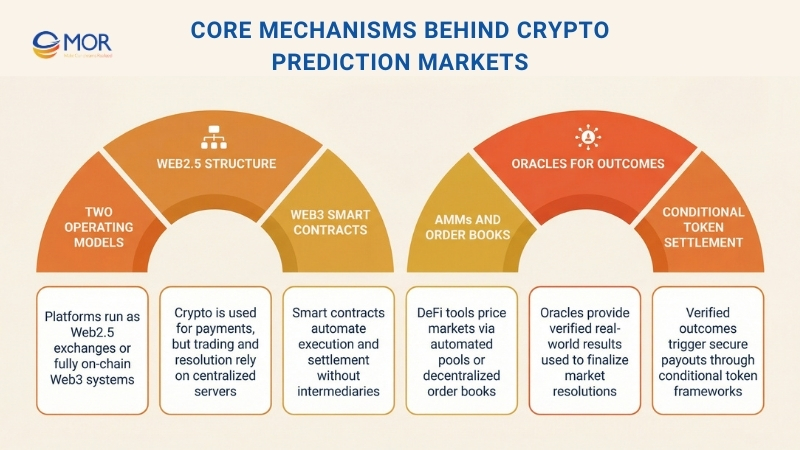
The second, a true Web3 model, takes full advantage of blockchain technology. It uses smart contracts to automate trade execution, along with decentralized tools like automated market makers (AMMs) and order books commonly seen in decentralized finance (DeFi). These components ensure fairness, transparency, and trustless settlement without intermediaries.
Equally vital are oracles, which supply verified real-world data to determine the outcomes of events. On Polymarket, for instance, the UMA oracle serves as an unbiased arbitrator. When a market is created using the Gnosis conditional token framework, the oracle verifies the event’s final result, allowing smart contracts to resolve payments securely and instantly.
Pay-Out Methods On Crypto Prediction Markets
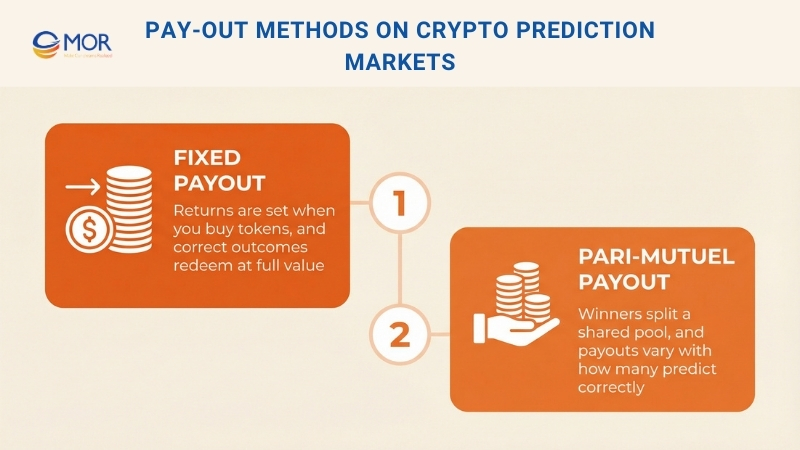
Every crypto prediction market settles outcomes using one of two payout systems: fixed payout or pari-mutuel payout. Both determine how traders receive rewards once the event result is confirmed.
Fixed Payout
The fixed model is simple and predictable. When you buy outcome tokens, your potential earnings are set immediately and remain unchanged. Suppose you purchase 300 “Yes” tokens for a given event. If your prediction is correct, you’ll receive 300 units at full value. If it’s wrong, you lose the stake. Market fluctuations after your trade don’t affect the payout. This structure is ideal for traders who value certainty and prefer predefined returns.
Pari-Mutuel Payout
In the pari-mutuel system, the total pool of wagers is divided among all the winning participants. The fewer winners there are, the larger each payout becomes. Conversely, if many traders choose the correct outcome, each receives a smaller portion of the pool. This structure adds a layer of excitement because your return depends not only on being right but also on how many others share your view.
Both payout types have their strengths: fixed ensures stability, while pari-mutuel rewards risk-takers willing to go against market sentiment.
How Blockchain Empowers The Crypto Prediction Market
Blockchain technology has reshaped how the crypto prediction market operates by eliminating many of the flaws seen in traditional platforms, centralized control, restricted access, and biased market resolution. It introduces trustless systems that prioritize fairness, security, and open participation.
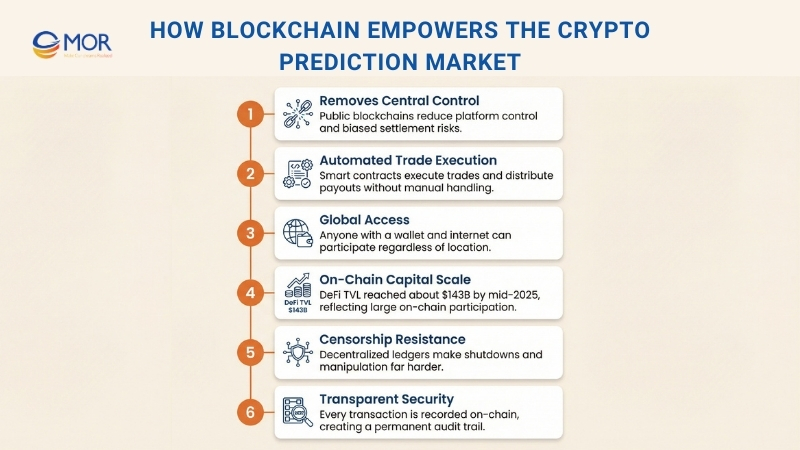
- Decentralization: Running entirely on public blockchains removes the need for middlemen. Smart contracts handle trade execution and payout distribution automatically, ensuring that results cannot be altered.
- Global Access: Anyone with an internet connection and a digital wallet can join these markets, regardless of country or background. This openness has turned prediction trading into a global activity. By mid-2025, DeFi protocols collectively held around $143 billion in total value locked, a rough gauge of how much capital now operates on-chain worldwide.
- Censorship Resistance: Since all transactions occur on decentralized ledgers, shutting down or manipulating the market becomes extremely difficult, giving users full control over their assets.
- Transparency and Security: Every transaction is visible on-chain, creating a permanent, auditable record that minimizes fraud and enhances trust.
Combining automation, transparency, and accessibility, blockchain gives the crypto prediction market the reliability and inclusiveness that centralized systems often lack.
Top 15+ Leading Platforms In The Crypto Prediction Market
The crypto prediction market ecosystem is expanding fast, with platforms competing to offer better liquidity, transparency, and user experience. Below is a comprehensive list of prediction markets shaping how decentralized forecasting works in 2026.
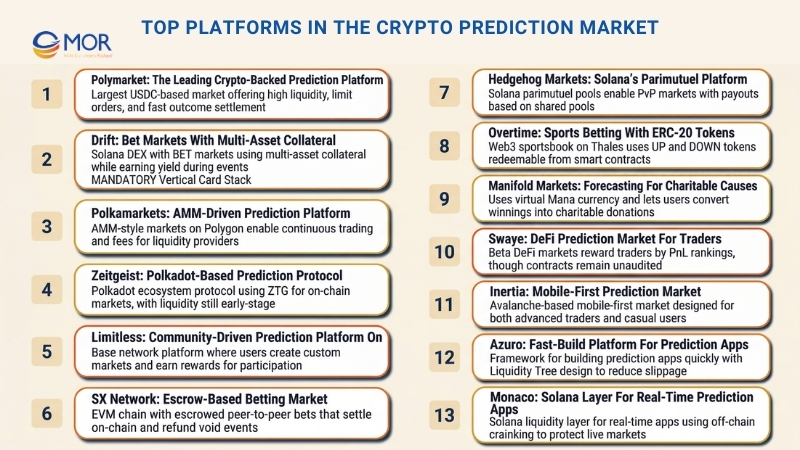
Polymarket: The Leading Crypto-Backed Prediction Platform
Polymarket stands as the largest and most active crypto prediction market today. Known for its high liquidity and strong presence across the crypto community, it allows traders to participate using USDC, a stablecoin pegged 1:1 to the U.S. dollar.
While U.S. residents cannot trade directly on the platform due to regulatory restrictions, they can still access live market data and view forecasts across trending events. Polymarket has become a hub for diverse topics, from sports and finance to betting market election forecasts that capture global political sentiment. It has evolved into the go-to destination for real-time crowd sentiment in crypto and world affairs.
Inside Polymarket’s System
Each event on Polymarket functions like a live poll backed by financial stakes. The token price represents the market’s current estimate of an event’s likelihood.
Take one market as an example:
“Will Sam Bankman-Fried be sentenced to more than 50 years in prison?” A “Yes” token trading at $0.31 suggests a 31% chance that the outcome will happen. If the market resolves “Yes,” each token becomes worth $1. If the outcome is “No,” those shares lose all value.
Traders can freely change positions anytime before settlement. If new information changes sentiment, they can sell their tokens at current market odds rather than holding until the resolution. This flexibility makes crypto prediction markets like Polymarket dynamic and constantly evolving.
Order Book And Trader Rewards
Polymarket supports limit orders, enabling users to buy or sell at preferred prices rather than taking the current market rate, similar to spot trading. This feature gives traders more control over their entries and exits.
Additionally, Polymarket rewards liquidity providers who help fill the order book. Participants earn weekly incentives similar to maker fees, which encourages active trading and deeper liquidity. Full reward structures are available in the platform’s official documentation.
How To Get Started On Polymarket
To begin trading, users need a supported self-custody wallet and some USDC. Signing up can be done using a Google account, Coinbase Wallet, or any major non-custodial wallet like MetaMask.
Once registered, deposit USDC into your Polymarket account. You control your funds entirely, as private keys can be exported and imported into other wallets for maximum flexibility.
Before making a prediction, browse available markets, review event details, and check liquidity levels. Use the built-in calculator to estimate potential returns. After selecting your position, click “Yes” or “No,” input your wager, and confirm the trade.
If your outcome wins, your tokens automatically convert to $1 each upon market resolution. You can also sell early if market sentiment changes in your favor.
Polymarket combines simplicity with transparency, giving traders a reliable, blockchain-driven environment to express and profit from their views.
Drift: Bet Markets With Multi-Asset Collateral
Drift Protocol is a decentralized exchange built on the Solana blockchain that introduced BET (Betting Earn Terms), a capital-efficient crypto prediction market designed for yield generation. With BET, users can speculate on events such as the U.S. election while simultaneously earning yield as markets unfold.
What sets Drift apart is its flexibility in collateral. Instead of relying solely on USDC, it supports about 30 crypto assets, including yield-bearing stablecoins like PyUSD and USDY, allowing traders to hedge or diversify positions while participating in markets. This flexibility makes Drift more versatile than most prediction market apps operating on single-token systems.
Unlike open-market models, Drift Labs manages its listings through an in-house security council that curates and arbitrates active markets. While this adds trust and oversight, it may also limit the number of available events in the early stages.
Polkamarkets: AMM-Driven Prediction Platform
Polkamarkets operates on Ethereum, Moonbeam, and Moonriver but sees most activity on Polygon. Users interact directly from MetaMask using USDT to take positions on real-world outcomes, from corporate bankruptcies to global events.
Its model mirrors that of an automated market maker (AMM) like Uniswap. Instead of relying on order books, liquidity is provided algorithmically, ensuring markets remain open and accessible. Traders buy and sell shares continuously, while liquidity providers earn a share of trading fees.
Still, the AMM structure carries certain risks, including impermanent loss and potential price slippage in thinly traded pools. Yet, the accessibility and constant liquidity make Polkamarkets a key part of today’s expanding crypto prediction market ecosystem.
Zeitgeist: Polkadot-Based Prediction Protocol
Zeitgeist runs on the Kusama network, part of the broader Polkadot ecosystem. It enables users to speculate on future events using its native ZTG token. Participants can access markets through compatible wallets like Polkadot.js, Talisman, or SubWallet.
Though still early-stage with limited liquidity, Zeitgeist represents the first native prediction market protocol within the Polkadot ecosystem. It showcases how Web3 infrastructure is broadening decentralized forecasting across multiple blockchain networks. Zeitgeist adds diversity to the ecosystem by expanding beyond sports and finance into betting political markets, proving how blockchain-based prediction systems can cover any real-world event.
Limitless: Community-Driven Prediction Platform On Base
Limitless operates on Coinbase’s Base layer-2 network and allows users to create custom markets spanning crypto, tech, and sports. Participants can both trade and earn rewards for active engagement.
While smaller than giants like Polymarket, Limitless continues to grow steadily, with increasing all-time volume and weekly user activity. Its user-generated model positions it as one of the most community-focused platforms in the crypto prediction market space.
SX Network: Escrow-Based Betting Market
Since 2019, SX Network has been one of the longest-running decentralized betting ecosystems. Built on its own EVM-compatible blockchain, it processes every stage of betting, from market creation to settlement, entirely on-chain.
Markets can be generated through APIs or manually via a GUI dApp. Once a market is created, a hash is stored in the registry, and all bets are secured in an Escrow contract. Funds remain locked until the final outcome, Outcome1, Outcome2, or Void, is confirmed. If an event is canceled or ends in a tie, both parties automatically get their funds back without fees.
SX Network stands out for its peer-to-peer betting structure. Users can both offer and accept bets directly, removing the need for a centralized bookmaker and giving traders full ownership of their wagers.
Hedgehog Markets: Solana’s Parimutuel Platform
Hedgehog Markets is a leading crypto prediction market built on the Solana blockchain. After securing $3.5 million in seed funding in 2022, the platform expanded into peer-to-peer prediction markets and automated market maker (AMM) models to boost on-chain liquidity.
Traders can create or join binary markets with flexible odds, all recorded transparently on Solana. This public ledger ensures verifiable transactions and open market data access. Hedgehog also enables users to stake their predictions in pooled markets, allowing participants to earn passive yield from trading activity while strengthening market liquidity.
The platform uses parimutuel pools, meaning traders don’t rely on market makers. This model encourages competitive, player-versus-player (PvP) betting, though it differs from traditional systems where traders know fixed odds or can exit positions early.
Overtime: Sports Betting With ERC-20 Tokens
Overtime Markets is a Web3 sportsbook built on the Thales Protocol, a decentralized positional markets system originally launched on Ethereum and later expanded to Optimism, Arbitrum, and Base.
It supports live sports betting using stablecoins or ETH, with every event deployed through a dedicated smart contract. These contracts mint UP and DOWN ERC-20 tokens that reflect each side of a wager. When the market closes, the winning token, determined by price movements relative to the strike price, can be redeemed for the USD collateral held in the smart contract.
Powered by Chainlink oracles, Overtime recorded over $3 million in betting volume and 3,000+ active users during its public beta, making it one of the most recognized decentralized sports prediction venues.
Manifold Markets: Forecasting For Charitable Causes
Manifold Markets offers a different take on prediction trading. Instead of crypto, it runs on a virtual in-house currency called Mana (M). Every user starts with M500 and can use it to create or participate in markets covering diverse topics.
The unique twist lies in its charitable model: users can convert Mana into real charitable donations at a rate of M100 for $1. This community-driven approach encourages forecasting for social good rather than financial profit.
Though it currently doesn’t run on blockchain, many expect Manifold to integrate crypto in the future, an ironic prediction that users can already trade on the platform itself.
Swaye: DeFi Prediction Market For Traders
Swaye is an emerging DeFi prediction market tailored to crypto-native traders, or as the community calls them, “degens.” Still in open beta, Swaye lets users create and join markets around trending speculative topics.
Rewards are distributed based on traders’ profit and loss (PnL) performance, with top earners highlighted weekly. This competition-driven design blends prediction trading with social ranking, rewarding skill over luck.
However, since Swaye’s smart contracts remain unaudited, users are advised to participate cautiously during the beta phase. Even so, it’s quickly gaining attention for gamifying speculation and making prediction trading more engaging for active crypto communities.
Inertia: Mobile-First Prediction Market
Inertia, built on the Avalanche blockchain, is a new entrant in the crypto prediction market scene that gained early recognition after winning first place at Codebase’s Demo Day. The platform aims to serve both experienced crypto traders and casual users, what the team calls “hyper degens” and “normies.”
Inertia’s standout feature is its mobile-first design, a direction few prediction markets have taken seriously. By prioritizing accessibility through smartphones, the platform aims to make speculation more social and seamless for users worldwide. Inertia envisions a space where anyone can create a market on a topic they care about, whether it’s finance, politics, or pop culture.
Beyond just predictions, the project positions itself as part of a broader effort to make market-building simpler and more intuitive for mobile users.
Azuro: Fast-Build Platform For Prediction Apps
Azuro goes beyond operating as a traditional prediction market. It provides an open framework that allows developers to create decentralized prediction applications in minutes. With 28,000 users and several independent apps already built on its infrastructure, Azuro has quickly become one of the most active ecosystems in the space.
Backed by $11 million in funding from investors including Gnosis, Azuro’s goal is to democratize prediction market creation. Its unique Liquidity Tree system improves how capital is organized and deployed. Liquidity providers can allocate funds precisely across market branches, reducing slippage and maximizing yield.
This design not only sustains liquidity across multiple prediction apps but also optimizes trading efficiency, setting Azuro apart from older pool-based systems.
Monaco: Solana Layer For Real-Time Prediction Apps
Monaco Protocol runs on Solana and acts as an infrastructure layer connecting multiple decentralized betting and prediction applications. It functions as a shared liquidity hub, allowing apps to tap into a unified global pool for tighter pricing and larger market depth.
Using non-custodial smart contracts, Monaco automatically settles outcomes in a transparent and trustless way. One of its biggest innovations lies in live event prediction. Through “off-chain cranking,” Monaco introduces a brief delay between order submission and execution, preventing unfair advantages during live sporting events.
This technology has led to several new sports betting exchanges being built on top of Monaco, positioning it as one of Solana’s most promising backbones for the next wave of real-time crypto prediction markets.
Key Risks And Limitations Of The Crypto Prediction Market
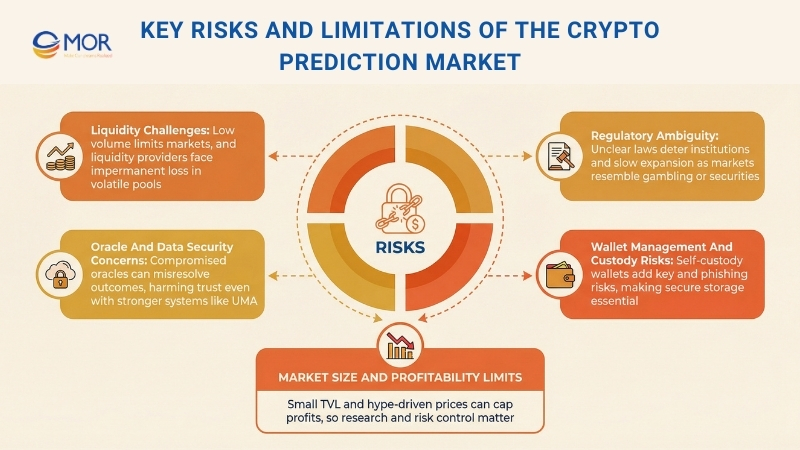
The crypto prediction market offers a decentralized and data-based approach to forecasting global events, but it still faces several obstacles before achieving large-scale adoption. These challenges relate to liquidity, regulation, security, and overall profitability, each shaping how sustainable these platforms can become in the long run.
Liquidity Challenges
One of the main constraints is liquidity. Many markets struggle to attract consistent trading volume, and liquidity providers risk impermanent loss when token prices move sharply. To manage this, platforms often focus on events with fixed timelines, like elections or major sports tournaments. While this helps maintain stability, it also narrows the variety of events available to traders, limiting broader participation.
Regulatory Ambiguity
Legal uncertainty remains a major hurdle. In many countries, prediction markets operate in a gray area that overlaps with gambling or financial securities laws. This lack of clarity deters institutional involvement and hinders global expansion. Clearer regulations could unlock growth by providing a safer environment for developers and investors, but current laws are still catching up with innovation.
Oracle And Data Security Concerns
Smart contracts rely on oracles to verify and report real-world outcomes. If an oracle is compromised, markets may resolve incorrectly, damaging user trust. Although systems like UMA strengthen verification accuracy, no oracle is fully resistant to manipulation or technical failure. As such, reliable data sourcing remains a top priority for maintaining credibility in prediction platforms.
Wallet Management And Custody Risks
Participation requires connecting a self-custody wallet to interact with smart contracts. This introduces risks tied to poor key management or phishing attacks. Hardware wallets like OneKey or Ledger offer better protection by keeping private keys offline. For active traders in prediction market crypto platforms, secure wallet management is vital to safeguard funds.
Market Size And Profitability Limits
Despite increased awareness, the overall market size remains modest. Total value locked across major platforms is still under $7 million, with Polymarket contributing the largest share. Profit potential exists for skilled forecasters, but sentiment and hype often drive price movement, making it similar to speculative trading. Prudent risk management and research are essential before committing capital.
The path ahead for crypto prediction markets will depend on stronger liquidity models, transparent regulations, and more resilient oracle systems. Until then, these markets will likely remain a niche yet promising segment of decentralized finance.
MOR Software – Blockchain Development Partner for Crypto Prediction Markets
Building a reliable crypto prediction market takes more than just coding. It requires a trusted partner who understands blockchain coding infrastructure, smart contract logic, and real-world usability. That’s where MOR Software delivers proven experience and end-to-end development expertise.

- Blockchain Development Expertise: We design and implement blockchain outsourcing architecture for crypto prediction markets using Ethereum, Polygon, and Solana. Our approach ensures transparency, scalability, and efficient automation across every transaction.
- Smart Contract Design & Auditing: Our blockchain developers develop and audit smart contracts to ensure payouts, data feeds, and trade settlements are accurate and tamper-proof, maintaining user confidence and system integrity.
- Oracle & Data Integration: We integrate reliable oracles such as Chainlink and UMA to verify event outcomes, prevent data manipulation, and provide trustworthy market results.
- User-Centered Platform Development: From intuitive interfaces to responsive layouts, we create web and mobile platforms that make prediction markets easy to access and enjoyable to use.
- Comprehensive Project Support: MOR Software offers full-cycle services, from consultation and design to deployment, testing, and maintenance, helping you bring your crypto prediction market to launch quickly and confidently.
MOR Software combines deep blockchain knowledge with practical product design to help businesses transform prediction market ideas into secure, high-performing platforms. Our goal is to make your market stable, scalable, and ready for growth.
Conclusion
The crypto prediction market is reshaping how people trade opinions and forecast global events, combining transparency, decentralization, and financial insight. Yet, building such platforms demands technical precision and blockchain expertise. As interest in crypto market prediction 2026 grows, MOR Software provides end-to-end blockchain development to turn your vision into a trusted, scalable product. From smart contract design to oracle integration, we help you build with confidence. Contact us today to start developing your next-generation prediction market.
MOR SOFTWARE
Frequently Asked Questions (FAQs)
What are crypto prediction markets?
Crypto prediction markets are decentralized platforms where users can earn rewards by forecasting the outcome of real-world events related to cryptocurrency. Participants buy shares or tokens that represent possible outcomes, such as whether Ethereum’s price will rise after a network upgrade or how Bitcoin will perform next month. When their prediction is correct, they receive payouts based on the final market resolution.
What is a prediction market in crypto?
A crypto prediction market works like an exchange where people speculate on event outcomes using contracts tied to “yes” or “no” results. Each contract has a price that reflects the market’s belief about how likely that outcome is. Once the event occurs, contracts tied to the correct prediction are paid out at full value.
Can the crypto market be predicted?
Yes. Studies have found that Long Short-Term Memory (LSTM) models, a type of deep learning algorithm, perform well in forecasting cryptocurrency prices. These models recognize long-term patterns in time-series data, which helps improve the accuracy of crypto market predictions.
Is crypto predicted to rise again?
Analysts currently expect Bitcoin’s price to increase by about 3.5%, potentially reaching around $127,000 by October 2026. Market sentiment remains largely optimistic, with most indicators suggesting a steady upward trend.
What is the realistic crypto prediction for 2026?
Bitcoin is forecasted to trade between $80,000 and $151,000 in 2026. Some projections suggest that under strong bullish conditions, it could even approach $175,000 to $185,000, driven by growing institutional adoption and wider mainstream acceptance.
Are prediction markets legal?
In most regions, real-money prediction markets are restricted or considered a form of gambling. Regulators often classify event-based contracts, like those tied to sports or politics, under gambling laws unless they receive special approval to operate legally.
How is AI used in crypto prediction?
AI tools analyze large volumes of market data to detect trends, assess investor sentiment, and forecast price movements. Machine learning algorithms can identify repeating patterns and help traders make data-driven decisions with greater precision and speed.
What is the promise of prediction markets?
Prediction markets create financial instruments that pay out depending on the result of uncertain future events. They aggregate insights from many participants, offering a more accurate and efficient way to forecast outcomes across industries and sectors.
What is the power of prediction markets?
Their power lies in collective intelligence. When people trade based on their knowledge and incentives, market prices reflect the collective probability of an event happening. This mechanism often produces forecasts that are more accurate than traditional expert predictions.
Share


Make Our-Dreams Realized


© 2023 . MOR Software. All Rights Reserved
Sitemap
Privacy Policy
Terms of Use

Rate this article
0
over 5.0 based on 0 reviews
Your rating on this news:
Name
*Email
*Write your comment
*Send your comment
1