


DevOps Consulting Services: Definitive Guide for Businesses

Fast delivery, stable systems, and lower risks are goals many teams struggle to reach without the right support. DevOps consulting services help solve these gaps and give businesses a clearer path to growth. Many leaders now expect stronger pipelines, tighter security, and better teamwork from their tech teams. This guide from MOR Software will show why these needs matter even more in 2026.
What Are DevOps Consulting Services?
DevOps consulting services refer to expert guidance from trained engineers who help organizations introduce, refine, and grow their DevOps practices. This support gives teams a smoother path to automation, steady delivery, and stronger alignment across development and operations. Many companies also rely on a trusted DevOps consulting partner when they want a clearer way to improve daily workflows. These services are well suited for:
- Businesses that want to scale delivery in a clean and controlled way
- Groups aiming to cut downtime and avoid repeated mistakes
- Companies planning to build cloud-native products
- Enterprises moving through a cloud transformation
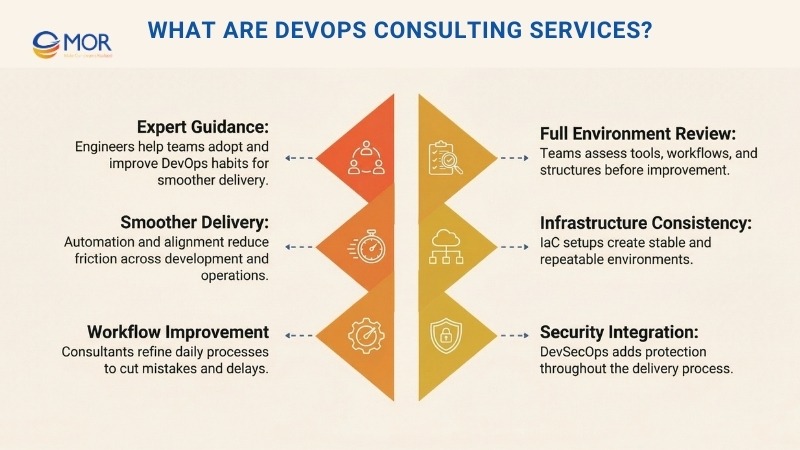
A consulting engagement normally includes:
- A full review of the current tools and working practices
- Designing CI and CD pipelines that match business needs
- Setting up Infrastructure as Code for consistent environments
- Building observability through monitoring, logs, and alerts
- Adding DevSecOps practices to keep systems secure
- Planning cloud cost optimization to manage long term spending
The main goal is to help teams adopt a culture built on collaboration, more automation, and steady improvement at each stage of delivery.
Core DevOps DevOps Service Offerings
A skilled team offering DevOps consulting services gives companies end to end support that makes software delivery smoother, strengthens reliability, and lowers ongoing risks or extra costs. These solutions adjust to each organization’s goals, whether the aim is faster delivery, better scale, or stronger protection across the system.
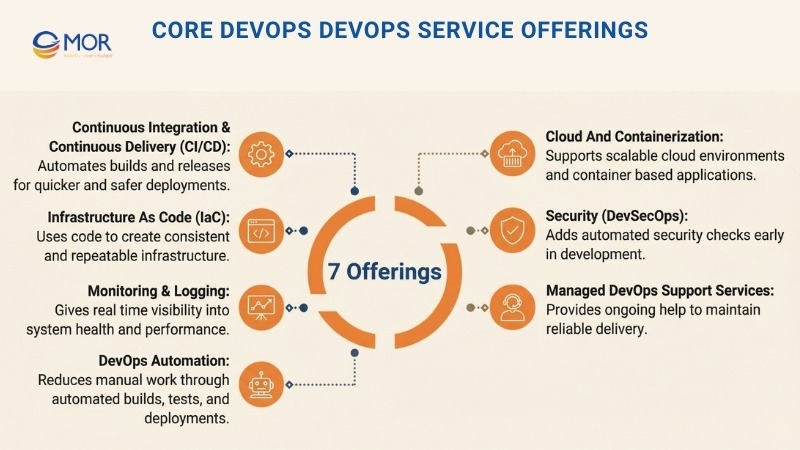
Continuous Integration & Continuous Delivery (CI/CD)
CI or CD pipelines help automate the steps for building, testing, and releasing code, and each stage prepares the next one in a simple way, which results in quicker and more stable launches. This setup reduces human mistakes, limits bugs, and tracks new changes across all testing phases. Common tools used for this include Jenkins, GitLab CI, and Circle CI. A DevOps consultant can guide teams through this work and keep the process steady as needs grow.
Infrastructure As Code (IaC)
IaC makes it possible to define and manage infrastructure through code, which keeps environments consistent, easy to scale, and simple to repeat. Tools like Terraform, Ansible, and Puppet support the automation of tasks that usually create errors when done manually. A trusted DevOps consulting company helps teams use these tools in a clean and safe way.
Monitoring & Logging
Strong monitoring tools give teams clear visibility into the health of a system at any moment. With the right setup, companies can detect issues early and react in real time. Platforms like Prometheus offer dashboards and alerts, and solutions like Grafana or the ELK Stack provide detailed logging views that support troubleshooting and deeper checks. Many DevOps consulting companies help teams shape these tools so the system stays stable and easier to manage.
DevOps Automation
Automation across builds, deployments, and infrastructure tasks limits manual work, reduces human error, and helps delivery move faster. Tools like Docker, Kubernetes, and Jenkins support clean workflows and keep each step consistent. Skilled DevOps consultants guide teams through these setups so the process stays smooth as systems grow.
Cloud And Containerization
Cloud native approaches built on AWS, Azure, or Google Cloud give teams flexible ways to scale and adjust. Container orchestration lets Kubernetes support a full microservices setup, which raises performance and improves reliability across the platform. Modern teams often look for cloud DevOps consulting when they want help shaping these environments so cloud DevOps stays stable and easy to manage.
Security (DevSecOps)
Integrating automated scans and compliance checks into the delivery pipeline helps build security into development from the start instead of waiting until the final stage. A trusted DevOps consulting service guides teams through this setup so every release stays safer and more controlled.
Managed DevOps Support Services
Along with the technical setup, top DevOps services providers also deliver reviews, tailored plans, and ongoing help with round-the-clock availability that supports steady progress. These support services keep systems healthy and help teams adapt as needs change.
Together, these solutions make it possible for companies to adopt DevOps consulting services in a way that supports faster innovation while staying stable, protected, and cost friendly.
Top 10 Benefits Of Working With DevOps Consulting Services
Software plays a central role in nearly every part of business today. Companies need to deliver stable and secure code at a fast pace to keep customers satisfied and stay ahead of other players. Many teams know the value of DevOps, yet real change requires hands-on skill and experience. Partnering with skilled DevOps consulting services gives organizations the guidance they need to reshape how they build and release software. A trusted group of DevOps consulting firms helps teams adopt better practices and move past limits that slow delivery.
Studies show that companies using strong DevOps methods deploy code 46 times more often and recover from issues 96 times faster than their peers. These gains come from more than simple tools or basic steps. Real progress depends on a deep understanding of DevOps ideas, technical strength, and the ability to support teams through change.
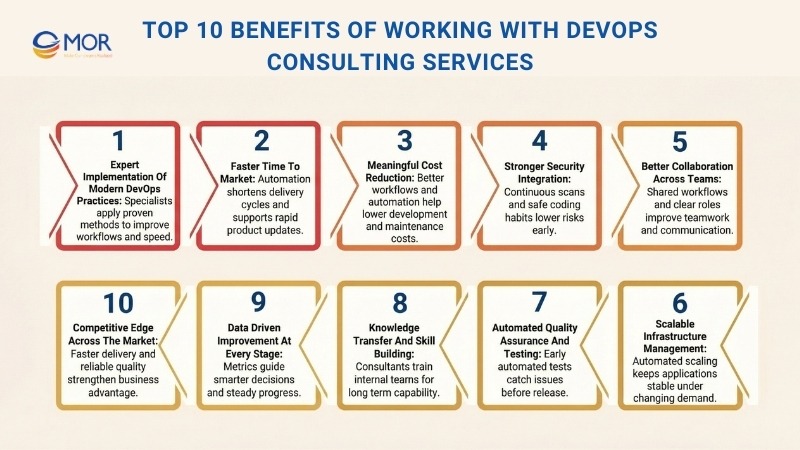
Expert Implementation Of Modern DevOps Practices
Experienced teams from well known DevOps consulting firms bring years of real project work and strong technical skill to any organization. Their specialists have supported companies across many fields, which gives them a clear view of what succeeds and what often fails in different situations. This wide background helps them find improvement points quickly and apply proven methods that lead to strong results.
These experts take time to study current development and operations workflows so they can spot delays or areas that slow progress. They shape and apply tailored solutions that solve these issues while staying aligned with accepted best practices. Their support spans the full DevOps cycle, starting with early assessments and planning and continuing through delivery and long term improvement.
Reports from Puppet show that top DevOps teams spend 50% less time on unplanned work and fixes. This improvement comes from strong CI or CD pipelines, reliable automated tests, and smoother workflows that keep projects moving with fewer surprises.
Skilled DevOps teams know how to connect tools and platforms in a simple and effective way, which creates a clean process that supports productivity and keeps quality high.
Faster Time To Market
A major benefit of working with experienced DevOps consulting services is the clear drop in delivery time for new updates and products. These teams help companies simplify each step in the development pipeline through automation that cuts manual tasks and shortens deployment cycles. This faster rhythm gives businesses an advantage in markets where customer needs shift quickly.
Data from DORA shows that high performing DevOps teams can deploy whenever needed and release updates several times a day. This ability helps organizations react fast to market changes and user feedback, which protects their lead in a competitive space. Rapid releases also support better customer satisfaction and allow companies to reach new opportunities sooner than others.
This higher release speed does not lower quality or weaken stability. Skilled teams use strong testing setups, continuous integration practices, and controlled deployment pipelines to keep standards high. They rely on automated checks and steady monitoring to guide each release safely.
This balanced setup helps companies move at a faster pace while still delivering the stable and dependable experience that customers expect. Many growing firms continue to adopt modern DevOps models because this approach supports both speed and long term reliability.
Meaningful Cost Reduction
The financial gains from working with skilled DevOps consulting services are wide and long lasting. When teams adopt automation and better workflow designs, they cut expenses across many parts of their daily operations.
A Forrester study shows that strong DevOps programs can reduce infrastructure spending by 25%, lower development costs by 30%, and cut maintenance expenses by 50%.
These savings appear in several ways. Automated testing and deployment lower the hours spent on repeated tasks, which lets teams focus on work that brings higher value. Better control of resources also keeps computing costs in check and avoids waste.
Fewer production issues and less downtime protect revenue, since teams avoid emergency fixes and customer disruptions.
Clear processes and shared best practices also limit mistakes and reduce the need for rework. Stronger teamwork between development and operations leads to quicker problem solving and better use of time. These gains build up slowly and support a higher return on investment over the long term.
Stronger Security Integration
Security becomes a major strength when companies work with skilled DevOps consulting services. These teams have deep experience with DevSecOps methods that place security checks throughout the entire development cycle. This early approach helps prevent weak points instead of forcing teams to rush fixes after issues appear.
Specialists set up automated tools that scan code, libraries, and system settings to spot risks. They guide teams in safe coding habits and add security controls that protect apps and infrastructure without slowing delivery. This steady security process also supports compliance with industry rules and lowers the chance of a breach.
Recent studies show that teams using DevSecOps practices can find and fix security issues up to 11.5 times faster than older methods.
Fixing issues early also saves money, since solving a security problem during development costs far less than repairing it in production. Strong DevOps consulting firms help teams reach these gains through the right tools, clear processes, and ongoing training.
Better Collaboration Across Teams
Teams see stronger cooperation when they work with experienced DevOps consulting services. These groups help connect development, operations, and security teams that often work apart from each other. This shift creates a more unified and productive environment where issues are solved faster and communication flows more freely.
Consultants support this change through tools and workflows designed for teamwork. Shared dashboards, clear communication channels, and joint processes help everyone stay aligned. They also define roles and responsibilities so each person knows their place in the delivery process. This clarity reduces confusion and lowers the chance of conflict while raising overall efficiency.
Better collaboration brings more benefits than quicker delivery. Teams feel more satisfied with their work, stress levels drop, and knowledge spreads more easily across groups. Research shows that companies with strong DevOps practices see 50% higher employee satisfaction and noticeably lower turnover compared to older IT models.
Scalable Infrastructure Management
Modern applications need infrastructure that can adjust smoothly as demand changes. Skilled DevOps consulting services support this through Infrastructure as Code and automated scaling tools that keep applications steady under different levels of load. This setup removes many manual tasks while improving stability and lowering ongoing expenses.
Experts also build cloud native designs and container orchestration systems that scale automatically when demand rises. They add monitoring and alerting tools that show real time performance and usage trends. This mix of automation and visibility helps teams keep strong performance while managing costs with care.
Scalable infrastructure delivers more than just load handling. Teams can create new testing or development environments quickly, which speeds up feature work and improves testing quality. Companies can also expand into new regions or launch new services with far less manual effort.
Automated Quality Assurance And Testing
Quality assurance becomes a strong advantage when teams work with experienced DevOps consulting services. Specialists design full testing strategies that rely on automation to find problems early in the development cycle, when they are easier and cheaper to fix. They set up frameworks that include unit tests, integration tests, performance checks, and security scans.
Automation brings many benefits. It shortens the time needed for testing and expands coverage so more issues are caught. Automated tests run often and give developers quick feedback, which helps maintain high quality even as teams move faster.
Research shows that companies with mature DevOps processes spend 44% less time fixing security issues and 50% less time handling defects. These gains appear because early detection stops many issues from reaching production. Strong DevOps consulting firms support these improvements with the right mix of testing tools and best practices.
Knowledge Transfer And Skill Building
DevOps specialists do more than set up tools and workflows. They help build long term capability through clear knowledge transfer programs. They work side by side with internal teams so everyone understands how each new process works, why it was chosen, and how it can grow in the future.
This knowledge sharing often includes formal training, hands on workshops, and detailed best practice guides. Consultants usually partner with team members during early implementations and slowly hand over full responsibility as confidence increases. This method helps companies keep their DevOps habits strong long after the project is complete.
The benefits reach beyond the core team. As internal champions grow, they can train new staff and spread DevOps thinking across the entire organization. This gradual increase in skill supports long term technical strength and healthier delivery practices.
Data Driven Improvement At Every Stage
Skilled DevOps consulting services help organizations set up strong monitoring and analytics systems that give clear insight into development and operations. They define metrics and build dashboards that track key performance indicators across the full delivery cycle. Working with real data instead of guesswork helps teams improve in a steady and predictable way.
Common metrics include deployment frequency, lead time for changes, mean time to recovery, and the rate of failed changes. Consultants also guide companies to measure indicators that match their own goals and challenges. They put the right tools in place to collect, study, and act on this information.
Organizations that adopt a steady data driven model report a 23 times higher success rate in improving performance. These insights help teams spot delays, refine workflows, and choose the right areas for improvement. This ongoing cycle supports long term gains and stronger delivery practices.
Competitive Edge Across The Market
All the earlier benefits come together to give companies a strong edge when they work with skilled DevOps consulting services. Faster feature delivery, steady quality, and smoother operations help businesses serve customers better and react quickly to new chances in the market. Support from a trusted DevOps agency or leading DevOps companies often strengthens this progress even more.
Reports show that organizations using mature DevOps practices are 2.5 times more likely to exceed goals for profit, market share, and productivity. They can innovate at a quicker pace, scale with less effort, and keep higher quality standards than many competitors. This edge becomes even more important as competition grows and customer expectations continue to rise.
How To Choose The Right DevOps Consulting Services Partner?
Selecting the right partner for DevOps consulting services shapes the success of any long term DevOps plan. A reliable team helps your business work faster, stay stable, and avoid costly mistakes. The points below make it easier to judge whether a provider can meet your technical and operational needs.
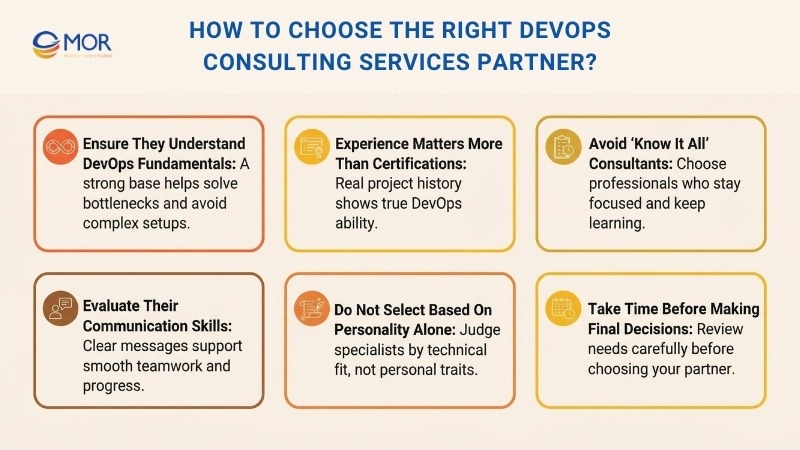
Ensure They Understand DevOps Fundamentals
A strong grasp of DevOps basics is important when evaluating any specialist. Some consultants set up cloud systems with unnecessary complexity, which can slow teams down later. Talk with the experts and learn how they handle servers, network layers, and system boot processes.
Check whether they understand core DevOps methods well enough to solve bottlenecks. Their knowledge should also include configuration work, troubleshooting, and debugging across different tools. A dependable DevOps consultancy must understand the technology stack that supports your operations.
Experience Matters More Than Certifications
Technical certificates can help you understand a specialist’s basic skills, yet they should not replace real project experience. Training gives engineers a starting point, but it does not prove they can manage full DevOps operations on their own.
In DevOps consulting services, someone may know how to build a platform, but that does not mean they can run it well or solve problems under pressure. Choose professionals who can take full responsibility for daily operations and troubleshoot issues when they appear. It is wiser to trust experienced DevOps consultants rather than individuals who rely only on classroom training.
Avoid ‘Know It All’ Consultants
Some specialists try too hard to impress clients and present themselves as experts in everything. Yet technology changes fast, and skills that worked in the past may not fit current needs. It is better to work with professionals who stay focused on results and keep learning. These traits often lead to stronger and more flexible DevOps consulting services.
A simple way to judge the right fit is to ask how they would handle key adoption steps. Avoid anyone who claims to know every detail of the technology. Instead, look for a DevOps consultant who stays clear minded, honest, and able to deliver steady and dependable work.
Evaluate Their Communication Skills
Clear communication is important for smooth delivery and better teamwork. Strong DevOps engineers explain ideas in simple terms and stay transparent throughout the project. Look for a DevOps consultancy known for steady and open communication.
Your DevOps partner should keep all channels active and easy to use. Choose DevOps consultants who have real experience working with development teams and can maintain a clear flow of updates, questions, and feedback. This helps avoid confusion and keeps the work on track.
Do Not Select Based On Personality Alone
There is no single checklist for choosing a DevOps specialist, and every expert will bring different strengths. You may meet many impressive people during your search, but personal traits should not guide the final choice. Focus on their real DevOps background instead of how they present themselves.
Your hiring goals should match your business mission, so choose professionals with skills that support that mission. Keep your attention on the technical side of DevOps to make sure you select proven consultants who can deliver reliable results.
Take Time Before Making Final Decisions
DevOps success depends on careful planning and clear steps, so it is important to choose your partner with patience. Many providers work hard to help clients fix weak points, yet the right DevOps consulting services partner looks deeper and finds practical ways to improve how each team functions.
Avoid making quick decisions during your search. Speak with experts to learn how they work and explain what you expect. Select a DevOps consultant only after you review your company’s needs and confirm that their approach fits your goals.
Cost Overview For DevOps Consulting Services
Many people exploring a career in DevOps often ask how much a specialist earns. The answer depends on several factors, including experience, seniority, technical skill, and location, especially when outsourcing. Salary insights matter as much as knowing the role itself because these details help businesses and candidates understand real market expectations.
Most differences in cost come from two areas: where the consultant is based and how senior they are. These points shape the final rate more than anything else. Below is a clear look at how earnings vary across different regions.
Salary Breakdown By Location
The cost of hiring talent changes from country to country, and each region offers a different salary range for DevOps consulting services talent.
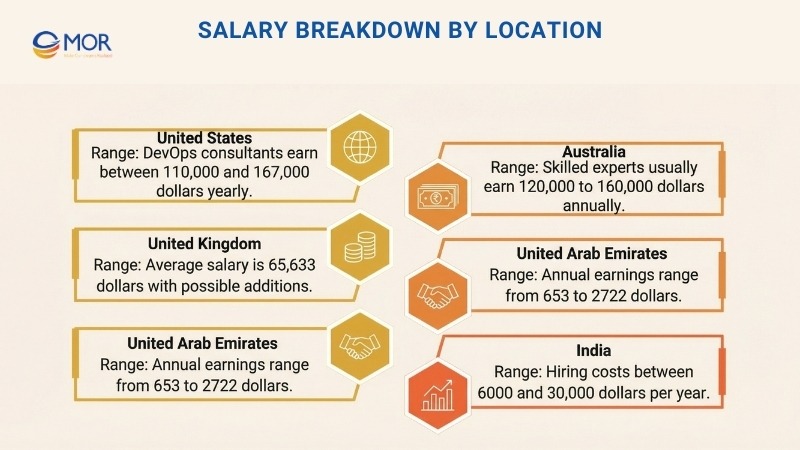
- Hiring a DevOps consultancy USA can range from 110,000 to 167,000 dollars per year.
- In Australia, skilled experts usually earn 120,000 to 160,000 dollars annually.
- The average salary in the UK is 65,633 dollars, with possible extra compensation.
- In the UAE, yearly earnings typically fall between 653 and 2722 dollars.
- Hiring from India may cost between 6000 and 30,000 dollars per year for a DevOps consultant.
Salary Breakdown By Seniority Level
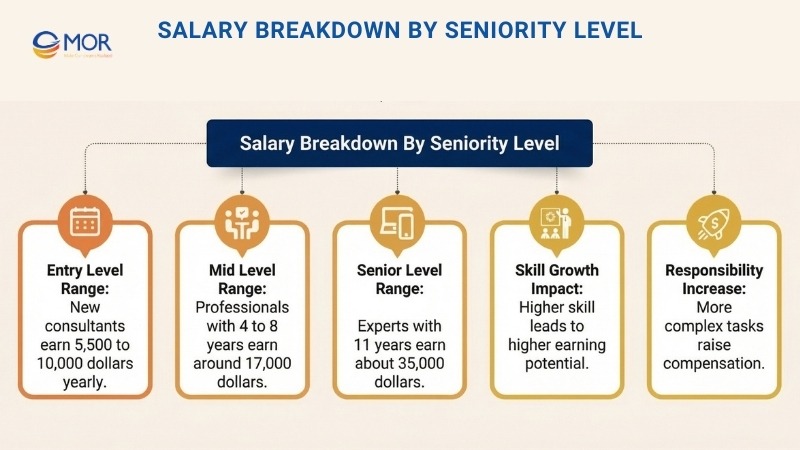
Seniority also plays a major role in shaping the cost of DevOps consulting services. As specialists gain more experience, their ability to handle complex systems and guide teams grows, which naturally increases their earning potential.
- A consultant who has just started or has under three years of experience may earn 5,500 to 10,000 dollars.
- Someone with 4 to 8 years of experience often earns around 17,000 dollars per year.
- Professionals with 11 or more years in DevOps can reach an average salary of 35,000 dollars.
Driving Business Success With MOR Software’s DevOps Consulting Services
MOR Software helps companies move faster and work with steady control. Our DevOps consulting services focus on clear goals, strong engineering, and practical improvements that support long term growth. We guide teams through modern DevOps adoption, from early planning to stable delivery, so they can release better products with less friction.
We build custom AI solutions that fit each business, not generic setups. Our teams combine deep technical skill with a hands on approach that solves issues before they slow you down. This creates a smoother pipeline and stronger teamwork across development, operations, and security.
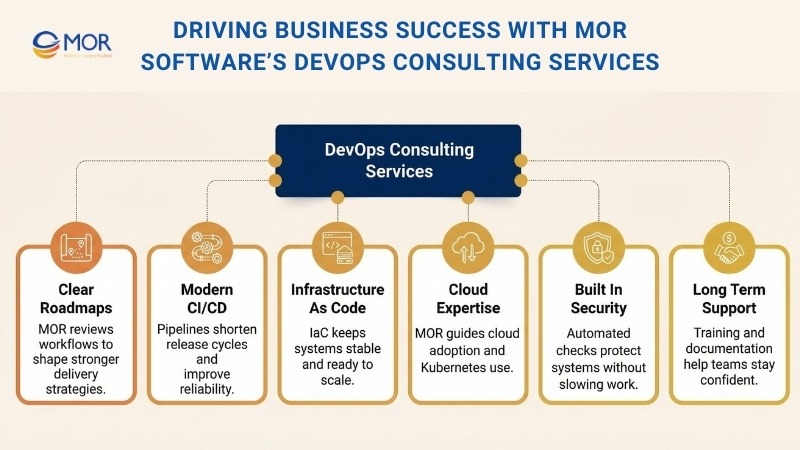
Key areas where MOR Software drives success:
- Thorough assessment and planning: We review workflows, tools, and pain points to design a roadmap that matches your business goals.
- Modern CI/CD practices: Our teams build pipelines that shorten release cycles and improve reliability.
- Infrastructure as Code for better control: IaC setups help you keep systems consistent, repeatable, and ready to scale.
- Cloud and container expertise: We help you move to cloud platforms and use Kubernetes effectively for stable performance.
- Security built into the workflow: Automated checks strengthen protection without slowing the team.
- Ongoing support that strengthens internal teams: We train your staff, document processes, and make sure you stay confident after the handover.
MOR Software acts as a long term Vietnam outsourcing partner that helps you grow with steady steps. Our DevOps consulting services give you the structure, tools, and guidance needed to build strong products and respond to change with speed and clarity.
Contact MOR Software today to explore how we can support your DevOps journey.
Conclusion
A strong DevOps foundation helps businesses move faster, avoid risks, and keep their systems stable as they grow. With the right DevOps consulting services, teams gain clearer workflows, better security, and steady improvement across daily operations. MOR Software delivers practical guidance that turns DevOps goals into real results. Our experts support every stage, from planning to full adoption. Reach out to MOR Software today and start building a smarter, more reliable delivery process for your products.
MOR SOFTWARE
Frequently Asked Questions (FAQs)
What are DevOps consulting services?
DevOps consulting services help teams improve how they build, test, release, and manage software. Consultants guide companies through modern practices like automation, CI/CD, cloud adoption, and Infrastructure as Code so development and operations work in sync.
What does a DevOps consultant do?
A DevOps consultant reviews current workflows, identifies weak spots, designs a clearer delivery process, and introduces automation tools. They help teams adopt better release methods, improve system reliability, and build a steady delivery pipeline.
Why do companies hire DevOps consultants?
Companies hire consultants to speed up software delivery, lower downtime, improve teamwork, and reduce manual work. Many teams need help setting up modern pipelines, choosing the right tools, or moving to the cloud without guesswork.
How long does a DevOps consulting engagement usually take?
Small projects may take a few weeks, while larger transformations that involve cloud setup, new pipelines, and cultural shifts can take several months. The timeline depends on goals, team size, and tech stack.
What problems can DevOps consulting fix?
Consultants help solve issues like slow releases, repeated production failures, unclear processes, scaling challenges, and weak security controls. They streamline systems so teams work with more clarity and less friction.
Do DevOps consulting services include cloud support?
Most consultants help with cloud setup, platform selection, environment configuration, cost control, and running containerized workloads. They also guide teams through building cloud-ready pipelines.
How do DevOps consultants improve security?
They introduce automated checks, access controls, code scanning, and early security testing. This reduces risk and helps teams catch issues before they reach production.
Are DevOps consulting services suitable for small businesses?
Yes. Small teams gain speed and structure from DevOps guidance, while larger companies use it to manage complexity. The approach scales to any size.
What tools do DevOps consultants usually work with?
Common tools include Jenkins, GitLab CI, Terraform, Ansible, Docker, Kubernetes, Prometheus, Grafana, and platforms like AWS, Azure, and Google Cloud. Tool choices depend on project needs.
How much does DevOps consulting cost?
Costs vary based on project scope, consultant experience, tools involved, and region. Cloud migrations or full automation projects usually require higher budgets due to complexity.
Share


Make Our-Dreams Realized


© 2023 . MOR Software. All Rights Reserved
Sitemap
Privacy Policy
Terms of Use

Rate this article
0
over 5.0 based on 0 reviews
Your rating on this news:
Name
*Email
*Write your comment
*Send your comment
1