


Top 10 HRMS Payroll Software For 2026 [Complete Guide]
HRMS payroll software is no longer just a back-office tool. It now shapes accuracy, compliance, and how fast teams grow across regions. Choosing the wrong platform often leads to payroll errors, reporting gaps, and rising admin pressure. In this guide, MOR Software will highlight the top picks for 2026, explain how these systems work, and help you choose a solution that truly fits your business.
What Is HRMS Payroll Software?
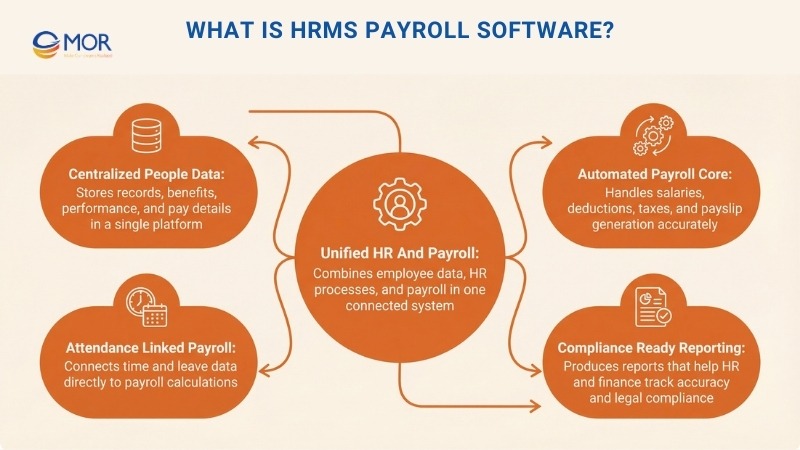
HRMS payroll software combines core human resource functions with payroll processing in a single system. It supports everyday HR work like maintaining employee records, recruitment tracking, benefits administration, and performance reviews, while also managing payroll operations.
What Is HRMS Payroll Software?
With payroll built directly into the HRMS, the system calculates salaries, applies deductions and taxes, generates payslips, syncs attendance and leave data, and produces accurate payroll and compliance reports.
Top 10 HRMS Payroll Software Platforms To Consider In 2026
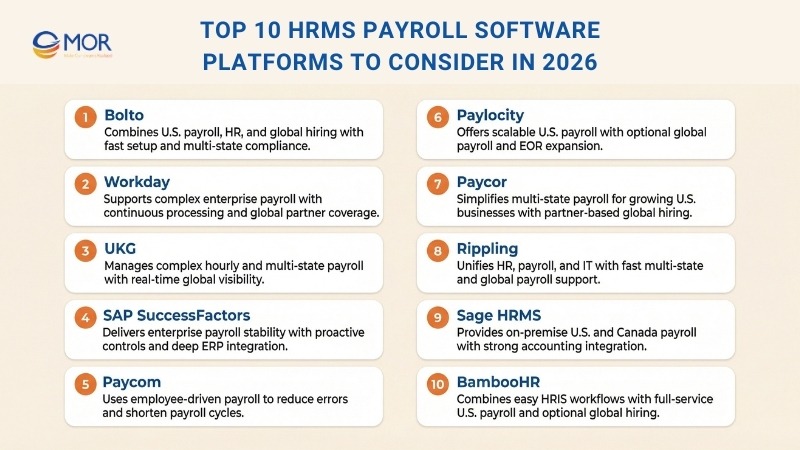
After understanding the definition and role of this software, this section highlights the best HRMS and payroll software platforms for 2026. The list brings together well-established solutions known for reliable payroll processing, clear user experiences, and broad HR capabilities. Each platform has shown it can support changing business needs, which makes these options strong candidates for companies planning their payroll and HR strategy for the year ahead.
Top 10 HRMS Payroll Software Platforms To Consider In 2026
1. Bolto
Bolto brings U.S. payroll, HR, and global hiring into one clear workflow, which helps founders avoid managing multiple vendors as their teams grow. This HRMS payroll software is designed for speed, with onboarding completed in days, automated filings across all 50 states, and coverage that extends to more than 150 countries.
Best for: Seed-to-Series B U.S. startups that need compliant multi-state payroll and plan to hire globally through EOR and contractors.
The platform stands out by removing common early-stage workarounds like using separate tools for payroll, taxes, and international hiring. A dedicated support contact and quick setup shorten the time to the first payroll run, while EOR and contractor features support global hiring without the need to set up local entities.
Payroll and HR capabilities
- U.S. W-2 payroll and 1099 contractor payments
- Automated tax calculation, filing, and remittance across all 50 states
- Benefits administration that includes health insurance and 401(k) plans
- Global EOR options for hiring employees in more than 150 countries
- International contractor management with payouts in local currencies
- Integrations with widely used accounting and HR platforms
Pricing overview
- Starting at: $599 per month per employee for EOR
- Model: Quote-based pricing for U.S. payroll with modular global HR options
- Global hiring: Contractor plans start from $599 per month
- Trial or demo: Demo available
- Notable limits or add-ons: U.S. payroll and PEO services require custom quotes
2. Workday
Workday provides one of the most tightly connected platforms across HR, payroll, and finance, which suits organizations where workforce size and operational complexity grow at the same pace. Its continuous payroll runs and built-in AI checks help teams spot problems earlier and complete payroll cycles more quickly.
Best for: Large enterprises with over 1,000 employees that manage complex, multi-state U.S. payroll and need a unified global system with partner-based EOR options.
What sets this platform apart is its global-first design. It combines native payroll in major markets with a wide partner ecosystem managed through Global Payroll Connect. This setup supports a single source of truth, clear governance, and fewer fragile integrations as companies expand across regions.
Payroll and HR capabilities
- U.S. W-2 and 1099 payroll with continuous processing and multi-state compliance
- Native payroll coverage for the U.S., Canada, the U.K., France, and Australia
- Global payroll reach in more than 180 countries through certified partners
- Integrated time tracking, paid time off, benefits management, and recruiting tools
- Contractor and extended workforce support through Workday VNDLY
- Pre-built connections for accounting systems, tax filing services, and global EOR partners
Pricing overview
- Starting at: Custom pricing provided through the sales team
- Model: Modular structure with separate agreements for partner services
- Global hiring: EOR and payroll costs are defined by external partners
- Trial or demo: On-site and self-guided demos are available
- Notable limits or add-ons: U.S. tax filing often depends on certified connector services
3. UKG
UKG connects HR, payroll, and workforce management in one system, which works well for multi-state businesses with complex hourly staff. This HRMS payroll software uses Payment Services and Bryte AI to lower filing mistakes and flag irregularities before they turn into expensive issues.
Best for: Mid-market to enterprise U.S. organizations with complex multi-state payroll and global teams paid through their own international entities.
The key strength is control and transparency. UKG One View delivers real-time payroll visibility across more than 160 countries without requiring companies to replace existing in-country providers. This setup suits leaders who want stronger oversight and consistency, not operational disruption.
Payroll and HR capabilities
- U.S. W-2 and 1099 payroll with automated federal, state, and local tax filings
- Built-in time tracking, scheduling, and PTO for complex hourly workforces
- Multi-state automation that supports SUI rates and labor rule compliance
- Global payroll hub through UKG One View for insight across 160 plus countries
- AI agents that handle routine tasks, detect errors, and simplify reporting
- Core integrations with NetSuite, QuickBooks, Greenhouse, and other platforms
Pricing overview
- Starting at: Quote-based pricing shared during consultation
- Model: Per-employee licensing for UKG Pro and UKG Ready suites
- Global hiring: UKG One View pricing depends on country coverage and service tier
- Trial or demo: Demos are available through the sales team
- Notable limits or add-ons: Tax filing services and W-2 printing are commonly add-ons
4. SAP SuccessFactors
SAP SuccessFactors is designed for large-scale operations, combining a reliable global payroll engine with strong U.S. tax automation. This ERP software for HRMS and payroll management helps identify issues early and keeps payroll cycles stable, even across complex, multi-entity setups.
Best for: Large enterprises with more than 1,000 employees that manage complex, multi-state U.S. payroll and support a sizable global workforce within one unified system.
A standout element is the Payroll Control Center. Proactive checks and guided resolutions reduce manual effort. With native payroll support in dozens of countries and close integration with SAP’s finance tools, organizations gain enterprise-level reliability without relying on disconnected point solutions.
Payroll and HR capabilities
- U.S. W-2 payroll with multi-state tax automation supported by BSI TaxFactory
- Native global payroll in more than 50 countries, with additional coverage through partners
- Payroll Control Center that supports proactive error detection and guided fixes
- Integrated time tracking, PTO, and benefits administration for automated deductions
- Contractor management through SAP Fieldglass, with 1099 payments handled separately
- Deep integrations with SAP S/4HANA and approved third-party EOR providers
Pricing overview
- Starting at: $144 per user per year, with a 1,000-user minimum
- Model: Requires an Employee Central license for core HR functionality
- Global hiring: EOR services are delivered through third-party partner integrations
- Trial or demo: Demo available through SAP, with no self-service trial
- Notable limits or add-ons: Implementation must be completed by a certified partner
5. Paycom
Paycom focuses on getting payroll right at the source through its employee-driven payroll tool, Beti. This HRMS payroll software turns review-heavy payroll checks into a guided, self-correcting process. The outcome is fewer payroll surprises on payday and less routine admin work for HR teams.
Best for: Mid-market U.S. employers that manage multi-state payroll and want a single HR database, without the need for a global Employer of Record.
Since the platform operates on one unified database, information stays consistent from recruiting all the way through payroll processing. Decision-makers benefit from cleaner audits and quicker cycles, while employees correct issues before submission, which leads to clear time and cost savings.
Payroll and HR capabilities
- U.S. W-2 and 1099 payroll with automated multi-state tax filing
- Beti employee-driven payroll, available in the U.S., Canada, Mexico, the U.K., and Ireland
- Integrated time tracking, attendance, PTO, and benefits management with ACA reporting
- Talent acquisition tools that cover applicant tracking, onboarding, and background checks
- Compliance features for E-Verify, I-9, and required government reports like EEO-1 and OSHA
- Direct general ledger integration along with expense and mileage management
Pricing overview
- Model: Quote-based pricing charged per employee per month
- Global hiring: Employer of Record services are not offered
- Trial or demo: No free trial, with a personalized demo required
- Notable add-ons: Year-end filing services may involve additional charges
6. Paylocity
Paylocity combines payroll, HR, time tracking, and spend management into one system, which suits teams that prefer fewer vendors and clearer ownership. This payroll HRMS software includes tax filing liability coverage and proactive alerts that help protect each payroll run.
Best for: U.S. companies with 50 to 1,500 employees that require multi-state payroll and an all-in-one HCM, with options to support global payroll and contractors.
What draws many teams is the ability to scale internationally over time. Organizations can manage U.S. payroll with confidence, then expand into more than 100 countries and EOR services through partners without leaving their main platform. This continuity helps control transition costs and keeps reporting aligned.
Payroll and HR capabilities
- Full-service U.S. W-2 and 1099 payroll with automated multi-state tax filing and compliance
- Integrated time tracking, PTO management, and benefits administration with carrier connections
- Global payroll support available in over 100 countries for unified reporting
- EOR and global contractor hiring through a dedicated partner integration with G-P
- On-demand pay options that give employees access to earned wages
- Integrations with QuickBooks, NetSuite, Greenhouse, Lever, Okta, and other tools
Pricing overview
- Starting at: Quote-based pricing
- Model: Base platform fee plus a monthly per-employee cost
- Global hiring: Global payroll is offered as an add-on, with EOR pricing handled separately by partners
- Trial or demo: Demo available
- Notable limits or add-ons: Time, benefits, and talent modules are often sold as add-ons
7. Paycor
Paycor is a practical option for growing U.S. businesses that want payroll, time tracking, and benefits managed in one place. Unlimited payroll runs and clear compliance tools help simplify daily operations for HR teams.
Best for: U.S.-based small and mid-sized companies with 10 to more than 1,000 employees that need a unified HCM for multi-state payroll and access to global EOR through partners.
Its marketplace-style approach to global hiring allows companies to keep domestic HR processes centralized while using EOR partners when international needs arise. This setup supports global expansion plans in a cost-aware way without long-term commitments.
Payroll and HR capabilities
- Full-service U.S. W-2 and 1099 payroll with multi-state tax filing
- Time and attendance tracking, PTO management, and benefits administration
- Employee onboarding tools that include E-Verify and contractor hiring support
- Global EOR and contractor hiring through marketplace partners
- Earned Wage Access options through OnDemand Pay
- Integrations with QuickBooks, NetSuite, and common recruiting platforms
Pricing overview
- Starting at: $99 per month plus $5 per employee
- Model: Tiered bundles priced per employee per month
- Global hiring: EOR partner services are priced separately
- Trial or demo: Guided demos are available
- Notable limits or add-ons: Advanced modules and usage overages may apply
8. Rippling
Rippling brings HR, payroll, and IT into one system so teams can onboard staff, set up access, and run pay in minutes rather than days. This HRMS & payroll software gains its speed from a single data model that keeps changes in sync across the platform, which helps reduce errors and manual admin work.
Best for: U.S. companies growing from 20 to more than 1,000 employees that need fast multi-state payroll and plan to hire globally.
This solution is designed to grow with the business. Organizations can manage U.S. payroll, pay contractors in over 185 countries, and activate EOR services in more than 80 locations without moving to a new system. That level of consolidation helps control total costs and gives leaders clear oversight as teams expand.
Payroll and HR capabilities
- U.S. W-2 and 1099 payroll with automated multi-state tax filings
- Integrated time tracking, PTO management, and benefits administration
- Global contractor payments available in more than 185 countries
- Employer of Record services covering over 80 countries
- Native integrations with accounting tools like QuickBooks and NetSuite, plus HRIS systems
- Unlimited off-cycle payroll runs and new-hire reporting
Pricing overview
- Starting at: $8 per employee per month, plus a base fee
- Model: Modular pricing, with payroll added to the core HRIS
- Global hiring: EOR services start at $499 per employee per month
- Trial or demo: Demo available, with no public free trial
9. Sage HRMS
Sage HRMS is a reliable on-premise solution for organizations that want close control over domestic payroll and employee data. This HRMS payroll software combines U.S. and Canadian payroll with built-in e-filing and regular tax table updates to support steady compliance.
Best for: U.S.-based small and mid-sized businesses that want on-premise control and in-house, multi-state payroll, without a built-in global EOR.
The main advantage is consistency. Strong connections with Sage 100 and 300 accounting systems and Aatrix e-filing help limit the number of vendors involved. This keeps payroll, HR, and finance aligned, which suits organizations that remain mostly U.S.-focused.
Payroll and HR capabilities
- In-house U.S. and Canadian payroll with automatic tax table updates
- Federal and state e-filing for W-2 and 941 forms through Aatrix
- Multi-state payroll compliance and reporting features
- Direct deposit options using ACH or EFT, along with garnishment calculations
- Employee Self-Service access for pay stubs, benefits, and time-off requests
- Native integrations with Sage 100 and Sage 300 accounting software
Pricing overview
- Starting at: Quote-based pricing, licensed per module
- Model: Modular structure that includes Payroll, Benefits, and ESS
- Global hiring: Not available and requires a third-party EOR
- Trial or demo: Demos are available upon request
- Notable limits or add-ons: E-filing through Aatrix requires separate package pricing
10. BambooHR
BambooHR begins with an easy-to-use HRIS and adds full-service U.S. payroll, which allows data to move smoothly from onboarding through payday. This HRMS payroll software setup reduces manual fixes and supports automatic federal, state, and local tax filings.
Best for: U.S.-based small and mid-sized businesses with 25 to 500 employees that need multi-state payroll inside an HRIS, with optional EOR and global contractor support.
Many founders appreciate the clear pricing and fast setup. An integrated EOR option through Remote also enables hiring in more than 90 countries. This creates a simple path from domestic payroll to a broader global payroll structure.
Payroll and HR capabilities
- Full-service U.S. payroll with W-2 and 1099 processing and multi-state tax filing
- Integrated time tracking, PTO management, and benefits administration that sync with payroll
- Ability to pay U.S.-based 1099 contractors alongside W-2 employees
- Global Employer of Record services for hiring in over 90 countries through Remote
- Native integrations with accounting tools like QuickBooks and NetSuite, plus more than 150 other apps
- Automated overtime calculations, compliance alerts, and detailed audit trails
Pricing overview
- Starting at: $10 per employee per month, or a $250 monthly flat rate for teams with 25 staff or fewer
- Model: Core HR subscription with optional payroll and benefits add-ons
- Global hiring: EOR services start from $599 per month, with contractor management at $29 per month through Remote
- Trial or demo: A 7-day free trial and live demos are available
- Notable limits or add-ons: Payroll and benefits add-ons are available only for U.S. operations
How Does HRMS Payroll Software Work?
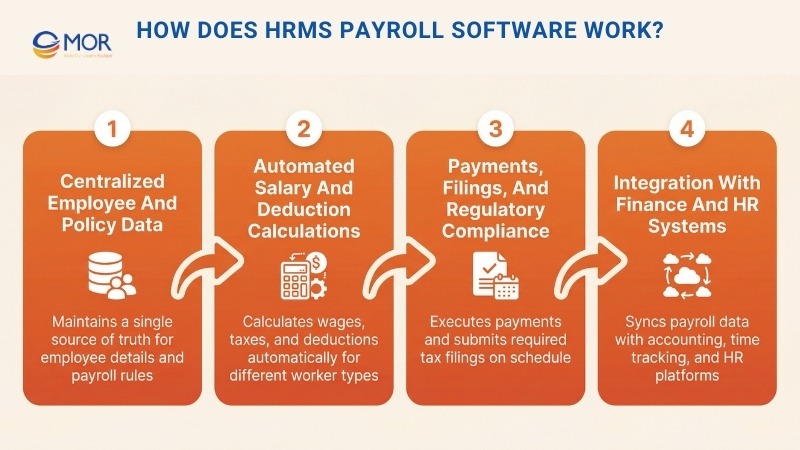
The core operation relies on four connected processes that turn raw employee data into accurate, compliant pay outcomes, while keeping smooth links across the wider business system.
How Does HRMS Payroll Software Work?
Centralized Employee And Policy Data
A reliable platform begins by securely storing and managing full employee records. This covers essential details like pay rates, bank information, tax forms, and benefit selections. The online HRMS software also stores company rules for leave, overtime calculations, and different pay structures. This centralized setup creates a single source of truth that avoids the data errors often seen in manual processes. It also makes sure every payroll calculation uses current and consistent information.
Automated Salary And Deduction Calculations
The calculation engine is the main source of value in this type of system. The way this software operates becomes clearer when looking at how it handles payroll math. It automatically completes the detailed calculations required for accurate payroll. The platform considers base salaries or hourly wages, applies the correct tax withholdings based on current rules, deducts insurance costs and retirement contributions, and includes other required additions or deductions. This automated logic supports different worker types, including salaried staff, hourly employees, temporary workers, and contractors. Each person’s pay is calculated based on their own terms and the rules that apply to them.
Payments, Filings, And Regulatory Compliance
After calculations are complete, the platform handles the final payroll steps through automated payment and compliance tools. Direct deposit options make sure employee wages reach bank accounts safely and on schedule. It can also issue physical checks for workers who still prefer paper payments. The system prepares and submits required tax forms to the appropriate government agencies automatically. This process supports local compliance rules and lowers the risk of fines caused by late or incorrect filings.
Integration With Finance And HR Systems
Current payroll platforms improve efficiency through smooth connections with existing business tools. These links often include accounting systems for financial syncing, time and attendance tools for accurate hour tracking, and HR platforms for complete employee record management. Strong integration capabilities remove the need for duplicate data entry, reduce the chance of errors, and support a unified environment where payroll data moves automatically across related business functions.
Essential Features Every HRMS Payroll Software Should Include
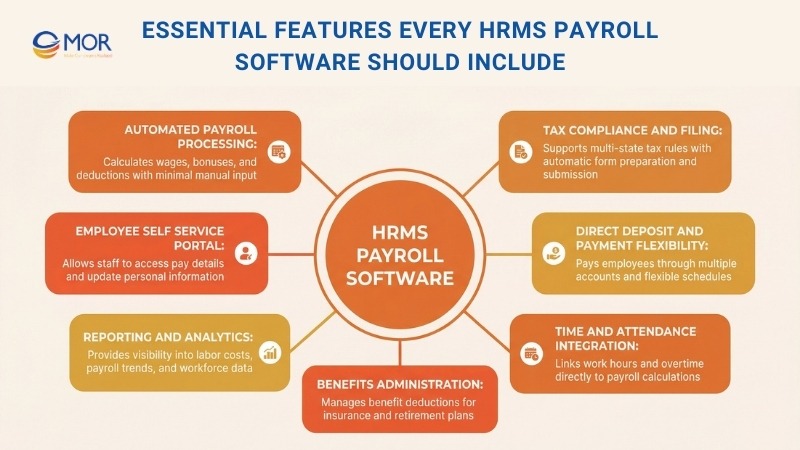
When reviewing HRMS payroll software, several core features should appear on your evaluation list. These functions support accuracy, compliance, and day-to-day efficiency.
Essential Features Every HRMS Payroll Software Should Include
- Automated Payroll Processing: The system should calculate wages, salaries, bonuses, and deductions automatically, which saves time and lowers the risk of manual mistakes.
- Tax Compliance and Filing: An important capability is support for multi-state payroll tax compliance, including federal, state, and local withholding, with automatic filing of required forms like W-2s and 1099s.
- Direct Deposit and Payment Flexibility: The platform should allow direct deposits to multiple bank accounts and provide flexible pay schedules.
- Time and Attendance Integration: Strong integration with time tracking tools is needed to pay hourly workers correctly and manage overtime accurately.
- Benefits Administration: The solution should handle deductions for health insurance, retirement plans such as 401(k)s, and other employee benefits.
- Reporting and Analytics: Reliable reporting tools should give visibility into labor costs, payroll patterns, and employee turnover to support informed decisions.
- Employee Self Service Portal: A self-service portal that lets employees view pay stubs, update personal details, and access tax documents helps reduce administrative work for HR teams.
Business Benefits Of Using Integrated HRMS Payroll Software
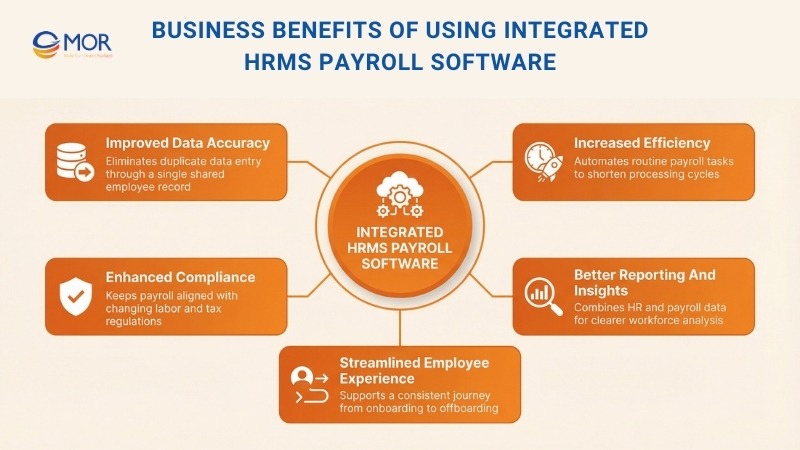
Workday research shows that 92% of business leaders see payroll as strategic, yet 89% think their current solutions need to do more. Using one integrated system for HR and payroll brings clear advantages compared to managing separate and disconnected tools.
Business Benefits Of Using Integrated HRMS Payroll Software
- Improved Data Accuracy: With a single source of truth for employee information, teams no longer need to enter the same data twice. A recent Deloitte survey found that 73% of businesses say using integrated HR and payroll improves efficiency and reduces errors in their processes. When employee details change in the HR area, updates pass directly into payroll, which greatly lowers the chance of errors.
- Increased Efficiency: Automating routine work like payroll calculations and tax submissions gives HR and finance teams more time for higher-value tasks .Payroll automation can reduce payroll processing time by up to 75%, saving businesses an average of 156 hours a year in staff time, giving teams more time to focus on important tasks. This smoother workflow allows payroll cycles to finish much faster.
- Enhanced Compliance: An integrated platform helps organizations keep up with changing labor laws and tax rules. Automatic updates support compliant payroll processing and reduce the risk of fines or penalties.
- Better Reporting and Insights: When HR and payroll data sit in one HR management application, teams can create detailed reports that show workforce costs and trends more clearly. This supports stronger financial planning and long-term decisions.
- Streamlined Employee Experience: A unified system supports a smoother employee journey from onboarding through offboarding. Staff manage their details in one portal, and solutions can link recruiting directly to payroll so new hires become productive sooner.
How To Evaluate HRMS Payroll Software Before Buying
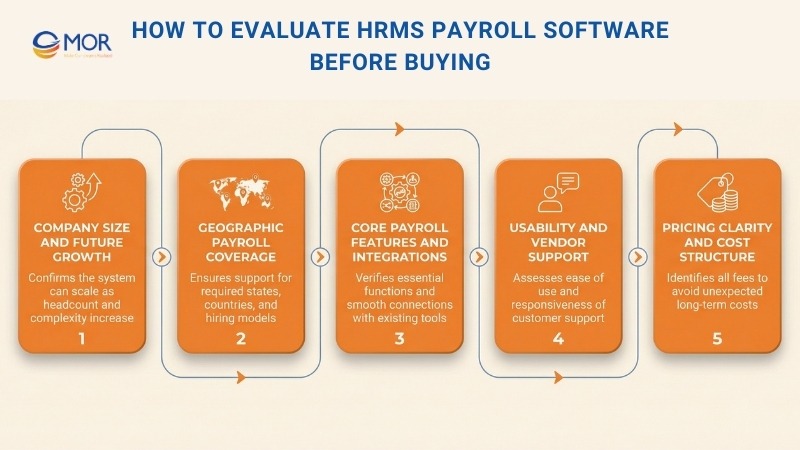
Choosing the right HRMS payroll software is an important decision for any business. This checklist helps guide a clear and structured evaluation.
How To Evaluate HRMS Payroll Software Before Buying
Company Size And Future Growth
Consider whether the platform is designed for a startup, a mid-sized organization, or a large enterprise. Make sure it can scale as your workforce grows. A system that fits 20 employees today may not support the needs of 200 later.
Geographic Payroll Coverage
Think about where your employees are located. Some companies operate in a single state, while others manage staff across many states or countries. Multi-state tax compliance is a common concern. If global hiring is part of the plan, the HR online system should include Employer of Record or contractor management options.
Core Payroll Features And Integrations
Check whether the solution includes all the key features you need. Review how well it connects with existing tools, including accounting platforms and applicant tracking systems. Strong integrations reduce manual work and data errors.
Usability And Vendor Support
The system should be easy to use for both administrators and employees. Review the type of customer support provided. For early-stage companies, direct and responsive support can be more helpful than a large, ticket-based help desk.
Pricing Clarity And Cost Structure
Understand how pricing works before committing. Many vendors charge per employee per month along with a base fee. Ask about additional costs for setup, tax filings, or ongoing support. Providers with clear and transparent pricing reduce surprises later.
HRMS Payroll Software Costs And Pricing Models
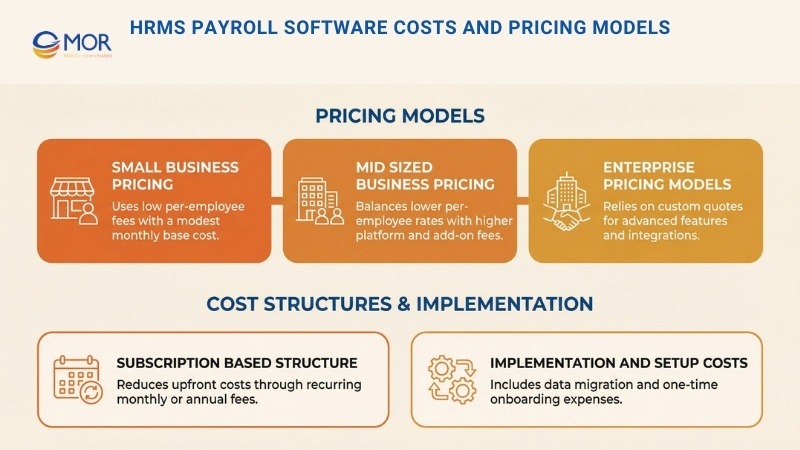
The pricing for HRMS payroll software usually follows a subscription approach. This model allows businesses of different sizes to adopt payroll systems without a heavy upfront cost.
 HRMS Payroll Software Costs And Pricing Models
- Small Businesses (Under 50 employees): Costs often range from $5 to $15 per employee each month, along with a base platform fee that typically falls between $40 and $100 per month. Some vendors may also promote entry plans that resemble free HRMS and payroll software, though these are often limited in features.
- Mid Sized Businesses (50 to 500 employees): The per-employee rate may drop slightly as headcount grows, but higher platform fees and paid feature add-ons can raise the overall monthly spend.
- Enterprise (500 plus employees): Large organizations usually receive custom pricing based on their needs, which may include advanced capabilities, dedicated support teams, and complex system integrations.
Always request a detailed quote that clearly outlines all expected costs. This should include implementation, data migration, and any one-time setup fees to avoid surprises later.
HRMS Payroll Software Trends Shaping 2026
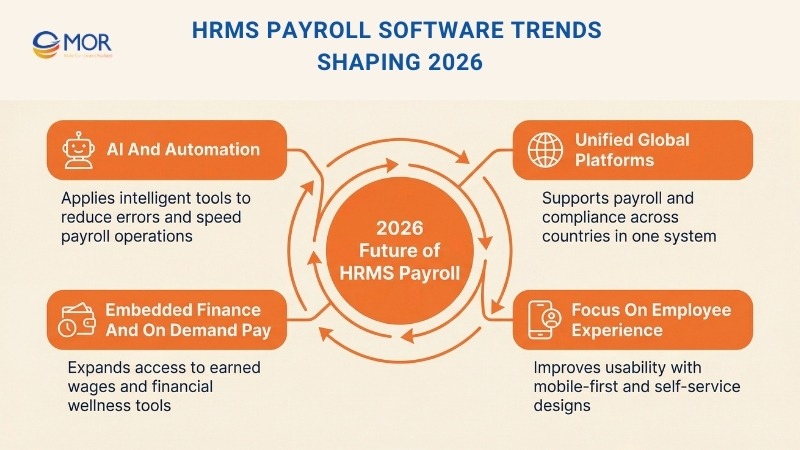
HR and payroll technology continues to change as business needs grow and regulations become more complex. The following trends are shaping how HRMS & payroll software is expected to develop in 2026.
HRMS Payroll Software Trends Shaping 2026
- AI and Automation: Artificial intelligence is increasingly used to handle repetitive payroll tasks, identify errors before they occur, and support predictive analysis of workforce patterns. The global HR payroll software market is projected to exceed $57 billion by 2029, with much of this growth linked to wider use of AI-driven automation.
- Unified Global Platforms: As global hiring becomes more common, companies are looking for single platforms that manage payroll, compliance, and HR for employees and contractors across many countries. This demand is especially visible in regulated sectors, including the growing use of HR management software for energy industry organizations that operate across regions.
- Embedded Finance and On-Demand Pay: Many modern platforms now include financial wellness tools, including on-demand pay options that allow employees to access earned wages before the standard payday.
- Focus on Employee Experience: Leading human resources management systems continue to invest in user-friendly, mobile-first designs. These interfaces support self-service access and improve transparency around pay, benefits, and personal information.
Partner With MOR Software For HRMS Payroll Software Development
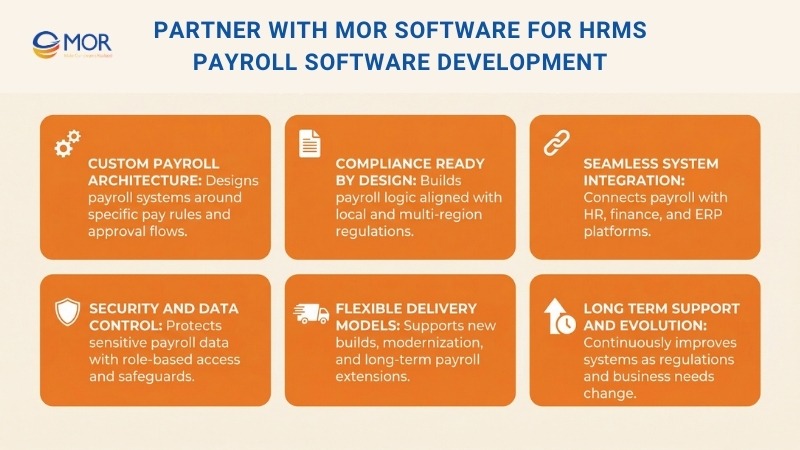
MOR Software develops custom HRMS payroll software around real payroll operations, not generic assumptions. Our teams focus on how data flows between HR, attendance, finance, and compliance, then design systems that stay accurate as headcount, locations, and regulations change. This approach helps businesses avoid rigid tools that create manual fixes and reporting gaps over time.
Partner With MOR Software For HRMS Payroll Software Development
- Custom payroll architecture: We design HRMS payroll software that matches your pay cycles, deduction rules, tax structures, and approval flows, instead of forcing fixed templates.
- Compliance-ready by design: Payroll logic is built around local and multi-region regulations, with clear audit trails and structured reporting to support ongoing compliance.
- Seamless system integration: We connect payroll with HR platforms, time tracking, accounting, and ERP systems so data stays consistent and payroll runs faster.
- Security and data control: Access management, role-based permissions, and data protection are embedded from the start to safeguard sensitive payroll information.
- Flexible delivery models: We support full system builds, payroll modernization, and long-term extensions using dedicated teams that scale with your needs.
- Long-term support and evolution: After launch, we continue improving performance, adapting to regulatory updates, and expanding features as your business grows.
If you are planning to build or upgrade HRMS payroll software and need a solution tailored to your operations, we are ready to support the next step.
Contact us to discuss your goals and timeline.
Conclusion
HRMS payroll software plays a central role in payroll accuracy, compliance, and long-term workforce growth. The right platform reduces manual work, supports changing regulations, and scales with your business. Each solution in this guide serves a different need, from SMB operations to complex global payroll. If you are planning to implement or modernize your payroll system, MOR Software can help you design a solution that fits real operations. Contact us to start the conversation.
Share


Make Our-Dreams Realized


© 2023 . MOR Software. All Rights Reserved
Sitemap
Privacy Policy
Terms of Use

Rate this article
0
over 5.0 based on 0 reviews
Your rating on this news:
Name
*Email
*Write your comment
*Send your comment
1