


Hire Offshore AI Developers: A Complete Guide for 2026
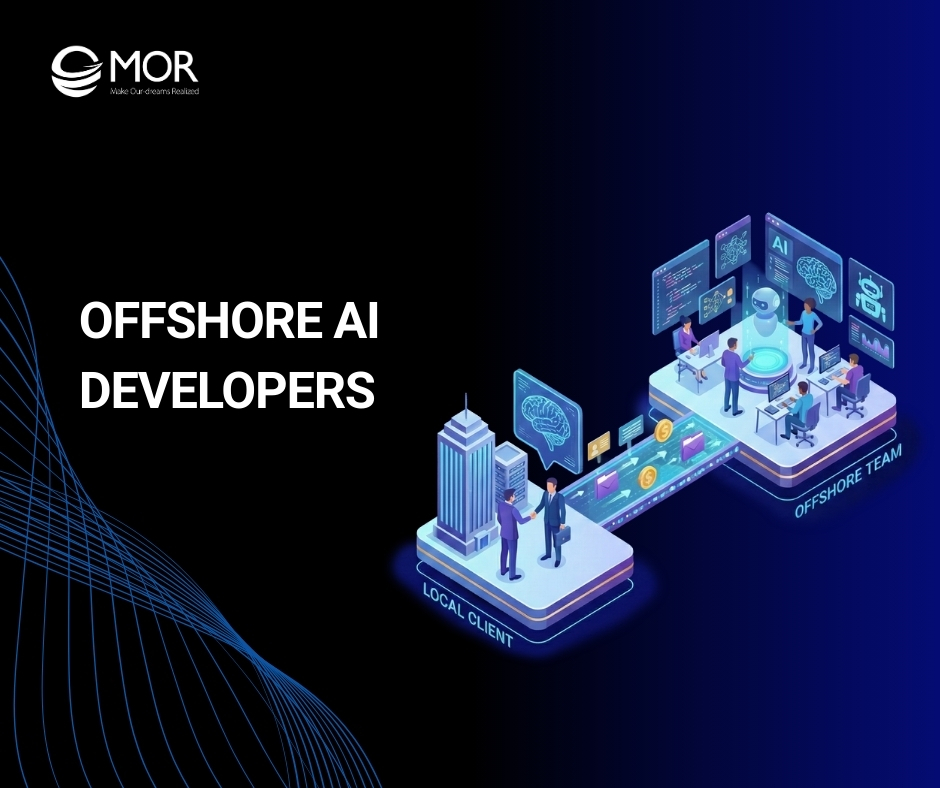
Hiring offshore AI developers helps companies scale faster, cut costs, and unlock stronger technical talent across borders. Many teams also want reliable support for advanced projects but struggle to find the right mix of skills locally. This MOR Software’s guide will show you how to build the right strategy, choose smart models, and work with global AI talent with confidence.
What Is An Offshore AI Developer?
An offshore AI developer is a software engineer or data expert who supports AI projects from another country. They help build, deploy, and maintain systems powered by artificial intelligence while working as part of a remote team. Alongside them is a wider group of AI specialists who create smart applications and tools. This group often includes developers from several regions, giving companies access to varied skills and reliable delivery. One 2024 study found that about 60% of IT decision makers see AI as their biggest skills shortage, so many companies now look abroad for the talent they cannot find at home.
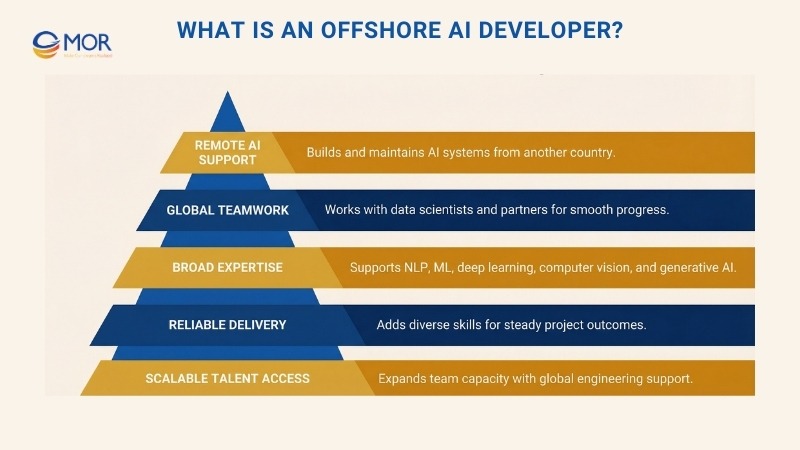
They collaborate with data scientists and technical partners so each task moves forward smoothly and every project reaches the right outcome. These professionals contribute to global teams that use modern methods to create strong AI solutions through technologies like:
- Natural Language Processing (NLP)
- Machine Learning (ML)
- Deep Learning
- Computer Vision
- Generative AI
Key AI And ML Roles Needed For Offshore AI Developers
The AI and ML space covers many different job types, and each one supports a specific part of the work. Knowing how these roles differ helps you choose the right person for the task, especially when you build teams that include an offshore AI engineer along with local staff.
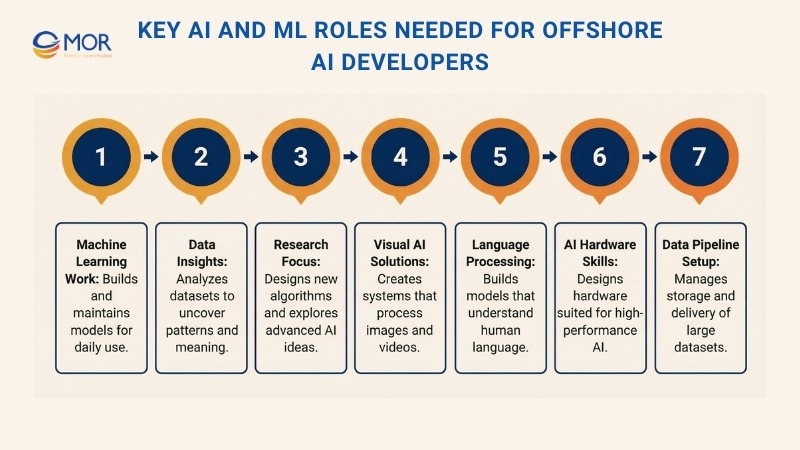
- Machine Learning Engineer: This role focuses on creating, training, and maintaining machine learning models. They help move ideas from research into real products that can run in daily use.
- Data Scientist: This expert studies and interprets large datasets to find patterns and meaning. They sometimes apply ML tools, although their main work centers on data study and statistical methods.
- AI Research Scientist: These professionals work in a research-focused area where they study fresh AI ideas, design new algorithms, and explore new limits in the field.
- Computer Vision Engineer: This role builds AI systems that help machines understand and process visual inputs, including photos and video streams.
- Natural Language Processing (NLP) Engineer: This specialist creates models that read, understand, and produce human language in a natural way.
- AI Hardware Engineer: This engineer designs hardware built for AI tasks, such as GPUs or TPUs, where performance requirements are high.
- Data Engineer: This person creates and maintains the systems that collect, store, prepare, and deliver large amounts of data so AI vs ML vs DL models can use it effectively.
Why Do Businesses Need To Hire Offshore AI Developers?
Companies turn to offshore AI developers when they want stronger skills, quicker delivery, and better use of their budgets. A global Deloitte survey reported that 52% of companies choose outsourcing to close their AI skill gaps, which shows how common this model has become for advanced tech work.
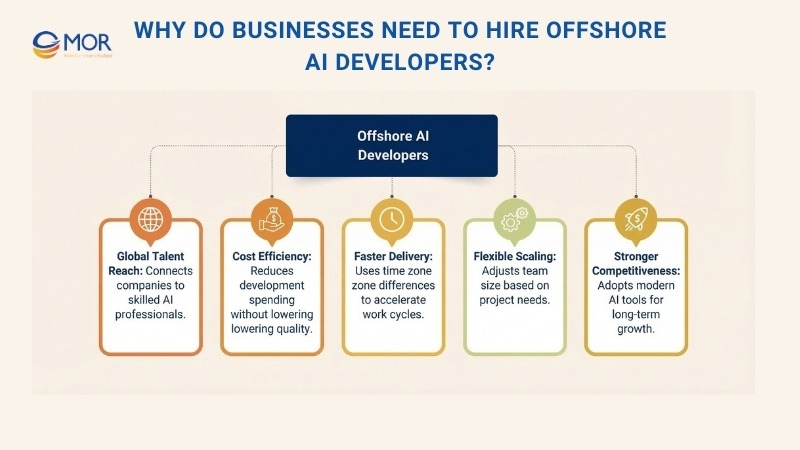
Many organizations also need support for long and complex projects, so a remote team becomes a practical way to keep work moving without delays. This approach helps firms build smarter products and maintain steady progress. Some teams also rely on offshore machine learning development services to support digital growth and expand their capabilities with trusted global talent.
- Reach worldwide talent – Companies can work with skilled AI professionals who bring varied technical backgrounds and real industry experience. Recent data from Statista shows that the global IT outsourcing market is on track to reach about 812 billion dollars by 2029. This highlights how many firms now depend on external tech partners.
- Cut development spending – Many offshore regions offer lower labor costs while keeping quality high. KPMG has reported that developers in countries such as India or Eastern Europe can cost up to 70% less than similar roles in the United States, which helps firms manage budgets more effectively.
- Speed up product progress – Different time zones allow work to continue through the day and night, which helps teams ship updates sooner.
- Adjust team size easily – Organizations can expand or shrink their teams as needed, which keeps resource planning simple and cost friendly.
- Strengthen market position – Remote AI teams give companies access to new tools and research that support better ideas and long-term growth.
Step-By-Step Guide To Hiring Offshore AI Developers
Hiring strong AI or Machine Learning engineers takes more than placing a simple job post. It calls for a planned process where you look at both technical ability and real project experience. The person you choose should understand how to apply models in real work and support business goals. This structured approach helps you hire offshore AI developer talent that can deliver reliable results for your team.
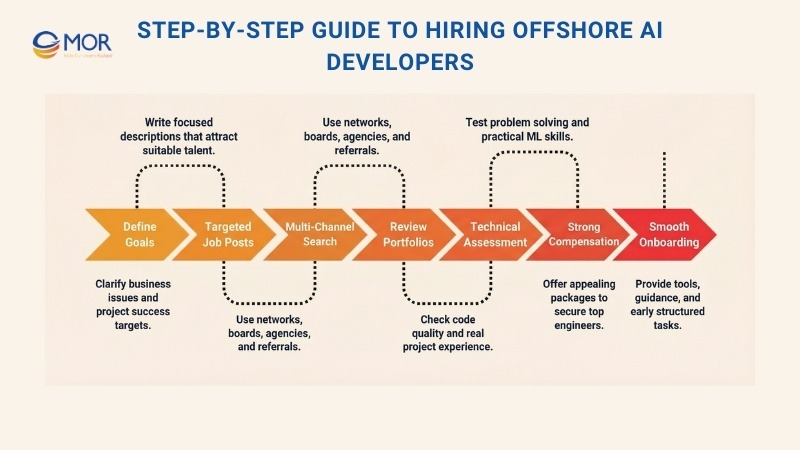
Clarify Project Goals And Technical Needs
Before you begin the hiring steps, you need a clear picture of what you want to achieve with your AI or ML plan. Start with simple questions:
- What business issue do you want to fix?
- Are you creating a recommendation tool, adding automated decisions, studying large datasets, or adding generative AI features?
- What will success look like for your team, such as better customer retention, smoother processes, or stronger predictions?
A clear view of these points shapes the job role, guides your search, and helps you find someone with the right knowledge and hands-on skill for your project.
Write A Clear And Targeted Job Description
Your job post should avoid long lists of random AI or ML terms. A focused description helps you attract the right people for the work. Try to keep each part simple and direct:
- State the exact role focus such as NLP, computer vision, or work on a recommendation system.
- Write the main tasks like preparing data, building models, handling deployment, and checking performance.
- Show the tools and languages the role needs, for example Python, PyTorch vs TensorFlow, or MLflow.
- Make the experience level clear, whether you need a junior developer who can grow or someone with deep expertise.
- Note any soft skills that matter when the engineer will work with product, data, or business teams.
- Add suitable keywords for search visibility like machine learning engineer, AI developer, deep learning, or generative AI so your posting reaches the right talent.
Use Multiple Channels To Find Qualified Candidates
Reaching strong AI and ML professionals calls for a mix of sourcing methods. This approach helps you connect with talent from many regions, which is useful when you plan to hire offshore AI engineer in New York or in other locations.
a. Professional Networks
Use platforms like LinkedIn to find people with the right background. Check GitHub activity and join ML groups where developers share ideas, including communities like Towards Data Science or Reddit’s r/MachineLearning.
b. Job Boards
Post your role on boards that focus on AI and ML hiring, including Kaggle Jobs, Stack Overflow, AIJobs, and larger tech job sites such as Otta, Wellfound, and HackerRank.
c. Specialist Recruitment Firms
Work with recruitment groups that focus on AI and data talent. These firms often have pre-screened candidates who meet proven technical standards.
d. Referrals
Ask your current team for suggestions. People in AI or ML often know others with similar skills and can recommend reliable contacts.
e. Online Freelance and Contractor Platforms
If you plan to hire for short-term or project-based tasks, platforms like Upwork, Toptal, and Freelancer can help you reach skilled global professionals who fit the work.
Evaluate Portfolios And Technical Work Samples
A CV gives only a small view of a candidate’s skills. To understand how they work in real situations, you need to study what they have built and how they solve problems.
- Check their GitHub projects or open-source work to see the quality of their code.
- Look at their Kaggle activity to learn how they handle issues like model testing, feature work, and problem solving.
- Read through their personal sites or technical posts where they explain how they created and deployed their models.
- Give priority to candidates who explain their project goals clearly, describe the issues they faced, and show how their work supported real business needs.
Conduct Thorough Technical Assessments
When you interview AI or ML engineers, you need a complete and structured review. This helps you check their coding skills, their thought process, and how well they turn theory into working solutions.
a. Use Coding Tasks That Reflect AI And ML Work
Choose tasks that match real AI or ML needs instead of simple puzzles. For example:
- Write a script that cleans and prepares a messy dataset.
- Build and train a small classification model.
- Improve a basic neural network or adjust a pre-trained model.
These tasks show how they handle real data and make decisions during AI assistant development services.
b. Check Understanding Of Algorithms And Model Evaluation
Ask questions that test their knowledge in key areas, including:
- The differences between supervised, unsupervised, and deep reinforcement learning.
- Important methods like decision trees, gradient boosting, and clustering.
- Metrics such as precision, recall, F1-score, and AUC-ROC, plus when each one is suitable.
- Issues like overfitting, data leakage, and class imbalance, and how they would solve them.
This helps you see if the candidate can build stable and reliable models.
c. Review Experience With ML Tools And Frameworks
Discuss their hands-on work with popular tools and libraries, such as:
- TensorFlow, PyTorch, and Scikit-learn for building models.
- Pandas, NumPy, and Dask for data tasks.
- MLflow, Kubeflow, or SageMaker for tracking experiments and supporting deployment.
Look for depth, especially from candidates who have deployed models in real systems.
d. Present Practical Scenarios To Test Problem Solving
Use real or sample cases to explore how they think, such as:
- A recommendation system with cold start issues.
- A model showing reduced accuracy over time.
These cases help you see how they react under pressure and how they connect technical choices to business goals.
e. Review Soft Skills And Team Interaction
Strong AI work also depends on communication and teamwork. Ask questions that highlight:
- How well they explain complex topics to non-technical teammates.
- How they work across groups and handle feedback.
- Their comfort level with learning new tools.
- Their method for solving difficult problems.
f. Confirm Past Experience Through References
Do not skip this step. Speak with past employers or supervisors to confirm:
- Their real project contributions.
- Their consistency and ability to finish work on time.
- Their teamwork skills.
- Whether they stayed updated with modern AI practices.
These insights help you understand how they are likely to perform in your team.
Create An Attractive Compensation Package
AI and ML engineers receive many job offers, so you need a strong package to catch their attention. To stand out from other employers:
- Research salary ranges based on region, skills, and the industry standard.
- Share clear details about bonuses, stock options, flexible work hours, remote work choices, and training support.
- Consider giving access to GPU tools, research funds, or support for AI events and conferences.
A fair and appealing package shows that you respect the value and knowledge they bring.
Build A Smooth Onboarding Flow
After you choose the right person, make sure their start in the team feels simple and well supported. This helps them adjust quickly and work with confidence.
- Give them access to needed tools such as development platforms, data sources, and documentation.
- Help them meet team members in different departments.
- Plan early tasks that are small and easy to handle so they can learn the system step by step.
- Assign a mentor or teammate who can support them during the first phase.
A clear and friendly onboarding plan helps new hires stay longer and reach full productivity faster.
Pros And Cons Of Working With Offshore AI Developers
Many companies now rely on offshore AI developers to scale their projects while keeping costs stable. This model helps firms grow faster and stay flexible, although it also brings certain challenges. A clear view of both sides supports smart decisions when you plan to expand your AI capacity. This setup also reflects the growing impact of AI in offshoring, which shapes how modern teams build and deliver advanced solutions.
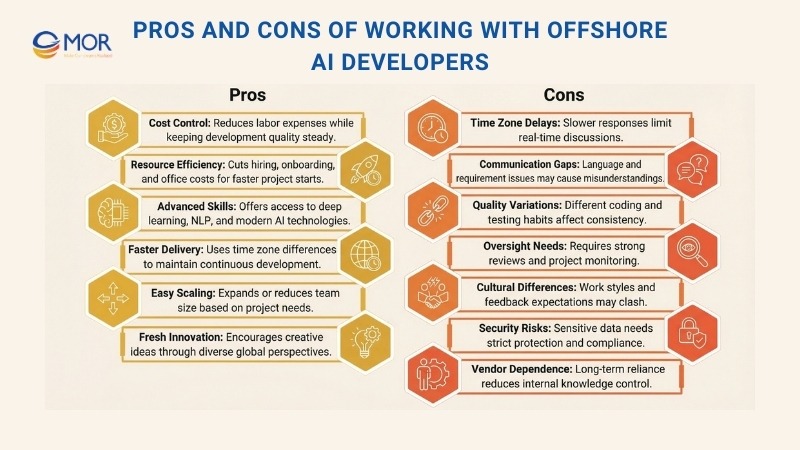
Pros
Strong Cost Control And Better Use Of Resources
Working with remote AI talent can lower overall expenses. In countries like Vietnam vs India, or parts of Eastern Europe, labor costs are often 40 to 60 percent lower than in North America or Western Europe. This allows companies to spend more on product development, tools, or marketing instead of high payroll.
AI outsourcing also reduces hiring expenses, onboarding time, and office maintenance. You gain quick access to trained teams who can start work without long delays.
Key advantages:
- Lower development expenses while keeping quality stable
- Fewer HR and setup costs
- Easy team scaling based on workload
Wider Skill Access And Advanced Technologies
Remote AI groups often work with deep learning, NLP, generative AI, and other modern tools. Many regions invest heavily in technical education, which makes them strong talent centers.
When you team up with an offshore AI engineer or data expert who knows the latest methods, your organization gains access to tools and research that may not yet be common in your local market.
Key advantages:
- Access to strong technical knowledge
- Awareness of fresh tools, languages, and methods
- Faster adjustment to global AI trends
Faster Release Cycles
Different time zones can speed up delivery when managed well. Work continues even after your local team logs off. While one team rests, your offshore group moves to the next task, which shortens development cycles.
This approach helps AI projects progress quickly, especially with constant testing and model improvement. Many AI offshore teams support fast model tuning, data handling, and system updates.
Key advantages:
- Development moves forward around the clock
- Quicker testing and deployment
- Better response to shifting market needs
Easy Scaling And Flexible Team Structure
Offshore setups let you grow or shrink your team with less difficulty. You can add ML experts for short tasks or build a long-term group for full product development. This makes it easier to stay on budget while exploring new AI-based automation services.
Key advantages:
- Fast adjustments to team size
- Smooth response to market changes
- Flexible support for project demands
Innovation Through Diverse Teams
Working with remote AI talent exposes your project to new ideas and problem-solving styles. People from different regions often bring creative approaches, which is useful in AI where fresh thinking leads to stronger results.
This mix of backgrounds supports long-term growth and keeps your product ideas moving forward.
Key advantages:
- Stronger innovation
- New ways to solve complex problems
- Broader global insights
Cons
Time Zone And Communication Obstacles
Different time zones can support round-the-clock progress, but they also create limits for live discussions and fast decision-making. When teams work at different hours, feedback may slow down and important updates can be delayed.
Clear processes help reduce these issues. Teams need shared work hours, defined communication rules, and strong tools like Slack, Jira, or Microsoft Teams.
Potential risks:
- Delayed updates or slow problem resolution
- Limited real-time teamwork
- Misunderstandings caused by uneven communication times
Mitigation strategies:
- Use shared dashboards and short daily meetings
- Set clear milestones so teams stay aligned
- Build organized document hubs for clarity
Quality Issues And Oversight Needs
Offshore AI projects require close attention to quality and process. Teams may follow different coding rules, testing habits, or documentation styles. These gaps can affect the final product.
With no clear oversight, the outcome may fall short of internal standards or industry rules. Regular code checks, sprint reviews, and dedicated QA steps help keep work consistent.
Potential risks:
- Uneven code quality or weak model results
- Missing documentation or limited testing
- Lower accountability when teams are loosely managed
Mitigation strategies:
- Create a QA setup with clear KPIs
- Hold frequent sprint demos and review sessions
- Use unified project management tools
Cultural And Language Differences
Cultural habits shape how teams communicate, share ideas, and make decisions. Some groups may avoid asking questions or disagreeing openly, which can cause unclear direction.
Language gaps still appear in some cases, especially in detailed AI discussions about models, data use, or compliance rules. These gaps may slow collaboration.
Potential risks:
- Requirements misunderstood or applied incorrectly
- Slower team connection and trust building
- Different tones or feedback styles causing confusion
Mitigation strategies:
- Offer onboarding that explains cultural expectations
- Support open communication and honest feedback
- Assign bilingual leads when needed
Data Security And Compliance Concerns
AI work often uses sensitive information, including finance, health, or customer data. With offshore partners, you must follow strict rules such as GDPR, HIPAA, or ISO standards.
Weak controls or unclear agreements can expose the business to risk. Companies need strong security steps like encryption and strict access rules.
Potential risks:
- Unauthorized data access or loss
- Breaking industry compliance rules
- Reputation damage from breaches
Mitigation strategies:
- Sign clear NDAs and strong data agreements
- Choose partners with security certifications like ISO 27001
- Limit data access and require encrypted transfer
Dependency On External Teams
Relying on external partners for a long period can place important knowledge outside your company. If a vendor leaves or shifts focus, ongoing projects can face delays and teams may lose access to important information.
Strong documentation, internal training, and transition planning help prevent this issue.
Potential risks:
- Heavy reliance on outside expertise
- Losing control of core technical knowledge
- Project delays during vendor changes
Mitigation strategies:
- Keep shared repositories and clear documentation
- Rotate team members or mix roles when possible
- Train internal AI staff for long-term stability
Offshore Developer Costs In 2026
Companies planning to work with offshore AI developers need a clear view of the cost range for different technical roles. Prices often change based on region, seniority, and the type of work involved. These numbers also help teams choose the right setup for digital offshore AI projects and plan budgets with better accuracy. Costs can shift from year to year, but the 2026 estimates below give a solid starting point for most organizations.
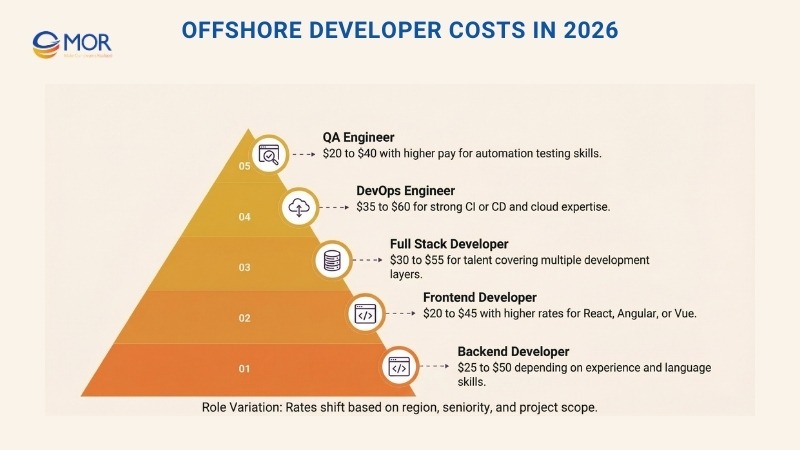
Rates Across Roles And Regions
Salary and Rate Benchmarks by Role (2025 Estimates, USD/hour)
Role | Typical Rate Range | Notes |
Backend Developer | $25 – $50 | Rates change based on experience and language skill in Node.js, .NET, or Java. |
Frontend Developer | $20 – $45 | Developers skilled in React, Angular, or Vue are often in high demand. |
Full-Stack Developer | $30 – $55 | A strong choice for startups that need someone who can handle many layers. |
DevOps Engineer | $35 – $60 | Rates rise when the engineer has deep skills in CI or CD, AWS, Azure, or Kubernetes. |
QA Engineer | $20 – $40 | Manual testers sit at the lower end, while automation QA earns more. |
These numbers help companies estimate early costs, although final rates shift based on location, experience, and whether the work is freelance or handled by a dedicated team.
Understanding pricing also requires looking closer at each specialty and the region involved. The points below explain how rates differ across countries.
Backend Developers
Backend developers manage server logic, databases, APIs, and core system design. In Vietnam, mid-level talent familiar with Node.js, Python, or Java often charges between 30 and 45 dollars per hour. Senior developers with architecture skills may reach 45 to 60 dollars. In India, backend rates range from 25 to 50 dollars depending on skill and city, with Bangalore and Hyderabad at the higher end. Eastern Europe usually charges 45 to 75 dollars, which reflects higher living costs. Latin America ranges from 40 to 65 dollars, with Argentina and Brazil at the top of the range.
Frontend Developers
Frontend work in React, Angular, Vue, or similar tools tends to cost slightly less than backend tasks. Vietnam rates range from 25 to 40 dollars for mid-level and 40 to 55 dollars for senior specialists. In India, rates move between 20 and 45 dollars. Eastern Europe often charges 40 to 70 dollars, and Latin America usually stays between 35 and 60 dollars.
Full-Stack Developers
Full-stack engineers earn more because they cover both frontend and backend tasks and may also support DevOps. In Vietnam, mid-level full-stack developers charge 35 to 55 dollars, while senior professionals reach 50 to 70 dollars. India ranges from 30 to 55 dollars, Eastern Europe from 50 to 80 dollars, and Latin America from 45 to 70 dollars.
Quality Assurance Engineers
QA engineers support manual testing, automation, and quality tracking. Vietnam QA specialists charge 20 to 35 dollars, with automation rates at the high end. India ranges from 18 to 35 dollars, Eastern Europe from 30 to 50 dollars, and Latin America from 25 to 45 dollars.
DevOps Engineers
DevOps specialists manage cloud systems, CI or CD pipelines, and deployment. Vietnam often ranges from 40 to 65 dollars. India charges 35 to 60 dollars. Eastern Europe can reach 50 to 85 dollars, and Latin America stays between 45 and 75 dollars.
Hidden Cost Factors
Hourly rates do not show the full picture. Several hidden elements can raise the real cost of working with offshore AI developers when they are not handled with care.
Rework caused by unclear requirements
Poor or incomplete specifications often lead to the wrong features being built. Fixing these mistakes can take twice as long as doing the work correctly the first time. Time spent on clear specs, mockups, and acceptance rules helps avoid expensive rework later.
Security gaps
Weak security habits can create technical debt and expose the company to costly breaches. If a remote team skips secure coding steps, ignores updates, or handles sensitive data carelessly, the risks can outweigh any savings. Review security practices when choosing a vendor and include security checks in your project standards.
Weak project coordination
Poor management can lead to missed deadlines, unclear tasks, and extra work. A team may look active in meetings but still skip tests or deliver features that do not meet requirements. These issues usually appear during QA or deployment, which makes them more costly to fix. Work with partners that have strong project control or assign an experienced manager from your side.
Lack of clarity in feature requirements
Vague requirements lead developers to guess how a feature should behave. Wrong guesses create extra development rounds and additional costs. It is important to refine requirements at the start and before new features begin. Hold sessions where developers ask questions about edge cases, error handling, and system connections. Clear answers prevent misunderstandings that become expensive later.
Best Countries To Hire Offshore AI Developers
Choosing the right location matters when you want to build an offshore team for AI and still stay on budget. Each country offers different strengths, from technical skills to cost levels, so selecting the right market helps you form a strong and steady team. The countries below are among the top choices for global AI talent.
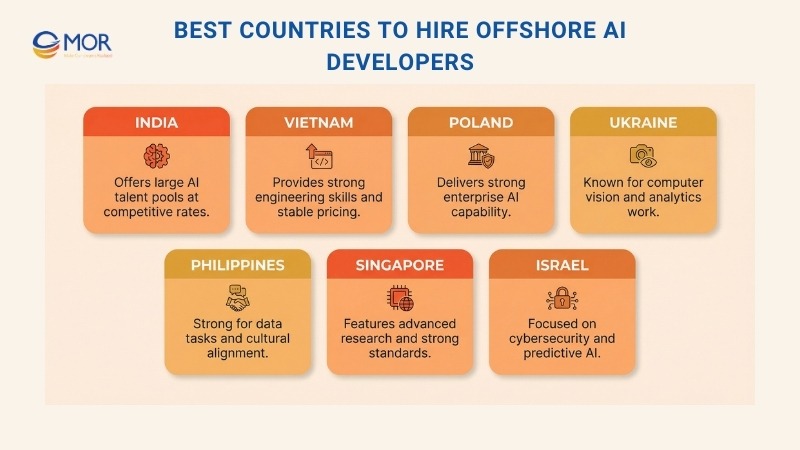
- India – A long-standing IT center with strong skills in machine learning, data work, and NLP. India offers a large talent pool at competitive prices.
- Vietnam – A fast-growing market with developers skilled in fastest programming languages Python, Java, and .NET. Stable rates and strong government support make it a strong match for offshore development needs.
- Poland – Known for strong technical training and hands-on experience in enterprise AI. Good English skills and cultural fit support smooth collaboration.
- Ukraine – Home to many engineers skilled in computer vision and predictive analytics. It provides strong value for medium to large AI projects.
- Philippines – Growing quickly in AI work and data annotation. Labor costs stay low and the business culture aligns well with Western teams.
- Singapore – A major tech hub in Southeast Asia with advanced AI research and reliable data standards.
- Canada – Well known for research in deep learning and generative AI, supported by strong R&D programs.
- Israel – A center for AI startups focused on cybersecurity, NLP, and predictive modeling. Ideal for innovation-focused partnerships.
When selecting a country, review factors like English level, tech infrastructure, government support, and time zone fit to build a team that works smoothly with your organization.
Which Offshore AI Developer Pricing Models Suit You Best?
Choosing the right pricing approach is important when working with offshore AI developers. It affects your spending, level of control, and how smoothly the project moves forward. Each model supports different types of work, from small tests to full enterprise systems. Many companies also use these models when working with an offshore AI ML company that manages long-term development.
Below are the most common structures for remote AI teams, along with how they operate and when they make the most sense.
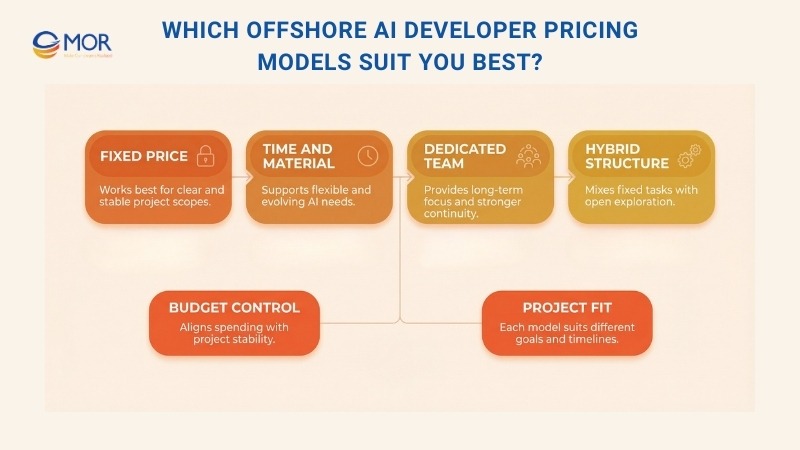
Fixed-Price Approach
The fixed-price option is simple and easy to follow. Both sides agree on a clear budget, project scope, and timeline before any work starts. After this agreement, the vendor must deliver all items within those limits.
This model works well when the goals are stable and defined. It suits tasks like building a single AI module, creating a chatbot, or adding automation features that are unlikely to change. It supports clear financial planning and straight progress tracking, although it needs careful planning at the start.
Suitable for:
- Small or medium projects with clear outputs
- Early versions such as PoC work, prototypes, or MVPs
- Companies with tight budgets that need stable costs
Benefits:
- Clear, predictable pricing
- Low oversight needed after the contract begins
- Simple milestone and timeline tracking
- Lower financial risk for the client
Challenges:
- Limited room to change the scope once work starts
- Not ideal for research-heavy or evolving AI tasks
- Requires complete documentation before development begins
Time And Material Model
The Time and Material model gives teams more freedom because you pay for the real hours and resources used. Instead of a fixed budget, the cost depends on hourly or daily rates for developers, data scientists, and project managers who support the work.
This approach fits AI projects that rely on research, repeated testing, or constant updates. Tasks like model training, algorithm tuning, or adding generative AI features often change as the project grows, so this flexible model supports those needs well.
Suitable for:
- Long-running projects with changing goals
- R&D work, prototypes, or early multimodal AI model testing
- Companies focused on new ideas and stronger performance
Benefits:
- Strong flexibility that supports new findings or scope changes
- Helps teams explore and test creative AI ideas
- Works smoothly with agile processes and ongoing updates
- Clear tracking of hours and progress
Challenges:
- Costs may rise when the project becomes larger than expected
- Requires the client to stay involved in planning and management
- Harder to predict the final total cost early in the process
Dedicated Offshore AI Developers Team Model
The dedicated team model gives you a full-time remote group that focuses only on your AI projects. This team works as part of your internal setup and follows your workflows, tools, and long-term goals, which creates a strong and steady working structure.
This model fits companies that build AI systems needing constant updates, long-term expansion, or deep domain knowledge. Many enterprises prefer this setup because it provides control and commitment without extra hiring or HR tasks.
Suitable for:
- Large companies or tech firms with ongoing AI programs
- Teams that want a long-term and stable partnership
- Complex AI products that require continuous updates and support
Benefits:
- Clear control over the team structure and tasks
- Strong knowledge retention since the same team stays with the project
- Smooth collaboration with internal teams and shared tools
- High focus and accountability across the workflow
Challenges:
- Needs time at the start for onboarding and alignment
- Higher initial cost than short project contracts
- Requires steady leadership and effective project management
Hybrid Engagement Model
The hybrid model mixes fixed-price work with time and material tasks. It fits projects that include steady, well-defined parts as well as sections that require testing or open exploration. For instance, a core system can follow a fixed budget, while model experiments or integration tasks use a flexible T&M setup.
This approach creates a balance between budget control and space for innovation. It works well for mid-sized projects that shift over time or when company goals may change during development.
Suitable for:
- Projects that combine stable work and evolving tasks
- Companies testing new AI features while keeping budgets in order
- Teams using agile methods with phased delivery
Benefits:
- Keeps financial planning clear while allowing flexible development
- Supports faster progress through fixed and experimental work streams
- Lowers risk since uncertain tasks stay within the T&M track
- Encourages gradual improvement while keeping costs visible
Challenges:
- Needs clear separation between fixed and flexible scopes
- Requires strong project management to coordinate both parts
- Can increase the amount of communication needed between teams
Choosing the best pricing model depends on your goals, project size, and how much internal oversight you can provide.
- Projects with tight deadlines and clear tasks fit the fixed-price approach.
- Teams that want freedom to test and change plans work best with time and material.
- Long-term programs with strong ownership needs fit the dedicated team option.
- Projects that mix stable tasks and innovation work well with the hybrid model.
Each model affects how smoothly your offshore AI developers can work, scale, and support long-term growth.
Major Risks To Watch When Working With Offshore AI Developers
Working with offshore AI developers offers many benefits, but it also comes with risks that can affect project quality, cost, and speed if they are not managed well. These risks appear in many outsourcing setups, especially when teams move fast or handle complex AI tasks across borders. Companies need clear processes and strong alignment so both sides understand goals and avoid costly mistakes that slow progress.
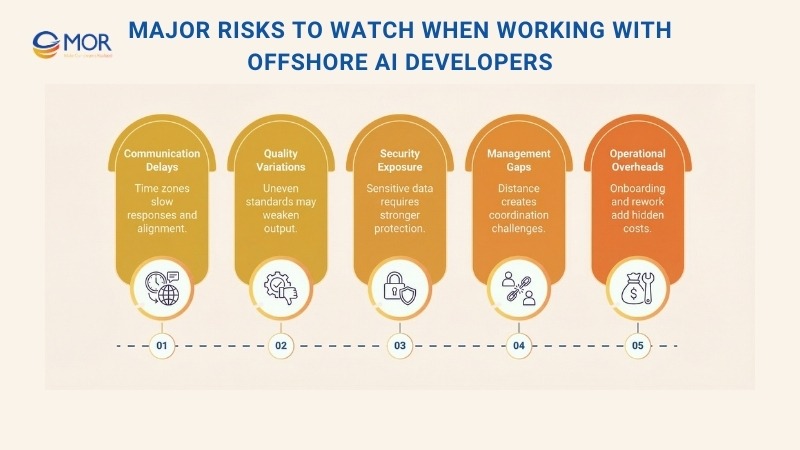
Communication Obstacles
Communication challenges remain one of the biggest risks in offshore projects. These issues appear when teams work in different time zones, use different languages, or do not have clear documentation.
Time zone gaps often slow response times. A developer in Vietnam may finish for the day before a client in California starts work. Simple questions may take hours to answer, and short clarifications may stretch over several days.
Different language levels can also create confusion. AI terms can be misunderstood, and unclear phrases may lead to wrong interpretations. This causes teams to build features that do not match the actual requirements.
Unclear briefs make these problems worse. When tasks are vague, offshore teams make guesses, and those guesses rarely match what the client expects.
How to reduce communication issues in offshoring:
Create written documentation for each requirement. Use screenshots and clear examples so everyone understands the same details.
Set overlapping working hours, even for a short time each day, to support live discussions and quick answers.
Use organized updates like daily standups, weekly check-ins, and sprint reviews to keep all teams aligned.
Assign one main contact on each side. This keeps communication smooth and prevents information gaps across channels.
Quality Issues
Quality problems often appear in offshore projects when teams lack the right experience, skip key testing steps, or rush work to meet deadlines.
Weak development habits can lead to bugs. Teams that do not use code reviews, testing tools, or clear quality rules often produce unstable results. These issues usually show up only after deployment, when fixes become more costly.
Less experienced developers may struggle with complex tasks. They can write code, but they may not fully understand system design, scaling needs, or security standards. The result may work at first but fail under heavy use or expose the system to risks.
Poor oversight can also make quality worse. If your team does not check code or test features, you depend completely on the offshore team’s own quality level. Their standards may differ from yours.
How to reduce quality risks:
Review code for every pull request. Senior engineers should check offshore work often so they can catch issues early and guide the team.
Use automated testing. Unit tests, integration tests, and continuous integration pipelines help find bugs before release. Ask the offshore team to include tests for all new features.
Include senior engineers from the beginning. Do not rely only on junior developers for offshore work. A good mix of experience helps protect quality.
Start with a small pilot. A short trial project shows you how the vendor works. You can test their quality, teamwork, and speed before committing to larger work.
Data Security Concerns
Security risks become more serious when sensitive information is shared with outside teams in different countries. Each region follows its own data rules, which can make compliance more complex. A vendor located elsewhere may not fully align with the standards your industry requires.
Poor access control can also expose your systems. Some offshore groups allow too many people into production servers or data sources. Every extra person increases the chance of leaks or misuse.
Weak vendor screening adds to the danger. Some offshore companies do not have strong security systems, background checks, or clear plans for handling incidents. When you work with them, their weaknesses become your risks.
How to reduce data security risks:
Use NDAs before sharing any information. These agreements help protect your data and show that security is a priority.
Run security checks on potential vendors. Ask about their policies, tools, certifications, and past issues. Look at real practices, not just surface claims.
Limit system access to what the offshore team needs. Use role-based permissions and give access to staging environments rather than production whenever possible. Remove access as soon as someone leaves the project.
Choose vendors with ISO certifications like ISO 27001. These standards show that the company follows accepted security practices and provides a safer starting point.
Project Management Challenges
Managing remote teams becomes more difficult when distance, missing background information, or unclear responsibilities get in the way. These issues can slow progress and reduce the quality of work delivered by offshore AI developers.
Physical distance removes quick, informal conversations. You cannot walk over to a developer’s desk to confirm a detail, and short hallway chats no longer exist. Every question needs a message or a scheduled meeting.
Lack of context also creates misalignment. Offshore teams do not sit in internal meetings, hear customer concerns, or follow your long-term plans closely. They may move forward with incomplete information, which leads to mistakes or rework.
Unclear roles add more confusion. When ownership is not defined, tasks fall behind. Developers wait for decisions, deadlines slip, and no one feels fully responsible for the outcome.
How to reduce offshore project management issues:
Use agile methods like Scrum or Kanban with clear steps, meeting times, and shared expectations. These structures help everyone stay on track.
Assign clear owners for each task. Document who makes decisions, who approves work, and who answers key questions. This reduces delays and confusion.
Keep your workflow steady. Avoid changing processes too often. Consistent sprint schedules, meetings, and delivery routines help both sides work smoothly.
Share context often. Give offshore teams customer feedback, product roadmaps, and business updates so they understand why their work matters and how it supports the bigger picture.
Hidden Operational Costs
Hidden expenses can appear when working with remote teams, and these costs often grow over time. They may come from onboarding, rework, tools, coordination, or travel needs linked to offshore AI developers.
Onboarding requires both time and money. New offshore team members must learn your systems, codebase, and workflows. During this period, productivity is lower as they adjust.
Rework caused by unclear tasks or quality issues is usually more expensive than building features correctly the first time. Fixing bugs, rewriting code, or replacing incomplete work leads to extra costs.
Tools and infrastructure also add pressure to the budget. Video calls, project management platforms, VPN access, and security tools all require paid plans. These services support smooth remote work but increase overall expenses.
Travel costs may appear when teams need to meet face to face. Inviting offshore members to your office or sending your staff to visit them raises the project budget.
How to reduce hidden offshore costs:
Plan for onboarding when building your budget. Expect lower performance during the first weeks and include this in your financial plan.
Ask for clear reports from vendors. Monthly invoices should list how hours were used so you can spot problems early.
Assign someone in your team to oversee offshore work. Close supervision helps catch issues early before they turn into costly delays.
Practical Tips For Hiring Offshore AI Developers Successfully
Hiring offshore AI developers is not only about signing a contract. It also involves building a steady and productive working relationship. With the right approach, companies can use offshore AI & machine learning staff augmentation to strengthen their teams and support long-term growth. The tips below help you get better results and avoid common problems when working with remote AI talent.
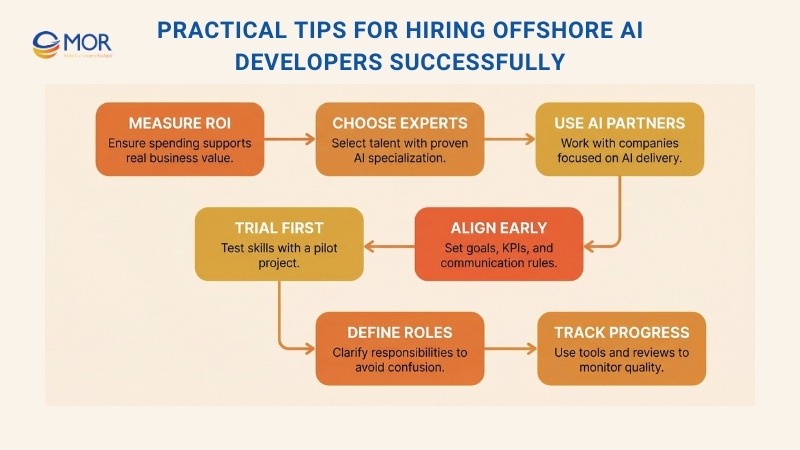
- Evaluate ROI – Look closely at the balance between cost and skill. Each dollar should support clear business value and strong AI performance.
- Look for real AI experts – Choose developers with solid experience in ML, NLP, or computer vision so your solution stays accurate and useful.
- Partner with specialized AI outsourcing companies – Work with groups focused on AI development to gain stable processes, skilled teams, and dependable results.
- Ensure alignment – Set clear goals, KPIs, and communication rules early so remote teams stay on track with your plan.
- Conduct a trial period – Start with a small pilot to check technical ability, teamwork, and fit with your in-house staff.
- Define roles clearly – Assign responsibilities early to prevent overlap, speed up workflows, and support accountability.
- Establish project management frameworks – Use tools like Jira or Asana to keep work transparent and make progress easy to follow.
- Maintain regular communication – Hold steady check-ins and updates to solve issues quickly and keep momentum strong.
- Monitor performance and quality – Run frequent reviews and testing to make sure the work stays stable and long lasting.
These steps help you build strong AI solutions with offshore partners while keeping quality, speed, and performance at a high level.
Why Choose MOR Software for Your Offshore AI Developer Team?
MOR Software gives you a steady, reliable way to grow your AI capabilities without stretching your budget or slowing your roadmap. Our Vietnam software outsourcing teams work across Vietnam, Japan, and global markets, so you gain skilled engineers who understand real product needs and deliver on time.
We cover the full AI cycle. You can bring us an early idea, a half-built model, or a large system that needs support. Our developers handle data pipelines, ML models, NLP tools, computer vision, and integrations with your existing tech stack. You get practical output, not theory.
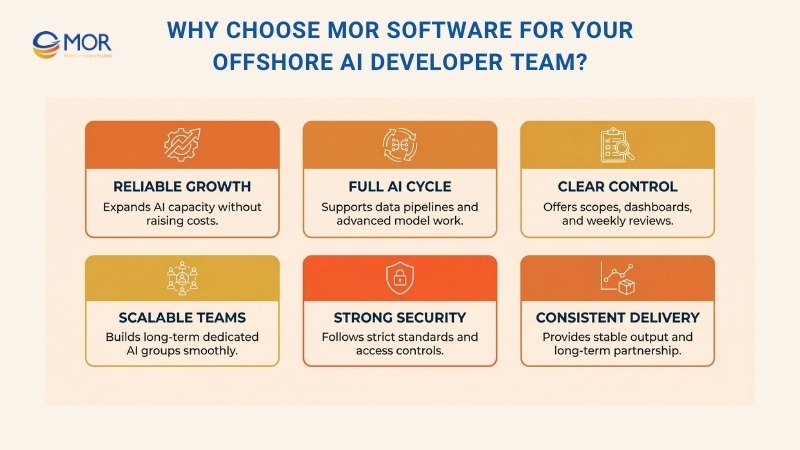
You stay in control. We set clear scopes, create shared dashboards, and hold weekly reviews. This keeps progress visible and makes it easy to adjust priorities when plans shift.
Teams scale smoothly. You can start with one or two offshore AI developers and grow into a long-term dedicated team. We keep onboarding simple, maintain clear documentation, and align our work with your internal processes so there is no disruption.
Security stays tight. Our delivery centers follow ISO-certified workflows, strict access control, and clean handover protocols. You get safe data handling and dependable delivery, which is key for finance, healthcare, and enterprise projects.
The best part is stability. Clients stay with us for years because our developers work with consistency, communicate well, and take ownership of outcomes. You get a long-term partner who supports your product growth rather than a team that just completes tasks.
If you want an offshore AI development team that feels like an extension of your own staff, MOR Software gives you the mix of skill, structure, and steady output that keeps your roadmap moving.
Conclusion
Working with offshore AI developers helps you grow faster, strengthen your tech capacity, and stay competitive without raising costs. The right team brings steady output, clear communication, and long-term value for your product. MOR Software helps you build and scale a reliable offshore AI team with strong skills, secure delivery, and smooth collaboration.
If you want trusted support for your next AI project, contact MOR Software and let our experts guide your roadmap with confidence.
MOR SOFTWARE
Frequently Asked Questions (FAQs)
What does an offshore AI developer do?
An offshore AI developer builds and maintains AI models, data workflows, and automation systems from a remote location. Their tasks often include training models, preparing datasets, and integrating AI features into existing products.
Why do companies hire offshore AI developers?
Businesses hire offshore AI developers to access strong technical talent at lower costs. This setup shortens development time, supports continuous progress, and allows teams to scale quickly.
Are offshore AI developers reliable?
Many offshore AI developers are reliable when they follow structured processes and clear communication practices. Reviewing their past work and confirming their workflow habits helps ensure consistent results.
How much does it cost to hire offshore AI developers?
Costs depend on location, experience, and project complexity. Offshore regions usually charge far less per hour compared to US or European markets, which helps teams budget more effectively.
What skills should offshore AI developers have?
They should understand machine learning frameworks, data engineering tools, cloud platforms, and deployment methods. Strong Python knowledge and experience with model training and evaluation are also important.
How do I manage communication with offshore AI teams?
Teams stay aligned when expectations are set early. Most companies use shared dashboards, recurring check-ins, and overlapping work hours to keep progress steady and avoid delays.
Can offshore AI developers work on sensitive data?
They can, as long as proper security controls are in place. This includes NDAs, access restrictions, encryption practices, and compliance with standards like GDPR or ISO 27001.
What is the difference between offshore and onshore AI developers?
Offshore developers work from another country, often at lower cost. Onshore developers work locally with closer time-zone alignment. The right choice depends on project needs and budget.
How can I evaluate an offshore AI developer before hiring?
You can look at their GitHub projects, technical assessments, past client work, and communication style. Running a small pilot task is an effective way to confirm fit.
Do offshore AI developers handle full AI projects or only specific tasks?
Many offshore AI developers can support full end-to-end AI projects, from data prep to deployment. Others focus on individual components, depending on the engagement model you choose.
Share


Make Our-Dreams Realized


© 2023 . MOR Software. All Rights Reserved
Sitemap
Privacy Policy
Terms of Use

Rate this article
0
over 5.0 based on 0 reviews
Your rating on this news:
Name
*Email
*Write your comment
*Send your comment
1