


Will AI Replace Software Developers or Just Redefine Their Work?
Many teams today wonder will AI replace software developers as AI tools take on more coding tasks and shift how products are built. This MOR Software’s guide will help you understand what is changing, what is not, and how developers can stay strong in an AI-driven future.
Will AI Replace Software Developers?
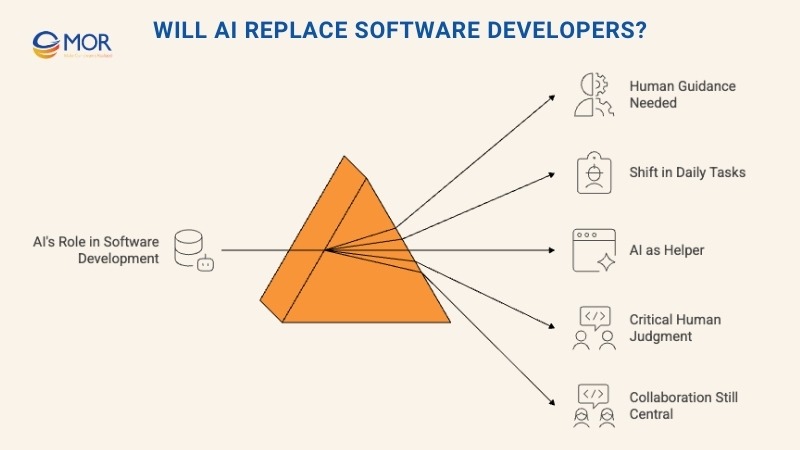
NO, AI will not remove the need for software engineers. Instead, it is already changing how they work each day. It handles simple coding tasks and gives teams more speed. This shift allows engineers to focus on design, deeper problem solving, and guiding these systems. This is why many teams still look at real skills and human judgment when they ask if AI will replace software developers or how future roles will evolve.
How AI Coding Assistants Became Part Of Everyday Development
Will software developers be replaced by AI? This question becomes more common as autonomous AI agents takes a bigger role in daily engineering work. Many teams now use tools like GitHub Copilot and ChatGPT to help write and review code. Recent studies show that nearly two-thirds of developers rely on these assistants in their routine, which naturally leads to deeper conversations about how the future of software development might change.
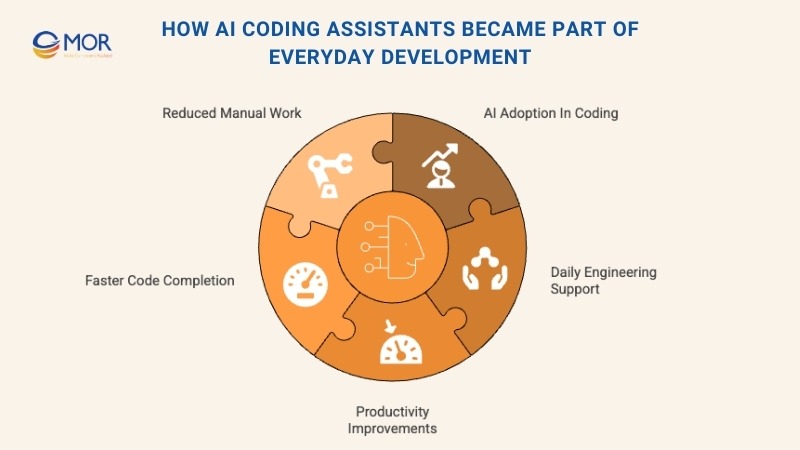
These assistants can fill in missing lines, suggest cleaner logic, spot errors, and even create full functions from a short prompt. For many programmers, this support feels essential. As one engineer shared, “I can’t imagine working without it now”, which shows how quickly these tools have become part of daily work.
The productivity lift is also clear. GitHub Copilot’s research showed that about 30% of its users reported higher productivity. Many developers also saved an average of 4.5 hours per week and wrote cleaner code with fewer mistakes.
GitHub ran another test and found that completion rates reached 78% when Copilot guided the work, compared to 70% without it. These gains point to a real change in how software gets created. Tasks like writing simple code or digging advanced prompt engineering through long documentation without a strong RAG system can be handled by AI so engineers can focus on harder parts of product development.
Concerns About AI Taking Over Software Engineering Jobs
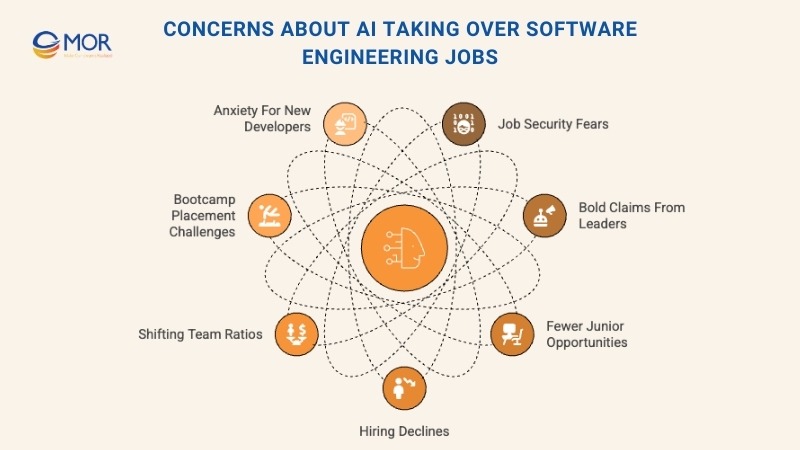
Even with clear productivity gains, the rise of AI in coding has also made many developers worry about long-term job security. Well-known tech leaders have shared strong opinions that add to these concerns and make people question how far AI tools might go as they become more capable.
Mark Zuckerberg, the CEO of Meta, once said that in 2025 “Meta will probably have a mid-level engineer AI that can write code, and over time it will replace human engineers.” Sam Altman from OpenAI also stated that there is a “high probability that AI will replace coding jobs in a gradual but accelerating manner.”
In a 2025 interview, Altman explained that developers may become far more productive with AI in the short term, though he noted that fewer engineers could be needed later. NVIDIA’s CEO Jensen Huang also commented that with powerful multimodal AI models, “coding might be dead in the water”, and he suggested that young people should look at other career paths.
These strong remarks have created bold headlines about a coming “coding collapse”. Many fear that if AI systems can complete a wide range of programming tasks, companies may hire fewer human developers, especially those with limited experience.
Some early signs already appear. In August 2025, Stanford researchers reported that employment for new workers in AI-exposed roles dropped 13 percent over the last three years.
Nicholas Daniel, the CPO of Etsy, mentioned on The Product Podcast:
Our PM-to-engineer ratio has shifted from 1:10 to 1:6. AI is accelerating discovery and delivery. Team design has to evolve with it.
Reuters also shared that hiring new graduates for software positions in 2023 fell by 50% compared to 2019, calling it one of the fastest shifts in any job field. Many coding bootcamps have seen much lower placement rates because AI tools now complete many of the tasks that junior developers once handled.
These changes explain why so many new programmers feel unsure about their future and wonder what kind of career path still makes sense.
Why Will Human Touch Outshine AI?
Will AI replace programmers in 10 years? The honest answer still leans toward the value of human thinking. People bring context, emotion, and real experience into their work, which leads to stronger products and clearer decisions. These qualities, such as creativity, empathy, and sound judgment, do not follow fixed rules, and that is why humans continue to play an important role even as AI grows more advanced.
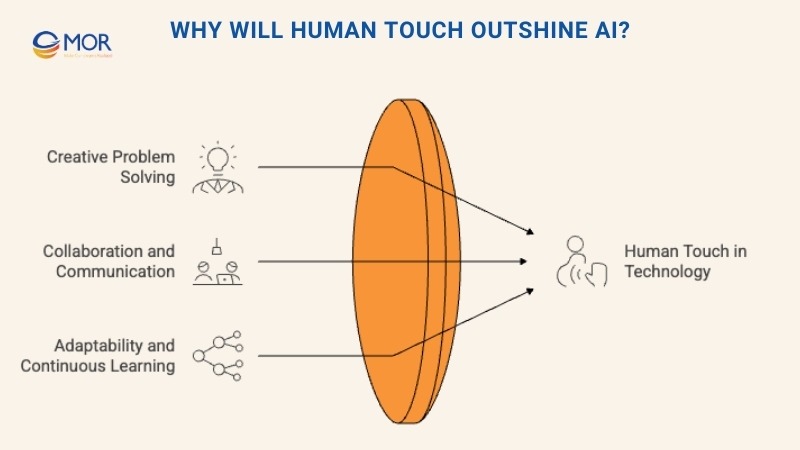
Creative Problem Solving That AI Can’t Replicate
Think about a favorite app or website. It blends logic with design and small ideas that make it feel natural. Engineers do more than write code. They create. They imagine new flows, test new angles, and adjust ideas when users respond in unexpected ways. These actions come from human insight.
AI can help with repeating tasks or checking code, but it does not spark new product directions. It does not form original ideas or understand how people think and feel. An AI coding assistant tool might follow patterns, but real innovation comes from people who connect those patterns in new ways.
It is similar to a kitchen where AI acts like a helpful sous chef that follows steps, while the engineer plays the head chef who chooses flavors, adjusts the dish, and makes something that feels right to the customer.
Collaboration And Communication In Real Teams
Teamwork shapes most software projects, and it reaches far beyond writing code. Real progress depends on open conversations, clear questions, and an understanding of how people think and feel. These parts of the job are hard for any AI to match.
Engineering teams grow when members share ideas, respond to client needs, and adjust plans based on live feedback from users. These moments guide a product toward what people actually want, and they rely on human judgment.
It feels similar to a jazz group where every musician adds a distinct sound. Each person brings something personal to the process, and the full result comes from that mix. AI can support the work, but it cannot create that shared rhythm on its own.
Adaptability And Continuous Learning
Technology moves fast, and developers need to adjust to new tools, languages, and ways of working all the time. Humans handle this shift well because they learn from real projects and carry those lessons into the next challenge.
Many engineers build new skills through courses, hands-on practice, or coding bootcamps that train them to think with speed and flexibility. They can change direction when needed and apply ideas from different experiences.
AI systems improve through updates and new training, but they do not adjust on instinct. They follow the data they are given, while humans can sense when something feels off, explore new paths, and grow with every project they touch.
AI Can Assist, Not Replace Software Developers
Will AI replace software developer jobs? The clearer view shows that offshore AI developers are not being pushed out but are starting to work alongside smarter tools. Many teams already describe these systems as “pair programmers” or virtual helpers because they support daily tasks without taking over the whole job. Most signs point to a future built on partnership, not full replacement, with humans still guiding direction and handling complex decisions.
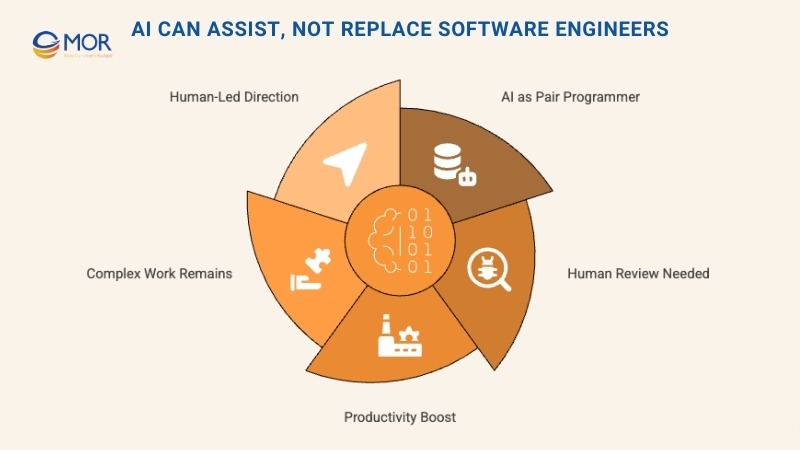
GitHub’s CEO Thomas Dohmke shared that AI may write “80 percent or even 90 percent of code” for a typical build in the future. Humans will still steer the work. They will check the output, correct mistakes, and manage the complex parts that these tools cannot handle.
This shared workflow gives engineers a strong lift in productivity. Many senior developers say that AI adds extra speed and lets them focus on deeper thinking.
For instance, a skilled programmer might use an assistant to create quick code samples or test cases for tasks they already understand well. This frees them to look at the bigger picture, work on system structure, or solve new and harder problems.
How AI Is Reshaping The Software Developer’s Role
AI is not taking away developer jobs, but it is changing what the work looks like. The daily routine for many engineers is shifting toward more planning, checking, and system thinking. There is less focus on typing every line and more focus on guiding how everything comes together. This change also raises questions about will software development be replaced by AI, yet most signs point to a clear shift in tasks rather than a full replacement.
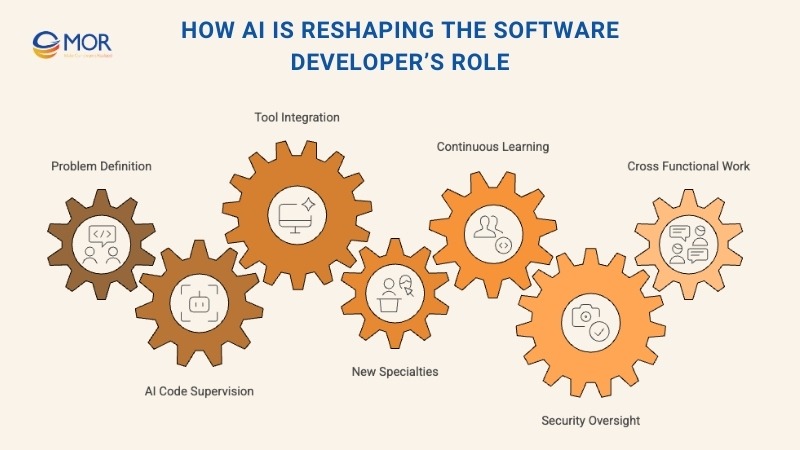
- Problem definition and design: Engineers spend more time understanding what the product should do, working with PMs, and shaping the core structure of the system.
- AI code supervision: They review, test, and improve AI-created code to make sure it stays safe, fast, and correct.
- Integrating multiple tools: Teams combine AI outputs with APIs, agentic AI development solution, libraries, and current platforms.
- New specialties: Roles like AI software engineer, AI product manager, prompt engineer, or AI auditor are appearing in many organizations.
- Continuous learning: Developers keep learning new AI automation tools, models, and best practices as the field grows quickly.
- Security and compliance checks: They watch for mistakes, risks, or hidden biases in AI-generated code.
- Cross-functional collaboration: Teams work more closely with design, product, and business groups to turn AI-supported work into something real and useful.
Overall, software engineering is becoming a mix of coding, product analysis, system thinking, and guiding AI systems so products reach a higher level of quality.
Building A Career That Thrives In An AI Augmented Environment
AI is not removing developers from the field, but it is shifting what makes their work stand out. Engineers who want steady careers must grow their skills, adjust their mindset, and plan for long-term growth. Many still ask if a software developer will be replaced by AI, yet most future paths show that people who adapt will stay in demand.
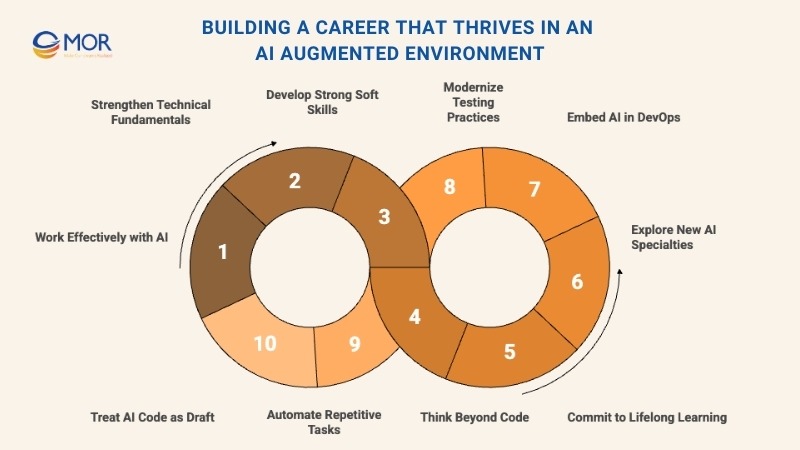
Learn To Work With AI Tools
Developers who grow the fastest are the ones who learn how to work well with AI instead of avoiding it. Tools like GitHub Copilot, GPT models, and Amazon CodeWhisperer already cut down development time on many kinds of tasks.
Engineers should learn how to give clear prompts, fit AI output into real projects, and recognize when the results need human fixes. Those who work smart with these tools will stay ahead.
Strengthen Core Technical Knowledge
AI can write working code, but it can miss edge cases, break security rules, or create slow solutions. Without strong computer science basics, sharp debugging skills, and clear system thinking, it becomes hard to catch these issues.
Developers with firm fundamentals guide AI more easily. They use these tools to extend their abilities, not replace them.
Grow Soft Skills That AI Can’t Replace
As AI handles more repetitive tasks, engineers will spend extra time communicating with cross-functional teams and connecting technical work with business goals. Skills like clear communication, negotiation, and strong product awareness help some developers step into leadership roles while others stay focused only on tasks.
These strengths matter because AI does not add much in these areas. Human judgment, empathy, and the ability to guide a group make you stand out.
Expand Beyond Writing Code
Engineers who plan for the future learn how technical choices shape real product outcomes, not outputs. This includes knowing how features change the product experience, how design affects scale, and how business limits guide decisions.
This kind of thinking also makes it easier for developers to shift into new roles. Many move toward pivots into product management, where combining technical skill with business insight becomes a big advantage.
Commit To Constant Upskilling
Generative AI keeps moving forward fast. Tools that look new and exciting today can feel outdated in a short time. Engineers need a steady habit of learning to stay ready for these changes. They must follow new frameworks, test emerging AI tools, and understand how these systems work behind the scenes.
This kind of flexibility has always helped strong engineers stand out. The difference between fast learners and everyone else will grow even more in the AI era.
Explore New AI Focused Specialties
AI is opening many new career paths. Developers can expand into machine learning work, move toward AI product management, or study skills like prompt engineering and AI auditing. These roles were rare only a few years ago, but they now shape many modern teams.
Gartner predicts that by 2027, 80% of engineers will need to build new skills to work well with AI. The rise of roles connected to AI governance, compliance, and system oversight shows how much the field is growing.
Bring AI Into DevOps Workflows
AI is reshaping how release engineering works. CI agents can now sort flaky tests, label failures, and suggest fixes for broken pipelines. When teams mix these tools with trunk-based development, feature flags, and canary or blue-green releases, the process becomes faster and safer.
Teams can measure the results with DORA metrics, including deployment frequency, lead time for changes, change failure rate, and mean time to restore. These numbers show how much AI can lift delivery speed and stability.
Modernize Testing With AI
Testing now goes far beyond basic unit tests. AI can help create deeper test plans, boundary checks, property-based tests, and fuzz inputs. Mutation testing is also a strong way to measure how effective current tests really are. Service teams often rely on consumer-driven contract tests to keep shared systems stable.
For data-focused products, engineers check schemas and drift. For UI, they use AI-supported visual comparisons and accessibility reviews. Humans still guide the final decisions, especially on key flows and security steps.
Automate Repetitive Engineering Work
AI agents can handle many small but time-consuming engineering tasks. They can open dependency pull requests, fix simple lint issues, strengthen IaC templates, update SDK clients from OpenAPI files, backport minor patches, and gather release notes from merged work.
It is best to begin with low-risk tasks that are easy to undo. Keep controls in place with code owner reviews, signed commits, and required checks before anything is merged.
Treat AI Generated Code As A Starting Point
Generative code should act as a base layer rather than a finished solution. It works well for CRUD logic, API clients, migrations, telemetry setup, or basic test files.
To keep quality high, use guardrails like repository prompts, style rules, license checks, secret scanning, and supply chain reviews such as SAST or dependency policies.
For safer runtime behavior, rely on typed templates, controlled decoding, or pattern libraries. These steps help the generated code stay aligned with your architecture and quality standards.
Conclusion
Will AI replace software developers or simply reshape how they work? Most trends point toward a future where AI handles routine tasks while humans guide the vision, solve complex problems, and bring creativity that machines cannot match. Developers who keep learning and adapt to new tools will stay valuable. If your team wants to build smart, future-ready products, contact MOR Software. We are ready to support your next project with the right expertise.
MOR SOFTWARE
Frequently Asked Questions (FAQs)
Will AI completely replace software developers?
No. AI can automate repetitive coding tasks, but it cannot replace human judgment, creativity, and problem solving. Developers guide architecture, strategy, and final decisions.
What parts of a developer’s job can AI automate?
AI can help with boilerplate code, bug detection, documentation, test generation, and basic refactoring. These tasks free developers to focus on deeper technical work.
Will AI reduce the demand for junior developers?
It may change entry-level expectations. Companies want juniors who can work alongside AI tools, review AI output, and understand core fundamentals.
How can developers stay relevant as AI improves?
Strengthen fundamentals, learn AI-assisted workflows, improve communication skills, and build product thinking. Developers who adapt will remain in high demand.
Is AI good enough to build full software applications on its own?
AI can create prototypes or draft components, but it struggles with large-scale systems, security, architecture, edge cases, and long-term maintenance.
What skills will matter most in an AI-driven development future?
System design, debugging, architecture, cross-team communication, security awareness, and the ability to validate AI-generated code.
Will AI make programming easier to learn?
Yes. AI tools help beginners understand syntax, structure, and logic faster. But learning fundamentals is still essential for producing reliable software.
Which developer roles are least likely to be replaced?
Roles requiring deep system knowledge, product decisions, or complex architecture, like senior engineers, solutions architects, and DevOps specialists.
Can AI create secure and production-ready code?
Not without human oversight. AI may introduce vulnerabilities or incorrect assumptions, so developers must review, test, and enforce security standards.
Should aspiring developers still pursue a career in software engineering?
Absolutely. Demand for software skills continues to grow. AI changes how developers work, but it also opens new roles in AI engineering, automation, and systems integration.
Share


Make Our-Dreams Realized


© 2023 . MOR Software. All Rights Reserved
Sitemap
Privacy Policy
Terms of Use

Rate this article
0
over 5.0 based on 0 reviews
Your rating on this news:
Name
*Email
*Write your comment
*Send your comment
1