


Top 50 Agentic AI Use Cases for Enterprise Across Industries 2026
Agentic AI use cases are moving from lab tests into real enterprise work, but many teams still struggle to pick the right workflow, control risk, and connect AI agents with daily systems. This MOR Software’s guide explores the top 50 use cases of Agentic AI across industries and shows where enterprise AI applications can create real business value.
Key Takeaways
- Agentic AI use cases work best in repeatable workflows with clear rules, trusted data, and defined approval points.
- AI agents can support customer service, retail, software development, HR, finance, banking, healthcare, telecom, manufacturing, logistics, legal, and knowledge work.
- Businesses should start with a guided AI agent, measure trust in daily work, and scale only when the workflow is stable.
Why Are Businesses Prioritizing Agentic AI Use Cases In 2026?
Agentic AI use cases are built around goal-driven systems that can plan steps, choose actions, and complete multi-stage work under clear rules, access limits, and approval paths.
Common use cases for agentic AI include document handling, customer service tasks, IT and back-office work, work-order creation, and selected operations in logistics, fintech, and EdTech. In many companies, the rollout begins with one agent that supports a current team, then grows into connected agent workflows across wider departments.
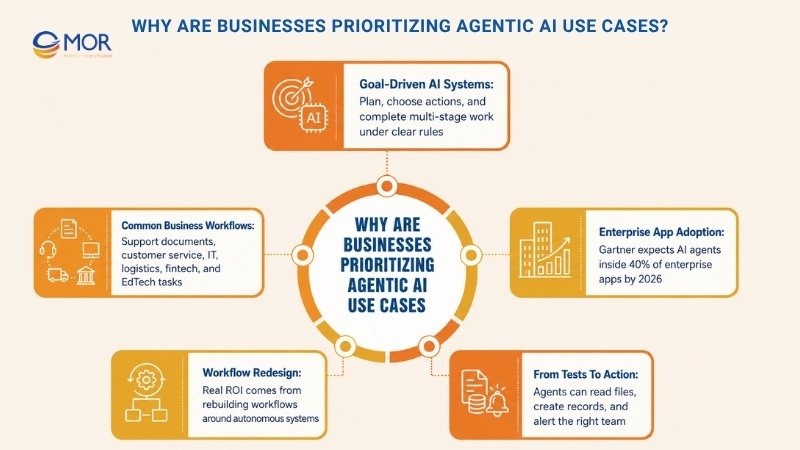
Gartner predicts that 40% of enterprise apps will include AI agents by the end of 2026, compared with less than 5% in 2025. That signals a major change in the way enterprise software runs.
But the companies getting real value tend to share one clear pattern: they are not only automating single tasks. To gain real results from AI, teams need to rebuild workflows around autonomous systems. Instead of asking AI to summarize files, a business may use an agent that reads documents, pulls out key fields, creates system records, and alerts the right team. That gap separates teams gaining AI ROI from teams still stuck in test projects.
Best Agentic AI Use Cases By Industry And Business Function
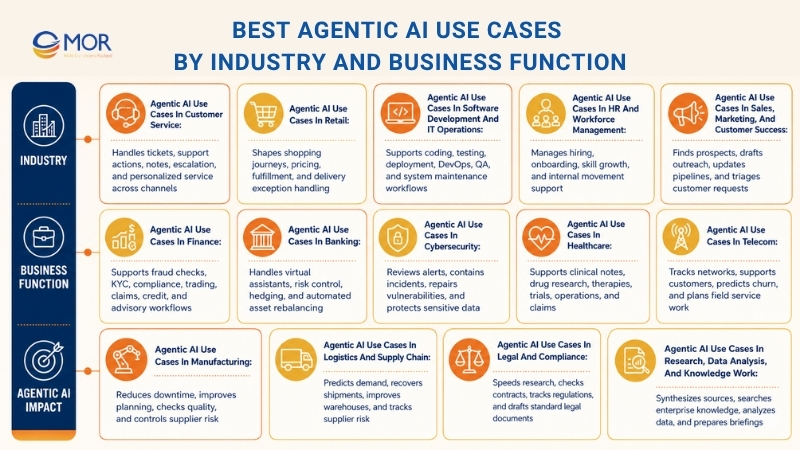
The strongest agentic AI business use cases often sit inside repeatable work with clear data, rules, and approval points. These business applications of AI agents are most useful when teams need to act across systems, not just receive a text answer.
Agentic AI Use Cases In Customer Service
Agentic AI use cases in customer service work well because support teams deal with repeat questions, hard tickets, product faults, refunds, renewals, and account updates every day. Instead of replying like a basic chatbot, an AI agent can read intent, connect to business tools, complete approved actions, and hand the case to a person with full history when needed.
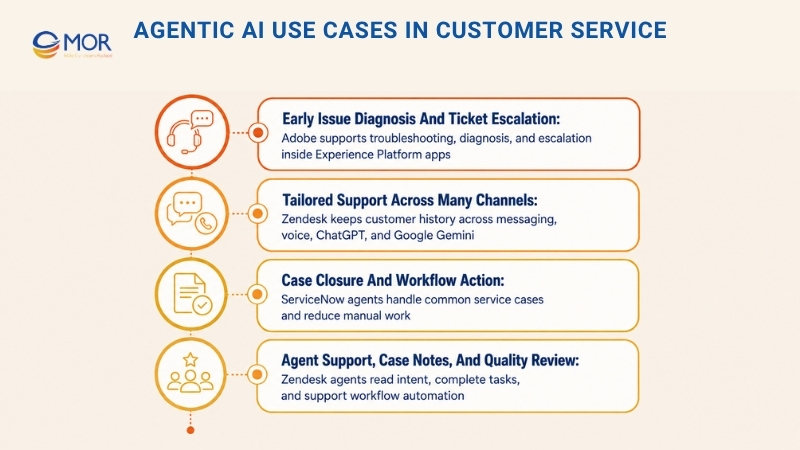
Early issue diagnosis and ticket escalation
Support work often gets delayed when agents must ask many basic questions before they know what went wrong. Agentic systems can lead customers through checks, search product guides, review account or device data, and gather the right details before a support rep steps in.
Say a customer says a software function has stopped working, the agent can ask focused questions, compare the issue with known bugs, inspect setup data, and suggest possible fixes. If automation cannot close the issue, the agent can open a ticket with the full case trail, covering what the customer tested, what did not work, and which proof was collected.
Live company example: Adobe Product Support Agent, powered by Adobe Experience Platform Agent Orchestrator, supports teams with troubleshooting, diagnosis, and escalation inside Adobe Experience Platform apps. Adobe presents it as an interactive support agent built to help teams improve resolution speed and operating flow.
Tailored support across many channels
Customers want support teams to know their past issues, choices, purchases, subscriptions, and account history. Agentic AI can bring those details into one view and shape the service flow based on the customer’s link with the brand.
Say a repeat buyer reaches out, the agent can check earlier orders, open tickets, loyalty level, renewal dates, and past complaints. It can then suggest the best fix, point to the right product choice, or remind the customer about a coming renewal. This gives customers a more personal support flow without asking human agents to search through many tools.
Live company example: Zendesk has grown its AI agents across messaging, voice, ChatGPT, and Google Gemini. Its newer agent tools aim to keep customer history across channels and devices, so a support chat does not restart when a customer moves to another platform.
Case closure and workflow action
Many support tickets are repeated, yet they still need updates inside company systems. Agentic AI can manage these cases from start to finish when the rules are fixed. This can cover access reset, plan changes, return handling, order checks, delivery edits, or refund requests that need approval.
Say a customer asks to update a delivery address, the agent can confirm identity, check if the order can still be edited, change the shipping record, send a message, and update the CRM. If the parcel has already left the warehouse, the agent can route the case with the right reason and the available choices.
Live company example: ServiceNow Customer Service Management AI Agent Collection includes prebuilt AI agents and workflows for common service cases. ServiceNow says these agents are made to cut manual work, move cases faster, and free human agents for higher-value work.
Agent support, case notes, and quality review
Agentic AI can also help human support teams move faster. During a chat, the agent can sum up the issue, draft replies, suggest the next action, find policy details, and prepare follow-up messages. After the chat ends, it can write case notes, fill CRM fields, tag the ticket, and mark possible quality gaps.
This helps busy support teams because agents often spend too much time moving between tabs, reading old chats, and writing the same type of notes. With agentic systems, people can focus on judgment, tone, and sensitive cases while AI handles the background work.
Live company example: Zendesk frames its AI service platform around full issue handling, with agents that read intent and sentiment, complete tasks across channels, and learn from customer chats. Zendesk also says its AI agents can support up to 80% automation in support workflows, but each business should test that claim against its own ticket types and rules.
Agentic AI Use Cases In Retail
Agentic AI use cases in retail now go far past simple product suggestions. These agents can take on larger parts of the buying journey, changing how they act based on customer needs and market signals.
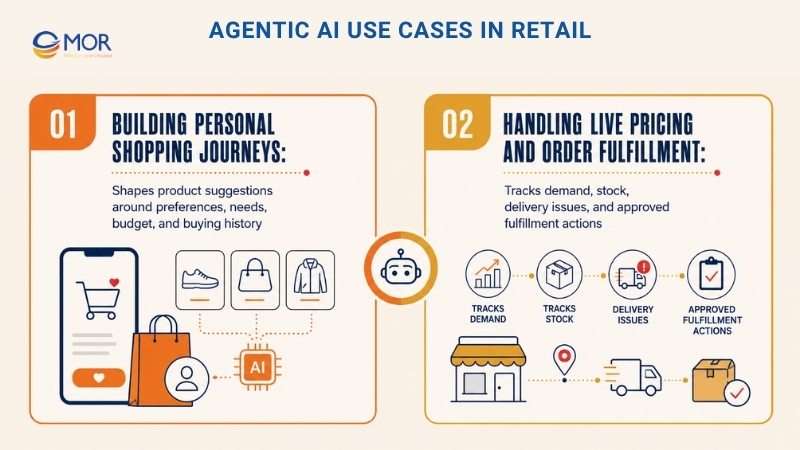
Building personal shopping journeys
Older AI tools recommend products based on recent clicks, but agentic AI can work more like a personal shopper. It does not only show related items; it can understand what the shopper wants to achieve. AI agents can shape product suggestions and full shopping paths around preferences, browsing habits, and buying history.
Say a customer is preparing for a hiking trip, some AI agents can check the destination weather, review past size choices, and use the customer’s budget to build a full gear list. If the customer asks, “Will these boots arrive before Friday?” the agent does not only answer “yes,” it checks many background items before replying. The agent can review nearby warehouse stock, confirm delivery windows, and hold the item for a short time while the customer decides. This active support turns a fixed product catalog into a more helpful, goal-led shopping flow.
This personal shopping support can continue across the whole journey. As shoppers browse, add items to carts, or leave without buying, agents can update recommendations in response. The journey feels less like browsing a fixed catalog and more like speaking with a shop assistant who remembers what matters.
Handling live pricing and order fulfillment
Behind the store view, AI agents can manage hard operations that often need human staff watching them all day. In high-volume retail, prices and stock can change within minutes.
- Demand-based pricing control: Instead of having staff change discounts by hand, agents can track competitor prices and local demand. If one product is trending on social media but stock is low, the agent can raise margin through a price change. If stock is sitting still in one area, the agent can start a local campaign to move items out of the warehouse.
- Delivery exception handling: Logistics agents can manage work from order placement through delivery. This can include stock updates across channels, route choice, and partner coordination. These agents are useful for exceptions. Say a storm slows a shipment, the agent can find each affected buyer. It can reroute the parcel through another hub or send a message with a discount for the next order after the delay. When a manager checks the report later, the agent has already listed the affected orders, suggested fixes, or taken approved action.
This shift helps eCommerce brands grow without adding staff for every price update or delivery issue. The team spends less time watching the store and more time building the business.
Agentic AI Use Cases In Software Development And IT Operations
Agentic AI use cases in SDLC fit well because software teams already work with tickets, code reviews, tests, logs, and deployment rules. These AI-driven workflows can help teams move through repeated engineering tasks without taking control away from senior reviewers.
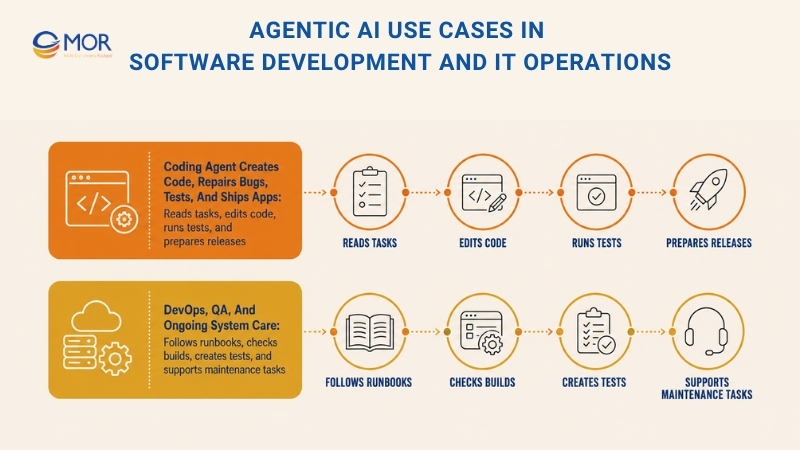
Coding agent creates code, repairs bugs, tests, and ships apps
Software delivery often has clear inputs and outputs. That makes it a good match for agent-based work. A coding agent can read a task, review a repository, and suggest a fix. It can then create code, change tests, and open a pull request.
After that, it can run unit tests and static checks. Then it can repair failed checks and try again. At the end, it can prepare a release package and start a deployment process. People still check risky changes. But the agent handles the dull repeat work that slows teams down.
Teams see stronger results when rules are set at the start. Say they restrict which folders an agent can change. They can also require test results for every update. With these limits, the agent works like a tireless junior developer that follows the same process every time.
DevOps, QA, and ongoing system care
DevOps and QA teams often depend on runbooks. Agents can follow those instructions step by step. A build agent can spot a failed build, scan logs, and point to the likely cause. It can also roll back a release when error rates go above a set limit.
In testing, an agent can turn user stories into test cases. It can run automated test suites, create bug tickets, and attach proof. In maintenance, the agent can rotate keys, update dependencies, and check if services still run after changes.
This is not magic. Teams still need clear monitoring, clean delivery pipelines, and tight access control. But once those basics are in place, agentic automation turns routine operations into a much faster loop.
Agentic AI Use Cases In HR And Workforce Management
AI agent use cases in HR are moving beyond simple employee records into active workforce support. Agentic AI can help HR teams manage internal tasks while making the employee journey feel more guided over time.
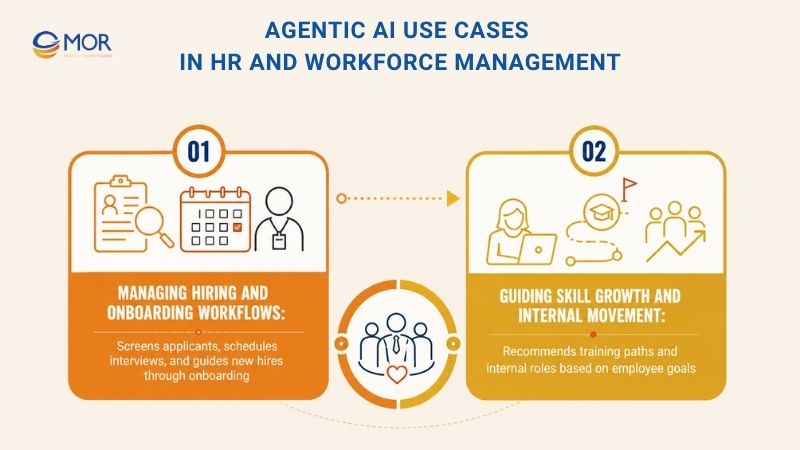
Managing hiring and onboarding workflows
Hiring includes many repeated steps that once needed constant manual checks. AI agents can manage parts of the recruitment process, cutting admin work while making the experience smoother for hiring managers and candidates.
When a new role opens, an agent can compare hundreds of resumes against the job needs. It can rank strong applicants based on skills, background, and hiring rules. The agent does more than mark a name; it can run early assessments and arrange interview times across calendars.
After a new hire starts, the agent can move into onboarding mode and create a custom 30-day plan for the department. It walks the employee through documents, sets up system access, and connects them with the right people, so no onboarding step gets missed.
Guiding skill growth and internal movement
After hiring, agents can support employees like active career guides. Instead of making staff search old internal portals for growth options, agents can match people with open needs inside the company.
An agent can review an employee’s skills and work history to suggest training paths or internal jobs that fit their goals. Say an employee wants to move toward leadership, the agent can show useful courses and alert them when a junior manager role opens in another team. This creates a more active internal talent market where employees feel guided, which can support stronger retention.
Agentic AI Use Cases In Sales, Marketing, And Customer Success
Agentic AI use cases can support revenue teams because sales, marketing, and customer success depend on many small steps across tools. These agents can help teams move from research to action faster while still leaving high-value calls and decisions to people.
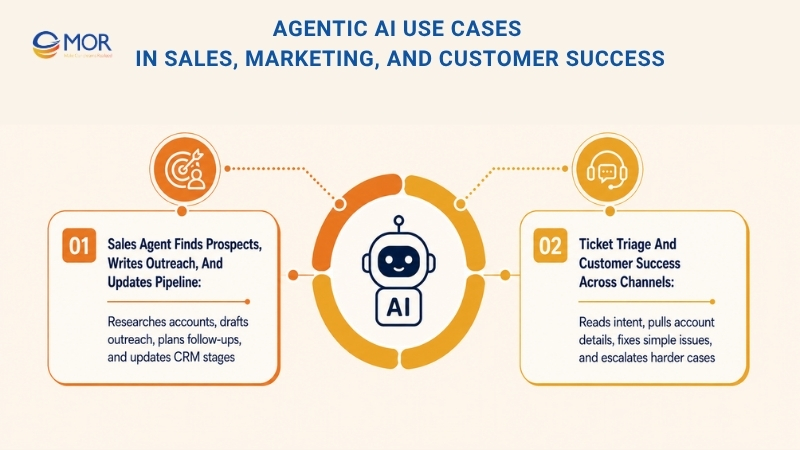
Sales agent finds prospects, writes outreach, and updates pipeline
Sales work includes many small jobs. Reps search for accounts, enrich contacts, draft emails, and log updates. An agent can complete these steps in order. It can also change the message based on signals from the company.
One sales workflow may scan a target list, remove poor-fit accounts, and write outreach for each group. Then it can plan follow-ups and update the CRM stage once a prospect replies. This lets reps spend more time speaking with buyers and less time jumping between tabs.
Marketing teams can use agents for campaign work too. The agent can write a brief, create a first draft, and send it for review. It can then publish content and watch early performance signals.
Ticket triage and customer success across channels
Customer success teams often handle many incoming requests. Agents can read intent, pull account details, and suggest the next step. They can also draft replies that follow company rules.
Then the agent can complete simple fixes, like changing a plan or resetting access. For harder cases, it can sort the issue and send it to the right person. It can also summarize the history, so the human teammate does not begin with no background.
These workflows work best when teams write clear escalation rules. They also need plain rules for refunds, renewals, and data changes. Once that setup exists, an agent can become a trusted first-line helper across chat, email, and in-app support.
Agentic AI Use Cases In Finance
Agentic AI use cases in finance are growing because financial teams work with high data volume, strict rules, and repeated review steps. These systems can support fraud teams, risk teams, claims teams, and analysts when every action has a clear rule and audit trail.
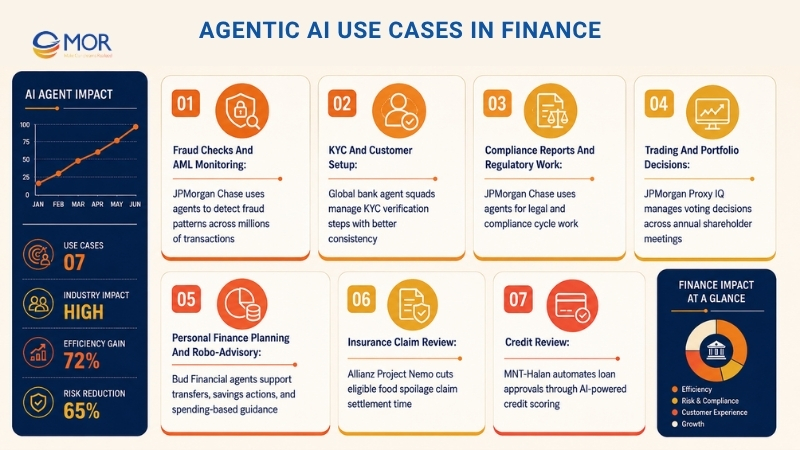
Fraud checks and AML monitoring
Fixed fraud rules struggle to match changing attack methods. Once a rule is added, bad actors may already be using a new pattern.
An agentic AI solution for fraud checks and AML work can watch transactions in real time, find unusual behavior, block or flag risky activity, and adjust detection logic when new warning signs appear.
Company case: JPMorgan Chase runs AI agents that detect fraud patterns across millions of transactions on their own, adjusting to new threats without waiting for manual rule changes.
KYC and customer setup
Manual Know Your Customer reviews slow down onboarding, create uneven checks, and raise compliance risk at large scale.
An agentic AI solution for KYC and onboarding can read identity documents, compare customer data with sanctions lists and watchlists, spot mismatches, and approve or escalate applications.
One related case: A global bank’s “agent factory” manages KYC with 10 agent squads, with each squad responsible for one verification step. That setup improves output quality and consistency in a measurable way.
Compliance reports and regulatory work
Compliance teams often collect data from many tools before they can create regulatory filings.
An agentic AI solution for compliance and reporting can pull data from trading tools, risk databases, and finance records, prepare audit-ready reports, flag rule breaches, and refresh outputs when regulations change.
Company case: JPMorgan Chase uses agentic AI for legal and compliance tasks with agents that plan, find issues, adjust plans, and produce final outputs. The company reports up to 20% gains in compliance cycle work.
Trading and portfolio decisions
Human traders cannot watch and act on every market signal at the speed and size needed across large portfolios.
An agentic AI solution for trading and portfolio work can track live market data, run trades within set risk rules, change portfolio allocation as market conditions shift, and keep assets balanced over time.
JPMorgan Asset Management replaced outside proxy advisors with its own Proxy IQ platform. It works as an agent that manages voting decisions and reviews data across more than 3,000 annual shareholder meetings.
Personal finance planning and robo-advisory
Older robo-advisors often follow fixed schedules. They rebalance at set times, not based on a customer’s real financial behavior or live needs.
An agentic AI solution for personal finance planning can learn each customer’s money habits, move funds between accounts to avoid overdrafts or capture better interest, and guide customers toward their financial goals.
Company case: Bud Financial, a UK fintech, launched a financial data system with agentic features that can start transfers, improve savings actions, and adjust to each customer’s spending behavior in real time.
Insurance claim review
Claims work is often slow and manual. It causes customer frustration and creates workflow blocks, especially for simple cases that do not need investigation.
An agentic AI solution for insurance claims can check policy coverage, review evidence from photos and documents, find possible fraud signs, and approve standard claims for payout.
Company case: Allianz launched Project Nemo in Australia, using a seven-agent system for food spoilage claims that cut settlement time from several days to less than one day for eligible cases.
Credit review
Loan reviews are often slow, uneven, and too dependent on manual work. This delays customers and creates processing blocks for lenders.
An agentic AI solution for credit underwriting can pull credit bureau data, check documents, compare applicant risk against scoring models, and make early approval decisions, including instant micro-loan approvals for simple cases.
Company case: MNT-Halan, Egypt’s leading fintech, launched an AI-powered credit scoring engine that automated more than 50% of loan approvals and reached a 60% approval rate for users who were previously hard to score.
Agentic AI Use Cases In Banking
Agentic AI use cases in banking deserve a separate view because banks deal with high-trust workflows, large customer volumes, and strict approval rules. Banking agents can help with support, risk scanning, treasury tasks, and portfolio actions when every step is logged.
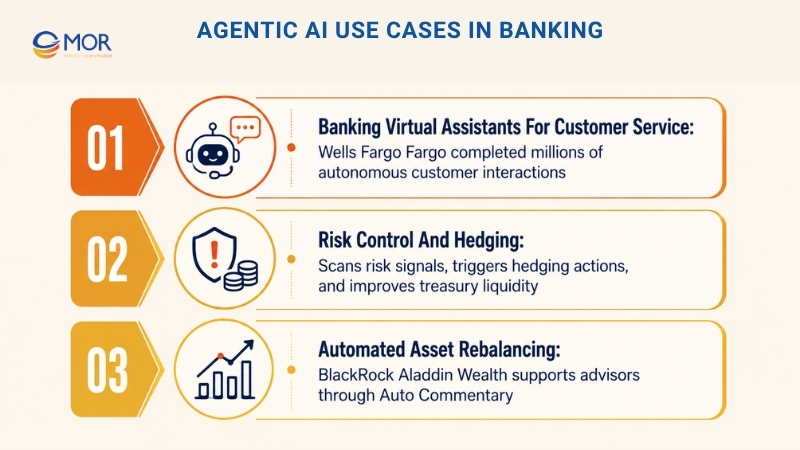
Banking virtual assistants for customer service
Bank customers want round-the-clock help for multi-step requests, but human teams cannot always meet that demand at scale.
An agent in banking can manage complex requests from end to end: it gathers customer details, checks transaction records, applies policy, completes actions like dispute filing or account updates, and confirms the result.
Company case: Wells Fargo said its virtual assistant Fargo completed more than 242 million fully autonomous customer interactions, handling complex tasks that once needed human agents while learning from each exchange.
Risk control and hedging
Risk changes faster than analysts can review, which leaves banks exposed to market shifts, credit events, and operating failures between review cycles.
An agentic AI solution for risk control can scan market risk, credit risk, and operating risk in real time, trigger hedging trades when exposure passes set limits, and improve treasury liquidity by moving funds across accounts and currencies for better yield.
Automated asset rebalancing
Portfolio drift happens all the time, but manual rebalancing is often scheduled, slow, and weak at handling live tax or execution cost choices.
An agentic AI solution for asset rebalancing can watch portfolio drift and market signals, run buy and sell orders to keep target allocations, and plan trades to lower tax burden and execution costs.
Company case: BlackRock Aladdin Wealth launched Auto Commentary, a GenAI tool for wealth advisors. The first client to use it was Morgan Stanley Wealth Management, which added it to its Portfolio Risk Platform in October 2025.
Agentic AI Use Cases In Cybersecurity
Cybersecurity teams face too many alerts, too little time, and constant pressure to act fast. Agentic AI use cases examples in this area show how agents can review signals, connect evidence, and guide response work before risk spreads.
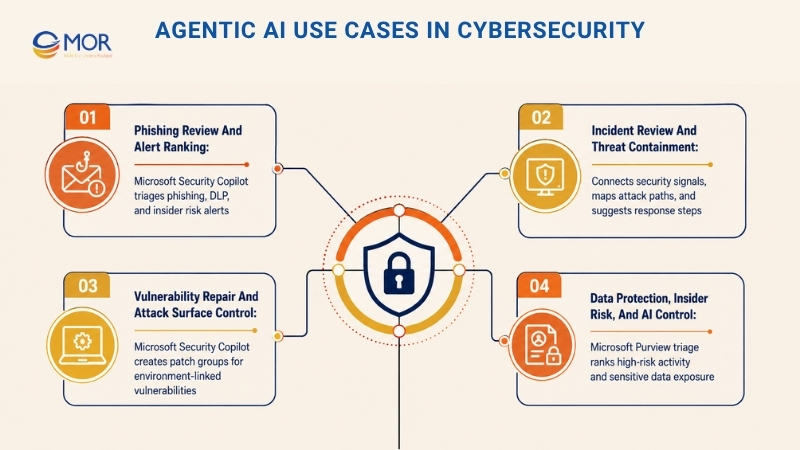
Phishing review and alert ranking
Security teams get thousands of alerts from email, endpoint, identity, cloud, and collaboration platforms. Some alerts carry little risk, some repeat the same issue, and some lack the right details for fast action. Agentic AI can support analysts as it checks suspicious emails, reviews sender trust, reads message text, studies links or files, and decides if a human needs to review the alert.
For example, Microsoft Security Copilot includes agents that can triage phishing events, data loss prevention alerts, and insider risk signals with little manual input. Microsoft also says these agents can add context to incidents, group alerts, and help analysts handle the most urgent work first.
Incident review and threat containment
When a real breach occurs, analysts must pull proof from many tools. This may include endpoint logs, user actions, identity records, network traffic, file access logs, and cloud warnings. An agentic AI system can review these signals in order, link related events, map possible attack paths, and suggest the next response move.
For example, if malware activity shows up on one device, the agent can check if the same account opened sensitive files, if odd sign-ins took place, and if similar behavior appeared on other endpoints. It can then suggest steps like isolating the device, blocking a bad IP address, turning off a risky account, or sending the case to a senior analyst.
Vulnerability repair and attack surface control
Vulnerability work can create more tasks than security teams can finish by hand. Agentic AI can read vulnerability feeds, compare threats with the company’s real systems, group affected assets, and rank the issues that need action first. Instead of treating every weakness the same way, the agent can weigh exploit status, asset value, exposure, patch level, and business risk.
Microsoft Security Copilot agents include a Vulnerability Remediation agent that creates patch groups for public vulnerabilities tied to the customer’s environment. Microsoft also lists Threat Intelligence Briefing and Conditional Access Policy Drift agents as proactive security agents.
Data protection, insider risk, and AI control
Agentic AI can also help protect sensitive data. These agents can inspect private files, spot risky sharing, detect possible insider risk, and rank alerts based on content risk, data leak risk, user risk, and policy risk. This matters when staff share files outside the company, remove labels, move confidential records, or use unapproved AI tools.
The Microsoft Purview triage agent can find and rank high-risk activity, review content and possible intent, and explain why an alert falls into a certain category. Microsoft also says its data security posture agent can help find sensitive data across documents, emails, messages, and Copilot activity.
Agentic AI Use Cases In Healthcare
Agentic AI use cases in healthcare stand out because hospitals, clinics, and life sciences teams deal with heavy documentation, complex patient records, manual research, and time-sensitive work. Menlo Ventures reported that ambient scribes became healthcare AI’s first breakout segment in 2025, reaching $600 million in revenue with 2.4x year-over-year growth.
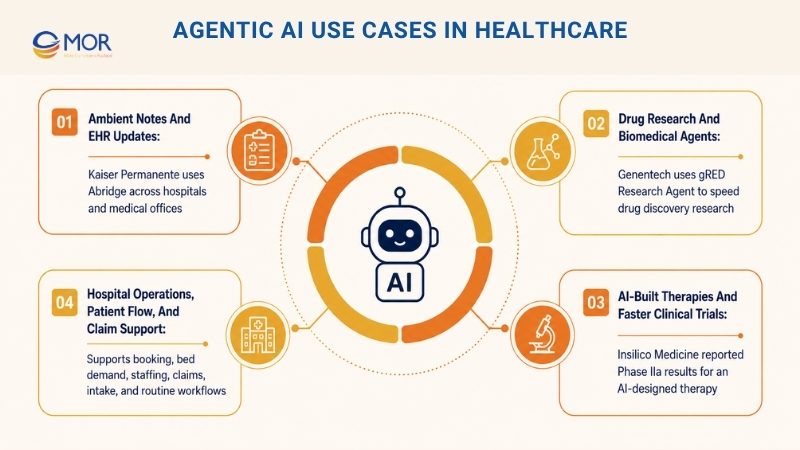
Ambient notes and EHR updates
Doctors spend much of the day writing notes, updating patient files, and finishing records after each appointment. Agentic AI can listen to doctor-patient talks, pull out key medical details, draft clinical notes, and update electronic health records for human review.
Live company example: Kaiser Permanente deployed Abridge across 40 hospitals and more than 600 medical offices. The tool helps clinicians create medical notes from patient conversations, which cuts manual charting and gives doctors more time with patients.
Drug research and biomedical agents
Drug discovery requires teams to read research papers, compare biological targets, study trial data, and build research ideas. Agentic AI can split this work into smaller steps, search internal and external sources, sum up findings, and suggest possible research paths.
Live company example: Genentech built the gRED Research Agent with Amazon Bedrock Agents and Anthropic Claude 3.5 Sonnet to cut manual research search time and move drug discovery work faster. AWS says the agent helps researchers find drug targets and plan studies with less delay.
AI-built therapies and faster clinical trials
Agentic AI can assist drug teams as they create molecules, test possible targets, predict biological activity, and refine candidates before clinical trials. This helps life sciences teams cut early trial-and-error work that often slows drug development.
Live company example: Insilico Medicine shared positive Phase IIa results for ISM001-055, also called rentosertib, an AI-designed therapy for idiopathic pulmonary fibrosis. A 2025 Nature Medicine paper described it as a first-in-class AI-generated small-molecule inhibitor tested in a Phase IIa clinical trial.
Hospital operations, patient flow, and claim support
Hospitals also use AI agents for daily operations, not just clinical choices. These agents can support appointment booking, bed demand prediction, staff planning, coverage questions, claim status checks, and patient intake. In care settings, agents can help screen patients, summarize histories, and surface risk signals before clinicians review the case.
This use case matters because many healthcare delays come from admin work, not direct care. An agent can keep routine workflows moving, then send sensitive or complex cases to doctors, nurses, billing staff, or insurance teams when human judgment is needed.
Agentic AI Use Cases In Telecom
Agentic AI use cases in telecom matter because providers manage large networks, demanding customers, outages, billing problems, and field service work at scale. Agentic AI can help telecom teams shift from late support to live monitoring, quicker incident response, and more personal customer care.
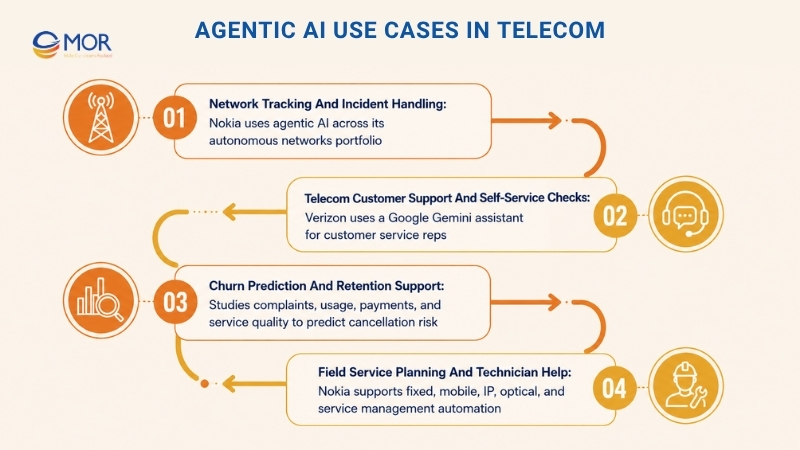
Network tracking and incident handling
Telecom networks produce huge amounts of traffic, latency, outage, device, and service quality data. Agentic AI can watch these signals all the time, detect strange patterns, locate likely causes, create incident tickets, and suggest repair steps.
A network operations agent can find service decline before customers report it. It can then review related network KPIs, locate the affected area, rate the service risk, and send a detailed ticket to the right engineering team.
Live company example: Nokia has added agentic AI functions across its autonomous networks portfolio. Nokia says its AI-led approach can help communications service providers cut manual work and reduce the time between a threat appearing and removal from the network from days to minutes.
Telecom customer support and self-service checks
Telecom support teams often deal with billing questions, plan checks, connection tests, service resets, and technical help. Agentic AI can walk customers through these steps without making them repeat the same details across channels.
A telecom support agent can check the customer’s plan, review service status, run line tests, reset simple settings, and escalate harder cases with the full support record attached. This can cut call handling time and give human agents better background before they step in.
Live company example: Verizon deployed a Google Gemini-based AI assistant for customer service reps. Reuters reported that the tool uses about 15,000 internal documents, helped reduce call time, and supported a nearly 40% sales increase after full rollout in January 2025.
Churn prediction and retention support
Telecom users may cancel after repeated outages, poor service quality, billing errors, weak plan fit, or stronger competitor offers. Agentic AI can study usage patterns, complaints, payment behavior, support history, and network experience to find customers likely to leave.
The agent can then suggest retention steps, create tasks for sales or customer success teams, and recommend tailored offers. This helps telecom providers reach customers before they cancel.
Field service planning and technician help
Telecom field teams must manage installation requests, repair visits, technician routes, customer updates, and urgent reassignment when delays appear. Agentic AI can review repair jobs, check technician schedules, plan routes, update appointment times, and move jobs when field conditions change.
Nokia’s autonomous network message also covers fixed and mobile access, IP, optical, data center, and service management, with systems built to sense, think, and act through AI and automation.
Agentic AI Use Cases In Manufacturing
Agentic AI use cases in manufacturing fit factories that deal with equipment downtime, late production, quality issues, inventory shortages, and supplier risk. Agentic AI can link shop-floor data, planning systems, inspection results, and supplier records so factories can run with fewer breaks.
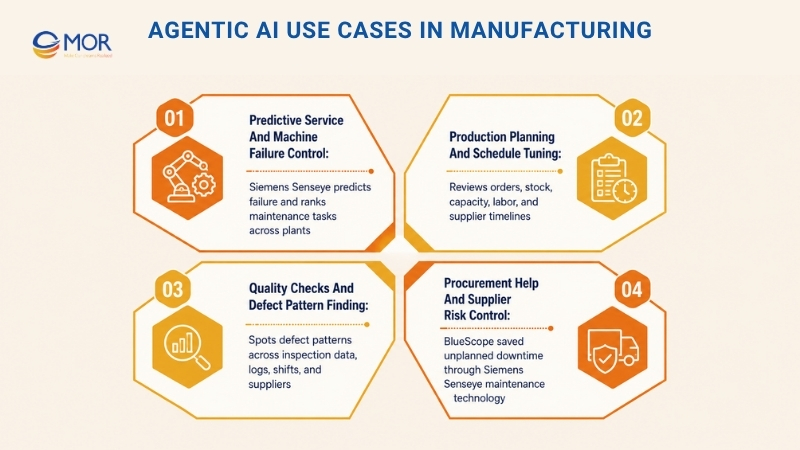
Predictive service and machine failure control
Sudden machine failure can stop the line, delay orders, and raise repair cost. Agentic AI can watch equipment sensor data, catch early failure signs, open maintenance tickets, suggest repair windows, and help teams cut downtime.
Live company example: Siemens Senseye Cloud Application uses AI and current machine data to predict equipment failure, show risk, estimate remaining useful life, and rank maintenance tasks across plants. Siemens says the system can support many assets, sites, and teams.
Production planning and schedule tuning
Production planning asks teams to balance orders, stock, machine capacity, labor, and supplier timelines. Agentic AI can review these inputs, change schedules when demand or supply shifts, and flag bottlenecks before they slow output.
A planning agent can check if a rush order is possible, compare machine slots, review material levels, and suggest a new schedule. If a machine stops, it can rebuild the plan and alert production managers.
Quality checks and defect pattern finding
Manufacturers need to catch quality problems early before defects spread across more batches or product lines. Agentic AI can review inspection data, machine logs, defect patterns, shift records, and supplier details to spot repeat issues.
The agent can flag unusual defect rates, suggest likely causes, and route alerts to production, quality, or maintenance teams. This makes quality work more active because teams can respond before the same defect keeps happening.
Procurement help and supplier risk control
Manufacturing teams rely on materials arriving at the right time. Agentic AI can check stock levels, review supplier delivery times, create purchase requests, and flag late or risky suppliers.
A procurement agent can spot when a key material may run out before the next production cycle. It can then compare approved suppliers, review lead times, prepare a purchase request, and warn procurement if the chosen supplier may deliver late.
Live company example: BlueScope, a global steel maker, saved about 2,000 hours of unplanned downtime across three years using Siemens Senseye predictive maintenance technology, according to Siemens.
Agentic AI Use Cases In Logistics And Supply Chain
Logistics and supply chain teams must handle demand swings, stock movement, route delays, warehouse limits, supplier issues, and customer delivery promises. These AI-driven workflows can connect signals across the chain and suggest action faster than manual planning.
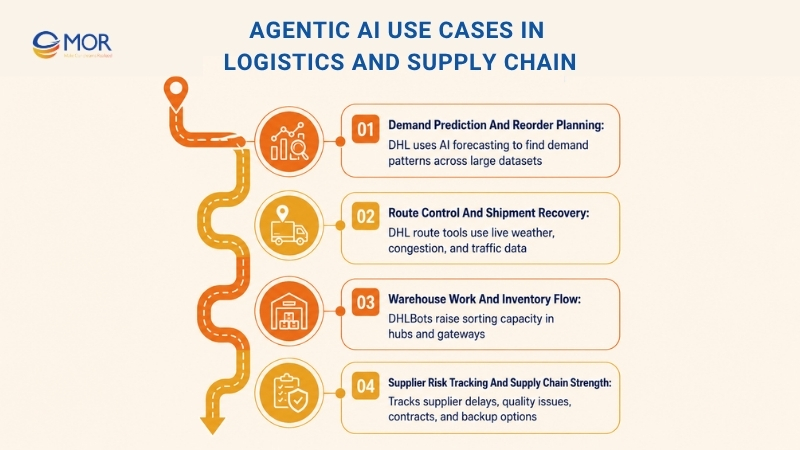
Demand prediction and reorder planning
Demand forecasting depends on sales trends, seasonal patterns, market signals, promotions, and current inventory. Agentic AI can review these inputs, predict future demand, warn teams about stock risk, and suggest reorder steps.
DHL says AI-powered demand forecasting uses machine learning to study large data sets and find patterns that older forecasting methods may miss.
Route control and shipment recovery
Shipment delays often come from traffic, weather, port crowding, carrier capacity, and changed delivery deadlines. Agentic AI can review these conditions, suggest better routes, reroute shipments when delays occur, and update customers.
DHL describes AI-powered route tools that calculate better routes with live data, including weather, port congestion, carrier performance, and traffic flow.
Warehouse work and inventory flow
Warehouse teams manage picking, packing, sorting, stock moves, slotting, and exception work. Agentic AI can follow inventory movement, find picking delays, flag stock gaps, suggest slotting changes, and create warehouse task lists.
Live company example: DHL has used AI-powered sorting robots called DHLBots in hubs and gateways. DHL says these robots can raise sorting capacity by about 40% or more in express logistics.
Supplier risk tracking and supply chain strength
Supplier delays can affect production, fulfillment, and customer delivery dates. Agentic AI can track supplier lead times, missed shipments, quality issues, contract terms, geopolitical signals, and demand changes to warn teams early.
The agent can suggest backup suppliers, recommend safety stock updates, and alert procurement teams. This helps supply chain teams act sooner instead of waiting until a shipment is already late.
Agentic AI Use Cases In Legal And Compliance
Legal and compliance work relies on research, document review, deadline control, and rule reading. Agentic AI can help legal teams move faster as it searches legal sources, checks contracts, tracks rule changes, and prepares routine legal documents for review.
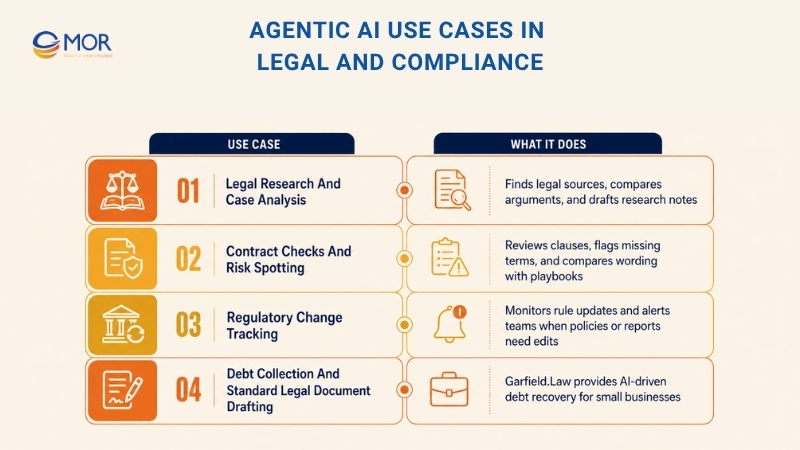
Legal research and case analysis
Legal teams often spend hours reviewing case law, statutes, regulations, opinions, and internal knowledge sources. Agentic AI can speed up this work as it finds relevant materials, compares legal arguments, summarizes precedents, and explains why certain sources matter.
For example, an agent can take a legal question, search approved legal databases, pull the strongest sources, compare similar cases, and draft a research note for a lawyer. This helps lawyers cut manual search time while final judgment stays with a trained professional.
Contract checks and risk spotting
Contract review is a strong fit because agreements follow common patterns but still need careful judgment. An AI agent can read clauses, find missing terms, flag unusual duties, compare wording with company playbooks, and suggest changes.
For example, a procurement team can use an agent to check supplier contracts. The agent can review payment terms, renewal clauses, liability caps, termination rights, data protection wording, and jurisdiction terms. If the contract includes risky or unusual language, it can send the issue to legal with a clear reason.
Regulatory change tracking
Compliance teams must follow changing laws, internal rules, audit needs, and industry-specific requirements. Agentic AI can monitor rule updates, compare them with company workflows, and alert the right team when a policy, contract, process, or report may need edits.
For financial services, healthcare, insurance, and technology firms, this can cut manual tracking work. The agent can also draft compliance checklists, prepare audit summaries, and show gaps between current work and new rules.
Debt collection and standard legal document drafting
Some legal tasks are structured enough for agentic AI to manage much of the process. Debt recovery works well because it often follows repeat steps: collect claim facts, prepare reminder letters, draft before-action letters, organize evidence, and prepare court forms when needed.
AI agent useful case study: In May 2025, the Solicitors Regulation Authority approved Garfield.Law Ltd as the first AI-driven law firm allowed to provide regulated legal services in England and Wales. The SRA said Garfield.Law helps small businesses recover unpaid debts through the court system.
The Financial Times also reported that Garfield provides low-cost debt recovery services, including AI-made debt collection letters and legal claim forms, with quality control checks built into the process.
Agentic AI Use Cases In Research, Data Analysis, And Knowledge Work
Research, analysis, and knowledge work often slow down when teams must read many sources, compare claims, and turn messy notes into useful answers. Agentic AI can help teams move through this work with clearer steps, better source tracking, and faster first drafts.
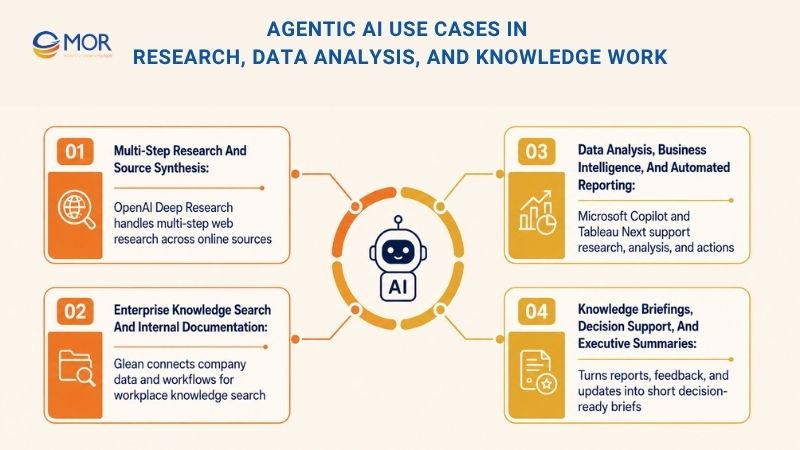
Multi-step research and source synthesis
Research work often begins with a broad question, then grows into many rounds of searching, reading, checking, and source comparison. Agentic AI can turn that loose process into a clear workflow. The agent can split the question into smaller research tasks, scan different sources, compare claims, find conflicts, and create a report with references.
This works well for market research, strategy planning, technical due diligence, policy review, legal research, and competitor checks. Instead of asking employees to read dozens of pages by hand, teams can use agents to prepare a first research draft, then ask people to check the sources and final points.
Live company example: OpenAI Deep Research is built for multi-step web research. OpenAI describes it as an agentic tool that can browse, study, and combine information from many online sources for complex tasks.
Enterprise knowledge search and internal documentation
Many businesses keep knowledge across emails, meeting notes, shared drives, CRM records, support tickets, wikis, and internal files. Staff often lose time looking for the right document or asking teammates for details that already exist somewhere. Agentic AI can link these sources, find useful information, summarize it, and turn scattered knowledge into practical answers.
A sales manager can ask an agent to find older proposals for a similar client, summarize the pricing logic, pull objections from past calls, and prepare a new account brief. A product manager can ask the agent to collect user feedback from tickets, meeting notes, and survey files, then sort the findings by product request.
Live company example: Glean presents its Work AI platform around enterprise search, assistants, data analysis, deep research, and agents that connect with company data and workflows. Its agent tools are designed to help employees find information, create outputs, and automate tasks across workplace systems.
Data analysis, business intelligence, and automated reporting
Data analysis needs more than charts. Teams need plain answers about what changed, why it changed, and what action should come next. Agentic AI can pull data from dashboards, run calculations, detect patterns, explain performance changes, and create reports for different audiences.
If conversion drops, the agent can check traffic sources, campaign results, page speed, cart abandonment, product stock, and customer segments. It can then suggest likely causes, recommend tests, and flag tracking gaps. This helps analysts move faster from raw numbers to business action.
Live company example: Microsoft 365 Copilot introduced Researcher and Analyst as reasoning agents for work. Microsoft says they can study work data, web information, emails, meetings, files, and chats to support research and analysis tasks. Salesforce Tableau Next also uses agentic analytics to help users move from data to action, including data preparation, natural-language questions, answers, and recommended actions.
Knowledge briefings, decision support, and executive summaries
Agentic AI can also help teams turn long streams of information into short outputs ready for decisions. The agent can watch new reports, customer feedback, internal updates, competitor news, and performance data, then prepare a leader-ready brief.
An executive team can use an agent to prepare a weekly market note. The agent can summarize new competitor actions, customer problems, sales risks, product changes, and financial signals. It can also separate confirmed facts from unclear claims, point out conflicts between sources, and recommend which items need human review.
This use case is useful because knowledge workers rarely need more information. They need cleaner summaries, clearer priorities, and quicker decisions. Agentic AI helps cut information overload while people still make judgment-heavy calls.
Agentic AI Use Cases In Business Process Management And Business Intelligence
Business process management and business intelligence fit agentic AI well because many companies still depend on manual handoffs, disconnected tools, late reports, and slow decision loops. AI agents can watch workflows, read operating data, trigger actions, and turn business data into clearer recommendations.
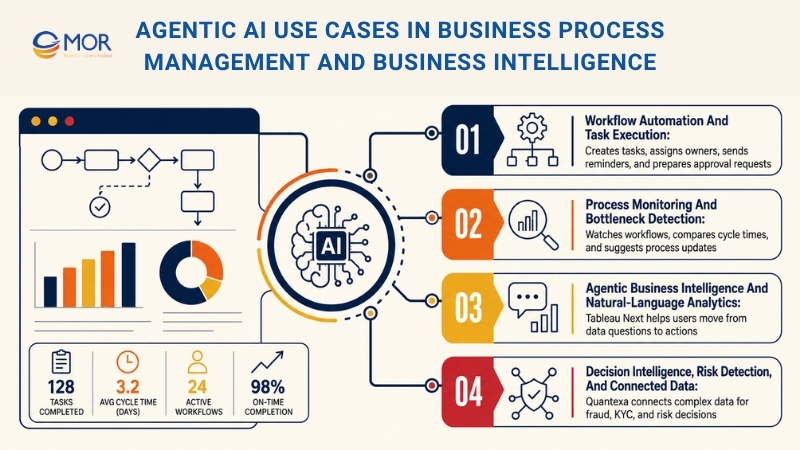
Workflow automation and task execution
Business workflows often include small repeatable steps across many platforms. Teams turn meeting notes into tickets, update project boards, create purchase requests, send approval reminders, check stock levels, and follow up when tasks slow down. Agentic AI can complete these steps across systems instead of only advising what to do.
A BPM agent can read a meeting transcript, find action items, create tasks in a project management tool, assign owners, set due dates, and follow up when progress slows. In operations, the agent can notice low stock, check supplier rules, prepare a purchase request, and send it for approval. This helps teams cut manual coordination and keep work moving.
Process monitoring and bottleneck detection
Traditional BPM tools often show workflow status, but people still need to understand delays and decide what to fix. Agentic AI can watch business processes all the time, find bottlenecks, compare cycle times, and suggest process changes.
A process agent can track order approval delays, invoice exceptions, customer onboarding drop-offs, or supplier response times. If one approval step keeps slowing work down, the agent can mark the issue, find the team or rule behind the delay, and suggest a process update. This makes BPM more active because the system does not wait for managers to review dashboards by hand.
Agentic business intelligence and natural-language analytics
Business intelligence often depends on analysts who prepare reports, clean data, build dashboards, and explain performance shifts. Agentic AI changes this flow because non-technical users can ask business questions in simple language and receive analysis, explanations, and suggested actions.
Live company example: Tableau Next uses agentic analytics to help users move from data to action. Salesforce says users can work with AI agents to speed up the data-to-action workflow, including data preparation, natural-language questions, trusted answers, and recommended actions.
This helps leaders who need quick answers without waiting for a full BI request. A sales director can ask why revenue dropped in one region. The agent can check pipeline data, campaign results, win rates, product mix, and customer groups, then create a short answer with next steps.
Decision intelligence, risk detection, and connected data
Some business decisions need more than one dashboard. Companies must connect customer records, supplier data, transaction history, ownership structures, risk signals, and outside data. Agentic AI can support decision intelligence as it links scattered data, finds hidden relationships, and recommends actions.
Live company example: Quantexa presents its platform around decision intelligence, connected data, financial crime, fraud, KYC, customer intelligence, risk, and enterprise data modernization. Its own writing on agentic AI says agents work best in adaptive settings where data is messy or changing, while predictable high-speed operations may still fit structured workflows better.
So, Quantexa works best as an example of decision intelligence and risk-heavy BI. It should not be described only as a general BPM automation tool. A stronger angle is that Quantexa helps organizations connect complex data, reveal links, and improve choices in fraud, KYC, and risk work.
How To Evaluate Agentic AI Use Cases Before Building
Early agentic AI use cases can create 3-5% yearly productivity gains. Scaled multi-agent systems can raise enterprise growth by 10% or more, according to McKinsey. But companies need a clear review method before they invest in the use cases of agentic AI. These five questions help teams choose the right AI pilot.
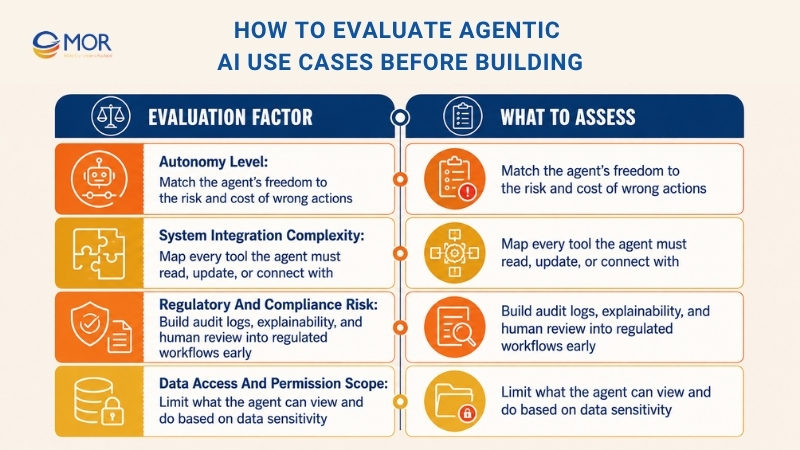
Autonomy Level
How serious is the result if the agent gets it wrong?
This is not only about the agent’s skill. It is about the cost of a bad action. Before raising autonomy, ask what happens if the agent makes the wrong call, how serious the result is, and who owns the decision. Match autonomy to risk level, not technical strength.
System Integration Complexity
How many tools must the agent reach?
Agentic AI does not work inside one isolated place. To take action, it must read from and write to current systems, including CRMs, ERPs, databases, chat tools, compliance platforms, and APIs. This is where many AI pilots slow down. The agent may be ready, but the systems may not be ready for the agent. Map every tool it must reach, what it must read, and what action it can take.
Regulatory And Compliance Risk
Does the use case change how your system must be built?
Compliance is not a last-minute review. It shapes the build from day one. If a workflow sits under the EU AI Act, GDPR, or industry rules, the system design must reflect that from the start. Audit logs, explainable outputs, and human review need to be part of the product early. At MOR Software, we help teams design AI systems for regulated fields, including fintech, EdTech, healthcare, and logistics. Our work across software outsourcing, AI development, QA, cloud, and integration shows that compliance must sit inside the build, not outside it.
Data Access And Permission Scope
What data can the agent view and act on?
More sensitive data needs tighter access rules. In real projects, data sensitivity sets the limits for what an agent can see and what it may do inside your systems.
MOR Software uses this quick formula to help clients rank agentic AI use cases:
- Remove weak candidates first. Cut workflows that process fixes, rules, training, or basic automation can already solve.
- Check the upper limit. Prove the current workflow cannot scale or is already causing clear loss.
- Score five dimensions. We score each use case as low, medium, or high across autonomy, integration, compliance, data access, and pilot readiness. A low-to-medium score across the group is usually a better first pilot.
- Tie it to money. Measure the current loss and define what value AI agents should recover within 3-6 months.
Describe the agentic AI case in this format:
We’re losing $[X] per [time period] because the current workflow cannot [specific task] at the speed, quality, or scale needed. An AI system should recover $[Y] within [3-6 months], measured by [cash-linked KPI].
If the use case passes the business test, the next step is to test whether it can be controlled, governed, and launched as a realistic pilot.
Risks Behind Agentic AI Use Cases And How To Control Them
Agentic AI use cases can bring clear value, but autonomy without rules creates new types of risk. Based on MOR Software’s experience with AI development, software integration, QA, and cloud-based delivery, the main risks usually fall into three groups: compliance exposure, security gaps, and too much trust in automation.
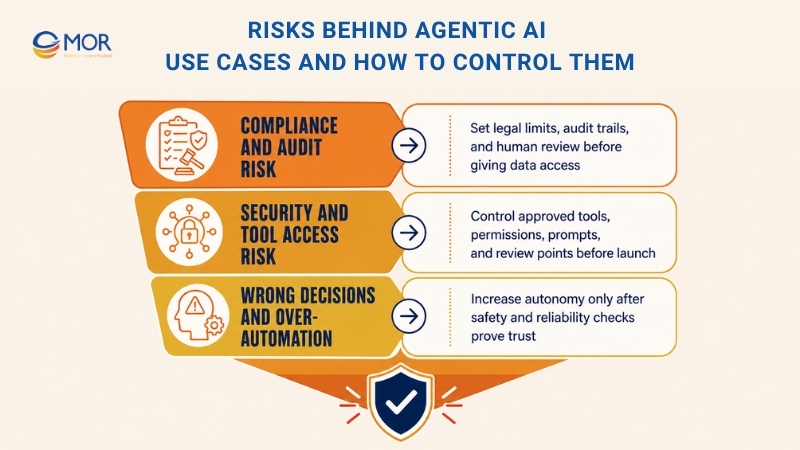
Compliance And Audit Risk
The biggest compliance error is giving an agent access to personal, financial, or operating data before legal limits, audit trails, and human review are set. In practice, this can delay launch, force redesign, or stop adoption in regulated workflows. At MOR Software, we lower that risk by turning requirements like GDPR and the EU AI Act into system design choices early. To do this, we work with domain teams who understand the rules around each business process.
Security And Tool Access Risk
With agentic systems, security risk goes beyond “model hallucinations.” The real issue is that the agent may connect to internal files, APIs, workflows, and action layers. If access is too wide, prompts are not isolated, or tools are not limited, sensitive data can be exposed. At MOR Software, we use approved tool lists, role-based permissions, and human review points to handle edge cases and build trust in the system. These agentic AI examples show why access design matters before launch.
Wrong Decisions And Over-Automation
The easiest risk to miss is over-trust. Teams may assume the agent is right because it sounds sure, handles normal cases well, or performs strongly in demos. But live workflows include edge cases, missing details, conflicting records, and messy exceptions. At MOR Software, we raise autonomy step by step. At each stage, the agent must pass safety and reliability checks before it receives more tools or higher-risk actions.
These risks do not mean companies should avoid agentic AI. They mean the rollout needs clear structure.
Most companies that struggle with adoption repeat the same mistake: they treat agentic AI like a normal technology project. In practice, it changes how teams work, how decisions happen, and how processes run.
The opportunity is large. According to Gartner, agentic AI could create $2.9 trillion in economic value by 2030. But that value will come only when companies redesign work around AI, not when they automate a few separate tasks.
This is where an experienced AI solution development partner like MOR Software can help. A scalable AI system often depends on early decisions. Teams need to define the architecture, set governance rules, and understand the business problem before the first agent goes live.
How To Start With Agentic AI Use Cases In A Controlled Way
Based on MOR Software’s experience building AI systems, software platforms, and integration-heavy workflows for business clients, these 5 steps can help teams begin in a safe and practical way:
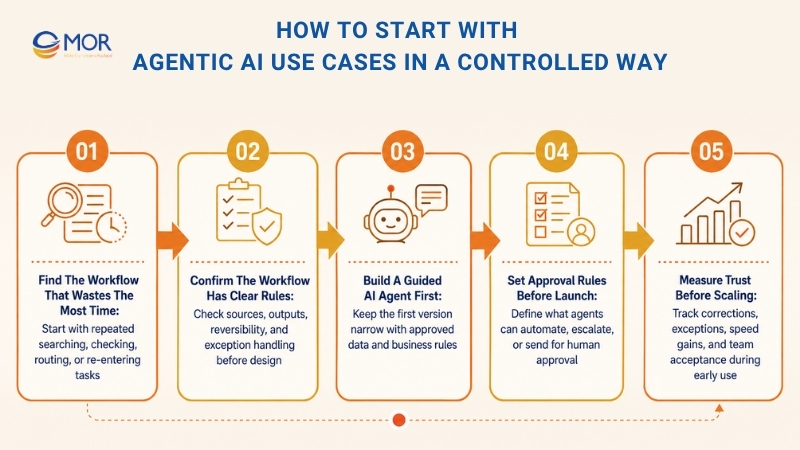
Find The Workflow That Wastes The Most Time
We begin with workflows where people keep searching, checking, re-entering, or routing the same information across tools. Strong first pilots include document-heavy search, onboarding checks, work order creation, and support triage.
Confirm The Workflow Has Clear Rules
Some workflows look valuable but make poor pilots. Before we design anything, we check four points: where the source of truth sits, whether the output can be checked, whether actions can be reversed, and how exceptions are handled. If those points are unclear, the pilot often slows down.
Build A Guided AI Agent First
The first version should stay narrow. Connect approved data sources, add retrieval and business rules, and use the model only where judgment adds value. High-risk actions stay behind human approval until the agentic system proves it can be trusted.
Set Approval Rules Before Launch
Before go-live, decide what the agent may do, what needs human approval, and what must always be escalated. Low-risk tasks like classification, summarization, and routing can move to automation earlier. Customer-facing, financial, or compliance-related actions need stronger control.
Measure Trust Before Scaling
In the first 4-6 weeks, we check whether teams accept the output, how often they correct it, where exceptions appear, and whether the workflow becomes faster with less rework. An AI pilot is ready to scale when the team trusts it in daily operations.
The timing for agentic systems is strong, and this is not just hype. The agentic AI market is moving through a natural consolidation phase. What used to be hundreds of vendors, uneven tools, and unclear standards is becoming more mature. Platforms are getting steadier. Good practices are becoming easier to see.
As Gartner Senior Director Analyst Will Sommer puts it:
Consolidation will enable industry leaders to develop agentic products that meet the technical and business requirements of customers. Will Sommer, Gartner Senior Director Analyst
Put simply, the base systems needed for agentic AI are becoming ready for wider use.
Leading tech companies already treat agentic AI as a full business change. Google Cloud is one example. It has formalized a structured agentic transformation approach based on three pillars: strategy and opportunity framing, a full development lifecycle, and core capabilities across architecture, data, security, and governance. The same rule appears across serious enterprise work: start with the business problem you want to solve with AI agents, then choose the tools that fit.
How MOR Software Helps Build Agentic AI Use Cases That Work In Real Projects
Agentic AI sounds exciting on paper, but real value starts when it connects with your data, tools, and daily workflows. That is where many teams get stuck. They know the goal, yet the system design, integration plan, and control rules are still unclear.
MOR Software helps businesses turn agentic AI use cases into working products. We support the full process, from business analysis and workflow design to AI agent development, API integration, testing, deployment, and long-term maintenance.
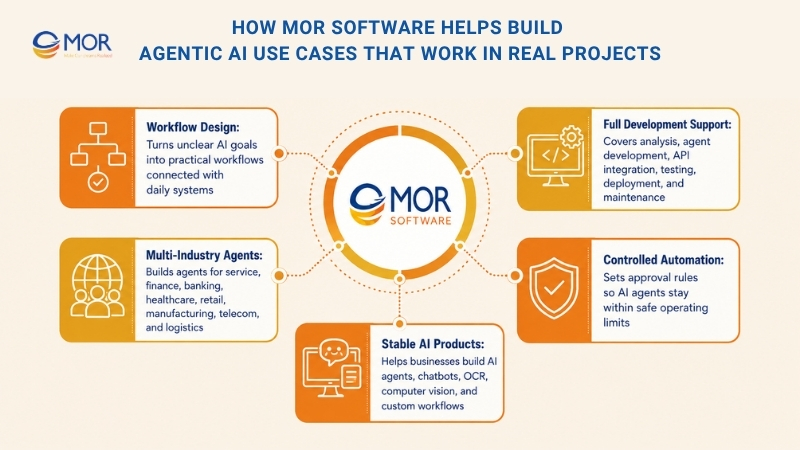
Our team can build AI agents for customer service, finance, banking, healthcare, retail, manufacturing, telecom, logistics, HR, and internal operations. These agents can read documents, classify requests, check records, create tickets, suggest next actions, and hand off complex cases to human teams.
We also help set clear approval rules so AI agents do not act beyond their limits. This matters when workflows touch customer data, payment records, medical data, contracts, or security systems.
If your business wants to explore AI agents, chatbot systems, OCR, computer vision, or custom AI workflows, MOR Software can help shape the right plan and build it into a stable product. Contact MOR Software to discuss your agentic AI project.
Conclusion
Agentic AI use cases can help enterprises move beyond simple automation and handle real workflows across teams, tools, and data. The best results come from clear goals, safe access rules, strong integration, and steady testing. MOR Software helps businesses design, build, and maintain AI agents, chatbot systems, OCR, computer vision, and custom AI workflows. Contact MOR Software to discuss your agentic AI project and turn the right use case into a working product.
"Evolution is not a destination, it is a disciplined journey of innovation."
Phung Van Tu


CEO MOR AI
MOR SOFTWARE
Frequently Asked Questions (FAQs)
What are agentic AI use cases?
Agentic AI use cases are business tasks where AI agents can plan steps, use tools, make bounded decisions, and complete work with limited human input. Common areas include customer service, finance, banking, healthcare, telecom, retail, manufacturing, logistics, HR, and cybersecurity.
How is agentic AI different from generative AI?
Generative AI creates content after a prompt. Agentic AI goes further. It can break a goal into steps, connect with systems, take approved actions, check results, and adjust its next move.
Which industries use agentic AI the most?
Banking, finance, healthcare, retail, telecom, manufacturing, logistics, and software development are strong fits. These industries have many repeat tasks, large data flows, and workflows that need fast decisions.
What can agentic AI do in customer service?
It can classify tickets, read customer history, suggest replies, process simple requests, create support tickets, and route complex cases to the right team. It helps support teams handle more requests without losing context.
How can banks use agentic AI?
Banks can use AI agents for fraud checks, KYC review, customer support, risk alerts, portfolio monitoring, and compliance tasks. Human approval should still stay in place for sensitive actions.
What are common agentic AI use cases in healthcare?
Healthcare teams can use AI agents for clinical note drafting, patient risk alerts, appointment scheduling, claims support, research summaries, and remote patient monitoring. Doctors and care teams still review medical decisions.
Can agentic AI help manufacturing teams?
Yes. It can monitor machines, detect early failure signs, create maintenance tickets, support production planning, flag quality issues, and review supplier delays. This helps teams react before small issues become costly.
What risks come with agentic AI?
The main risks include wrong decisions, weak access control, data leaks, unsafe tool use, unclear approval rules, and poor audit trails. Teams should limit permissions and track every action.
How should a company choose its first AI agent project?
Start with a workflow that wastes time, follows clear rules, uses available data, and has a measurable business cost. Good starting points include ticket triage, document review, sales follow-up, and report drafting.
Does agentic AI replace human teams?
No. It works best as a support layer for repeated and time-consuming work. People should still handle strategy, judgment, customer trust, legal review, and high-risk decisions.
Share


Make Our-Dreams Realized


© 2023 . MOR Software. All Rights Reserved
Sitemap
Privacy Policy
Terms of Use

Rate this article
0
over 5.0 based on 0 reviews
Your rating on this news:
Name
*Email
*Write your comment
*Send your comment
1