


Contingent Workforce Management: Complete Guide for HR Leaders
Contractors, freelancers, and temporary specialists now play a bigger role in modern teams, yet many companies still struggle with visibility, cost control, and compliance. Contingent workforce management helps HR leaders organize this growing external talent ecosystem and avoid operational risk. In this guide, MOR Software will explore how organizations can strengthen oversight, improve contingent workforce planning, and build a more reliable workforce strategy.
What Is Contingent Workforce Management?
Contingent workforce management refers to the structured process organizations use to plan, engage, and supervise workers who are not part of the permanent staff. It explains how companies source, contract, and coordinate contingent talent across projects and departments at scale, often through structured contingent management staffing models.
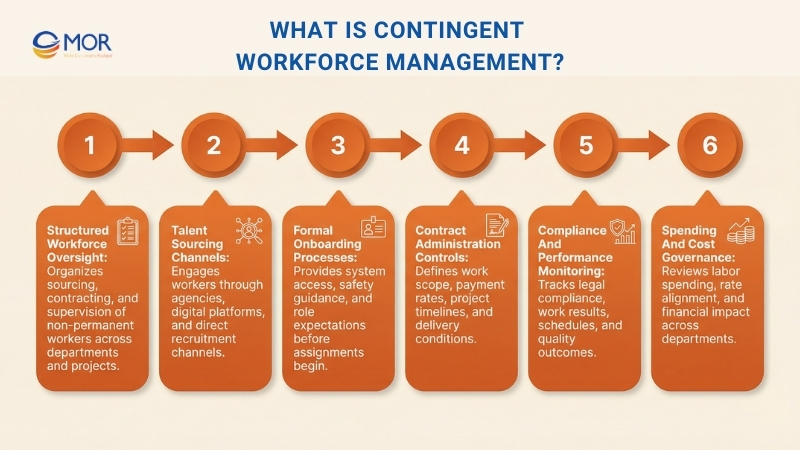
The process usually begins when companies source talent through staffing agencies, digital platforms, or direct hiring channels. Onboarding then establishes system access, workplace safety guidance, and clear role expectations before the assignment starts. Contract administration outlines scope, payment rates, project timelines, and delivery conditions for these contingent works.
Compliance monitoring helps organizations meet legal, tax, and employment requirements. Performance tracking concentrates on results, delivery schedules, and the quality of completed work. Cost governance then reviews spending patterns, rate alignment, and financial impact across departments. Together, these workforce practices allow companies to operate flexible talent programs in a controlled and predictable way.
Importance Of Contingent Workforce Management
Contingent workforce management determines whether flexible labor becomes a strong business advantage or gradually turns into a serious operational concern. The following points explain why this workforce model matters and how HR teams contribute value when overseeing external talent.
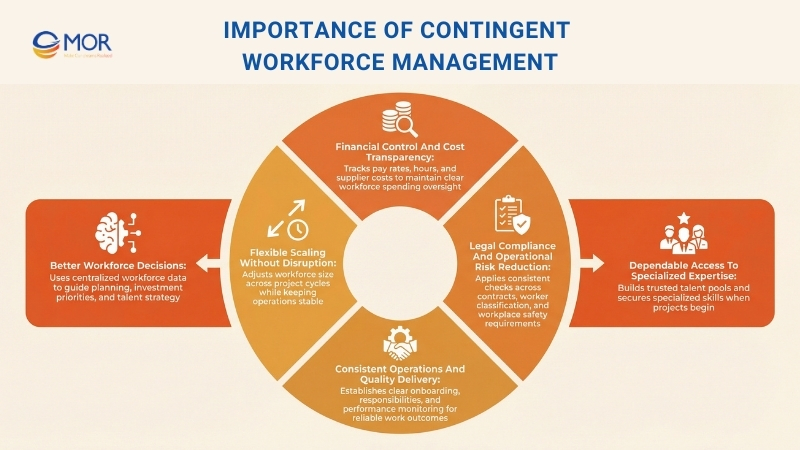
Financial control and cost transparency
A report from Indeed Flex shows that 65% of companies expect to expand their use of contingent labor during the next two years because of higher labor costs and persistent skill shortages. Yet when oversight is weak, spending on external workers can increase without clear control. A structured approach tracks pay rates, working hours, and overall costs across departments and suppliers. This visibility helps leaders compare spending, avoid rate inflation, and plan budgets more confidently, especially when organizations adopt global contingent workforce management across regions.
Legal compliance and operational risk reduction
Every external engagement involves tax rules, employment laws, and workplace obligations. A disciplined system applies consistent verification across contracts, worker classification, and safety standards. These checks lower the risk of fines, legal disputes, or service interruptions.
Consistent operations and quality delivery
Clear onboarding procedures, defined responsibilities, and regular performance monitoring establish expectations early. Work is evaluated against agreed deliverables rather than informal arrangements. This structured oversight improves output quality and helps prevent delays or repeated work.
Flexible scaling without disruption
Project demand often changes across seasons or product cycles. Effective contingent workforce management gives companies a consistent method to increase or reduce team size while keeping operations stable. This flexibility supports business continuity without adding pressure to permanent staff numbers.
Better workforce decisions
Centralized information about skills, performance history, and labor costs strengthens planning processes. Leaders gain clearer visibility into outsourced work, capability gaps inside the organization, and areas where investment delivers the best value. These insights support long-term contingent workforce planning and guide the development of a structured contingent labor program.
Dependable access to specialized expertise
Many contingent professionals provide rare or highly technical skills. Research from CXC highlights that specialized expertise is a major driver behind contingent hiring trends as demand grows. Access to these skills becomes valuable only when supported by strong HR oversight. A well-managed workforce model helps organizations build reliable talent pools and trusted suppliers, shorten hiring timelines, and secure the right expertise when projects begin.
Key Challenges In Contingent Workforce Management
Companies continue to increase their use of contingent labor for several reasons. HBR explains that skill demand is a major factor. Many organizations rely on freelancers and independent professionals because certain capabilities are difficult to hire internally, and businesses must move faster during digital and AI transformation.
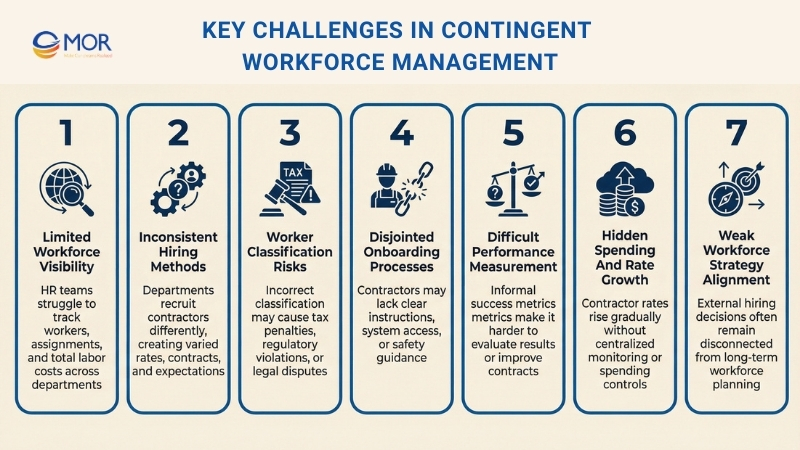
The difficulty is that managing a contingent workforce introduces operational challenges that become more complex as scale increases. For this reason, HR teams benefit from introducing structured contingent workforce management early. The following issues commonly appear when organizations expand their external workforce programs.
Restricted visibility across the external workforce
Contingent professionals are usually hired through several different channels. HR leaders often struggle to track who is working, where assignments occur, and under which conditions. This lack of transparency hides the real number of workers, the range of available skills, and the total labor cost. Indeed Flex US reports that 75% of HR leaders struggle with cost visibility, while 70% lack full workforce oversight because of legacy systems. These gaps make it harder to forecast staffing needs, manage budgets, or provide reliable data to Finance and Operations teams. This challenge becomes even more complex when organizations are managing a contingent workforce across multiple departments or locations.
Uneven sourcing and engagement methods
Individual departments often recruit external workers using different channels. Pay rates, contract terms, and job expectations can vary widely. These inconsistencies create inefficiencies and weaken supplier negotiation power. As companies scale external hiring, the problem becomes more visible when teams begin managing contingent workforce programs independently.
Worker classification and compliance exposure
Correct worker classification requires careful review of job scope and work conditions. Mistakes can lead to tax penalties, legal disputes, or regulatory violations. Manual reviews rarely scale well when the use of contingent labor increases.
Disjointed onboarding and access management
Onboarding processes are sometimes rushed or incomplete. Contractors may not receive clear job instructions, proper system permissions, or workplace safety guidance. This situation slows productivity and raises operational and security concerns.
Challenges measuring results and performance
Many temporary engagements begin without clear success metrics. Managers find it difficult to evaluate outcomes or improve future contracts when work quality is judged informally or only after problems appear.
Hidden spending and rising pay rates
When central oversight is missing, contractor rates may gradually increase. Similar roles may receive different compensation across teams, and spending expands without a clear connection to delivered value. Payroll processes for external workers can also become complicated, especially when companies rely on fragmented systems for contingent workforce payroll.
Poor connection with strategic workforce planning
External hiring decisions often operate outside the organization’s core workforce strategy. When companies cannot connect contingent roles with long-term talent goals, it becomes harder to design sustainable workforce structures or develop internal capabilities.
Unclear ownership across departments
Responsibility for contractor oversight often spreads across HR, procurement teams, and hiring managers. Without shared policies or centralized data, decisions slow down and accountability gaps appear. Many organizations begin exploring structured contingent labor solutions once these governance issues become visible.
Contingent Workforce Management Best Practices For HR Leaders
Reliable contingent workforce management becomes sustainable when HR leaders work together with Procurement to introduce clear guardrails for how external work is planned, approved, delivered, and completed. The following practices expand the operational toolkit and help organizations address the risks and operational issues discussed earlier. Many organizations treat these actions as core contingent workforce management best practices when strengthening their workforce strategy.
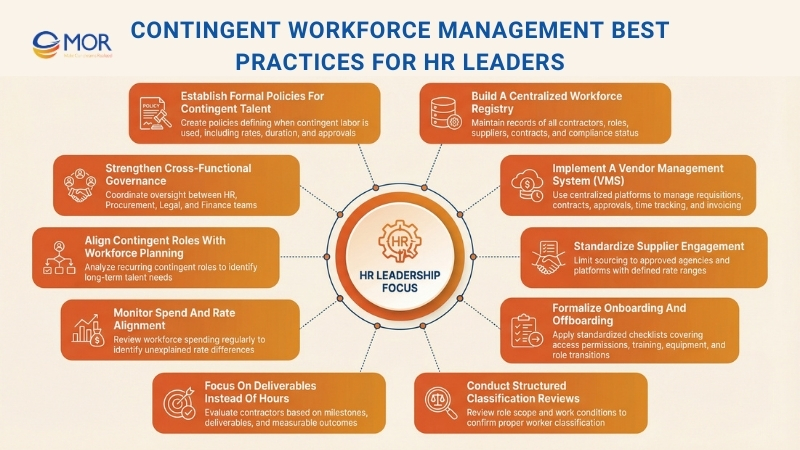
Establish Formal Policies For Contingent Talent
When a written policy is missing, decisions often depend on a manager’s individual preference. This situation creates inconsistent contract terms, uneven risk oversight, and uncertainty about responsibilities. Clear policies establish expectations before hiring demand appears and allow HR to intervene when standards are not followed.
Apply this approach: Publish a formal policy that explains when contingent labor can be used, approved contract models, engagement duration limits, rate benchmarks, and review procedures. Provide annual training so managers understand the policy and follow it consistently.
Build A Centralized Workforce Registry
Scattered records hide the real size and cost of the contingent workforce. Central visibility helps HR monitor risk exposure, workforce capacity, and project performance across the organization. It also supports accurate reporting to senior leadership.
Apply this approach: Maintain a live registry or workforce system that records every contingent worker, their role, direct manager, supplier, contract start and end dates, rates, and compliance status. Review and update this record each month.
Implement A Vendor Management System (VMS)
Manual tracking methods do not scale well as external hiring grows. A centralized platform improves consistency, lowers administrative work, and strengthens data accuracy across sourcing activities, contract handling, and workforce spending. Many organizations adopt these platforms as part of broader contingent workforce management solutions.
Apply this approach: Implement a Vendor Management System (VMS) or shared workforce platform that manages requisitions, approvals, contracts, time reporting, and invoicing within one system. Make the platform mandatory for every contingent engagement.
Standardize Supplier Engagement
Unstructured sourcing practices weaken quality standards and pricing discipline. Approved sourcing channels improve hiring speed, reliability, and supplier accountability. These practices are often coordinated through managed service provider contingent workforce programs that oversee supplier performance.
Apply this approach: Restrict sourcing activities to approved agencies and digital platforms. Define role-based rate ranges and document any exceptions clearly.
Formalize Onboarding And Offboarding
Uneven onboarding processes reduce productivity and create security risks. Weak offboarding procedures can leave system access open and transfer of responsibilities incomplete.
Apply this approach: Apply standardized onboarding and offboarding checklists that include system access, security orientation, safety training, equipment allocation, and work handover steps. Assign clear owners and confirm completion for every engagement.
Conduct Structured Classification Reviews
Every contingent engagement carries legal and tax responsibilities. A structured review process lowers risk exposure and protects the organization as contingent workforce management expands.
Apply this approach: Work with Legal teams to define clear worker classification standards. Require a documented assessment of role scope and working conditions before any engagement receives approval.
Focus On Deliverables Instead Of Hours
Tracking only time worked does not capture real value. Outcome-based evaluation keeps attention on results, quality, and business impact.
Apply this approach: Define clear deliverables, project milestones, and measurable success criteria for each engagement. Conduct formal progress reviews during the contract period.
Monitor Spend And Rate Alignment
Cost increases often appear in small increments over time. Regular monitoring helps ensure spending stays aligned with delivered value.
Apply this approach: Review workforce spending by role, supplier, and internal team every quarter. Investigate unexplained rate differences with hiring managers and vendors.
Align Contingent Roles With Workforce Planning
Contingent positions often reveal recurring skill gaps within the organization. Clear visibility into these patterns supports stronger long-term decisions about whether to build skills internally, hire permanent staff, or continue using external expertise.
Apply this approach: Include contingent roles and capabilities during contingent workforce planning discussions. Identify roles that appear repeatedly and evaluate whether the organization should develop permanent capacity for those skills.
Strengthen Cross-Functional Governance
HR teams cannot control workforce risk or spending on their own. Close collaboration improves decision quality and shortens approval cycles.
Apply this approach: Schedule regular governance reviews with Procurement, Legal, and Finance teams. Examine compliance patterns, contract exposure, and spending behavior together. Many organizations also work with specialized contingent workforce management partners to strengthen oversight and coordination.
These practices provide practical control over contingent engagements. They replace informal decisions with clear processes, shared responsibility, and measurable results.
Top Contingent Workforce Management Softwares
Contingent workforce management software, commonly known as a Vendor Management System (VMS), enables organizations to plan, engage, monitor, and govern non-permanent workers from a single platform. These systems operate between HR, hiring managers, suppliers, and Finance, and they regulate how contingent workers are requested, approved, onboarded, compensated, evaluated, and offboarded. The purpose is simple. Replace scattered emails, spreadsheets, and invoices with structured workflows and dependable data.
HR leaders usually consider investing in these tools once contingent labor becomes a regular part of operations instead of an occasional solution. Typical indicators include increasing contractor spending, working with multiple staffing vendors, inconsistent rate structures, compliance concerns, or limited clarity about who is working where. At that stage, manual processes often fail to scale and can introduce additional risk. A VMS improves consistency, strengthens oversight, and supports better decision making within contingent workforce management.
At a broad level, these platforms offer visibility across the contingent workforce, strengthen compliance through standardized documentation and review checks, and generate reports covering spending, performance, and supplier activity. This capability helps HR teams move from reactive administrative tasks toward active workforce oversight.
Select a system based on the size of your contingent workforce, the number of suppliers involved, the level of approval and compliance control required, and whether you need tight integration with systems such as Workday or Oracle.
Software | What it does | Example use case |
SAP Fieldglass | Vendor management system designed for sourcing, engaging, and overseeing contingent workers and service providers. | Large enterprises coordinating significant contractor volumes across many regions and suppliers. |
Beeline | VMS platform built to manage contingent labor sourcing and workforce operations with visibility, efficiency, and compliance features. | Companies working with multiple staffing agencies that require stronger rate control and detailed reporting. |
Workday VNDLY | Vendor management system within the Workday ecosystem used for managing contingent workforce processes and operational oversight. | Organizations already using Workday that want integrated contractor workforce oversight. |
Coupa Services Procurement | Contingent workforce management and services procurement capabilities within Coupa’s spend management platform, designed to improve spending visibility and control. | Finance-led organizations focused on service procurement governance and supplier accountability. |
Oracle Cloud Procurement | Source-to-settle procurement platform often used for service purchasing and external labor engagement workflows, approvals, supplier coordination, and reporting within the Oracle ERP environment. | Enterprises operating on Oracle ERP that require service procurement oversight and centralized procurement data. |
VectorVMS | Vendor management system with strong analytics and supplier performance tracking, designed to improve workforce outcomes and optimization. | Organizations seeking a dedicated VMS platform with configurable workflows and workforce program support. |
TalentNet (Direct Sourcing Platform) | Direct sourcing technology that integrates with MSP and VMS programs instead of replacing them. | Companies developing private talent pools to fill contingent roles faster and reduce reliance on staffing agencies. |
Next Steps In Strengthening Your Contingent Workforce Management Strategy
Contingent workforce management no longer focuses only on handling contracts in the background. It now requires HR to take responsibility for a growing segment of the workforce and ensure flexibility does not weaken cost control, compliance standards, or delivery quality. As contingent labor becomes a common way work gets done, informal habits can quickly turn into structural risk.
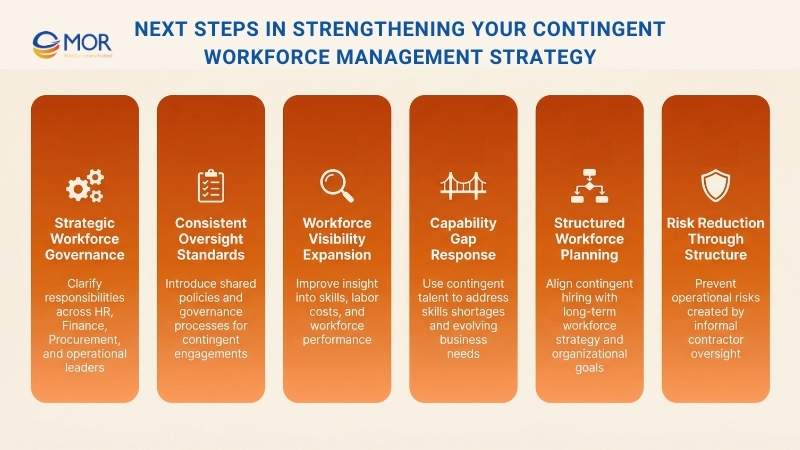
The next step for HR leaders is deciding where contingent labor fits within the operating model. This includes clarifying responsibilities across HR, Finance, Procurement, and line managers, establishing consistent governance standards, and creating clear visibility across skills, workforce spending, and performance results. It also means shifting the discussion away from “who can start quickly” toward “how we plan, govern, and evaluate non-permanent work with the same discipline applied to permanent roles.”
Organizations that manage this workforce model successfully use contingent talent to close real capability gaps, respond faster to change, and support stronger long-term workforce decisions. Companies that delay often realize too late that flexibility without structured oversight does not create true agility.
MOR Software – Your Trusted Partner in Contingent Workforce Management
Managing a flexible workforce requires more than spreadsheets and manual approvals. It demands structured systems, secure integrations, and clear visibility across departments. MOR Software supports organizations that want to bring discipline and transparency to their contingent workforce management programs.
We design and build customized workforce solutions that align with real operational needs. Our teams have delivered HRM systems, time attendance platforms, and enterprise integrations that connect legacy systems with modern cloud environments. This experience allows us to develop solutions that centralize contingent worker data, automate approvals, and simplify reporting.
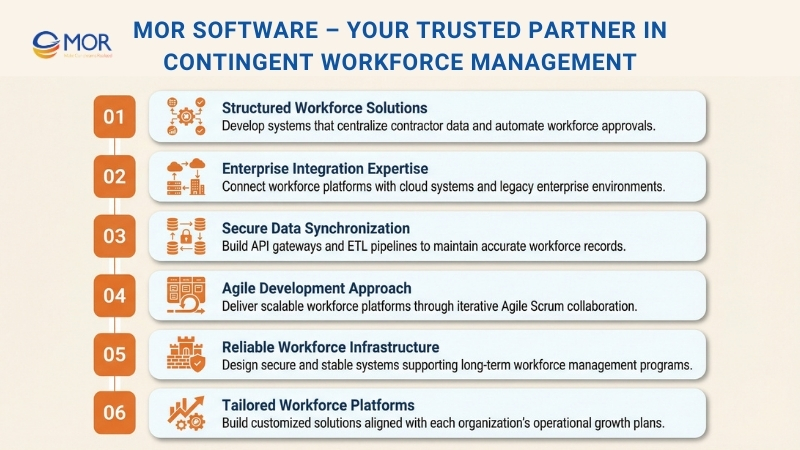
For companies running on Salesforce or other enterprise platforms, we provide deep integration expertise. We build secure API gateways, implement ETL processes for data migration, and create bidirectional synchronization to maintain accurate records across systems. This helps HR leaders track contracts, monitor compliance status, and manage workforce spend with confidence.
Our development approach follows Agile Scrum, enabling rapid iteration and close collaboration with stakeholders. We focus on scalable architecture, strong data security practices, and long-term system stability. Whether you are formalizing this approach for the first time or upgrading an existing process, MOR Software delivers structured, measurable, and sustainable solutions tailored to your organization’s growth plans. Contact MOR Software today to discuss how we can help you build a more controlled and scalable contingent labor management system.
Conclusion
Strong contingent workforce management helps HR leaders turn flexible talent into a strategic advantage instead of an operational risk. With clear governance, better visibility, and the right technology, organizations can manage external talent with the same discipline applied to permanent teams. As contingent labor continues to grow, structured oversight becomes essential for cost control, compliance, and performance. If you want to build smarter workforce systems and scalable HR technology, contact us to explore how MOR Software can support your workforce transformation journey.
MOR SOFTWARE
Frequently Asked Questions (FAQs)
What is contingent workforce management?
Contingent workforce management is the structured approach to planning, sourcing, engaging, and overseeing non-permanent workers such as contractors, freelancers, and temporary staff. It covers contracts, compliance, performance tracking, and cost control.
Who counts as a contingent worker?
Contingent workers include independent contractors, freelancers, consultants, agency temps, and gig workers. They are not part of the permanent payroll and usually work under defined contracts.
Why are companies increasing their use of contingent labor?
Organizations use contingent talent to access specialized skills, respond to short-term project needs, manage seasonal demand, and control fixed labor costs without expanding permanent headcount.
What risks come with managing a contingent workforce?
Common risks include worker misclassification, inconsistent rates, compliance violations, data security gaps, and limited visibility into total workforce spend.
How can HR improve visibility over contingent workers?
HR can centralize data in a single system, track all contracts and suppliers, require standardized approvals, and conduct regular audits of rates and engagement terms.
What is a Vendor Management System (VMS)?
A Vendor Management System is software that helps organizations manage contingent worker sourcing, approvals, onboarding, invoicing, compliance tracking, and reporting in one centralized platform.
How does contingent workforce management help control costs?
It standardizes rate guidelines, monitors hours worked, compares supplier performance, and provides consolidated spend reports to prevent cost drift and duplication.
How is contingent workforce management different from traditional HR management?
Traditional HR focuses on permanent employees, career development, and long-term retention. Contingent workforce management concentrates on contract governance, compliance checks, supplier coordination, and outcome-based performance.
When should a company invest in contingent workforce management software?
Investment becomes necessary when contingent labor spend grows, multiple suppliers are involved, compliance risks increase, or leadership lacks clear oversight of who is working across projects.
How can organizations align contingent labor with workforce planning?
They should include contingent roles in workforce reviews, analyze recurring skill gaps, and evaluate whether repeated temporary needs signal the requirement for permanent capability development.
Share


Make Our-Dreams Realized


© 2023 . MOR Software. All Rights Reserved
Sitemap
Privacy Policy
Terms of Use

Rate this article
0
over 5.0 based on 0 reviews
Your rating on this news:
Name
*Email
*Write your comment
*Send your comment
1