


The True Cost of Outsourcing IT Services for Businesses in 2026
Managing the cost of outsourcing IT services often feels unclear when quotes vary and hidden fees appear late. Many businesses struggle to predict IT outsourcing costs while still needing reliable systems and support. In this guide, MOR Software will walk you through real pricing models, common cost drivers, and practical ways to control your total outsourcing spend before it grows out of control.
What Is The Cost Of Outsourcing IT Services By Service Type?
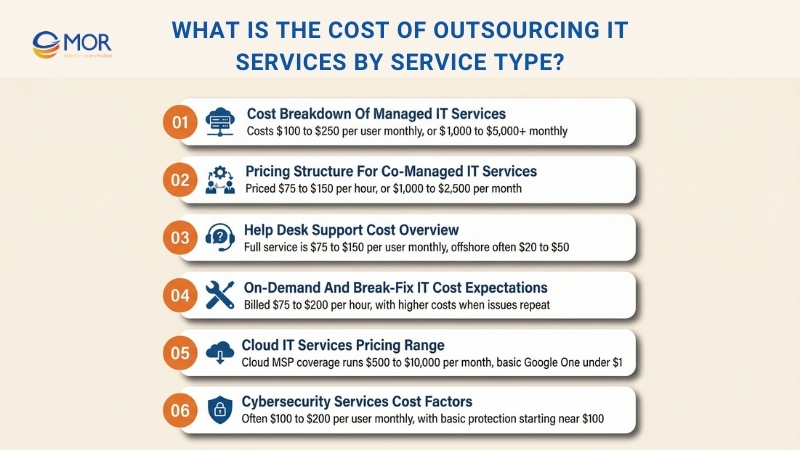
The cost of outsourcing IT services usually ranges from $75 to $250 per hour or up to $10,000 per month for small and mid-sized businesses, based on the type of service, project scope, and technical complexity. This pricing range covers options like managed IT, co-managed IT, help desk support, on-demand assistance, cloud platforms, and cybersecurity, with final figures shaped by skill requirements, user volume, and how closely the services align with your business needs.
Cost Breakdown Of Managed IT Services
Managed IT services commonly fall between $100 and $250 per user per month, or roughly $1,000 to $5,000+ per month for full coverage. These packages often include network monitoring, security management, issue resolution, and help desk support, with outsourced IT pricing shifting based on company size, service coverage, and customization depth. For SMBs, this approach provides a steady, flat monthly cost for end-to-end IT support, making it easier to manage the overall cost of outsourcing IT services without unexpected charges.
Pricing Structure For Co-Managed IT Services
Co-managed IT services are usually priced at $75 to $150 per hour or $1,000 to $2,500 per month, depending on which responsibilities are shared. This setup lets organizations split IT duties with an external provider, often covering advanced problem solving or strategic guidance while keeping internal teams involved. It suits business outsourced IT models that value flexibility, since companies pay only for selected tasks, keeping expenses lower than fully managed services when in-house teams still handle day-to-day operations.
Help Desk Support Cost Overview
Help desk support pricing usually falls between $75 and $150 per user per month for full-service plans that include 24/7 support and priority response, while per-incident fees often range from $1 to $25 per ticket, based on request complexity. When companies look at outsourced IT support costs in regions like Southeast Asia or Eastern Europe, rates are often lower, with common pricing between $20 and $50 per user per month. These markets benefit from lower labor expenses, which makes them appealing for SMBs aiming to manage the costs while keeping the overall cost of outsourcing IT services under control.
On-Demand And Break-Fix IT Cost Expectations
On-demand or break-fix IT services are typically billed at $75 to $200 per hour. This approach lets businesses pay only when problems occur, with pricing shaped by urgency and technical difficulty. Although this option provides flexibility, outsourcing charges can become harder to predict and may rise over time for companies that face frequent system issues. SMBs often choose this model for occasional support needs, but regular use can drive up expenses due to downtime and inconsistent service demands.
Cloud IT Services Pricing Range
Cloud IT services usually cost between $500 and $10,000 per month when delivered through Managed Service Providers for full coverage, which often includes network administration, data storage, security controls, backups, and disaster recovery. That said, pricing can differ greatly, with some options priced at under $1 per month for the most basic Google One plans when billed annually. This model gives businesses the choice to pay monthly subscriptions or usage-based fees, making IT service cost more flexible and scalable for both SMBs and large enterprises.
Cybersecurity Services Cost Factors
Cybersecurity services commonly fall in the range of $100 to $200 per user per month. The final price depends on company size, security complexity, and the depth of protection required, which directly affects the cost of outsourcing IT services. For SMBs, basic network protection and monitoring may start near $100, while broader coverage that includes threat detection, incident response, and compliance assistance for standards like HIPAA or GDPR can increase the cost of outsourced IT. Ongoing risk management, continuous monitoring, and specialized skills make cybersecurity solutions more expensive than many other IT service categories.
Cost Of Outsourcing IT Services Across Common Pricing Models
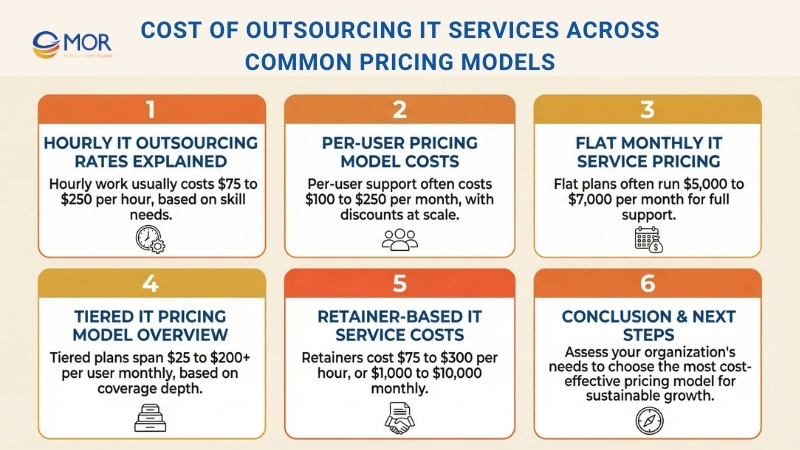
IT outsourcing providers use hourly, per-user, flat monthly, tiered, and retainer-based pricing to define how organizations pay for services. These structures allow businesses to align the cost of outsourcing IT services with their operating style, whether they need predictable billing, room to scale, or short-term flexibility.
Hourly IT Outsourcing Rates Explained
Hourly pricing for outsourced IT work usually falls between $75 and $250 per hour, based on the skill level required and the technical difficulty of the task. This option lets you pay only for the time spent, which suits short projects or limited engagements, but IT outsourcing costs can become harder to manage for companies that rely on ongoing support.
Per-User Pricing Model Costs
Per-user pricing often ranges from $100 to $250 per month. Many small and mid-sized businesses choose this model because it provides steady IT support with a clear monthly fee and fewer unexpected expenses. As user numbers grow, providers may apply volume discounts, which lowers the per-user rate and helps control the overall cost of outsourcing IT services as teams expand.
Flat Monthly IT Service Pricing
With flat monthly pricing, outsourced IT services usually cost between $5,000 and $7,000 per month, with the final amount depending on employee count and service scope. Managed Service Providers adjust pricing based on company size and coverage needs. This approach works well for SMBs and larger organizations that want budget stability, since it delivers a fixed monthly fee for full IT support, including network monitoring, issue resolution, security, and routine maintenance.
Tiered IT Pricing Model Overview
Tiered pricing plans often range from $25 to $200+ per user per month. A basic tier may sit between $25 and $100 per user for core support and monitoring, a standard tier often costs $100 to $200 for deeper support and expanded monitoring, and premium tiers can exceed $200 for companies that require specialized skills or broader service coverage. This structure gives SMBs the flexibility to pick a level that matches current needs and budgets, with the ability to adjust as requirements change.
Retainer-Based IT Service Costs
Under a retainer arrangement, IT services typically cost $75 to $300 per hour, or between $1,000 and $10,000 per month for SMBs, based on reserved hours and expertise level. Companies pay a fixed fee to secure dedicated support for a defined number of hours or services each month, which directly shapes the cost of outsourcing IT services. This model suits organizations with regular needs like updates, maintenance, and ongoing troubleshooting, and it helps SMBs manage the cost to outsource IT through guaranteed access and prioritized assistance when issues arise.
>>> How much do IT consulting rates cost in 2026? Discover the average IT consulting fees and key factors shaping pricing.
Key Factors That Shape The Cost Of Outsourcing IT Services
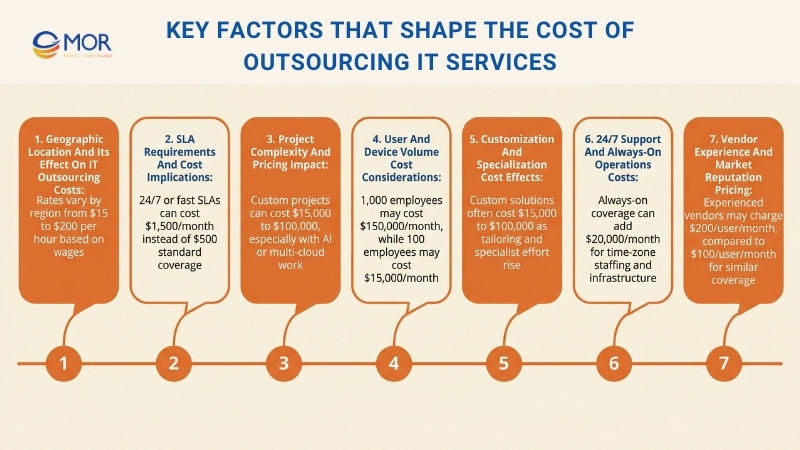
The cost of outsourcing IT services depends on several elements, including geographic location, service level agreements, project complexity, team size, and how much customization is required. These factors influence operational risk, staffing levels on the vendor side, and the depth of expertise needed to meet specific business goals.
Geographic Location And Its Effect On IT Outsourcing Costs
Geographic location plays a major role in shaping outsourcing expenses because labor rates vary widely between regions. Providers based in higher-cost markets, including North America or Western Europe, often charge more for the same work than teams operating in countries with lower wage levels. Many organizations compare regional pricing to balance service quality, access to skilled talent, and the overall IT outsourcing costs when choosing a partner. Based on research from DistantJob, average hourly IT rates around the world typically fall within the following ranges:
Regions | Countries | Hourly Range |
Southeast Asia | Indonesia, Philippines, Vietnam, India, Pakistan, Bangladesh | $20 to $40 |
Latin America | Mexico, Argentina, Brazil, Colombia, Peru | $25 to $50 |
Eastern Europe | Ukraine, Romania, Poland, Hungary, Czech Republic | $25 to $50 |
Africa | South Africa, Nigeria, Morocco, Egypt | $15 to $40 |
North America, Europe & Australia | USA, Canada, UK, Germany, Netherlands, Australia, New Zealand | $50 to $200 |
SLA Requirements And Cost Implications
Service Level Agreements directly shape the cost of outsourcing IT services because they define targets like uptime, response speed, and problem resolution. Higher-tier SLAs that require faster replies or extended monitoring raise expenses since providers must assign more resources to meet these commitments. For example, companies that need 24/7 support or rapid escalation may pay $1,500 per month instead of $500 for standard coverage, as Managed Service Providers must keep staff and systems running around the clock.
Project Complexity And Pricing Impact
Project complexity drives higher costs because advanced work demands more time, specialized skills, and added resources. Custom software projects, for example, can range from $15,000 to $100,000, depending on scope and technical difficulty. These projects involve detailed planning, experienced engineers, and longer delivery timelines. Work that includes multi-cloud setups or AI and machine learning integrations also raises the cost, since deeper technical knowledge is required to build and maintain them.
User And Device Volume Cost Considerations
The number of users and devices has a direct effect on the cost of outsourcing IT services, since a larger environment needs more support, monitoring, maintenance, and infrastructure. An enterprise with 1,000 employees may spend around $150,000 per month on IT services, while an SMB with 100 employees might spend closer to $15,000. Larger organizations often receive volume discounts that lower the per-user or per-device rate, although the overall cost remains higher because more users and devices still require ongoing support.
Customization And Specialization Cost Effects
When a business needs customized or specialized IT services, pricing usually increases due to the added time, skills, and resources involved. Bespoke software development, for example, can cost between $15,000 and $100,000, depending on how tailored the solution must be. Custom security setups or enterprise-grade systems also carry higher fees because they demand advanced expertise and extra effort to match specific business needs. The more personalized the solution, the higher the expense due to added complexity and specialist knowledge.
24/7 Support And Always-On Operations Costs
Around-the-clock support requires continuous staffing and dedicated infrastructure to keep services running without interruption, which raises the cost of outsourcing IT services. An eCommerce business operating across multiple time zones and depending on critical systems may spend an extra $20,000 per month for full-time coverage. This increase reflects the need for additional personnel and systems to handle support demands across regions. It also involves tighter coordination between teams to keep assistance available at all hours, maintain uptime, and respond to customer requests worldwide.
Vendor Experience And Market Reputation Pricing
Vendors with extensive experience often set higher rates because they can support their pricing with a history of strong service quality, effective risk handling, and solid industry knowledge. Many companies decide that paying more is worthwhile when working with providers that have proven reliability and specialized skills. For instance, a Managed Service Provider focused on advanced cybersecurity may charge $200 per user per month, while a less experienced provider may charge closer to $100 for similar coverage.
Cost Of Outsourcing IT Services Vs In-House IT Teams
The cost of outsourcing IT services is often much lower than running an in-house IT department because you avoid salaries, benefits, and overhead tied to full-time staff. Companies do not need to cover annual wages for roles like network architects or IT support specialists, which range from $61,550 to over $130,000 based on data from the Bureau of Labor Statistics. Beyond payroll, outsourcing also removes the need to invest in hardware, software licenses, and continuous training programs, which supports long-term IT outsourcing cost savings.
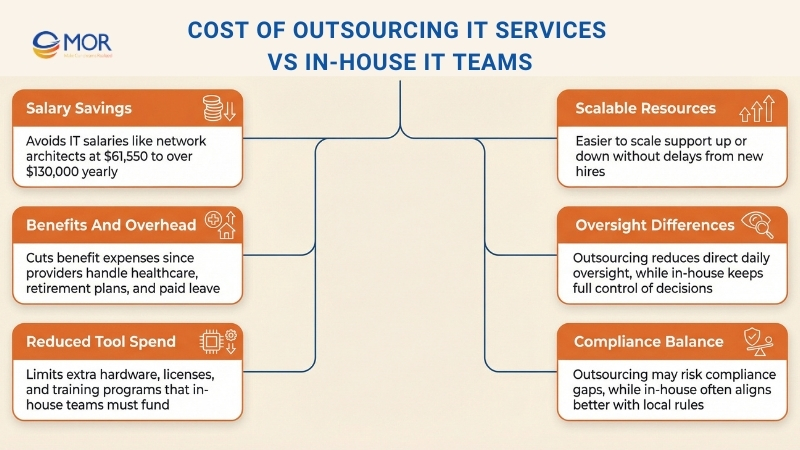
The table below highlights key differences between outsourcing IT work and maintaining an internal IT team:
Factor | Outsourced IT | In-House IT |
Initial setup and equipment spending | Often included within service fees | Requires upfront spending on infrastructure and equipment |
Staff compensation | Lower due to offshore delivery options | Higher because of salaries, benefits, and hiring costs |
Employee benefit obligations | Not required since there are no direct employees | May include healthcare, retirement plans, and paid leave |
Skill development and training | Handled by the service provider | Ongoing training and certification expenses for staff |
Ability to scale resources | Flexible and easy to adjust as needs change | Limited flexibility and dependent on new hires |
Operational oversight level | Reduced direct oversight of daily operations | Full control over IT decisions and processes |
Compliance responsibility | Risk of gaps if requirements are not managed closely | Stronger alignment with local regulations and compliance rules |
What Is The Hidden Cost Of Outsourcing IT Services?
Although outsourced IT services often seem more affordable at first, there are hidden expenses that businesses need to factor in, including onboarding, training, system integration, service level agreement penalties, and communication issues. These hidden items can affect the total budget and may reduce the expected savings, which can increase the overall cost of outsourcing IT services beyond initial estimates.
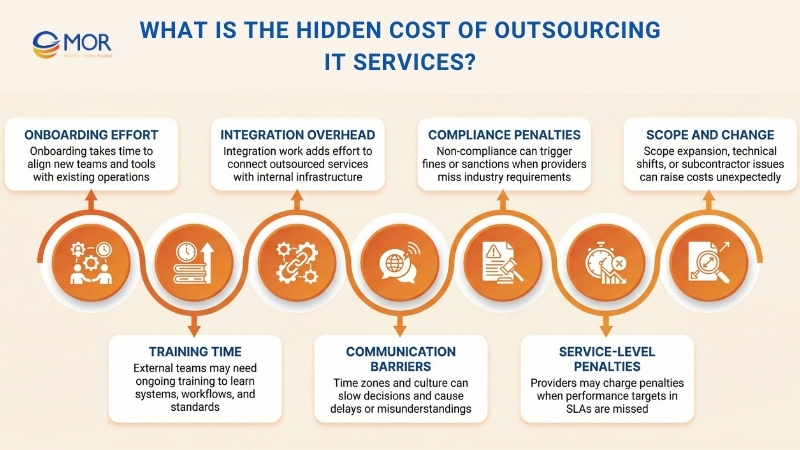
Hidden costs of outsourced IT services:
- Initial onboarding effort: Time and effort required to integrate new teams or tools into your existing business operations.
- Ongoing training expenses: Ongoing training needed so external teams fully understand your systems, workflows, and standards.
- System integration overhead: Time and expense involved in connecting outsourced IT services with internal infrastructure.
- Communication barriers: Time zone differences and cultural factors that can slow work and cause delays or misunderstandings.
- Compliance-related penalties: Fines or sanctions that may occur if providers fail to meet industry compliance requirements.
- Service-level penalties: Charges applied when service providers do not meet agreed performance targets.
- Unplanned scope expansion: Extra services or unexpected needs that appear during delivery and raise expenses.
- Unexpected technical changes: Sudden shifts in technology or project scope that increase costs without advance planning.
- Subcontractor-related risks: Issues linked to subcontractors that may affect service quality, timelines, or accountability.
How To Reduce The Cost Of Outsourcing IT Services
To lower the cost of outsourcing IT services, businesses often focus on contract negotiation, hybrid delivery models, volume-based pricing, and long-term agreements after careful review. These actions, combined with simplifying platforms and tools, help protect service quality while removing unnecessary spending.
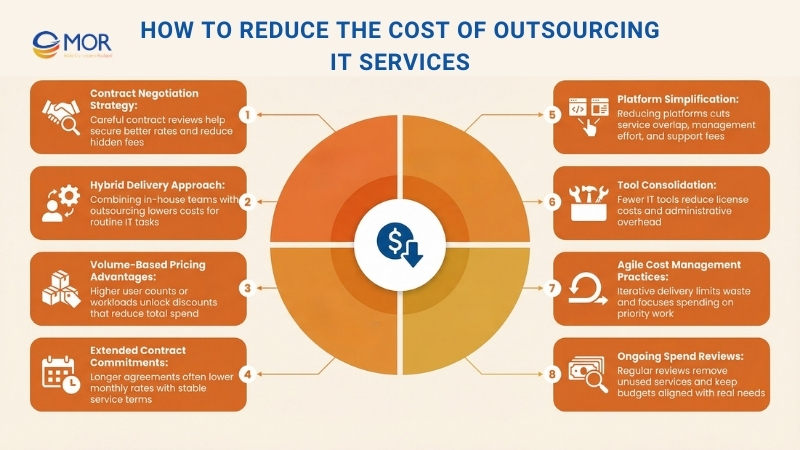
8 ways to reduce outsourced IT costs are:
- Contract negotiation strategy: Reviewing terms closely and negotiating conditions can lead to better rates, clearer service level agreements, and fewer hidden fees. Regular contract reviews also make it easier to adjust terms as business needs change.
- Hybrid delivery approach: Mixing in-house teams with external providers helps control costs, since core or strategic work stays internal while routine tasks move outside, which improves resource use.
- Volume-based pricing advantages: Large projects with high workloads or many users often qualify for discounts that lower per-unit pricing and reduce the total outsourcing spend.
- Extended contract commitments: Longer contracts can result in better pricing because vendors value stability, although this approach requires careful planning due to higher financial commitment.
- Platform simplification: Cutting down the number of platforms used for IT services can reduce management effort and service fees, while also lowering operational complexity.
- Tool consolidation: Using fewer tools for IT management, security, and monitoring reduces overlap, license fees, and administrative effort.
- Agile cost management practices: Agile approaches divide work into smaller tasks that can change as needed, which limits waste and keeps spending focused on priority work.
- Ongoing spend reviews: Frequent reviews help identify unused services, remove unnecessary expenses, and keep IT budgets aligned with real business needs.
How To Choose An IT Outsourcing Partner With Cost Efficiency In Mind
When selecting an IT outsourcing partner with cost efficiency as a priority, focus on providers that offer transparent pricing, well-defined SLAs, strong monitoring capabilities, and communication methods that fit their time zone. Managing the cost of outsourcing IT services is a core reason companies outsource, and the right Managed Service Provider can help control expenses while keeping service quality high.
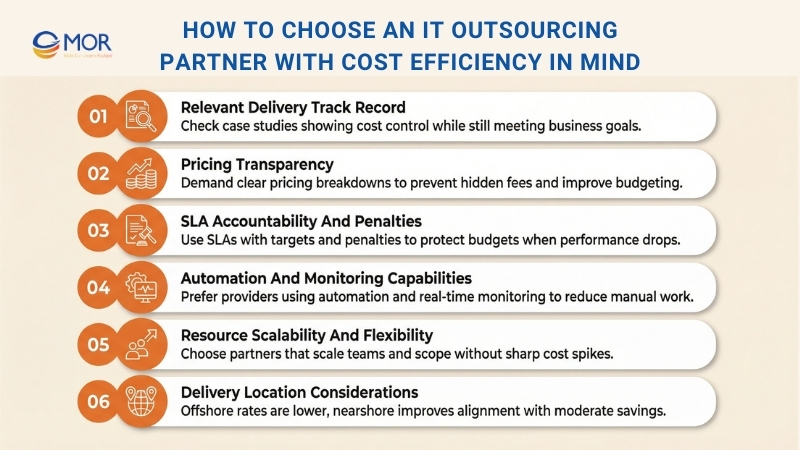
The following factors help guide this decision:
- Relevant delivery track record: Review case studies or client feedback that show how the provider has helped other organizations manage costs while still meeting business goals.
- Pricing transparency: A clear pricing structure with detailed breakdowns helps prevent hidden fees and makes budgeting simpler and more accurate.
- SLA accountability and penalties: Service level agreements that define performance targets and include penalties for missed commitments demonstrate accountability and protect your budget.
- Automation and monitoring capabilities: The use of automation and real-time monitoring reduces manual effort and supports more consistent service delivery.
- Resource scalability and flexibility: The provider should adjust team size and service scope as your needs change without causing sharp increases in costs.
- Delivery location considerations (offshore vs. nearshore): Provider location affects communication, response time, and collaboration. Offshore teams often charge lower rates but may face time zone challenges, while nearshore teams can provide better alignment with moderate cost savings.
Why Businesses Choose MOR Software For Outsourcing IT Services
Choosing an software outsourcing partner directly affects cost control, delivery stability, and long-term results. For businesses evaluating the cost of outsourcing IT services, MOR Software is often selected for its balance of competitive pricing, delivery discipline, and practical engagement models that scale with real business needs.
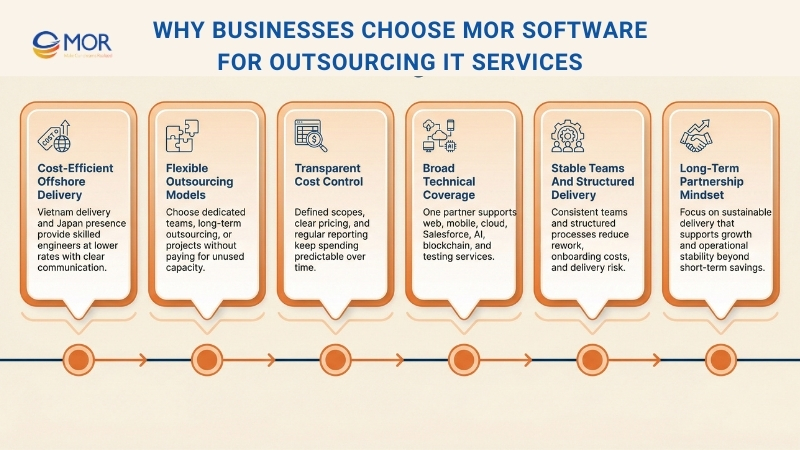
- Cost-efficient offshore delivery: MOR Software operates from Vietnam with offices in Ho Chi Minh City, Ha Noi, and Da Nang, alongside a Japan presence. This structure gives businesses access to skilled engineers at lower rates while maintaining clear communication and reliable delivery.
- Flexible outsourcing models: Teams are built around actual workload and scope, not fixed assumptions. Businesses can choose dedicated teams, long-term outsourcing, or project-based delivery without paying for unused capacity.
- Transparent cost control: Clear pricing structures, defined scopes, and regular reporting help companies track spending and avoid hidden costs. This transparency keeps the cost of outsourcing IT services predictable over time.
- Broad technical coverage under one partner: MOR Software delivers web, mobile, cloud, enterprise systems, Salesforce, AI, blockchain, and testing services. Working with one partner reduces vendor sprawl and lowers coordination overhead.
- Stable teams and structured delivery: Projects follow clear processes with consistent team assignment. This reduces rework, onboarding costs, and delivery risks that often increase outsourcing expenses.
- Long-term partnership mindset: MOR Software focuses on sustainable delivery rather than short-term savings. This approach helps businesses manage outsourcing costs while building systems that support growth and operational stability.
For companies comparing IT outsourcing options, MOR Software is a strong choice when the goal is to manage the cost of outsourcing IT consulting services without trading away control, quality, or long-term reliability.
Conclusion
Understanding the cost of outsourcing IT services helps businesses plan smarter, avoid surprises, and choose models that truly fit their scale and goals. Clear pricing, the right delivery structure, and a reliable partner make all the difference over time. With proven offshore delivery and transparent engagement, MOR Software helps companies control costs without losing quality or stability. Ready to plan your outsourcing strategy? Contact us to discuss your requirements and next steps.
MOR SOFTWARE
Frequently Asked Questions (FAQs)
What is the average cost of outsourcing IT services?
The cost of outsourcing IT services usually ranges from $20 to $250 per hour, depending on service type, provider location, and technical depth. Monthly managed services for SMBs often fall between $1,000 and $10,000.
Why does the cost of outsourcing IT services vary so much?
Pricing changes based on factors like geographic region, service scope, support level, project complexity, and required expertise. Offshore teams typically charge less than providers in North America or Western Europe.
How much does IT cost to outsource human resources?
Outsourcing HR usually costs $45–$200 per employee per month for basic services. Full-service HR support can range from $210–$400 per employee per month, depending on scope and provider.
How much does IT cost to outsource IT support?
Outsourced IT support commonly ranges from $100–$250 per user per month. Small businesses often spend $1,000–$5,000 per month for managed IT services, based on coverage level.
How much does IT cost to outsource marketing?
Outsourced marketing typically costs $2,000–$15,000 per month. Pricing depends on services included, from basic content or social media to full strategic marketing support.
Is outsourcing IT services cheaper than hiring an in-house IT team?
In most cases, yes. Outsourcing removes expenses tied to salaries, benefits, recruitment, training, and infrastructure. Businesses pay only for services used instead of maintaining full-time staff.
Which IT services are the most expensive to outsource?
Cybersecurity, cloud architecture, and complex enterprise systems usually cost more. These services demand continuous monitoring, specialized skills, and higher responsibility levels.
How do pricing models affect the total outsourcing cost?
Hourly pricing suits short-term work, while per-user or flat-rate models provide predictable monthly costs. Tiered and retainer models balance flexibility and budget control, depending on usage patterns.
Does offshore outsourcing always reduce IT costs?
Offshore outsourcing often lowers labor costs, but savings depend on communication efficiency, delivery quality, and management overhead. Poor coordination can increase indirect costs.
Are there hidden costs in outsourcing IT services?
Yes. Common hidden costs include onboarding time, knowledge transfer, integration work, SLA penalties, scope expansion, and delays caused by time zone or communication gaps.
How can businesses control the cost of outsourcing IT services?
Clear scopes, transparent pricing, regular cost reviews, hybrid outsourcing models, and long-term contracts help keep spending under control without lowering service quality.
Is outsourcing IT services suitable for small businesses?
Yes. Small businesses often benefit the most since outsourcing gives access to skilled teams without large upfront investment or long-term staffing commitments.
How often should outsourcing costs be reviewed?
Costs should be reviewed quarterly or biannually. Regular reviews help identify unused services, adjust scopes, and keep outsourcing spend aligned with business needs.
Share


Make Our-Dreams Realized


© 2023 . MOR Software. All Rights Reserved
Sitemap
Privacy Policy
Terms of Use

Rate this article
0
over 5.0 based on 0 reviews
Your rating on this news:
Name
*Email
*Write your comment
*Send your comment
1