


DEX Development Cost in 2026: The Full Pricing Breakdown
DEX development cost can shift fast once smart contracts, audits, liquidity, and blockchain networks enter the plan. A simple swap may look affordable at first, but custom trading logic or multi-chain support can change the whole budget. In this MOR Software, we’ll explore real pricing factors, hidden costs, and build choices so you can plan a safer DEX launch in 2026.
Average DEX Development Cost For A New Platform
DEX development cost usually falls between $50K and more than $500K. A simple swap product with basic smart contracts often starts at $50K to $100K. A larger build with custom AMM logic, multi-chain support, and audit work can reach $250K to $500K+. Even a small exchange needs proper security review. A professional audit may add $10K to $30K, and that cost should stay in the plan. Investors will rarely trust a platform that skips it.
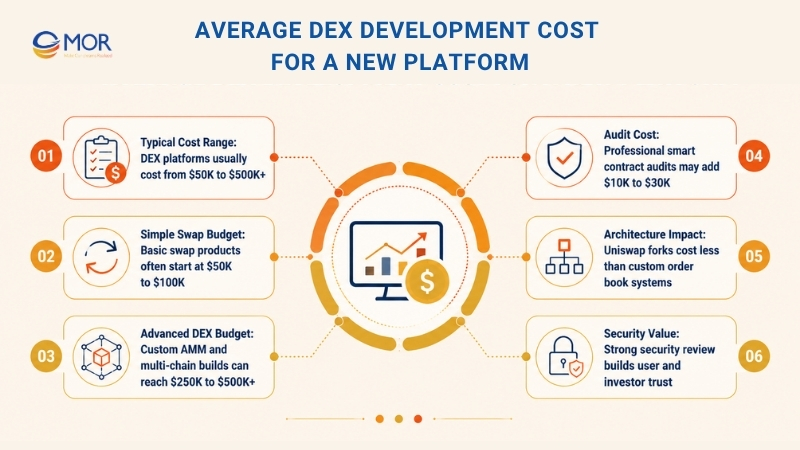
Uniswap forks can keep the budget lower. Custom order book systems need far more backend work. Security is not a nice add-on; it is what makes users trust the platform. You need a skilled decentralized exchange development company that understands DeFi products. If you ask how much does DEX cost, the real answer depends on the product you want to launch.
DEX Development Cost Breakdown By Budget Level
DEX development cost can shape early business planning in a big way. These numbers help you set a real build budget. A clear DEX development cost breakdown shows the usual pricing levels, product scope, and expected value. A decentralized exchange also affects scaling, security, and returns through each blockchain choice.
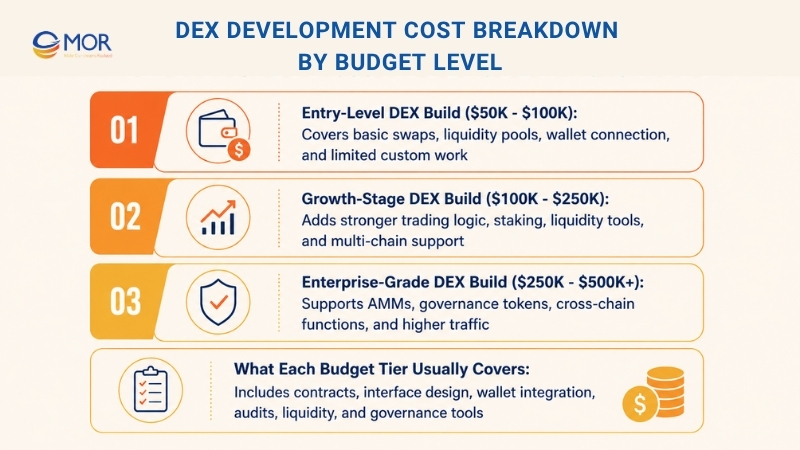
Entry-Level DEX Build ($50K - $100K)
Many first-time DeFi startups begin with this option. It usually includes basic swaps, liquidity pools, and wallet connection. Security still needs serious care. Scaling options remain limited. Custom work is also narrow, with just enough to support a quick launch.
Growth-Stage DEX Build ($100K - $250K)
This level adds stronger trade logic and a cleaner user interface. Staking may become part of the product. Liquidity tools can be set up with more control. Multi-chain support gives users more choice, so they can move across networks. Audit work also helps growing teams build more trust.
Enterprise-Grade DEX Build ($250K - $500K+)
Enterprise-grade DEX development cost fits platforms built for higher traffic and long-term use. Automated Market Makers support trades with steady pool logic. Governance tokens allow users to take part in platform decisions. Cross-chain functions let assets move across networks with less central control.
What Each Budget Tier Usually Covers
Most tiers include contract work, interface design, and wallet integration. Larger budgets can add deeper liquidity systems and governance tools. Audit work also becomes stricter when the platform gets more complex. The right DEX development partner can match the build scope with the budget.
A good cost tier helps the project stay useful after launch. Businesses need to weigh budget, product scope, and future growth. A secure and high-performing decentralized exchange can build user confidence. It can also raise trading activity and help the platform compete in the DeFi market.
DEX Development Cost By Core Product Component
DEX development cost changes based on the parts you need to build, so a component view gives a cleaner budget plan. Each item, from smart contract development to UI/UX, changes the final price of a decentralized exchange. These parts also affect future scaling and blockchain performance.
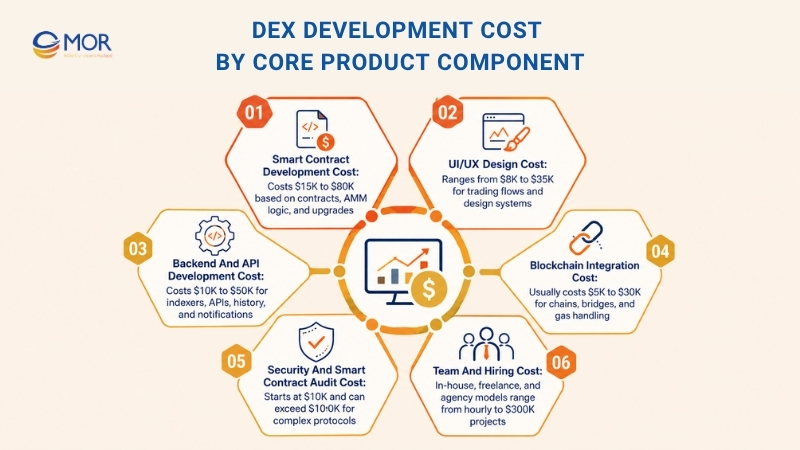
Smart Contract Development Cost
Smart contracts are the base layer of any decentralized exchange. The usual price sits between $15,000 and $80,000. A simple Uniswap V2 fork costs far less than a custom concentrated liquidity AMM. A basic clone with light edits may take a senior Solidity developer around two or three weeks, but a new AMM with custom fees and upgradeable proxy logic can take three to four months. Price changes depend on the number of contracts, upgrade needs, cross-chain support, and gas tuning work.
UI/UX Design Cost
DEX interface design is harder than it may look. Users trade real money while token prices move, slippage changes, gas fees shift, and one unclear screen can cause a costly mistake. A basic product may use ready-made components and familiar design flows. A high-end product may need user research, mobile planning, and a full design system. The design budget can range from $8,000 to $35,000.
Backend And API Development Cost
Backend and API work often costs $10,000 to $50,000. Many new DEX founders do not see how much off-chain work the product needs. The core trading logic lives on-chain, but the product users see still depends on off-chain systems. This may include indexers, price feed APIs, portfolio views, transaction history, and notification tools. The Graph Protocol can cut some work, but custom subgraphs, API planning, and database setup still take real development time.
Blockchain Integration Cost
Single-chain setup is often simpler on EVM networks. Multi-chain support is far more complex. Each new chain needs contract deployment, bridge logic, and gas handling for that network. Cross-chain functions also add more moving parts, which can raise the budget and make audit work harder. The usual integration budget ranges from $5,000 to $30,000.
Security And Smart Contract Audit Cost
Audit pricing can start at $10,000 and rise past $100,000. DeFi has seen huge losses when founders cut this item from the plan. Audit cost depends on the audit firm, contract difficulty, and review depth. A mid-level audit team may charge $10K to $25K for a basic review. Firms like CertiK, Trail of Bits, and OpenZeppelin can charge more than $100K for complex protocol audits. This is also where teams should review the risks of using a DEX, from contract bugs to liquidity and oracle failures.
Team And Hiring Cost
The DEX project cost also changes with your hiring model. In-house teams may cost $80K to $150K per year. Freelancers often charge $25 to $80 per hour. Agencies may price a full project between $50K and $300K. Each model affects speed, quality control, and security in a different way.
A clear estimate for a DEX trading platform helps you make better spending choices. Every component affects speed, safety, and user experience. The right blockchain development company can help build a scalable decentralized exchange that fits your business goals.
DEX Development Cost: How Your DEX Architecture Determines Your Budget
The way you build your exchange decides what you will spend. Architecture changes contract difficulty, trade speed, and server needs. DEX development cost often rises or falls based on the tech stack behind the platform.
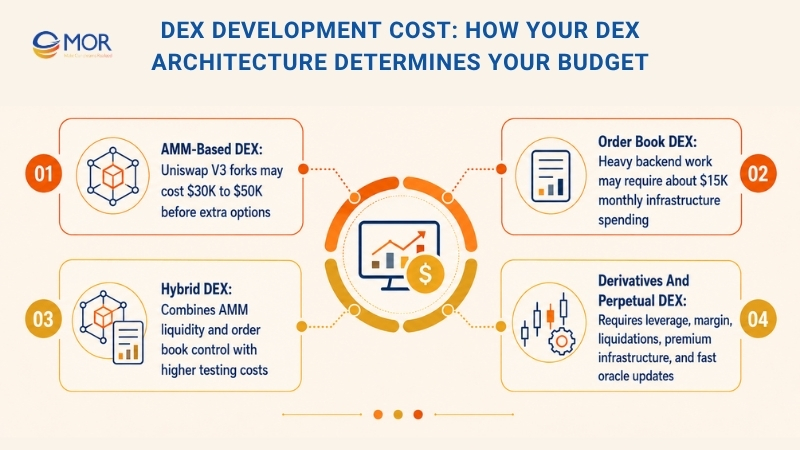
AMM-Based DEX
Automated Market Makers depend on formulas rather than a trade-matching engine. Your AMM build budget goes toward contracts for pools, fees, and concentrated liquidity.
- A Uniswap V3 fork may cost around $30K to $50K.
- Extra options like hooks, flash loans, or changing fee models can raise the final price. Pool safety and trading logic matter more than raw speed.
Order Book DEX
Order book platforms match buyers and sellers through price levels, not pool math. Many products use on-chain settlement and off-chain matching to lower gas fees.
- You’re funding heavy backend work: Redis caching, WebSocket streams, and indexers help trades stay live and harder to front-run.
- Plan for about $15K per month in infrastructure spending to keep data in sync.
Hybrid DEX
A hybrid model brings AMM liquidity and order book control into one product. In practice, it works like two exchange engines joined together.
You must develop, test, audit, and connect both parts through strong routing logic.
The gain: better speed and deeper liquidity. The cost: more work, more testing, and a larger hybrid exchange budget.
Derivatives And Perpetual DEX
Perpetual and derivatives platforms sit at the high end of DeFi builds. You need leverage, margin rules, liquidation flows, and fast oracle updates.
Each action must happen almost instantly. A small issue in liquidation logic or price feed data can damage the full protocol.
You pay for premium infrastructure, dedicated nodes, Chainlink or Pyth feeds, and risk engines tested for heavy market moves.
Your architecture choice is not only technical. It controls the full DEX development cost.
5 Key Reasons DEX Development Cost Can Rise Fast
DEX development cost can jump when the platform needs more than a simple trading flow. Custom features, multi-chain support, deeper audits, and richer UI can all raise the budget. The blockchain design and the team’s skill level also affect DEX platform pricing and long-term product health.
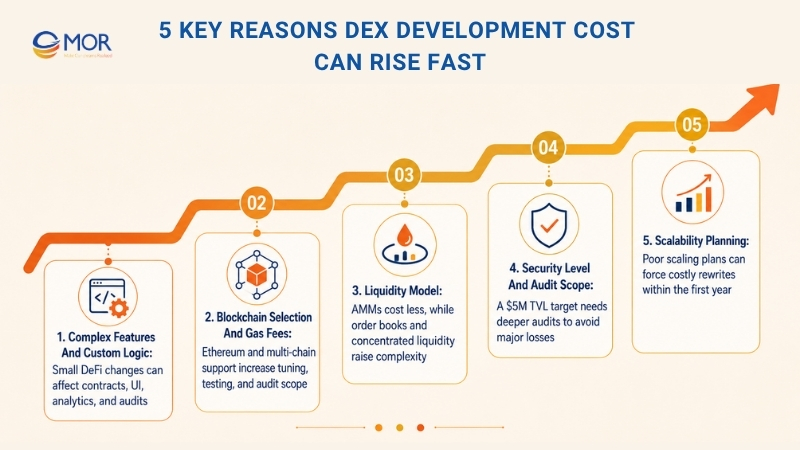
Complex Features And Custom Logic
Custom logic is often the main reason the budget goes off track. In DeFi, even a small request can create work in other parts of the product. A new fee tier, for instance, may touch the router contract, interface, analytics page, and audit plan. Founders often struggle to lock the MVP scope in the first sprint, mostly when they compare their idea with larger competitors.
Blockchain Selection And Gas Fees
Choosing Ethereum mainnet instead of Polygon or BNB Chain changes more than deployment spending. It also changes how your team writes and tunes smart contracts. On Ethereum, low gas usage becomes part of the product value. Multi-chain support is one of the largest budget multipliers, since each network needs new setup, extra tests, and a wider audit scope.
Liquidity Model
AMM platforms usually cost less and move faster than order book builds. Concentrated liquidity AMMs, like Uniswap V3, sit in the middle. Full on-chain order books take much more work and raise the price fast. The liquidity model budget touches almost every part of the build, including contracts, backend systems, design, and security review.
Security Level And Audit Scope
Your security budget should match the funds your platform may handle. A DEX that expects $5M in TVL within six months needs a much deeper safety plan than a small MVP. Skipping audit work does not truly save money. DeFi exploits have often led to losses above $10M, which makes this risk very real for founders.
Scalability Planning
A platform built only for launch day will look different from one planned for the next 18 months. Teams that ignore scaling often need large rewrites within the first year. That means they pay for much of the same development work again. This can stretch the budget and slow market growth.
DEX Development Cost By Blockchain Network
DEX development cost also depends on the blockchain network chosen for the product. Ethereum is usually more expensive because gas and security demands are higher. Networks like BNB Chain, Polygon, and Solana can lower fees, speed up transactions, and support scalable decentralized exchange builds.
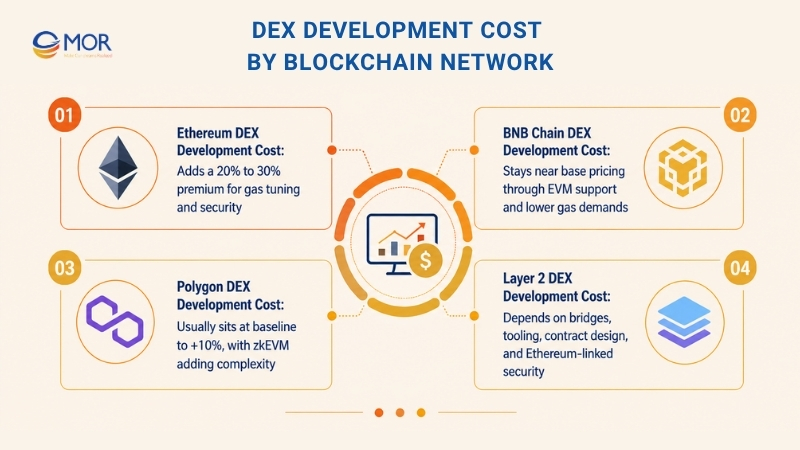
Ethereum DEX Development Cost
Ethereum still gives DEX projects strong TVL potential and business trust. Gas tuning is a must, and the security standard is higher than on many other networks. A typical premium can add 20% to 30% above the base build cost. The attack risk is also higher because successful exploits can bring bigger rewards to hackers.
BNB Chain DEX Development Cost
EVM support helps teams move Ethereum-style DEX products to BNB Chain with fewer changes. BNB Chain DEX development cost often stays near the base range because gas tuning is less demanding. The audit scope may also be slightly smaller. PancakeSwap shows that strong demand can still grow without heavy technical novelty.
Polygon DEX Development Cost
Polygon follows a similar cost pattern to BNB Chain. Both support EVM tools, low transaction fees, and mature developer resources. A common estimate is baseline to +10%. The zkEVM path can add more technical work, but it can also support future scaling. Polygon works well for DEX products tied to gaming tokens, NFT assets, or high-frequency retail users.
Layer 2 DEX Development Cost
Layer 2 networks like Arbitrum, Optimism, and Base are strong choices for serious DEX builds in 2026. Users can stay close to Ethereum security and still pay much lower gas fees. The price range depends on bridge setup, tooling, and contract design. Base deserves extra attention because Coinbase can support user access through its large retail audience.
The right chain can lower development spending and improve product speed. Businesses need to balance operations, security needs, and cost. A smart blockchain choice supports faster trades, lower fees, and better room for future DEX growth.
DEX Development Cost By Region And Hiring Market
DEX development cost changes across regions because talent rates, DeFi skill depth, and team demand vary. North America usually has higher rates, while Asia gives stronger cost control for blockchain development. Regional pricing affects the full decentralized exchange build budget and future scaling plan.
Region | Hourly Rate | Total Project Cost |
North America | $100 to $250 | $150K to $500K+ |
Eastern Europe | $50 to $150 | $80K to $300K |
Europe | $80 to $200 | $120K to $400K |
Asia | $30 to $100 | $50K to $250K |
The DEX development cost in India is often lower than in Western markets, which makes it a common choice for DeFi projects. Still, founders should compare India with Vietnam, Eastern Europe, and other Asian markets based on skill fit, audit needs, and delivery model.
A Vietnam-based partner can give you strong engineering value, clear team setup, and practical cost control. For MOR Software, the added strength is Japan-facing delivery experience, Agile work, and teams across Vietnam and Japan. The best region depends on your scope, risk level, and need for long-term product support.
The right hiring market can cut DEX pricing in a clear way. MOR Software provides cost-aware development support for global businesses. You can plan and launch a DEX around a budget that fits your product goals.
Custom DEX, Clone Script, Or White-Label: Which Costs Less?
DEX development cost changes a lot across custom builds, clone scripts, and white-label products. Each option has its own price range, feature limit, and launch schedule. The right DEX build model helps your business balance security, scaling needs, and speed to market.
DEX Type | Features | Timeline | Price Range |
Custom DEX Development | Full control, stronger security, scalable design | 4 to 9 months | $150K to $500K+ |
DEX Clone Script | Ready-made functions, limited custom work, fast setup | 2 to 6 weeks | $20K to $80K |
White-Label DEX Solution | Pre-built product, brand setup, moderate changes | 1 to 4 weeks | $30K to $120K |
Choosing the right model means reviewing your budget and product needs together. A custom build gives full design freedom, while clone and white-label choices lower the early build cost. The right choice can create a decentralized exchange that is secure, scalable, and fit for daily use.
Hidden DEX Development Cost Founders Often Miss
Hidden DEX development cost often appears after the main build estimate looks complete. These costs can include audits, liquidity, API setup, monthly upkeep, and compliance work. DEX development cost per month can also rise due to nodes, monitoring, support, and small upgrades, which can hurt scaling and security if founders ignore them.
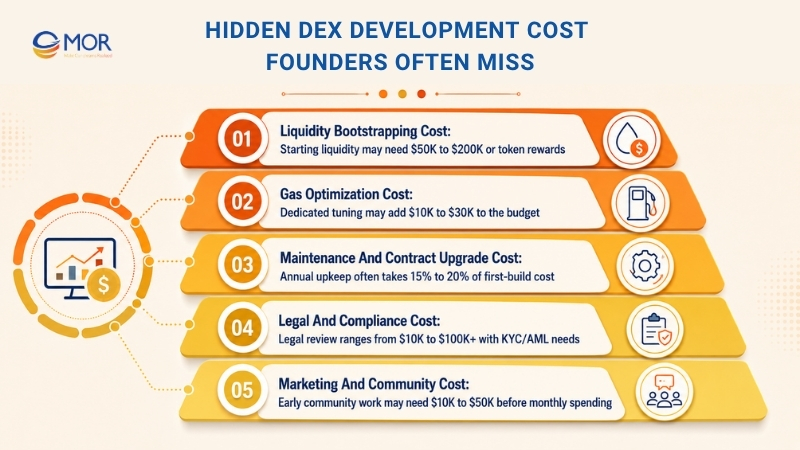
Liquidity Bootstrapping Cost
A DEX with no liquidity has little real use. Even a small starting pool of $500K to $2M in TVL may require $50K to $200K in capital or token rewards, based on APY plans and token value. Token design for liquidity mining, vesting contracts, and budget control all need assets with real market value.
Gas Optimization Cost
Gas tuning is not just a speed issue on Ethereum. It can affect user trust and repeat use. Traders often compare gas fees across DEX platforms before they swap. Dedicated gas work may add $10K to $30K to the software budget, but it can pay back through better user loyalty and higher trade volume.
Maintenance And Contract Upgrade Cost
A live smart contract system needs steady care. Plan around 15% to 20% of the first build budget each year for maintenance, monitoring, and small updates. Large upgrades, like moving from V1 to V2, can cost almost as much as the first build.
Legal And Compliance Cost
DEX rules in 2026 remain hard to predict. Legal review may cost around $10K for a basic check, or more than $100K when you need full counsel and KYC/AML setup. The final number depends on your market, product model, and user access rules. Late compliance work usually costs more than planning it from the start.
Marketing And Community Cost
A strong DEX without users is still a quiet product. DeFi community work often includes Discord management, Twitter/X activity, partner outreach, and launch support. You may need a full-time person or an agency. Set aside $10K to $50K for early marketing and community tools, then plan monthly spending after launch.
Knowing the hidden decentralized exchange costs helps teams avoid cash gaps and slow delivery. Companies should plan for audits, upgrades, liquidity, and operating support from the start.
How Timeline Affects DEX Development Cost
Timeline affects DEX development cost and the way the product scales after launch. A long build raises expenses. A faster release can cut spending. Good planning keeps work moving, gives better budget control, and supports stronger platform performance.
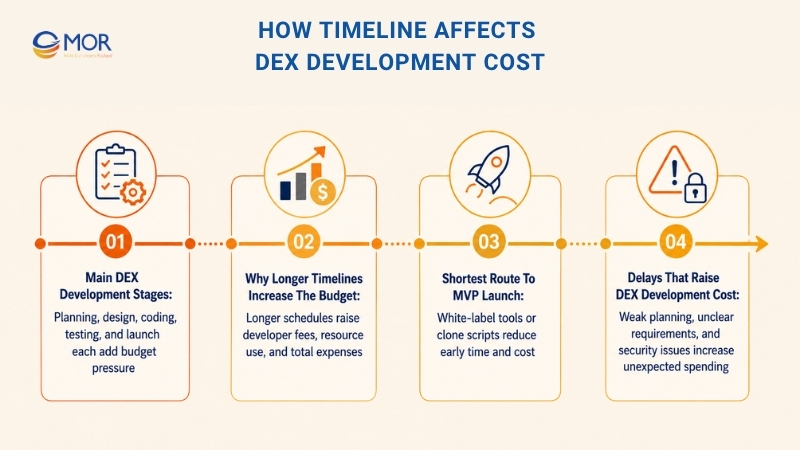
Main DEX Development Stages
A DEX delivery timeline usually covers planning, design, coding, testing, and launch. Each stage adds to the full build budget. Clear workflows reduce gaps between teams and help the platform reach market sooner.
Why Longer Timelines Increase The Budget
Long schedules raise developer fees and use more resources. Extra waiting time can also put pressure on the total budget. Faster decentralized exchange development can lower spending and improve returns.
Shortest Route To MVP Launch
White-label tools or clone scripts can help an MVP launch sooner. They reduce development time and early cost. Businesses can enter the market faster with a scalable decentralized exchange base.
Delays That Raise DEX Development Cost
Weak planning, unclear requirements, and security issues can push the schedule back. These delays can raise the budget in a serious way. A clear DEX plan helps avoid extra spending that the team did not expect.
A managed build schedule keeps the budget under control. Faster delivery lowers project risk. Strong planning supports safer platforms and better market traction.
How To Lower DEX Development Cost Without Risking Quality
DEX development cost depends heavily on scope, timeline, and build choices. A longer build costs more, while a focused launch costs less. Strong planning helps decentralized exchange development move with better performance and tighter budget control.
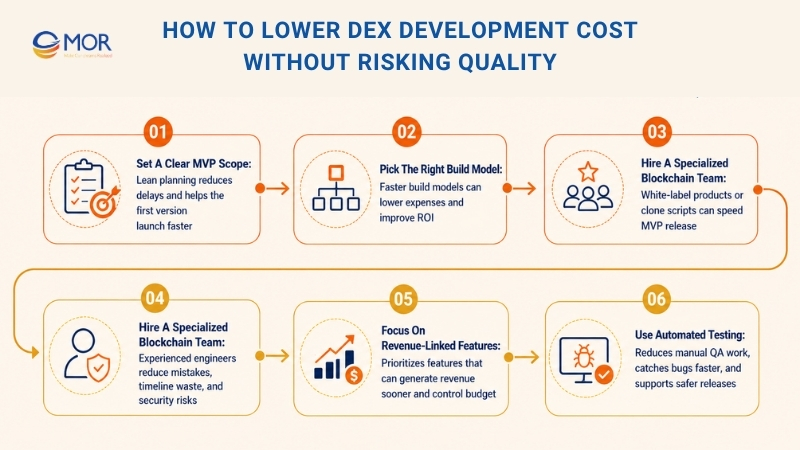
Set A Clear MVP Scope
A DEX build should begin with planning, design, development, testing, and launch needs. Each stage affects cost. A lean scope reduces delays and helps the first platform version reach users faster.
Pick The Right Build Model
Longer development cycles increase resource use and team charges. Delays can push the budget up fast. A faster build model can lower expenses and support a better return on investment.
Hire A Specialized Blockchain Team
White-label products or clone scripts can speed up MVP release. They cut both build time and cost. Businesses can test the market quickly with a scalable decentralized exchange platform.
Hire A Specialized Blockchain Team
Experienced engineers reduce mistakes and timeline waste. They build safer decentralized exchanges. A team with real project experience can improve security, scaling, and delivery without pushing DEX development cost too far.
Focus On Revenue-Linked Features
Start with functions that can bring revenue sooner. Leave non-core extras for later. Revenue-linked features help the business move faster and keep the development budget tighter.
Use Automated Testing
Automated tests reduce the need for repeated manual checks. They cut QA labor and improve accuracy. Bugs become easier to catch. Releases move faster, and security remains under control.
Lowering the DEX build budget takes clear decisions and skilled delivery. Businesses should focus on speed, quality, and future growth. Smart decentralized exchange development supports long-term value without waste.
DEX Revenue Models And Realistic ROI Timeline
According to CoinGecko, decentralized exchanges handle billions of dollars in daily trading volume, which shows the earning potential of well-built DEX products.
Most DEX platforms earn through three main routes: trading fee spreads, often around 0.05% to 0.30% per swap based on pool tier. They can also earn protocol fees, where part of each trading fee moves to the treasury or token holders. Listing and launchpad fees from new token projects can add another revenue stream.
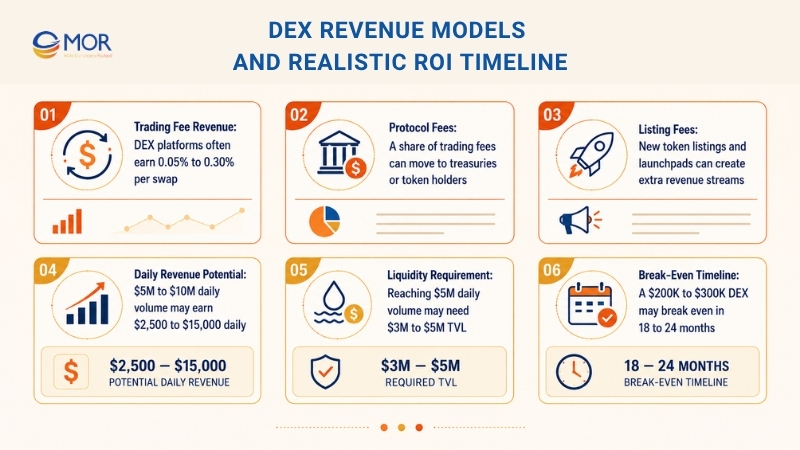
A mid-range DEX with $5M to $10M in daily trade volume may earn $2,500 to $15,000 in daily protocol revenue at common fee levels. Reaching $5M in daily volume is still hard. It usually needs deep liquidity, often $3M to $5M in TVL, and active users who trade through your platform instead of aggregators.
A realistic break-even point for a $200K to $300K DEX platform cost is often 18 to 24 months, assuming steady trading volume growth. Lower-cost builds around $60K to $100K may reach payback faster, but they usually serve a narrow niche or work as part of a larger product instead of a full revenue engine.
Why Choose MOR Software To Develop Your DEX Platform?
Choosing MOR Software for your DEX platform gives your project a practical technology team, clear planning, and strong delivery control. We build custom software, web apps, mobile apps, and blockchain products for businesses that need stable systems and long-term value. Our team supports each stage, from business analysis and UI/UX design to development, QA, integration, launch, and maintenance.
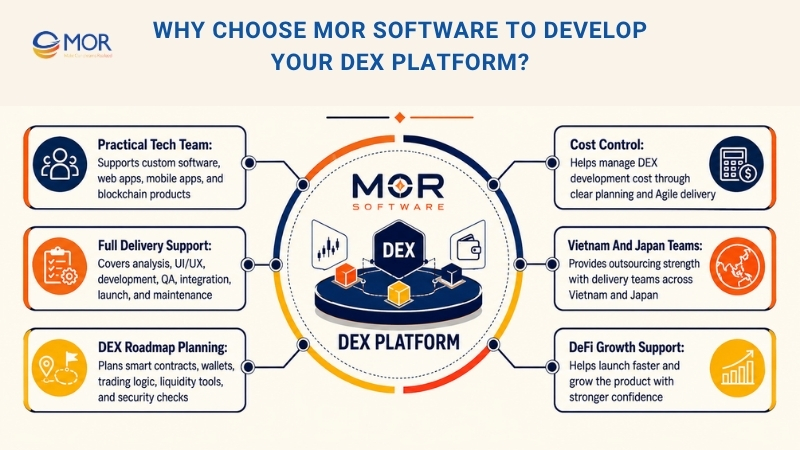
For DEX development, we help you plan smart contracts, wallet flows, trading logic, liquidity tools, and security checks through a clear roadmap. With proven outsourcing work, Agile delivery, and teams in Vietnam and Japan, MOR Software helps you launch faster, control DEX development cost, and grow your DeFi product with more confidence.
Conclusion
DEX development cost depends on architecture, blockchain choice, security depth, team model, and launch goals. A lean AMM can start small, but a full multi-chain or perpetual DEX needs deeper planning and a larger budget. The best move is to define the MVP, protect smart contracts, and spend where revenue or safety matters most. Need a clear estimate for your DEX idea? Contact us to discuss your project with MOR Software.
MOR SOFTWARE
Frequently Asked Questions (FAQs)
How much does it cost to build a DEX?
A basic DEX usually costs $50K to $100K, while a mid-level platform may range from $100K to $250K. A custom, multi-chain, or enterprise-grade DEX can cost $250K to $500K+, especially when advanced smart contracts, audits, liquidity tools, and backend systems are included.
Is it cheaper to build an AMM DEX or an order book DEX?
Yes. An AMM DEX is usually cheaper because it uses liquidity pools instead of a complex order-matching engine. An order book DEX needs stronger backend systems, real-time matching, and more infrastructure, so it usually costs more.
How much do smart contract audits cost for a DEX?
Smart contract audits can range from a few thousand dollars to tens of thousands of dollars. The final cost depends on contract complexity, audit depth, and the number of fixes needed. Audits are important because DEX smart contracts manage user funds.
Does blockchain choice affect DEX development cost?
Yes. Ethereum may cost more because of gas optimization and security needs. Layer 2 networks, BNB Chain, and Polygon can reduce some costs, while Solana may require different technical skills. Multi-chain support always increases the total budget.
What is the cost difference between building a DEX from scratch vs using white-label solutions?
A white-label DEX is cheaper and faster to launch, but it offers less flexibility. A custom DEX costs more, but it gives you full control over features, architecture, tokenomics, security, and future scaling.
How much does it cost to maintain and scale a DEX?
Maintenance costs include hosting, monitoring, bug fixes, security updates, smart contract upgrades, analytics, and support. Scaling costs increase when you add new chains, liquidity pools, staking, governance, or advanced trading features.
Is DEX development profitable for startups?
It can be profitable if the platform has strong trading volume, deep liquidity, a clear fee model, and steady user growth. Common revenue streams include trading fees, listing fees, launchpad fees, staking fees, and premium tools.
How long does it take to build a decentralized exchange?
A basic DEX MVP may take 4 to 8 weeks. A custom DEX can take 3 to 6 months. A multi-chain, hybrid, or perpetual DEX may take 6 months or longer because it needs deeper testing, audits, and infrastructure.
Share


Make Our-Dreams Realized


© 2023 . MOR Software. All Rights Reserved
Sitemap
Privacy Policy
Terms of Use

Rate this article
0
over 5.0 based on 0 reviews
Your rating on this news:
Name
*Email
*Write your comment
*Send your comment
1