


Hire Agentic AI Developers 2026 for Custom Automation Solutions
Finding the right talent for agentic AI is hard. Many businesses want to hire agentic AI developers, but struggle to judge skills, hiring models, and real project fit. This MOR Software’s guide will show you what to look for, how to avoid costly mistakes, and when AI agent development services or dedicated specialists make the most sense.
Skills And Expertise Businesses Look For In Agentic AI Developers
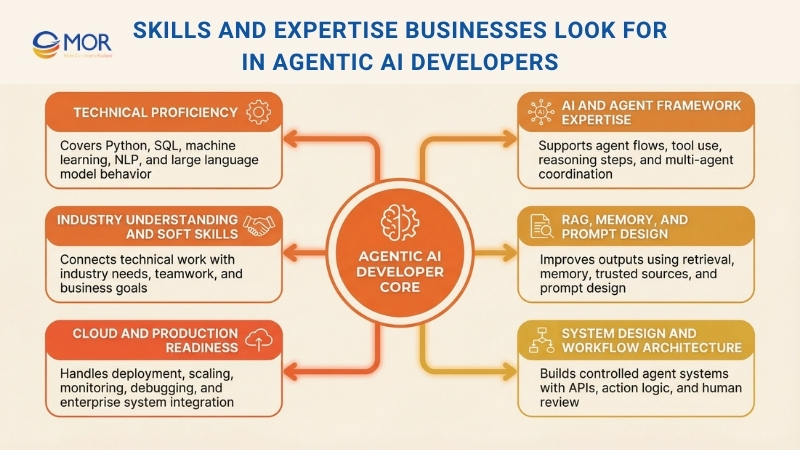
Companies looking to hire agentic AI developers usually want more than solid programming skills. They need people who can create intelligent systems, tie them to actual business processes, and keep them stable as usage grows. That is why the strongest professionals bring technical depth, system thinking, and the ability to work well with different teams.
Technical Proficiency
Technical skill is still the base. Companies that want to hire agentic AI developers often look for strong Python knowledge, since Python remains the leading language in AI work. Familiarity with SQL also matters because these systems often rely on structured data, internal databases, logs, and reporting flows. A strong foundation in machine learning, natural language processing, and large language model behavior is now expected from AI developers for hire.
AI And Agent Framework Expertise
Modern agentic AI work depends a lot on orchestration frameworks. Businesses often search for hands-on knowledge of tools like LangChain, LangGraph, CrewAI, AutoGen, or Semantic Kernel. These frameworks let teams shape agent flows, manage reasoning steps, connect tools, and coordinate how many agents work together. A developer who knows these ecosystems can move from testing to live deployment much more smoothly.
RAG, Memory, And Prompt Design
Many companies also value developers who know how to improve model output in real business settings. This includes experience with prompt engineering, Retrieval-Augmented Generation (RAG), and vector databases. These skills matter because agentic systems often need access to private knowledge bases, long-term memory, and current business data. Developers should understand how to build retrieval pipelines, anchor outputs in trusted sources, and keep context consistent over time.
System Design And Workflow Architecture
Beyond separate tools, companies want developers who can design full agent systems. This includes planning multi-step flows, coordinating tools and APIs, defining how agents choose actions, and setting up human-in-the-loop review points when needed. In many cases, the value of hiring agentic AI developers comes from their ability to build systems for AI agent automation that are not just smart, but also controlled, safe, and useful for real business work.
Cloud And Production Readiness
Businesses also want developers who can move agentic AI past the prototype stage. Experience with cloud platforms like AWS, Google Cloud, or Azure is important for deployment, scaling, monitoring, and connection with enterprise systems. Familiarity with production needs, including performance, observability, debugging, and reliability, helps make sure the AI system can handle real operational pressure.
Industry Understanding And Soft Skills
Technical skill by itself is not enough. Companies value developers who understand the industry they are building for. A finance-focused agent may need knowledge of risk controls and compliance, while a healthcare solution may rely on knowledge of clinical workflows and sensitive data practices. Strong communication and problem-solving skills also matter because these developers often work with product teams, operations staff, and business leaders to shape how the system should behave in real situations.
When businesses hire agentic AI developers, they are usually searching for a full mix of skills. The best people can write code, design workflows, handle retrieval and memory, deploy systems in the cloud, and turn business needs into AI systems that produce useful results.
Why Businesses Outsource Agentic AI Development Services?
Managers face a hard decision when they begin a new automation project. They need to choose between training their own team and working with an outside partner. Most companies choose the second option to save time and reduce costs, especially those planning to hire remote AI agent developers.
Access Experienced AI Talent Without Hiring Delays
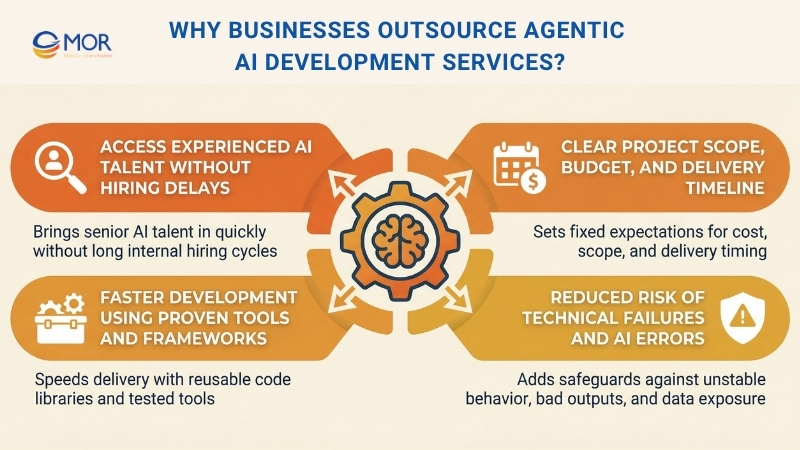
Hiring a new employee can take weeks or even months. Finding a real AI specialist is even more difficult. Your current engineers are capable people. But they are likely focused on standard web applications. Teaching them to build agents takes time. You lose speed while they learn the basics. Rather than waiting months to hire agentic AI developers internally, many companies outsource to specialists who are ready to build AI automation. An outside team skips that learning phase entirely. They bring senior-level knowledge from day one.
Clear Project Scope, Budget, And Delivery Timeline
Internal software projects often miss deadlines. The scope expands as the team uncovers new issues. This kind of drift can damage your quarterly budget. Working with a specialized partner helps fix this issue. You agree on a fixed price at the start. You also set a clear delivery date. The outside team is expected to finish on schedule. You avoid the pressure of an uncertain final bill.
Faster Development Using Proven Tools And Frameworks
Starting from zero wastes time. Your internal team would need to build every script themselves. Agencies do not begin at zero. They already have code libraries from past work. They know which tools fit specific tasks best. They reuse these tested building blocks to create your agent. This approach cuts weeks from the delivery timeline. You get a working product much sooner through AI automation services and proven delivery experience.
Reduced Risk Of Technical Failures And AI Errors
AI systems can fail in unusual ways. A chatbot may invent facts or expose data. Less experienced developers often miss these warning signs. They may release unsafe code. Skilled professionals know where these risks appear. They test the system against bad inputs. They put controls in place to keep the agent stable. This discipline protects your business from public problems and costly mistakes.
Pain Point | Build In-House | Hire Remote AI Agent Developers |
Missing Skills | You hire new staff or retrain engineers. This process takes months. | Senior specialists begin immediately. No extra training is required. |
Slow Launch | The team learns during the project. Mistakes and research create delays. | Experts use existing code libraries. The project is completed weeks earlier. |
Unclear Costs | Scope changes often increase the final cost. Budgets become hard to control. | You sign a fixed contract. The cost remains stable. |
High Risk | Less experienced teams miss edge cases. The agent may fail or expose data. | Experienced teams test for known errors. The system stays more stable and secure. |
Methodology | You build every line from the ground up. It takes trial and error. | The team uses tested methods. They avoid common mistakes. |
The Strategic Role Of Agentic AI Developers In Building Advanced AI Systems
Companies need skilled developers to create advanced AI systems. A hire agentic AI developer can build smart tools. These systems can reason and act with less human input. This can help businesses improve revenue, efficiency, and long-term returns.
Want to know how these specialists help enterprises become more profitable? Let’s look at it step by step.
Deep Technical Expertise
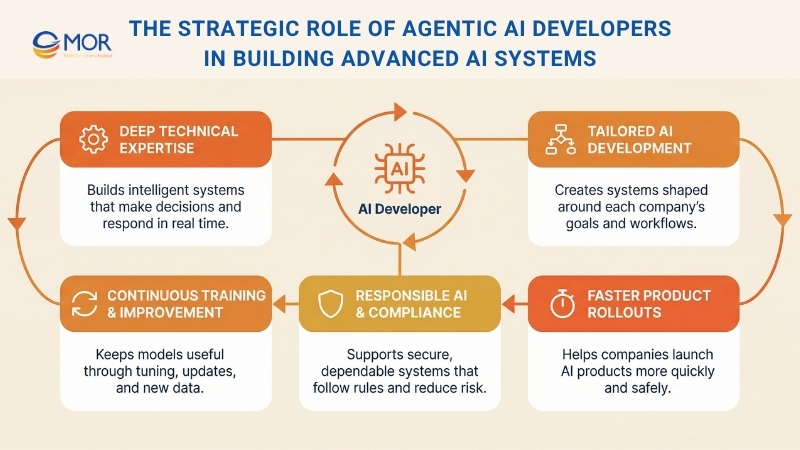
Building agentic AI calls for specialized skills. Developers need a solid understanding of machine learning. A strong expert can create systems that make smart decisions in real time. This matters a lot when businesses build new AI products.
Tailored AI Development
Every company works in its own way. So, each one needs AI systems built for its exact needs. An experienced developer can create tools that match a business’s goals. This custom method works far better than a one-size-fits-all product.
Continuous Training And Improvement
Launching an AI system is only the beginning. These systems need regular tuning and updates. A skilled developer keeps the model working at a high level. They help it respond to new data over time. This keeps the solution useful as business needs change.
Responsible AI And Compliance
As AI adoption grows, companies pay more attention to safety. Skilled developers build systems that are secure and dependable. They also make sure the platform follows the right rules and standards. This matters even more for teams evaluating AI agents as a service. It helps lower business risk and supports long-term trust.
Faster Product Rollouts
Experienced developers save valuable time. They know how to build and launch AI solutions quickly and safely. Because of that, hiring the right people helps companies release products faster. This gives them a better chance to move ahead of others in the market.
Key Benefits When Businesses Hire Agentic AI Developers
Bringing in an experienced developer creates many business benefits. These specialists build solutions that help your company grow and perform better.
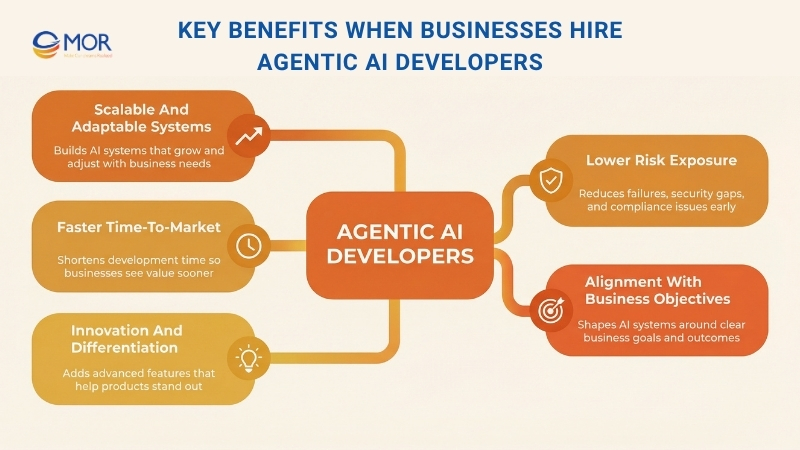
Scalable And Adaptable Systems
Skilled developers build AI systems that can scale. This means the platform can expand as your business expands. They also create flexible solutions that can respond to new problems. This helps protect the value of your AI investment over time. A strong team builds for your current needs and your future plans.
Faster Time-To-Market
An experienced agentic AI specialist knows how to work with speed and focus. They can build and release AI solutions in less time. A shorter path to launch helps your business see value earlier. It also helps you stay ahead of competitors.
Innovation And Differentiation
To stand out, businesses need modern technology. When companies hire agentic AI developers, they can bring advanced features into their products faster. These experts build solutions that deliver distinct value to customers. That matters even more for agentic AI startups trying to separate themselves in crowded markets.
Lower Risk Exposure
AI systems can become very complex. Without the right expert, problems can appear quickly. A poorly built platform may fail or create security gaps. Skilled developers know how to stop these issues early. They build systems that are safe, stable, and compliant. This lowers business risk in a clear way.
Alignment With Business Objectives
A skilled developer works around your business needs. They take time to understand your exact goals. Then they build an AI solution that fits those goals closely. This focused approach helps the system perform well and produce real business value.
How To Hire Agentic AI Developers The Right Way
Finding the right talent is essential when you build AI solutions that work in real business settings. When you want to hire agentic AI developers, a clear and structured hiring process helps you find someone who can create real value. That means you need more than a basic resume check. You need to review practical skills and measure how well the candidate fits your team.
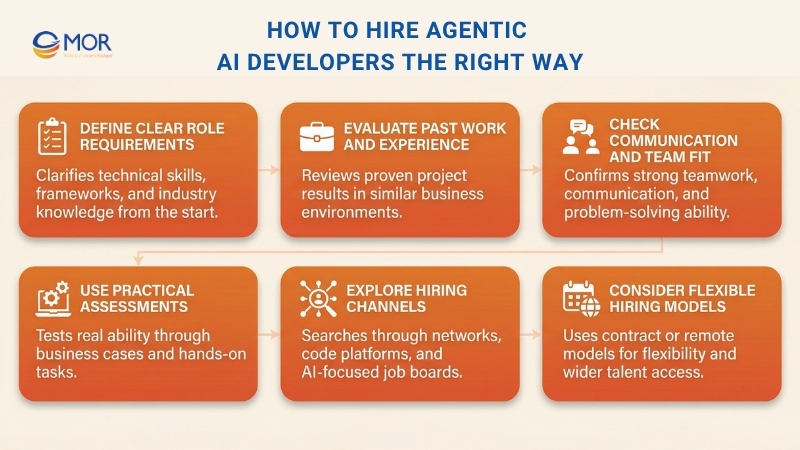
Define Clear Role Requirements
Start with a clear picture of what you need. Your job description should explain the required technical skills, including machine learning, agent frameworks like LangChain or CrewAI, and any industry knowledge linked to your business. This kind of clarity helps you attract the right people from the start when you hire AI agent developer talent.
Evaluate Past Work And Experience
Look for a developer with a portfolio of finished work. Their earlier projects should show hands-on experience building autonomous systems in business settings close to yours. Reviewing what they built and what results they achieved helps you judge whether they can meet your company’s needs.
Check Communication And Team Fit
Technical skill matters, but soft skills matter too. A strong developer should communicate well, solve difficult problems, and work smoothly with teams across the business. This helps hire agentic AI developers who can connect technical work with larger business goals.
Use Practical Assessments
A resume shows only part of the picture. Your hiring process should include practical tests or short case studies. This lets you see how a candidate handles real business problems. It is one of the best ways to measure hands-on ability.
Explore Hiring Channels
You can search for candidates on professional networks like LinkedIn or code platforms like GitHub. Many AI-focused job boards also attract specialists in this space. Some businesses also compare options like an AI automation agency near me when they want a faster path to qualified talent.
Consider Flexible Hiring Models
A full-time in-house role is not always the only answer. You may want to work with a remote developer on a contract basis. This model can give you access to a wider and more diverse talent pool. It also gives you more flexibility when you need to scale AI projects up or down. In some cases, companies also hire dedicated AI agent developers to support a focused roadmap without adding permanent headcount too early.
Real-World Use Cases Driving Businesses To Hire Agentic AI Developers
Different industries already use this technology in daily operations. Many companies now hire AI agent developers to build custom tools that solve real business problems. Some of the most common use cases include:
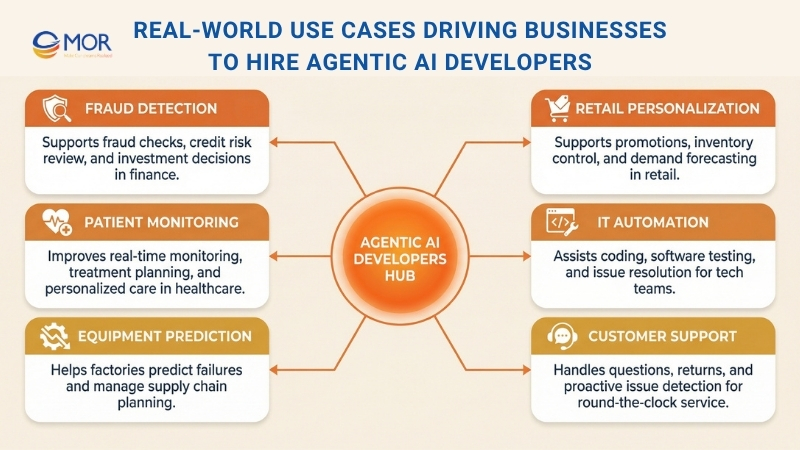
- Agentic AI In Finance: Companies use it to detect fraud. They also use it to assess credit risk and support investment management.
- Agentic AI In Healthcare: It helps monitor patients in real time. It also supports treatment planning and more personalized care.
- Agentic AI In Manufacturing: Factories use it to predict equipment failures. It also supports supply chain planning and control.
- Agentic AI In Retail: Stores use it to create personalized promotions. It also helps manage inventory and forecast customer demand.
- Agentic AI In IT And Software: Tech teams use it to automate coding tasks. It also helps with software testing and IT issue resolution.
- Agentic AI For Customer Support: Autonomous agents answer customer questions, manage returns, and sometimes detect problems before they happen. This supports a reliable 24/7 service model. To build these systems well, businesses often look for experts with both technical strength and industry knowledge.
Typical Cost Structures Of Hiring Agentic AI Developers By Region (2026)
Hiring costs can vary a lot depending on region, seniority, and engagement model. This comparison gives businesses a quick way to understand what they may spend when they hire agentic AI developers in different markets.
Location | Junior (Annual) | Mid-Level (Annual) | Senior (Annual) | Hourly Rate |
| United States | $117K–$140K | $150K–$180K | $190K–$250K+ | $80–$150/hr |
| United Kingdom | £45K–£65K | £70K–£90K | £90K–£130K | $45–$80/hr |
| Germany | €65K–€80K | €85K–€100K | €100K–€130K | $50–$90/hr |
| Canada | $95K–$115K | $120K–$140K | $140K–$165K | $60–$100/hr |
| Australia | AUD 100K–130K | AUD 140K–160K | AUD 160K–190K | $55–$95/hr |
| Singapore | $70K–$85K | $90K–$110K | $110K–$140K | $45–$80/hr |
| Vietnam | $18K–$28K | $28K–$45K | $45K–$65K | $15–$35/hr |
| Philippines | $15K–$25K | $25K–$38K | $38K–$55K | $12–$30/hr |
| Indonesia | $12K–$20K | $20K–$32K | $32K–$50K | $10–$28/hr |
| India | $15K–$22K | $22K–$35K | $35K–$55K | $12–$30/hr |
Sources: Qubit Labs AI Engineer Salary Guide 2026, Glassdoor US AI Developer Data (March 2026), Second Talent Asia Tech Salary Index.
Common Mistakes When Hiring Agentic AI Developers
When businesses hire agentic AI developers, mistakes can happen easily. These common problems can cost both time and money. It is smart to watch for these hiring issues from the start.
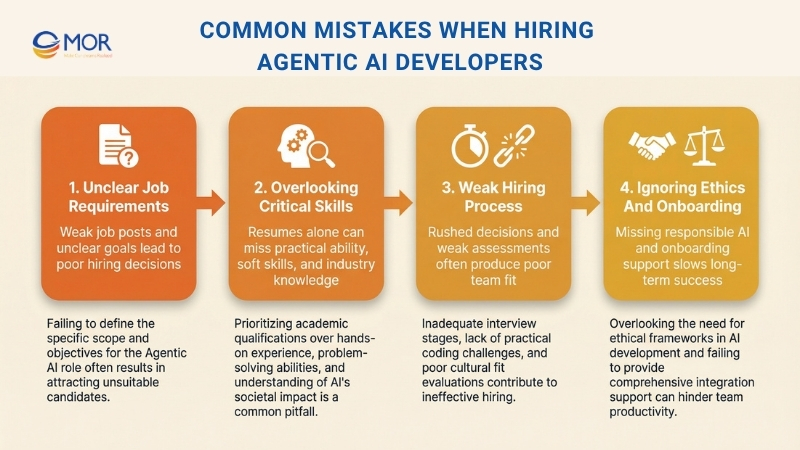
Unclear Job Requirements
A weak hiring process often begins with a weak job post.
- Define The Role Clearly: Do not use broad job titles. Write a clear job post instead. List the exact skills you need, such as machine learning or natural language processing.
- Align Around Business Goals: You need to know what you want the AI to do. Your business goals should shape the hiring process. This helps you find someone who can solve the right problems.
Overlooking Critical Skills
It is important to look beyond a simple resume.
- Prioritize Soft Skills: Strong communication and problem-solving skills matter a lot. A developer in this role needs to work well with your team.
- Look For Proven Practical Experience: Academic knowledge alone is not enough. Look for someone who has already built and launched AI models in a business environment.
- Make Industry Knowledge A Priority: Your developer should understand your field. This context helps them build an AI agent that works well in real use.
Weak Hiring Process
A rushed or weak process often leads to poor hires.
- Take Time To Choose Well: Take enough time to find the right person. A fast decision can lead to a poor fit and larger costs later.
- Assess Real Problem-Solving Ability: Use practical tests that show how a candidate solves actual problems. Basic coding tests do not measure AI ability well enough.
- Choose Someone Who Fits The Team: An AI specialist should fit your company culture. This matters for team cooperation and long-term success.
Ignoring Ethics And Onboarding
Do not forget ethics or post-hire support.
- Put Responsible AI First: Your developer needs to understand how to build fair and responsible AI. This helps protect your business from bias and legal trouble.
- Prepare A Strong Onboarding Process: A strong onboarding process helps your new hire become effective faster. Many companies forget this step, even though it matters a lot.
How Agentic AI Development Companies Simplify Your Hiring Process
For many businesses, building an advanced AI team internally is a significant challenge. Working with specialized firms or agentic AI providers can be a smarter way forward. These companies are built to solve the common issues businesses face when they adopt agentic AI.
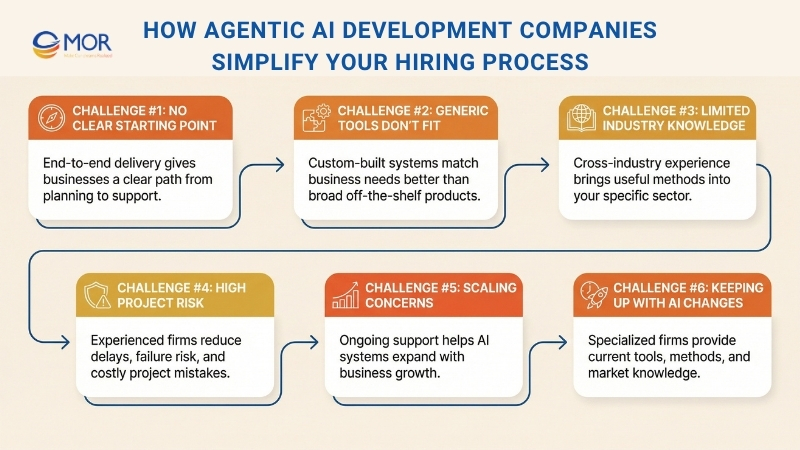
Challenge #1: No Clear Starting Point
You may have a strong idea for an AI agent, but no clear path to plan it, build it, and launch it.
Solution: End-To-End Delivery: An expert AI partner can manage the full process. They can handle consulting, design, development, deployment, and ongoing support. This helps every part of the system work together in a clear way.
Challenge #2: Generic Tools Don’t Fit
Off-the-shelf AI products are often too broad. They may not solve your company’s exact problems.
Solution: Custom-Built Systems: A strong AI partner can build tailored AI agent solutions for your business. They shape the system around your needs, so you get a tool that works well and creates measurable value.
Challenge #3: Limited Industry Knowledge
Your team may not know how AI practices from one sector can apply to another. That gap can slow your decisions when you hire agentic AI developers.
Solution: Cross-Industry Experience: Many AI development companies have worked with clients in healthcare, finance, retail, and other sectors. They bring useful lessons from that broader work and help apply proven methods to your own industry.
Challenge #4: High Project Risk
AI projects can be complex and expensive. One failed launch can set your company back in a serious way.
Solution: Lower Development Risk: Working with an experienced firm adds a layer of protection to your project. Their knowledge and resources reduce the chance of failure or delay and support a smoother launch.
Challenge #5: Scaling Concerns
As your business grows, you may worry that your AI system will not keep up with new demands.
Solution: Scalability And Ongoing Support: A reliable AI company does not just launch the system and disappear. They continue to support it and help it scale as your business changes and grows.
Challenge #6: Keeping Up With AI Changes
AI changes very quickly, and it can be hard for internal teams to keep pace with every new model, tool, and method.
Solution: Access To The Latest Technology: When you work with a specialized firm, you gain access to current tools, new methods, and experienced AI engineering teams. They stay close to fast-moving changes in the market, which helps your business stay competitive.
MOR Software - Your Trusted Partner For Enterprise Agentic AI Development
Building agentic AI takes more than writing code. It requires clear direction, strong engineering, and real experience with business platforms. Many teams stall at the concept stage, or create something that performs well in testing but struggles in real operations.
At MOR Software, we focus on outcomes that matter in real business settings. We work with enterprises to design and deliver agentic AI systems that can plan tasks, make decisions, and run inside existing platforms. Our team supports the full process, from early consulting to deployment, so you do not have to coordinate several vendors.
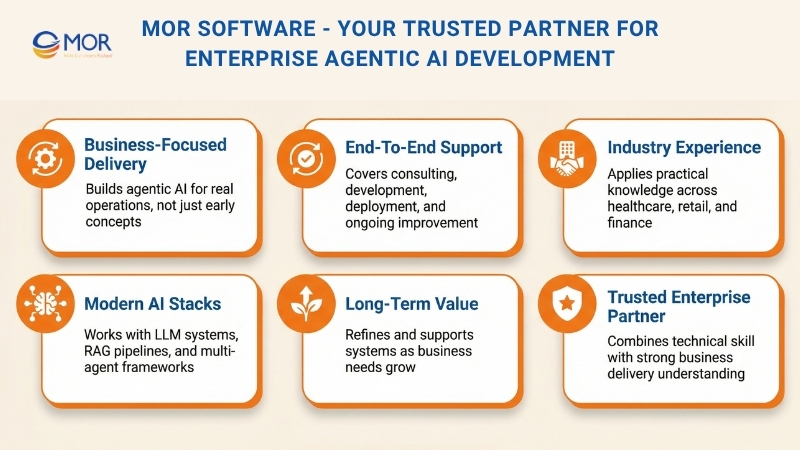
We bring practical experience across industries such as healthcare, retail, and finance. That means we understand how these systems fit into real workflows, not just technical theory. Our developers work with modern AI stacks, including LLM-based systems, RAG pipelines, and multi-agent frameworks. This allows us to build solutions that can adapt, scale, and remain reliable over time.
We also focus on long-term business value. After launch, we continue to support, refine, and improve your AI systems as your business grows.
If you are preparing to build or expand AI capabilities, working with MOR Software gives you a team that understands both the technology and the business side of delivery.
Conclusion
Hiring the right team can shape how fast your business moves, how safely your systems run, and how much value your AI investment returns. When you hire agentic AI developers, every choice matters, from technical skills and hiring models to delivery quality and long-term support. MOR Software helps enterprises build, scale, and support practical agentic AI solutions that fit real business needs. Contact us to discuss your goals and choose the right path for your next AI project.
MOR SOFTWARE
Frequently Asked Questions (FAQs)
What does it mean to hire agentic AI developers?
It means bringing in specialists who can build AI systems that act independently, plan tasks, and execute decisions with minimal human input. These developers focus on creating autonomous agents that handle complex workflows across business operations.
What skills should agentic AI developers have?
They should be strong in Python, machine learning, and natural language processing. Experience with LLMs, RAG techniques, and frameworks like LangChain or CrewAI is also important. Knowledge of cloud platforms such as AWS or Google Cloud is often required.
How much does it cost to hire agentic AI developers?
Costs vary by region and experience level. In the US, senior developers can earn over $190K annually, while in countries like Vietnam or India, rates are much lower. Hourly rates typically range from $15 to $150 depending on location and expertise.
Should we hire in-house or remote agentic AI developers?
It depends on your needs. In-house teams give you closer control, while remote developers provide access to a wider talent pool and lower costs. Many businesses choose a hybrid approach for flexibility.
How long does it take to hire agentic AI developers?
It can take anywhere from a few weeks to several months. The timeline depends on how complex your requirements are and how quickly you can assess candidates’ technical and practical skills.
What industries benefit most from hiring agentic AI developers?
Finance, healthcare, retail, manufacturing, and IT all benefit from agentic AI. These systems are useful for fraud detection, patient monitoring, supply chain optimization, and automated customer support.
What is the difference between traditional AI developers and agentic AI developers?
Traditional AI developers focus on models that respond to inputs. Agentic AI developers build systems that can plan, make decisions, and take actions independently across multiple steps.
How do we evaluate candidates when hiring agentic AI developers?
Look beyond resumes. Review real projects, test problem-solving skills with practical tasks, and check their experience with AI frameworks and real-world deployments. Communication and teamwork also matter.
What challenges should we expect when hiring agentic AI developers?
Common challenges include unclear requirements, difficulty assessing real expertise, and high competition for top talent. A structured hiring process helps reduce these risks.
Can small businesses afford to hire agentic AI developers?
Yes, especially with remote or contract hiring options. Many small businesses start with smaller AI projects and scale gradually as they see results.
Share


Make Our-Dreams Realized


© 2023 . MOR Software. All Rights Reserved
Sitemap
Privacy Policy
Terms of Use

Rate this article
0
over 5.0 based on 0 reviews
Your rating on this news:
Name
*Email
*Write your comment
*Send your comment
1