


Top 10 Manufacturing Accounting Software Solution in 2026
Managing costs, inventory, and production in one place is still a challenge for many manufacturers. Choosing the right manufacturing accounting software can fix that, but the options often feel overwhelming. In this MOR Software’s guide, we’ll review the best tools and what really matters when selecting accounting software for manufacturing that fits your operations.
Top 10 Manufacturing Accounting Software Of 2026
Manufacturers now rely on connected tools to manage production, inventory, and finance in one place. This list highlights leading solutions that support manufacturing business software needs with better visibility and control.
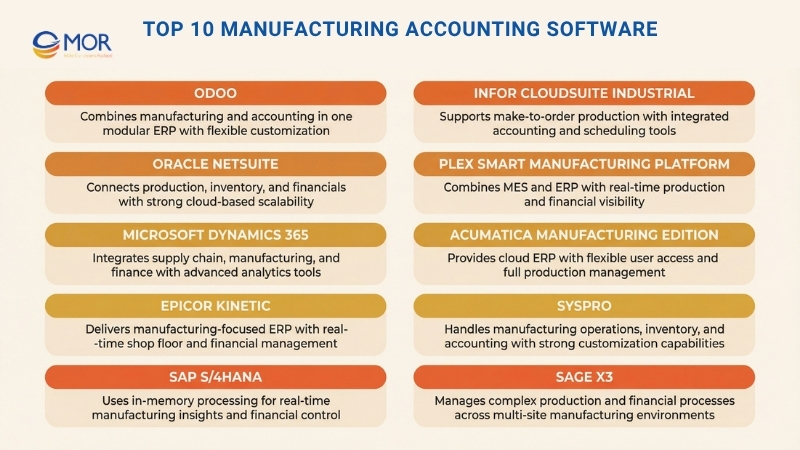
Odoo
Open-source ERP with modular manufacturing, MRP, inventory, and accounting applications.
Odoo is an open-source ERP system that combines manufacturing and financial modules in a single platform, helping businesses handle production planning, inventory tracking, quality checks, and financial tasks together. It supports tools like MRP, work orders, BOMs, and shop floor management, while its accounting side includes invoicing, payment tracking, bank synchronization, and multi-currency reporting. Its modular structure allows smooth data exchange across functions, helping teams avoid disconnected systems and improve efficiency as they grow. Many teams consider it the best accounting software for manufacturing business when they want flexibility and control in one system.
Pros
- Strong integration between manufacturing and accounting modules with real-time data updates
- Flexible and customizable through apps and low-code configuration tools
- Affordable entry with a free version and scalable enterprise plans
Cons
- Steep learning curve during initial adoption
- Advanced customization often needs developer support
- System performance may slow with large datasets or complex setups
Highlight: Fully integrated MRP and accounting with automated cost tracking from production to financials
Best for: Small to mid-sized manufacturers looking for an all-in-one ERP to manage production and finance without relying on separate tools
Pricing: Free open-source Community edition; Enterprise starts at approximately $25 per user per month, billed annually with a minimum of 12 users, plus implementation costs, with both online and on-premise deployment options
Oracle NetSuite
Cloud ERP integrating manufacturing, inventory management, production planning, and full financial accounting.
Oracle NetSuite is a cloud-based ERP system that connects manufacturing processes with strong financial and accounting capabilities. It delivers end-to-end functions such as demand forecasting, production control, inventory tracking, bill of materials, and shop floor operations, together with full GAAP-compliant accounting, financial reporting, and multi-entity consolidation. Built to scale, it gives real-time visibility and analytics that help improve production workflows and financial results across global operations, making it a strong choice in the manufacturing industry accounting software space.
Pros
- Seamless connection between manufacturing tools such as MRP, MES, and quality control with core accounting systems for unified workflows
- Real-time dashboards combined with AI-based insights to support production performance and financial planning
- Strong scalability for multi-location and multi-subsidiary businesses with solid compliance and customization capabilities
Cons
- Complex setup and steep learning curve that often requires expert implementation support
- High cost structure that may not fit smaller companies
- Customization can increase long-term maintenance expenses
Highlight: Advanced Manufacturing module with real-time production tracking, lot and serial traceability, and demand-driven MRP integration
Best for: Mid-to-large manufacturing companies that need a fully connected ERP for global operations and complex supply chains
Pricing: Subscription pricing starts at about $999 per user per month for 5 to 10 users, with one-time implementation costs often above $50,000 and custom quotes based on requirements
Microsoft Dynamics 365
Comprehensive ERP with supply chain management, manufacturing operations, and integrated finance modules.
Microsoft Dynamics 365 is a cloud ERP solution that brings together manufacturing operations and advanced financial tools, helping companies manage production planning, inventory, shop floor activities, and accounting processes such as general ledger, accounts payable, accounts receivable, and compliance reporting. It supports mixed manufacturing models, demand forecasting, and real-time analytics through integration with Power BI and AI capabilities. As a manufacturing accounting software option, it connects supply chain and finance data in one place, making decision-making more accurate and efficient, especially when used as a cloud based MRP software in growing enterprises.
Pros
- Strong connection with the Microsoft ecosystem including Office 365, Power BI, and Azure for smooth workflows
- Wide range of manufacturing tools including mixed-mode production, IoT-enabled shop floor systems, and predictive maintenance
- Advanced financial features with multi-entity support, automated reconciliation, and global compliance tools
Cons
- High setup costs and system complexity that often require experienced consultants
- Steep learning curve for users without technical background
- Subscription pricing can be expensive for small and mid-sized manufacturers
Highlight: Copilot AI integration delivering real-time insights, predictive analysis, and natural language queries across manufacturing and financial data
Best for: Large organizations and mid-sized manufacturers that need a scalable ERP system for complex production and global financial management
Pricing: Subscription plans begin at around $180 per user per month for Finance Essentials and can reach $210 or more per user per month for full Finance and Operations, with discounts and custom pricing available
Epicor Kinetic
Manufacturing-focused ERP offering production control, shop floor management, and robust accounting features.
Epicor Kinetic is a cloud-based ERP solution designed for manufacturing sectors, including discrete, process, and mixed-mode operations. It brings together manufacturing execution systems, supply chain tools, inventory management, and strong financial modules such as general ledger, accounts payable and receivable, and reporting. The platform supports real-time visibility and analytics, helping businesses improve production performance, maintain quality standards, and meet compliance needs while keeping financial processes organized. It is often recognized as a strong MRP accounting software choice for companies with complex production workflows.
Pros
- Deep manufacturing functionality supported by built-in MES for real-time shop floor monitoring
- Advanced analytics and IoT capabilities that support Industry 4.0 readiness
- Flexible customization through low-code tools to match specific business processes
Cons
- Implementation can be complex and requires time and technical expertise
- Steep learning curve for users without a technical background
- Higher pricing may not be suitable for smaller manufacturing businesses
Highlight: Embedded Manufacturing Execution System with real-time production tracking and full traceability
Best for: Mid-to-large manufacturers that need a scalable ERP system with strong shop floor control and integrated financial management
Pricing: Subscription pricing is quote-based, starting around $175 per user per month for cloud deployments, with implementation costs often exceeding $100,000 for mid-sized projects
SAP S/4HANA
Intelligent ERP suite with advanced manufacturing execution, planning, and real-time financial analytics.
SAP S/4HANA is an enterprise ERP platform built on the HANA in-memory database, delivering real-time insights across manufacturing processes such as production planning, quality control, and inventory tracking, along with full financial accounting and controlling capabilities. It connects operations from the shop floor to financial systems, supporting predictive analytics and AI-driven decisions that improve supply chain performance. This solution is widely used in large enterprises, including those requiring ERP software for steel manufacturing industry operations, where scale and precision are critical.
Pros
- Strong capabilities in manufacturing execution and financial consolidation with real-time processing
- AI and machine learning tools that support predictive maintenance and demand planning
- Scalable architecture for global operations with multi-language and multi-currency support
Cons
- Implementation is complex and may take 6 to 24 months with extensive consulting support
- High learning curve and training requirements for users
- Premium pricing may be too high for smaller manufacturers
Highlight: HANA in-memory technology enabling real-time manufacturing insights and fast financial closing
Best for: Large global manufacturers with complex supply chains that need a fully integrated system for production and financial management
Pricing: Subscription pricing starts at around $150,000 per year for mid-level deployments and increases based on users and modules, with custom quotes available through SAP
Infor CloudSuite Industrial
Industry-specific cloud ERP for make-to-order manufacturing with shop floor and financial management.
Infor CloudSuite Industrial is a cloud ERP platform designed for industrial equipment and machinery companies, combining advanced production tools with full accounting capabilities. It supports discrete and make-to-order manufacturing through features such as MRP, shop floor management, and detailed scheduling, while also connecting financial modules like general ledger, accounts payable and receivable, and reporting. The system uses Infor ION middleware to manage data across departments, giving real-time visibility and supporting growth for mid-sized and large companies that rely on accounting software manufacturing solutions.
Pros
- Strong industry-focused tools including advanced planning and CPQ for handling complex product configurations
- Integrated accounting system with support for multi-entity finance and compliance requirements
- Scalable cloud setup supported by analytics through Infor Birst
Cons
- Long implementation process with complex customization requirements
- Higher pricing that fits mid-to-large businesses more than small companies
- Interface may feel outdated compared to newer SaaS platforms
Highlight: Industry-focused CPQ tools and structured workflows that simplify complex quoting and production setup
Best for: Mid-sized and large industrial manufacturers that need tightly connected ERP systems for make-to-order production and financial control
Pricing: Subscription pricing is quote-based, usually between $175 and $300 per user per month, plus implementation costs, with enterprise pricing depending on modules and user count
Plex Smart Manufacturing Platform
Cloud-native MES and ERP combining real-time manufacturing data with accounting and supply chain tools.
Plex Smart Manufacturing Platform is a cloud-native ERP and MES system built for discrete manufacturers, combining production execution, quality control, supply chain management, and financial tools in one platform. It gives real-time visibility into shop floor activities, inventory levels, production schedules, and financial reports, helping teams make faster and more accurate decisions. Designed to scale, it uses IIoT connections to track machines and improve workflows from production through to financial reporting, making it a strong manufacturing accounting software choice for companies focused on production accounting and real-time control.
Pros
- Tight integration between MES and financial modules for smooth operations
- Real-time IIoT data tracking with analytics for predictive manufacturing insights
- Strong compliance support and scalability for growing mid-sized manufacturers
Cons
- Complex setup with a steep learning curve during early stages
- Pricing model based on usage can be expensive for smaller manufacturers
- Limited flexibility for deep customization compared to traditional ERP systems
Highlight: Real-time IIoT machine monitoring combined with MES to support proactive shop floor management and automatic financial updates
Best for: Mid-sized manufacturers in sectors such as automotive, aerospace, and electronics that need a cloud platform connecting production and finance
Pricing: Subscription pricing is quote-based, typically ranging from $100 to $250 per user per month, with additional costs based on production volume or connected devices, and enterprise plans available
Acumatica Manufacturing Edition
Cloud ERP providing MRP, production management, inventory control, and distribution financials.
Acumatica Manufacturing Edition is a cloud ERP system built for manufacturers, combining production management with strong financial and accounting tools. It supports MRP, bill of materials, work orders, shop floor operations, inventory tracking, and quality control, along with general ledger, accounts payable and receivable, and cost accounting. The platform delivers real-time visibility and can scale with business growth, helping companies make informed decisions across the full production cycle. It is often considered a reliable accounting software for manufacturers that need flexibility without strict user limits.
Pros
- Smooth integration of manufacturing functions such as MRP, BOM, and production scheduling with a complete accounting system
- Cloud-based structure with unlimited users and real-time dashboards for operational visibility
- Flexible customization through low-code tools to support different manufacturing requirements
Cons
- Steep learning curve and complex setup process for users without technical experience
- Pricing can increase quickly with added resource usage and advanced features
- Fewer built-in industry-specific templates compared to more specialized solutions
Highlight: Real-time MRP with multi-level pegging and demand-driven planning fully built into the ERP system
Best for: Mid-sized manufacturers that need a scalable and integrated accounting ERP for managing production, inventory, and financial processes without per-user licensing limits
Pricing: Subscription model based on resource usage such as database and hosting, starting around $2,000 to $5,000 per month for mid-sized companies with unlimited users
SYSPRO
ERP system for manufacturers handling inventory, job costing, production, and general ledger accounting.
SYSPRO is an ERP solution developed for manufacturing and distribution companies, combining production planning, inventory control, supply chain tools, and full accounting capabilities including general ledger, accounts payable and receivable, and financial reporting. It supports advanced manufacturing processes like MRP, shop floor management, and quality control, while giving real-time visibility across operations. Available as on-premise, cloud, or hybrid deployment, it allows businesses to adjust workflows based on their needs. Many consider it among the best accounting software for manufacturing business options when customization and control are key priorities.
Pros
- Strong manufacturing features including advanced MRP, BOM handling, and shop floor operations
- Integrated accounting with support for multiple currencies, sites, and compliance requirements
- Flexible customization through the low-code Espresso platform and API integrations
Cons
- Complex setup and learning curve that require proper training
- Higher cost structure that may not fit smaller businesses
- Interface may feel outdated compared to newer cloud-based platforms
Highlight: Advanced Manufacturing Operations Management with engineer-to-order and configure-to-order support
Best for: Mid-to-large manufacturing businesses that need a customizable ERP system with strong financial integration
Pricing: Quote-based pricing, with perpetual licenses starting above $50,000 or cloud subscriptions ranging from $175 to $300 per user per month depending on selected modules
Sage X3
ERP solution for manufacturing and distribution with production planning and integrated financials.
Sage X3 is a powerful ERP system built for mid-sized and large manufacturing and distribution companies, combining accounting, financial management, inventory tracking, and production planning into one platform. It handles complex manufacturing processes such as BOM management, shop floor operations, quality control, and supply chain coordination, while supporting multi-site and multi-currency environments for global businesses. The system also delivers real-time analytics and flexible workflows that help improve efficiency and maintain compliance. Many companies see it as a strong accounting software for manufacturing when dealing with complex operations.
Pros
- Strong manufacturing functions including BOM handling, routing, and MES connectivity
- Integrated accounting system with solid financial consolidation for multi-entity operations
- Scalable and customizable to support complex, global manufacturing environments
Cons
- Steep learning curve and complex interface for new users
- Long and expensive implementation process
- Higher pricing that may not be suitable for smaller manufacturers
Highlight: Advanced multi-site manufacturing management with real-time shop floor data tracking and production scheduling
Best for: Mid-to-large manufacturing businesses with complex production requirements and international operations that need a fully integrated ERP system
Pricing: Quote-based pricing, typically around $100 to $200 per user per month for cloud deployment, while on-premise options require higher upfront licensing costs
Comparison Table Of The Best Manufacturing Accounting Software In 2026
Choosing the right manufacturing accounting software can be easier when you compare key features, pricing, and use cases side by side. The table below gives a clear view to help you identify the best accounting software for small manufacturing business based on your needs.
# | Software | Category | Best For | Key Strengths | Ease Of Use | Pricing (Starting) |
1 | Odoo | SMB to Mid ERP | Growing manufacturing companies | Modular ERP, strong MRP and accounting integration, affordable cost | Moderate | Free Community version, about $25 per user per month |
2 | Oracle NetSuite | Enterprise ERP | Large global manufacturers | Full cloud ERP, strong financial tools, multi-entity support | Moderate | Around $999 per user per month plus setup costs |
3 | Microsoft Dynamics 365 | Enterprise ERP | Expanding businesses | Deep Microsoft integration, AI insights, strong finance and supply chain tools | Moderate | About $180 to $210 per user per month |
4 | Epicor Kinetic | Manufacturing ERP | Mid to large manufacturers | Built-in MES, strong shop floor control, IoT support | Moderate | Around $175 per user per month estimated |
5 | SAP S/4HANA | Enterprise ERP | Global corporations | Real-time analytics, advanced planning, high scalability | Complex | Starting from $150,000 per year |
6 | Infor CloudSuite Industrial | Industry ERP | Make-to-order manufacturers | Industry-focused workflows, CPQ tools, strong planning features | Moderate | Around $175 to $300 per user per month |
7 | Plex Smart Manufacturing Platform | Cloud MES and ERP | Discrete manufacturing companies | Real-time IIoT data, MES-driven approach, automation support | Moderate | Around $100 to $250 per user per month |
8 | Acumatica Manufacturing Edition | Cloud ERP | Mid-sized manufacturers | Unlimited users, real-time dashboards, flexible setup | Easy to Moderate | Around $2,000 to $5,000 per month |
9 | SYSPRO | Manufacturing ERP | Custom manufacturing workflows | Strong MRP, high customization, hybrid deployment options | Moderate to Complex | Around $175 to $300 per user per month |
10 | Sage X3 | Enterprise ERP | Global mid to large businesses | Multi-site support, strong financial consolidation | Moderate | Around $100 to $200 per user per month |
Key Features Of Manufacturing Accounting Software
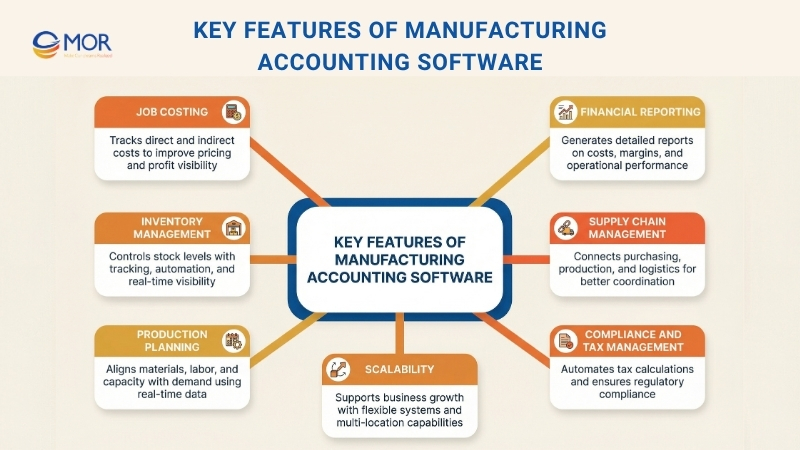
Manufacturers need systems that link financial data with production, inventory, and supply chain activities. Demand keeps rising, as the global manufacturing accounting software market is expected to grow from about $16.15 billion in 2024 to over $26 billion by 2031, based on data from Cognitive Market Research. The right solution combines these features to give real-time visibility into costs, performance, and profit.
Job Costing
Job costing reviews the expenses tied to each product, project, or batch, then classifies them as direct costs like materials and labor or indirect costs such as overhead. A clear view of total costs at every stage of production helps manufacturers identify which products bring the best returns and which may need changes to protect margins. When cost data connects with inventory and production systems, accuracy improves. Many platforms used as accounting software for small manufacturing business also include variance analysis to detect overspending, waste, and inefficiencies. In the end, accurate job costing supports better pricing decisions that reflect real production costs.
Inventory Management
Strong inventory management keeps production stable and helps manufacturers meet demand without locking cash into excess stock or finished goods. Manufacturing accounting software supports this through clear visibility of inventory across warehouses and production lines, along with tools like automated reorder points to keep stock at the right levels. Features such as batch tracking, lot tracking, and serial number control improve traceability, making it easier to handle defects, manage recalls, and meet compliance requirements. With mobile access, teams can check stock and perform audits directly on the shop floor, improving speed and efficiency.
Connecting with supplier systems also simplifies purchase orders and procurement tasks. Integration with material requirements planning further aligns inventory control with production schedules so materials arrive on time and surplus stock stays low. This coordinated approach helps reduce waste and improve overall performance.
Production Planning
Effective production planning matches the right level of materials, labor, and capacity with customer demand to improve output. Manufacturing finance software supports this process in several ways. Tools like Gantt charts and drag-and-drop scheduling make it easier to view and adjust production timelines. With real-time data from the shop floor, capacity planning tools help you detect limits in machines and labor, review lead times, find bottlenecks, and avoid delays. Scenario modeling allows faster responses to demand changes, supply chain issues, and shifting priorities. Integration with inventory and financial systems also provides accurate cost and availability data needed for lean and just-in-time manufacturing.
These capabilities work together to reduce excess inventory, improve delivery timelines, and increase customer satisfaction.
Financial Reporting
Custom reports and dashboards focused on manufacturing metrics, such as cost of goods manufactured, profit margins by product line, and production cost differences, help businesses better understand financial and operational performance. KPI tracking supports quick reactions to changes in production or market demand, giving an advantage in competitive industries. AI-based tools can automate reporting tasks, detect unusual patterns, and provide forecasts that support planning and continuous improvement.
Financial reports gathered from different business units or locations give leadership a full view of company performance. With flexible export options, manufacturers can share reports with investors, regulators, and internal teams, helping everyone stay aligned with business goals.
Supply Chain Management
Supply chain management gives you clear visibility across purchasing, production, and distribution, helping manufacturers run operations more efficiently and manage costs. When supply chain data connects with financial and production information, it supports better decisions that can improve profitability and raise customer satisfaction. Manufacturing accounting software plays a key role in linking these areas into one view.
When real-time data from inventory levels, incoming shipments, and supplier performance comes together, the system helps reduce the impact of disruptions. Tasks like purchase order processing, demand forecasting, and stock replenishment can run automatically, freeing your team to focus on higher-value work. With AI-based scenario planning, you can explore alternative suppliers or adjust order quantities when conditions change, lowering risk. Additional supplier tools also track certifications, performance data, and contract terms to support better sourcing and negotiation.
Compliance And Tax Management
Automated tax calculations, ready-to-use audit reports, and alerts for filing deadlines help lower the risk of human errors that could lead to penalties. Regular updates keep the system aligned with current laws and regulations, helping manufacturers stay compliant. Clear documentation and secure audit trails make audit preparation easier, while integration with ERP and tax systems reduces manual work during the tax process. Many platforms also detect possible tax deductions and credits across different currencies and regions, making compliance simpler for global businesses.
Scalability
Accounting systems for manufacturers must support higher production volumes, new product lines, and business expansion without affecting performance or usability. Modular platforms allow you to add new functions as your company grows and your needs change. Cloud-based systems support this growth with secure access and stable performance, even as user numbers and data increase. Flexible customization helps adjust workflows and reports to match new business requirements, while integration with ERP, CRM, and other systems keeps data consistent during expansion. For companies operating globally, support for multiple locations, currencies, and tax rules helps maintain smooth and compliant growth.
Key Benefits of Manufacturing Accounting Software for Businesses
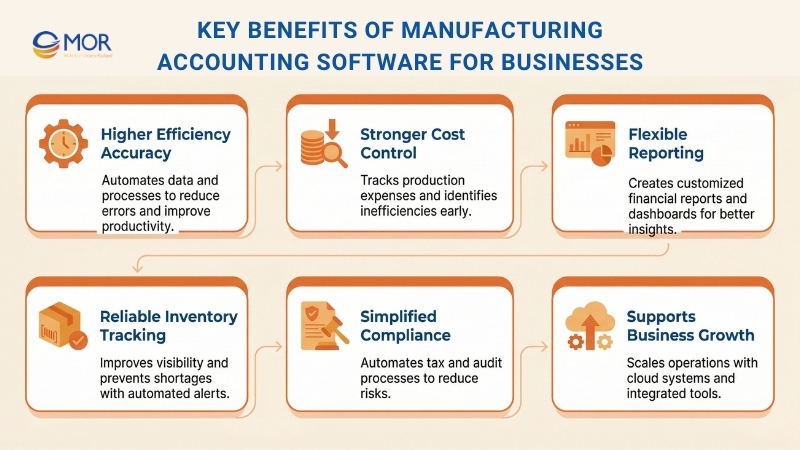
Manufacturing accounting software connects financial data with operations to improve visibility and support business growth. It goes beyond basic bookkeeping, helping automate workflows and improve performance across production and finance. Key advantages include:
Higher efficiency and better data accuracy
Automated entry of data, inventory tracking, and production scheduling helps reduce mistakes and allows your team to focus on more valuable tasks. Real-time data integration keeps information consistent and speeds up the financial close and other accounting activities.
Stronger cost control
Detailed tracking of production costs gives clear insights into expenses at the level of jobs, batches, and products. Deeper analysis helps you find inefficiencies, detect overruns early, and plan budgets more accurately. Forecasting tools also support scenario planning to guide better decisions.
Flexible financial reporting
Built-in reporting tools let you create financial statements and dashboards that match your business needs, including analysis by product line, department, or time period, as well as tracking key cost and profit indicators. These reports support better planning, compliance, and communication across teams.
Reliable inventory tracking
Combined data from inventory, production, and sales improves visibility across operations. Automated alerts for low stock, upcoming expiry dates, and slow-moving items help you control inventory levels and prevent disruptions. Strong traceability also supports quality management and regulatory compliance.
Simplified compliance processes
This system automates tax calculations, audit tracking, and other compliance tasks, helping reduce errors and avoid penalties. Audit-ready reports, full transaction records, and support for standards like ISO 9001 make compliance easier and save time for both finance and operations teams.
Supports business growth
Modern platforms that manage multiple locations, currencies, and product lines can scale as your company expands. Cloud-based systems make it easier to connect with tools like CRM and ecommerce platforms, helping unlock new capabilities and support faster growth.
Choosing The Right Manufacturing Accounting Software For Your Business
There are many cloud-based and on-premise solutions available today. Whether you choose a standalone tool or part of a larger ERP system, you need to evaluate carefully. Manufacturing accounting software should match your real needs, not just look good on paper. These four factors can guide your decision:
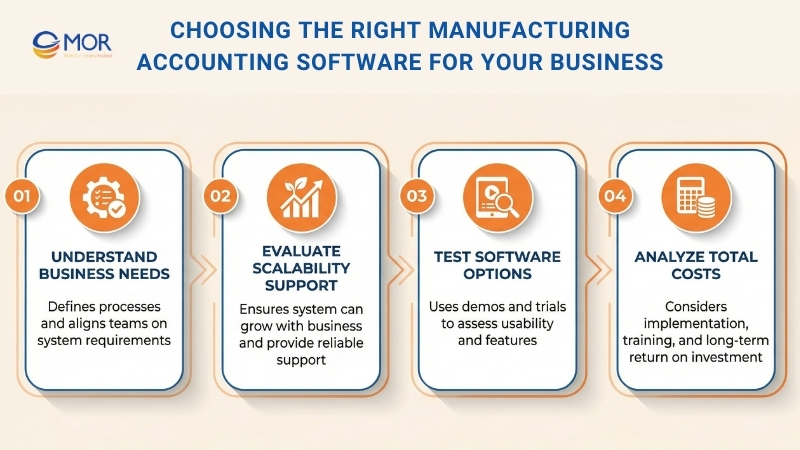
Understand your business and industry requirements clearly
Outline your key processes, including job costing, inventory control, and production planning, to see which functions need support. Bring in teams from accounting, operations, and IT to define detailed needs and build alignment across the organization.
Assess the level of scalability and support your business requires
Look for platforms that meet your current needs and can grow with you through additional modules and flexible pricing models. Reliable support services also matter, as they help you maintain smooth operations after deployment.
Compare and test different software options
Ask for demos or trial access so your key users can review usability and core functions before making a decision. Check for AI features that improve operations, such as predictive analytics, anomaly detection, and workflow automation. A simple interface, customizable dashboards, and smooth integration with your current systems will help your team adopt the system faster and keep data consistent.
Review total cost and long-term return on investment
Do not focus only on the initial price. Consider implementation, training, support, and customization costs as well. Compare these costs with the measurable benefits over time to make sure the system delivers real value for your business.
MOR Software - Your Trusted Partner for Manufacturing Accounting Software
Many companies invest in manufacturing accounting software but struggle to connect finance and production in daily work. Data gets scattered, reports do not match, and cost tracking becomes unclear. MOR Software focuses on solving these issues with a practical approach.
We work side by side with your finance and production teams to build a system that reflects real operations. Inventory movement, job costing, and financial records stay aligned, so you always know where your numbers come from. This helps teams act faster without relying on manual checks.
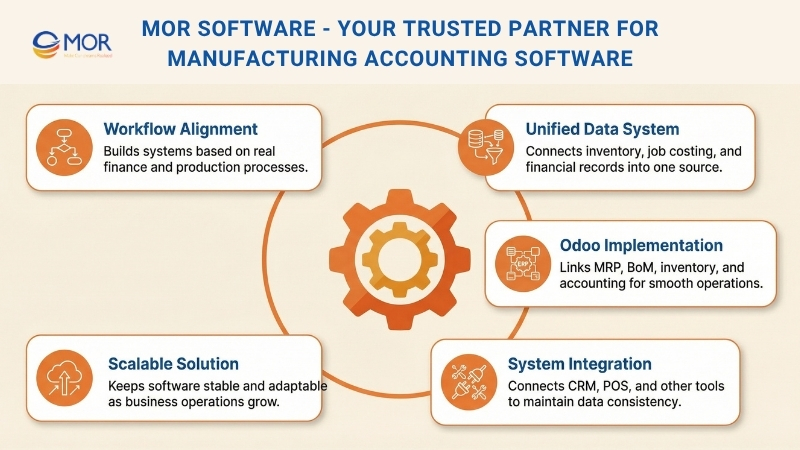
MOR implements Odoo solutions to bring everything into one connected system. We link MRP, BoM, inventory, and accounting so data flows smoothly across departments. This reduces errors and keeps reporting consistent across the business.
Beyond implementation, we support customization and integration with systems like CRM and POS. As your operations grow, your manufacturing accounting software stays stable, easy to use, and ready to scale with your business. Contact us today to discuss your needs and get expert guidance for your next step.
Conclusion
The software you select today will quietly influence every decision your team makes tomorrow, from cost control to production planning. A well-fitted manufacturing accounting software solution keeps your data aligned across departments without slowing people down. We’ve explored what matters most and highlighted strong options for 2026. If you are aiming for a setup that truly reflects how your operations run, MOR Software can support you. Contact us to get started.
MOR SOFTWARE
Frequently Asked Questions (FAQs)
What is manufacturing accounting software?
It is a system that connects accounting with production activities. It tracks costs, inventory, and financial data in one place, helping manufacturers understand how operations affect profit.
How is accounting software for manufacturing different from standard accounting tools?
Standard tools focus on basic finance tasks. Manufacturing accounting software goes further by tracking job costs, production stages, and inventory tied to manufacturing workflows.
Who should use manufacturing accounting software?
Any business involved in production, assembly, or fabrication can benefit. It works well for small workshops, mid-sized factories, and large manufacturing firms.
What key features should you expect in accounting systems for manufacturers?
Core features include job costing, inventory tracking, production planning, financial reporting, and supply chain visibility.
How does manufacturing accounting software help with cost control?
It tracks material, labor, and overhead costs in real time. This makes it easier to spot inefficiencies and adjust pricing or processes quickly.
Can financial management tools for manufacturing businesses handle inventory management?
Yes. It monitors stock levels, tracks materials across locations, and supports batch or serial tracking for better control.
Is cloud-based manufacturing accounting software a good choice?
Cloud systems allow access from anywhere and scale as your business grows. They also make it easier to connect with other systems.
How long does it take to implement manufacturing finance software?
It depends on the system and business size. Simple setups may take a few weeks, while larger deployments can take several months.
What are common challenges during implementation?
Typical issues include data migration, user training, and aligning the software with existing workflows.
How do you choose the right manufacturing accounting software?
Focus on your production needs, scalability, ease of use, and how well the system integrates with your current tools.
Share


Make Our-Dreams Realized


© 2023 . MOR Software. All Rights Reserved
Sitemap
Privacy Policy
Terms of Use

Rate this article
0
over 5.0 based on 0 reviews
Your rating on this news:
Name
*Email
*Write your comment
*Send your comment
1