


Top 24 Manufacturing Cost Reduction Strategies Proven in 2026
Rising input prices, labor pressure, and daily waste make manufacturing cost reduction harder than it looks. This MOR Software’s guide will show you practical ways to cut factory spending, improve production efficiency, and support better determining manufacturing costs, so you can find savings without hurting output, quality, or long-term growth.
Key Areas for Savings in Manufacturing Cost Reduction
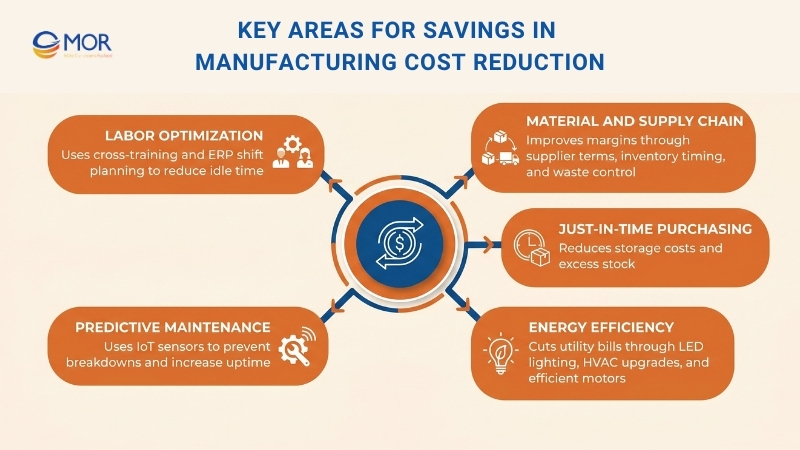
When teams look at manufacturing cost reduction, they usually get better results when they focus on a few high-impact areas first. A clear view of labor, materials, energy, and equipment performance also helps with determining manufacturing costs, since each one shapes the real cost of every unit you produce.
Labor Optimization
Smart labor control is not just about cutting jobs. Many manufacturers improve flexibility through cross-training, so workers can move between tasks as demand changes. ERPbased shift planning also helps match labor hours to real production needs, which lowers idle time and supports steadier output.
Material & Supply Chain
Material costs are often one of the fastest places to improve margins. Better supplier deals, tighter inventory timing, and smarter waste handling can lower factory spending without affecting output. Long-term contracts and bulk pricing help stabilize input costs, while Just-in-Time (JIT) purchasing reduces storage fees and excess stock. Selling scrap metal, batteries, or electronic waste can also turn disposal loss into added income.
Energy Efficiency
Power use is a major factory expense, especially in facilities that run long hours. Upgrades like LED lighting, smart HVAC controls, and high-efficiency motors can cut utility costs by 20% to 40%, depending on the site and equipment condition.
Predictive Maintenance
IoT sensors can track heat, vibration, and other early signs of machine trouble before a full failure happens. That allows maintenance teams to fix problems earlier, avoid costly shutdowns, and raise equipment uptime by as much as 20%.
24 Manufacturing Cost Reduction Strategies That Drive Real Savings
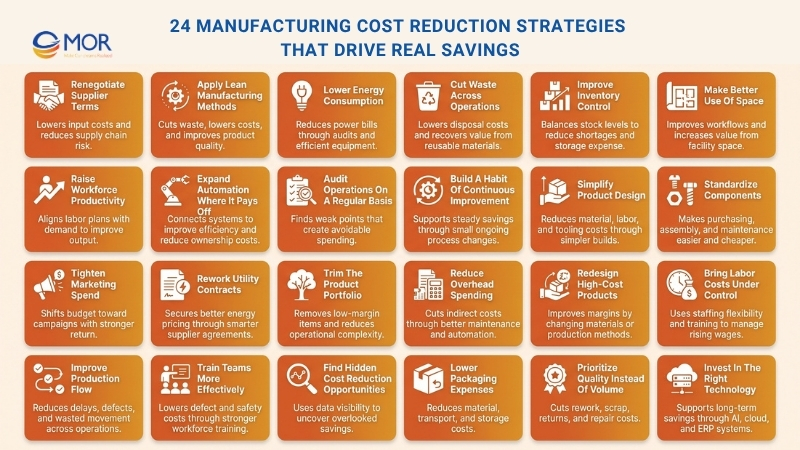
Since production spending comes from many different inputs, manufacturers have many ways to push it down. Still, because this is a wide business measure, companies need to apply several actions together and keep doing so over time if they want real change. That is why manufacturing cost reduction works best as a connected effort, not a single quick fix. In practice, this is where manufacturing cost management begins, using the levers below as practical cost reduction ideas in manufacturing to improve profit and control spending more effectively.
Renegotiate Supplier Terms
Strong supplier talks, backed by solid supplier relationship management, can help companies save a large amount on production spending while also making the supply chain more dependable. One useful step is to agree on volume-based contracts that secure lower prices across a longer period. Companies may also arrange exclusive agreements with selected suppliers in return for better rates, or they may widen their network with more local vendors to trim delivery expenses. In short, there is a lot of room for flexible deal making here, and it remains one of the clearest drivers of cost reduction in manufacturing industry because it can cut spending and lower supply risk at the same time.
Apply Lean Manufacturing Methods
Lean manufacturing can help businesses lower production spending by stopping excess output and cutting wasted time. It also helps reduce material costs because fewer defects and purchasing mistakes happen when systems are tighter. Research shows that, in the first year after adoption, many manufacturers see cost drops of around 5% to 20%. Those gains do not come at the expense of product quality. In many cases, lean methods improve quality results too, with defect reduction often rising by 25% to 90%, which is why they remain one of the most trusted cost reduction strategies for manufacturing industry.
Lower Energy Consumption
Energy costs are rising faster than general inflation, so manufacturers have good reason to act early and improve how they use power. This is one of the most direct ways to support manufacturing cost reduction in the plant. A good starting point is a routine energy review that finds waste in production equipment and building systems, then helps rank the best upgrades. Some of the clearest improvements come from tools like LED lighting, efficient motors, and greener HVAC systems. Companies can also use automated facility controls that rely on Industrial Internet of Things data and advanced analytics to cut waste during slow periods, helping them reduce usage and lower energy bills.
Cut Waste Across Operations
Reducing waste helps bring down production spending in several areas at once. One clear example is lower disposal expense. When companies shrink waste output, they spend less on transport, handling, and storage for trash, scrap, and hazardous leftovers. It also lowers the amount of raw material lost before the final product is even finished. The opportunity goes beyond materials alone. Lean practices like just-in-time production, better equipment scheduling, and simpler workflows remove overproduction, surplus stock, and extra movement, all of which create real savings. Recycling factory waste can also prevent landfill charges and may even create extra income when reusable materials, such as cardboard, are sold instead.
Improve Inventory Control
Good inventory management helps companies cut production spending at every stage of the product life cycle. In fact, one of the clearest forms of cost reduction in manufacturing comes from putting the right stock in the right place at the right time. When raw materials are controlled well, production delays caused by shortages or bottlenecks are less likely to happen. At the same time, better forecasting and smarter finished-goods planning help maintain supply without building up too much stock that locks up cash. This also lowers the chance that older items become outdated and unusable. Whether the focus is raw materials, work in progress, or finished goods, strong inventory control also reduces storage expense by keeping stock levels in better balance.
Make Better Use Of Space
Facility expense is part of production spending, so manufacturers need to get as much value as possible from every site they own or rent. A practical goal is to shape buildings in a way that improves storage and uses every paid square foot wisely. Just as important, warehouse and plant layouts often have a strong effect on how smoothly operations run. When companies build layouts that support easier workflows and cut bottlenecks, they often improve margins over the long term.
Raise Workforce Productivity
Better workforce systems and stronger management tools can help manufacturers get more value from employees across factories, warehouses, and shipping sites. For example, when workflows and shift plans match real demand forecasts, output usually improves. Training also matters because well-prepared employees work at a higher level and make fewer mistakes. Many companies now use automated back-office systems with artificial intelligence support to manage issues like needed skills, available labor hours, customer demand, and labor rules. These tools help create schedules that fit actual business needs and budgets. That makes this area central to manufacturing efficiency and cost reduction needs, especially when labor productivity has a direct effect on daily output.
Expand Automation Where It Pays Off
Since the early days of the assembly line, manufacturers have used automation to improve efficiency and control spending. Today, that trend has moved into a broader stage where advanced analytics, robotics, and AI work together across IT, operational technology, and engineering systems to improve workflow returns and connect areas that used to stay separate. In this environment, back-office data on customer behavior can drive better forecasts, which then trigger changes in inventory control and production scheduling using live information. That helps manufacturers protect output during slow periods without losing the ability to meet customer needs on time. This kind of connected automation is now a major part of manufacturing cost reduction. Many analysts also point to composability, which means using modular parts inside a well-connected automation system. They estimate that manufacturers adopting this model in the coming years could cut total ownership costs for automation by 50%.
Audit Operations On A Regular Basis
Audits do more than support compliance or quality checks. When manufacturers review areas like energy use, production methods, waste levels, and the supply chain on a regular schedule, they often find practical ways to improve operations and lower overall spending. A process audit, for instance, may uncover workflow delays or weak handoffs that can be fixed through better sequencing or more consistent procedures. In the same way, regular inventory reviews may show where too much stock is raising holding costs. When companies use them well, audits can become a clear guide for future savings actions.
Build A Habit Of Continuous Improvement
In manufacturing, small changes often create large savings when they build up over time. That is why continuous improvement sits at the center of well-known operating systems such as lean manufacturing, total quality management, and just-in-time inventory control. Strong manufacturers use findings from audits, factory data, customer feedback, and employee input to keep searching for better ways to run processes and refine product design. This steady mindset supports manufacturing cost reduction because it turns improvement into a daily habit. It also works as a practical cost reduction process, since it favors small steps and low-risk trials that can be reversed easily if needed. That makes it easier to cut waste without hurting output or product quality.
Simplify Product Design
Products that are easier to build and assemble often cost less to produce. To reach that goal, manufacturers should choose materials that balance performance and price, while also reducing part counts and using more standard elements where possible. Simpler design can lower material spend, shorten assembly time, and reduce labor expense. In some cases, it can also cut capital spending because less specialized tooling is needed in the factory. A shorter parts list may also reduce defect risk over time, since fewer moving pieces create fewer points of failure. One common way to improve this area is through design for manufacturability, a set of engineering practices built around lower production spending. More manufacturers are also using generative AI to create simulation models and improve design choices. Some forecasts say that by 2027, about 33% of new product and asset designs will use generative AI, up from under 5% in 2023.
Standardize Components
Using more standard parts can have a major effect on production spending. When manufacturers reduce part variety, buying becomes easier and both procurement and inventory control become simpler to manage. That also makes bulk purchasing easier to negotiate and supports greater scale in production. With fewer different parts moving through the line, assembly tends to run faster and with fewer defects. This is also where component cost reduction becomes easier to achieve, because companies can buy, track, and replace parts more efficiently. Repair and maintenance spending can drop as well, since standardized parts are easier to locate across the business and waiting time is shorter when replacements are needed.
Tighten Marketing Spend
Recent data shows that manufacturers put about 13% of their total budgets into marketing. When businesses try to lower indirect spending, which can shape overall production economics, marketing should be reviewed closely. This area is not simple to cut because, when it performs well, it supports revenue growth and helps the company expand. The real task is to study marketing metrics more carefully and track the return on investment from each campaign. With a data-based review of spending, manufacturers can drop weaker activities and move funds toward the efforts that create the most business value.
Rework Utility Contracts
Manufacturers can lower production spending when they manage utility sourcing with more care. A common move is to secure better prices from energy or fuel suppliers, for instance through long-term agreements that lock rates in for set time periods. Another useful option is to negotiate cheaper pricing for electricity bought during low-demand hours on the grid, when production can run beyond normal daytime schedules.
Trim The Product Portfolio
A tighter product range helps manufacturers make fewer items and put more attention on the products they deliver best. In many cases, this form of manufacturing cost reduction means dropping expensive, low-margin items that do not add much value for buyers. Companies often review overlapping products for the same reason. These choices can reduce complexity and improve margins through shorter setup times, better scale, and lower storage and distribution overhead. A well-managed portfolio uses existing resources more effectively and supports stronger profit at the same time.
Reduce Overhead Spending
Manufacturing overhead covers the indirect costs tied to making products, including utilities, facility upkeep, asset depreciation, and office-related expenses. Businesses that keep searching for ways to shrink those costs are usually the ones that protect margins most successfully. Whether the change is broad, like a lean initiative, or small, like better maintenance that extends machine life, each saving helps cut total production spending. One of the strongest ways to lower this burden is to simplify manual back-office work with technology that removes repetitive tasks and improves data analysis at the same time.
Redesign High-Cost Products
Changing how a product is designed or put together can make costly production steps easier and may also reduce material spend. Manufacturers that keep reviewing materials and product features, especially on items with high factory and raw input costs, can often build better margins over time. Many manufacturing cost reduction ideas start here, but companies still need to protect customer satisfaction while making changes. That means balancing new material choices and savings targets with clear quality goals, while watching customer feedback closely as updates are made. Lower spending is the aim, yet manufacturers must avoid weakening the value customers expect from the product.
Bring Labor Costs Under Control
Labor expense can quickly put pressure on a manufacturer’s profit. Recent research shows that although manufacturing labor costs are no longer rising as sharply as they did earlier, they still went up by 4.2% over the past year. Companies can take several steps to manage that pressure. Automation and ongoing process improvement can increase output without needing as many workers. Flexible staffing models, including part-time work and job sharing, can help adjust headcount and reduce idle time during slower periods. Cross-training and skill building can reduce reliance on highly paid specialists, while incentives and reward programs can encourage employees to work more effectively.
Improve Production Flow
Better production flow can reduce overall factory spending because it raises output efficiency and cuts both cycle time and defect levels. One way to do this is through standard workflows and smarter facility layouts that ease bottlenecks and help materials move more smoothly. Investment in automation and robotics can also increase speed and make labor use more effective. Lean manufacturing remains one of the most common ways to support these gains because it helps manufacturers remove waste from production steps, including extra movement, waiting time, and overproduction. Some businesses also rely on stronger scheduling methods, using Kanban-style systems to make workflow visible and manage stock levels more effectively. This also supports assembly line cost reduction and makes manufacturing cost reduction more achievable in day-to-day operations.
Train Teams More Effectively
According to the National Association of Manufacturers, 71% of manufacturers say that building and keeping a skilled workforce is their top concern, which shows why better training matters. Training plays a major role in cutting production expense because it limits the loss of knowledge when employees leave and can also improve retention by creating a better work experience. Strong training also helps reduce costs linked to defects and safety problems. Many manufacturers are now trying newer, technology-based ways to improve this area. Some use generative AI to study incident reports and compare them with health and safety rules so they can create targeted lessons on the issues that need attention. Others use augmented reality, virtual reality, and metaverse-based environments to give factory workers more practical learning experiences.
Find Hidden Cost Reduction Opportunities
Strong cost control begins with a better view of every input that shapes production spending. When a company builds effective data collection across factory systems and business platforms, it becomes much easier to spot hidden savings opportunities. For teams searching for ideas for cost reduction in manufacturing, this visibility is often the real starting point. When that information is combined with solid accounting tools and analytics, decision-makers can judge areas like maintenance timing, production planning, and inventory control with greater confidence. Real-time tracking and data analysis matter even more when companies are working on continuous improvement. They need that evidence to confirm that changes are producing the right savings without harming quality or performance.
Lower Packaging Expenses
Just like smarter product design, better packaging design can create meaningful savings over time. Improved packaging can reduce material use, and it can also lower transport expense when loads become lighter and easier to move. In the same way, warehouse costs may fall when packaging takes up less shelf space. Manufacturers can also save money by standardizing packaging across product lines, which makes inventory easier to manage, supports bulk buying of materials, and simplifies packaging work overall. Together, these improvements can help reduce production expense.
Prioritize Quality Instead Of Volume
Moving away from high-volume, low-margin output can help manufacturers cut production spending and build a stronger business. When companies focus on making fewer products at a higher standard, they can lower the amount of costly rework and scrap caused by high defect rates. After those products reach customers, the business is also less likely to face costs tied to repairs, replacements, and returns. In many cases, a stronger focus on quality also improves process performance over time, which then supports lower production spending.
Invest In The Right Technology
Manufacturing leaders are putting major funds into technology to increase revenue and control spending. Some of the most visible investments now center on AI, with 97% of manufacturing CEOs saying they have already adopted it or plan to do so soon, and 60% reporting returns from those efforts already. Manufacturers are also increasing their use of industry cloud platforms. Analysts expect that by 2027, more than 60% of large manufacturers will use those platforms to speed up business and product innovation, compared with 37% in 2023. This includes major spending on back-office technology like cloud-based enterprise resource planning (ERP) systems, which can help companies uncover savings opportunities and confirm that changes are truly working. For many firms, this is a direct path to manufacturing cost reduction and to lower manufacturing costs over the long run.
Implementation Steps for Manufacturing Cost Reduction
A good cost program works best when you move in a clear order. Instead of changing everything at once, manufacturers should first understand where money is being lost, then fix the easiest and most valuable problems before moving into larger upgrades.
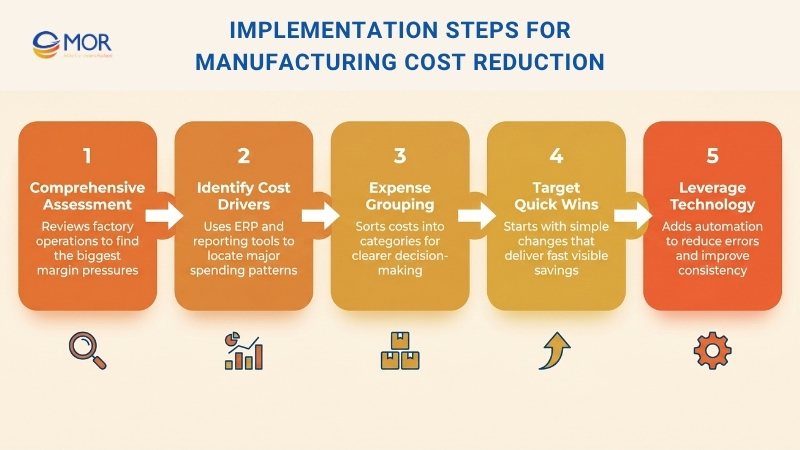
- Comprehensive Assessment: Start with a full review of the factory, equipment, workflows, and support functions. This helps you spot the areas that create the most pressure on margins, such as labor-heavy tasks, rising energy use, or repeated material loss.
- Identify Cost Drivers: Use reporting tools, ERP data, and cost tracking systems to see where spending is concentrated. Grouping expenses into categories like materials, direct labor, and overhead makes it easier to find patterns and decide where action will matter most.
- Target Quick Wins: Begin with changes that are easy to carry out but can create visible savings fast. Simple actions like fixing compressed air leaks, applying 5S organization, or improving machine setup routines can cut waste and build momentum for larger improvements.
- Leverage Technology: Add automation where repetitive, risky, or manual work slows the operation down. The right systems can improve output consistency, reduce error rates, and lower long-term labor costs without making the process harder to manage.
Using Odoo To Support Manufacturing Cost Reduction
Whether a manufacturer wants to cut spending in one area or improve control across the full plant, it needs a clear view of materials, labor, and daily activity. Built for connected factory workflows, Odoo Manufacturing gives teams one place to track raw material expense, work center costs, and finished goods value. It connects BoMs, manufacturing orders, inventory records, and costing methods such as standard cost, AVCO, and FIFO, helping manufacturers spot waste sooner, manage spending with more precision, and keep cost figures tied to real operating data.
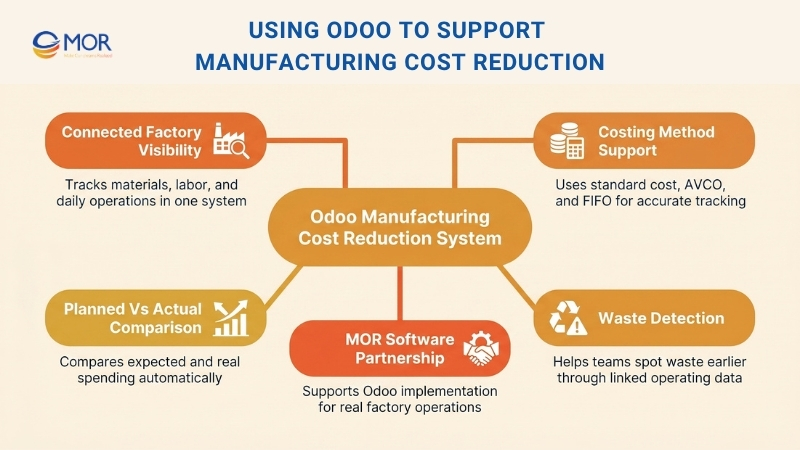
The strongest manufacturers understand that cost control does not sit in only one department. It happens through purchasing, shop floor work, labor tracking, and reporting together. Reducing production costs takes steady discipline, reliable numbers, and a system that shows what is actually happening behind each order. With Odoo, manufacturers can calculate operation and material costs automatically, compare planned and actual spending, and build a more consistent improvement cycle instead of relying on rough estimates. That makes it easier to reduce manufacturing cost with facts rather than assumptions, and it strengthens manufacturing cost reduction efforts across the business.
MOR Software delivers Odoo implementation for businesses that want ERP systems shaped around real factory operations, and the company’s official website now features Odoo-focused implementation content along with a January 2026 announcement about our strategic partnership with Odoo.
Conclusion
Manufacturing cost reduction works best when companies act on real cost drivers, not rough guesses. From labor and materials to energy, maintenance, and technology, steady improvements can protect margins and build a stronger operation in 2026. With the right systems, these changes become easier to track and scale. If you are planning to improve cost control with Odoo or a custom digital solution, contact MOR Software to discuss the next step.
MOR SOFTWARE
Frequently Asked Questions (FAQs)
What is manufacturing cost reduction?
Manufacturing cost reduction refers to lowering the total expenses involved in producing goods. It covers materials, labor, energy, and overhead, with the goal of improving margins without hurting product quality or delivery speed.
Why is manufacturing cost reduction important for businesses?
It helps companies stay competitive on pricing while protecting profit. Lower costs also give more flexibility to invest in growth, improve products, or handle market changes without pressure.
What are the main areas to focus on for cost reduction?
Most companies focus on materials, labor, energy usage, production processes, and overhead expenses. Small improvements across these areas often add up faster than one large change.
How does lean manufacturing support cost reduction?
Lean methods remove waste like overproduction, idle time, and defects. This leads to better use of resources and smoother workflows, which directly lowers production spending.
Can automation really reduce manufacturing costs?
Yes, when used in the right areas. Automation reduces manual work, limits errors, and keeps production consistent. It also helps teams handle higher output without adding more staff.
How does inventory management affect production costs?
Poor inventory control leads to overstocking, storage costs, and wasted materials. Good planning keeps stock levels balanced, which prevents delays and reduces tied-up cash.
What role does data play in manufacturing cost reduction?
Accurate data shows where money is being spent and where waste happens. With real-time tracking, teams can adjust faster and make better decisions based on actual performance.
Is it possible to reduce costs without lowering product quality?
Yes. Many companies cut costs by improving processes, not by cutting corners. Better design, smarter sourcing, and fewer defects often lead to both lower costs and higher quality.
How long does it take to see results from cost reduction efforts?
Some changes, like supplier negotiations or energy savings, show results quickly. Others, like process improvement or training, take longer but usually bring more stable gains.
What is the biggest mistake companies make with cost reduction?
Focusing only on short-term savings. Cutting too aggressively in the wrong areas can hurt quality, slow production, or damage customer trust. Sustainable manufacturing cost reduction always looks at long-term balance.
Share


Make Our-Dreams Realized


© 2023 . MOR Software. All Rights Reserved
Sitemap
Privacy Policy
Terms of Use

Rate this article
0
over 5.0 based on 0 reviews
Your rating on this news:
Name
*Email
*Write your comment
*Send your comment
1