


Outsourced Salesforce: The Ultimate Guide [2026 Update]
Outsourced Salesforce has become a practical choice for businesses facing rising costs, skill gaps, and slow CRM delivery. When internal teams struggle to scale or keep up with platform changes, delays and inefficiencies quickly follow. In this guide, MOR Software will explain how this approach works, when it makes sense, and how the right delivery model helps teams move faster, control costs, and stay focused on growth.
What Is Outsourced Salesforce?
Outsourced Salesforce refers to the practice of assigning Salesforce-related responsibilities to an external team or Salesforce outsourcing service provider. This scope can cover customer relationship management tasks, customer support workflows, technical assistance, and data reporting activities. As a form of CRM outsourcing, this approach shifts day-to-day platform work away from internal teams, which gives businesses more time and capacity to focus on growth plans and customer relationships. CRM work brings real value when it is set up well. In one ROI analysis, Nucleus Research found CRM returns $8.71 for every $1 spent.
One clear benefit of this model is cost control. Companies pay only for the specific services they require at a given time, without committing to long-term hiring or maintaining a full internal Salesforce team. This model also speeds up delivery. Teams do not need to spend months training staff or learning the platform from scratch, since experienced specialists can step in and start working right away.
What Does An Outsourced Salesforce Model Usually Cover?
Salesforce operates as a cloud-based software provider. This software-as-a-service platform delivers tools connected to customer relationship management systems. As companies aim to gain clearer insight from the data they collect, Salesforce provides a centralized system to store and manage customer information. Better visibility into customer behavior supports sales activities, ecommerce operations, and internal workflows across teams, which is why CRM outsourcing services often rely on this platform.
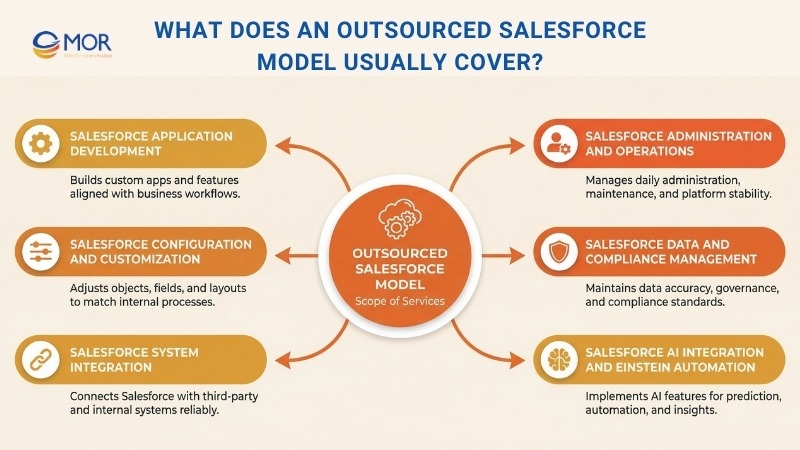
Salesforce also accounts for the fact that every organization runs differently and follows its own processes. Salesforce setups for nonprofits and NGOs differ greatly from those used by large enterprises or ecommerce businesses. Since the platform runs in the cloud, it supports a flexible service model that adjusts to changing needs. For this reason, many companies choose outsourced Salesforce teams to adjust and tailor the system. These responsibilities usually fall into five main areas.
Salesforce Application Development
First, an external Salesforce developer or solution architect designs and delivers applications, features, and core functionality. Each component aligns with how the business plans to use the platform in daily operations. This type of work often includes Salesforce product development outsourcing, using Apex programming, Visualforce pages, and Lightning components to support custom requirements.
Salesforce Configuration And Customization
Second, the outsourcing team adjusts the Salesforce environment to match specific business needs. Every organization has workflows that require proper alignment inside the system. A developer may create custom objects, fields, page layouts, and record types to reflect those processes. These changes help improve internal system efficiency and day-to-day operations.
Salesforce System Integration
Third, Salesforce developers set up smooth and reliable data flows across systems. Most businesses already use many third-party tools and internal platforms, including marketing systems or accounting software. The Salesforce platform needs to gather and organize all of this information in one place. An outsourced Salesforce team handles API connections, data imports, and automation tasks to keep information consistent across systems.
Salesforce Administration And Operations
Fourth, the outsourcing team takes care of daily Salesforce administration and operational tasks. This responsibility often covers outsource Salesforce administration, including system configuration, routine updates, application maintenance and support, performance tuning, and platform migrations. These efforts help keep the system stable and ready for long-term use.
Salesforce Data And Compliance Management
Fifth, Salesforce specialists support ongoing data management activities. High-quality data needs regular monitoring and upkeep to stay accurate. Data handling also involves compliance rules, governance standards, security controls, and integration requirements. An outsourced Salesforce team manages data migration, data cleansing, and data modeling to maintain accuracy while meeting compliance expectations.
Salesforce AI Integration And Einstein Automation
Finally, beyond core CRM functions, many organizations now outsource Salesforce work to implement AI-driven capabilities. Salesforce Einstein helps teams analyze large data sets, predict customer behavior, and automate decision-making inside the platform. As data volumes grow, manual analysis becomes less practical.
An outsourced Salesforce team can configure Einstein features for lead scoring, sales forecasting, case classification, and personalized recommendations. External specialists also prepare data models, clean input data, and align AI outputs with real business workflows. Looking toward 2026, Salesforce AI integration is increasingly focused on turning raw CRM data into actionable insights that support faster decisions and more accurate planning.
Key Benefits Of Choosing Outsourced Salesforce Services
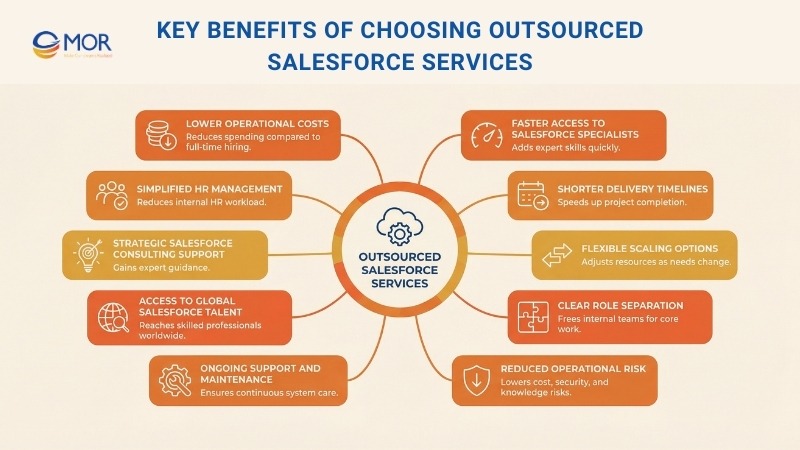
Because Salesforce outsourcing vendors bring broad experience across industries and use cases, businesses gain access to several clear advantages. Outsourced Salesforce delivery allows teams to rely on proven skills and structured processes. Outsourcing is becoming a standard part of how companies plan for talent. In Deloitte’s Global Outsourcing Survey, 80% of executives said they plan to maintain or increase investment in third-party outsourcing.
The points below outline the main benefits of outsourcing Salesforce work through an external provider.
Lower Operational Costs
Cost pressure is not going away. Forrester projects global technology spending will reach $4.9 trillion in 2025, up from $4.7 trillion in 2024, so many teams keep looking for smarter ways to use the budget.
With an external model, Salesforce implementation cost cover only the services required for each stage of work. This approach often costs far less than traditional hiring and long-term employment commitments. Companies also contract talent at the exact skill level needed, which removes training expenses and supports Salesforce workday offshore hiring cost savings.
Faster Access To Salesforce Specialists
Hiring can be slow when the talent pool is tight. In ManpowerGroup’s 2024 Talent Shortage results, 75% of employers reported difficulty filling roles.
Working with a trusted vendor is one of the quickest ways to add specialized skills to an internal team. Certain projects leave little room for mistakes or trial-and-error delivery. When consistent quality matters, companies can extend their teams with experienced Salesforce professionals who already have the right technical focus and industry knowledge.
Shorter Delivery Timelines
External teams often finish Salesforce projects more quickly. When internal resources are limited or deadlines are approaching, companies can add more specialists to the effort. This approach saves valuable time and helps outsourced Salesforce initiatives move to market sooner.
Flexible Scaling Options
Salesforce runs on a cloud-based platform, which means resource needs can change over time. With internal teams, scaling up during busy periods is possible, but it can also lead to higher costs when demand drops. Managed Salesforce service providers remove the need for constant hiring and layoffs, since specialists can join or leave projects as business needs shift.
This is even more important as cloud use grows. Gartner forecasts public cloud end-user spending will reach $723.4 billion in 2025, up from $595.7 billion in 2024.
Reduced Operational Risk
Outsourcing helps lower business risk in several important ways.
First, hiring commitments become much simpler to manage. Companies define the scope and length of an external engagement clearly, whether the support is needed for a short project or a long-term program. This flexibility gives external Salesforce delivery engagements more control over cost and responsibility.
Second, this approach limits potential internal security concerns. A reliable vendor applies strong security measures to protect data and company assets. This risk is not small as IBM reports the average global cost of a data breach reached $4.88 million in 2024. These controls support privacy requirements and make compliance easier to maintain across systems.
Third, the risk related to knowledge transfer is much lower. Salesforce ships platform updates three times a year, so staying current is part of staying stable. Many Salesforce outsourcing teams stay current with platform updates and industry changes. They also bring proven methods and working practices into the project. A stable partnership reduces the need for ongoing training investment and helps operations remain consistent over time.
Access To Global Salesforce Talent
Outsourcing opens the door to a worldwide talent pool. A trusted provider of Salesforce professional services gives access to developers from different regions who have already passed thorough screening processes. This diversity supports many business needs. Companies may work with an outsourced Salesforce specialist who speaks the same language as key clients or operates within similar time zones. This geographic reach makes it easier to find skilled professionals who also align well with company culture and communication styles.
The ecosystem is growing fast. An IDC study says Salesforce and its partner ecosystem will create 9.3 million new jobs worldwide by 2026.
Simplified HR Management
Adding external Salesforce specialists helps reduce pressure on internal HR teams. This approach avoids many issues tied to employee turnover and limits spending on long-term training programs. Although each external specialist still needs time to adjust, the process is much shorter than full in-house onboarding. Most HR responsibilities stay with the vendor, which allows internal HR teams to focus on broader workforce priorities.
When Does Outsourced Salesforce Make Sense For Your Business?
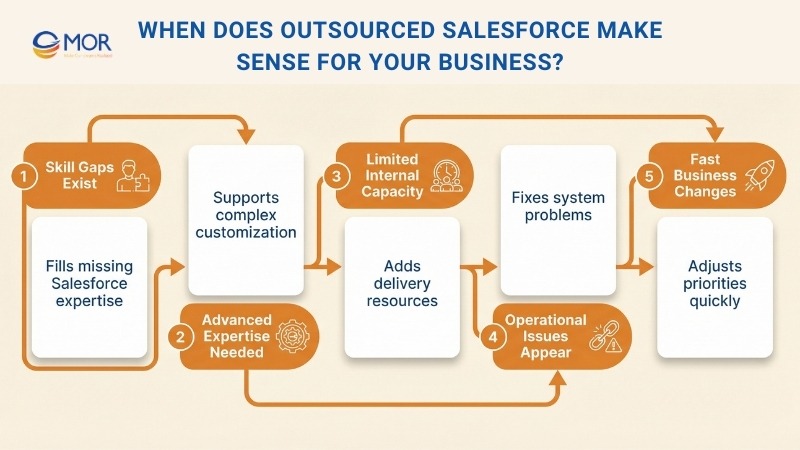
Salesforce developers play an important role in helping companies reach operational and growth goals. The harder question is knowing when external support is the right choice. That decision depends on business priorities, internal capacity, and delivery timelines. Still, several common situations often signal that working with an outsourced Salesforce partner can bring clear value.
Your team lacks critical Salesforce skills
Your team may not have the Salesforce-specific skills required to deliver a project successfully. Third-party Salesforce support helps close that gap quickly. This approach gives access to skills that may not exist within your local market or current hiring pipeline.
Projects demand advanced or niche expertise
In some cases, internal teams have general Salesforce knowledge but lack senior guidance or niche experience. Certain initiatives also require advanced expertise beyond standard configurations. An external Salesforce specialist can extend internal capacity when projects demand deeper customization or technical leadership.
Delivery slows due to limited internal resources
Large initiatives often require more hands than internal teams can provide. External Salesforce professionals can step in to support integrations or unblock slow implementation phases. External Salesforce delivery works well when deadlines are tight and traditional hiring cannot scale fast enough.
Operational problems start to pile up
Existing Salesforce setups may rely on manual steps, contain unresolved bugs, or suffer from poor data quality. Bringing in a Salesforce specialist helps address problems that exceed current team capacity. Some situations call for custom development, while others involve outdated features still in use. When bottlenecks and recurring system errors appear, Salesforce outsourcing model support can help restore stability.
Business plans require fast adjustment
In-house hiring splits spending across many areas. Only part of each budget dollar supports actual development, while the rest covers management, legal work, training, and equipment. External Salesforce specialists focus spending directly on the work that matters most. This structure gives teams more freedom to adjust priorities quickly when market conditions change, which makes outsourcing a practical choice for fast-moving plans.
Outsourced Salesforce Vs In-House CRM Teams - A Practical Comparison
Choosing between an internal CRM team and outsourced Salesforce support affects cost control, delivery speed, and long-term flexibility. Each model has strengths and trade-offs, which become clearer when reviewed side by side. The comparison below highlights how day-to-day operations differ when working with an internal team versus a managed delivery model.
Aspect | In-House CRM Management | Salesforce Managed Services (Outsourcing) |
Cost/Expenses | High upfront spending on hiring, training, and tools | Predictable subscription pricing where you pay only for the services used |
Expertise | Limited to the skills available within the internal team, with difficulty keeping pace with updates | Continuous access to certified specialists through a managed Salesforce service provider |
Salesforce Scalability | Scaling requires new hires and additional training, which increases cost and time | Scaling is straightforward, as providers adjust resources based on changing needs |
Proactivity | Issues are usually handled after they occur | Systems are monitored to identify and prevent problems early |
Availability | Support depends on internal working hours | Support is often available around the clock |
Time Efficiency | Slower response as teams balance many responsibilities | Faster resolution supported by automation and focused workflows |
Control | Full internal control over CRM processes and data security | Slightly less direct control, while strategic decisions remain with the business |
Common Drawbacks Of Each Approach
Both internal Salesforce teams and outsourced Salesforce services come with specific limitations. Understanding these challenges helps businesses set realistic expectations and choose the right delivery model for their situation.
Challenges with Outsourcing Services
Working with an external provider requires a level of trust and coordination. Teams must align clearly on communication, responsibilities, and decision-making to avoid friction. Without strong oversight, dependency on a third party can affect response speed and flexibility.
- Reliance on external providers for critical Salesforce tasks
- A perceived reduction in direct control over certain CRM activities
- Higher costs when projects require advanced or complex customization
- Limited on-site presence, which can slow support in urgent situations
Challenges with Managing Salesforce In-House
Running Salesforce internally gives full control, but it also demands ongoing investment. Teams must balance daily operations with continuous learning and system maintenance, which can stretch resources over time.
- High costs linked to hiring, onboarding, and staff training
- Difficulty staying current with frequent Salesforce platform updates
- Limited exposure to the wide range of expertise available through a service provider
Choosing The Right Delivery Model
The right option between an internal CRM team and external managed services depends on business goals, operational needs, available budget, and company size. Each organization must weigh control against flexibility when deciding how to manage Salesforce long term.
Managed services work well for companies that want to rely on outsourced Salesforce support when they need to:
- Scale operations quickly and with fewer internal limits
- Control spending with predictable pricing models
- Access expert support without building a full in-house team
- Use scalable Salesforce solutions that adjust as needs change
- Maintain smooth customer service management and system integrations
- Receive ongoing maintenance and regular system improvements
- Rely on proactive monitoring and issue prevention
- Support complex Salesforce environments or custom-built tools
Consultants within managed service teams bring strong delivery experience and stay current with Salesforce platform updates. Their outside perspective helps reduce downtime and identify opportunities to improve how the system is used.
In-house Salesforce CRM management is a better fit for companies that want full operational control and already have a well-trained internal team with the resources to support long-term investment and continuous system ownership.
Alongside fully in-house or fully managed models, many large enterprises now adopt a hybrid delivery approach. This model combines an internal Salesforce team that owns strategy, data governance, and business rules with outsourced Salesforce specialists who handle development, integration, and scaling work. The hybrid setup keeps decision-making and domain knowledge in-house while adding flexible external capacity. For complex Salesforce environments, this approach balances control and speed, and has become the most common model for enterprises managing long-term growth and frequent platform change.
How To Select The Right Outsourced Salesforce Partner
After deciding to move forward with outsourced Salesforce, the next step is choosing the right Salesforce outsourcing companies. The challenge is not only finding a vendor, but also making sure the partnership delivers long-term value and a strong return on investment.
Most companies work with a vendor that can supply experienced Salesforce professionals. This process requires trust, since the provider and its team will work closely with internal systems and sensitive business data. Because of that access, careful screening and proper evaluation of both the vendor and individual developers are essential.
When reviewing potential partners, several key factors should guide the decision-making process.
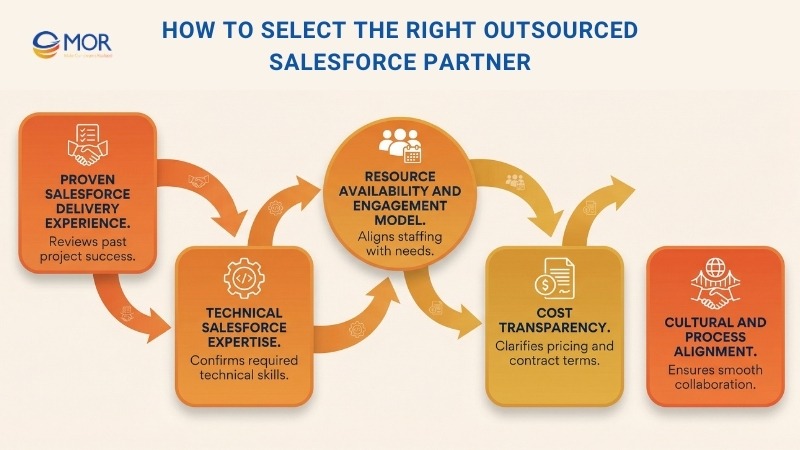
Proven Salesforce Delivery Experience
Start by reviewing the vendor’s background and the Salesforce professionals they propose for your project. Look closely at resumes, case studies, and project portfolios to understand each candidate’s strengths and practical experience. Check whether they have delivered similar solutions within your industry, for instance real estate or other comparable sectors. Past success records help indicate reliability and delivery quality. It is also important to confirm that each outsourced Salesforce partner provides certified professionals, including Salesforce Certified Administrator, Salesforce Certified Developer, or Salesforce Certified Consultant credentials.
Technical Salesforce Expertise
Confirm that the developers assigned to your project have the Salesforce-specific skills required for successful delivery. This level of capability directly affects return on investment. A strong vendor should provide specialists who close skill gaps within your team. Practical experience with salesforce Apex, Visualforce, Lightning Components, and SOQL is important, along with knowledge of Salesforce APIs and system integrations when needed.
Resource Availability And Engagement Model
Make sure the engagement terms align with your project needs. Clarify whether the role involves consulting support, hands-on delivery, or long-term collaboration. Define expected response times and confirm availability during required working hours, especially if teams operate across time zones. Resource planning matters as well. Avoid assigning senior specialists when the workload does not justify their involvement.
Cost Transparency
Review all financial details before committing to a vendor. Decide which pricing model fits your project, whether that is hourly billing, fixed project fees, or a retainer-based arrangement. Account for added expenses, including training, onboarding, software access, licenses, and equipment. Every cost and responsibility should appear clearly in a formal contract that defines scope, timelines, deliverables, payment terms, intellectual property rights, confidentiality rules, and dispute handling.
Cultural And Process Alignment
Finally, evaluate how well the vendor and its developers will work within your organization. Many external teams aim for long-term cooperation, so alignment matters. Review communication styles through interviews and regular discussions. It also helps to assess project management habits and leadership approach. Most importantly, confirm that assigned developers understand and can follow your preferred delivery methods, including Agile or other established workflows.
Where Outsourced Salesforce Projects Often Fail
Outsourced Salesforce initiatives often begin with strong momentum but lose direction over time. When this happens, well-planned investments turn into long projects with rising costs and growing frustration. Reviewing the common failure points helps teams understand where execution breaks down and how to avoid similar outcomes.
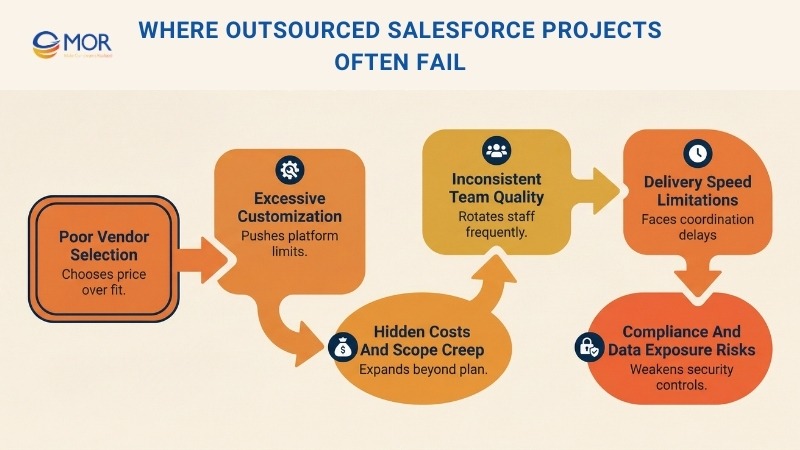
Poor Vendor Selection
Many outsourcing efforts fall short when businesses choose the wrong vendor. Problems usually start when selection decisions focus on price instead of overall fit. Low pricing may look attractive early on, but it often leads to delivery issues later.
Outsourced Salesforce projects depend heavily on close coordination with the provider. When values, working styles, and goals are not aligned, cultural gaps appear quickly. Some organizations select vendors based only on cost without checking whether strategies, methods, and long-term objectives match. Over time, this mismatch often causes budget pressure, poor communication, and delayed delivery timelines.
Excessive Customization
Many organizations face issues when customization goes too far. In some cases, teams are not fully aware of the platform’s technical limits. In others, expectations are not clearly discussed with the service provider. When requirements exceed what the system can handle, performance problems can appear.
These situations often lead to system overload, unexpected downtime, and lost time during delivery. Without clear boundaries and proper guidance, external Salesforce delivery projects may become harder to manage and maintain over the long term.
Hidden Costs And Scope Creep
Outsourced projects usually follow a pricing structure based on hourly work, monthly fees, or fixed project rates. These models help estimate initial costs, but they do not always cover every change that happens later. Adjustments caused by scope changes or longer timelines often add new expenses.
As requirements grow, rework and extended delivery can increase total costs. What starts as a lower-priced engagement may expand over time, leading to budget overruns if expectations and scope are not tightly controlled.
Inconsistent Team Quality
Project stability can suffer when a service provider frequently rotates team members. Each new developer needs time to understand the system, the business logic, and prior decisions. These repeated onboarding cycles create knowledge gaps that slow progress and can lower overall delivery quality.
Delivery Speed Limitations
Working across regions introduces coordination challenges. Even with modern collaboration tools, differences in time zones and work schedules can slow communication. Delayed feedback and limited overlap hours often lead to missed deadlines and frustration on both sides of the project.
Compliance And Data Exposure Risks
Handling sensitive data always carries risk, especially when third parties gain system access. Without strong security rules and clear protocols in place from the start, the chance of data leaks increases. Weak controls can expose businesses to compliance violations and legal consequences, which may also damage brand reputation.
Problems often arise when access rights are shared without proper safeguards. During data transfers or system updates, gaps in security controls can lead to unintended exposure. Careful planning and strict governance are necessary to protect data throughout an outsourced Salesforce engagement.
Partner With MOR Software For Outsourced Salesforce Delivery
MOR Software supports businesses that want reliable outsourced Salesforce execution without unnecessary friction. We work as an extension of your internal team, not a detached vendor. That mindset shapes how projects run, how risks get handled, and how results stay predictable.
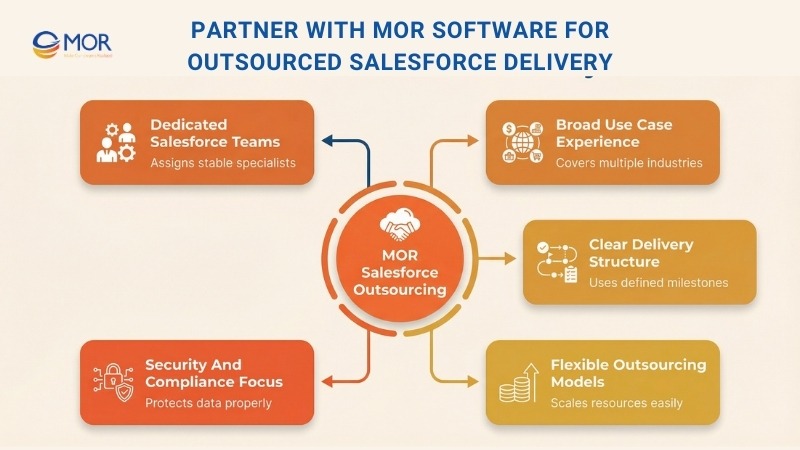
- Dedicated Salesforce teams: We assign Salesforce developers, admins, and consultants based on your scope, not a shared pool. That keeps knowledge stable and reduces rework.
- Experience across real-world Salesforce use cases: Our teams have handled Salesforce custom development, integration, migration, and long-term management across finance, healthcare, ecommerce, and enterprise systems.
- Clear delivery and communication structure: We use structured reporting, defined milestones, and regular checkpoints so progress stays visible at all times.
- Flexible outsourcing models: You can scale resources up or down as needs change, whether for short-term projects or ongoing outsourced Salesforce operations.
- Security and compliance awareness: We follow strict data protection practices and align Salesforce implementations with security and compliance expectations from global clients.
This approach allows MOR Software to deliver a Salesforce outsourcing model that stays aligned with business goals, timelines, and long-term platform stability.
If you are planning to improve your Salesforce delivery or scale faster with less risk, contact us to discuss how we can support your goals with a reliable outsourced Salesforce approach.
Conclusion
Outsourced Salesforce gives businesses a clear path to scale CRM operations without adding internal strain. With the right partner, teams gain speed, control, and access to specialized skills while keeping costs predictable. MOR Software delivers Salesforce outsourcing services built around real workflows, stable teams, and long-term system health. If you are planning to improve your Salesforce setup or move faster with fewer risks, contact us to discuss how MOR Software can support your goals.
"Mr. Cong’s guiding philosophy is simplicity, believing that the simplest solutions are often the most powerful. He sees trust, empowerment, and the opportunity to demonstrate one’s abilities as the key elements that set MOR apart from traditional IT companies."
Mac Tien Cong


Division Manager (Hanoi Branch)
MOR SOFTWARE
Frequently Asked Questions (FAQs)
What does outsourced Salesforce mean in practice?
Outsourced Salesforce means working with an external team to handle Salesforce-related tasks instead of relying entirely on internal staff. This can include development, customization, integrations, administration, data management, and ongoing support, depending on your needs.
Which Salesforce tasks are most commonly outsourced?
Companies often outsource custom development, system integrations, workflow automation, data migration, performance optimization, and ongoing administration. Support and maintenance are also frequently handled by external Salesforce specialists.
Is outsourced Salesforce suitable for small businesses?
Yes. Small businesses often benefit because outsourcing avoids the cost of hiring full-time Salesforce experts. It allows access to certified skills on demand while keeping spending aligned with actual project scope.
How does outsourced Salesforce compare to hiring an in-house team?
Outsourced Salesforce offers faster access to expertise and easier scalability. In-house teams provide more direct control but usually require higher long-term investment in hiring, training, and retention.
How do companies maintain data security when outsourcing Salesforce?
Security is managed through access controls, confidentiality agreements, role-based permissions, and compliance processes. Reputable providers follow strict security standards and limit access to only what is required for delivery.
Can outsourced Salesforce teams work with existing internal staff?
Yes. Outsourced teams often work alongside internal users, admins, or developers. This hybrid approach allows internal teams to retain oversight while external experts handle complex or time-sensitive tasks.
How quickly can an outsourced Salesforce team get started?
Timelines vary, but onboarding is usually faster than hiring internally. Once scope, access, and priorities are defined, outsourced Salesforce teams can often begin work within days or weeks.
What pricing models are common for outsourced Salesforce services?
Common models include hourly rates, fixed-price projects, and monthly retainers. The right model depends on whether the work is short-term, ongoing support, or a clearly defined implementation.
When should a company consider outsourced Salesforce instead of internal expansion?
Outsourcing makes sense when there is a skills gap, limited internal capacity, tight deadlines, or fluctuating workloads. It is also a practical option when Salesforce expertise is needed temporarily or for specialized initiatives.
Share


Make Our-Dreams Realized


© 2023 . MOR Software. All Rights Reserved
Sitemap
Privacy Policy
Terms of Use

Rate this article
0
over 5.0 based on 0 reviews
Your rating on this news:
Name
*Email
*Write your comment
*Send your comment
1