


Step-by-Step Guide to Hire NodeJS Developers Effectively
Hiring the wrong developer can slow your product and waste months of effort. Many teams try to hire Nodejs developers but struggle to find the right fit across skills, cost, and speed. This MOR Software’s guide will show you how to hire dedicated Nodejs developers, avoid common mistakes, and build a team that delivers from day one.
Why Hiring NodeJS Developer?
The first thing many teams ask is why they should hire Nodejs developers at all. In a crowded IT market with many development choices, Node.js stands out as one of the most widely used frameworks based on several reports. It has proven its value over time and continues to stay popular across different types of projects.
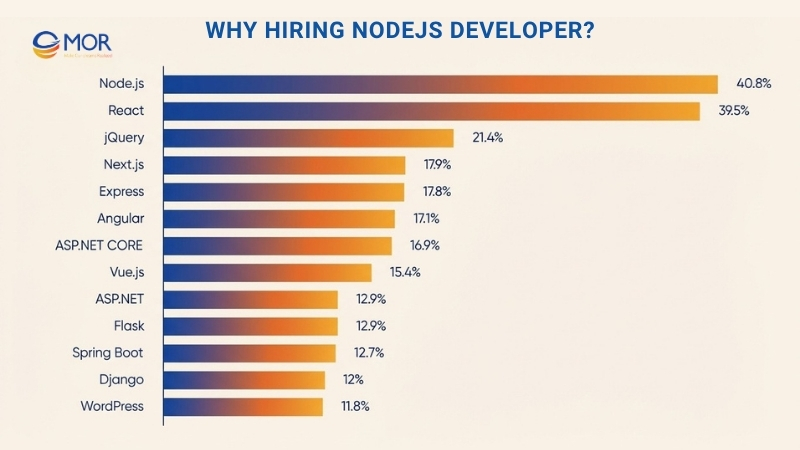
Based on Statista’s “Most Used Web Framework among Developers Worldwide, as of 2024” report, Node.js leads the list with 40.8% of developers selecting it. This shows that when businesses look to recruit web engineers, they often choose Node.js as the main technology for building modern applications.
Key Benefits To Hire Remote Node.js Developers
Node.js works on an asynchronous model with strong performance and the ability to scale, making it a good fit for real-time systems and handling many connections at once. A skilled developer understands backend logic, error control, functional programming, Node Package Manager (NPM), API creation, JSON Web Tokens (JWT), and object-relational mapping tools.
Unified Cross-Platform Engineering
Building separate codebases for different operating environments often leads to fragmented application logic, prolonged development timelines, and bloated project budgets. By leveraging the cross-platform development capabilities of programming language Node.js, engineering teams can write a unified codebase that runs seamlessly across diverse environments. This structural consistency drastically reduces overall development time and resource allocation while ensuring a uniform, bug-free user experience across all deployment targets.
Access to a Boundless Enterprise Ecosystem
Speed and reliability are critical to maintaining a competitive edge in digital transformation. Node.js houses one of the largest, most active, and highly innovative open-source ecosystems in the world through the Node Package Manager (NPM). This extensive registry provides developers with an unparalleled library of pre-tested, secure components and modules. Utilizing these robust resources allows engineering teams to avoid building standard features from scratch, significantly accelerating production timelines and driving down total engineering costs.
Full-Stack Operational Efficiency
Managing isolated teams for frontend interface design and backend database management often creates communication barriers and integration friction. Node.js bridges this gap by offering comprehensive full-stack development capabilities, enabling developers to utilize JavaScript across both the client-side and server-side layers of an application. This architectural unity simplifies development workflows, enhances code reusability, and eliminates the logistical need to hire and manage two separate, specialized developer teams, resulting in streamlined project governance.
High-Performance Architecture for Real-Time Scaling
Modern enterprise applications require high-speed data processing and minimal latency to support concurrent user traffic. Powered by Google’s advanced V8 engine, Node.js compiles source code directly into native machine logic, facilitating lightning-fast execution speeds. This event-driven, non-blocking I/O model makes it the ideal framework for creating real-time, high-throughput applications - such as complex fintech modules, live streaming platforms, and data-intensive enterprise tools - that scale effortlessly under intense computational demand.
What Skills To Look For To Hire Dedicated NodeJS Developers
For any project, when you hire dedicated Nodejs developers, they need a clear understanding of technical concepts, workflows, and tools. At the same time, they should also show strong soft skills and communication ability to work with others, share ideas, and turn code into real business results.
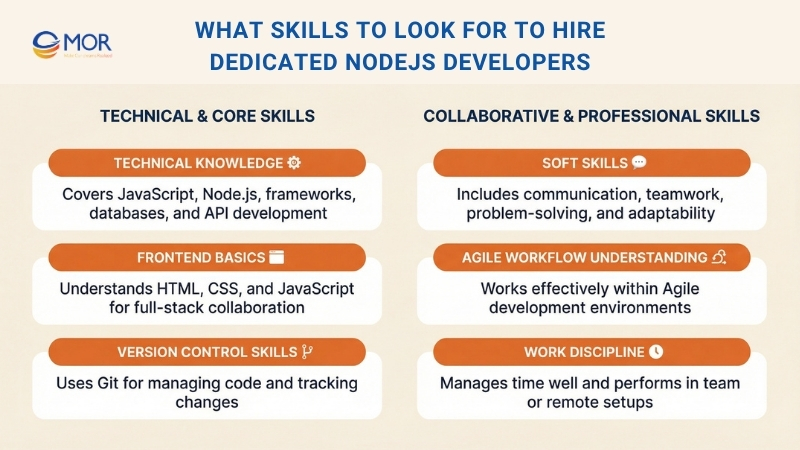
Teams that plan to hire Node js programmer talent or even hire passport.js developers, hire lodash developers, and hire moment.js developers should look at both technical and personal skills. These areas help you choose the right people who can support your project from start to finish.
NodeJS Developer Technical Skills | NodeJS Developer Soft Skills |
Strong knowledge of JavaScript and Node.js | Clear communication ability |
Experience with Node.js frameworks like Express.js and Nest.js | Ability to work well in a team |
Hands-on experience with database systems (SQL/NoSQL) | Strong problem-solving and thinking skills |
Understanding of frontend basics (HTML, CSS, JavaScript) | Willingness to learn and adapt |
Experience with version control tools such as Git | Knowledge of Agile workflows |
Ability to build scalable and well-structured systems | Ability to work in teams or remote setups |
Knowledge of RESTful APIs | Good time management and work discipline |
Where To Hire The Best NodeJS Developers
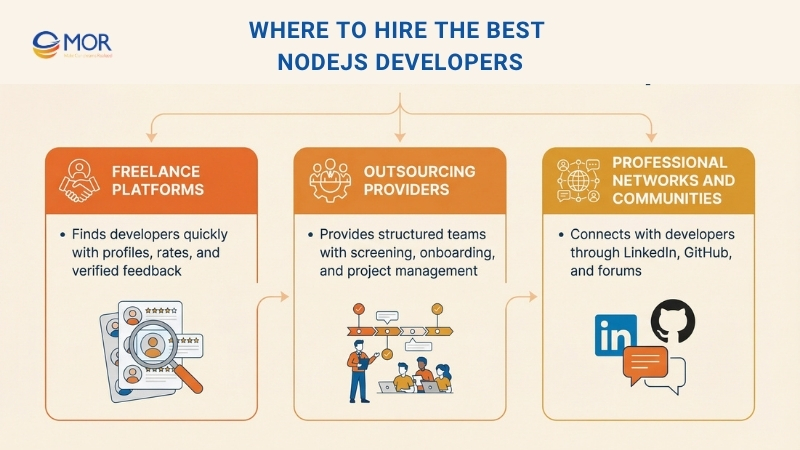
Finding the right talent means you first understand your project goals and then explore different hiring channels until you identify the best fit. When you hire Nodejs developers, looking across multiple sources helps you compare skills, pricing, and experience more effectively.
Freelance Platforms
Freelance platforms are one of the fastest ways to review many developer profiles for both short-term and long-term needs. These websites give you access to Nodejs developers for hire, with clear details on skills, hourly rates, and client feedback so you can evaluate each candidate properly. You can look for talent on well-known platforms like Upwork, Toptal, Fiverr, and others.
Outsourcing Providers
If your project requires a structured team with stable delivery quality, working with a partner like MOR Software is a practical option when you plan to hire Nodejs offshore software development company services. We take care of software outsourcing, screening, and onboarding, so you do not need to spend time filtering profiles or running long interview cycles.
We provide teams of pre-selected Node.js engineers who already have experience in real delivery environments. They are familiar with Agile processes, team collaboration, and fast release cycles, which makes onboarding smooth and efficient from the start.
You can also choose from different profiles, from backend engineers to full-stack developers, based on your project needs. In addition, we assign a project manager at no extra cost to keep communication clear and timelines under control.
This model helps you save time, lower hiring risks, and work with a team that is ready to deliver results immediately.
Professional Networks And Communities
Social platforms, professional networks, and developer communities are strong sources for finding skilled engineers. These spaces often include developers who are actively searching for new roles and taking part in discussions or technical sharing. You can explore platforms like LinkedIn, GitHub, Twitter, and Reddit to connect with potential candidates.
Common Use Cases To Hire Node JS Developers
Node.js is a flexible and widely used platform. From using it in product development to applying it across mobile, web, and software solutions, there are many practical ways to apply this technology. It supports a wide range of projects across different environments. Many teams choose to hire Nodejs developers when working on projects such as the following.
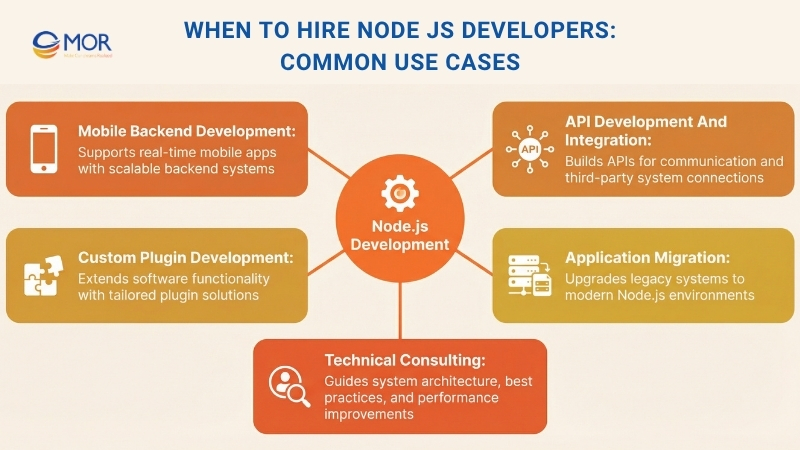
Mobile Backend Development
When you build mobile apps that need real-time data processing, you need a strong backend system. Node.js works well for handling these tasks and managing high traffic with scalable backend services. Whether your goal is to build an iOS or Android app, you can hire Node.js developers to create full APIs, manage databases, and handle features like user authentication.
API Development And Integration
APIs play a central role in modern web and mobile systems. They act as connectors that allow different platforms to communicate. Node.js is known for building RESTful APIs or GraphQL APIs because of its speed and flexibility. Developers can design APIs that connect external services like payment gateways or help structure your system using microservices.
Custom Plugin Development
Plugins allow you to expand the capabilities of your existing software. If you are using platforms like WordPress or Magento, or even custom-built systems, Node.js engineers can build plugins based on your specific needs to improve system performance and functionality.
Application Migration
If your current system is outdated and cannot meet modern demands, moving it to Node.js can improve performance and make it usable again. Experienced developers from a trusted Node.js development provider can handle this process carefully, making sure the migration runs smoothly and the new system works well for current requirements.
Technical Consulting
At times, you may not be sure how to apply Node.js in your current system. In these cases, working with a Node.js consultant can help you understand best practices, system design choices, and ways to improve performance based on your project goals.
Types Of NodeJS Developers For Hire In 2026
Before you hire Nodejs developers, you should review key factors that affect your decision. Elements like experience level, role, location, and hiring model all play a part in choosing the right team for your project in 2026.
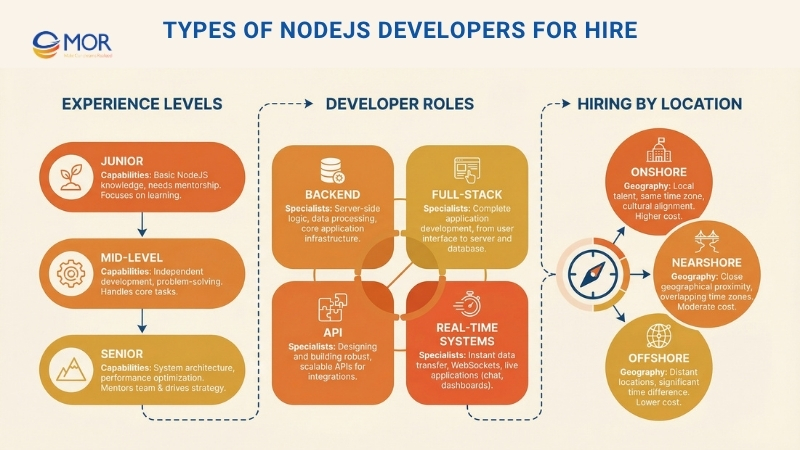
Experience Levels
Experience level has a strong influence when you hire Nodejs developer talent. The level of skill and knowledge directly affects the type and complexity of projects they can manage. Developers at different stages bring different strengths. Knowing the difference between junior, mid-level, and senior Node.js engineers helps you choose the right fit for your goals and budget.
Developer Roles
Node.js can be used for many types of projects, so the role of each developer can vary a lot. Whether you need support for backend APIs or real-time systems, understanding the roles available will help you select the right specialists. These are the most common Node.js developer roles.
Hire Node JS Programmers by Role | Description |
Backend NodeJS Developer | Handles server-side logic, database connections, user authentication, and API building. |
Full-stack NodeJS Developer | Works on both frontend and backend, building complete applications from interface to server logic. |
Real-Time Application Developer | Focuses on real-time systems like chat apps or live tracking tools that need instant updates. |
API Developers | Works mainly on building and managing APIs for secure system communication. |
Node.js Tooling & Framework Developer | Builds custom tools, libraries, and frameworks to support development needs. |
Hiring By Location
The location of your Node.js developers can affect communication, cost, and how you manage the project. Based on your needs, you can hire Nodejs developers from different regions around the world.
Onshore Developers
Onshore developers are based in the same country or region as your company. This is a common choice for teams that want to hire Nodejs developers USA for easier collaboration, shared culture, and real-time communication. Working with local Node.js teams also gives managers more direct control over daily operations. However, this choice often comes with higher costs, including hourly rates, salaries, and employee benefits.
Nearshore Developers
When you expand your search to nearby countries with similar time zones, you often find a better balance between cost and convenience. Communication and teamwork remain smooth, while development rates are usually lower than onshore options. Nearshore hiring is common in regions like Latin America or Eastern Europe.
Offshore Developers
You can also hire Nodejs developers in india and other regions such as Ukraine. These locations are often far from markets like the United States or United Kingdom. The main advantage is lower labor costs and access to a wider talent pool. Time zone differences can be managed with the help of a professional provider that supports flexible schedules, clear communication, and reliable delivery processes.
Cost To Hire NodeJS Developers In 2026: What You Need To Know
Many elements influence the total cost when you hire Nodejs developers for your project. These include experience level, location, hiring model, project scope, and timeline. Below is a simple overview of estimated pricing based on these key factors.
Category | Details | Cost Range |
Hiring NodeJS Developer based on Experience Level | Junior DevelopersMid-Level DevelopersSenior Developers | $25 – $50/hour$50 – $100/hour$100 – $150+/hour |
Hiring NodeJS Developer based on Location | Onshore (e.g., U.S., Europe)Nearshore (e.g., Latin America, Eastern Europe)Offshore (e.g., India, Ukraine) | $80 – $200+/hour$40 – $100/hour$20 – $60/hour |
Hiring NodeJS Developer based on Hiring Models | FreelancersFull-TimeOutsourcing/Offshoring | $25 – $100/hour$70,000 – $150,000 annually$30 – $100/hour |
Hiring NodeJS Developer based on Project Complexity | Simple ProjectsMedium Complexity ProjectsHigh Complexity Projects | $20 – $50/hour$50 – $100/hour$100 – $200+/hour |
Hiring NodeJS Developer based on Development Time | Short-Term Projects (1–3 months)Medium-Term Projects (3–6 months)Long-Term Projects (6+ months) | $5,000 – $30,000 total$30,000 – $75,000 total$75,000 – $500,000+ total |
Hiring Models To Hire NodeJS Developers That Fit Your Project
The model you choose when you hire Nodejs developers will affect how flexible your project is, how it scales, and how much it costs.
Depending on your goals, you can select from several common hiring approaches.
Hiring Model | Description | Best For | Challenges |
Full-Time Hiring/In-House | Permanent employees who work only on your project. | Long-term projects that need continuous support and close teamwork. | Higher expenses due to salaries, benefits, and office-related costs. |
Freelancer/Contractual | Hiring developers for specific tasks or short-term work. | Small projects or one-time tasks like fixing bugs or adding features. | Limited long-term availability and less control over schedules. |
Outsourcing/Offshore | Working with an external partner or hiring from cost-effective regions. | Large projects or fast scaling without building an in-house team. | Possible communication gaps, time zone differences, and quality concerns. |
Staff Augmentation | Adding external developers to your current team for a limited time. | Expanding your team quickly while keeping project control. | Time is needed to onboard and align new members with your workflow. |
Step-By-Step Guide To Hire NodeJS Developers In 2026
Now that you understand what NodeJS can do and the value these engineers bring, it is time to look at how to hire Nodejs developers in 2026. This guide helps you attract the right candidates, assess their skills, and onboard them smoothly for your project.
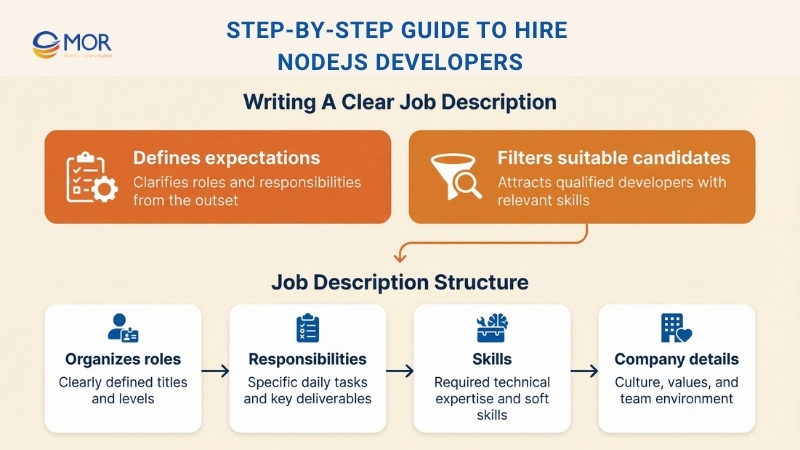
Writing A Clear Job Description
If you plan to post job openings for Node.js roles, you need a clear and well-written job description to attract the right applicants. It defines expectations early and helps you filter out candidates who are not a good match.
Job Description Structure
A clear structure makes your job post easier to understand and helps candidates quickly decide if they are suitable. It also helps you compare applicants more effectively during the hiring process.
Component | Details | Purpose |
Job Title | Clearly define the role, such as ‘Junior NodeJS Developer’ or ‘Senior NodeJS Developer’ | Helps explain the position and required skill level |
Responsibilities | List the tasks expected, such as building APIs or developing server-side systems | Gives a clear view of daily work and expectations |
Requirements | Include must-have skills like JavaScript knowledge, framework experience, and database handling | Helps filter candidates based on required qualifications |
Preferred Qualifications | Add extra skills like experience with DevOps, cloud services, or microservices | Shows which candidates may stand out more |
Company Overview | Share a short description of your company, including goals and values | Helps candidates understand your company culture |
Benefits | List key benefits such as salary, flexible hours, and health support | Attracts strong candidates by showing workplace value |
4-Step Process To Hire NodeJS Developers From MOR Software
If your hiring process feels slow or unclear, MOR Software keeps things simple and structured. You do not need to spend time writing job posts or waiting weeks to find the right match. We help you hire Nodejs developers SUA and build a team that fits your project from the very beginning.
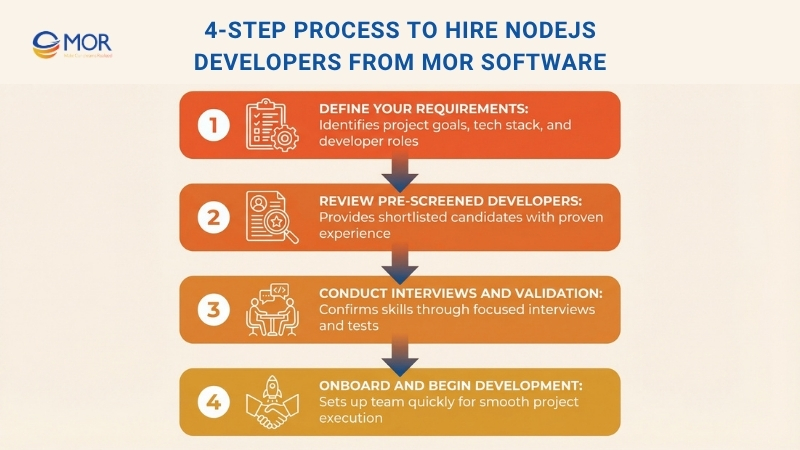
Step 1: Define Your Requirements
We begin by working closely with you to understand your real needs. Not just “a Node.js developer,” but the exact role that fits your system.
We review your product goals, current tech stack, and expected timeline. Then we define clear requirements, whether you need API development, backend design, or full-stack support.
Step 2: Review Pre-Screened Developers
You do not need to go through random CVs. We share a shortlist of developers who already match your requirements.
Each candidate profile shows real project experience, technical strengths, and past results. You can review, compare, and choose faster than in a typical hiring process.
Step 3: Conduct Interviews And Validation
We support you in running focused interviews without wasting time. Candidates are prepared, informed, and aligned with your expectations.
If needed, we also run technical tests to check skills in real working scenarios. This helps you make decisions based on actual ability, not just written profiles.
Step 4: Onboard And Begin Development
Once you select your developer or team, we take care of contracts and initial setup.
Your team receives access to tools, documents, and workflows right away. After that, development starts smoothly, with full support from MOR Software to keep progress on track.
Conclusion
Finding the right team takes more than scanning resumes. When you hire Nodejs developers with the right skills, model, and support, your project moves faster and stays on track. From choosing hiring channels to onboarding, each step matters. MOR Software helps you simplify the process and build a team that fits your goals. Ready to get started? Contact us today to find Node.js experts who can deliver real results.
MOR SOFTWARE
Frequently Asked Questions (FAQs)
What should we look for when hiring Node.js developers?
We focus on strong JavaScript fundamentals, experience with Node.js frameworks, and real project work. Communication skills matter just as much as technical ability.
How much does it cost to hire Node.js developers?
Costs vary by location and experience. Offshore developers can cost much less than local hires, often saving up to 40 to 60 percent.
Should we hire freelance or dedicated Node.js developers?
Freelancers work well for short tasks. Dedicated developers fit long-term projects where consistency and team collaboration matter more.
How long does it take to hire a Node.js developer?
It depends on your process. Traditional hiring can take weeks. Working with a partner helps you start in just a few days.
What skills are essential for a Node.js developer?
We look for skills in APIs, database handling, async programming, and system design. Experience with tools like Express.js or Nest.js also helps.
Can Node.js developers handle full-stack development?
Yes, many can. Full-stack developers work on both frontend and backend, which helps speed up development and reduce team size.
When should we hire Node.js developers for a project?
We bring them in when the project needs real-time features, scalable APIs, or high-performance backend systems.
How do we manage remote Node.js developers effectively?
Clear communication is key. We use tools like Slack, Jira, and Git to keep work transparent and on track.
What are the benefits of hiring offshore Node.js developers?
You get lower costs, access to global talent, and faster team scaling without long hiring cycles.
Do Node.js developers support ongoing maintenance?
Yes, they handle updates, bug fixes, and performance improvements after launch to keep your system stable.
Share


Make Our-Dreams Realized


© 2023 . MOR Software. All Rights Reserved
Sitemap
Privacy Policy
Terms of Use

Rate this article
0
over 5.0 based on 0 reviews
Your rating on this news:
Name
*Email
*Write your comment
*Send your comment
1