


The Definitive Guide On How To Build A Tech Team in One Week

Startup hiring gets messy when founders rush to hire developers before the product scope, roles, budget, and delivery model are clear. Learning how to build a tech team helps you avoid slow delivery, weak ownership, and repeated work. In this guide, MOR Software will explain how startup teams can plan roles, compare hiring models, manage costs, and ship faster in one week.
Key Takeaways
- A strong startup team needs clear roles, shared goals, and real ownership before the first sprint starts.
- Your hiring model should match your stage, budget, timeline, and control needs, whether you choose in-house hiring, outsourcing, freelancers, or dedicated squads.
- Founders can make real progress in one week if they define the scope, write clear job specs, vet talent, onboard developers, and ship a small working result in 7 days.
Tech Team Fundamentals Every Startup Should Know
A development team brings together the people who plan, code, test, and keep a digital product running. In Agile, it is not a loose mix of job titles. It works more like one connected unit with one target: shipping useful software often.
When founders ask how to build a tech team, the answer starts with structure. Building a tech team is less about collecting smart people and more about shaping how they work.
The real gap between startups that move quickly and those that get stuck is not only talent. It is the way that talent is arranged.
Lessons From Spotify And LEGO About Team Design
There is a useful story behind this idea.
When Henrik Kniberg worked with Spotify, the company ran into a common growth problem. It had strong people, but its pace began to drop. Big groups, too many handoffs, long meetings, and shared blockers started to slow the work.
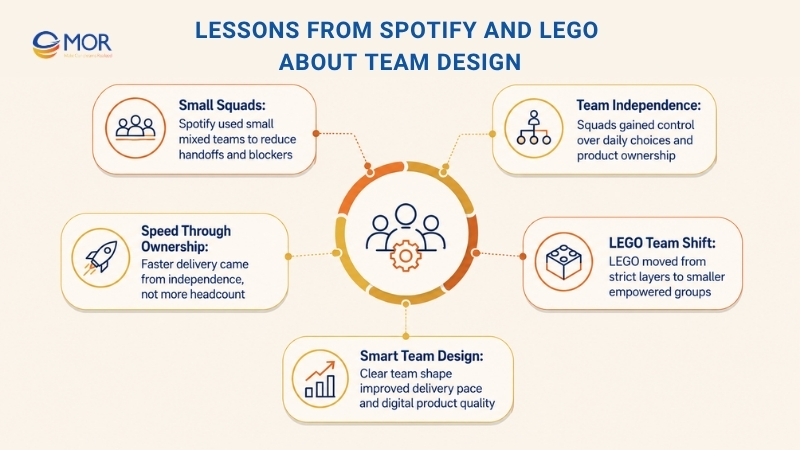
The fix was not another hiring push. The fix was a new team shape.
That was how Squads became well known:
- Small groups, often 6 to 8 people
- Mixed skills in one unit
- Real control over day-to-day choices
- Clear ownership of one product area
One short line from Kniberg captures the idea well:
“If deployment needs approval from another team, your speed is already gone.”
Spotify learned a sharp lesson: Speed comes from independence, not headcount.
Henrik explains it with a neat style. In our way of saying it, speed has nothing to do with bacon, if we borrow an “Iberian” joke.
LEGO went through a related shift after using similar ideas. The company moved away from strict team layers and gave smaller groups more control. Delivery became faster, and digital product quality improved. It was not luck. It was smart team design.
Main Roles Inside A Product Squad
Role | Main Duty |
Scrum Master | Keeps the working process clear and removes blockers |
Product Owner | Decides what should be built and manages product priorities |
Developers (FE/BE/Full-stack) | Turn product ideas into working software |
QA (Manual/Automation) | Checks quality and catches defects before release |
Product Designer | Shapes the UX/UI and product flow |
DevOps | Handles release work, delivery setup, and cloud systems |
The main point is simple: A strong result comes from team design, not solo talent alone.
You may hire excellent engineers. But if they sit in separate silos, lack ownership, miss shared goals, or follow weak processes, the product will still move slowly, cost more, and fall short on quality.
This is why technical team roles and responsibilities should be clear from the start. Each person needs to know what they own and how their work connects with the product.
What Makes The Squad Model Work
The real difference is not the job titles. It is the way the people work together:
- They work toward the same goals
- They can move without waiting on other groups
- They have the right to make product decisions
The Mistake Many Founders Miss
Many startups fall into the same trap. They hire strong developers, then place them inside a setup that blocks speed:
- Teams split by function
- Too many outside dependencies
- No clear ownership
The result:
- more meetings
- fewer releases
- weaker product quality
That is why the discussion about development teams should change:
- It is not “who should I hire?”
- It is “how should I set up the team so the work moves?”
Questions To Answer Before Your First Tech Hire
Before you make your first technical hire, slow down and check what the business really needs. Many founders start hiring too early, then realize the product scope is unclear, the budget is too thin, or custom development was not needed yet. These questions help you decide whether to build, buy, outsource, or wait before adding your first developer.
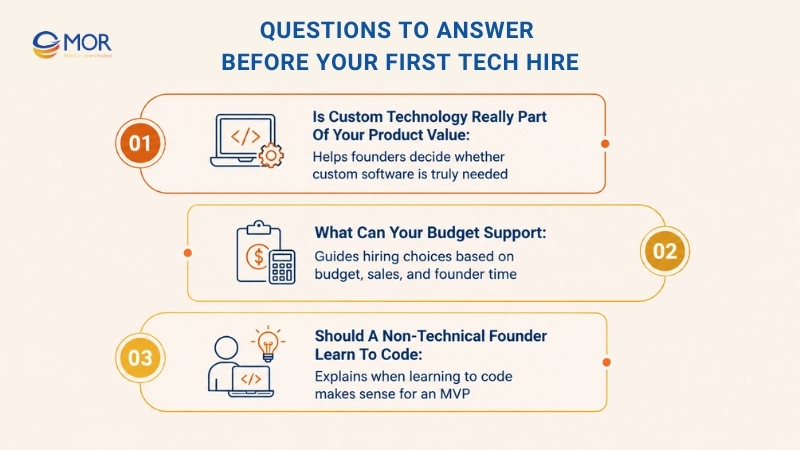
Is Custom Technology Really Part Of Your Product Value?
This is the first big choice a founder has to make when thinking about how to build a team for a tech startup. If you sell goods through an eCommerce site, you should not start with custom software unless your digital product has something truly different from what the market already has. Most online stores can run well with Shopify and Shopify Apps at the start. In the same way, if your app only needs simple create, update, and delete functions for structured data, no-code tools like Bubble and Stacker may be enough.
What Can Your Budget Support?
If you begin with a self-serve tool like Shopify or a CMS, hiring outside developers on day one may be wasteful unless your budget is already strong. You should handle the basic setup yourself, add products, adjust settings, and learn how the dashboard works.
After that, your budget and sales plan should guide the next move. If customers are already coming in, your time may be better spent selling. But if money is tight, you can often start on your own. If you have some budget, a small CMS task may be better handled by a specialist who can finish in one hour what might take you days, saving real founder time.
Should A Non-Technical Founder Learn To Code?
If custom code is needed to launch your MVP, you have two choices. You can learn to build it yourself, or you can hire someone who already knows how.
In most cases, learning to code just to ship an MVP is not the best route. It only makes sense when the idea is not time-sensitive. In that case, you can spend time learning before turning your full focus to the market.
A few tutorials may make a basic app look easy. But you will soon spend long stretches fixing bugs and changing your own code. Some startups have taken this path and made it work. Still, if you choose it, do not set a tight timeline. Expect the first version to take at least two times longer, and sometimes three or four times longer, than you first thought.
If you have no money for development and no track record to raise funds quickly, this route can still work. Raising even a small angel check might take six months, but a rough first product may be possible in one or two months.
There is also one upside for non-technical founders. If you build and ship something yourself, future engineers may take you more seriously when you hire them later.
How To Build A Tech Team For A Startup In 7 Days
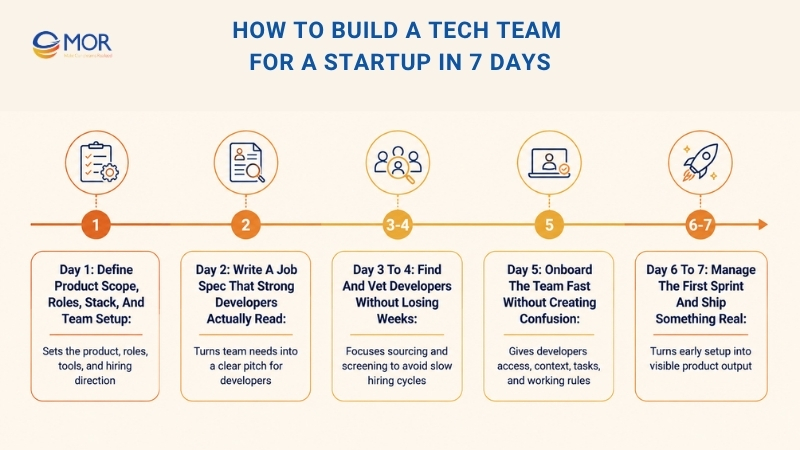
- Day 1: Define Product Scope, Roles, Stack, And Team Setup
- Day 2: Write A Job Spec That Strong Developers Actually Read
- Day 3 To 4: Find And Vet Developers Without Losing Weeks
- Day 5: Onboard The Team Fast Without Creating Confusion
- Day 6 To 7: Manage The First Sprint And Ship Something Real
Day 1: Define Product Scope, Roles, Stack, And Team Setup
Before the first developer joins, you need a clear plan. You must know what product you want to build, who should build it, how the team will work, and which tools or technologies make sense.
Skipping this step is like hiring a band before knowing if the show is jazz or metal.
Day 1 is where you set the base for a faster build.
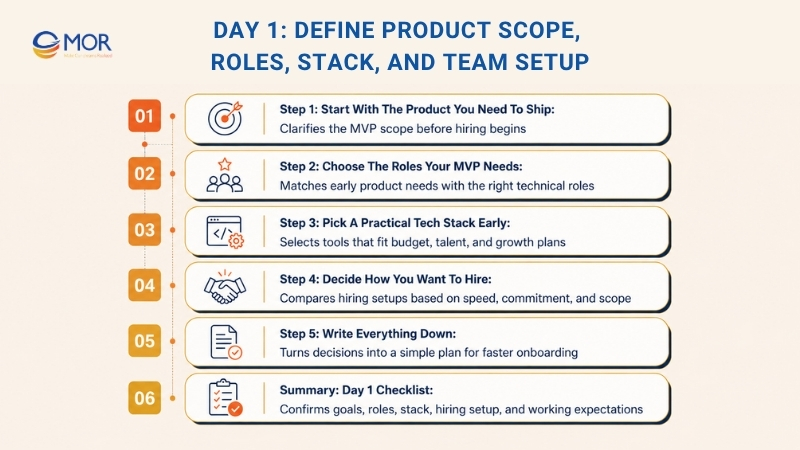
Step 1: Start With The Product You Need To Ship
What are you actually trying to launch?
- Is it a mobile app, a SaaS platform, a marketplace, or an AI tool?
- Will it need user accounts, dashboards, payments, or live messages?
Many startups rush into hiring before they map the product properly.
You do not need a 50-page document. But you do need a clear launch scope for the next 30 to 90 days.
Practical Note: Keep the first version tight. Focus on your MVP (Minimum Viable Product). The team should ship that version, not your whole five-year plan to build a tech startup.
Step 2: Choose The Roles Your MVP Needs
A simple early startup product team often looks like this:
Role | What They Handle |
Frontend Developer | Builds the user-facing screen, handles responsive layouts, and works with tools like React, Vue, or Next.js. |
Backend Developer | Builds server logic, APIs, and databases. Common stacks include Node.js, Django, or Ruby on Rails. |
Full-Stack Developer | Works across frontend and backend. This role suits lean MVP teams well. |
DevOps Engineer | Sets up hosting, deployment flows, CI/CD, and cloud systems on AWS or GCP. |
UI/UX Designer | Optional but helpful. Designs wireframes, screens, and user journeys. |
Product Manager (PM) | Optional in the early stage. Helps control scope, timelines, user stories, and backlog. |
Your product may only need two or three of these roles at first. A SaaS MVP, for instance, may start with one full-stack developer and a little DevOps help.
MOR Software can help founders turn MVP needs into real team roles, then match those needs with skilled engineers who fit the work.
Step 3: Pick A Practical Tech Stack Early
Your tech stack shapes how your product is built. Choose tools that are:
- Easy to learn from documentation
- Ready to grow with the product
- Backed by strong developer communities
A lean startup stack often looks like this:
Category | Suggested Stack For 2026 |
Frontend | React.js, Next.js, Vue.js |
Backend | Node.js, Python (Django/FastAPI), Ruby on Rails |
Database | PostgreSQL, MongoDB, Firebase |
DevOps | AWS, Vercel, Docker, GitHub Actions |
Design | Figma for UI/UX |
Communication | Slack, Notion, Jira, Loom |
Do not chase trends just because other teams use them. Pick what fits your money, pace, and available talent.
If the stack feels unclear, MOR Software can help review your MVP needs and choose technologies that match your product and hiring plan.
Step 4: Decide How You Want To Hire
This is where many startups burn time.
Ask yourself:
- Do I need someone who will stay long term?
- Or do I only need help to ship the MVP?
- Should one full-stack developer handle most tasks, or should I split work across specialists?
A quick guide can help:
Need | Best Match |
Ship an MVP fast | 1 to 2 full-stack developers |
High availability and fast progress | Full-time remote contractors |
One clear module or task set | Project-based freelancers |
Grow after the MVP launch | Specialist developers through MOR Software |
Step 5: Write Everything Down
After these choices are made, put them into a simple document:
- A one-page product brief
- The roles and duties you need
- Your tech stack and the reason behind it
- Timeline and working expectations, such as “MVP ready in 6 weeks”
This level of clarity can save hours in interviews and onboarding.
Summary: Day 1 Checklist
- Set your MVP goals
- Choose the core tech roles
- Pick a lean tech stack that can grow
- Decide the hiring setup
- Write the plan down so work can move faster
At the end of Day 1, you should know who you need, what they will build, and how you want the team to work.
That clarity makes Day 2, writing the job spec, much easier.
Day 2: Write A Job Spec That Strong Developers Actually Read
You have defined what you need. Now you must turn that plan into words. The wording matters more than many founders think.
A job description is not just a checklist. It helps attract the right developers and filter out the wrong ones. When you are learning how to build a tech team in 7 days, each line should help the right person say yes.
The job spec is your first pitch to technical talent. Strong developers, especially the busy ones, look for projects that are clear, serious, and well planned.
According to SignalFire’s State of Talent Report 2025, companies are leaning toward contributors who can start producing value quickly.
For a startup that needs speed, your team cannot only look strong on paper. It must deliver quickly.
A sharp job spec helps you cut through the noise.
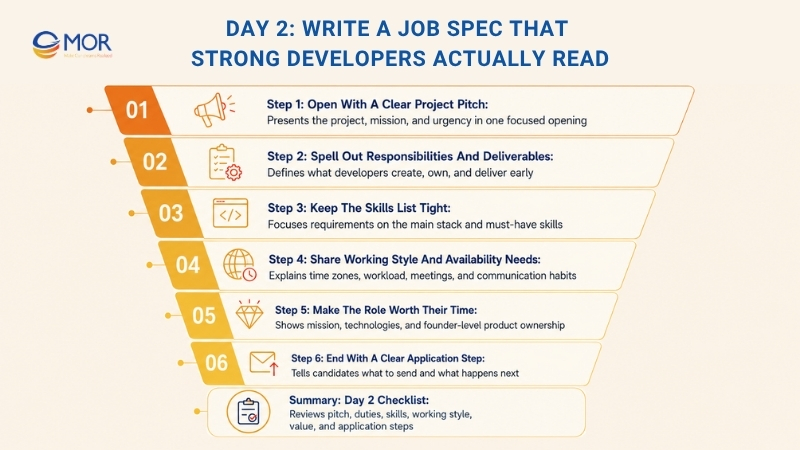
Step 1: Open With A Clear Project Pitch
Your first paragraph should:
- Explain the project in one clear sentence
- State the mission
- Show why the work is worth attention
Example:
“We are a funded early-stage startup building a B2B platform that automates cross-border invoicing for remote teams. We plan to launch our MVP in 60 days and need a strong backend developer (Node.js + PostgreSQL) to join a small, fast team.”
This shows focus, direction, and urgency, which strong developers notice fast.
Step 2: Spell Out Responsibilities And Deliverables
Be clear. Developers do not want soft lines like “support technical work with the team.” Tell them instead:
- What they will create, such as REST APIs or mobile screens
- What they will own, such as architecture, tests, or deployments
- What results you expect in the first 30 to 60 days
Strong Version | Weak Version |
“Build and maintain backend APIs for our MVP.” | “Help with backend development.” |
“Set up CI/CD pipelines using GitHub Actions.” | “Manage dev ops tasks.” |
“Connect Stripe for payment processing.” | “Assist with integrations.” |
Step 3: Keep The Skills List Tight
Many startups make the same mistake here:
They write down every tool they have heard of, like Kubernetes, Kafka, GraphQL, Firebase, and Rust, then scare away people who could do the job well.
A better route:
- Focus on your main stack
- Split must-have skills from nice-to-have skills
- Keep the list below 8 bullet points
Core stack sample:
- Must-Have: React, Node.js, PostgreSQL
- Nice to Have: AWS, Docker, TypeScript
Be honest about the work. If your stack is simple, say that. You are not building NASA software, at least not yet.
Step 4: Share Working Style And Availability Needs
This small detail can change the quality of your applicants.
Make clear:
- Time zone needs or overlap hours
- Weekly workload, such as full-time or part-time
- Communication habits, including standups, check-ins, and tools
Example:
“We work async, with Monday standups and Friday demos each week. We prefer at least 4 hours of overlap with GMT+1.”
Step 5: Make The Role Worth Their Time
Good developers have choices. If you want them to care, make the role feel worth reading:
- Explain the mission.
- Name the technologies they will use.
- Show what makes your startup interesting.
Example:
“You will work directly with the founders, shape the backend from the start, and launch a product backed by real customer demand.”
Step 6: End With A Clear Application Step
Finish with simple direction:
- What should they send?
- When are you hiring?
- Will a trial task be part of the process?
Example:
“We are hiring this week. Send a short note with links to past work or GitHub. We will reply within 24 hours.”
MOR Software can speed this up by helping you connect with developers whose skills already match your job spec, so you avoid the flood of weak applications and move to real interviews.
Summary: Day 2 Checklist
- Write a clear one-paragraph project pitch.
- Name the main duties and outputs.
- List must-have skills without stuffing the page.
- Explain work style and availability needs.
- Make the role sound worth their time.
- Add a clear next step for applicants.
A clear job spec is one of the biggest shortcuts in startup hiring. It brings in the right people, so Day 3, sourcing, does not turn into a black hole.
A strong spec can cut hiring time sharply, and MOR Software helps match you with people who already fit the work.
You are not only hiring hands. You are choosing the people who may shape the future of your product.
Day 3 To 4: Find And Vet Developers Without Losing Weeks
Your job spec is now clear and useful. The next move is finding the people who can turn your product plan into working software.
For many founders, this stage takes the longest and causes the most stress. It does not need to drag on for weeks.
If you want to build a remote tech team with speed and care, sourcing must be focused, time-aware, and filtered early.
You need a hiring path that avoids endless LinkedIn messages, low-fit Upwork proposals, and slow recruiter loops.
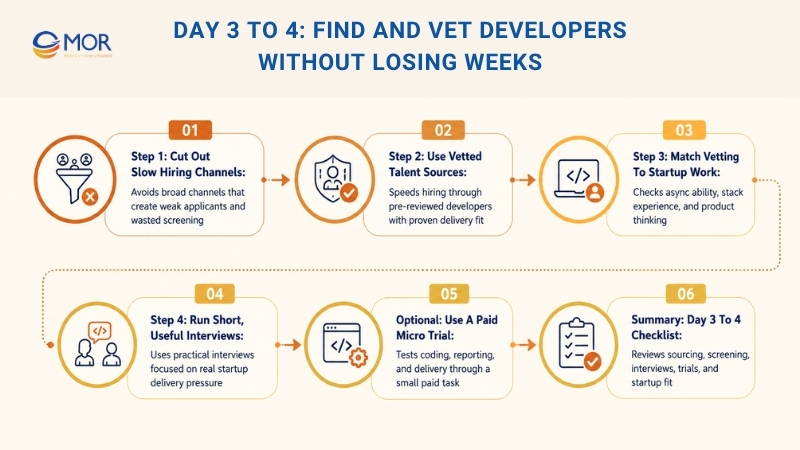
Step 1: Cut Out Slow Hiring Channels
You may feel tempted to:
- Post on broad job boards
- Ask around in a few Slack groups.
- Spend hours browsing freelance sites.
Don’t.
These paths often bring:
- Large numbers of weak applicants
- Freelancers who disappear after one sprint
- Wasted time screening people who do not fit your stack or startup pace
Instead of digging through noise, you should close the trust gap faster.
Step 2: Use Vetted Talent Sources
This is where MOR Software becomes useful for startup teams.
Rather than posting and waiting, MOR Software can help you access developers who have already been reviewed for skills, work habits, and delivery fit.
These engineers are not just names on a profile. The right vetting process should check:
- Practical coding ability
- Team work on real projects
- Clear communication
- Agile thinking and ownership
Strong numbers should be easy to prove:
- Developer pool size and skill coverage
- Past startup or product delivery work
- Return client rate or long-term client data
- Average time needed to form the first team
That means you spend less time sorting profiles and more time starting work.
This is a cleaner way to build a tech team without guessing, because the screening work happens before the final interview.
Step 3: Match Vetting To Startup Work
Speed still needs quality. No matter which hiring path you use, make sure the developer:
- Can work in your time zone or handle async work well
- Has real experience with your stack, not just keywords on a CV
- Thinks about the product, not only the code
MOR Software engineers can support startup-style work, including MVP builds, founder communication, and short delivery cycles.
A trial period can help you check fit before a longer commitment.
Step 4: Run Short, Useful Interviews
Do not run interviews like a large tech company. You are not filling a seat at Google. You need people who can ship under startup pressure.
Keep interviews:
- Focused, around 30 to 45 minutes
- Practical, with questions about recent work, trade-offs, and bugs
- Future-facing, so you can test interest in the product
Ask questions like:
- “How do you handle MVP builds when the deadline is tight?”
- “Tell me about a release that failed. What did you do after that?”
Good developers will not only answer well. They will ask smart questions too. That is a good sign.
Optional: Use A Paid Micro Trial
You can add one more check with a small paid task:
- Run a paid 3-day build sprint
- Give one real component or product task
- Watch how they code, report, and deliver
MOR Software can support trial-style starts with clear onboarding, defined outputs, and less awkward back-and-forth.
Summary: Day 3 To 4 Checklist
- Avoid slow, broad hiring channels
- Use vetted talent networks when speed matters
- Screen for startup fit, not just CV keywords
- Keep interviews tied to real product work
- Use a trial task if you need one more proof point
If you have followed the plan so far, you now know how to form the team without chaos. The right partner can help you move faster while still checking quality.
Day 5: Onboard The Team Fast Without Creating Confusion
You have found and chosen your developers. Now the job is to help them start well.
Onboarding is often rushed, yet it sets the base for speed, quality, and team trust when building a remote tech team.
A good onboarding flow does not need weeks. It needs clear materials, simple systems, and real intent. If you want your team to ship in days, not months, this is the next move.
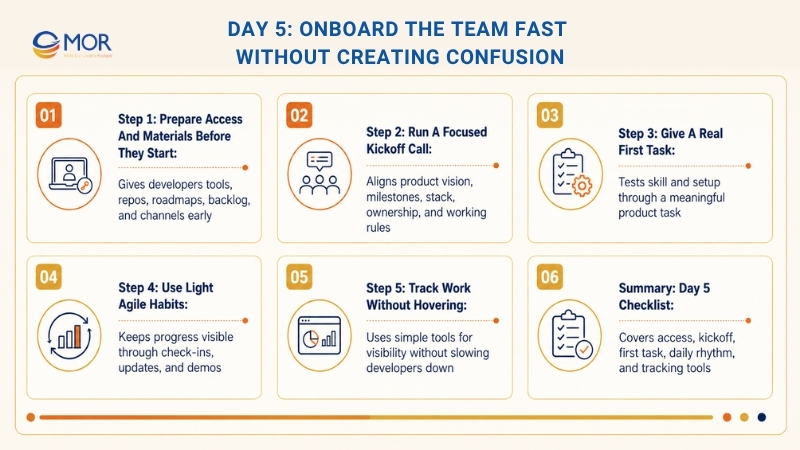
Step 1: Prepare Access And Materials Before They Start
Before Day 5 starts, get these items ready:
- GitHub/GitLab access
- Development setup, including Docker files, repo README, and API keys if needed
- Product roadmap, even a simple one
- Backlog with clear first tasks or product items
- Communication channels, such as Slack, Notion, and Linear
If you work with MOR Software, developers can receive project background before the start date, so they join with less confusion.
Step 2: Run A Focused Kickoff Call
Do not skip this call. Your first 30-minute kickoff should:
- Restate the product vision and goals
- Cover near-term milestones, such as 7 days and 30 days
- Show the stack, current status, and where help is needed
- Explain ownership and working rules
Small Tip: Ask the developer what they need from you to work well. Strong developers usually know their best working style, so listen.
Step 3: Give A Real First Task
Avoid the “fix one tiny bug” habit. A better first task should:
- Be a real product feature or useful improvement
- Stay small enough for 2 to 3 days
- Have a clear meaning of “done,” such as deployed, tested, and ready to demo
Example: “Build a working Stripe test payment flow through our API.” This lets you check skill, setup, and output at the same time.
MOR Software developers are used to short sprints and production-level delivery. They should not spend the first week only reading docs. They should start building.
Step 4: Use Light Agile Habits
You do not need full Scrum, but you do need a light rhythm:
- Daily 10-minute check-in through Slack or a quick call
- End-of-day updates or short Loom videos
- End-of-week demo or release target
This rhythm lowers hand-holding and keeps progress visible, which matters when the product timeline is tight.
MOR Software teams often work with async tools, feedback cycles, and product-focused delivery habits.
Step 5: Track Work Without Hovering
Use simple tools like:
- Trello, ClickUp, Linear, or Notion for task tracking
- Slack plus Loom for async updates
- GitHub for pull request reviews
Trust helps. Clear systems help more.
With simple docs and visible progress, even a 2-person startup team can run with strong control.
Summary: Day 5 Checklist
- Prepare access, repos, and task boards early
- Hold a kickoff call with roadmap and working rules
- Assign a real product task, not filler work
- Set light habits for daily updates
- Track work with async-friendly tools
Onboarding is not a welcome tour. It is activation. Startups that gain pace early are the ones that turn new hires into real contributors fast.
If you want a fast team without messy handoffs, MOR Software can provide prepared, product-minded developers who can start with less ramp-up time.
Day 6 To 7: Manage The First Sprint And Ship Something Real
At this point, the hard setup work is done. You have planned the product, found the right people, and started onboarding. The last two days are not about adding more headcount. They are about turning early effort into visible output.
If you care about how to build a tech team that ships, this part shows what kind of leader you are.
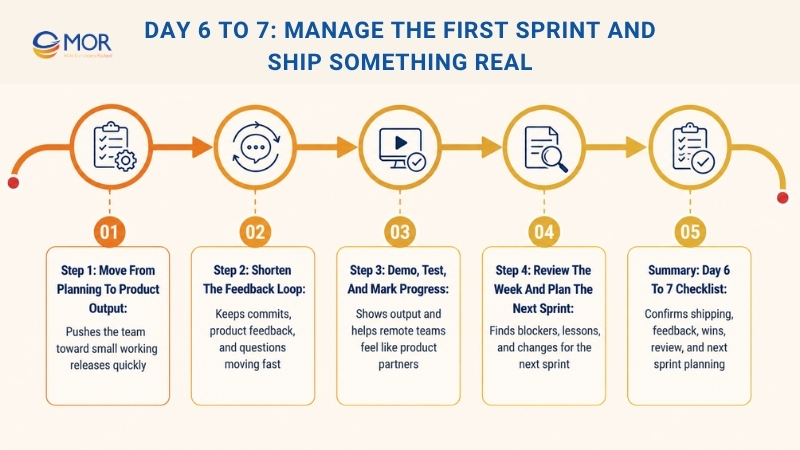
Step 1: Move From Planning To Product Output
Drop the mindset of “we are still figuring it out.” Even with 2 to 3 developers, your job now is to:
- Set small goals, such as a basic login flow, a working feature flag, or a live staging build
- Choose speed before polish
- Release something, even if it is only internal
This move from planning to product work changes team behavior. People stop waiting for perfect detail and start owning delivery.
Practical Note: A working internal demo or staging link still counts as a launch. Ship something usable, even if it is lean.
Step 2: Shorten The Feedback Loop
If the earlier steps worked, your developers are now shipping pieces of the product. Your job is to:
- Review each commit or pull request within 12 to 24 hours
- Give clear product feedback, not just line edits
- Welcome questions that show deeper product thinking
Use Loom videos, async voice notes, and Figma comments to keep feedback easy.
This is where a trained team from MOR Software helps. You spend less time explaining the basics and more time shaping the product.
Step 3: Demo, Test, And Mark Progress
No matter if you are building a fintech MVP, marketplace, or SaaS admin panel, create a habit of showing output.
At the end of Day 7, your goals should include:
- A feature or prototype that can be demoed
- A short written note on what is now live
- A shared view of the next step
Mark the win. Send a short team message. Share a Loom walkthrough. Small habits like this help remote teams bond and make developers feel like product partners, not hired hands.
Step 4: Review The Week And Plan The Next Sprint
Good founders do more than build. They learn how to repeat what worked.
Set aside 30 minutes with the development team and ask:
- What worked well this week?
- What slowed us down?
- What should change in the next sprint?
Most startups do not reflect this early. But this habit gives you a real advantage.
With MOR Software, this review can become part of the working rhythm. Developers are used to sprint reviews, async notes, and feedback-led improvement.
Summary: Day 6 To 7 Checklist
- Ship something working, even if it is small
- Focus on learning speed, not full scope
- Keep feedback fast and clear
- Recognize small wins
- Review the sprint and plan the next one
Choosing The Right Hiring Model For Your Startup
When you are building or growing a product, one moment always comes up: you need a team. This is also where many founders make choices that look smart at first, but later become expensive. Knowing how to build a tech team means knowing which model fits your stage.
No single team model works for every startup.
One model gives you control, but it may slow hiring. Another gives you speed, but quality can suffer. Another looks cheap at the start, then becomes costly because the work is scattered.
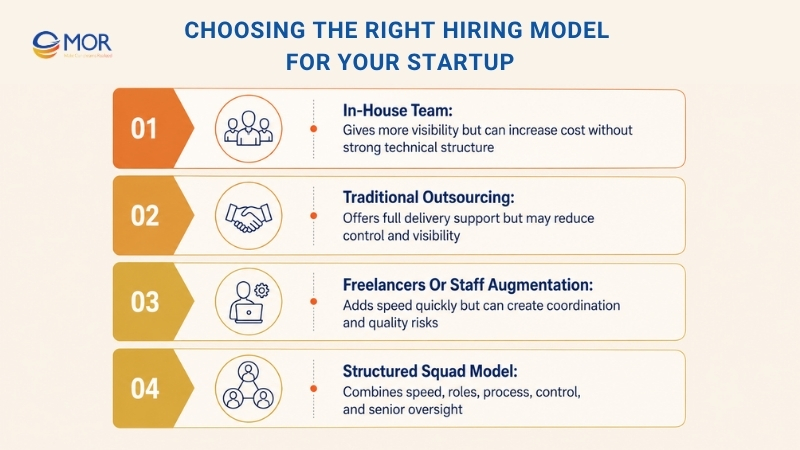
A useful case comes from a digital health startup that wanted to launch a system for medical representatives. It first hired a development vendor, but after months of slow progress, it ended the contract because the product was barely moving. Then it tried two freelancers and got a basic working version, but every new improvement meant redoing parts of the system because there was no long-term structure. After that, it built an internal team, which pushed costs up without fixing the real problems: weak structure, poor processes, and no strong technical lead. The result was painful. The startup burned through its budget before the product became stable, then stayed “incubated” for more than two years while waiting for funding to escape a problem caused by the wrong team setup, not by weak talent.
The goal is not to pick “the perfect model.” The goal is to pick the model that matches your current stage, budget, and delivery speed.
In 2026, most startups will choose from four main development team models. Understanding the trade-offs helps separate startups that ship real products from those that stay stuck in planning.
Model | Relative Cost | Control | Start Speed | Quality | Scalability |
| In-house | High | High | Slow | Medium | Low |
| Traditional outsourcing | Medium | Low | Slow | Low | Medium |
| Freelancers / Staff Aug | Low | Low | Fast | Low | High |
| Structured squads | Medium | High | Very fast | High | Very high |
In-House Team
For this digital health startup, the move to an internal team came too late and was handled poorly. After testing other routes, the founders hired directly to take back control, but the reality hit fast: long recruitment cycles, slow ramp-up, and no clear technical leadership. While the team was still forming, the product kept moving too slowly, and fixed costs kept rising. Having their own staff gave them better visibility, yes, but it did not fix the deeper issue. They still lacked the method and structure needed to turn people into delivery speed. The result was faster cash burn with no matching gain in product progress.
Traditional Outsourcing
The first choice was to hand all development to an outside company. On paper, it looked simple: one vendor would take care of the full build. In real work, the usual issues appeared: low control, weak visibility, and total dependence on the provider. Each change needed another discussion, each product cycle took longer than planned, and the software moved ahead without a strong link to business needs. When the founders wanted to adjust, months had already gone by. The issue was not outsourcing itself. The issue was outsourcing without a model that gave steady visibility and ongoing control.
Freelancers Or Staff Augmentation
After ending the vendor contract, the startup used freelancers to regain speed. It worked, but only partly. In a few weeks, the team had a first working version, which had not happened before. Then the next problem showed up: poor coordination, little ownership, and uneven quality. Each freelancer handled their own part well, but nobody carried the full product view. Without QA, clear process, or senior technical direction, the system began collecting technical debt fast. What looked quick and cheap became unstable and hard to grow.
Structured Squad Model
This is where a structured squad can change the outcome. Instead of hiring from zero or passing everything to a vendor with little control, you work with a team that already has roles, process, and delivery habits in place. With a strong squad model, you can build tech group capacity fast while keeping ownership visible. In a setup like this, the team can start in days, include vetted engineers, follow a clear hiring and delivery model, and add the missing layer from this case: steady progress checks, technical debt tracking, and senior oversight. It is not only about getting tasks done. It is about getting them done with method. That is what helps startups avoid the same cycle of delays, budget creep, and weak control that kept this company stuck for years.
For startups that need more control than freelancers but cannot yet afford a full internal team, a dedicated offshore team can work as a useful middle path. MOR Software supports this model by helping businesses form dedicated teams with developers, QA, project managers, business analysts, BrSE/Comtor, and other roles based on project needs.
How To Decide Between In-House, Outsourcing, Freelancers, And Squads
Most founders do not fail because they choose the “wrong” model. They fail because they decide before asking the right questions.
The risky part is that most choices feel reasonable when you make them:
- outsource to gain speed
- hire freelancers to save money
- build an in-house team to get control
The problem appears months later, when the situation changes and you realize your model does not match your real needs. This is why knowing how to build a tech team also means knowing when each model breaks.
That is exactly what happened in the case above. It was not one failed hire or one bad vendor. It was a series of choices made without a clear decision method.
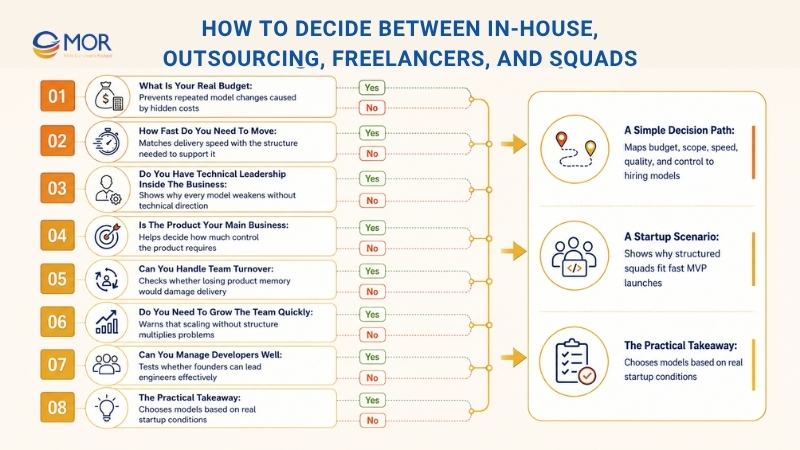
To avoid that loop, answer these 7 questions with full honesty.
What Is Your Real Budget?
In this case, the startup began with outsourcing because it looked like a “controlled” choice, but the founders did not fully calculate the real cost.
When the provider failed to deliver, they moved to freelancers to spend less, then paid twice for the same progress.
After that, they hired an internal team, and fixed costs quickly ate into their runway.
Failing to define the real budget early forced them to keep changing team models.
How Fast Do You Need To Move?
They needed speed, yet they chose traditional outsourcing, where each cycle often takes longer than expected.
When they moved to freelancers, they gained pace, but structure disappeared.
The issue was not only speed. The issue was moving quickly with a clear system behind it.
Do You Have Technical Leadership Inside The Business?
This was one of the biggest gaps.
There was no strong CTO. No technical lead was guiding key choices.
- With outsourcing, they depended on the vendor
- With freelancers, nobody managed the whole product
- With the in-house team, direction was still missing
Without technical leadership, every model gets weaker over time.
Is The Product Your Main Business?
The product they were building was the business itself.
Yet they treated it like work that could be passed outside without close control.
If your product drives the company, you need real control, not only outside delivery.
Can You Handle Team Turnover?
With freelancers, turnover was not only a risk. It came with the model.
People joined and left. Product knowledge vanished. The code became harder to maintain.
If losing product memory would hurt you, choose a more stable setup.
Do You Need To Grow The Team Quickly?
When the startup tried to grow, the system could not support it.
There was no strong architecture, no QA, and no process, so each new feature slowed the product even more.
Growing your product team without structure does not multiply output. It multiplies problems.
Can You Manage Developers Well?
This is the hard question.
Managing engineers is not simple.
In this case, moving to an internal team did not fix the problem because the founders still lacked real management ability.
Having developers does not mean you know how to lead them.
The Practical Takeaway
The real choice is not only between in-house and outsourcing. It is about whether your startup has the conditions needed for that model to work. If you need speed, control, and quality, but you do not yet have the internal strength to manage everything, a well-structured hybrid model can make practical sense.
A Simple Decision Path
- High budget + long-term product vision → in-house team
- Clear project scope → outsourcing
- Short-term task → freelancers
- Speed + quality + control → structured squads
A Startup Scenario
“I need to launch an MVP in 3 months with a limited budget”
- In-house → too slow
- Outsourcing → weak control
- Freelancers → high risk
Best option: a structured squad
Because it brings together:
- speed
- coordination
- quality
What It Costs To Build A Tech Team In 2026
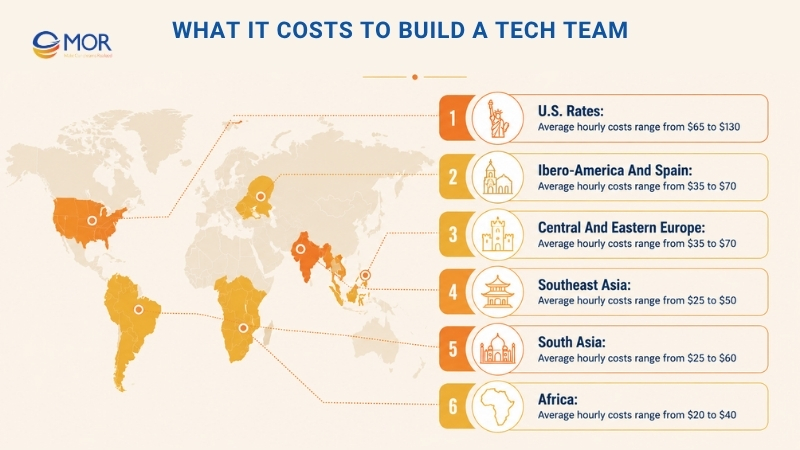
Region | Average Cost Per Hour |
U.S. | $65 – $130 |
Ibero-America & Spain | $35 – $70 |
Central & Eastern Europe | $35 – $70 |
Southeast Asia | $25 – $50 |
South Asia | $25 – $60 |
Africa | $20 – $40 |
Source: Yeeply, Interfell, NCube, DistantJob, UVIK
Estimated savings: 30–50% when hiring remote talent outside the U.S. If you only compare hourly rates, the choice looks easy: U.S. rates often sit between $65 and $130 per hour, while regions like Ibero-America, Central and Eastern Europe, Southeast Asia, South Asia, and Africa can give startups access to experienced talent at lower hourly costs. But this is where many startups misread the cost. The real cost is not only the rate. It is the system around the work. In the digital health case above, the startup tried to save money with outsourcing and freelancers, but there was no structure or oversight. The outcome was clear: repeated work, constant mistakes, team changes, and months of lost time. What looked cheaper became far more expensive.
Real Cost Breakdown From A Startup Case
When we split the timeline, the pattern becomes easier to see:
- External Vendor (6 months)
- Development company with an estimated cost of $25,000–$40,000/month
- Total spend: $150,000–$240,000
- Result: poor visibility, weak control, and little progress.
- Freelance Developers (3 months)
- Two freelancers at $30–$50/hour, working part-time
- Total spend: $15,000–$30,000
- Result: first working version, but no strong base.
- Internal Team (12 months)
- 1 CTO in Spain: $50,000–$60,000/year
- 2 developers in Latin America (AOR): $40,000–$60,000/year each
- Total yearly spend: $130,000–$180,000
- Result: better control, but no major gain in speed or quality.
Total Estimated Spend
Between $295,000 and $450,000 invested
The biggest issue was not the number itself. It was the return:
- unstable product
- growing technical debt
- slow release speed
What The Numbers Really Show
When founders ask how to build a tech team, they often look first at salary. But total cost of ownership (TCO) includes much more:
- tools
- management
- onboarding
- turnover
- errors
- monitoring
In this case, the startup paid more than once for the same progress.
And here is the painful truth: a poorly structured team can cost 2 to 3 times more before you even see the damage.
The Real Cost Is Repeated Work
If you look at the full story, one point keeps showing up: the money did not fail on its own, the setup did. The startup spent about $300K–$450K across different models, but there was no stable structure to protect continuity, quality, and speed. Progress was not straight. It became a loop: build, break, rebuild, then start again.
That is the real hidden cost in development: paying again for work you already paid for.
This is where ROI should be judged through method, not only talent.
If your startup needs a stable team but does not want to manage hiring, payroll, and daily operations alone, a dedicated team partner can help. MOR Software works with clients to define team needs, screen candidates, onboard members, and adjust the team as the project grows.
How To Measure And Improve Team Productivity
To understand how to build a tech team that performs well, you need to track productivity and improve it over time.
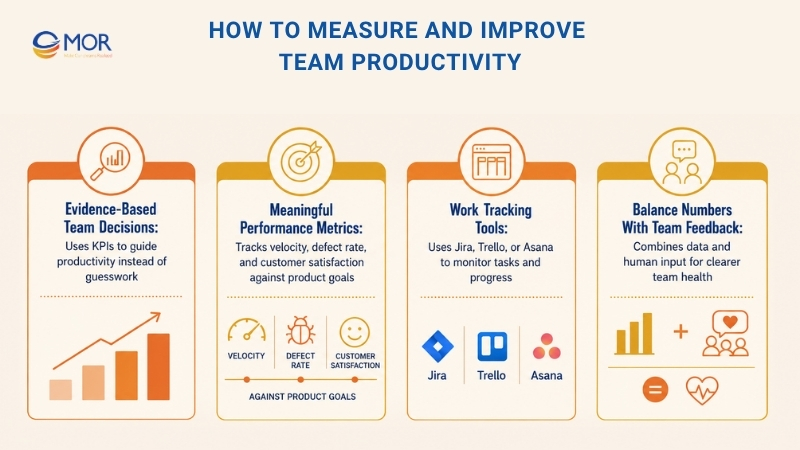
- Evidence-Based Team Decisions: Use data to guide team productivity, not guesswork. Set up tools and dashboards that follow key performance indicators (KPIs) like cycle time, code quality, and release frequency. These numbers show how your team is doing and where changes may be needed.
- Meaningful Performance Metrics: Choose the KPIs that match your product goals and business needs. Common metrics for software teams include velocity, defect rate, and customer satisfaction. Review them often so you can see progress and spot weak points.
- Work Tracking Tools: Use productivity tools that give real-time views of team performance. Platforms like Jira, Trello, or Asana can track tasks, show progress, and keep projects on schedule.
- Balance Numbers With Team Feedback: Quantitative data matters, but human feedback matters too. Ask team members and stakeholders for regular input to understand the full picture. When you combine numbers with real feedback, you get a better view of team health and output.
Common Challenges When Building Tech Teams And How To Fix Them
Growing a startup tech team often looks simple on paper, then gets messy in daily work. Goals shift, developers wait for answers, quality drops, and hiring mistakes start to cost real money. These common problems are fixable when you set clear roles, build simple working habits, and treat the team as a product system, not just a list of hire.
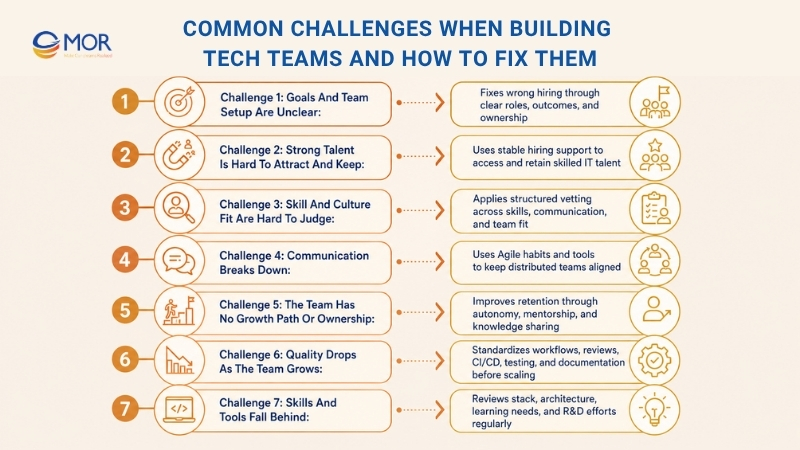
Challenge 1: Goals And Team Setup Are Unclear
Problem:
Without a clear product goal, defined roles, or shared ownership, you may hire the wrong people, overlap duties, or miss skills your product needs.
Solution:
Set your business outcomes, technical direction, and skill needs before recruitment starts. Create a clear team shape with roles, duties, and expectations.
Challenge 2: Strong Talent Is Hard To Attract And Keep
Problem:
The IT hiring market is crowded. Good candidates move fast, and slow hiring or weak onboarding makes it easy to lose them. High turnover creates delays, drains product knowledge, and adds more cost because you keep hiring again.
Solution:
Work with nearshore or offshore partners with a strong hiring record, including teams like MOR Software, that can provide access to skilled IT professionals, structured onboarding, and stable team support. This lets you add senior-level engineers, keep them for as long as needed, and lower the chance of losing key people during the project.
Looking for a technical team that can deliver from the first sprint? MOR Software connects you with skilled engineers in Vietnam to help you form a technical team quickly, with better control and less admin work.
Challenge 3: Skill And Culture Fit Are Hard To Judge
Problem:
A poor hire can become one of the most expensive mistakes a startup makes. People with weak skills or poor team fit slow delivery, create friction, need extra support, and delay releases. This hurts morale and may force you to restart the hiring process.
Solution:
Partners like MOR Software can support structured vetting across technical ability, culture fit, English level, and communication skills. The process should match your ideal candidate profile, so you only meet people who are close to what your team needs.
Challenge 4: Communication Breaks Down
Problem:
When the team does not sync in a clear way, decisions slow down, work gets repeated, and priorities become messy. Blockers stay hidden, development pace drops, and product quality suffers.
Solution:
Use Agile habits like standups, planning, demos, and retrospectives, then support them with tools like Jira, Slack, and GitHub Projects. Regular check-ins keep priorities clear, speed up decisions, and keep the squad aligned.
Nearshore and offshore work can still support close collaboration when the setup is clear. Overlapping work hours, direct communication channels, and fast feedback loops make distributed teamwork smoother than many founders expect.
Challenge 5: The Team Has No Growth Path Or Ownership
Problem:
When engineers see no growth path, have little autonomy, or do work that feels meaningless, performance drops and turnover risk rises.
Solution:
Set clear career paths, provide mentorship, and create regular knowledge-sharing sessions.
Give engineers space to make decisions, then recognize their work in simple, visible ways. This helps raise engagement, output, and long-term loyalty.
Even if your company is not fully tech-focused, a dedicated team partner can place engineers inside a stronger technical environment with modern practices, shared standards, and experienced peers. This supports the team and lowers the risk of losing motivated people.
Want to build your own tech team without spending 6+ months on hiring? MOR Software helps you set up your own tech team with vetted engineers, faster onboarding, and stable delivery support.
Challenge 6: Quality Drops As The Team Grows
Problem:
When technical units grow too fast without proper systems, quality often drops. Bugs appear, speed falls, and the product becomes harder to maintain.
Solution:
Standardize workflows before you add more people. Set code review rules, define CI/CD practices, outline testing needs, and create documentation standards. Check that core metrics like delivery speed, code quality, bug count, and team health are stable before scaling.
A partner aligned with your process, like MOR Software, can help you grow more safely because new engineers join an existing structure instead of creating their own working habits from scratch.
Challenge 7: Skills And Tools Fall Behind
Problem:
When technology changes faster than your team can adapt, old skills and outdated processes slow the whole company. Delivery becomes slower, development becomes unstable, and the product struggles to match user expectations.
Solution:
Run regular reviews to check whether your stack, architecture, and process still fit the product. Support staff learning through courses, conferences, certifications, and internal workshops. Add new roles when needed and create small R&D groups to test new technologies without putting the main product at risk.
Create cross-functional squads that bring product, design, and engineering together, so teams can solve problems from end to end and move faster.
Startup Hiring Mistakes To Avoid When You Build A Tech Team
Every hiring process has rough spots, but cash-limited startups feel those mistakes much faster. If you want to build a tech company, poor hiring choices can slow the whole business.
These are common startup hiring mistakes and ways to avoid them.
Common Hiring Mistake | How To Avoid It |
Hiring for titles | Focus on people with the skills and product mindset your startup needs, not only a job title |
Overvaluing generalists | Even broad-skill team members still need clear roles and expectations |
Poor communication | Share long-term product goals clearly so the team stays aligned beyond short-term tasks |
Micromanaging | When people understand the vision, you can trust them to work toward it |
Over-reliance on AI | AI cannot fully replace people, but it can lower cost and raise output when humans guide the work |
Need Help Building A Tech Team Without Starting From Zero?
Building a tech team needs more than a few developers on a call. You need the right roles, clear ownership, steady delivery habits, and people who understand your product goals. MOR Software helps businesses move faster with dedicated tech teams that match their roadmap, budget, and way of working.
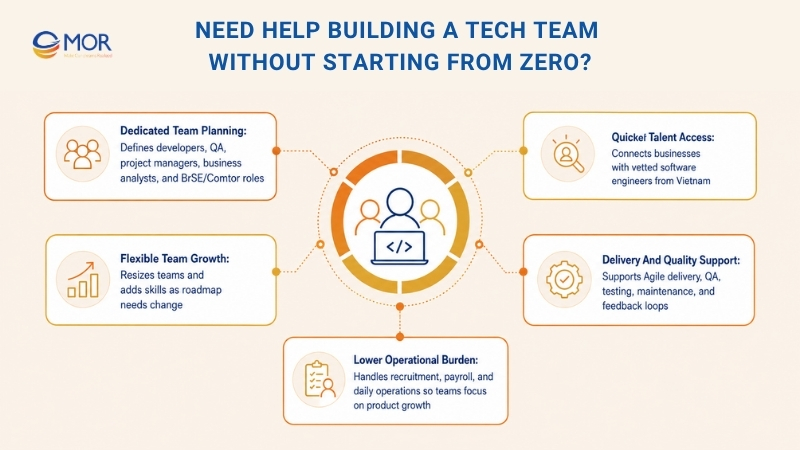
- Dedicated Team Planning: MOR Software helps you define the roles your product needs, including developers, QA teams, project managers, business analysts, and BrSE/Comtor members. This gives the team a clear shape before development starts.
- Quicker Talent Access: Instead of managing every hiring step alone, you can work with vetted software outsourcing engineers from Vietnam. This is useful when you want to build tech team in Vietnam with speed, stability, and strong delivery control.
- Flexible Team Growth: Product needs often change after the MVP stage. MOR Software can help you resize the team, add new skills, or increase delivery capacity as the roadmap grows.
- Delivery And Quality Support: A product team needs more than code. MOR Software can support planning, Agile delivery, QA, testing, maintenance, feedback loops, and building a technical support team when your product needs post-launch care.
- Lower Operational Burden: Recruitment automation, payroll, and daily team operations take time. MOR Software handles much of that work so your business can stay focused on product direction, users, and growth.
Conclusion
Learning how to build a tech team starts with clear scope, practical roles, and a hiring model that fits your runway. A good team does more than write code. It protects product direction, delivery speed, and long-term quality. MOR Software helps startups form dedicated tech teams with developers, QA engineers, project managers, and other key roles. To build your team without starting from zero, contact us today.
MOR SOFTWARE
Frequently Asked Questions (FAQs)
What is the first step in learning how to build a tech team?
Start with your product goal. Define what you need to ship in the next 3 to 6 months, then list the roles needed to build, test, and maintain it.
How to build a tech team for a startup with a small budget?
Begin with a lean setup. A full-stack developer, UI/UX designer, and part-time QA support may be enough for an MVP. Add more roles only when the product grows.
Which roles should a startup tech team hire first?
Most startups need a technical lead or senior developer first. After that, add frontend, backend, QA, DevOps, and product roles based on the roadmap.
Should I hire in-house developers or outsource the team?
Choose in-house when you need long-term product control. Choose outsourcing when you need speed, wider talent access, or fewer hiring tasks during the early stage.
How many developers does a startup need for an MVP?
Many MVPs can start with 1 to 3 developers. The right number depends on product scope, deadline, tech stack, and how much testing or design work is needed.
How To Build A Tech Team without a technical co-founder?
Work with a senior technical advisor, fractional CTO, or experienced development partner. They can help review architecture, vet developers, and avoid poor technical choices.
What skills matter most in an early tech team?
Look for problem-solving, clear communication, product thinking, and ownership. Strong coding skill matters, but early teams also need people who can make smart trade-offs.
What mistakes should founders avoid when hiring developers?
Avoid hiring only junior developers, skipping technical vetting, writing vague job specs, or adding people before the product scope is clear. These mistakes burn time fast.
How To Build A Tech Team that can scale later?
Set clear roles, coding standards, QA habits, documentation, and release processes early. A messy MVP may launch fast, but it becomes painful when the team grows.
When should a startup add QA and DevOps roles?
Add QA when bugs start slowing releases or harming users. Add DevOps when deployment, cloud setup, monitoring, or infrastructure work takes too much developer time.
Share


Make Our-Dreams Realized


© 2023 . MOR Software. All Rights Reserved
Sitemap
Privacy Policy
Terms of Use

Rate this article
0
over 5.0 based on 0 reviews
Your rating on this news:
Name
*Email
*Write your comment
*Send your comment
1