


Recruitment Automation: Complete Business Guide for 2026
Hiring teams often lose valuable time on repetitive tasks like resume screening, interview scheduling, and candidate follow-ups. Recruitment automation helps reduce this workload through automated recruiting workflows and smarter hiring tools that keep the process organized and efficient. In this guide, MOR Software will explain how automation in recruitment works and how the right systems can transform the way companies attract and hire talent.
What Is Recruitment Automation?
Recruitment automation describes the use of digital technology to simplify and organize the talent acquisition process. Through tools powered by Artificial Intelligence (AI), Machine Learning (ML), and other software systems, HR teams can manage hiring activities in a more structured, consistent, and data-supported way. This broader concept of automation in recruitment helps companies handle hiring tasks with greater speed and accuracy.
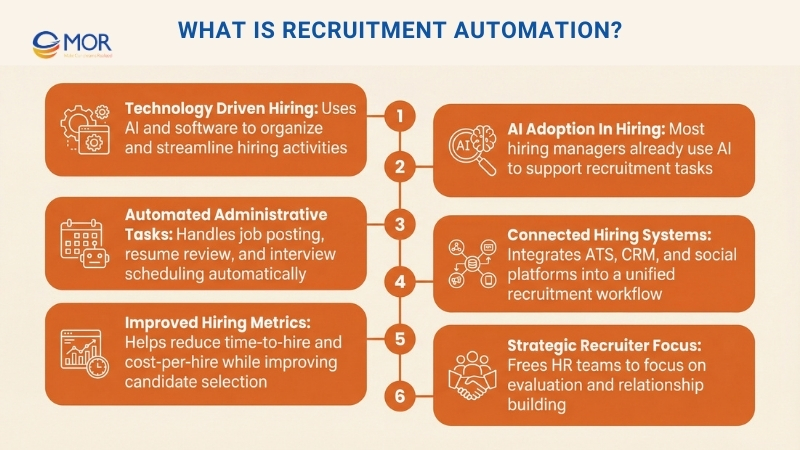
The adoption of AI within hiring is already very common. One study found that 99% of hiring managers reported using AI at some point during recruitment. Automated systems can take care of many routine administrative duties that normally consume recruiter time. These tasks include publishing job listings, reviewing resumes, arranging interview schedules, and similar operational work. New technologies are also appearing that assist with more complex hiring decisions and workflow coordination.
These platforms often connect smoothly with Applicant Tracking Systems, recruitment CRM solutions, and social media channels to create a more connected hiring environment. When organizations implement modern recruitment automation tools, they remove many repetitive manual steps. This allows human resources teams and hiring managers to concentrate on strategic activities that require thoughtful human evaluation. When used correctly, this technology can improve hiring metrics such as time-to-hire and cost-per-hire while helping organizations secure stronger candidates.
Types Of Recruitment Automation
Different software solutions support different stages of the hiring journey. These systems form the foundation of modern recruitment automation, helping organizations manage hiring activities more efficiently. Many companies rely on recruiting automation technology to coordinate tasks that once required significant manual effort. The following categories represent some of the most widely used hiring solutions built around recruiting workflow automation.
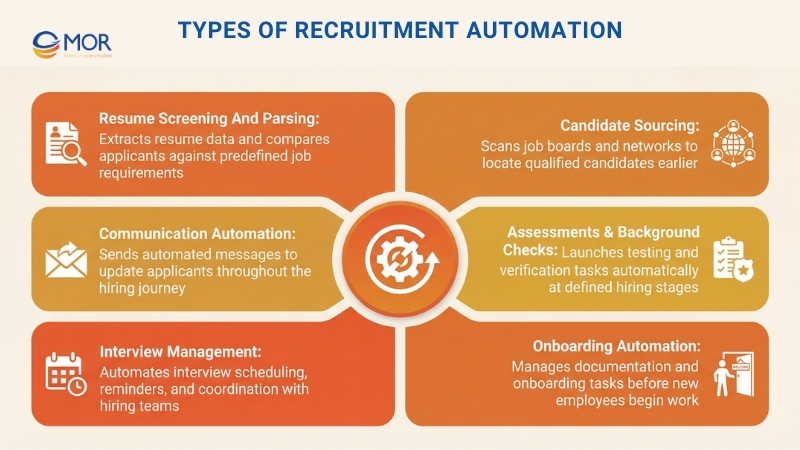
- Resume Screening And Parsing: These platforms review candidate applications against predefined job criteria. They extract important details from resumes and organize them into structured profiles so recruiters can compare candidates easily. Some systems can examine hundreds of resumes within minutes, highlighting strong applicants your team might otherwise overlook in a large applicant pool.
- Candidate Sourcing: Automated sourcing platforms scan job boards, social networks, and professional communities to locate potential applicants. These automated sourcing tools help you expand your talent pipeline ahead of future hiring needs. They also allow recruiters to identify qualified professionals earlier and prepare for upcoming recruitment demands.
- Communication Automation: Automated messaging workflows keep candidates informed throughout the hiring journey. Email sequences confirm application submissions, share updates about hiring status, and send rejection notifications when necessary. Reliable communication supports your employer reputation even when you decide not to move forward with a candidate.
- Assessments & Background Checks: These systems connect candidate testing and verification tasks directly to the hiring workflow. Recruiters can launch skills assessments, reference checks, or compliance reviews automatically when a candidate reaches a defined stage in the process. This approach reduces manual coordination and allows hiring teams to reach decisions faster.
- Interview Management: Coordinating interviews between multiple stakeholders can slow the hiring timeline. Interview management platforms simplify this process through automated scheduling, interviewer calendar coordination, and reminders sent to both applicants and hiring managers. Structured interview workflows also allow teams to gather feedback more quickly and maintain consistent evaluation standards.
- Onboarding Automation: After you extend a job offer, automated onboarding workflows manage documentation, benefits registration, and related administrative steps. New employees can complete required tasks before their official start date, helping them become productive sooner.
Key Benefits Of Recruitment Automation
Recruitment automation does more than accelerate hiring activities. It also changes the way HR teams operate every day. When repetitive administrative work moves to automated hiring systems, recruiters gain more time for valuable human tasks such as relationship building and improving candidate engagement. This technology also helps organizations move quickly while maintaining hiring quality and making more informed decisions through reliable data.
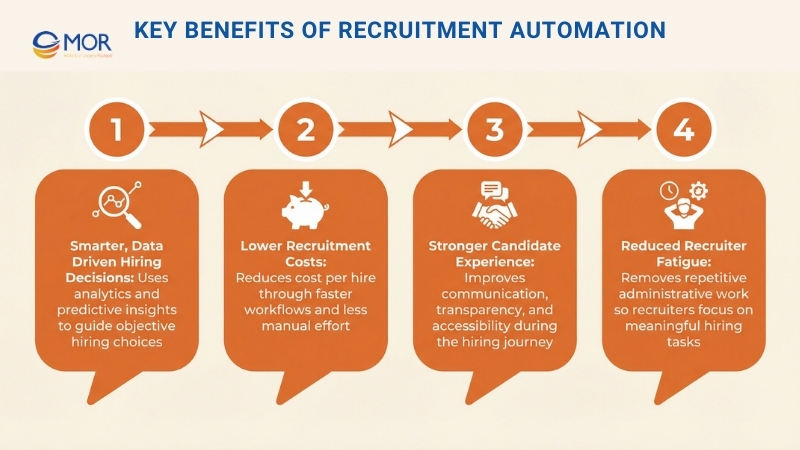
Smarter, Data-Driven Hiring Decisions
Recruitment automation allows hiring teams to access insights that manual recruitment processes often miss. These analytics help organizations base hiring choices on clear data rather than intuition. Through automated recruiting technology that monitors the full hiring funnel, HR teams can better understand several important areas:
- Source effectiveness: Recognizing which hiring channels produce the strongest candidates
- Quality metrics: Tracking how applicants from different sources perform after they join the company
- Conversion patterns: Identifying the stages where candidates leave the hiring pipeline
More advanced hiring platforms can also forecast candidate success using patterns from previous hires. This predictive capability allows recruiters to prioritize the applicants who show the greatest potential within their talent pipeline.
Data-based hiring methods also help reduce unconscious bias during the recruitment process. When organizations apply consistent evaluation criteria through automated recruiting systems, candidates are assessed based on relevant qualifications instead of personal impressions.
Lower Recruitment Costs
Recruitment platforms generate meaningful cost savings when they simplify the most time-consuming hiring activities. Recruitment process automation removes many repetitive tasks from recruiters’ daily workload. As teams spend less time handling manual work, the cost-per-hire decreases and recruiters can dedicate more attention to engaging with strong candidates rather than filtering through unsuitable applications. Organizations can also depend less on external recruitment agencies. Built-in candidate sourcing tools allow internal teams to locate qualified applicants without paying agency commissions.
Shorter hiring cycles also contribute to additional financial benefits. Each day that an open position remains vacant represents lost productivity for the organization. Automated hiring workflows reduce that delay through faster resume screening, interview coordination, and candidate communication. This efficiency helps companies fill important roles sooner and maintain steady business operations.
Stronger Candidate Experience
Today’s applicants expect a hiring journey that is clear, responsive, and transparent. Research shows that nearly half of job seekers may reject a job opportunity if the hiring experience does not meet their expectations.
Automated hiring solutions help companies deliver that level of experience without overwhelming HR teams. Recruiters can rely on recruitment management systems and modern candidate experience software to automate communication and keep applicants informed throughout each stage. Candidates no longer wonder whether their application disappeared. These systems provide timely updates and feedback that maintain trust in the hiring process.
Mobile-ready application systems also play an important role. Modern hiring technology allows candidates to apply from smartphones, tablets, or computers within minutes. This accessibility often improves application completion rates because the process becomes easier and faster.
Automation also supports personalized communication at scale. Recruiters can tailor messages according to a candidate’s background, interests, and current position in the hiring pipeline. Even though technology manages the process, the experience still feels personal and human.
Reduced Recruiter Fatigue
Recruiters bring enthusiasm, judgment, and strong communication skills to the hiring process. Yet many of them spend large portions of their day handling repetitive administrative tasks that reduce their focus and energy. Recruitment automation removes much of that pressure by managing routine work behind the scenes.
When recruiters deal with fewer forms, spreadsheets, and scheduling tasks, they can dedicate their attention to work that truly matters:
- Building meaningful relationships with potential hires
- Developing long-term talent acquisition strategies
- Supporting the business as trusted hiring advisors
When recruiting professionals spend more time applying their expertise rather than chasing paperwork, they often feel more motivated and productive. Their work becomes more meaningful, and the overall hiring process becomes stronger.
When To Introduce Recruitment Automation Into Your Hiring Process
You may not need a complete recruitment automation setup right away. Yet if your hiring team feels stretched or slowed down, several warning signs may suggest that automated recruitment could deliver meaningful improvements.
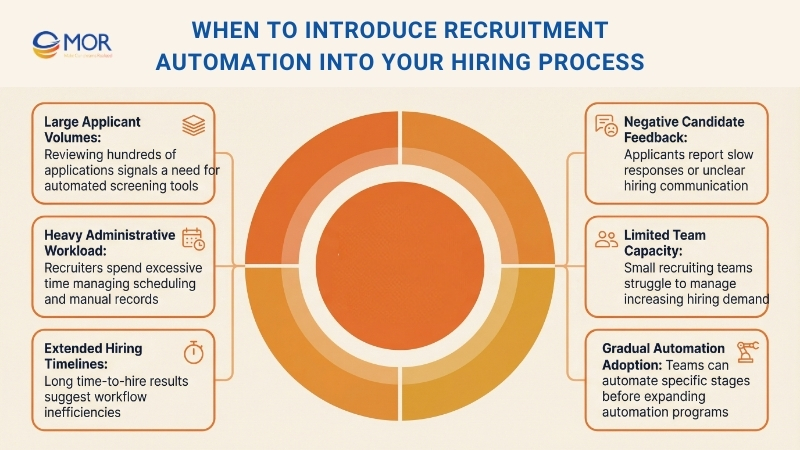
- Large applicant volumes: You often review hundreds of job applications for a single open position
- Heavy administrative workload: Recruiters spend more time arranging interviews and updating spreadsheets than interacting with candidates
- Extended hiring timelines: Your time-to-hire and time-to-fill results regularly fall behind industry benchmarks
- Negative candidate feedback: Applicants report slow replies or unclear guidance about the next stage
- Limited team capacity with growing demand: Your recruiting staff handles many open roles at the same time and struggles to keep pace
If several of these situations sound familiar, your hiring operation may gain real value from automated hiring solutions. Begin with the stages that consume the most time or create the most delays. Interview coordination, resume screening, and candidate follow-ups are common areas where hiring workflow automation can reduce pressure.
Automation does not require a full transformation from day one. Many HR teams introduce one automated recruiting workflow first and expand once they see measurable improvements. The right platforms increase efficiency while keeping the hiring process personal. They allow recruiters to focus on what matters most: identifying strong talent and building genuine relationships with future employees.
Where Recruitment Automation Delivers The Most Value
Recruitment automation can improve almost every stage of the hiring journey. Knowing where to apply automated hiring solutions allows you to gain the greatest benefit from these tools while still preserving the human judgment that strong hiring requires.
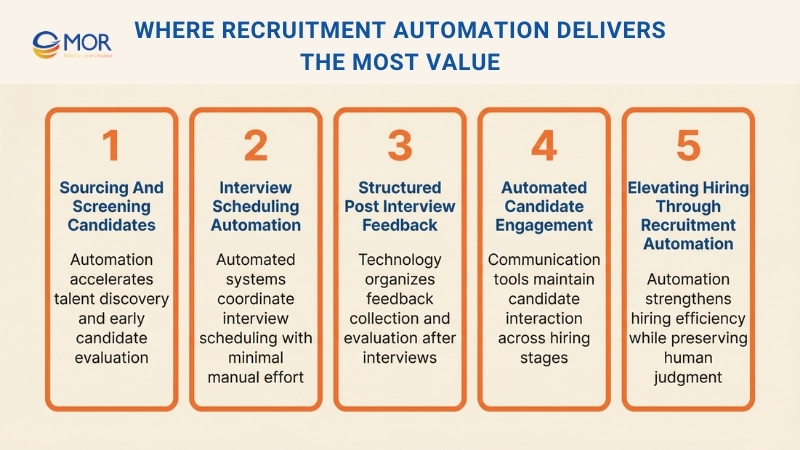
Sourcing And Screening Candidates
Automation reshapes the way hiring teams discover and assess potential applicants. Job description optimization tools, for example, increase the effectiveness of job postings through language suggestions that attract qualified and diverse candidates. These platforms examine successful job listings and recommend wording adjustments that help your roles reach a broader audience.
Resume parsing technology also pulls candidate details from applications and organizes them into consistent formats that make comparison easier. This process removes the need for manual data entry and produces standardized candidate profiles for evaluation. Once candidate data becomes structured, automated pre-screening assessments can evaluate qualifications before a recruiter reviews the application. These may include:
- Skills tests designed to match specific job requirements
- Role-based scenario questions that evaluate practical knowledge
- Verification of basic qualifications
These solutions help HR teams move faster and make informed hiring decisions with confidence. At the same time, efficiency should not reduce fairness. Human oversight remains necessary. Regular reviews of evaluation criteria and hiring outcomes help ensure technology supports inclusive and unbiased hiring practices.
Interview Scheduling Automation
The repeated back-and-forth involved in arranging interviews often consumes valuable time for both recruiters and candidates. Automation in hiring removes much of this administrative work through several practical capabilities.
- Integrated calendar visibility enables scheduling platforms to view the availability of multiple interviewers and suggest meeting times automatically. This removes the need for manual calendar checks and reduces delays during the scheduling process.
- Candidate self-booking options allow applicants to choose interview slots that match their own schedule. This approach gives candidates greater control and eliminates long email exchanges that often occur with traditional scheduling.
- Automated meeting reminders reduce the number of missed interviews through timely notifications sent to every participant. These systems can send reminders at planned intervals before each scheduled session.
When hiring processes involve several interviewers, automation tools can also coordinate panel discussions. They identify time slots that work for everyone involved. This capability becomes especially helpful for senior roles that require feedback from multiple stakeholders.
Structured Post-Interview Feedback
Gathering input after interviews often becomes difficult. Interviewers may have busy schedules, follow different evaluation styles, and lack a shared system for assessing applicants. When the process lacks structure, valuable insights may arrive late or disappear entirely. This slows hiring decisions and creates a frustrating experience for everyone involved.
HR teams can simplify this stage through clear and repeatable evaluation steps after each interview, including:
- Consistent evaluation templates: Ensure every interviewer reviews candidates using the same criteria. These templates can reach interviewers automatically right after each interview, improving response rates and keeping evaluations aligned.
- Automated evaluation scoring tools: Convert qualitative interview feedback into measurable scores, which makes it easier to compare candidates fairly. These systems can assign different weight levels to each evaluation factor depending on the role.
- Side-by-side candidate comparison tools: Allow hiring teams to review applicants across several criteria at the same time. Visual comparisons make it easier to recognize strengths and weaknesses than relying only on written notes.
- Hiring decision support systems: Combine feedback from multiple interviewers to highlight areas of agreement or differing opinions. This helps teams reach decisions faster because discussions focus on the points where opinions vary.
Automated Candidate Engagement
Communication throughout the hiring journey can strongly influence the candidate experience. It also affects your ability to attract and secure high-quality talent. Yet maintaining contact manually at every stage is difficult for busy recruiters.
Automation helps solve this challenge. Recruitment marketing automation tools can send structured email sequences that keep candidates informed, clarify expectations, and reduce uncertainty without increasing recruiter workload. These messages can adjust to the applicant’s background, the job role, and their position within the hiring pipeline.
HR teams can also rely on chatbots to answer common candidate questions instantly at any time. These tools may explain details about the role, provide updates about the hiring process, or share personalized information based on each candidate’s interests. Examples include:
- Daily work insights for specific positions
- Information about company values and mission
- Details about benefits and employee perks
- Guidance on upcoming steps so candidates can prepare for interviews or assessments
Clear and accessible information reduces repeated questions for recruiters and keeps candidates engaged throughout the hiring process.
Elevating Hiring Through Recruitment Automation
Recruitment automation helps make the hiring process smoother and more efficient for HR teams, recruiters, and candidates. When automated hiring solutions manage repetitive administrative tasks, your team gains more time to focus on what truly matters: forming meaningful relationships and making careful hiring decisions.
The future of hiring focuses on strengthening people rather than replacing them. With the right automated hiring tools in place, your team receives the time, insight, and confidence needed to identify strong candidates faster and deliver a hiring experience that reflects your organization’s values.
Key Technologies Behind Recruitment Automation
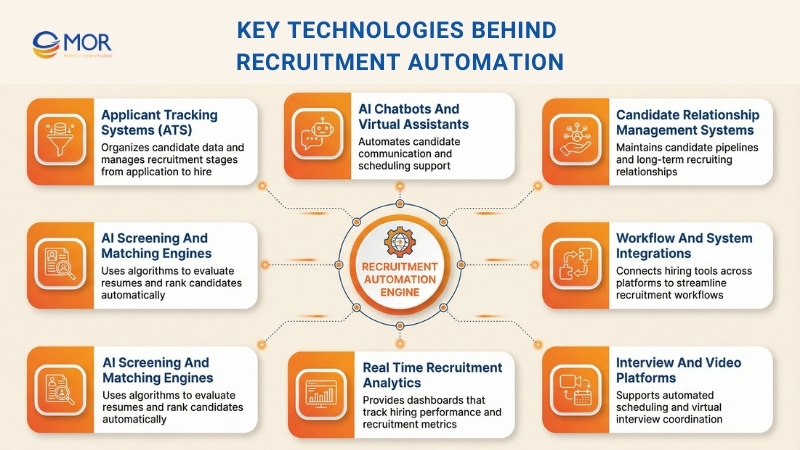
Several essential technologies support modern hiring systems and enable efficient recruitment automation. These tools work together within a recruitment automation platform to simplify recruiting activities, organize candidate information, and support better hiring decisions.
Applicant Tracking Systems (ATS)
Applicant Tracking Systems (ATS) organize candidate records and monitor each stage of the hiring journey, starting from the initial application and continuing through interviews until the final hiring decision. These platforms also connect with automation tools such as resume parsing systems, interview scheduling software, workflow triggers, and analytics dashboards that support hiring workflow automation.
AI Chatbots And Virtual Assistants
AI-powered assistants and chatbots help respond to candidate questions, provide instant updates about application status, and interact with potential applicants throughout the recruitment process. These tools can also engage passive candidates, coordinate interview scheduling, and support continuous communication during the hiring journey.
Candidate Relationship Management Systems
Candidate relationship management systems (CRMs) help hiring teams maintain organized candidate pipelines and build long-term relationships with potential applicants. Recruitment-focused CRMs support activities such as sourcing talent, managing referrals, and tracking individuals who may be strong candidates for future opportunities.
Workflow And System Integrations
Many automated hiring tools connect directly with platforms such as job boards, LinkedIn, social media channels, Applicant Tracking Systems, recruitment CRMs, video interview platforms, and HRIS or onboarding systems. These connections improve hiring workflow automation because they remove manual handoffs between different tools and platforms. Integrated systems also create a unified environment where separate recruiting steps operate together more efficiently.
Interview And Video Platforms
Interview scheduling tools connect with the calendars of hiring managers, recruiters, and candidates so the system can coordinate meeting times automatically. Video interview platforms support both live and recorded sessions, which helps automate several stages of the interview process and reduces scheduling challenges.
Real-Time Recruitment Analytics
Analytics dashboards and reporting platforms give recruitment teams clear visibility into hiring performance. These tools track information such as workflow efficiency, process delays, candidate sourcing results, time-to-hire, cost-per-hire, quality of hire, candidate satisfaction, and drop-off rates throughout the pipeline. Automation helps gather, process, and display these metrics, allowing teams to identify overlooked sourcing opportunities or reduce the time spent on repetitive hiring tasks.
AI Screening And Matching Engines
Advanced AI-powered algorithms can review resumes, evaluate candidate skills, and compare applicant profiles with job descriptions. These systems may also score applicants automatically so recruiters can shortlist the most suitable candidates more efficiently.
How To Successfully Implement Recruitment Automation
Recruitment automation plays an important role in modern HR operations. It saves time, lowers operational costs, and shifts talent acquisition away from routine administrative work toward more strategic responsibilities. When recruiters handle fewer manual tasks, they can spend more time building talent pipelines, strengthening employer branding, and developing meaningful relationships with strong candidates.
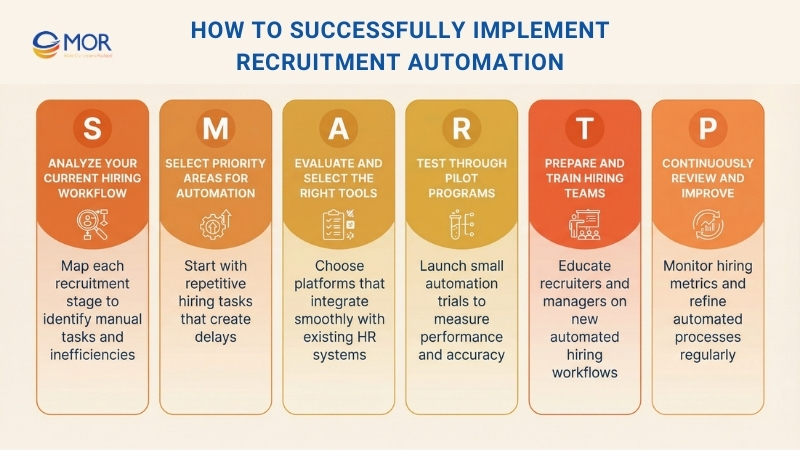
Analyze Your Current Hiring Workflow
The first stage of adopting hiring process automation is gaining a clear understanding of how your current recruitment process operates. Organizations benefit from mapping every step, starting from job requisition and continuing through onboarding. This review should identify who participates in each stage, which systems support the process, and where manual tasks tend to accumulate. This type of analysis often exposes repeated work or slow points that are ideal for automation. A clear workflow map also ensures that automation efforts focus on real operational challenges rather than theoretical improvements.
Select Priority Areas For Automation
After documenting the hiring workflow, organizations can determine which tasks should move toward automated recruiting workflows. Early automation projects usually focus on repetitive and rule-based activities such as posting job openings, screening resumes, and arranging interviews. These tasks offer strong improvement opportunities because they frequently create delays and require significant recruiter effort. Starting with a small group of well-defined processes also allows teams to gain confidence and demonstrate clear results before expanding automation to more complex parts of the recruitment process.
Evaluate And Select The Right Tools
After defining the initial use cases, the next step involves selecting the technology that will support those automation goals. Some organizations choose to upgrade their Applicant Tracking System or introduce a recruitment CRM, while others gain value from workflow coordination platforms such as IBM watsonx Orchestrate that manage activity across several systems.
Recruitment processes often interact with calendars, communication tools, job boards, HRIS platforms, and document management systems. Strong integration capabilities are therefore essential. When these platforms connect and exchange data reliably, organizations create a smoother and more stable rollout of recruitment automation.
Test Through Pilot Programs
The initial deployment may focus on one specific job role or a limited group of recruiting tasks. Running a pilot in a controlled environment makes it easier to assess the accuracy of automated actions and measure the outcomes. This method allows teams to identify and resolve issues before the wider hiring process is affected.
Prepare And Train Hiring Teams
When automated hiring solutions are introduced, HR teams and hiring managers need to understand how the updated workflows operate and where human judgment remains necessary. Training sessions and clear internal communication help employees adjust to new processes and remain confident when using automated recruiting workflows. It is especially important that users understand when to step in or override system actions. This awareness helps maintain trust in the technology and prevents disruptions during the hiring process.
Continuously Review And Improve
Hiring demands often change as recruitment volumes shift or new technology becomes available. Organizations should revisit their workflows regularly and refine automated processes when needed. Ongoing reviews of metrics such as candidate throughput, drop-off rates, and interview scheduling delays can reveal new areas for improvement. Over time, this process of continuous adjustment helps ensure that recruitment automation remains efficient, scalable, and aligned with the company’s overall talent strategy.
Why Choose MOR Software For Recruitment Automation Solutions
Recruitment automation works best when it fits your real hiring workflow. Not a generic template. Not a disconnected tool stack. At MOR Software, we design solutions around how your HR team actually operates.
We build custom recruitment automation platforms that connect sourcing, screening, scheduling, and onboarding into one streamlined system. Whether you need to modernize a legacy HR platform or integrate AI into your existing ATS, we develop solutions that align with your internal processes.
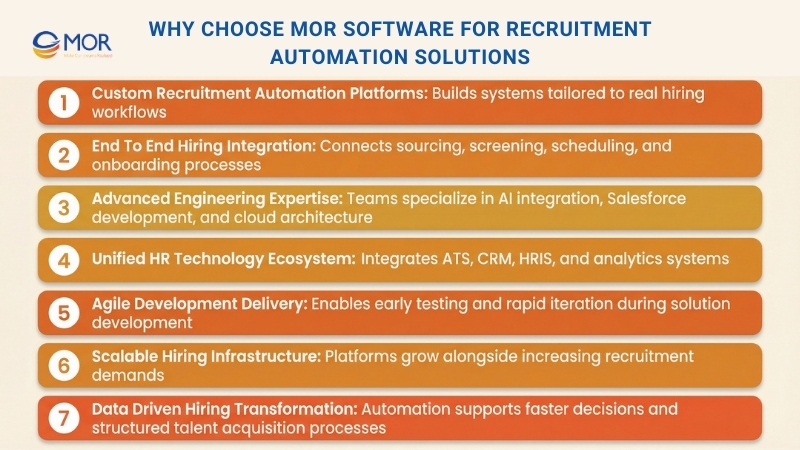
Our engineering teams bring strong experience in AI integration, Salesforce development, API architecture, and cloud infrastructure. That means we can automate resume screening, implement intelligent candidate matching, or create workflow triggers that reduce manual coordination. Everything is built to scale as hiring volume grows.
Integration is where many automation projects fail. We focus heavily on connecting your ATS, CRM, HRIS, communication tools, and analytics dashboards into a unified workflow. No data silos. No duplicate entry. Just consistent, real-time information across systems.
We also follow an Agile delivery model. You see progress early. You test workflows before full rollout. You adjust as needed. Hiring process automation should evolve with your organization, not lock you into rigid processes.
If your team wants to move from reactive hiring to a structured, data-driven approach, we help turn that shift into a practical system. Not just automation for speed, but automation that supports better hiring decisions. Contact MOR Software today to explore how we can build a recruitment automation solution tailored to your hiring goals.
Conclusion
Recruiting today requires speed, clarity, and the ability to manage growing candidate volumes without losing the human touch. Recruitment automation helps organizations simplify hiring workflows, improve candidate experiences, and support smarter hiring decisions. When implemented thoughtfully, automated hiring systems free recruiters to focus on strategy and relationships rather than repetitive tasks. If your organization is ready to modernize its hiring process with reliable technology, contact us to explore how MOR Software can support your automated hiring journey.
MOR SOFTWARE
Frequently Asked Questions (FAQs)
What is recruitment automation?
Recruitment automation refers to the use of software, artificial intelligence, and workflow tools to handle repetitive hiring tasks. It helps HR teams manage sourcing, screening, scheduling, communication, and onboarding more efficiently.
How does recruitment automation work?
These tools connect with systems like applicant tracking systems and HR platforms. They use rules, AI algorithms, and triggers to screen resumes, schedule interviews, send updates, and track hiring data automatically.
What tasks can be automated in the hiring process?
Common tasks include job posting, resume parsing, candidate ranking, interview scheduling, follow-up emails, onboarding paperwork, and recruitment analytics tracking.
Does automation in hiring replace recruiters?
No. It removes repetitive administrative work so recruiters can focus on relationship building, strategic hiring decisions, and candidate engagement. Human judgment remains essential in final evaluations.
Is recruitment automation suitable for small businesses?
Yes. Even small teams benefit from automating high-volume or time-consuming tasks like scheduling and resume screening. Many tools are scalable and can grow with your hiring needs.
How does recruitment process automation improve candidate experience?
Automation enables faster responses, consistent communication, and transparent updates. Candidates receive timely notifications instead of waiting days for manual replies.
Can recruitment automation reduce hiring bias?
Structured screening criteria and standardized evaluation processes can reduce unconscious bias. However, systems should be regularly reviewed to ensure fairness and inclusivity.
What metrics can automated hiring solutions help improve?
It can positively influence time-to-hire, cost-per-hire, candidate drop-off rates, source performance tracking, and overall hiring efficiency.
Is recruiting automation technology secure for handling candidate data?
Most modern platforms include encryption, access controls, and compliance features. Organizations should verify that tools meet data privacy regulations relevant to their region.
How long does it take to implement recruitment automation?
Implementation timelines vary based on system complexity and integrations. Basic automation can be set up in weeks, while full enterprise integration may take several months.
Share


Make Our-Dreams Realized


© 2023 . MOR Software. All Rights Reserved
Sitemap
Privacy Policy
Terms of Use

Rate this article
0
over 5.0 based on 0 reviews
Your rating on this news:
Name
*Email
*Write your comment
*Send your comment
1