


PoC vs MVP: Key Differences Businesses Should Know
PoC vs MVP is a common question for teams trying to build the right product without wasting time or budget. Many projects fail because the wrong validation path is chosen too early. In this guide, MOR Software will break down these two concepts clearly, help you avoid costly mistakes, and show you how to choose the right approach based on your business goals.
PoC Vs MVP: What Are The Key Differences?
The core role of a PoC vs MVP comparison is to show how feasibility testing differs from early market learning. A proof of concept checks whether an idea can work from a technical angle, while a minimum viable product exists to collect feedback from early users through a limited set of core features. Proofs of concept usually stay narrow in scope and focus on specific technical checks without covering the full product flow, while MVPs look outward and try to meet real market expectations in a usable form.
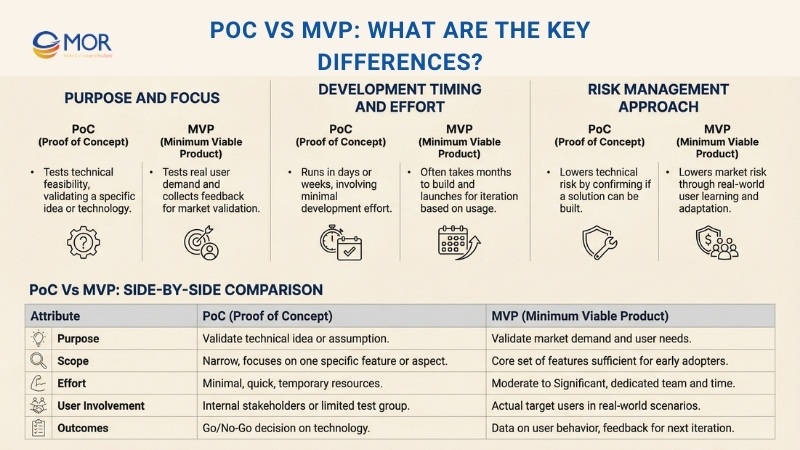
In most cases, a PoC comes before the development of an MVP and acts as an initial filter for technical soundness and budget logic. This early step helps teams decide whether it makes sense to invest further. Understanding this separation matters when choosing the right path in product development and knowing how the two stages support different business decisions.
Aspect | PoC (Proof of Concept) | MVP (Minimum Viable Product) |
Primary purpose | Confirms whether an idea is technically feasible | Confirms whether users want the product |
Main focus | Core functionality and technical capability | Usability, value, and real user demand |
Risk addressed | Technical and implementation risk | Market and adoption risk |
Stage in development | Early validation before product build | Early product release to the market |
Development timeline | Short, usually days or weeks | Longer, often several months |
Scope of work | Narrow and experimental | Focused but user-ready |
User involvement | Minimal or none | Active use by real users |
Iteration approach | Limited testing and refinement | Ongoing iteration based on feedback |
Outcome | Go or no-go decision | Direction for scaling or pivoting |
Purpose And Focus
The primary goal of a proof of concept is to confirm whether an idea is technically possible. Looking at both technical and practical feasibility allows this method to surface unknowns that might disrupt later development. This phase is especially relevant when working with new or untested technologies, as it gives teams a clear signal about whether the idea can realistically be built. Keeping an eye on software development trends can also help teams make technology choices that stay viable as the product grows. In this stage, discussions often resemble PoC vs PoV, where the emphasis stays on proof rather than opinion.
An MVP, in contrast, concentrates on validating demand and learning from users. Created after a PoC succeeds, this early product version goes to market to test appeal and collect real feedback. The difference between the two approaches becomes clear in their intent. One checks if something can be built, while the other checks if people actually want it.
Development Timing And Effort
A proof of concept usually happens as an early step before moving into an MVP and often confirms feasibility within days or a few weeks. This phase stays lightweight and focused.
Building an MVP takes more time and typically spans several months. It involves broader development work, exposure to users, and repeated improvements based on what teams learn during testing. This contrast in effort is one of the most practical differences in PoC vs MVP decisions.
Risk Management Approach
A proof of concept reduces early technical uncertainty by spotting possible implementation issues before major resources are committed. This early insight helps teams plan the next steps with more confidence.
An MVP lowers market risk instead. It relies on user feedback to confirm that the product fits real needs before large-scale investment. Ongoing feedback supports both methods and helps refine the direction of each approach so expectations stay aligned.
PoC Vs MVP: Side-By-Side Comparison
When teams compare PoC vs MVP, a side-by-side view makes the differences easier to see. This format highlights how the two models vary in purpose, scope, effort, and expected outcomes. Looking at MVP vs PoC in parallel helps you decide which validation path fits your current product stage.
POC Vs MVP: Short Definition
Proof of concept refers to a way to test early assumptions with a target audience and confirm whether your idea can work from a technical point of view.
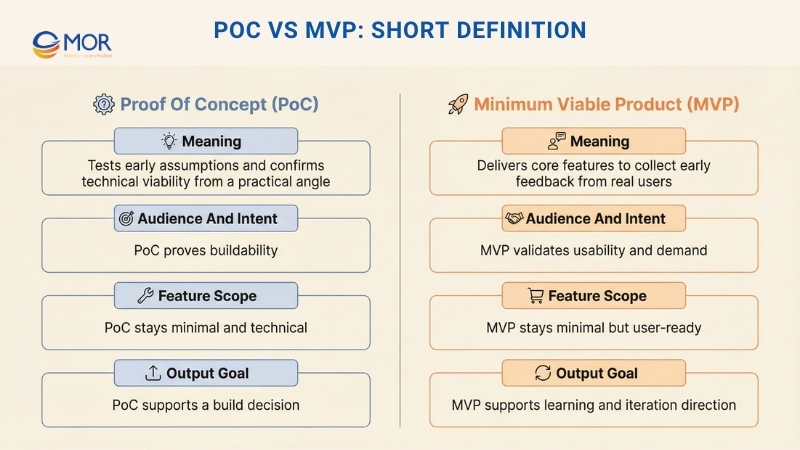
Minimum viable product describes a usable version of your product that includes only the core features needed to collect early feedback from real users.
What Is A Proof Of Concept?
In mobile app development, a POC is a small and simple project used to test or demonstrate an idea. Its purpose is to check whether the idea can actually be built and whether it will require too much time or effort.
With a proof of concept, you mainly evaluate core functionality. When your app idea is complex, you may create several PoCs to test different functions separately.
User experience is not a priority when building this solution. Designing a strong user experience takes time and effort, and that is not the goal at this stage. The aim is to confirm technical capability, not usability.
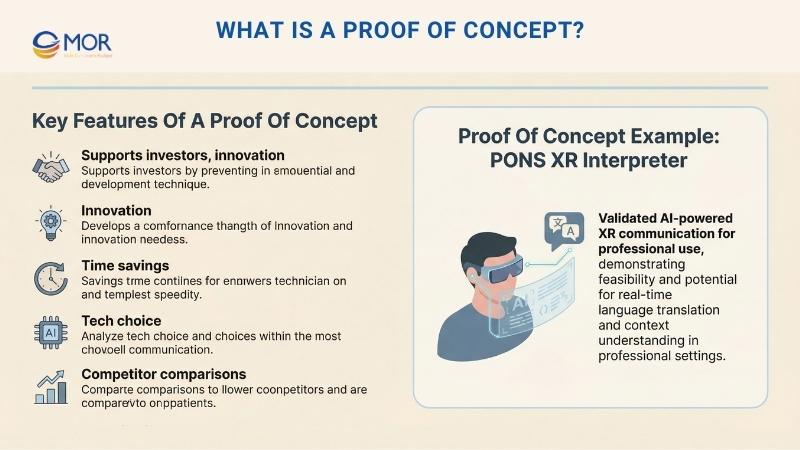
Key Features Of A Proof Of Concept
Attract early investor interest. You can create a POC to show your idea to investors and raise seed funding for the next development stage.
Drive innovation. Innovation appears where technical feasibility meets market needs. This method helps you see whether current technology can support your idea, which clarifies the line between concept vs prototype.
Save time. When you confirm that your idea can be built early, you avoid wasting time later on technical issues after hiring developers and committing large resources.
Select the right technology. Running several PoCs with different technologies allows you to choose the most suitable tech stack. This gives you early clarity on what is possible and how to plan your product roadmap.
Compare with competitors. If you plan to launch a mobile app in a competitive market, a proof of concept helps you test unique features. Your product must solve the same problem in a different way to stand out from existing solutions.
Proof Of Concept Example
PONS XR Interpreter
Many companies are now adopting remote work tools and new ways to collaborate. We worked with PONS, a global publishing company and long-term partner, to build a proof of concept for an AI-powered XR cross-language communication solution.
This proof of concept helped confirm that the XR Interpreter could work in professional settings and support clearer communication.
What Is A Minimum Viable Product?
There are many ways to define a minimum viable product, and to be honest, there is no single fixed definition. An MVP for one project can mean something very different for another.
In simple terms, an MVP depends on your product type and your organization. What counts as a minimal feature set for one company may look like a fairly complex application for another.
That said, the core idea behind an MVP is to begin learning with a version of your product that includes only the essential features while still allowing you to test your hypothesis, which is a key distinction in PoC vs MVP discussions.
Teams working through how to build an AI app often use an MVP to test real user value early while keeping scope controlled.
A minimum viable product helps you understand demand and product market fit, meaning whether early users are interested and feel satisfied with what you deliver.
An MVP should include the smallest set of features that still allows the product to enter the market. Keep in mind that the main goal is to gather and study user data and feedback.
With each new iteration of this product stage, you gain deeper insight into user problems and can adjust your solution. You continue refining it until the MVP grows into a complete product that addresses real user needs and pain points.
Minimal does not mean low quality or overly simple. This point is often misunderstood. Even with only core functions, the product should remain reliable, distinctive, and well built, and it should never feel inferior.
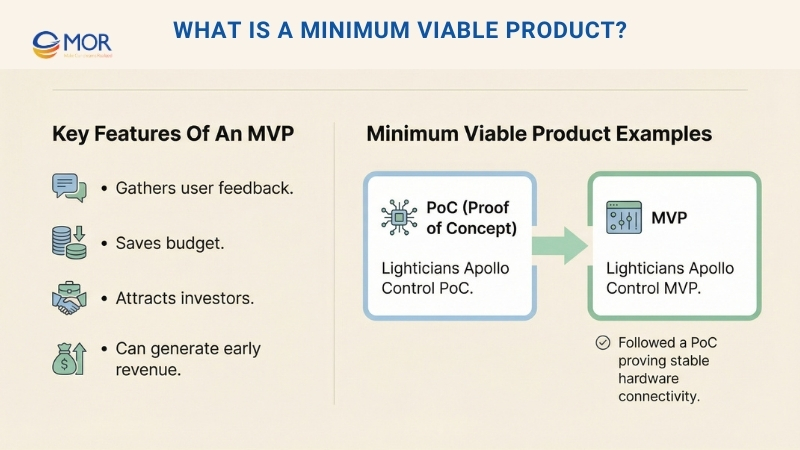
Key Features Of An MVP
Collect user feedback. An MVP works well when you want to understand what early users think about your product and use their input to improve future versions. This step reflects the real MVP tech meaning, learning fast from actual usage.
Save resources and budget. Since you do not need to build every feature at this stage, development effort stays lower. When you review user feedback, you can shape a clear product roadmap and development direction, which lowers the risk of building features no one needs.
A minimum viable product also allows gradual product growth. You can move to the next release only after you secure funding and confirm that the idea gains real traction.
Attract investors. While a proof of concept or a prototype may support early funding, an MVP can help you reach larger investments. When this solution shows usage and positive feedback, investors feel more confident putting money behind the idea.
Generate revenue. Once the MVP is available in the market and supported with basic marketing, you can start gaining paying users who contribute to steady growth.
Minimum Viable Product Examples
Lighticians Apollo Control
The Lighticians Apollo Control project focused on enabling communication with Apollo Bridge, a wireless router used to connect lighting fixtures. Together with Lighticians, we built an MVP that linked the hardware to mobile devices.
The minimum viable product for iOS allowed lighting professionals to control on set lighting directly from a mobile app.
What makes this case notable is that the MVP grew out of an earlier proof of concept created by Lighticians. During the PoC stage, the team confirmed that a stable connection with the wireless router was possible.
Choosing Between PoC Vs MVP
Choosing whether to use a proof of concept or a minimum viable product depends on your project goals and current needs. Proofs of concept are mainly used to confirm whether an idea can work, with a strong focus on technical feasibility before moving ahead. This option suits projects that carry major technical risks and need answers before you commit to full development, which is a common decision point in PoC vs MVP.
In comparison, minimum viable products are used to test real market demand and check product market fit through user feedback. This path allows startups to adjust their business direction based on how users respond, helping the product connect with the right audience before scaling. For app development for startups, this often means launching a focused MVP, measuring traction, and iterating quickly.
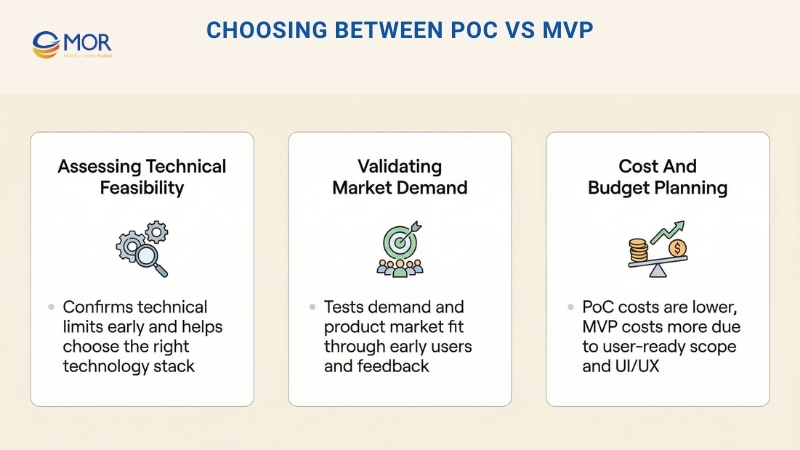
Assessing Technical Feasibility
The main reason to run a proof of concept is to review technical and practical feasibility before large scale development begins. When you test whether an idea can work, this step reduces the risk of failure due to technical limits and supports smarter budget planning, which is often discussed in PoC vs prototype vs MVP comparisons.
Early input from stakeholders during this stage can lead to improvements before major spending starts. Running several proofs of concept also helps you choose the most suitable technology stack, giving your team a clearer path for later development. For blockchain-based products, choosing the right blockchain development company early can also reduce rework during later stages.
Validating Market Demand
The core aim of a minimum viable product is to verify market demand. It also works to confirm product market fit. Testing the idea with early users helps this product stage show whether enough people want the solution, a key concern when weighing MVP vs prototype vs PoC.
Collecting useful feedback from users plays a vital role in understanding traction and guiding decisions for future versions of the product.
Cost And Budget Planning
Planning your budget for a PoC or an MVP plays a key role in using resources wisely and avoiding waste. A Proof of Concept (PoC) usually needs a smaller investment because it focuses on checking one technical assumption instead of building a full product. Typical PoC costs fall between $5,000 and $50,000, based on technology complexity, development time, and team skill level. When this work involves advanced areas like AI app development, blockchain, or IoT development services, costs often move toward the higher range due to special skills and infrastructure needs.
A Minimum Viable Product (MVP), on the other hand, requires a higher budget since it is a working product for real users. MVP spending often ranges from $30,000 to $200,000+, shaped by factors like feature scope, platform choice, web, mobile, or both, UI/UX work, and backend setup. No code or low code tools may lower early MVP costs, which helps startups launch faster and test demand before deeper investment. Still, products that need custom builds, growth readiness, and strong security usually lead to higher expenses.
Knowing these differences helps teams decide how to spend their budget across the two stages. A carefully planned proof of concept can uncover technical risks early, while an MVP directs spending toward a solution with proven demand, which matters when comparing PoC vs MVP vs prototype paths.
Real-World Use Cases Of PoC Vs MVP
PoCs and MVPs are applied across many industries to test ideas and confirm viability before large investments. One example is the NFT Music Marketplace, which used a proof of concept to successfully validate its market idea. This practice is now widely valued for lowering risk and confirming whether projects are realistic and worth pursuing.
In mobile app development, MVPs play an important role in adjusting features through early user feedback. This process helps teams shape products that match real market needs. These two approaches also provide practical usage data that supports later development and growth.
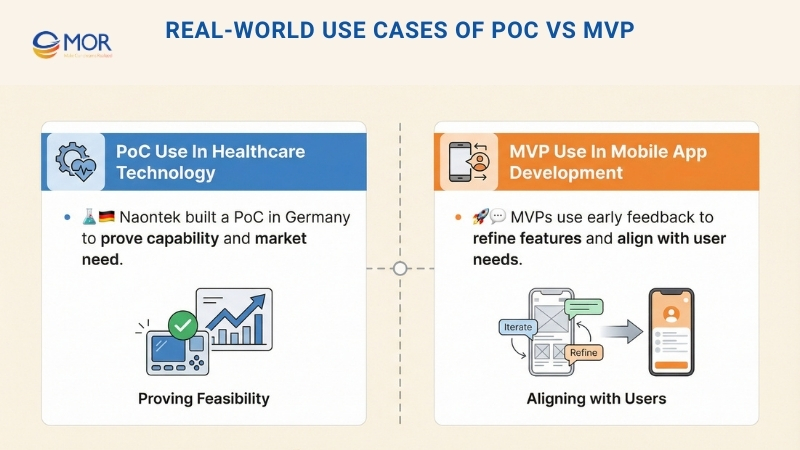
PoC Use In Healthcare Technology
Naontek built a proof of concept to create a digital contact point for the healthcare community in Germany. By proving technical capability and showing clear market need, this solution gave stakeholders a solid view of the project’s potential.
Clear goals helped guide development work and made it easier to measure results at each step.
MVP Use In Mobile App Development
Mobile app MVPs often rely on early user feedback to adjust features and improve the final release. This repeated improvement cycle supports steady progress and helps the app align with user needs.
Involving early users and collecting their input plays a key role in shaping how the product evolves and reaches its final form.
Best Practices For Implementing PoC Vs MVP
Applying PoC and MVP in the right way depends on strong product validation through repeated testing. This working style improves development results by checking that the solution meets both technical and market needs. An MVP also lets teams test ideas with limited resources and learn faster.
Clear goals and active involvement from key stakeholders help keep development aligned with business direction. Ongoing iteration and feedback loops support better feature decisions based on how users react and interact with the product.
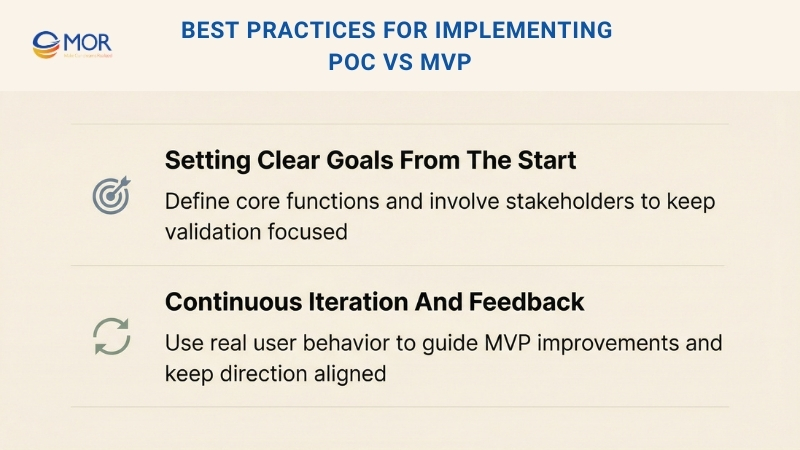
Setting Clear Goals From The Start
To make a proof of concept successful, you need to identify which core functions must work and why they matter. Involving the right stakeholders when setting these goals improves alignment with business priorities, which helps when comparing PoC vs. prototype vs. MVP paths.
In most cases, a proof of concept is built by a small team. This setup keeps the process lean and helps everyone stay focused on the main goal.
Continuous Iteration And Feedback
The repeat driven nature of MVP development supports steady improvement based on real user behavior. Regular input from early users helps teams adjust features and respond quickly to changing needs, which matters when reviewing PoC vs MVP.
This feedback driven process helps the final product stay close to market demand and user expectations as it moves toward a full release.
Common Misunderstandings About PoC Vs MVP
Even though these two stages play an important role, many teams still misunderstand PoC and MVP, which can cause confusion during product development. A frequent mistake is thinking that the two are interchangeable, while in reality they serve very different purposes. Knowing the difference matters for building products the right way and reducing risk.
Although both methods help validate ideas, a proof of concept centers on technical feasibility, while a minimum viable product focuses on real market demand. Clear separation between these two concepts helps you decide when to apply each one, so both technical and market needs receive proper attention.
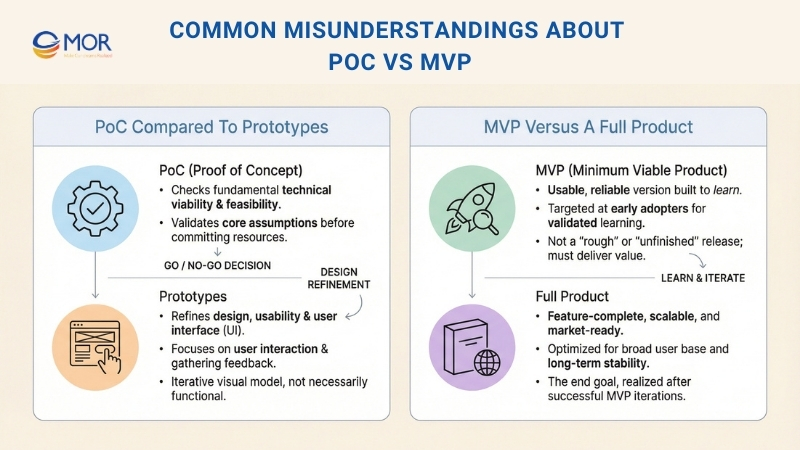
PoC Compared To Prototypes
The main objective of a Proof of Concept (PoC) is to confirm whether an idea or concept can work in practice, whereas a prototype focuses on improving design details and closing gaps in functionality. In simple terms, this stage checks technical viability, while a prototype pays more attention to user experience and interface, which often leads to confusion with MVP vs prototype.
Feedback collected from prototypes plays an important role in improving design choices and functionality based on how users interact with the product.
MVP Versus A Full Product
A common misunderstanding is the belief that MVPs are unfinished or overly simple products. In reality, they are usable solutions without extra features. An MVP exists to test the core idea and collect early feedback, rather than act as a reduced copy of the final product.
This working product stage focuses on checking market demand and improving features through real user input, which prepares the path toward full scale development.
In closing, PoC and MVP each play an important role in the product development cycle and serve different goals. A proof of concept concentrates on confirming technical feasibility, lowering risk, and offering early signals about whether an idea can work. A minimum viable product focuses on validating demand, learning from users, and adjusting the product to fit market needs.
Knowing when and how to apply PoC and MVP can greatly improve the success rate of new products. When teams set clear goals and follow an iterative development process, they can handle product challenges more effectively and turn ideas into market ready solutions.
How MOR Software Supports Businesses Across PoC Vs MVP Stages
MOR Software works with businesses that need clarity before committing to full product development. We support both PoC and MVP initiatives, depending on where the idea stands and what risks need attention first.
At the PoC stage, we help teams test feasibility when technology choices are uncertain. That includes validating core logic, integrations, or performance limits without building a full product. The goal is simple, confirm the idea can work before time and budget grow. This stage gives decision-makers clear signals on what to pursue and what to stop early.
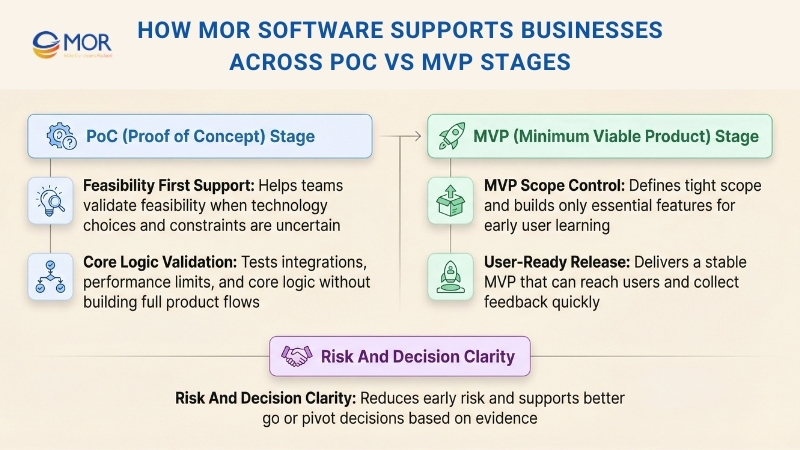
When projects move into MVP, we shift focus toward real users. We work with businesses to define a tight scope, build only essential features, and release a stable product ready for feedback. The MVP stage helps teams learn from real usage, not assumptions, and adjust direction with confidence.
Across both stages, we focus on clear goals, controlled scope, and practical outcomes. That approach helps businesses reduce early risk, make informed decisions, and move forward with a product plan that fits real needs.
If you’re deciding between PoC vs MVP for your next product, contact us to discuss the right starting point and development approach.
Conclusion
PoC vs MVP is not a technical choice alone. It is a business decision that shapes cost, speed, and product success. When teams choose the right validation path, they reduce risk and learn faster from real signals. With clear goals and the right execution model, both stages can create strong outcomes. MOR Software helps businesses move through PoC and MVP with clarity and focus. If you need guidance, contact us to start the conversation.
MOR SOFTWARE
Frequently Asked Questions (FAQs)
What is the main difference between PoC vs MVP?
A PoC checks whether an idea is technically possible. An MVP tests whether users actually want the product. One validates feasibility, the other validates demand.
Is a PoC required before building an MVP?
Not always. A PoC is useful when the idea involves new or complex technology. If technical risk is low, teams may move directly to an MVP.
Can a PoC be shown to users or customers?
Usually no. A PoC is built for internal teams or investors to confirm feasibility. It is not designed for real users or market testing.
Does an MVP need to include user interface and design?
Yes. An MVP should be usable and presentable. While it includes only core features, it still needs a clear interface for real user feedback.
Which comes first in the PoC vs MVP process?
In most cases, PoC comes first to confirm feasibility. MVP follows to test the product in the market. Some projects skip PoC if technology is proven.
Is an MVP just a low-quality or unfinished product?
No. An MVP is a functional product with limited features. It should be stable, reliable, and good enough for users to adopt and give feedback.
How long does it usually take to build a PoC vs MVP?
A PoC often takes days or weeks. An MVP usually takes several months because it includes development, testing, and user-facing features.
Which is better for attracting investors, PoC or MVP?
A PoC helps spark early interest by proving feasibility. An MVP is stronger for later-stage investment because it shows real users and traction.
Can a PoC turn directly into a production product?
No. A PoC is not built for scale or real users. It serves as a learning step before rebuilding the solution properly as an MVP or full product.
Share


Make Our-Dreams Realized


© 2023 . MOR Software. All Rights Reserved
Sitemap
Privacy Policy
Terms of Use

Rate this article
0
over 5.0 based on 0 reviews
Your rating on this news:
Name
*Email
*Write your comment
*Send your comment
1