


Find the Right Salesforce Consulting Services Provider for 2026
Are you searching for reliable salesforce consulting services to transform your business? Are you looking to optimize your Salesforce CRM system to better fit your unique business needs and goals? In this article, MOR Software JSC will help you understand the key benefits of Salesforce CRM consulting services, how to choose the right partner, and explore the top service types that can drive growth and efficiency.
What are Salesforce consulting services?
Salesforce consulting services help businesses design, implement, and optimize Salesforce CRM systems. These services are tailored to meet specific business goals and needs. Salesforce consulting companies analyze existing workflows to identify strengths and weaknesses. They customize Salesforce solutions for sales, customer service, and marketing teams.

Additionally, they integrate data from various sources to ensure smooth customer management. Salesforce professional services enhance the overall user experience. Through expert guidance and hands-on support, Salesforce consulting services enable organizations to streamline operations, reduce errors, and make data-driven decisions.
Whether you're a growing startup or a large enterprise, working with Salesforce consultants helps you unlock the full value of the platform and scale with confidence.
Best Salesforce Consulting Services To Transform Your Business
You wouldn’t buy a high-end suit off the rack and expect a bespoke fit, Salesforce is no different. The platform is incredibly powerful, but its value depends entirely on how it’s tailored to your business. Depending on your current stage, you might need a single specialist or a full squad. Here’s a breakdown of what these services actually look like in practice.
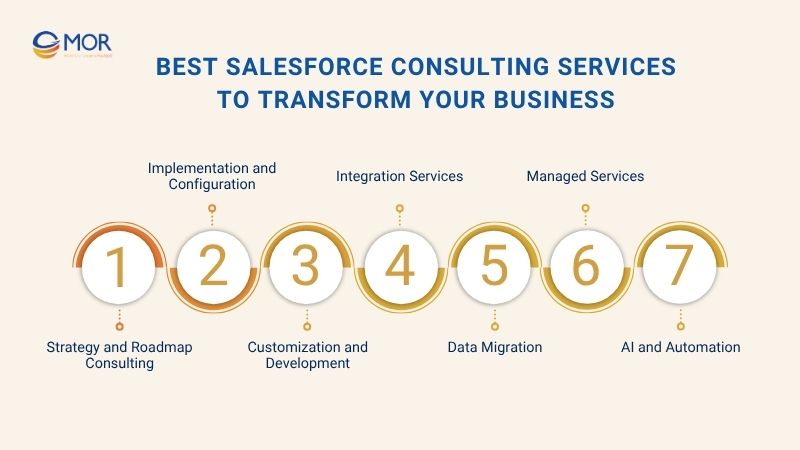
Strategy and Roadmap Consulting
Every successful engagement starts with a "look before you leap" approach. A strategy salesforce consultants London doesn't just ask what you want; they dive into how your teams actually work. They sit down with department heads to map out current workflows and pinpoint exactly where the friction is.
The output is a phased roadmap, a strategic document that tells you what to build on day one, what can wait until Q3, and how it all scales. If you have multiple departments using the platform, they’ll also set up a Center of Excellence (CoE) and governance model. Think of this as the "rules of the road" that prevent your Salesforce org from turning into a cluttered mess the moment the consultant leaves. A two-week strategy sprint is the cheapest insurance you’ll ever buy; teams that skip this almost always spend more time (and money) fixing "technical debt" six months later.
Implementation and Configuration
This is where the vision becomes reality. In this phase, the "building blocks" of Salesforce - objects, page layouts, validation rules, and automation flows - are meticulously set up. For larger organizations, this often means weaving together Sales, Service, and Marketing Clouds into one unified ecosystem.
What separates a top-tier partner from a basic "order-taker" is their willingness to push back. A great consultant uses pattern recognition from dozens of past projects in BFSI or manufacturing. When you ask for a specific feature, they might say: "We built that for a client last year, and here’s why it broke after six months. Let’s try a more scalable approach instead." That kind of expert foresight is something you rarely find in-house.
Customization and Development
Salesforce is great out-of-the-box, but sometimes your business has a "special sauce" that requires something unique. This is where Custom Development comes in, utilizing salesforce Apex triggers, Lightning Web Components (LWC), and custom APIs.
The real skill here isn't just knowing how to code, but knowing when to code. Over-customizing is the fastest way to break your system during a Salesforce update. Expert consultants build industry-specific tools, like custom incentive calculators for automotive dealers or complex loan origination workflows for banks, while keeping the core system lean and easy to maintain.
Integration Services
In a modern enterprise, Salesforce shouldn't be an island. It needs to talk to your ERP (like SAP or Oracle), your marketing tools, and even your phone systems. Integration consulting ensures that data flows seamlessly across your entire tech stack using tools like MuleSoft or REST/SOAP APIs.
But the real challenge isn't just the code. It’s the data governance. A good consultant will solve the tough questions before they start building: Which system is the "Source of Truth"? How do we handle sync conflicts? What happens if an API call fails at 2 a.m.? They build a bridge that is not only functional but also resilient.
Data Migration
Moving data from an old CRM or a messy spreadsheet into Salesforce is a high-stakes operation. It’s not just "copy and paste"; it’s about extraction, deduplication, and mapping while preserving years of customer history.
In our experience, data migration projects usually take 30-40% longer than expected. Why? Because you don't see the "garbage" in your old data until you try to move it into a clean system. Starting with a rigorous data audit saves you from the nightmare of broken reports and lost records down the line.
Managed Services
"Go-live" day is just the beginning. As your business grows, your Salesforce org needs to evolve, too. Salesforce managed services provide you with an outsourced team of admins, developers, and architects who handle everything from bug fixes to new feature releases and user training.
For many mid-market companies, this is the smartest move. You get access to high-level L2/L3 support and specialized expertise at a fraction of the cost of hiring a full-time, in-house team for every single role. It’s like having a pit crew ready to tune your car while you focus on driving the business forward.
AI and Automation
In the modern era, AI and Automation have become the primary drivers of hyper-efficiency. Implementing Agentforce and Einstein AI allows a business to move beyond basic chatbots and toward "autonomous agents" capable of handling complex tasks like resolving customer service cases or qualifying leads without human intervention. By configuring predictive AI for sales forecasting and lead scoring, companies can identify exactly where to focus their energy to close deals faster. The core objective here is to liberate employees from repetitive manual tasks, allowing them to focus on high-level strategy and meaningful human interactions that drive revenue.
Key Benefits Of Salesforce Consulting Services
While managing Salesforce internally is feasible for basic requirements, partnering with external specialists provides a quantifiable advantage for complex business needs. Professional expertise transforms the platform from a simple tool into a high-performance engine through several critical channels.
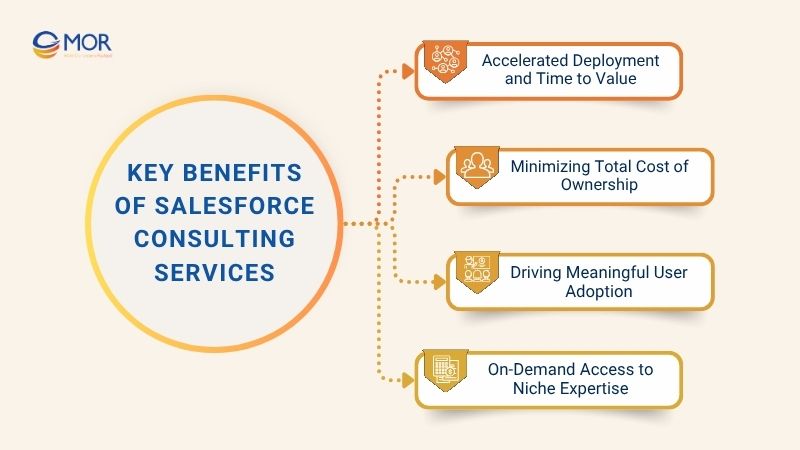
Accelerated Deployment and Time to Value
Leveraging experienced consultants significantly compresses project timelines. Because these experts have navigated dozens of similar implementations, they possess an intimate understanding of configuration shortcuts and hidden features that internal teams may overlook. By utilizing proven frameworks and pre-built accelerators, a seasoned partner can often deliver in 8 to 12 weeks what might otherwise take an internal team half a year to execute.
Minimizing Total Cost of Ownership
The initial investment in external consulting is often offset by the long-term financial health of the platform. Correcting a botched Salesforce Service Cloud implementation typically costs double or triple the price of an initial expert setup, and inefficiencies like redundant licenses can result in annual losses exceeding $50,000 for mid-sized firms. Data from the 2025 Salesforce ecosystem report highlights this fiscal reality, noting that organizations partnering with certified experts achieve a 32% higher ROI compared to those attempting a solo approach.
Driving Meaningful User Adoption
Technical excellence is irrelevant if the end-users bypass the system. Professional consultants treat adoption as a fundamental element of the project lifecycle rather than an afterthought. By integrating stakeholder workshops, user-centric design, and strategic change management from the outset, they ensure the platform fits the workflow of the team. They recognize that low engagement is rarely a training issue; it is a structural challenge that requires a disciplined rollout strategy.
On-Demand Access to Niche Expertise
The vastness of the Salesforce ecosystem, spanning over 20 distinct clouds and thousands of specialized features, makes it nearly impossible for a single internal administrator to achieve mastery across the board. Consulting firms solve this by providing a multidisciplinary team with deep certifications in specific sectors like Sales, Service, Revenue, or Financial Services Clouds. This ensures that every specific facet of your project is handled by a dedicated subject matter expert.
How To Choose The Right Salesforce Consulting Services?
Selecting the right Salesforce consulting services is crucial for optimizing CRM performance and driving business success. The right partner will help refine workflows, maximize system capabilities, and support long-term scalability. Below are key considerations to keep in mind when choosing a consulting provider.
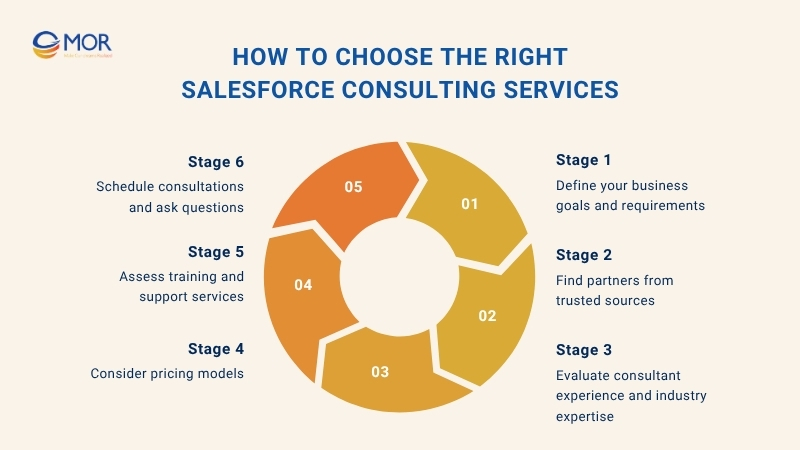
Define Your Business Goals And Requirements
Before choosing Salesforce consulting services, it’s essential to clearly define your business goals and pinpoint the specific processes or features that need improvement. Understanding these requirements in detail allows you to find a consultant who is best suited to address your unique challenges.
This focused approach helps avoid spending time and resources on unnecessary or irrelevant solutions. Additionally, having well-defined goals makes it easier to measure the success of the Salesforce implementation and ensures the system is aligned with your business objectives, ultimately maximizing your return on investment.
Find Partners From Trusted Sources
Choosing the right Salesforce consulting services is critical for project success. To find reliable partners, research extensively on the internet by visiting their official websites and reading detailed reviews on trusted platforms such as G2, Clutch, or Salesforce AppExchange.
Additionally, ask for recommendations or case studies from other businesses in your industry that have worked with these consultants. This thorough approach helps you select a partner with the right expertise, reputation, and understanding of your specific business needs.
Evaluate Consultant Experience And Industry Expertise
When selecting Salesforce consulting services, carefully review the consultant’s project portfolio. This helps ensure they understand the unique challenges and requirements your business faces. Look for relevant Salesforce certifications, such as Salesforce Certified Service Cloud Consultant, which demonstrate their technical skills and commitment to best practices.
Experienced consultants bring valuable insights that can prevent common implementation mistakes, reduce risks, and optimize the performance of your Salesforce CRM. Their expertise also means faster problem-solving and smoother integration, ultimately leading to a more successful and efficient deployment tailored to your business needs.
Consider Pricing Models
It’s important to fully understand how Salesforce consulting services charge their fees before making a decision. Common pricing models include fixed fees, hourly rates, or project-based pricing.
Take time to compare the costs alongside the scope of services provided to ensure you get the best value for your budget. Be cautious of any hidden fees or unexpected expenses that may arise during the project. Clear communication about pricing upfront helps prevent surprises and allows you to plan your investment more accurately.
Assess Training And Support Services
Choose Salesforce consulting services that provide comprehensive training for your staff to effectively use the platform.
Additionally, ensure the service includes ongoing technical support after implementation to quickly address any issues or system errors. Reliable post-deployment support minimizes downtime, maintains smooth operations, and helps your business fully leverage Salesforce capabilities for long-term success.
Schedule Consultations And Ask Questions
Before making a final decision, arrange a face-to-face meeting or video call with the Salesforce consultant. Use this opportunity to ask detailed questions about their implementation process, technology expertise, and the support they offer.
Preparing thoughtful questions helps you better understand their capabilities and ensures their approach aligns with your business needs. This direct interaction builds trust and allows you to evaluate whether the consulting service is the right fit for your organization.
Emerging Salesforce Consulting Services Trends for 2026
The landscape of Salesforce consulting is undergoing a rapid transformation, redefining how services are executed and delivered this year. Staying ahead requires a deep understanding of the forces shaping the ecosystem.
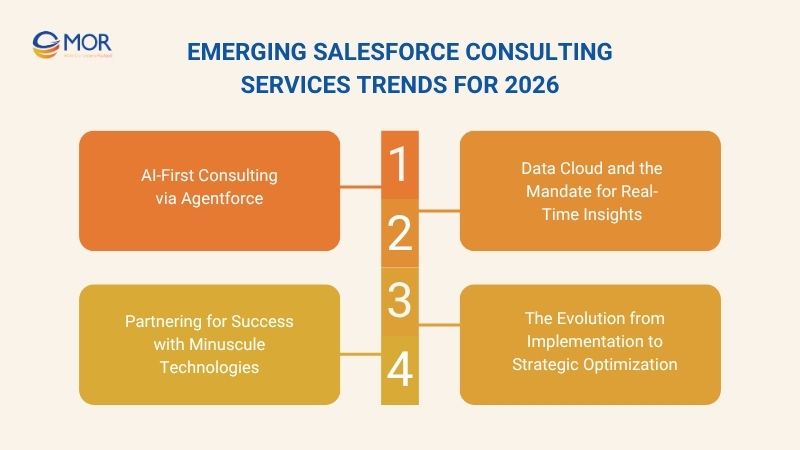
AI-First Consulting via Agentforce
Agentforce has fundamentally altered the playing field for consultants and clients alike. The rise of autonomous AI agents means that routine operations—such as lead qualification, ticket resolution, and record maintenance—no longer require the heavy manual configuration or custom coding of the past. Forward-looking consulting partners are now prioritizing Agentforce-driven architectures that simultaneously slash operational overhead and boost responsiveness. When selecting a partner today, the critical differentiator is whether they are designing native AI-first solutions or merely layering AI onto outdated legacy frameworks.
Data Cloud and the Mandate for Real-Time Insights
Salesforce Data Cloud has transitioned from an optional enhancement to an enterprise necessity for achieving a truly unified customer profile. Modern consulting engagements now place as much emphasis on comprehensive data strategy—encompassing identity resolution, data harmonization, and real-time segmentation—as they do on standard CRM setups. Any consulting partner failing to center their roadmap around Data Cloud is effectively falling behind the industry standard.
The Evolution from Implementation to Strategic Optimization
A significant yet undervalued shift in 2026 is that the bulk of consulting value has moved from initial setups to sophisticated optimization. Many organizations are currently burdened by years of technical debt, underutilized features, and escalating licensing fees within their existing environments. The most impactful partners now are those capable of re-engineering and modernizing legacy "brownfield" orgs without interrupting vital business operations.
Partnering for Success with Minuscule Technologies
This is precisely where Minuscule Technologies excels as a Trusted Salesforce Consulting Partner. With a global roster of over 160 experts and a track record of 75+ successful projects, Minuscule provides deep-tier expertise across Sales, Service, Financial Services, and Revenue Clouds. They specialize in helping enterprises refactor complex legacy environments, optimize license expenditures, and establish AI-ready infrastructures. Whether you are navigating a cluttered existing system or embarking on a fresh greenfield implementation, scheduling a strategic consultation with a dedicated engineering partner can ensure your Salesforce investment finally delivers its full potential.
Conclusion
Salesforce consulting services play a crucial role in helping businesses optimize their salesforce crm consulting systems according to specific goals and needs. Choosing a trusted consulting partner enables you to overcome challenges in implementation, integration, and user training effectively. This not only improves operational efficiency but also enhances customer experience and drives sustainable growth.
If you are looking for digital transformation solutions with Salesforce, don’t hesitate to contact our professional Salesforce consulting experts for detailed support and tailored advice to suit your business!
"Mr. Cong’s guiding philosophy is simplicity, believing that the simplest solutions are often the most powerful. He sees trust, empowerment, and the opportunity to demonstrate one’s abilities as the key elements that set MOR apart from traditional IT companies."
Mac Tien Cong


Division Manager (Hanoi Branch)
MOR SOFTWARE
Frequently Asked Questions (FAQs)
What are Salesforce Consulting Services?
Salesforce Consulting Services involve expert guidance and support to help businesses implement, customize, and optimize their Salesforce CRM platform. Consultants work to align Salesforce features with specific business processes, ensuring the system effectively supports sales, marketing, customer service, and other operations.
How can Salesforce consulting help my business grow?
Salesforce consulting can drive business growth by streamlining workflows, automating tasks, improving data management, and providing actionable insights. This leads to enhanced customer relationships, increased sales efficiency, better decision-making, and ultimately, a stronger competitive edge.
When should my company consider hiring a Salesforce consultant?
You should consider hiring a Salesforce consultant if you're planning a new Salesforce implementation, experiencing challenges with your current Salesforce setup, need help customizing the platform for unique business needs, want to integrate Salesforce with other systems, or aim to optimize your existing CRM for better performance and ROI.
What kind of expertise do Salesforce consultants offer?
Salesforce consultants typically offer expertise in various areas, including strategic planning, platform customization (Sales Cloud, Service Cloud, Marketing Cloud, etc.), data migration, third-party integrations, user training, and ongoing support. They understand best practices and how to leverage Salesforce's full potential.
What's the typical process for working with a Salesforce consulting firm?
The process generally begins with a discovery phase to understand your business needs and current challenges. This is followed by strategic planning, solution design, implementation/customization, data migration, testing, user training, and often, post-launch support and ongoing optimization to ensure long-term success.
Share


Make Our-Dreams Realized


© 2023 . MOR Software. All Rights Reserved
Sitemap
Privacy Policy
Terms of Use

Rate this article
0
over 5.0 based on 0 reviews
Your rating on this news:
Name
*Email
*Write your comment
*Send your comment
1