


Top 25+ Software Development Trends in 2025 Shaping the Future
Keeping up with the latest software development trends has become a serious challenge as technologies shift faster than ever. From AI-driven tools to software development trends 2025, businesses must adapt or risk falling behind competitors. In this guide, MOR Software will highlight 25+ trends shaping 2025 and their impact on how organizations build, secure, and scale software.
Current State Of The Software Development Industry
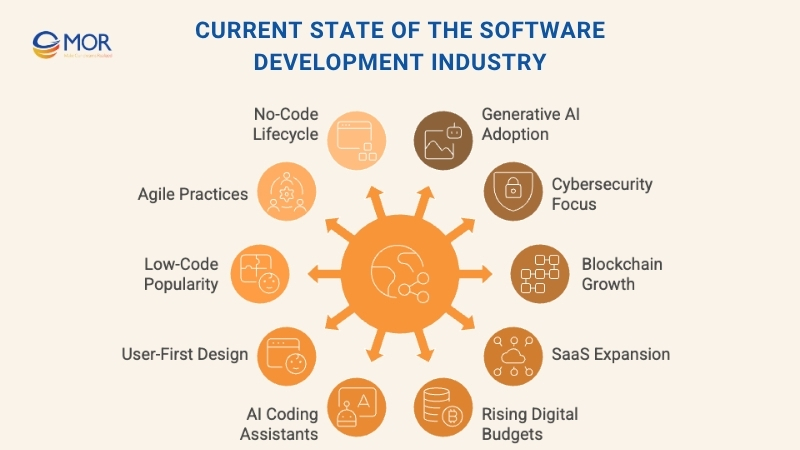
The software field in 2023 was shaped by several defining movements that signaled major shifts across the market.
Generative AI went from experimental to mainstream, capturing attention in nearly every sector. At the same time, rising global cyber-attacks pushed companies to rethink cybersecurity and data protection, making them non-negotiable priorities. Blockchain also moved into a new stage, drawing investment in fresh applications beyond finance. Alongside this, SaaS providers continued to expand, offering businesses greater flexibility and subscription-based services.
Even under economic pressure, organizations worldwide kept raising their digital budgets, viewing technology as a path to long-term growth. Demand for advanced solutions shows no signs of slowing.
In development practices, the adoption of AI coding assistants, stronger focus on user-driven design, and broader use of low-code and no-code tools have become standard. Agile values also regained importance, guiding teams toward adaptability and speed.
Today, AI-powered and no-code platforms play roles throughout the lifecycle, from generating code and resolving errors to testing and deployment. These shifts mark a new chapter in software development trends 2025.
Top 27 Software Development Trends Shaping 2025
Software engineering continues to move at high speed, with new technologies redefining how applications are designed, deployed, and maintained. Entering 2025, recognizing these changes is a priority for both companies and developers. The following breakdown highlights the software development trends expected to lead the market this year.
Artificial Intelligence (AI) And Machine Learning (ML)
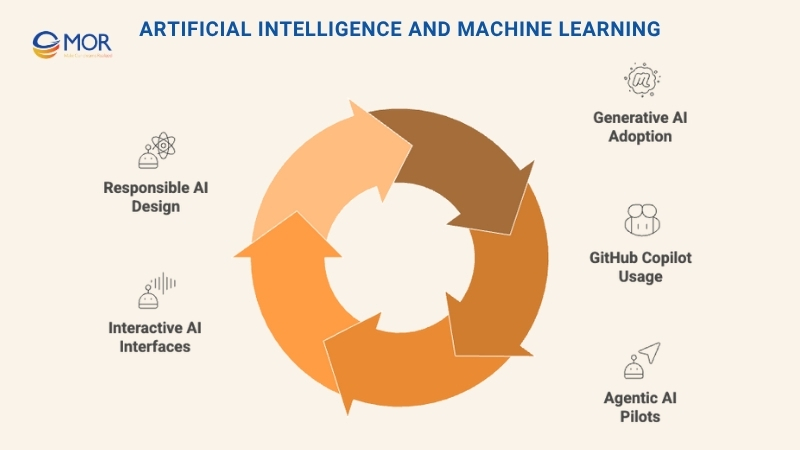
Artificial Intelligence (AI) and Machine Learning (ML) remain the most influential drivers of latest trends in software development for 2025. Generative AI has already shifted from research labs to business operations, producing text, images, and code at scale. At the same time, practical tools such as GitHub Copilot demonstrate how automation is reshaping daily development, helping teams work faster and with fewer errors.
The arrival of agentic AI, capable of independently executing complex tasks, is gaining attention. By 2025, more businesses are expected to pilot AI agents for testing, debugging, and even continuous deployment. This shift extends to the user side as well, where conversational and interactive AI-driven interfaces are replacing traditional forms.
Another major thread is the integration of ethical and secure design. Concepts like AI Trust, Risk, and Security Management (AI TRiSM) are being introduced to align innovation with safety.
Key highlights:
- More than 80% of teams expected to adopt GitHub Copilot by 2025.
- Generative AI becoming a mainstream part of production systems.
- One in four companies running pilot programs with agentic AI for DevOps.
- Interfaces moving toward interactive AI-powered experiences.
- Greater focus on responsible AI, security, and governance frameworks.
Rise Of ‘Vibe Coding’
‘Vibe coding’ represents one of the fresh trends in software development where natural language becomes the new programming interface. Instead of typing complex syntax, developers simply write instructions in plain words, and large language models (LLMs) translate those directions into functioning code. This approach significantly reduces barriers for newcomers, opening the door for non-programmers to take part in creating digital products. The term gained momentum after Andrej Karpathy highlighted it in early 2025, sparking global discussions.
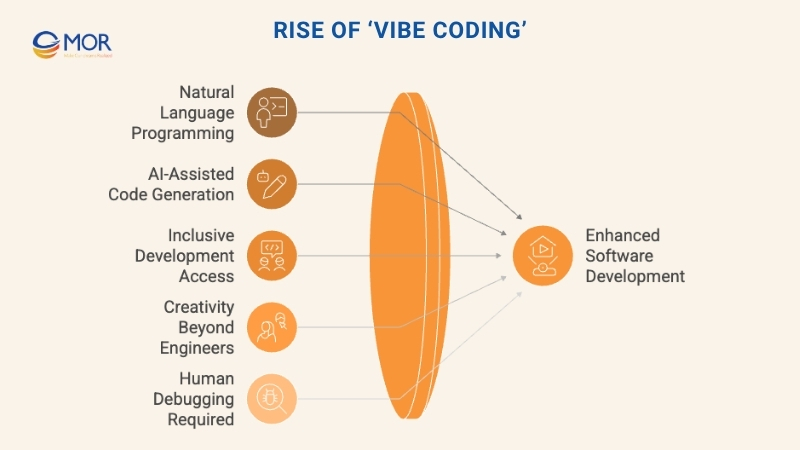
Through combining AI-assisted coding with natural language prompts, anyone with a clear idea can now describe their goals and see software generated in return. This shift makes development more inclusive, encouraging creativity from professionals in non-technical fields. Yet, the method is not flawless. AI systems may struggle with edge cases or debugging, forcing human intervention to refine results. As adoption grows, teams are experimenting with blending vibe coding and traditional programming to balance speed with reliability.
Quantum Computing Breakthroughs
Quantum computing is moving forward quickly, with global tech leaders pouring resources into research and new prototypes. Unlike traditional machines, these systems use quantum bits to perform calculations at speeds that were once unimaginable. This capability allows them to tackle challenges that have long been out of reach, from drug discovery and supply chain optimization to climate simulations and financial risk modeling. Companies embracing this innovation early are positioned to unlock solutions to the toughest problems and gain a strategic edge.
Major Advances in 2025
- Microsoft’s Eight-Qubit Processor: Introduces a topological qubit with just 1% error rates, pointing to scalable quantum hardware.
- IBM’s Quantum-Classical Hybrid: Merges quantum and traditional computing for real-world use in finance, telecom, and manufacturing.
- Google’s Neutral-Atom System: Delivers 99.5% fidelity with rubidium atoms, enabling both efficiency and improved scalability.
This acceleration makes quantum a core part of software development industry trends as enterprises look toward future-ready solutions.
Neuromorphic Computing
Neuromorphic computing draws inspiration from the structure of the human brain, using spiking neural networks to process data in parallel. This event-driven design brings significant energy savings and faster decision-making compared to conventional architectures. The market is expanding rapidly, valued at $8.36 billion in 2025 and projected to reach $47.31 billion by 2034, with a CAGR of 21.23%. Rising interest in energy-efficient AI and sensor-driven applications is fueling this growth.
One of its strongest advantages is in edge computing, where devices need to process information locally without relying on the cloud. Neuromorphic systems make this possible, cutting latency while boosting performance. These capabilities are especially relevant for use cases such as industrial automation and self-driving vehicles, where real-time insights are essential.
Low-Code And No-Code Platforms
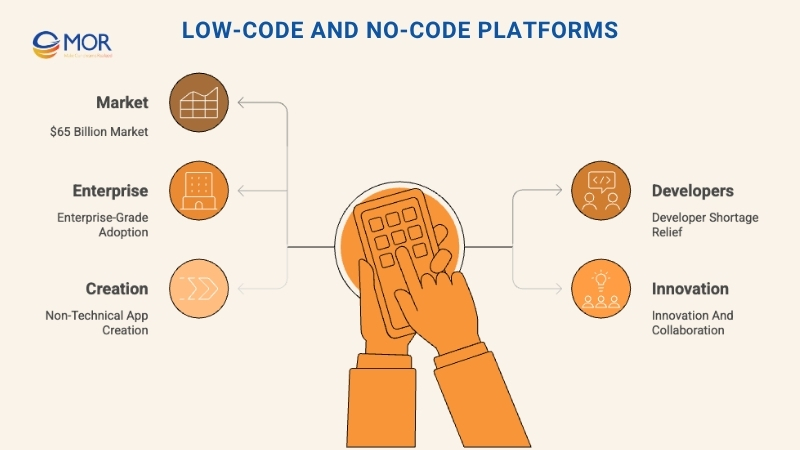
Low-code and no-code (LCNC) platforms are set to remain a defining part of software development trends in 2025. These tools give people without strong programming backgrounds the power to design and launch apps in record time. Doing so, they also help relieve the persistent shortage of skilled developers that continues to challenge the industry.
The demand for simplified app creation is clear. Research shows the LCNC market is on track to hit $65 billion in 2025, reflecting how much businesses value speed and accessibility in development. This momentum is driving organizations to adopt LCNC platforms not just for small projects, but also for enterprise-grade solutions.
Another important aspect is how these platforms foster creativity and teamwork. Employees across departments can prototype solutions on their own, bringing ideas to life faster and encouraging collaboration between technical and non-technical staff. The end result is greater agility and stronger productivity across the business.
Key takeaways:
- Market expected to reach $65 billion by 2025.
- Addresses the shortage of skilled engineers.
- Encourages innovation and faster collaboration.
- Enables non-technical users to build functional apps quickly.
Internet Of Things (IoT) Expansion
The expansion of IoT continues to define latest software development trends, with billions of devices requiring smooth and secure connectivity. Modern IoT solutions must guarantee not just performance but also interoperability, cloud integration, and cybersecurity. Developers are tasked with creating systems capable of managing constant streams of data in real time while keeping communications secure.
A major shift is the rise of AIoT, the combination of artificial intelligence and IoT. In 2025, more connected devices are expected to analyze and act on data locally using edge computing, reducing reliance on the cloud. This development speeds up responses and boosts reliability in critical fields like healthcare, logistics, and manufacturing. With AI and IoT working hand in hand, businesses can now design smarter, faster, and safer solutions.
Cybersecurity-As-A-Service And New Security Models
Cybersecurity-as-a-Service (CaaS) is emerging as a defining element of software development trends in 2025. Delivered through the cloud, this model gives organizations scalable, on-demand protection without the burden of upfront infrastructure costs. It enables companies to detect risks, assess vulnerabilities, and stay compliant in a faster, more cost-effective way. With threats growing alongside IoT, generative AI, and cloud expansion, the financial toll of cybercrime could climb to $10.5 trillion by 2025, making proactive defense non-negotiable.
CaaS also transforms the way businesses manage security. Instead of maintaining large in-house teams, they can adapt flexibly, scaling defenses up or down to meet changing risks. This approach reduces expenses, increases responsiveness, and allows leadership to keep more focus on core business strategies.
Key Cybersecurity Shifts in 2025
- Generative AI driving stronger protection for unstructured data, from text to video.
- AI embedded into DevSecOps, automating detection and boosting risk forecasting.
Evolution Of DevSecOps
DevSecOps continues to mature as part of software development industry trends, embedding security throughout the development pipeline. Once centered on “shift-left” practices, it now extends to a broader “shift everywhere” model. This change ensures protection is integrated across every stage, reducing vulnerabilities before deployment and improving trust in released products.
Automation plays a central role. Continuous delivery pipelines now include automated builds, tests, and monitoring, enabling faster and safer releases. As a result, teams can deliver secure software quickly without compromising reliability, creating a better balance between speed and safety.
Highlights for 2025
- DevSecOps evolving toward “shift everywhere” adoption.
- Global DevOps market forecasted to reach $12.85 billion this year.
- Continuous automation remains the standard for speed and security.
- Security integration strengthens customer trust and system resilience.
Cross-Functional Engineering Teams
More companies are moving away from siloed DevOps setups and forming integrated teams that blend multiple engineering skills. This cross-functional model encourages collective problem-solving and speeds up the innovation cycle. To support these teams, unified platforms are gaining importance, offering complete toolchains for CI/CD, chaos testing, and cloud cost control. With everything in one place, engineers can simplify workflows and boost output.
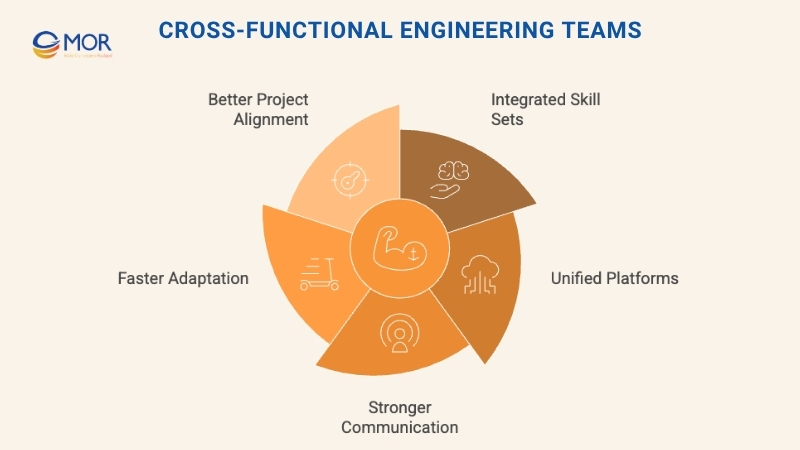
The benefits go beyond efficiency. Breaking down silos improves communication and ensures stronger alignment across disciplines. With better collaboration, teams can adapt faster to shifting priorities, helping projects stay on track and more responsive to business needs. This change is now firmly embedded in software development trends shaping 2025.
Remote And Globally Distributed Teams
Remote and distributed development models have become standard in 2025. Flexibility, global hiring, and improved employee satisfaction are driving adoption. Gartner reports that 87% of technology companies plan to keep or expand remote setups this year, showing strong confidence in the model. For businesses, this approach also unlocks global talent pools and lowers operational costs, making it one of the defining offshore software development trends.
The productivity case is equally strong. Data from Australia’s Productivity Commission highlights that hybrid work reduces commuting, cuts sick days, and minimizes distractions. By August 2024, 36% of Australians worked mainly from home, compared with only 12% before the pandemic.
To make these setups effective, companies are investing in advanced collaboration stacks. Platforms such as Zoom, Slack, and Jira are key in maintaining coordination across different time zones and keeping distributed projects running smoothly.
Agile Delivery Practices Returning To Core Values
In 2025, organizations are leaning back into the heart of Agile, prioritizing adaptability, collaboration, and fast delivery cycles. Instead of rigid structures, teams are emphasizing customer value and empowerment. The focus is shifting toward simplicity, making Agile a natural part of daily routines rather than a checklist of ceremonies. This approach streamlines processes and improves overall efficiency, reinforcing its place in software development trends.
Artificial Intelligence is now blending into Agile practices. AI-powered tools are reshaping sprint planning, backlog management, and resource allocation, allowing teams to predict bottlenecks and refine workflows. This mix of Agile and AI keeps teams focused on value while reducing wasted effort.
AI-Driven Development Tools
AI-driven coding assistants are now essential in latest trends in software development. These tools offer real-time suggestions, detect bugs early, and make coding faster and more accurate. Beyond productivity, they also guide developers with tutorials, tailored recommendations, and best practices, creating a continuous learning environment inside the workflow.
Ethical AI Practices
As AI becomes more common in sensitive domains, ethical use is taking center stage. Businesses are expected to adopt practices that make models transparent, accountable, and unbiased. Building ethical AI not only prevents discrimination but also strengthens trust among customers and regulators, driving wider adoption.
Key aspects include:
- Transparency and Accountability: Ensuring decisions made by AI are explainable and traceable.
- Bias Mitigation: Avoiding models that reinforce harmful biases or stereotypes.
Progressive Web Apps (PWAs)
Progressive Web Apps (PWAs) merge the strengths of web and mobile, providing fast load speeds, offline functionality, and smooth user experiences across all devices. Because they run on both desktop and mobile, companies can cut down on development expenses while still delivering high-quality digital products. This dual advantage makes PWAs a clear fixture in software development trends for 2025.
Cross-Platform Development
Instead of seeing native app growth dominate, cross-platform frameworks are quickly rising. Tools like Flutter, React Native, and Kotlin Multiplatform now deliver near-native performance while lowering both costs and release timelines.
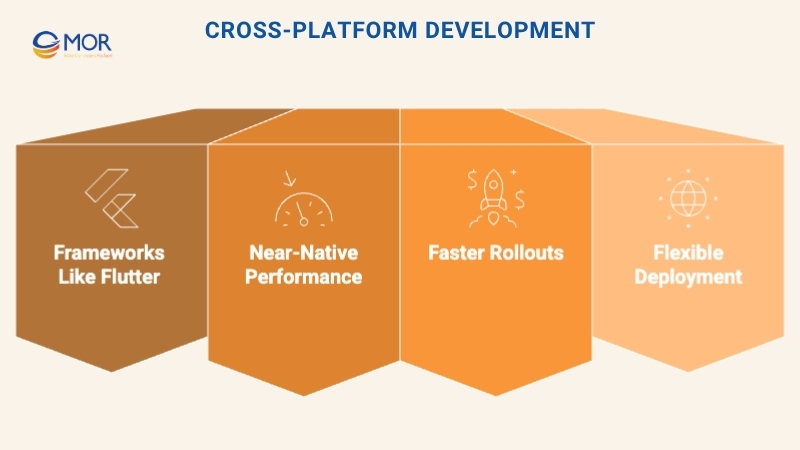
Businesses value faster rollouts and flexible deployment across multiple systems, fueling this move away from native-only builds. Native development is still used, but mostly in cases demanding specialized hardware access or extremely high performance. This direction highlights one of the most practical software development languages trends shaping 2025.
Programming Language Adoption And Shifts
The programming language scene remains led by familiar names while also welcoming modern challengers. Python, JavaScript, and Java continue to dominate, backed by large ecosystems and strong community support. At the same time, languages like Rust, Go, and TypeScript are winning ground, valued for memory safety, speed, and reliability.
Rust, for instance, has repeatedly ranked as a developer favorite in GitHub reports, showing its momentum in system-level and web-based projects. These shifts reflect how the mix of established and emerging options is shaping coding choices in today’s market.
Internal Developer Platforms And Portals
Internal Developer Platforms and Portals are becoming central to modern software development trends. They act as unified spaces that bring together tools, documentation, and services in one place.
Offering self-service options, personalized dashboards, and powerful search features, these platforms are designed to improve the developer experience. Automation further enhances their value, enabling smoother approvals and more efficient workflows, which speeds up delivery cycles across teams.
Growth Of Immersive Technologies (VR, AR, MR)
Immersive technologies like virtual reality (VR), augmented reality (AR), and mixed reality (MR) are moving forward quickly as new hardware becomes available. Meta’s Quest 3, powered by the Snapdragon XR2 Gen 2 processor and passthrough AR, shows how performance and affordability are advancing at the same time.
These improvements are pushing organizations to integrate XR into training programs, education tools, and collaborative environments. With stronger capabilities and lower costs, immersive technology is expected to expand as one of the standout software development trends 2024 carried into 2025.
Cloud-Native Development Models
Cloud-native development has become a cornerstone of software development trends in 2025. Through building applications designed specifically for cloud environments, companies gain scalability, faster deployment, and greater resilience.
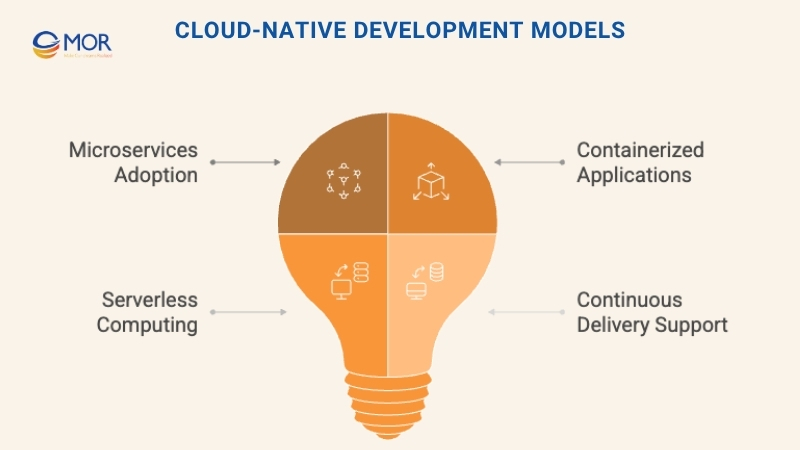
Microservices, containers, and serverless computing are no longer experimental, they’re standard practices. Businesses adopting this model can adjust resources dynamically, cut downtime, and release updates at speed, meeting the growing demand for continuous delivery.
Digital Twin Technology On The Rise
Digital twins are gaining stronger traction as part of software development industry trends. These virtual replicas of physical systems allow companies to test, predict, and optimize real-world performance without risks or delays.
By 2025, industries such as manufacturing, energy, and healthcare are expanding digital twin adoption for monitoring assets and simulating processes. The ability to analyze data in real time helps organizations reduce costs, improve reliability, and innovate faster.
Expansion Of Voice Technology
Voice technology continues to advance as part of software development trends in 2025. Improved natural language processing makes interactions between humans and machines smoother and more intuitive.
AI-driven personalization now enables assistants to adapt to individual habits, offering smarter and more relevant responses. At the same time, real-time translation features are helping remove language barriers, creating more seamless communication across global markets.
Blockchain Applications And Synthetic Media
Blockchain adoption is accelerating across industries, from finance and healthcare to supply chain operations. Analysts predict the global blockchain market could approach $1 trillion by 2032, underlining its long-term potential. Alongside this, synthetic media powered by AI is expanding quickly. With the market forecasted to reach $10.41 billion by 2030, businesses are adopting these tools to create, scale, and enhance digital content efficiently. Together, blockchain and synthetic media are shaping latest software development trends with both security and creativity at the forefront.
Robotics Powered By AI
Robotics is evolving rapidly through integration with AI and machine learning. These advancements allow robots to analyze complex data, make real-time decisions, and operate with greater autonomy.
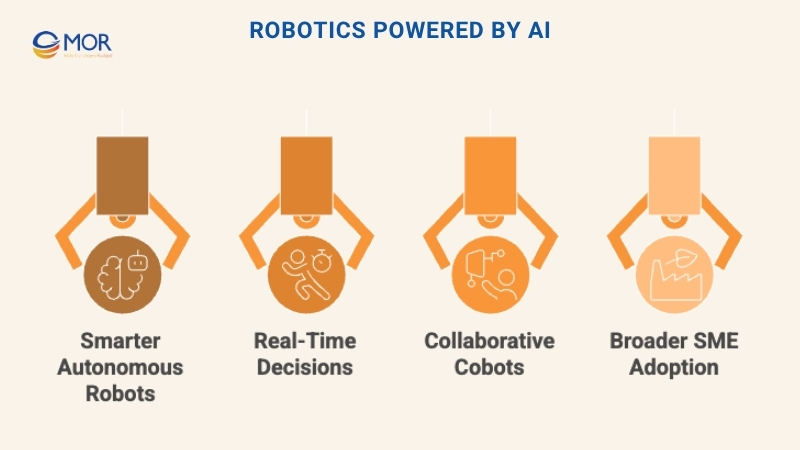
Collaborative robots, or cobots, are changing workplace dynamics by being easier to program and safer to use alongside people. In 2025, even small and medium-sized enterprises can adopt robotic solutions, broadening access and creating new opportunities for automation.
Biotechnology Software And AI-Assisted Discovery
AI is reshaping biotech software by boosting research accuracy and speeding up discovery pipelines. The global market for AI in biotech was valued at $3.2 billion in 2024 and is projected to hit $7.8 billion by 2029. Within drug development, AI-powered tools are cutting timelines by nearly 40% and lowering costs by around 30%. These gains make biotechnology one of the fastest-growing areas within software development trends for 2025.
Automotive Software Redefining Vehicles
Automotive software is redefining how modern vehicles are designed and experienced. Instead of relying on dozens of separate electronic control units, new centralized architectures handle all major computing tasks. This shift supports greater efficiency, easier upgrades, and smarter performance.
One standout capability is feature-on-demand, where car owners can unlock or purchase new functions even after buying the vehicle. This transition positions automotive software as a major player in software development industry trends going forward.
Enterprise Resource Planning Modernization
Global tax reforms and stricter regulations are driving multinational enterprises to modernize their ERP systems. The latest platforms now feature automated tax handling, built-in compliance modules, and centralized reporting dashboards.
These upgrades simplify preparation tasks, cut down on manual errors, and keep organizations aligned across multiple jurisdictions. As a result, ERP modernization is firmly part of software development trends that support both compliance and operational efficiency.
Greater Focus On User Experience (UX) And Total Experience (TX)
User experience has become a top priority in software development industry trends 2023 carried into 2025. Companies are increasing investment in design research to deliver applications that feel intuitive, engaging, and satisfying. A strong UX not only improves retention but also encourages deeper engagement, directly influencing business growth.
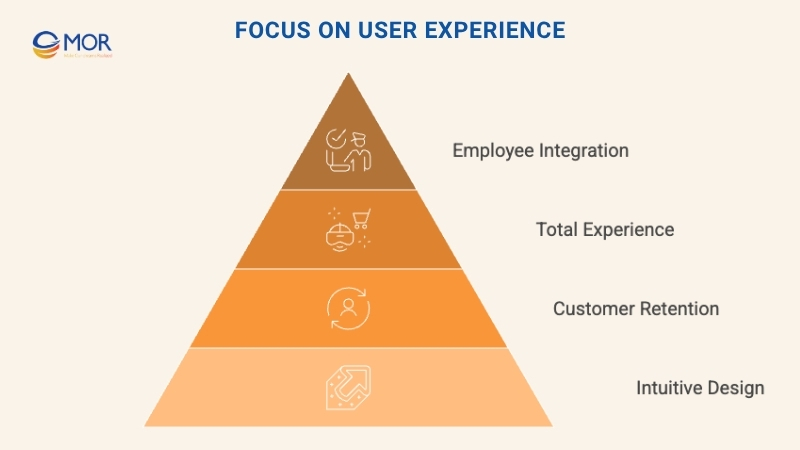
The idea of Total Experience (TX) is expanding this further by linking customer experience, user experience, employee experience, and multi-experience into one connected strategy. This approach boosts customer satisfaction while giving internal teams the tools to perform better. Looking ahead, software in 2025 will continue to be shaped by UX, automation, AI, and security as businesses compete to stay relevant.
What’s Next For Software Development Trends And Emerging Technologies
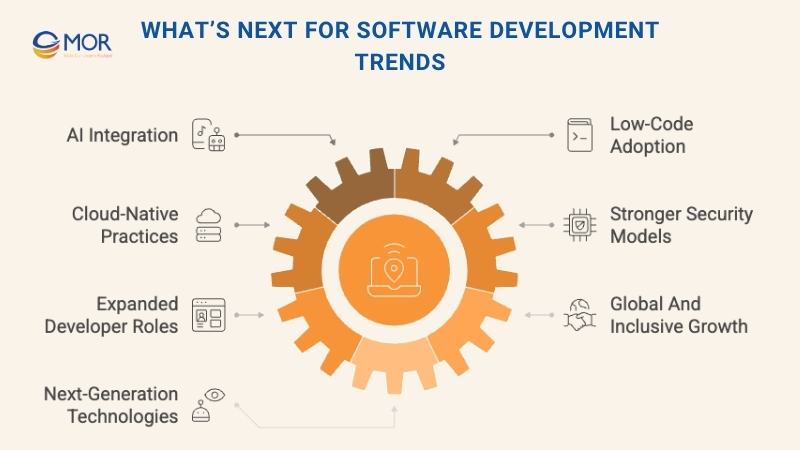
The future of software development is being shaped by AI integration, low-code adoption, cloud-native practices, and stronger security models such as DevSecOps and Zero Trust. These software development trends are transforming how teams design, secure, and release applications, making processes faster, more automated, and more collaborative.
Developers today are expected to go beyond coding, taking on roles that involve automation, product design, and user experience. At the same time, low-code platforms are enabling non-technical professionals to create apps, expanding who participates in building digital solutions. This democratization signals a major shift in the industry’s direction.
Much like offshore software development trends, the field is becoming more global, inclusive, and efficient. With agentic AI, Progressive Web Apps, and other next-generation technologies on the rise, the outlook points toward smarter, faster, and more accessible software creation for businesses and users alike.
MOR Software – Your Partner In Adopting Software Development Trends
MOR Software stands as one of Vietnam’s Top 10 ICT companies, recognized with the prestigious Sao Khuê Award. Our commitment to excellence is backed by international certifications, including ISO 9001:2015 for quality management and ISO 27001:2013 for information security.
We bring proven expertise across web and mobile development, Salesforce consulting, blockchain, AI, IoT, and cloud-based solutions. With more than 850 successful projects delivered to clients in over 10 countries, our team has earned trust on a global scale.
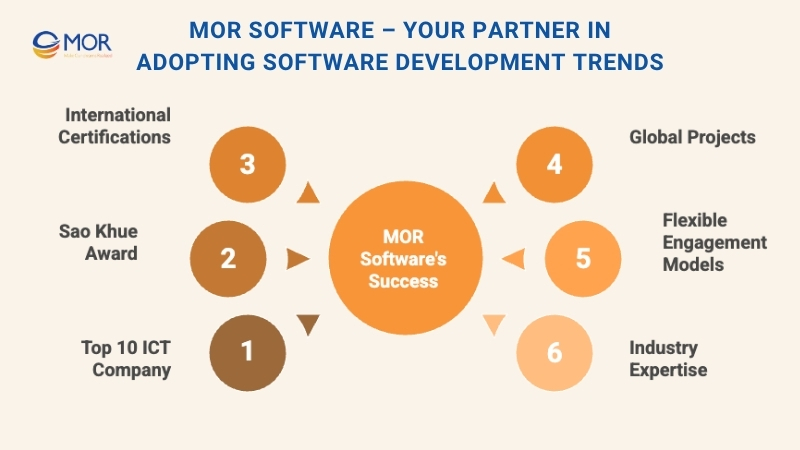
Businesses can rely on MOR for flexible engagement models, whether it’s forming dedicated development teams or scaling quickly with offshore outsourcing. Our case studies highlight success stories across healthcare, finance, manufacturing, and media, showcasing how we help organizations adopt new technologies and turn software development trends into measurable business results.
Conclusion
The pace of change in software development trends shows no sign of slowing. From AI-driven tools to cloud-native platforms and immersive technologies, 2025 is set to redefine how businesses build and deliver digital solutions. Staying ahead requires more than awareness, it demands the right partner. MOR Software brings global experience, proven expertise, and flexible models to help you transform ideas into results. Ready to move forward? Contact us today to start your journey.
MOR SOFTWARE
Frequently Asked Questions (FAQs)
What are the top software development trends in 2025?
The leading trends include generative AI, low-code/no-code platforms, cloud-native development, cybersecurity-as-a-service, immersive technologies, digital twins, and cross-platform development.
Why is AI shaping software development so strongly?
AI drives automation in coding, testing, and deployment. It improves productivity, supports conversational interfaces, and powers intelligent DevOps practices.
How are low-code and no-code platforms influencing businesses?
Low-code tools allow faster delivery of applications, even by non-technical staff. They help fill skill gaps and enable companies to test ideas quickly.
What role does cybersecurity play in software development trends?
With growing cyber risks, security is no longer an afterthought. Trends like DevSecOps and cybersecurity-as-a-service embed protection into every stage of development.
Are remote and distributed teams here to stay?
Yes. Companies value access to global talent and flexibility. Reports show a majority of tech firms will keep or expand remote development teams in 2025.
Which programming languages remain dominant in 2025?
Python, JavaScript, and Java still lead in adoption, while languages like Rust, Go, and TypeScript are gaining traction for specialized use cases.
What is the importance of user experience (UX) in these trends?
UX is now central to software success. Modern development emphasizes intuitive design, fast load times, and total experience (customer, user, and employee).
How does quantum computing affect software development?
Quantum breakthroughs open possibilities in logistics, medicine, and financial modeling. While still early, businesses adopting quantum solutions gain a competitive edge in solving complex problems.
Share


Make Our-Dreams Realized


© 2023 . MOR Software. All Rights Reserved
Sitemap
Privacy Policy
Terms of Use

Rate this article
0
over 5.0 based on 0 reviews
Your rating on this news:
Name
*Email
*Write your comment
*Send your comment
1