


20 Agile Software Development Best Practices to Follow for 2026

Agile can look simple on paper, then get messy once scope changes, deadlines move, and teams lose track of quality. Agile software development best practices help teams plan better, ship faster, and keep testing close to development. This MOR Software guide will walk through practical Agile planning, execution, coding, and scaling habits for stronger software delivery in 2026.
Key Takeaways
- Agile works best when planning, delivery, testing, and team management support the same product goal.
- Strong Agile teams keep backlogs clear, limit active work, review code often, and use retrospectives to fix real delivery problems.
- Businesses can apply agile software development best practices faster with a technical partner that understands sprint delivery, QA, CI/CD, and long-term product support.
What Are Agile Software Development Best Practices?
Agile software development best practices are tested ways of working that help teams ship useful software sooner and respond when needs shift. Forrester’s 2024 research found that 95% of professionals still see Agile as highly relevant to how they work. These methods come from the Agile Manifesto, which values team communication, working products, customer input, and fast response to change.
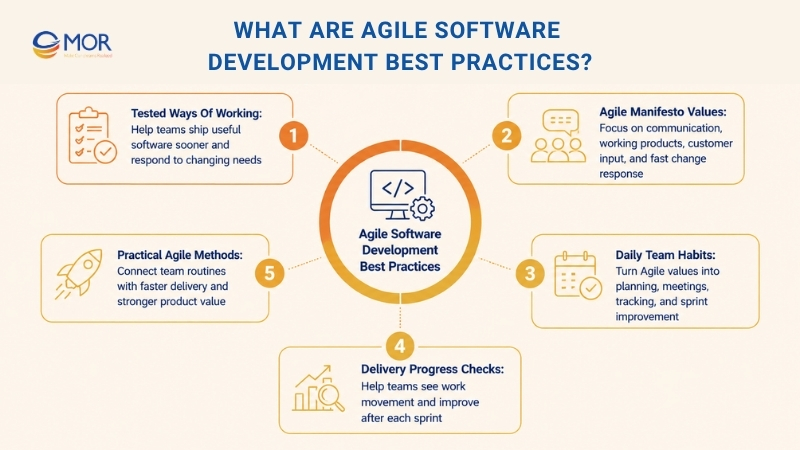
The best practices in agile software projects are the day-to-day habits that turn those values into real work: planning tasks, running team meetings, checking delivery progress, and improving after each sprint.
5 Must-Know Agile Planning Best Practices
Strong Agile planning gives your team a clear path without locking every detail too early. It helps everyone know the priority, agree on the goal, and shift direction when new facts appear. The strongest Agile teams see planning as regular teamwork, not a single meeting at the start.
Agile software development best practices work best when planning connects strategy with change, and strong agile best practices software development teams use should keep work tied to user value, feedback, and business needs.
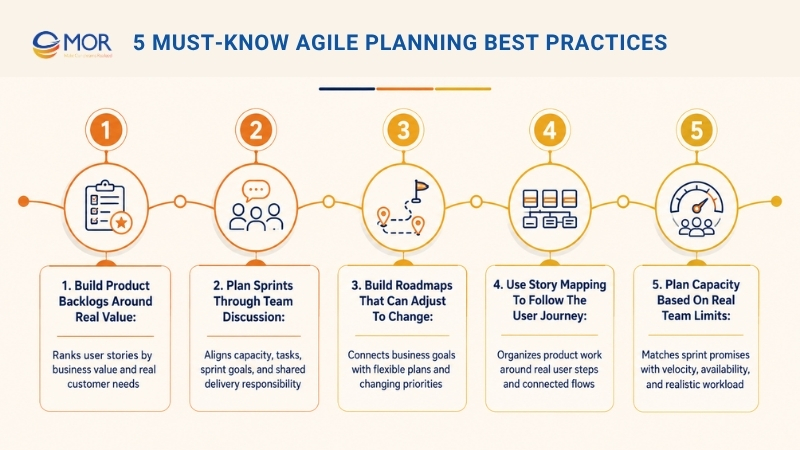
Build Product Backlogs Around Real Value
A product backlog is the ranked list of product needs, fixes, and ideas your team may build, and regular backlog refinement keeps that list aligned with user input and business goals.
Begin with user stories written from the user’s point of view: “As a [user], I want [goal] so that [benefit].” Rank those stories based on business value and user need, not on what looks easiest to code.
Check and clean the backlog each week. Add clear acceptance criteria to each item so the team shares the same meaning of “done.” This keeps your team working on useful tasks instead of building things users will ignore.
Plan Sprints Through Team Discussion
Sprints are set work cycles, often 2 to 4 weeks, where teams agree on a clear set of tasks. Sprint planning brings the team into one discussion so everyone knows what should be finished.
Start with the team’s real capacity, using past delivery and current availability as a guide. Choose backlog items that fit that capacity. Then turn those items into clear development tasks.
Close the meeting with team agreement on the sprint goal and workload. Good sprint planning stops teams from taking on too much and helps everyone feel responsible for delivery.
Build Roadmaps That Can Adjust To Change
Agile roadmaps give teams direction without forcing them into fixed dates too soon. They show business goals and changing priorities, so teams can respond to new market signals, customer needs, or product risks.
To create a useful Agile roadmap:
- Group work by themes or epics: center the plan on results and larger goals instead of single product items.
- Use flexible planning windows: set clearer goals for the next quarter and broader direction for later work.
- Revisit the plan often: adjust the roadmap each month using customer input, product data, or business changes.
At MOR Software, agile software development best practices help teams connect roadmap goals with active sprint work, progress tracking, and delivery planning. This keeps leaders, product owners, and engineering teams aligned on what matters now and what may change later.
Use Story Mapping To Follow The User Journey
User story mapping helps teams arrange product work around the steps users take, so the team builds connected user flows instead of scattered product parts.
Map the main actions users follow to reach their goal. Place related product items under each step. Then decide the smallest useful set of items for each release.
Check where the journey feels weak or incomplete. This keeps development tied to real user needs through the whole project.
Plan Capacity Based On Real Team Limits
Capacity planning connects sprint promises with what your team can truly finish, and Agile estimation helps keep the pace steady over time.
Track velocity, which shows how much work your team usually completes in a sprint. Keep 20% of team capacity open for urgent tasks, learning, and unknown issues. Spread work based on each person’s skills so one person does not become the bottleneck.
You should also count holidays, meetings, reviews, and other planned work. Careful capacity planning makes delivery easier to forecast and lowers the risk of team burnout.
5 Key Agile Development Practices For Execution Excellence
Good execution turns planning into visible progress. These Agile routines create a daily rhythm, shared visibility, and close teamwork so tasks keep moving and teams stay focused on the same goal.
When teams apply agile software development best practices in daily work, they keep momentum, spot blockers sooner, and ship better software with fewer delays. Daily standups, workflow boards, limits on active work, team roles, and automation form the base of strong agile development best practices.
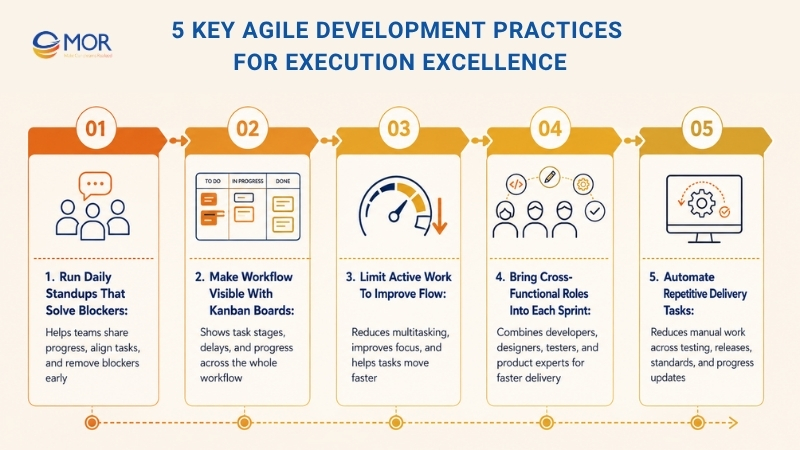
Run Daily Standups That Solve Blockers
Daily standups are short Agile meetings where team members share updates and raise blockers. When done well, they help the team move faster and catch small issues before they spread.
- What progress did you make yesterday? Share real work finished, not vague updates.
- What will you focus on today? Align tasks and find possible conflicts.
- What is blocking your work? Ask for help before the issue slows the sprint.
Standups should support team coordination, not become manager-led status checks. When people see that these meetings help them solve problems, they join with more focus and energy.
Make Workflow Visible With Kanban Boards
Kanban boards show work in clear stages through columns. Tasks move from one column to the next, so blockers and delays become easy to see.
Create simple columns like “To Do,” “In Progress,” “Review,” and “Done.” Set work-in-progress limits to stop the team from taking on too much at once. Track how long tasks stay in each stage.
In MOR Software projects, digital Agile boards can support automation, custom fields, sprint updates, and team visibility across locations. This helps distributed teams stay aligned without extra reporting work.
Limit Active Work To Improve Flow
Working on fewer tasks at the same time often helps teams finish more. Work-in-progress (WIP) limits cap the number of items allowed in each stage, which makes agile software development best practices easier to apply in real sprint work.
Teams often see gains soon after they set WIP limits:
- Less task switching: focused work on fewer items raises quality.
- Quicker delivery: tasks move through the workflow with less waiting.
- Lower defect risk: less multitasking means fewer careless mistakes.
- Clearer delay points: blocked stages become visible when work piles up.
Set your limits based on team size and task difficulty. You can change them later as your team learns what flow works best.
Bring Cross-Functional Roles Into Each Sprint
Cross-functional teams include the Agile roles needed to finish full product work, with developers, designers, testers, and product experts working together during each sprint. Daily teamwork leads to faster choices, fewer blockers, and stronger shared ownership.
Support collaboration through:
- Open team spaces: keep updates, questions, and progress visible to the full team.
- Mixed viewpoints: bring each role into product and technical discussions.
- Shared knowledge: record decisions so one person does not hold all the answers.
Shared ownership helps narrow the gap between what leaders expect and what employees feel responsible for. When every role helps the sprint succeed, teams cut handoffs, confusion, and slow feedback loops.
Automate Repetitive Delivery Tasks
Automation removes repeat manual tasks so teams can spend more time solving hard product and technical problems. When common delivery steps run with less manual effort, teams keep their pace and avoid friction that slows releases.
Common areas for automation include:
- Test runs: find bugs early and keep quality steady.
- Release steps: move approved code toward production with fewer manual actions.
- Coding standards: check code rules before review begins.
- Progress alerts: send updates to stakeholders without pulling developers away from work.
In MOR Software’s Agile delivery work, automation can support task movement, quality checks, sprint reporting, and system updates. This gives teams more time to focus on building useful software.
5 Proven Agile Management Practices For Steady Team Growth
Agile management should help teams do their best work, not control every action. A best practice agile software development teams often need is simple: give people visibility, trust, and room to make smart choices.
These management habits help teams stay aligned, measure progress, and use data to improve. Together, they support steady growth and stronger performance across Agile teams using agile software development best practices.
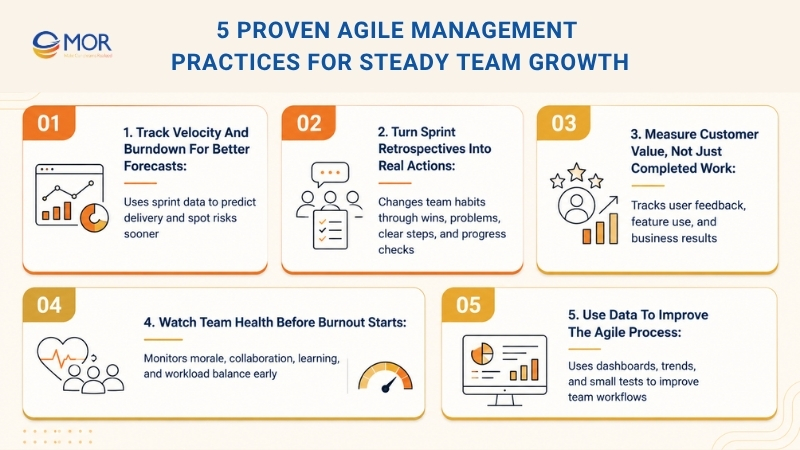
Track Velocity And Burndown For Better Forecasts
Velocity shows the amount of work your team finishes in each sprint. Burndown charts show how much work remains as the sprint moves forward. Used together, they help teams forecast delivery with more confidence.
Find velocity by averaging the last three to five sprints. Use burndown charts to compare real progress with the planned pace. Look for patterns across several sprints, not just one unusual week.
These metrics help your team make realistic promises and find delivery risks early. MOR Software’s Agile teams can set up sprint dashboards and reports that turn project data into clear planning signals.
Turn Sprint Retrospectives Into Real Actions
Sprint retrospectives happen at the end of a sprint, when the team looks back and chooses what to improve. The best sessions lead to change, not just another discussion about the same issues.
Use this simple flow for stronger retrospectives:
- Wins to keep: name what worked and should continue.
- Problems to fix: discuss pain points without blaming people.
- Clear next steps: agree on practical changes for the next sprint.
- Progress checks: review whether past action items were completed.
Create psychological safety so team members can speak honestly. Focus agile software development best practices on improving the process, not judging individual people.
Measure Customer Value, Not Just Completed Work
Success should mean users gain value, not just that tickets move to “Done.” Track results that matter to users and to the business.
Measure value from more than one angle. Collect user feedback through surveys and product usage data. Track which product parts people actually use. Link development work with business numbers like revenue, retention, or customer satisfaction.
These signals help your team choose better priorities and show how development supports business results. This matters because employees who understand how success is measured are 2x more likely to feel motivated.
Watch Team Health Before Burnout Starts
Team health shapes productivity, quality, and retention. Healthy teams can keep a strong pace, but tired teams often lose focus and burn out.
Track these health signals:
- Team mood checks: run regular pulse surveys on morale.
- Collaboration quality: watch how teams talk, solve conflict, and share work.
- Learning paths: support skill growth and career progress.
- Workload balance: check overtime, stress, and recovery time.
Fix team health problems early before they damage delivery. Engaged teams with a healthy pace tend to build better software.
Use Data To Improve The Agile Process
Use data to improve work habits in a steady way. This beats making process changes based only on guesses or loud opinions.
Build dashboards that bring key metrics into one place. Study trends across different signals. Test small process changes before making them standard. Make regular updates based on what the data shows.
MOR Software can help teams shape Agile reports, sprint metrics, and delivery views that support this steady improvement cycle.
Agile Coding Practices For Better Code Quality
Agile coding practices are hands-on development habits that match the values behind Agile programming. Agile delivery and coding discipline both support strong software work, but they serve different parts of the product life cycle. Agile software development best practices help teams keep code clear, stable, and simple to update, which is why agile software best practices must cover engineering quality too.
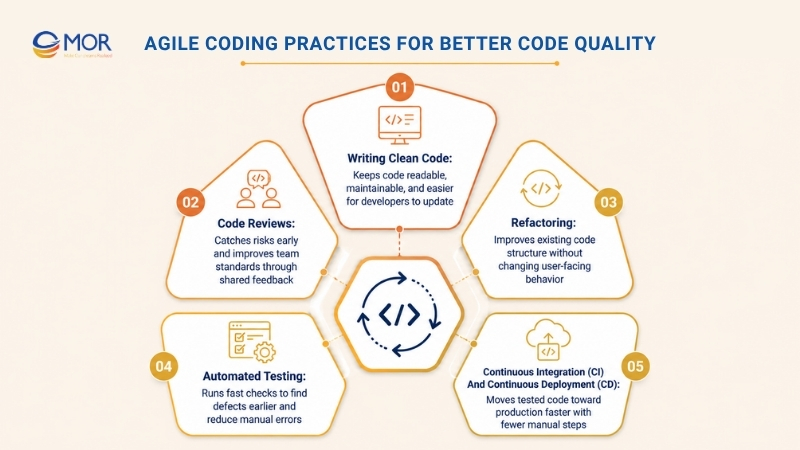
Writing Clean Code
Clean code is simple to read, easy to follow, and practical to maintain. It uses clear naming rules, helpful notes, and simple logic instead of needless layers.
- Clean code helps team members read and change the code with less confusion. New developers can understand the codebase faster, which shortens ramp-up time and helps them start contributing earlier.
- It lowers the chance of bugs and mistakes. Developers spend less time fixing broken logic, so they can put more time into new product work and product improvement.
- Clean code raises the general quality of the codebase. A stable and smooth product helps users stay satisfied and keeps them coming back.
Code Reviews
Code reviews mean checking and discussing code updates with other developers before they enter the main codebase. This habit helps the code meet team standards and follow agreed engineering practices.
- Code reviews help teams catch risks and weak spots earlier in the development flow, which costs less than fixing them after release. Early review creates software that is more stable and easier to trust.
- The review process opens useful talks about coding habits, design choices, and system structure. Feedback helps developers grow their skills, so the whole team becomes sharper and more capable. It also builds stronger team trust and supports open, respectful communication.
- Code reviews help code follow the company’s style rules and technical guidelines. A shared style and steady quality make the codebase easier to maintain and move through.
Refactoring
Refactoring means changing the inner structure of existing code without changing what the software does for users. Adding this step to the development flow helps make code easier to read and improve later.
- Refactoring makes code easier to maintain, easier to understand, and less weighed down by technical debt.
Automated Testing
Automated testing uses tools to run checks on code without manual effort. These checks may include unit tests for single functions and integration tests for how system parts work together.
- Automated tests can run fast and often, usually after each code update, so teams find problems soon after they appear. Early detection helps developers spend less time tracing defects and more time moving the product forward, which supports faster delivery cycles.
- Automated checks are less affected by human mistakes, so results tend to be more steady and accurate. Reliable test results give developers and stakeholders more confidence that the software works as planned and that new changes have not created new issues.
Continuous Integration (CI) And Continuous Deployment (CD)
Continuous Integration (CI) means developers merge code updates into a shared repository often, sometimes many times a day. Continuous Deployment (CD) means approved code changes move to production after automated tests pass. CD extends CI because new fixes and product updates can reach users faster.
- When the deployment process runs automatically, CD removes much of the manual work and makes releases faster. A shorter release cycle helps businesses bring new updates to customers sooner and stay ahead in the market.
- Automated deployment follows the same steps each time, which lowers the risk of human mistakes.
- Users can access updates soon after those changes pass the test process. Fast feedback gives teams useful signals for future product planning and business decisions.
Agile Software Development Best Practices Checklist For Teams
An Agile team can move quickly only when planning, delivery, management, and code quality support one another. This agile best practices checklist brings together key agile software development best practices across backlog work, sprint delivery, team coordination, progress tracking, and engineering quality. Teams can use it before a sprint, during active work, and after release to keep tasks practical, focused, and tied to customer value.
Area | Best Practice | What Teams Should Do | Why It Matters |
Agile Planning | Value-Focused Product Backlog | Keep backlog items clear, ranked, and updated with user feedback, business value, and acceptance criteria. | This helps teams work on product items users really need instead of low-value tasks. |
Agile Planning | Team-Based Sprint Planning | Check team capacity, choose realistic backlog items, set the sprint goal, and agree on commitment together. | This stops the team from taking on too much and gives everyone ownership of sprint work. |
Agile Planning | Adaptable Agile Roadmap | Arrange work around themes, epics, and business results instead of fixing every feature to a strict date. | This keeps the team aligned and still leaves room to change when priorities move. |
Agile Planning | Journey-Led Story Mapping | Arrange product work around the user journey and define the smallest useful set of items for each release. | This keeps development tied to real user needs instead of random feature requests. |
Agile Planning | Realistic Capacity Planning | Track velocity, count holidays and meetings, keep room for urgent work, and spread tasks based on skills. | This makes delivery easier to forecast and protects the team from burnout. |
Agile Execution | Blocker-Focused Daily Standups | Use standups to share progress, align today’s work, and raise blockers early. | This keeps the sprint moving and helps the team solve issues before they grow. |
Agile Execution | Clear Kanban Workflow | Use boards with stages like To Do, In Progress, Review, and Done to show work clearly. | This makes bottlenecks easier to find and gives the team better visibility. |
Agile Execution | WIP Control | Limit how many tasks can stay in each workflow stage at one time. | This cuts task switching, improves focus, and helps work move faster. |
Agile Execution | Full-Team Sprint Collaboration | Bring developers, testers, designers, product owners, and business experts into the sprint flow. | This cuts handoffs, improves decisions, and builds shared accountability. |
Agile Execution | Delivery Task Automation | Automate testing, deployment, task updates, progress reports, and code checks where possible. | This saves time and lets the team focus on product problems instead of repeat admin work. |
Agile Management | Velocity And Burndown Review | Track finished work and remaining sprint work across several sprints, not only one cycle. | This helps teams forecast delivery better and spot risks earlier. |
Agile Management | Action-Driven Retrospectives | Discuss what worked, what needs to change, and which actions the team will try in the next sprint. | This turns feedback into real process change instead of repeated talk. |
Agile Management | Customer Value Tracking | Track user feedback, feature use, retention, revenue effect, and customer satisfaction. | This helps teams measure product value, not only closed tickets. |
Agile Management | Team Health Checks | Review morale, teamwork, workload balance, growth paths, and signs of burnout. | Healthy teams build better software and keep strong performance for longer. |
Agile Management | Data-Led Improvement | Use dashboards, trend checks, and small tests to improve planning and delivery. | This helps teams improve from real evidence instead of guessing. |
Code Quality | Readable Code | Use clear names, simple structure, steady style, and logic that is easy to follow. | Clean code is easier to review, test, debug, and maintain over time. |
Code Quality | Peer Code Review | Check code before merging to review quality, logic, security, standards, and maintainability. | This catches problems early and helps developers learn from one another. |
Code Quality | Ongoing Refactoring | Improve current code structure without changing how the software works for users. | This lowers technical debt and keeps the codebase easier to expand. |
Code Quality | Automated Test Coverage | Run unit, integration, and regression tests often after code updates. | This helps teams catch defects early and release with more confidence. |
Code Quality | CI/CD Delivery Pipeline | Merge code often, run automated checks, and deploy approved changes through a repeatable pipeline. | This shortens release cycles, lowers manual mistakes, and supports faster customer feedback. |
Benefits Of Agile Software Development Best Practices
The value of Agile software development shows through real delivery results. When teams work around flow, feedback, and quality, their performance improves. The best practices agile software development teams follow should lead to clear gains like these:
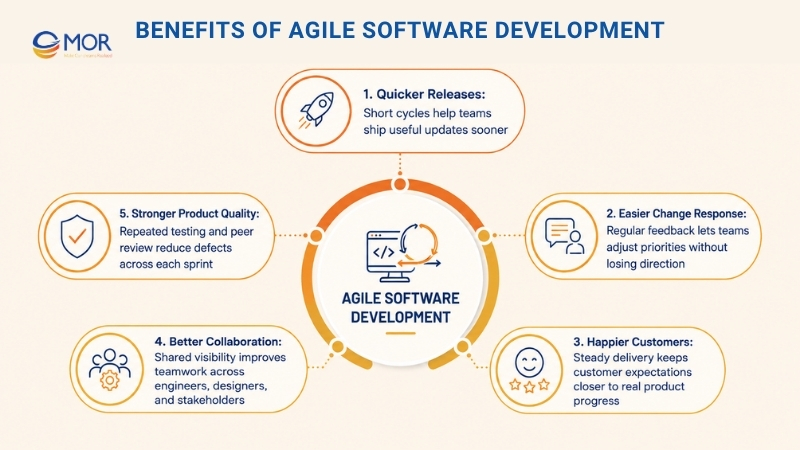
- Quicker releases, easier change, and happier customers: Short work cycles and regular feedback help teams ship useful product updates sooner. This speed gives teams room to change priorities without losing direction. Teams can also see about a 30% rise in customer satisfaction. This shows how steady delivery keeps customer expectations close to real progress.
- Better teamwork and lower delivery risk: Shared visibility removes walls between engineers, designers, and stakeholders. Clearer work makes handoffs easier and lowers dependency risk. The 17th State of Agile Report found that 59% of Agile teams saw better collaboration after they adopted Agile.
- Better quality through repeated testing: Agile turns testing into a regular habit instead of a final checkpoint. In every sprint, teams check and improve product behavior through test automation and peer review. It is also worth noting that 52% of companies adopt Agile to improve software quality, get better results, and cut repeat defects.
- Keep in mind: MOR Software helps extend these gains through Agile delivery, quality control, testing, maintenance, and sprint-based development work. Instead of guessing where delivery gets stuck, you can review the process. You can see how teamwork, delivery speed, and product quality change across your teams.
Common Agile Methodologies Used In Software Development
Agile methodologies are project delivery models based on repeated work cycles. They share Agile principles, but each one changes how your team plans, builds, reviews, and adjusts work.
That means you need to choose a method that fits your team setup, release rhythm, and feedback flow.
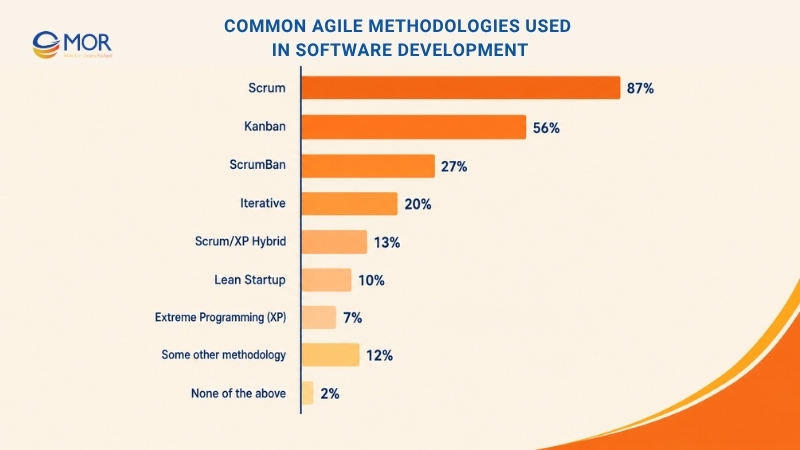
For teams studying software development best practices agile methods can shape, the 16th Annual State of Agile Report shows which approaches teams use most today. Let’s look at several common choices:
Scrum
Scrum is still the most common Agile method, used by 87% of teams. Its main strength is a clear working structure. This includes short fixed sprints, supported by roles like the Scrum Master, Product Owner, and delivery team.
Every sprint begins with sprint planning, closes with a review, and uses a daily standup to keep work moving. Scrum works because feedback appears throughout the process. You can see blockers almost right away instead of waiting until the end of a release cycle.
Kanban
Kanban centers on visible workflow. You manage tasks on a live board, limit work in progress, and notice bottlenecks as they appear.
Since Kanban does not require fixed sprint cycles, it works well for support-heavy or complex workloads. With 56% of teams using it, many teams pair it with Scrum to get structure and room to adjust.
Extreme Programming (XP)
Extreme Programming (XP) pushes engineering discipline deeper into daily work. It focuses on habits like pair programming, unit testing, and steady user feedback.
Only 7% of teams use it, but XP still matters for strong technical work. This is especially true when quality and reliability matter more than speed alone.
Lean Software Development
Around 8% of teams use Lean principles, which focus on cutting waste and increasing learning. Lean software development aims to build only what users value, shorten feedback cycles, and let teams decide how to improve their own work.
Crystal, FDD, And SAFe
Other methods like Feature-Driven Development (FDD), Crystal, and the Scaled Agile Framework support larger or more specialized teams. SAFe is used by 53% of teams. It helps larger groups apply agile software development best practices across departments with more shared visibility, though it needs heavier coordination.
Pro tip: MOR Software works with Agile and Scrum-based delivery across web, mobile, Salesforce, offshore development, and testing projects. Our teams connect planning, development, QA, integration, and maintenance work so you can track delivery with clearer visibility and less project noise.
Agile SDLC Workflow From Idea To Release
Knowing the Agile SDLC phases helps teams understand how work moves from early idea to live product. Agile can change when new feedback appears, but most teams still follow a clear loop.
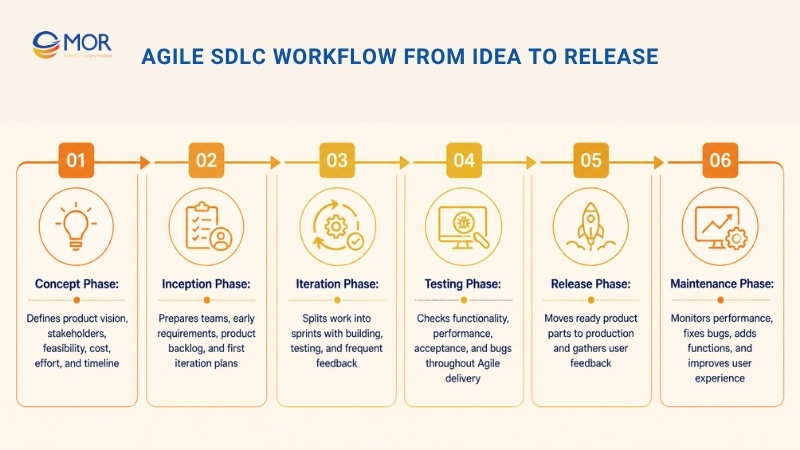
Concept Phase
This is where the first product idea takes shape.
- Define the product vision and main goals
- List key stakeholders
- Run an early feasibility check
- Estimate cost, effort, and timeline
This step sets the direction for the full Agile development life cycle.
Inception Phase
At this point, teams get ready for delivery work.
- Form the development team
- Clarify early requirements
- Prepare the product backlog
- Map the first iteration
MOR Software often supports this stage through business analysis, roadmap planning, team setup, and technical scoping so clients can start development with clearer direction.
Iteration Phase
This phase sits at the center of Agile delivery.
- Work is split into sprints, usually 1 to 4 weeks
- Developers build product parts step by step
- Testing runs through the whole sprint
- Feedback is collected often
Each sprint creates a usable product increment, which is why agile software development best practices help teams keep delivery fast and steady.
Testing Phase
Testing does not wait until the end like in older models.
- Functional testing
- Performance testing
- User acceptance testing
- Real-time bug fixing
This helps teams keep quality under control across the Agile methodology life cycle, not only during the last checkpoint.
Release Phase
When a product part is ready:
- It moves to production
- Documentation is finalized
- User feedback is gathered
This stage supports quick delivery, one of the main strengths of the Agile SDLC.
Maintenance Phase
Agile work continues after launch.
- Monitor product performance
- Fix bugs
- Add new functions
- Improve user experience
This ongoing loop makes best practices for software development in an agile environment useful for long-term product growth.
What Works Best For Enterprise Agile Teams
Enterprise Agile works best when teams keep speed, control, and quality in balance. Large companies need more than sprint meetings. They need clear ownership, safe delivery rules, sound architecture, and steady links between business teams and engineering teams.
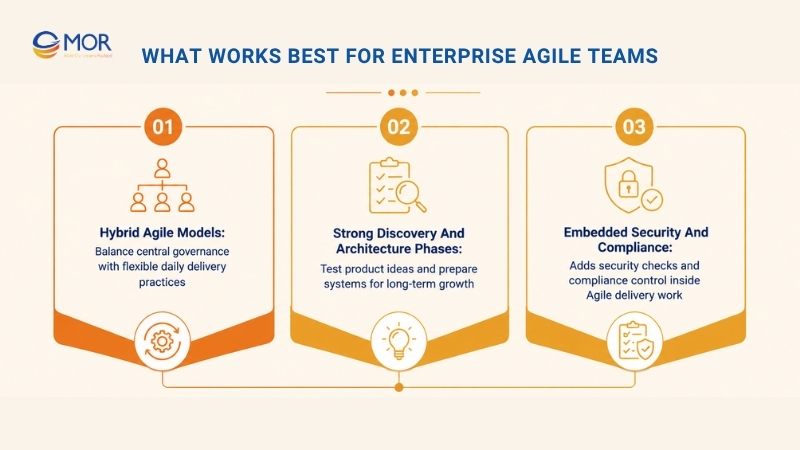
Hybrid Agile Models
Many companies use hybrid Agile models that mix iterative delivery with parts of traditional governance. Planning, budgets, and architecture control may stay central, while delivery teams follow Agile practices in their daily work.
Hybrid Agile helps large firms keep financial control and meet compliance needs while giving development teams enough room to adapt. This approach fits complex digital programs where many systems, teams, and stakeholders need to move together.
Strong Discovery And Architecture Phases
Strong Agile programs spend enough time on product discovery and architecture planning. Discovery helps test product ideas and user needs, while architecture planning helps systems grow as new functions are added.
For AI and machine learning systems, early choices around data pipelines, infrastructure, and model release methods can shape long-term system performance.
Teams that give discovery and architecture enough attention lower technical debt and improve product life span.
Embedded Security And Compliance
Security and compliance should sit inside Agile delivery work, not outside it. DevSecOps practices can automate vulnerability checks, dependency review, and infrastructure security validation.
Security research shows that teams using DevSecOps can cut security incidents by up to 50% while still keeping release cycles moving.
When security becomes part of Agile, teams can build faster without putting system reliability or compliance at risk.
Agile Software Development Best Practices At Scale: Lessons From Enterprise Programs
Scaling Agile in large companies means more than adding more Agile teams. Organizations must coordinate many teams working at the same time across shared architecture, cloud platforms, and data systems. Without clear governance, platform rules, and DevOps automation, Agile at scale can lead to disconnected systems, repeated work, and uneven delivery.
Large enterprises now use AI to handle this program-level complexity. MOR Software helps teams review delivery metrics across teams, find bottlenecks in CI/CD pipelines, track dependency risks before they block releases, and spot patterns in defects or deployment issues. Portfolio-level data can also help teams adjust backlogs based on product usage and system signals instead of waiting for static quarterly reviews.
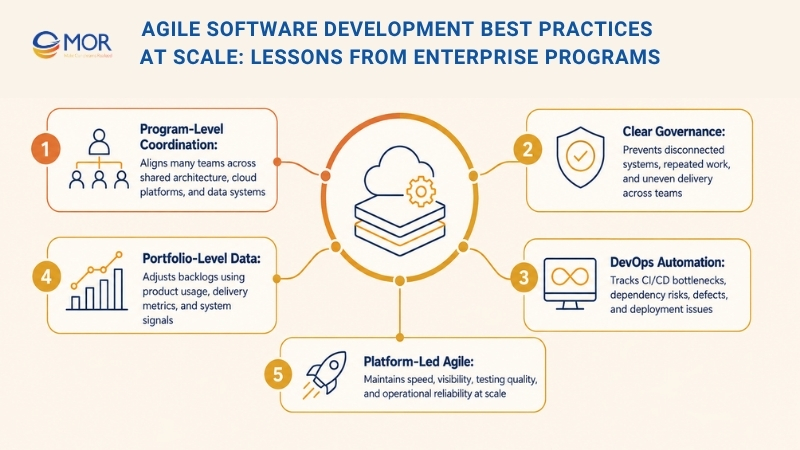
Real-time signals around risk, capacity, and delivery help leaders keep visibility across large programs without depending on a central team to collect manual status updates from every squad.
This platform-led Agile model helps organizations building complex systems, like digital banking platforms, AI analytics systems, and multi-cloud data environments, keep development speed without weakening operational reliability. It also shows why agile software development best practices for large software development projects must include architecture, governance, testing, and delivery visibility.
Common Agile Software Development Mistakes To Avoid
Agile helps software teams move faster, respond to change, and ship useful products in shorter cycles. Yet many teams get stuck when they focus on meetings and rituals instead of clear goals, close teamwork, and steady improvement. To make Agile delivery practices work, teams should avoid the mistakes that quietly slow work and hurt product quality.
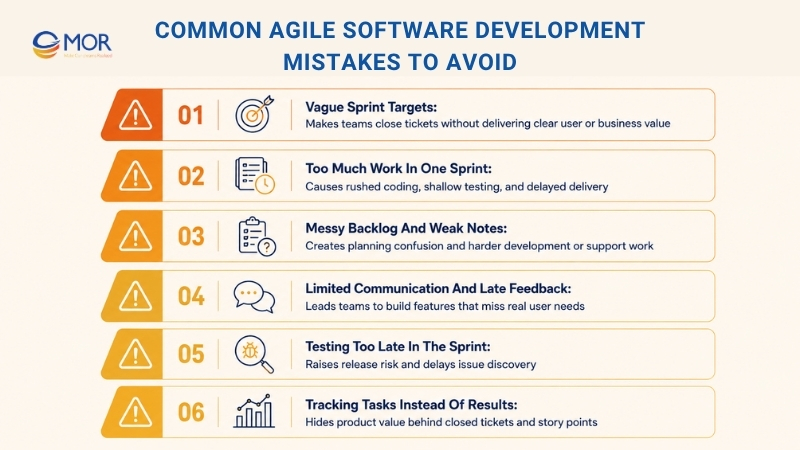
- Vague Sprint Targets: A sprint should aim for a clear result, not a random group of tasks. When the target is unclear, teams may close tickets but still fail to bring real value to users or the business.
- Too Much Work In One Sprint: Loading a sprint with more work than the team can handle often causes rushed coding, shallow testing, and late delivery. Teams should plan from real capacity, current blockers, and the amount of work they can finish well.
- Messy Backlog And Weak Notes: A poor backlog makes planning harder, and missing documentation creates confusion during development and support. User stories, acceptance criteria, API notes, release information, and major decisions should stay clear and easy to find.
- Limited Communication And Late Feedback: Agile needs steady alignment between developers, testers, product owners, designers, and business teams. Without early stakeholder feedback, teams may build product parts that look finished but miss real user needs.
- Testing Too Late In The Sprint: Testing should not start only during the last few days. Early QA input, automated tests, code reviews, and continuous integration help teams find issues sooner and protect release quality.
- Tracking Tasks Instead Of Results: Closed tickets and story points do not always prove the product is getting better. Strong Agile teams also watch customer value, feature use, defect rate, cycle time, release stability, and lessons from retrospectives.
How To Apply Agile Software Development Best Practices Successfully
Applying agile software development best practices works best when teams begin with a clear purpose instead of a long rulebook. The aim is to improve how people plan, build, test, release, and learn as one team. A strong Agile rollout should start small, track real progress, and grow only after the team has a steady rhythm. This is where best practices quality agile software development efforts can turn Agile from a process label into better delivery.
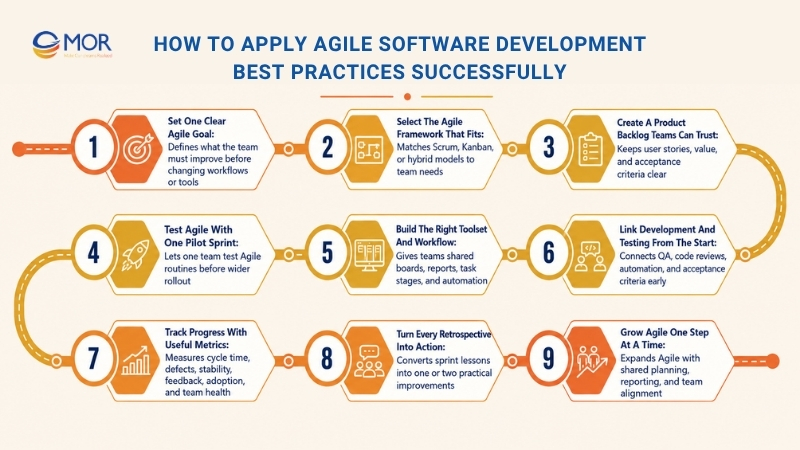
Set One Clear Agile Goal
Before changing meetings, tools, or workflows, define what the team needs to improve. Some teams need faster releases. Others need fewer bugs, clearer priorities, better stakeholder feedback, or tighter links between product and engineering. A clear goal helps everyone know why Agile matters and what success should look like.
Select The Agile Framework That Fits
Not every team needs the same Agile setup. Scrum fits teams that need structured sprints, planning meetings, and review cycles. Kanban works well for teams handling continuous requests, support tasks, or frequent priority changes. Some software teams may need a hybrid model that mixes sprint planning with flexible workflow control.
Create A Product Backlog Teams Can Trust
A strong backlog gives Agile teams a clear path. Product owners should write user stories from the user’s view, rank them by business value, and add acceptance criteria to each item. Backlog refinement should happen often so the team does not enter sprint planning with unclear, old, or low-value tasks.
Test Agile With One Pilot Sprint
Begin with one team or one product area before using Agile across the whole company. A pilot sprint lets the team try sprint planning, daily standups, task boards, reviews, retrospectives, and delivery expectations in a smaller setting. This helps teams find problems early and adjust the process before wider rollout.
Build The Right Toolset And Workflow
Agile tools should make work easier to see and manage. Teams need a shared board, clear task stages, backlog visibility, sprint reports, and basic automation for updates, testing, or deployment. The tool should support the workflow, not push the team into a process that does not fit how they build software. MOR Software helps teams apply agile software development best practices through clear workflow setup, Agile delivery support, QA, integration, and maintenance services.
Link Development And Testing From The Start
Agile delivery becomes risky when testing only happens near the end of a sprint. QA engineers, developers, and product owners should work together from the start. Automated testing, code reviews, acceptance criteria, and continuous integration help teams catch problems earlier and release with more confidence.
Track Progress With Useful Metrics
Agile teams should not rely only on finished tickets or story points. Those numbers show activity, but they do not always show product value. Teams should also track cycle time, defect rate, release stability, customer feedback, feature adoption, team health, and sprint goal completion.
Turn Every Retrospective Into Action
Retrospectives should create real change. At the end of each sprint, the team should discuss what worked, what slowed delivery, and what needs to change next. Choose one or two clear improvements for the next sprint instead of making a long list that nobody follows.
Grow Agile One Step At A Time
After one team builds a stable rhythm, the organization can bring Agile practices to more teams. Scaling should include shared planning rules, aligned product goals, consistent reporting, and clear communication across teams. Expanding too fast can create confusion, so each new team should adjust Agile habits to match its own work style and delivery needs.
Need A Technical Partner To Apply Agile Software Development Best Practices?
Knowing agile software development best practices is one thing. Making them work inside a real project is harder. Many teams have sprint meetings, task boards, and retrospectives, yet still deal with unclear scope, slow releases, weak testing, and too many handoffs.
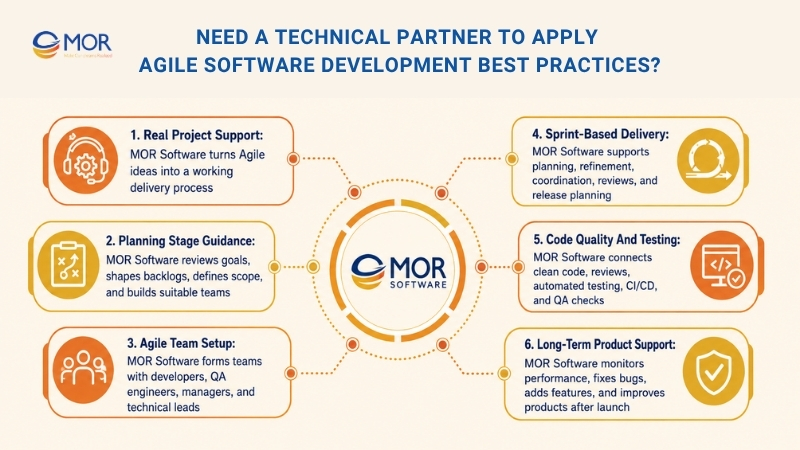
MOR Software helps businesses turn Agile ideas into a working delivery process. We can join from the planning stage, review product goals, shape the backlog, define sprint scope, and build a team that fits the project’s technical needs.
- Agile Team Setup: We help form the right team structure with developers, QA teams, project managers, technical leads, and other roles needed for steady delivery.
- Sprint-Based Delivery: We support sprint planning, backlog refinement, daily coordination, sprint reviews, and release planning so every cycle has a clear goal.
- Code Quality And Testing: We connect Agile delivery with clean code, code review, automated testing, CI/CD, and QA checks to lower release risk.
- Long-Term Product Support: After launch, we help monitor performance, fix bugs, add new features, and improve the product based on user feedback.
With MOR Software, agile team practices become part of daily delivery, not just a list of rules.
Conclusion
Agile software development best practices help teams move from scattered tasks to clearer, faster, and safer delivery. The real value comes from steady habits: clear sprint goals, strong backlogs, early testing, clean code, and honest retrospectives. For business teams, Agile works best when process and engineering quality move together. Need support turning Agile into real project results? Contact us to discuss your next software project with MOR Software.
MOR SOFTWARE
Frequently Asked Questions (FAQs)
What are agile software development best practices?
Agile software development best practices are proven ways for teams to plan, build, test, and release software in short cycles. They help teams stay flexible, work closely with users, and improve after each sprint.
Why do Agile teams use sprints?
Sprints give teams a clear time frame to finish selected work. Most sprints last one to four weeks, which helps teams stay focused and collect feedback sooner.
How often should teams refine the product backlog?
Teams should review the backlog every week or before sprint planning. This keeps user stories clear, removes outdated tasks, and helps the team focus on high-value work.
What makes a good Agile sprint goal?
A good sprint goal is clear, realistic, and tied to user or business value. It should explain what the team wants to deliver, not just list the tasks they plan to finish.
What is the role of daily standups in Agile?
Daily standups help team members share progress, plan the day, and raise blockers. They should be short and useful, not a long report to managers.
How do Agile teams improve code quality?
Teams improve code quality through clean code, code reviews, refactoring, automated testing, and CI/CD. These agile software development best practices help teams catch issues early and release with more confidence.
What metrics should Agile teams track?
Useful metrics include sprint goal completion, cycle time, defect rate, release stability, team health, user feedback, and feature adoption. Story points alone do not show whether the product is getting better.
How can teams avoid Agile burnout?
Teams can avoid burnout through realistic sprint planning, clear priorities, WIP limits, and regular team health checks. A steady pace works better than forcing too much work into every sprint.
Which Agile method should a software team choose?
Scrum works well for sprint-based product delivery. Kanban fits support work, maintenance, and changing priorities. Many teams mix both methods when one style does not fit all types of work.
How can a team start applying agile software development best practices?
Start with one team, one product area, and a clear delivery goal. Build a clean backlog, run a pilot sprint, review results, and improve one or two habits at a time before expanding.
Share


Make Our-Dreams Realized


© 2023 . MOR Software. All Rights Reserved
Sitemap
Privacy Policy
Terms of Use

Rate this article
0
over 5.0 based on 0 reviews
Your rating on this news:
Name
*Email
*Write your comment
*Send your comment
1