


Top 10 DEX Development Company in 2026
Choosing a DEX development company can feel confusing when every provider promises similar strengths, but your product goals, budget, and launch risks are not the same. This MOR Software’s guide will compare leading teams, core DEX development services, and the steps behind strong decentralized exchange development, so you can see which partner truly matches your roadmap.
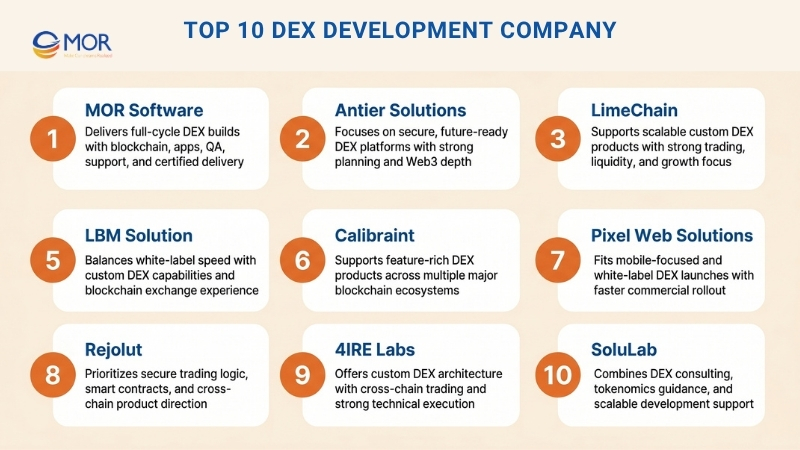
Top 10 DEX Development Company In 2026
Choosing the right DEX development company in 2026 takes more than scanning a short vendor list. You need a team that matches your product goals, trading model, and launch plan, whether you are comparing a DEX exchange development company for speed, custom work, or long-term product depth.
MOR Software: A Strong Choice For End-To-End DEX Development
At MOR Software, we do more than write blockchain coding for an exchange product. That wider scope matters when your platform needs smart contracts, backend architecture, web and mobile apps, QA, and ongoing support to work as one system. We started in 2016, have completed 850+ projects in 10+ countries, and run offices in Ho Chi Minh City, Ha Noi, Da Nang, Tokyo, and Osaka. We also present our blockchain services, flexible offshore model, and certified delivery approach through ISO 9001:2015, ISO 27001:2013, and the Sao Khue Award.
Our edge in this market comes from broader product coverage, not only exchange coding. We publicly cover crypto exchange builds, branded exchange products, Web3 development services, smart contract work, and custom blockchain development systems, which makes us a practical choice when DEX development is only one part of a larger roadmap.
Why Choose MOR Software?
- One delivery model brings together blockchain, web, mobile, QA, and IT consulting.
- Our offshore setup is proven, with Agile and Scrum delivery, flexible team growth, and full-lifecycle support.
- We fit businesses that want a custom DEX product, not a basic clone or a ready-made template.
- Our trust signals include global delivery work, awards, and security certifications.
Example fit: If a company plans to launch a DEX with admin controls, wallet journeys, exchange rules, mobile access, and future product releases, MOR Software is one of the safer all-round options in this group.
Antier Solutions: Built For Security-Heavy And Future-Ready DEX Platforms
Antier Solutions is a familiar name in blockchain product work, and its DEX page gives strong attention to AI-assisted productivity, bank-grade security, and flexible exchange structure. The company frames its offer around decentralized trading products built for the future, rather than simple white-label packages.
That makes it a solid match for businesses that want deeper system planning, a wider Web3 view, and a platform that can grow into more complex trading or DeFi use cases over time.
Why Choose Antier Solutions?
- Clear DEX positioning with bank-grade security and full-stack adaptability.
- A broad blockchain profile, which helps teams that may add other Web3 products later.
- A good fit for firms that value planning, protection, and enterprise-level readiness from the start.
Example fit: Antier Solutions suits a business preparing a serious DeFi trading platform where security and room to grow matter just as much as speed to launch.
LimeChain: A Smart Pick For AMM, DeFi, And Broader Web3 Product Builds
LimeChain presents its exchange work as one part of a wider end-to-end DeFi product offer. Its site points to peer-to-peer exchanges, automated market makers, NFT marketplace software development, smart contract work, and wallet development. That makes it appealing for teams that view an exchange as one layer inside a larger DeFi product set.
The company looks especially strong when a product needs deeper protocol design, not only interface work. If your roadmap includes AMMs, liquidity structure, token utility, or nearby DeFi layers, LimeChain deserves a serious look.
Why Choose LimeChain?
- Visible strength in DeFi product work, not only exchange interface delivery.
- Exchange capabilities tied to smart contracts, wallets, and NFT marketplace support.
- A good option for founders building a larger on-chain product set around the exchange.
Example fit: LimeChain fits a team building an AMM-style DEX that could later expand into staking, wallets, or NFT-linked trading tools.
IdeaSoft: A Practical Partner For Scalable Custom DEX Builds
IdeaSoft clearly presents itself as a DEX development company with end-to-end custom delivery. Its site puts weight on scale, security, richer trading features, liquidity systems, and exchange products for startups and larger firms. It also says its projects have helped clients grow trading volume through stronger integrations and better exchange functions.
That makes IdeaSoft a useful option for businesses that want a partner with a business view, not only a technical one. The company speaks about growth, integrations, and exchange output in a way that can attract product owners.
Why Choose IdeaSoft?
- End-to-end custom DEX work with a clear push toward scalable and secure products.
- Wider exchange capability across centralized, decentralized, and hybrid formats.
- A strong match for founders who want trading growth and product thinking built into the plan.
Example fit: IdeaSoft works for a business that wants a custom DEX today, while leaving room for more complex models, stronger liquidity tools, or hybrid trading flows later.
LBM Solution: A Reliable Name For Custom And White-Label DEX Launches
LBM Solution has a very direct market message. Its DEX page focuses on secure, scalable decentralized exchange software, smart contracts, white-label exchange products, and support for chains like Ethereum and Binance. The company also points to long-standing work in blockchain and crypto product development.
That makes LBM Solution a practical choice for businesses that want a quicker launch path without losing too much room for custom work. It sits in a useful space between product speed and deeper blockchain skill.
Why Choose LBM Solution?
- A strong balance between custom DEX builds and white-label exchange products.
- Clear experience in blockchain exchange systems and wallet-related infrastructure.
- A good option for teams that want proven exchange models and a faster release path.
Example fit: LBM Solution is a good match for a startup that wants to release a branded DEX fast, then improve it as trading activity increases.
Calibraint: Strong For Feature-Rich DEX Platforms Across Major Chains
Calibraint presents itself as a dApp software development company focused on fast, secure, and scalable decentralized exchange products. Its page also points to multi-crypto trading, smart contract integration, and support across many blockchain ecosystems, including Ethereum, Solana, Polygon, Cosmos, Hyperledger, and others.
That wide chain support is one of its clearest strengths. It suggests the company suits teams that want to keep more blockchain options open before they lock in the product architecture.
Why Choose Calibraint?
- Strong attention to multi-chain exchange development.
- Focus on multi-crypto trading, clean user experience, and smart contract-led automation.
- A good match for projects that need technical flexibility early in planning.
Example fit: Calibraint makes sense when a product team has not yet made a final chain choice and wants room to test several blockchain paths before scaling.
Pixel Web Solutions: Good For Mobile-Focused And White-Label DEX Products
Pixel Web Solutions presents itself as a DEX development company with a strong push toward secure, scalable, and feature-rich exchange products. It also gives clear attention to white-label exchange platforms, clone scripts, and a mobile-led user experience.
That makes Pixel Web Solutions especially relevant for teams that care about product packaging, shorter launch cycles, and user access on mobile devices. It feels aimed at businesses that want a commercial release path more than deep protocol experimentation.
Why Choose Pixel Web Solutions?
- Strong attention to white-label DEX products and shorter go-to-market paths.
- A mobile-first view, which matters for retail-focused trading users.
- Useful for founders who want a business-ready launch instead of a research-heavy build.
Example fit: Pixel Web Solutions fits a company building a user-friendly DEX brand for mobile-first traders.
Rejolut: Best For Teams That Want Secure Trading Logic And Cross-Chain Thinking
Rejolut frames its DEX work around secure decentralized exchange products with a higher technical bar, with attention to smart contracts, two-factor authentication, and cross-chain thinking inside its wider blockchain practice. It also promotes a broad blockchain stack and crypto exchange development work beyond one narrow service line.
That makes it a fair option for companies that want a development partner with a wider blockchain view, especially when protected trading flows and chain interoperability sit high on the list.
Why Choose Rejolut?
- A clear DEX services page with visible focus on security and smart contract-based exchange logic.
- Wider blockchain engineering coverage, which helps future product growth.
- A good match for exchange products that need stronger cross-chain thinking.
Example fit: Rejolut suits a project where the exchange may later become part of a larger blockchain product with cross-chain flows and added crypto services.
4IRE Labs: A Good Option For Cross-Chain And High-Performance DEX Architecture
4IRE Labs describes its DEX work around custom exchange products with rich trading features across several blockchain networks. What gives the company more weight is its public material, which points to real architecture work and case-based experience in decentralized exchanges.
That gives 4IRE Labs a more technical feel than some providers that focus mainly on white-label products. If your team cares about architecture quality, cross-network behavior, and product speed, it is worth a closer review.
Why Choose 4IRE Labs?
- Strong exchange positioning with cross-network trading features.
- Public case material that points to direct architecture work on DEX products.
- A better fit for demanding exchange builds than for quick template-based launches.
Example fit: 4IRE Labs suits a business building a more custom exchange where architecture, throughput, and cross-chain design matter from the beginning.
SoluLab: A Solid Fit For Businesses That Want Consulting Plus DEX Delivery
SoluLab presents itself as a decentralized exchange builder that delivers secure, scalable DEX platforms, white-label options, API integration, and consulting around tokenomics, architecture, compliance, and market direction. It also promotes wider blockchain services across its site.
That mix helps companies that need more than coding support. It can appeal to founders looking for an initial DEX offering development company, especially when launch direction, business rules, and feature priorities still need shaping before the product goes live.
Why Choose SoluLab?
- Balanced coverage across consulting, white-label DEX products, and custom dApp work.
- Clear focus on secure, scalable, and compliant exchange planning.
- A good option for founders who want business guidance as well as development support.
Example fit: SoluLab fits a business that needs help shaping tokenomics, exchange structure, and launch scope before moving into delivery.
Core Services A DEX Development Company Usually Provides
Teams entering the DeFi market usually need more than a simple trading screen. A strong DEX development company is often expected to deliver DEX development services that cover the right trading model, liquidity setup, settlement logic, and user journey. Good decentralized exchange development depends on how well those parts work together, since they shape how the product performs, grows, and serves different trading needs.
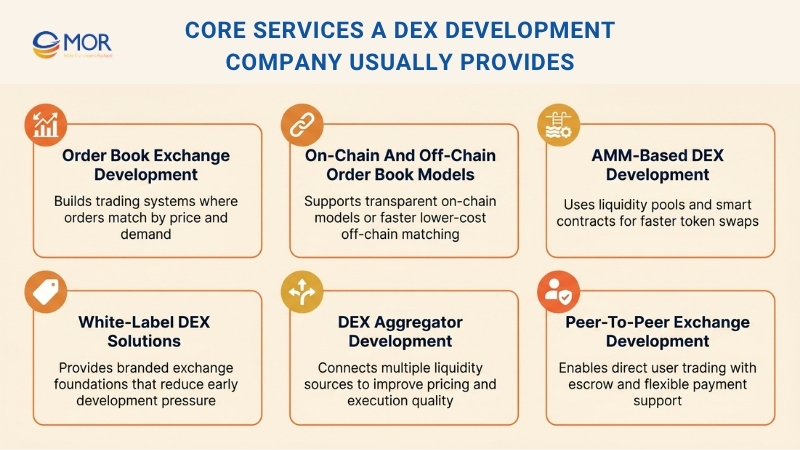
Order Book Exchange Development
Order book exchange development centers on platforms where buy and sell requests enter the market, match against each other, and close based on price and demand. Many traders already know this structure from centralized platforms, so it tends to suit experienced users well. It is often used for spot and perpetual trading products where users want tighter control over price, market depth, and execution tactics.
On-Chain And Off-Chain Order Book Models
An on-chain order book records trading actions directly on the blockchain, which makes activity easier to verify and more transparent to review. This model fits projects that put trust, audit visibility, and decentralized settlement first. An off-chain model handles order matching away from the blockchain, then settles completed trades on-chain. That setup can ease congestion, raise speed, and cut transaction decentralized exchange development cost, which helps platforms that need better performance.
AMM-Based DEX Development
AMM-based DEX development removes the old order-matching model and uses liquidity pools plus smart contracts instead. Rather than waiting for another trader to take the other side, users swap tokens straight against pool liquidity that is already there. A DEX development company will often build this type of platform for DeFi products because it supports faster trading, easier market entry strategy, and passive income for liquidity providers. These platforms fit token swaps, yield-led ecosystems, and products that want broad user access.
White-Label DEX Solutions
White label crypto exchange development solutions give businesses a ready starting point for releasing a branded exchange in less time. They usually include core trading tools, wallet links, admin controls, liquidity support, and a user interface that can be adjusted to match the brand. This route works well for startups and larger firms that want a DEX exchange crypto product without creating every layer from zero. It also helps cut development time and lowers early technical pressure.
DEX Aggregator Development
DEX aggregator development connects several decentralized exchanges inside one trading interface. Instead of using liquidity from only one place, the product checks several pools and protocols to find better pricing, lower slippage, and stronger trade paths. This type of service fits projects that want better execution quality and wider liquidity access across the DeFi market.
Peer-To-Peer Exchange Development
Peer-to-peer exchange development supports direct crypto trading between users without relying on a central party to run each trade from start to finish. These products often include escrow tools, dispute handling, user verification options, and flexible payment methods. P2P models are useful in markets where users want more control over trade terms, support for local payments, and direct contact between buyers and sellers.
Benefits Of Working With A DEX Development Company
Launching a decentralized exchange involves far more than contract coding and a trading screen. The right DEX development company helps you shape the product early, cut technical uncertainty, and move from concept to release with a clearer path. When you hire a seasoned team, you get help with architecture, security, liquidity design, user experience, and growth over time.
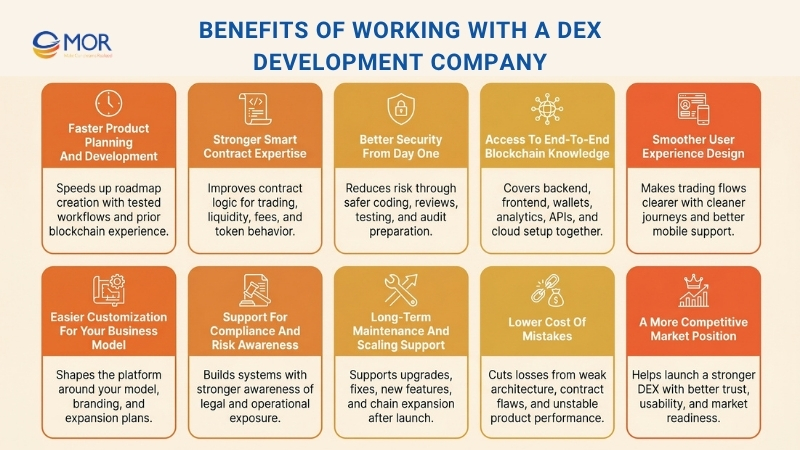
Faster Product Planning And Development
An experienced team can turn your idea into a clear product roadmap much sooner than an internal group that is starting with no prior base. They usually bring tested workflows, ready technical know-how, and hands-on experience from earlier blockchain products. That means less time is wasted on guesswork and false starts.
The same team can also help you decide your priority features early on, whether you need token swaps, liquidity pools, defi yield farming platforms, staking, wallet links, governance, or cross-chain functions. When planning is stronger at the beginning, you are less likely to face expensive rebuilds later.
Stronger Smart Contract Expertise
Every decentralized exchange depends on smart contracts at its core. A skilled partner, including an experienced DEX developer, knows how to structure, test, and refine those contracts for trading rules, liquidity handling, fee logic, and token behavior.
That matters because one small error in contract logic can trigger failed trades, lost funds, or security exposure. A team with real experience can create contracts that are cleaner, more efficient, and simpler to review. That gives your platform a firmer technical base.
Better Security From Day One
Security is one of the main reasons businesses hire a DEX development company. These platforms deal with digital assets, wallet actions, and public blockchain systems, so the attack surface is naturally wider.
A reliable team lowers that exposure through safer coding practices, internal reviews, vulnerability testing, and audit preparation. It can also advise you on access permissions, upgrade logic, admin protection, and defensive controls. That leads to a safer setup for your business and for your users.
Access To End-To-End Blockchain Knowledge
A DEX launch includes more than one technical layer. You may need help with backend logic, frontend systems, wallet connections, token standards, cross-chain bridges, APIs, admin panels, analytics, and cloud setup.
When you work with a specialist provider, you gain access to people who already know how those layers fit together. Instead of coordinating several separate teams, you can rely on one partner to manage the full delivery path. That improves alignment and cuts communication issues.
Smoother User Experience Design
Many DEX products still struggle with usability. Trading can be hard for first-time users, and weak interface decisions often lead to drop-off, user errors, or low retention. A capable team can make the product easier to understand and use.
That may include cleaner swap journeys, clearer pool data, simpler wallet connection steps, stronger mobile support, and easier dashboards for tokens, prices, and transaction history. A better user journey can have a clear effect on adoption.
Easier Customization For Your Business Model
Not all decentralized exchanges follow the same structure. Some products are built around automated market makers, while others need order books, derivatives tools, staking systems, DAO governance, or multi-chain access.
A good provider can shape the platform around your actual goals instead of pushing you into a generic model. That gives you more control over branding, feature depth, product structure, and future expansion. It also makes it easier for your platform to stand apart in a crowded market.
Support For Compliance And Risk Awareness
Decentralized products may work differently from traditional finance systems, but legal and operational exposure still matters. Depending on the market you want to serve, you may need help with user policies, token rules, transaction oversight, or business setup.
A skilled team cannot replace legal counsel, but it can build the technical side with stronger awareness of compliance demands. That includes preparing systems that can adjust more easily when future rules change.
Long-Term Maintenance And Scaling Support
A DEX is not something you build once and then leave alone. After release, you may need upgrades, speed improvements, new features, bug fixes, and support for more chains. The market also moves fast, so the platform needs to keep changing with it.
A dependable team can keep supporting the product after launch. That makes growth easier to manage, especially when user activity rises or when you want to add more complex features later.
Lower Cost Of Mistakes
A wrong architecture choice, weak contract logic, or poor interface work can become expensive very quickly. Delays, rework, security problems, and unstable performance often cost far more than choosing the right team at the start.
An experienced partner helps reduce those losses through proven methods, direct experience, and practical advice. In many situations, that leads to better budget use and a steadier path to launch.
A More Competitive Market Position
The decentralized exchange market is crowded, and users can choose from many options. To stand out, your product needs more than a short feature list. It needs speed, trust, usability, and a clear product direction, especially when users compare it with the best decentralized crypto exchanges already in the market.
The right partner helps you release a stronger platform with better market readiness. That gives your business a better chance to win users, build trust, and grow in a space where product quality shapes adoption.
Detailed Decentralized Exchange Software Development Procedure
Creating a decentralized exchange involves more than coding a trading product. It calls for careful planning, secure contract design, a clear interface, strong testing, and continued technical work after release. Every stage affects how the DEX behaves, how safe it is for users, and how well it can grow with the market.
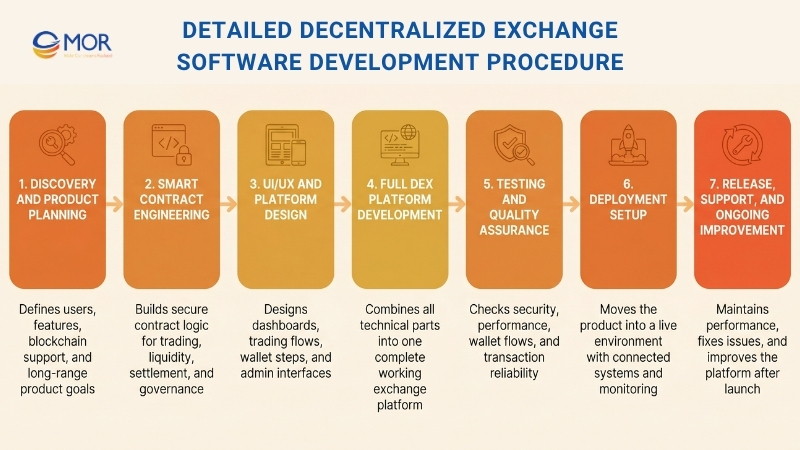
Discovery And Product Planning
The first stage sets the groundwork for the exchange. This usually means choosing the DEX model, defining the target users, selecting the blockchain networks to support, and listing the core functions, including token swaps, liquidity pools, staking, or order-book trading. At this point, the team also reviews business logic, compliance concerns, token utility, and long-range product goals, which is especially useful during initial DEX offering development and when studying examples of decentralized exchanges.
Smart Contract Engineering
Smart contract engineering is one of the most important steps because those contracts govern trading logic, liquidity movement, settlement flow, and user fund actions. A DEX development company must write this code with close attention to safety, clarity, and performance. This phase often includes swap logic, fee models, staking rules, governance functions, and wallet behavior, depending on how broad the product is.
UI/UX And Platform Design
This stage focuses on the user journey and the visual layout of the platform. It covers dashboard structure, trading views, wallet connection steps, liquidity management areas, and admin interfaces when they are needed. A good DEX design should make blockchain trading easier to follow, especially for users who know centralized exchanges but are still new to DeFi.
Deployment Setup
Deployment is the point where the product moves from a development setting into a live blockchain or a production-ready environment. That usually includes contract deployment, frontend connection to the selected network, backend setup where needed, and monitoring tool configuration. The goal is to confirm that every part works correctly in the real operating environment before users are allowed in.
Testing And Quality Assurance
Testing and quality assurance are used to confirm that the exchange performs properly under different conditions. This phase often includes contract audits, feature testing, security checks, performance reviews, wallet connection testing, and transaction-flow validation. Since decentralized exchanges handle financial activity directly, strong QA is needed to cut vulnerabilities, avoid logic errors, and improve reliability.
Full DEX Platform Development
This stage brings all working parts of the product together into one usable system. It includes frontend work, wallet integration, blockchain connectivity, swap engine logic, liquidity management, analytics, and user-side account actions, which are all necessary when you want to build a cryptocurrency exchange that works as a complete product. At this point, the exchange begins to look and behave like a real platform instead of a set of separate technical pieces.
Release, Support, And Ongoing Improvement
Release is the moment the exchange becomes available to live users, but the work does not stop there. Ongoing maintenance is needed to track performance, fix issues, improve features, respond to network changes, and strengthen security as time passes. In the DeFi market, post-launch support matters even more because user behavior, market conditions, and blockchain ecosystems can shift very quickly.
How To Choose The Right DEX Development Company
Before you compare providers, you need a clear way to judge them. A strong DEX development company should be able to meet the standards below.
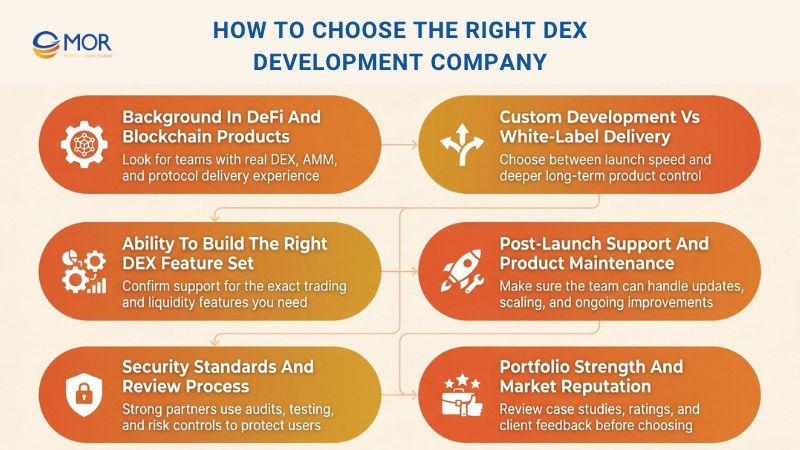
Background In DeFi And Blockchain Products
Look for teams with direct experience in DEX and blockchain product work. Strong providers understand smart contracts and AMM models well, and they should be able to explain the DEX meaning in practical product terms, not only in theory. IdeaSoft, for instance, has delivered fast DEX platforms that can process thousands of transactions per second, as shown in projects like Securitize and Biteeu. You should also ask which protocols they know well, including Ethereum, BNB Chain, Polygon, or Solana, and which related products they have delivered in DEX or DeFi.
Ability To Build The Right DEX Feature Set
Make sure the vendor can deliver the features your platform actually needs. Strong teams usually support automated market makers, order-matching systems, yield farming and staking, cross-chain bridges or swaps, token launch functions, and clear user interfaces. You should also check whether they can support limit orders, dynamic fee rules based on supply and demand, and other advanced trading functions that improve efficiency for users.
Security Standards And Review Process
Security should never be treated as optional. The best partners take it seriously through full smart contract reviews, third-party audits with firms like CertiK or Hacken, deep vulnerability testing, and bug bounty programs. It also helps when they understand or support KYC/AML requirements. Good security practices lower legal exposure and help users trust the platform.
Custom Development Vs White-Label Delivery
You need to decide whether your project needs a fully custom platform or a white-label option. White-label DEX products are usually faster to release and cheaper to build, and in many cases they cost about half as much as a custom version. A custom product, on the other hand, gives you more control over interface choices, feature depth, and long-term scale.
You should weigh both sides carefully. White-label solutions fit teams building an MVP or working with a very tight budget. Custom delivery is usually the better path for products that need unique tokenomics or more room to grow over time.
Post-Launch Support And Product Maintenance
DEX platforms do not stay still after release. Your provider should be ready to handle security updates, performance work, and new feature releases on a regular basis. You should also ask about service commitments and how they plan to support more users or more networks. More skilled teams are starting to include built-in monitoring and automated risk checks as part of the development workflow.
Portfolio Strength And Market Reputation
Review their earlier work through portfolio pages and independent feedback sources. Many providers showcase notable projects or case studies, including insurance-focused DEX products or token-trading platforms. You can also check peer reviews on sites like Clutch, G2, or GoodFirms. If a decentralized exchange DEX development company in USA or another major market has strong ratings and verified client references, that is usually a good sign. In general, steady scores above 4.0 and positive comments point to a provider you can trust.
Conclusion
The right DEX development company can shape far more than code. It can influence your launch speed, product stability, security posture, and room to grow in a crowded DeFi market. That is why choosing carefully matters. We hope this guide helps you compare vendors with a sharper view and a better plan. If you are ready to discuss your exchange idea, architecture, or delivery scope, contact us and let MOR Software support your next move.
MOR SOFTWARE
Frequently Asked Questions (FAQs)
What does a DEX development company do?
A DEX development company builds decentralized trading platforms where users can swap digital assets without a central authority. The work often includes smart contract coding, UI design, wallet integration, and ongoing support after launch.
How is a decentralized exchange different from a centralized one?
Decentralized exchanges allow users to control their own funds through private wallets. Centralized platforms hold user assets and manage trades internally. DEX platforms rely on smart contracts instead of intermediaries.
How long does it take to build a DEX platform?
The timeline depends on complexity. A basic white-label exchange may take a few weeks. A fully custom build with advanced trading features can take several months or longer.
What technologies are used in DEX development?
Most platforms use blockchain networks like Ethereum, BNB Chain, or Solana. Developers also work with smart contract languages, frontend frameworks, and backend systems to connect everything.
How much does it cost to hire a DEX development company?
Costs vary widely. A simple solution may start from a few thousand dollars. Larger, custom platforms with advanced features can reach six figures depending on scope.
Is security important when building a DEX?
Yes, security is one of the biggest concerns. Projects often include smart contract audits, penetration testing, and bug tracking to reduce risks before launch.
Can a DEX support multiple blockchain networks?
Yes, many platforms now support cross-chain functionality. This allows users to trade assets across different blockchains, which improves flexibility and access to liquidity.
What features should a good DEX include?
Common features include token swapping, liquidity pools, wallet connection, trading charts, and admin tools. Some platforms also add staking, governance, or analytics.
Should businesses choose custom or white-label DEX solutions?
White-label options help launch faster and cost less. Custom builds give more control over features and long-term growth. The right choice depends on budget and product goals.
What should you look for in a DEX development company?
Look at past projects, technical expertise, and security practices. A reliable DEX development company should also provide clear communication, structured delivery, and post-launch support.
Share


Make Our-Dreams Realized


© 2023 . MOR Software. All Rights Reserved
Sitemap
Privacy Policy
Terms of Use

Rate this article
0
over 5.0 based on 0 reviews
Your rating on this news:
Name
*Email
*Write your comment
*Send your comment
1