


Top 9 Blockchain Coding Languages Developers Use in 2026
Choosing the right blockchain coding language is one of the hardest decisions teams face when planning real-world blockchain projects. The wrong choice slows delivery, raises costs, and limits future growth. This guide of MOR Software breaks down the most used blockchain programming languages in 2026, helping blockchain developers align technical decisions with long-term product goals and business reality.
Why Does This Guide Focus On Only 9 Blockchain Coding Languages?
The MOR Software team has spent more than ten years delivering custom blockchain solutions, contributing to recognized platforms and developing our own products. Throughout this time, we have gained deep hands-on experience with widely used technologies for blockchain systems and smart contracts, giving us the confidence to narrow the field to a focused list of leading options. This background allows us to evaluate each blockchain coding language based on real delivery work rather than theory alone.
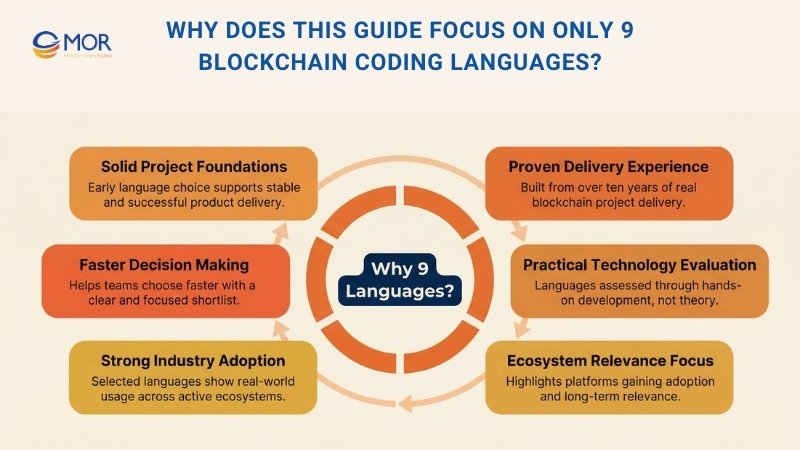
Thanks to our practical understanding of tools used to build blockchain applications and our long-term exposure to this space, we were able to identify the most promising technical directions shaping the industry. This perspective helped us highlight ecosystems that are gaining traction today and are also positioned to remain relevant in the coming years. From this analysis, we selected each blockchain programming language that shows strong adoption, technical depth, and future demand.
We see this curated list of essential smart contract blockchain development options as a way to help teams move faster and start building with clarity and confidence. Choosing the right one early can shorten decision time and set a strong foundation for delivering a successful product.
Top 9 Blockchain Coding Languages In 2026
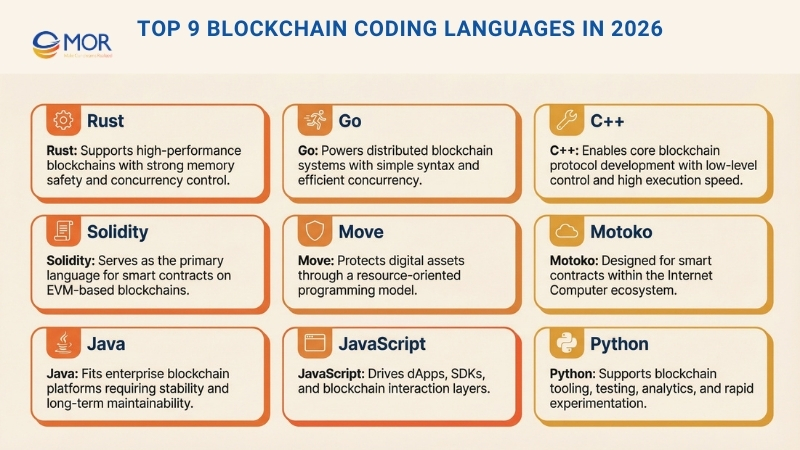
We have now reached the core of this guide, where we share the top blockchain programming languages used for modern smart contracts and reliable dApps development. Many tools exist across the blockchain space, but based on our experience, the strongest choices include Solidity, Go, Rust, C++, Move, and Motoko. Selecting the right blockchain coding language matters, so teams should work with skilled developers to fully unlock the strengths of each option.
1. Rust - High-Performance Blockchain Coding Language
Rust is a fairly new blockchain programming language, yet it has already shown strong results in real-world use. It gained wider attention after Parity introduced it through the development of a major Ethereum client, which brought Rust to a much broader audience.
Soon after, one of Parity’s founders, Gavin Wood, played a key role in expanding Rust adoption during his presentation on the interoperable blockchain Polkadot and its Substrate framework. Following this moment, other major players in the industry began to recognize the value of this language blockchain approach. As a result, platforms like Solana, NEAR, Secret Network, and other next-generation networks started relying on Rust to push technical boundaries.
What is Rust?
Rust is a multi-paradigm programming language designed with performance and safety as top priorities. It comes with clear documentation, a wide range of developer tools, and a compiler that provides clear and helpful feedback.
Many teams view Rust as one of the most effective choices for smart contract work because it supports smooth collaboration across project teams and open-source contributors. This programming language for blockchain gives developers strong control over low-level logic without unnecessary complexity, striking a solid balance between system power and developer comfort.
In addition, Rust delivers strong speed and stability through its compiler, which continuously checks code as features change and improvements are made. For these reasons, it meets the core needs of blockchain development and extends well beyond basic requirements.
Key strengths of Rust
- Clear development guidelines;
- Zero-cost abstractions;
- Speed;
- Memory efficiency;
- Reliability;
- Self-upgradability through WASM support;
- Concurrency-focused capabilities;
- Control over mutable state handling.
Blockchain networks using Rust
- Solana – a high-performance network known for its rapidly growing ecosystem. It supports very low transaction costs, often under $0.01, and fast block times close to 400 milliseconds.
- Substrate – a flexible framework that lets teams build customized blockchains tailored to specific needs.
- NEAR – a complete ecosystem featuring a sharded, proof-of-stake layer-one network, a foundation, and a large global community of builders and creators.
- Parity.io – an infrastructure platform for the decentralized web that helps protocols operate smoothly at scale and supports Web3 adoption.
- Polkadot – a decentralized web3 development services blockchain network focused on cross-chain communication and scalable architecture.
Rust is widely viewed as the best language for blockchain programming because of its focus on security, performance, and efficient memory use. It is a strong choice for teams building on fast networks or exploring modern blockchain designs, especially when working with Solana or NEAR.
2. Go - Practical Blockchain Coding Language For Distributed Systems
Go has already built a solid reputation in the blockchain space, and similar to Rust, its early success is closely tied to Ethereum. More specifically, this journey began with Geth, an Ethereum client written in Go that remains the most widely used option among all available Ethereum clients. This early adoption helped position Go as a reliable blockchain coding language for network-level components.
The next phase of Go adoption within the blockchain community came with the launch of the Cosmos interoperable network and its Cosmos SDK, a framework designed to support fast blockchain development. Later, Go gained even wider use through Tendermint, a BFT consensus engine integrated into many blockchain platforms. Today, Go is a widely adopted solution that serves many different purposes and continues to function as a strong language for blockchain systems.
What is Go?
Go, often referred to as Golang, is an open-source programming language developed at Google and inspired by the C language. It is now used across many industries and technical domains.
Golang is often seen as a strong choice among modern blockchain tools because it offers clean syntax and fast build times. It supports concurrent execution within a single language, which is useful for many development teams. In addition, it remains easy to manage over time and performs efficiently when compared with older blockchain coding language options.
Key strengths of Go
- Very easy to learn;
- Clear and readable syntax;
- Strong performance speed;
- Simple long-term maintenance;
- High efficiency;
- Well suited for distributed systems and high-load programs.
Blockchain projects using Go
- Go-Ethereum – one of the original Ethereum protocol implementations, alongside C++ and Python. It is available as the standalone Geth client or as a reusable library for Go, Android, and iOS applications.
- Cosmos – a growing ecosystem of connected applications and services linked through IBC, the Inter-Blockchain Communication protocol.
- Hyperledger Fabric – an open-source blockchain framework supported by The Linux Foundation. Its modular structure allows teams to build various blockchain solutions and decentralized applications.
Choose Go if you want a language for blockchain that is simple to learn and works well across EVM-based networks as well as newer alternative chains.
3. C++ For Core Blockchain Protocol Development
C++ holds a special place in blockchain history because Satoshi Nakamoto used it to build the original Bitcoin network. This decision shaped the technical base for many later chains, meaning a large part of the altcoin ecosystem, including Litecoin, PIVX, Qtum, Dogecoin, and others, relies on C++ at its core.
In addition to Bitcoin-based networks, C++ is also used to develop blockchains like EOS and Telos, along with their smart contract frameworks that support application development.
What is C++?
C++ is one of the oldest general-purpose programming languages and has also served as a trusted blockchain coding language for many well-known projects across the industry.
Although C++ first appeared in 1985, it continues to be widely used by blockchain developers and DeFi platforms. This long-term relevance comes from its strong control over CPU usage and memory management, which are critical for blockchain systems. It also delivers high efficiency, clear separation of code components, and compile-time polymorphism for better performance.
Key strengths of C++
- Precise CPU handling and memory control;
- Support for both parallel and non-parallel execution;
- Move semantics for efficient data copying;
- Compile-time polymorphism that improves performance;
- Code isolation across different data structures and components.
Blockchain networks using C++
- Bitcoin – the first blockchain and the world’s first cryptocurrency. Designed as a peer-to-peer digital currency, Bitcoin has passed the $60K mark and continues to attract global attention.
- Litecoin – one of the earliest cryptocurrencies forked from Bitcoin, recognized as one of the first major altcoins.
- Ripple – a major blockchain solution provider known for its real-time settlement system, currency exchange services, and global payment network.
- Stellar – an open-source payment network that supports wallets and decentralized exchanges for fast crypto, forex, and asset trading.
- EOS – an open-source blockchain protocol that enables developers to build, host, and run decentralized applications with a focus on high throughput and scalability.
Choose C++ if you want a proven and dependable programming language that many blockchain developers already understand. It works well for building both blockchain networks and smart contracts.
4. Solidity - The Primary Smart Contract Blockchain Coding Language
Influenced by C++, Python, and JavaScript, Solidity combines useful ideas from these languages and has become the most widely used option for smart contract development.
Developers around the world rely on Solidity for its accessibility, accuracy, and flexibility, all of which are highly valued in blockchain projects. Much of the DeFi space depends on Solidity, from Uniswap to Chainlink. Many teams choose it for smart contracts because it is clear, structured, and relatively easy to learn and work with as a blockchain coding language.
What is Solidity?
Solidity is an object-oriented, high-level programming language created specifically to run smart contracts on the Ethereum Virtual Machine. This design makes it well suited for building smart contracts and decentralized applications on blockchain platforms.
Solidity shares similarities with JavaScript, which helps many developers pick it up quickly. It is also one of the fastest-growing languages today, and its tooling and developer experience continue to improve over time.
Key strengths of Solidity
- Developer-friendly design;
- Access to JavaScript tools, debuggers, and ecosystems;
- Statically typed structure;
- Support for inheritance in smart contracts;
- High precision and predictable behavior.
Blockchain projects using Solidity
- Ethereum – all smart contracts running on Ethereum are written in Solidity. The language was created specifically to support applications on EVM-based networks.
- Chainlink – Solidity is used to build smart contracts for Chainlink, a decentralized oracle network that connects on-chain and off-chain data.
- Uniswap – a large DeFi ecosystem that includes a protocol, exchange, and community-driven infrastructure, all built using Solidity.
- Compound – an Ethereum-based protocol that creates decentralized money markets. Its autonomous interest rate contracts are written in Solidity.
Choose Solidity for smart contract development when working on EVM-based platforms, as it is designed specifically to support this type of blockchain application.
5. Move - A Resource-Oriented Blockchain Coding Language
Within modern blockchain development, Move has emerged as a distinct and forward-looking option, opening new paths in how programming languages support digital assets. Originally created by Novi, a subsidiary of Facebook, for the Libra initiative, Move moves past traditional design patterns and combines advanced architecture with a new way to manage on-chain assets, setting a higher standard for blockchain-focused tools.
What is Move?
Built on ideas inspired by Rust, a widely used multi-purpose programming language, Move was carefully designed for the Diem blockchain, previously known as Libra. Its core concept follows a resource-based model that places strong emphasis on safety and correctness in digital transactions.
Unlike conventional languages where data can be copied without limits, Move treats assets as unique resources. This approach means they cannot be duplicated or exist in more than one place at the same time. As a result, each transaction remains authentic, lowering the risk of asset loss or duplication, which is especially important for financial blockchain use cases.
Move also follows a modular design, giving developers the ability to create, publish, and manage custom modules. This structure supports flexibility and helps projects grow in a controlled and scalable way.
Operating directly at the bytecode level, this blockchain coding language delivers strong efficiency gains. Instead of relying on an external compilation process like Solidity on Ethereum, Move runs on its own Move Virtual Machine. This design leads to faster execution, higher accuracy, and closer alignment with the underlying system.
Key strengths of Move
- Prevents accidental duplication or deletion of digital assets.
- Built with asset fraud prevention in mind, supporting secure and verified transactions.
- Modular structure that allows developers to define and publish custom resource types.
- Provides clear control over data layout and module interaction for predictable behavior.
- Designed specifically for blockchain use, supporting efficient transactions and resource handling.
- Strong verifiability through controlled execution flow and modular separation, which simplifies code checks.
- Component diversity and specialized modules help reduce risks like re-entrancy attacks.
- Tight integration with the Move Virtual Machine enables smooth and reliable execution.
Blockchain networks using Move
Diem (formerly Libra) – the main and most notable implementation of Move is the Diem blockchain itself. Since Move was created for this platform, its smart contracts and transaction scripts rely fully on the language to deliver security and flexibility.
Dfinance – a decentralized platform focused on stablecoin issuance and financial products. It uses Move for smart contracts, benefiting from the language’s safety-driven design.
Sui – a clear example of Move’s flexibility in today’s blockchain environment. Sui applies Move to build a network that targets scalability while preserving decentralization and security. This approach addresses the well-known challenge of balancing these three factors, an area where many platforms still face limits.
Aptos – Aptos uses Move to create a scalable and composable blockchain infrastructure. In a market crowded with layer-one networks like Solana, Avalanche, and Tron, Aptos has renewed interest in next-generation platforms. Similar to Sui, it works toward balancing decentralization, security, and scalability through its use of Move.
Choose Move if you need a robust and expressive blockchain coding language designed to protect digital assets while maintaining system efficiency and predictable behavior.
6. Motoko For The Internet Computer Ecosystem
Motoko is a strong programming language choice for blockchain and smart contract development within the DFINITY ecosystem.
If DFINITY is not familiar yet, it is a non-profit organization behind the Internet Computer, a public blockchain platform built on the Internet Computer Protocol. This network operates as a more isolated environment, designed around the idea of a global computer that cannot be turned off, and it was launched in 2021.
Today, DFINITY runs its own independent DeFi ecosystem that functions in a similar way to common DeFi platforms. The main difference is that this environment is built with Motoko and does not connect directly to standard EVM-based chains.
Because of this isolated structure, Motoko continues to see steady use and is able to stand alongside EVM chains and the Solidity programming language in its own ecosystem.
What is Motoko?
Motoko is a relatively new smart contract language created by the DFINITY Foundation for writing smart contracts directly on the Internet Computer. It was designed specifically for blockchain use, with a focus on security, flexibility, and tools that support fast and reliable dApp development services, while also matching the unique architecture of the Internet Computer.
This language includes native support for Internet Computer canisters, which act as smart contracts. It follows a clear sequential style, uses a modern and simple syntax, and includes features that support orthogonal persistence. Together, these elements make it a safe and practical option for projects built on the Internet Computer.
Key Strengths of Motoko
- Automatic memory management;
- Features that support developer productivity and safety;
- Built-in support for orthogonal persistence;
- Fixed-precision arithmetic for consistent calculations.
Blockchain networks using Motoko
- Internet Computer – a modern blockchain security that supports secure, autonomous, and tamper-resistant canisters and allows applications to run at web-level speed.
Choose Motoko if you want to build within the DFINITY ecosystem. It is well suited for smart contract development on the Internet Computer.
7. Java In Enterprise Blockchain Systems
Java has remained one of the most trusted blockchain programming languages for building large and business-critical systems over many years. Its deep roots in enterprise software naturally led to adoption in blockchain, especially on platforms designed for permissioned networks, structured business processes, and regulated use cases.
Instead of focusing on public smart contract environments like EVM-based chains, Java is more often used in blockchain systems that value reliability, long-term support, and complex business rules. This focus makes it a common option for enterprise distributed ledgers and private blockchain platforms.
What is Java?
Java is an object-oriented, general-purpose programming language that compiles source code into platform-independent bytecode. This bytecode runs on the Java Virtual Machine, which allows applications to behave consistently across different operating systems and environments, an important requirement for distributed systems.
Within blockchain development, Java is appreciated for its mature concurrency model, built-in security features, and wide range of libraries and frameworks. These qualities make it suitable for handling transaction logic, consensus-related components, and system integration layers in enterprise blockchain solutions, rather than low-level protocol design.
Key Strengths of Java
- Platform independence supported by the JVM;
- Strong concurrency and multithreading capabilities;
- Mature ecosystem with enterprise-focused tools;
- High stability and long-term maintainability;
- Built-in memory management and security mechanisms;
- Smooth integration with existing enterprise systems.
Blockchain networks using Java
- NEO Blockchain – a notable feature of NEO is its support for multiple programming languages, including Java. This allows developers to deploy and interact with smart contracts using Java, which is helpful for teams already familiar with the language.
- Corda – developed by R3, Corda is an open-source blockchain platform designed for business use. It stands out for relying on familiar enterprise development languages, with Java playing a central role in its ecosystem.
Choose Java if you are building enterprise-oriented blockchain solutions that require stability, scalability, and deep integration with existing systems.
8. JavaScript For Blockchain SDKS And Tooling
JavaScript holds a key position in modern blockchain development, especially at the application and interaction layers. Although it is rarely used to build core blockchain protocols or low-level smart contracts, it is essential for creating dApps, developer utilities, and blockchain user interfaces.
Because of its event-driven and asynchronous design, JavaScript works very well for real-time communication with blockchain nodes, wallets, and smart contracts. This makes it the foundation of most Web3 user experiences and front-end interactions.
What is JavaScript?
JavaScript is a high-level, interpreted programming language built around asynchronous and event-based execution. With the arrival of Node.js, it expanded beyond the browser and became a full backend runtime that can handle network-heavy applications.
In blockchain projects, JavaScript is mainly used to interact with smart contracts, handle transactions, connect with nodes, and develop SDKs and tooling frameworks. It serves as the link between blockchain networks and applications that users interact with directly.
Key Strengths of JavaScript
- Asynchronous and non-blocking execution model;
- Strong fit for real-time blockchain communication;
- Broad ecosystem of Web3 libraries and frameworks;
- Simple integration with wallets and blockchain APIs;
- Fast development cycles for dApps and tooling;
- Active community and continuous ecosystem growth.
Blockchain tools built with JavaScript
- web.js & ethers.js – core libraries used to interact with Ethereum Virtual Machine networks. They provide clean and simple ways to communicate with smart contracts and blockchain nodes.
- Hardhat – a development environment used for compiling, deploying, testing, and debugging Ethereum applications. Built with JavaScript, it helps simplify the full development workflow on Ethereum.
Choose JavaScript if you are focused on building dApps, SDKs, tooling, or user interfaces that interact directly with blockchain networks.
9. Python - An Accessible Blockchain Coding Language
Python is often the first choice for developers starting their journey into blockchain because of its clear syntax and easy learning curve. Although it is not commonly used to build high-performance blockchain cores, Python is widely used for tooling, scripting, SDK creation, and some smart contract platforms.
Its flexibility and rich library ecosystem make Python a practical option for fast development, testing, data analysis, and blockchain research tasks.
What is Python?
Python is a high-level, interpreted programming language known for its clean structure and ease of reading. It focuses on developer productivity and simple code design, which makes it suitable for quick prototyping and repeated development cycles.
Within blockchain projects, Python is often used to create SDKs, automate processes, build testing frameworks, and write smart contract platforms that support Python-based execution. It also acts as the base for several blockchain-focused tools and contract languages.
Key strengths of Python
- Simple and easy-to-read syntax;
- Fast development and prototyping support;
- Large collection of blockchain-related libraries;
- Strong capabilities for scripting and automation;
- Well suited for testing, analytics, and tooling tasks;
- Beginner-friendly for developers entering blockchain.
Blockchain tools built with Python
- Algorand – this platform provides algokit, a toolset built around Python that helps developers interact with the Algorand network more easily.
- NEO Blockchain – in addition to Java, NEO supports Python for smart contract development, giving developers another familiar option.
- ProSaga Blockchain – Python plays an important role within the ProSaga platform, supporting its core functionality.
- Celo SDK – some Celo toolkits rely on Python, which simplifies interaction with the blockchain network.
- Vyper – a contract-focused programming language inspired by Python principles and used for EVM smart contracts.
- web3py – an Ethereum SDK designed for Python developers, similar in purpose to web.js.
- Brownie – a Python-based framework that supports Solidity development and testing workflows.
Choose Python if you want a developer-friendly language for blockchain tooling, experimentation, analytics, or smart contract development on Python-compatible platforms.
Quick Comparison Of Top 9 Blockchain Coding Languages In 2026
Below is a concise comparison to help you quickly see how each option differs in purpose and strengths. This overview highlights where each blockchain coding language fits best in real-world projects.
Blockchain Coding Language | Primary Focus | Technical Strengths | Best For | Popular Networks |
Rust | High-performance blockchain and smart contracts | Memory safety, speed, concurrency, WASM support | Layer-1 blockchains, high-throughput networks | Solana, NEAR, Polkadot, Substrate |
Go | Distributed systems and blockchain infrastructure | Concurrency, fast compilation, clean syntax | Core blockchain services, network components | Ethereum (Geth), Cosmos, Hyperledger Fabric |
C++ | Core blockchain protocol development | Low-level control, performance, memory management | Blockchain cores, performance-critical systems | Bitcoin, Litecoin, EOS, Stellar |
Solidity | Smart contract development on EVM | EVM compatibility, strong tooling, clear syntax | DeFi, NFTs, EVM-based dApps | Ethereum, Uniswap, Chainlink, Compound |
Move | Resource-oriented smart contracts | Asset safety, modular design, bytecode execution | Secure financial applications, new L1s | Aptos, Sui, Diem |
Motoko | Smart contracts on Internet Computer | Orthogonal persistence, canister support | DFINITY ecosystem applications | Internet Computer |
Java | Enterprise blockchain systems | Stability, JVM ecosystem, security | Permissioned and private blockchains | NEO, Corda |
JavaScript | Blockchain SDKs and application tooling | Asynchronous execution, Web3 libraries | dApps, front-end, developer tooling | Ethereum tooling, Web3 stacks |
Python | Tooling, scripting, and experimentation | Readability, fast prototyping, rich libraries | SDKs, analytics, testing, research | Algorand, NEO, Ethereum tooling |
Skills Required To Work With Blockchain Coding Languages
Building a career in blockchain requires a mix of technical ability and conceptual understanding:
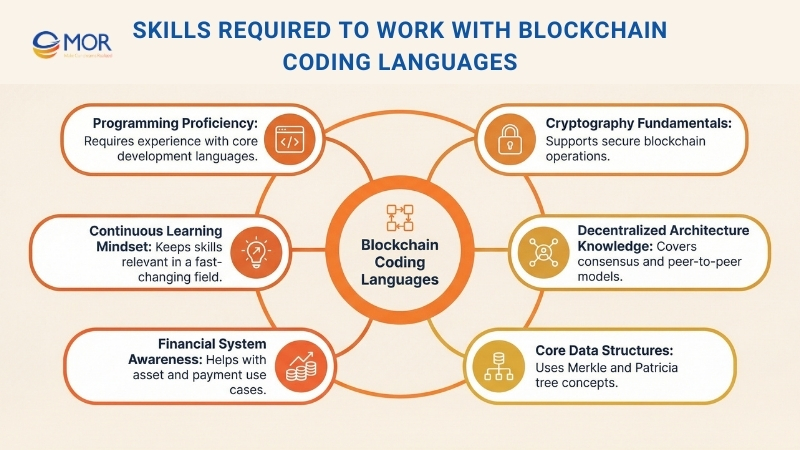
- Programming Proficiency: Experience with languages like JavaScript, Python, Go, Rust, or C++ is very important. Specialized options such as Solidity for Ethereum-based projects are also highly valuable. As of 2023, more than 80% of blockchain development job openings required knowledge of smart contract languages like Solidity, Rust, or Go, showing how critical programming skills are for these roles.
- Cryptography Fundamentals: Knowledge of public-key cryptography, hash functions, and digital signatures is necessary due to the strong focus on security in blockchain systems.
- Decentralized Architecture Knowledge: A basic understanding of peer-to-peer networks, consensus mechanisms, and decentralized applications is required to work effectively with blockchain platforms.
- Core Data Structures: Familiarity with structures like Merkle trees and Patricia trees is important, as they play a key role in how blockchains store and verify data.
- Financial System Awareness: Since many blockchain projects involve payments, assets, and value transfer, a general understanding of financial concepts can be helpful.
At the same time, the blockchain field continues to change and grow. This reality requires professionals to keep learning new tools, techniques, and skills in order to stay relevant and effective over time.
How Developers Can Learn Blockchain Coding Languages
Starting a career in blockchain requires a clear learning path and steady hands-on practice. Several trusted resources can help developers build strong skills over time:
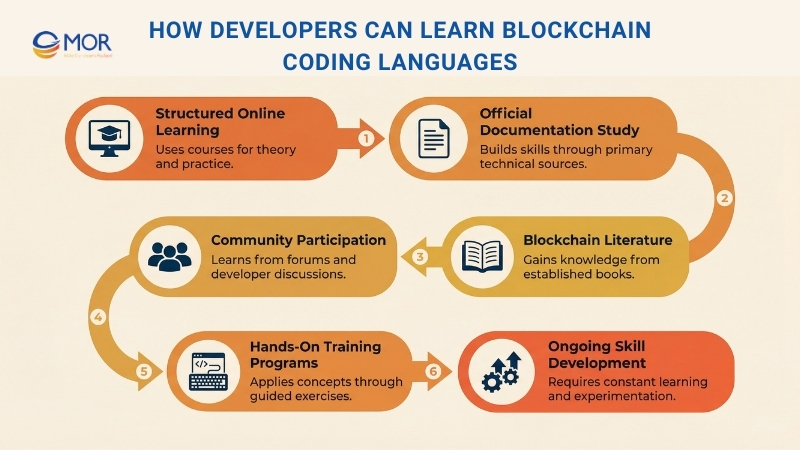
- Structured Online Learning: Learning platforms like Coursera, Udemy, and edX provide structured courses on blockchain topics, covering both theory and practical development work.
- Official Technical Documentation: Direct learning from official sources is very important. Resources like Ethereum’s Solidity documentation, the Diem developer portal, and Polkadot’s Substrate documentation support real-world practice and deeper technical understanding.
- Developer Communities and Forums: Active communities on platforms such as Stack Exchange, Reddit’s r/ethereum, and r/diem allow developers to ask questions, share experiences, and follow ongoing discussions.
- Blockchain-Focused Books: Well-known titles like Mastering Blockchain by Imran Bashir and Blockchain Basics: A Non-Technical Introduction in 25 Steps by Daniel Drescher provide detailed explanations and structured knowledge.
- Hands-On Training Programs: Training programs from organizations like Consensys Academy and the Blockchain Council combine guided instruction with practical exercises, helping learners apply concepts in real projects.
Learning blockchain is an ongoing process. The field continues to change, so developers need to keep studying, testing new ideas, and staying active in the community to build lasting skills.
Looking For Blockchain Developers For Your Project?
If you are planning a blockchain product and need a team that understands both technology and delivery, working with an experienced outsourcing partner is often the safest route. MOR Software supports startups and enterprises that want to build reliable blockchain systems without growing internal teams too fast.
MOR Software is a blockchain development outsourcing company specializing in custom blockchain solutions, decentralized applications, and smart contract systems across multiple networks. We work closely with clients from idea validation through production deployment, keeping technical decisions aligned with real business goals.
Our blockchain engineers are fluent in the most in-demand blockchain coding languages, including Solidity, Rust, Go, C++, JavaScript, and Python. This allows us to recommend the right technology stack for each use case, instead of forcing a one-size-fits-all approach. Whether your project focuses on smart contracts, core blockchain protocols, or developer tooling, our teams adapt quickly to your requirements.
Since our founding, MOR Software JSC has delivered dozens of blockchain and fintech-related projects for global clients. Our experience covers public blockchains, private networks, and enterprise-grade systems where security, performance, and long-term maintainability matter from day one.
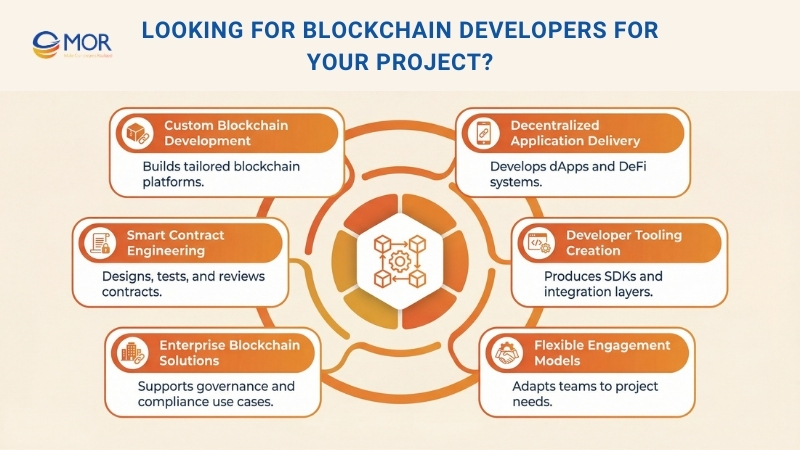
As part of our blockchain development services, we support:
- Blockchain platform development, including custom blockchains, forks, validator nodes, and cross-chain components;
- Decentralized application development, covering blockchain app development, DeFi platforms, NFT systems, wallets, and blockchain-based marketplaces;
- Smart contract development, including contract architecture, implementation, testing, and security reviews;
- Blockchain developer tooling, such as SDKs, APIs, automation scripts, and integration layers;
- Enterprise blockchain solutions, supporting governance workflows, supply chain tracking, identity systems, and compliance-driven use cases;
- Blockchain integration, connecting blockchain layers with existing systems like ERPs, CRMs, payment platforms, and centralized services.
At MOR Software, engagement models stay flexible. You can work with a dedicated blockchain team, extend your in-house developers with specialized engineers, or assign us a defined scope for a single delivery phase. If you are looking for a dependable partner to build and scale your blockchain software product, feel free to contact us and discuss your project in detail.
Conclusion
The blockchain coding language you select has a direct effect on scalability, security, and long-term maintainability. Each option discussed in this guide fits a specific type of product and technical direction. Clear decisions at this stage help reduce risk and speed up delivery. If you need expert input or hands-on development support, MOR Software is ready to assist. Contact us now to discuss how we can support your blockchain project from planning to launch.
MOR SOFTWARE
Frequently Asked Questions (FAQs)
Is Bitcoin written in C++?
Yes. Bitcoin’s original implementation was written in C++. The language gives developers strong control over memory, execution speed, and system behavior, which suits a core blockchain protocol that must remain stable and efficient over time.
What blockchain coding language should beginners start with?
Many beginners choose Python or JavaScript. Python is easy to read and helps learners understand blockchain concepts quickly. JavaScript is widely used for interacting with blockchains, wallets, and smart contracts through popular libraries.
Is Python used in blockchain development?
Yes. Python is widely used for blockchain SDKs, automation tools, testing frameworks, and some smart contract environments. Certain blockchains allow developers to write application logic directly in Python, making development more accessible.
Is Solidity better than Python for blockchain?
That depends on the target platform. Solidity is required for writing smart contracts on Ethereum and EVM-compatible networks. Python works better for learning, tooling, and backend logic. Developers often use both for different parts of a project.
Is Solidity harder to learn than C++?
For many developers, Solidity is easier. Its syntax is simpler and focused on smart contract logic. C++ covers a broader range of system-level concerns, which usually makes it more complex to learn and maintain.
Can AI write Solidity smart contracts?
AI tools can generate Solidity code, suggest contract structures, and speed up development tasks. Still, developers must review and test all output carefully, since smart contracts handle real assets and mistakes can be costly.
Is Solidity worth learning in the coming years?
Yes. Solidity remains the main language for Ethereum and many compatible blockchains. Demand for Solidity skills continues as decentralized finance, NFTs, and blockchain-based applications keep expanding.
What language is best for core blockchain development?
C++ and Rust are common choices for core blockchain systems. C++ offers fine-grained control over performance, while Rust focuses on memory safety and concurrency. The choice depends on technical priorities and team expertise.
Is JavaScript considered a blockchain coding language?
JavaScript is rarely used to build blockchain cores, but it plays a major role in blockchain development. It is commonly used for dApp front ends, SDKs, deployment tools, and smart contract interaction.
Do developers need to learn multiple blockchain coding languages?
Often, yes. One language may be used for smart contracts, another for backend services, and another for user interfaces or tooling. Knowing multiple languages helps developers work across the full blockchain stack.
How long does it take to learn a blockchain coding language?
Basic skills can be gained in a few months, depending on prior experience. Reaching a professional level takes longer, especially for smart contracts, where security, testing, and edge cases require deeper understanding.
Share


Make Our-Dreams Realized


© 2023 . MOR Software. All Rights Reserved
Sitemap
Privacy Policy
Terms of Use

Rate this article
0
over 5.0 based on 0 reviews
Your rating on this news:
Name
*Email
*Write your comment
*Send your comment
1