


Future-Proof Business with Enterprise Generative AI Integration Services
Traditional automation works well when tasks follow fixed rules. But many enterprise workflows now involve messy data, customer language, document lookup, approvals, and decisions that need context. That is why more companies are turning to AI integration services instead of building every AI function from scratch. MOR Software provides end-to-end generative AI integration services that connect AI models, enterprise data, APIs, and business apps in a safe, practical way, so teams can add AI where it creates real business value.
Why Your Business Needs AI Consulting Services
Many enterprises still depend on older ERPs, CRMs, databases, portals, and internal tools for daily work. These systems often hold years of customer, finance, HR, sales, support, and operation data, but that data is not always easy to search, connect, or use in real time. MuleSoft’s 2026 Connectivity Benchmark Report shows how common this challenge has become, with 95% of organizations reporting integration challenges and 96% agreeing that AI agent success depends on seamless integration.
That gap slows people down. A support agent may need to open three systems to answer one customer. A finance team may copy data between reports. A manager may wait for IT to pull the right numbers. The data exists, but the workflow still feels manual.
MOR Software’s AI consulting services integration with existing systems help businesses add AI without a full rebuild. Our team reviews your data sources, API readiness, access rules, security needs, and workflow gaps before any build starts. That early review matters because AI only works well when the surrounding system is ready for it. McKinsey also reports that 78% of organizations now use AI in at least one business function, which makes system readiness more urgent for companies that want AI to move beyond small experiments.
A practical AI plan starts with the systems you already use. MOR Software can connect enterprise AI platform with ERP, CRM, HRM, finance, customer support, internal knowledge bases, and custom business apps. The goal is to help teams search, summarize, classify, route, and act on business data with less manual effort.
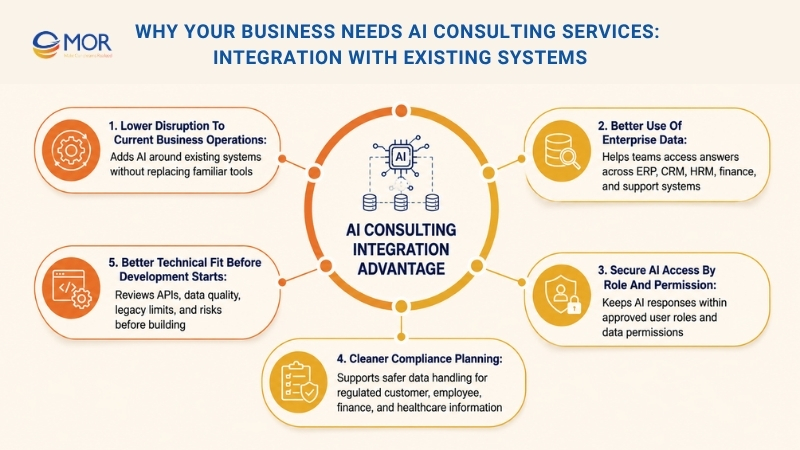
Lower disruption to current business operations
AI can be added around your current systems instead of replacing them all at once. Teams keep familiar tools, while AI supports selected workflows behind the scenes.
Better use of enterprise data
Useful data often sits across ERP, CRM, HRM, finance, support, and internal platforms. AI integration helps teams pull answers from those sources faster, instead of jumping between screens all day.
Secure AI access by role and permission
Not every user should see the same data. MOR Software plans access rules based on user roles, data sensitivity, and business permissions, so AI responses stay within approved limits.
Cleaner compliance planning
Regulated teams need more than a smart chatbot. Data handling must account for rules like GDPR, HIPAA, APPI, or industry-specific standards, especially when AI touches customer, employee, finance, or healthcare data.
Better technical fit before development starts
API availability, data quality, old system limits, and integration risks can change the whole project plan. MOR Software reviews these factors early, so the AI solution matches real system conditions rather than an ideal plan on paper.
Our Core Offerings: Tailored AI Integration & Development
Every organization has different systems, workflows, and business objectives, which is why a one-size-fits-all AI solution rarely delivers lasting value. MOR Software provides tailored AI integration and development services designed to align with your existing technology stack, operational requirements, and growth goals. From strategy and implementation to optimization and support, our team helps businesses adopt AI solutions that are practical, scalable, and built to generate measurable business impact.
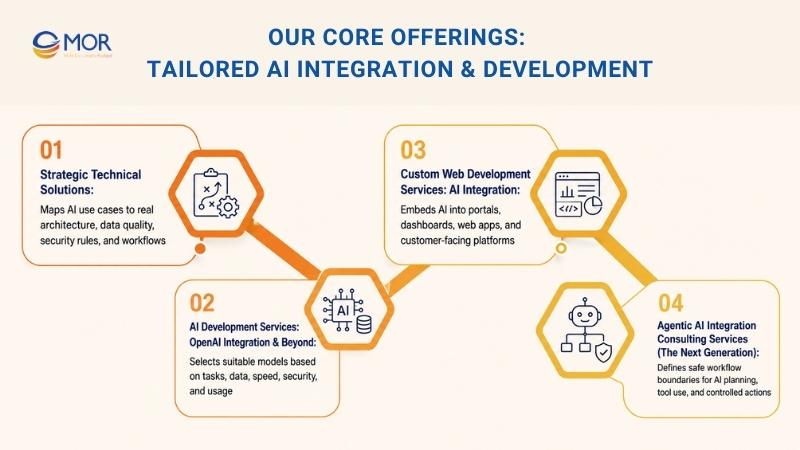
Strategic Technical Solutions
AI projects often fail when teams start with the model instead of the system around it. We start with your real architecture, data quality, security rules, and user workflows, then map the right AI use cases to the right technical plan.
That approach keeps the project grounded. A customer support assistant, a CRM summary tool, and an agentic workflow do not need the same design. Each one needs a different mix of data access, model choice, controls, testing, and long-term support.
AI Development Services: OpenAI Integration & Beyond
MOR Software supports AI development services OpenAI integration for GPT-based tools, Claude, Gemini, and suitable open-weight models such as Llama, Mistral, Qwen, or similar enterprise-ready options. The right model depends on the task, data type, response speed, security needs, and expected usage volume.
Some teams need a smart assistant for support tickets. Others need internal knowledge search, document processing, CRM summaries, report generation, or real-time business data lookup. A sales manager may want quick account notes before a client call. A support lead may want AI to scan past tickets and suggest the next best reply.
Model choice is only one part of the work. MOR Software also plans token usage, latency targets, caching, logging, and fallback rules so the system stays reliable after launch. When traffic grows, these details matter more than most teams expect.
A simple AI assistant may work well in a demo. Production use is different. Users ask unclear questions, data changes, APIs fail, and costs can rise fast. MOR Software designs the AI layer with those real issues in mind from the start.
Custom Web Development Services: AI Integration
Our custom web development services AI integration help businesses build AI-ready portals, dashboards, web apps, admin systems, and customer-facing platforms. The goal is to place AI inside the tools people already use, not force teams into a separate app that creates more work.
MOR Software can connect AI with frontend interfaces, backend logic, databases, third-party APIs, authentication systems, and cloud services. That means users can search business data, summarize records, generate drafts, classify requests, and follow guided workflows inside one connected system.
A web portal might include an AI chat interface for customers. An internal dashboard might turn raw data into plain-language summaries for managers. An admin system might help staff review documents faster, flag missing fields, or route tasks to the right team.
Good AI integration feels practical. The user should not need to understand the model behind it. They should know where to click, what data the system uses, and when a human needs to review the result.
Agentic AI Integration Consulting Services (The Next Generation)
MOR Software’s agentic AI development services help companies move beyond basic chatbots when a workflow needs planning, tool use, and controlled action. This is where AI can read context, choose a step, call a system, update a record, or prepare a task for approval.
That sounds useful, but it can get messy fast. Agentic AI should not run loose across business systems. A poorly planned agent may pull the wrong data, take action without permission, or create extra review work for the team it was meant to support.
We define workflow boundaries before any agent takes action. That includes what the agent can do, which systems it can access, which data it can read, which tasks need human approval, and how every action is logged.
Permission controls matter here. A sales agent may draft a follow-up email, but a manager may need to approve it before sending. A finance assistant may flag unusual invoices, but it should not approve payment on its own. A support agent may triage tickets, but sensitive complaints should move to a human queue.
Suitable use cases include sales follow-up, support ticket triage, internal task routing, finance review support, supply chain alerts, and HR workflow assistance. These workflows usually involve repeated steps, clear rules, and enough data for AI to support the process without guessing.
MOR Software recommends introducing agentic AI through a pilot first. The pilot should test value, risk level, user adoption, cost, and ROI before wider rollout. Better to prove one workflow carefully than connect AI to too many systems and create a new set of problems.
Our Framework: End-to-End AI Integration Consulting Services
MOR Software’s AI integration consulting services follow a practical path from discovery to launch and long-term governance. Each phase reduces uncertainty, identifies technical risks early, and ensures the AI solution remains aligned with real business processes.
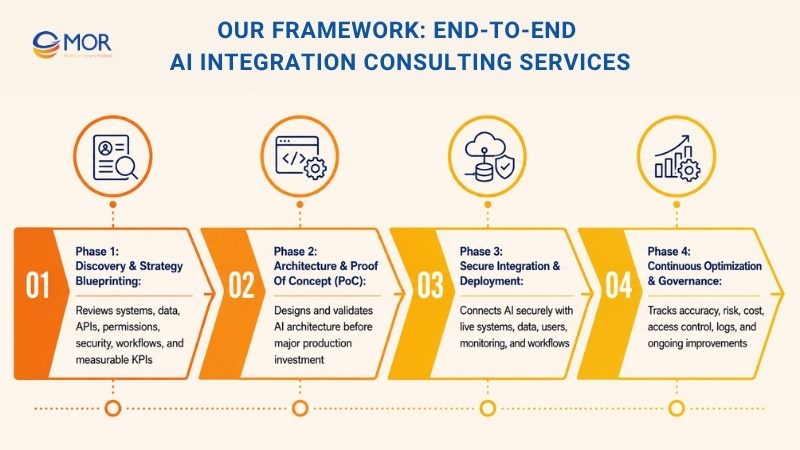
Phase 1: Discovery & Strategy Blueprinting
The challenge often begins before development starts. Many organizations know they want AI, but they have not yet determined whether their data, APIs, permissions, and workflows are ready to support it.
We begin with a discovery phase to understand the business objectives, available data sources, and the most effective way to introduce AI without creating unnecessary risks.
- Current system review: We assess your existing technology landscape, including ERP, CRM, HRM, finance platforms, support tools, databases, portals, and custom applications. This helps us understand where data resides and how teams operate today.
- API and integration check: Legacy systems may lack reliable APIs, stable connectors, or clearly documented data flows. MOR Software evaluates integration readiness early to avoid project delays caused by technical assumptions.
- Data readiness assessment: AI depends on accessible and high-quality data. We examine data quality, completeness, duplication issues, document structures, naming conventions, and update frequency before moving into solution design.
- Access control mapping: Not every user should have access to every piece of information. We map user roles, approval workflows, and permission structures to ensure AI responses remain within appropriate boundaries.
- Security and compliance review: Enterprise AI often interacts with sensitive information such as customer records, employee data, financial documents, healthcare information, or proprietary business content. We evaluate compliance requirements related to GDPR, HIPAA, APPI, and industry-specific regulations.
- Workflow bottleneck analysis: Processes that appear straightforward can become inefficient in daily operations. We identify repetitive manual tasks, approval delays, duplicate data entry, excessive search time, and workflow handoff issues.
- KPI definition: Successful AI initiatives require measurable outcomes. MOR Software helps define KPIs such as response accuracy, ticket deflection rates, handling time, search effectiveness, fraud investigation speed, escalation rates, and user adoption.
Phase 2: Architecture & Proof of Concept (PoC)
Once the discovery phase is complete, the next step is designing the technical foundation. This stage transforms business requirements into an AI architecture that can be validated before significant investment is made.
We use the PoC phase to verify feasibility and performance, rather than presenting an unfinished solution as a production-ready system.
- AI architecture design: We define how the AI layer interacts with existing systems, how data flows through the environment, what components are required, and how users will engage with the solution.
- Data flow planning: A well-designed data flow clarifies where information originates, how it is retrieved, filtered, processed, and delivered. This reduces the risk of AI relying on outdated or irrelevant content.
- Model selection: MOR Software evaluates model options based on business requirements, security expectations, response quality, performance, cost considerations, and deployment preferences. Depending on the use case, this may include GPT-based models, Claude, Gemini, or enterprise-grade open-weight alternatives.
- Security model design: Before development begins, we establish access controls, permission structures, protected data handling rules, logging requirements, and approval mechanisms. Security must be built into the architecture from the start.
- PoC development: The proof of concept validates whether the proposed solution can perform effectively under realistic conditions. We assess accuracy, latency, retrieval quality, security alignment, operational costs, and workflow compatibility.
- PoC and MVP separation: A PoC demonstrates technical feasibility, while an MVP delivers a usable business solution with stronger workflows, testing procedures, governance controls, and user access management. Keeping these stages separate helps maintain realistic expectations.
Phase 3: Secure Integration & Deployment
This phase moves AI from experimentation into production environments. At this stage, the solution must operate reliably with real users, live data, security controls, monitoring systems, and operational constraints.
MOR Software integrates the AI layer into your existing ecosystem using secure approaches that align with your architecture and business requirements.
- System connection: We connect AI capabilities to existing platforms through APIs, middleware, secure connectors, webhooks, or event-driven architectures. The integration approach depends on system maturity, data requirements, performance expectations, and access limitations.
- RAG implementation: Retrieval-Augmented Generation (RAG) enables AI to generate responses based on trusted enterprise knowledge at runtime. This approach is particularly effective for internal knowledge management, policy retrieval, customer support, product information, and document-based workflows.
- Fine-tuning assessment: Fine-tuning is not always necessary. We recommend it only when the model requires specialized domain expertise, unique communication styles, industry-specific terminology, or task behaviors that cannot be achieved effectively through RAG alone.
- Authentication and authorization: AI systems must follow the same security standards as the applications they support. We integrate authentication mechanisms, role-based access controls, and permission validation to ensure users only access authorized information.
- Data masking and privacy control: Sensitive information may need to be hidden, anonymized, redacted, or excluded from AI outputs. This is especially important in industries such as finance, healthcare, legal services, human resources, and customer support.
- Fallback handling: APIs can fail, data may be unavailable, and AI responses may occasionally be insufficient. We design fallback mechanisms that provide users with clear guidance and alternative actions when issues occur.
- Human escalation: Certain workflows require human oversight. We establish escalation paths for high-risk scenarios involving payments, legal matters, HR decisions, customer disputes, healthcare information, or other sensitive business processes.
- Production deployment: Deployment includes testing, environment configuration, monitoring setup, access validation, release planning, and user onboarding. Our goal is to deliver a stable and reliable production system rather than a short-lived demonstration.
Phase 4: Continuous Optimization & Governance
AI systems require ongoing management after deployment. Business priorities evolve, data changes, user behavior shifts, and new security challenges emerge over time.
We help organizations maintain AI performance, governance, and business value through continuous monitoring and improvement.
- Accuracy tracking: We monitor whether AI responses remain relevant, accurate, and useful. This includes identifying context gaps, incorrect references, and situations where human intervention is frequently required.
- Hallucination review: AI can occasionally generate convincing but inaccurate information. MOR Software implements review processes to identify these cases and improve prompts, retrieval strategies, and source data quality.
- Prompt injection testing: Users may intentionally or unintentionally attempt to bypass AI safeguards. Regular testing helps identify vulnerabilities related to prompt manipulation, tool access, and sensitive data exposure.
- Usage and cost monitoring: Visibility into token consumption, API usage, latency, caching efficiency, model fallback rates, and operational costs helps organizations maintain sustainable AI operations.
- Performance dashboards: Dashboards provide insights into model effectiveness, failed responses, escalation trends, search performance, user engagement, and business KPIs, enabling stakeholders to measure real impact.
- Audit log review: Comprehensive logs record what information the AI accessed, how it responded, and when human intervention occurred. These records support compliance, troubleshooting, and governance efforts.
- Access control checks: User roles, permissions, and approval structures should be reviewed regularly. Organizational changes, new teams, and additional data sources can introduce security gaps if left unmanaged.
- Prompt and retrieval updates: We continuously refine prompts, retrieval configurations, source content, model settings, and workflow logic as business requirements evolve. Regular optimization helps ensure the AI solution remains accurate, secure, and valuable over time.
Cost Breakdown for Generative AI Integration Services
Enterprise AI integration is not a one-time software purchase. It includes discovery, solution design, engineering, system connection, testing, security review, deployment, and long-term governance.
The cost of generative AI integration services depends on many moving parts. System complexity, data quality, integration scope, security needs, model choice, token usage, vector database size, user volume, latency targets, governance needs, and SLA level can all change the final budget.
The ranges below are useful for planning, not fixed quotes. Final pricing should come after technical discovery, data assessment, integration scope review, expected usage estimates, security checks, and governance planning.
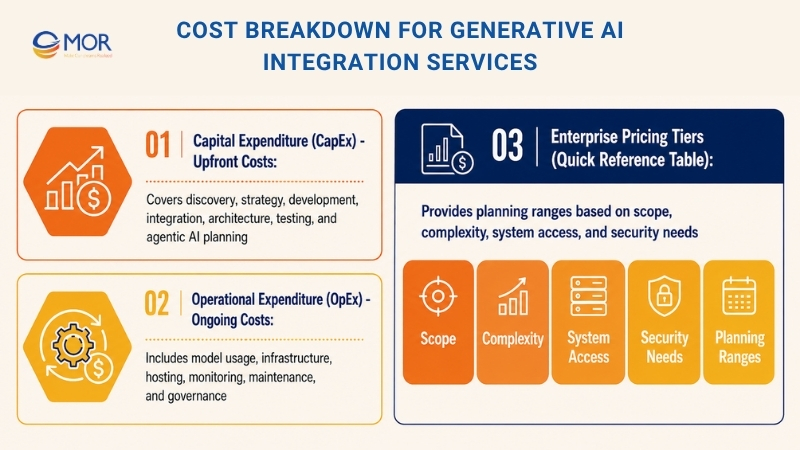
Capital Expenditure (CapEx) - Upfront Costs
Discovery & Strategy (15% - 20% of budget)
This stage is usually covered under AI integration consulting services. MOR Software reviews technical feasibility, data readiness, API availability, compliance needs, security risks, and the right AI architecture for your use case.
Treat this percentage as a planning guide, not a fixed market rule. A small internal knowledge assistant may need a shorter discovery phase, while a multi-system AI workflow across CRM, ERP, finance, and support tools needs deeper review before development starts.
Custom Development & Integration (40% - 50% of budget)
This is often the largest part of the project because most AI value comes from connecting the model to real systems. The work may include custom web development services AI integration, secure API pipelines, RAG systems, authentication, business logic, AI user interfaces, testing, and deployment.
This part may also include AI development services OpenAI integration or integration with other model providers and open-weight models. Teams often underestimate this stage because the demo looks simple, but production work includes edge cases, permission checks, logging, fallback handling, and user workflows.
Data cleaning, old API limits, private hosting, strict compliance needs, and complex approval flows can raise the development share. A legacy ERP with weak documentation will take more effort than a modern cloud system with clean APIs.
Premium Tier - Agentic AI Integration:
Agentic AI integration consulting services usually need extra design, testing, and governance. Multi-step agents require tool permissions, human approval points, action logs, monitoring, rollback paths, and clear workflow boundaries.
This is where a pilot matters. Before connecting an AI agent to payment workflows, sales tasks, HR cases, or support routing, the team needs to prove value, risk level, and cost under real usage.
Operational Expenditure (OpEx) - Ongoing Costs
Model Usage & API Token Fees (Variable): Token fees depend on the model provider, request volume, input tokens, output tokens, caching, latency targets, and user growth. A customer-facing assistant with heavy daily traffic will cost more to run than an internal tool used by a small team.
A simple planning formula is:
Monthly requests x average input/output tokens x model price + vector database + cloud hosting + monitoring.
This formula is basic, but it gives teams a better view than guessing from a one-time demo.
Infrastructure & Vector Hosting (Monthly):
Infrastructure costs may include cloud compute on AWS, Azure, or Google Cloud, vector databases, storage, monitoring tools, logging tools, and backup systems. The more data the AI needs to retrieve, the more planning the hosting layer needs.
Large knowledge bases, strict latency targets, private deployment, and high traffic can raise monthly costs. A private AI assistant for a regulated finance team will not have the same cost profile as a lightweight FAQ chatbot.
AI Maintenance & Governance (10% - 15% annually)
AI systems need regular review after launch. Maintenance usually starts from 10% - 15% annually, depending on SLA level, monitoring depth, compliance needs, model evaluation, and support scope.
Governance work may include prompt updates, RAG source review, hallucination checks, prompt injection testing, access control review, usage reporting, and model performance review. Regulated industries or agentic AI systems may need a higher governance budget because the risk level is higher.
Enterprise Pricing Tiers (Quick Reference Table)
The table below gives a practical starting point for budget planning based on MOR Software’s experience delivering AI integration projects. These ranges are indicative and may change after discovery, since real cost depends on data condition, system access, AI scope, security needs, and expected usage.
Tier | Complexity & Scope | Estimated Upfront Cost | Best For |
Standard | Limited-scope AI integration service, such as an internal knowledge base assistant or smart FAQ chatbot with clean data and minimal integration. Excludes complex ERP/CRM integration, strict compliance, multilingual workflows, and private hosting. | Starting from $15,000 - $35,000 | Mid-sized companies that want better support, internal search, or document lookup. |
Advanced | Custom RAG pipeline plus AI consulting services integration with existing systems, such as CRM/ERP sync, defined data sources, accessible APIs, and limited workflow automation. | Starting from $40,000 - $90,000 | Companies that want AI to support department workflows, reporting, data lookup, or CRM operations. |
Enterprise / Agentic | Full-scale agentic AI integration, custom web portals, private or localized model setup, multi-system integration, autonomous task support, security controls, governance, and monitoring. | Starting from $100,000+ | Large enterprises with complex workflows, high security needs, and strong governance requirements. |
Real-World Impact: Success Metrics of AI CRM & Workflow Integration
AI integration should be measured by business outcomes, not by how impressive the demo looks. A CRM assistant, fraud review tool, or AI search layer must prove that it saves time, improves decisions, or removes repeated manual work in a measurable way. MOR Software recommends starting with a pilot so teams can compare real usage against a clear baseline and identify measurable improvements before scaling further.
Industry | Integration Type | Business Outcome |
E-Commerce | Custom Web Development + OpenAI / LLM Integration | Better personalization, product discovery, smart search, and conversion potential. Exact engagement uplift should be tested through A/B testing, analytics review, and customer journey tracking. |
Finance | AI/ML Fraud Detection + ERP or Transaction System Integration | Faster anomaly detection and fraud triage. Results depend on data quality, detection rules, false-positive rate, compliance checks, and analyst review workflows. |
Customer Service | Generative AI CRM Integration | Potential drop in repeated support workload, faster response time, and lower operating cost when ticket deflection, escalation flows, and knowledge retrieval are set up well. |
Based on industry benchmarks and project-specific validation, enterprises may see measurable gains in engagement, fraud detection speed, support performance, and operating cost control. Actual results vary by use case, data quality, integration complexity, workflow design, governance, and user adoption.
Conclusion
Generative AI can help businesses turn static data into faster answers, smarter workflows, and better decision support. Yet real value depends on data readiness, secure integration, strong governance, and clear KPIs. Contact MOR Software for a technical assessment of your AI roadmap. Our team can help you plan generative AI integration services, connect AI with CRM or ERP systems, and build practical AI workflows that match your business goals.
"Evolution is not a destination, it is a disciplined journey of innovation."
Phung Van Tu


CEO MOR AI
MOR SOFTWARE
Frequently Asked Questions (FAQs)
What are generative AI integration services?
Generative AI integration services focus on connecting generative AI models with existing business systems, applications, and data sources. The goal is to make AI outputs usable inside real workflows, not as standalone tools.
Which business systems can generative AI be integrated with?
Generative AI can integrate with CRM platforms, ERP systems, customer support tools, internal dashboards, content management systems, and custom software. Integration depends on data access, APIs, and system architecture.
How long does a generative AI integration project usually take?
Timelines vary based on scope and complexity. Small integrations may take a few weeks, while enterprise-level projects involving multiple systems and data sources can take several months.
What data is required for generative AI integration?
Clean, structured, and relevant data is essential. This may include customer data, documents, logs, historical records, or domain-specific content, depending on the use case.
Is generative AI integration secure for sensitive data?
Yes, when implemented correctly. Security measures include access controls, data encryption, audit logging, and compliance with regulations like GDPR or HIPAA where applicable.
Do businesses need in-house AI expertise to use these services?
Not necessarily. External specialists often handle model selection, integration, and tuning, while internal teams focus on business requirements and ongoing usage.
Can generative AI integration scale as the business grows?
Yes. Well-designed integrations are built to handle increasing data volumes, more users, and expanded use cases without performance issues.
What are common use cases for generative AI integration?
Typical use cases include automated customer support, content generation, internal knowledge assistants, report creation, data summarization, and workflow automation.
How is model accuracy maintained after deployment?
Accuracy is maintained through monitoring, feedback loops, retraining, and periodic model updates. Data quality and usage patterns play a key role over time.
How much does generative AI integration typically cost?
Costs depend on factors like system complexity, data preparation needs, customization level, and deployment scale. Projects can range from modest budgets to large enterprise investments.
How is AI integration different from building an AI tool from scratch?
AI integration adds AI into the systems a business already uses. Building from scratch often requires a new platform, new data structure, and more development work. Integration is usually faster when the company already has usable data, clear workflows, and systems that can connect through APIs.
Can generative AI connect with ERP, CRM, or legacy systems?
Yes, but the difficulty depends on the system. Modern cloud platforms often have cleaner APIs, while older ERP, CRM, or legacy systems may need middleware, custom connectors, ETL processes, or data cleanup before AI can work well.
What business workflows can benefit from AI integration?
Common workflows include customer support, sales follow-up, CRM data lookup, invoice review, HR requests, internal knowledge search, fraud triage, product search, and document summarization. The best use cases are repeated tasks with clear data sources and measurable outcomes.
Is RAG better than fine-tuning for enterprise AI integration?
RAG is often a better starting point when the goal is to ground AI responses in company data. It retrieves trusted information at runtime. Fine-tuning is more useful when the model needs a specific tone, domain language, or repeated task behavior that RAG cannot handle well.
How much do generative AI integration services cost?
Costs vary by scope, data quality, system complexity, model choice, security needs, and expected usage. A limited AI assistant may start from $15,000 - $35,000, while advanced RAG systems or agentic AI workflows can start from $40,000 - $100,000+.
How long does an AI integration project usually take?
A small proof of concept may take a few weeks. A production-ready system with CRM, ERP, RAG, security controls, testing, and user access rules may take several months. The timeline depends on API readiness, data condition, compliance needs, and review cycles.
How can businesses measure the success of AI integration?
Success should be tied to clear KPIs. These may include response accuracy, search success rate, ticket deflection, average handle time, fraud triage speed, user adoption, escalation rate, or cost per ticket. A pilot helps compare results against a real baseline before wider rollout.
Share


Make Our-Dreams Realized


© 2023 . MOR Software. All Rights Reserved
Sitemap
Privacy Policy
Terms of Use

Rate this article
0
over 5.0 based on 0 reviews
Your rating on this news:
Name
*Email
*Write your comment
*Send your comment
1