


Hire Mobile App Developers: Guide to Find The Best Team for 2026
A polished CV can hide weak architecture judgment, limited release experience, or poor team fit. Companies that hire mobile app developers need to evaluate much more than Swift, Kotlin, Flutter, or React Native skills. This MOR Software guide will cover the developer roles, hiring models, technical checks, costs, contracts, and onboarding decisions that shape a successful mobile team. You’ll also see where dedicated developers and outsourced product teams fit different project needs.
Key Takeaways
- Define your product scope, target platforms, technical gaps, and release responsibilities before selecting developers.
- Compare hiring models based on total cost, team control, scalability, continuity, and management workload rather than hourly rates alone.
- Vet candidates through production apps, technical interviews, code reviews, store-release experience, and a paid pilot when the project size warrants it.
What to Decide Before You Hire Mobile App Developers
Good hiring starts before the first candidate interview. Define the work clearly, then match talent to that work instead of building a job description around a generic 'mobile developer' title.
If you plan to hire mobile app developer talent without mapping these points, you may end up paying a senior engineer to solve the wrong problem.
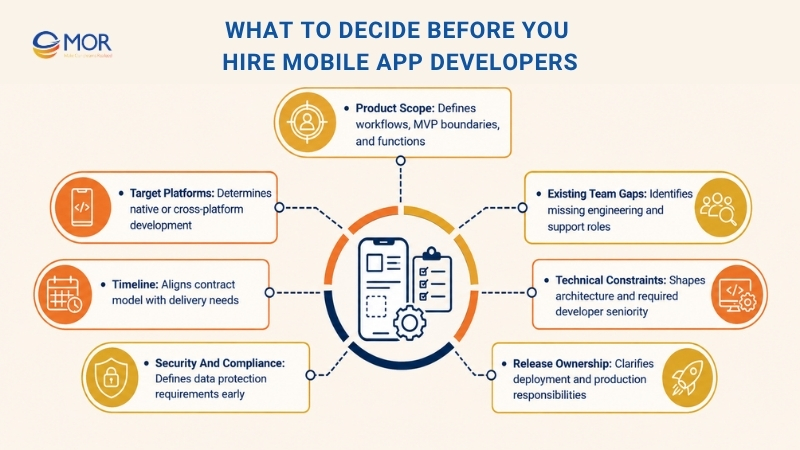
- Product scope: Write down the user problem, main workflows, MVP boundary, and planned functions. An on demand application with live driver tracking needs a very different team than a simple internal field app.
- Target platforms: Decide if the first release covers iOS, Android, or a shared Flutter or React Native codebase. Native Swift and Kotlin make sense when device APIs, platform UX, or heavy processing drive the product.
- Existing team gaps: Map what your current staff can already own. You may need one mobile engineer, backend support, QA, a product designer, or AI engineer staffing for intelligent functions rather than a whole new team.
- Timeline: Separate an urgent capacity shortage from a long product roadmap. A three-month backlog calls for a different contract than a product expected to receive weekly updates for several years.
- Technical constraints: Record existing APIs, cloud services, legacy systems, hardware access, payment services, authentication, offline behavior, and data flows. These constraints affect architecture and candidate seniority.
- Security and compliance: Flag healthcare data, payment information, employee records, location data, and other sensitive information early. Candidates should know the rules that shape storage, API access, permissions, and audit work.
- Release ownership: Name who handles TestFlight, Google Play testing, signing certificates, store accounts, release pipelines, crash reports, OS changes, and production fixes.
- Budget model: Set a realistic spending range before choosing freelancers, internal hires, staff augmentation, dedicated teams, or project outsourcing. Compare total cost rather than one hourly number.
A written scope also makes vendor proposals easier to compare. Teams that hire mobile app developers against the same requirements can judge skill, team structure, timeline, and price on equal terms.
Which Mobile App Developers Should You Hire?
The right role depends on the codebase, platform, server-side work, release duties, and level of technical ownership. Looking at generic mobile app developers for hire without separating these responsibilities makes candidate comparison harder.
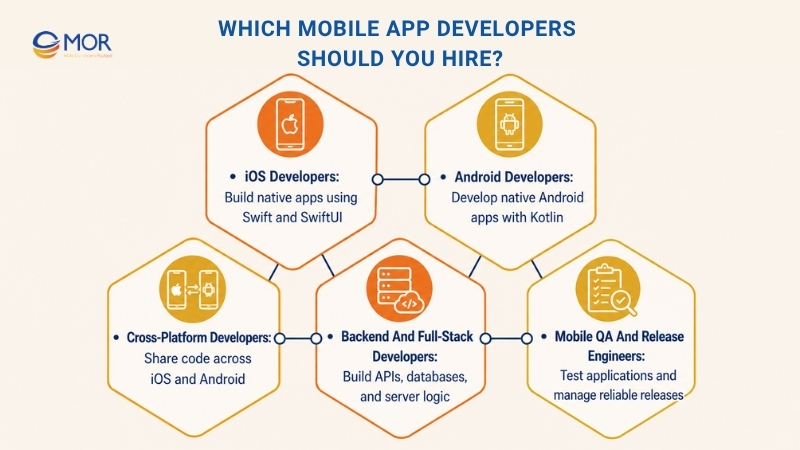
iOS Developers
Native iOS work calls for strong Swift and SwiftUI knowledge. UIKit still matters when the product contains older screens or a large existing codebase that hasn’t moved fully to SwiftUI.
A capable iOS engineer should understand Apple SDKs, application lifecycle behavior, background tasks, push notifications, local storage, accessibility, Instruments profiling, signing, TestFlight, and App Store submission. Deep Apple ecosystem work can also require knowledge of widgets, watchOS, Bluetooth, camera APIs, or Apple payment services.
App Store experience deserves direct attention during screening. Apple reviewed 9,100,620 submissions in 2025 and rejected 2,093,244, including large numbers tied to performance, design, business, and legal rules. Release knowledge belongs inside engineering responsibility rather than at the end of the schedule.
Choose a native iOS specialist when Apple-specific UX, hardware access, high graphics demands, or early support for new iOS APIs drive product value.
Android Developers
Kotlin and Jetpack Compose now sit at the center of modern native Android work. Java knowledge still matters because many production applications retain older modules and libraries.
Android engineers need to understand device fragmentation, lifecycle behavior, WorkManager, push notifications, permissions, local storage, Google services, memory usage, startup performance, and Play Store release controls. Real-device testing carries extra weight because screen sizes, manufacturers, OS versions, and hardware combinations vary widely.
Look for experience with staged releases and production diagnostics as well. A developer who can code a screen but can’t trace a crash across Android versions leaves a costly gap after launch.
Cross-Platform Developers
Flutter and React Native let one team share a large part of the code across iOS and Android. Flutter uses Dart, while React Native commonly pairs JavaScript or TypeScript with native modules where direct device access is needed.
Companies often hire mobile app developers in this category when release speed and shared product behavior matter more than deep platform-specific work. If you need to hire cross platform mobile app developers, check how they handle platform channels, native modules, permissions, build pipelines, and differences between Apple and Android behavior.
Cross-platform development fits many marketplace, commerce, booking, internal business, content, and SaaS companion apps. Native development still deserves consideration for heavy graphics, device-level processing, unusual hardware integration, or new OS APIs that lack mature cross-platform support.
Backend and Full-Stack Developers
A mobile interface rarely runs alone. Authentication, APIs, user accounts, payments, messaging, databases, cloud storage, analytics, business rules, and real-time updates usually sit behind it.
Backend engineers may work with Node.js, Python, Java, .NET, Go, PHP, or related server technologies. PHP programming services can still fit an existing Laravel or PHP backend where the mobile app must connect to established business systems.
REST APIs cover many standard integrations. GraphQL fits products that need flexible data queries, and WebSockets support chat, tracking, live dashboards, or other real-time communication.
A full-stack engineer can cover a small MVP when the server side remains modest. Larger products usually benefit from dedicated backend specialists because database design, security, cloud architecture, and server performance demand focused ownership.
Mobile QA and Release Engineers
QA engineers test far beyond screen behavior. Their work covers functional flows, regression, device coverage, security checks, network conditions, performance, permissions, accessibility, and release candidates.
Automation also changes the release rhythm. XCTest, Espresso, Appium, Detox, CI/CD tools, Firebase Crashlytics, and similar tooling let teams catch faults before users find them.
Add release engineering when several environments, frequent deployments, or regulated workflows raise the cost of failure. A broader mobile team should account for QA and release ownership before development begins.
Compare Mobile App Developer Hiring Models
Companies can hire mobile app developers through several commercial structures, but the cheapest contract rate rarely tells the whole story. Recruiting workload, internal supervision, continuity, replacement risk, and product ownership change the real cost.
Hiring model | Best project fit | Hiring / onboarding speed | Client management effort | Ability to scale | Scope flexibility | Continuity | Technical ownership | Main risk |
In-house developers | Core products with a long roadmap, proprietary systems, constant development | Slow | High employer responsibility | Low to medium | Very high | High if staff remain | Highest internal control | High fixed cost, long recruitment cycle, employee turnover |
Freelance developers | Prototype, bug fixes, isolated functions, short projects | Fast | High | Medium | High | Low to medium | High when IP terms are written properly | Availability gaps, uneven quality, knowledge loss |
Staff augmentation / dedicated developers | Existing product teams that need extra Swift, Kotlin, Flutter, React Native, backend, or QA capacity | Fast | Medium to high because you manage priorities | High | Very high | Medium to high | Client retains product and engineering control | Needs internal leadership to direct external talent |
Project-based outsourcing | Defined MVPs, new applications, modernization work, or companies that want a vendor to manage delivery | Medium | Low to medium | High through vendor staffing | Medium because major scope changes affect budget | Medium to high when the same vendor stays involved | Vendor manages implementation inside agreed scope | Weak scoping can lead to change requests and extra cost |
In-house developers
An internal developer works best when mobile engineering is a permanent company function. You control priorities, processes, security access, technical standards, and product knowledge directly.
The fixed cost goes far beyond salary. The U.S. Bureau of Labor Statistics reported a $135,980 median annual wage for software developers in May 2025, before recruitment, employer taxes, benefits, hardware, training, or management costs.
This model fits established product organizations that expect a steady mobile roadmap and can keep a permanent engineering function busy.
Freelance developers
Freelancers fit contained assignments, prototypes, maintenance tickets, or specialist work. A mobile app developer freelancer arrangement can also cover a short gap when an employee leaves unexpectedly.
You might pair a freelance engineer with a freelance UX designer during an MVP, for example. That setup keeps the team lean, but your company must manage coordination, architecture decisions, QA, code review, and knowledge transfer.
Continuity becomes the main concern. A strong mobile app developer for hire may be available today and booked by another client three months later.
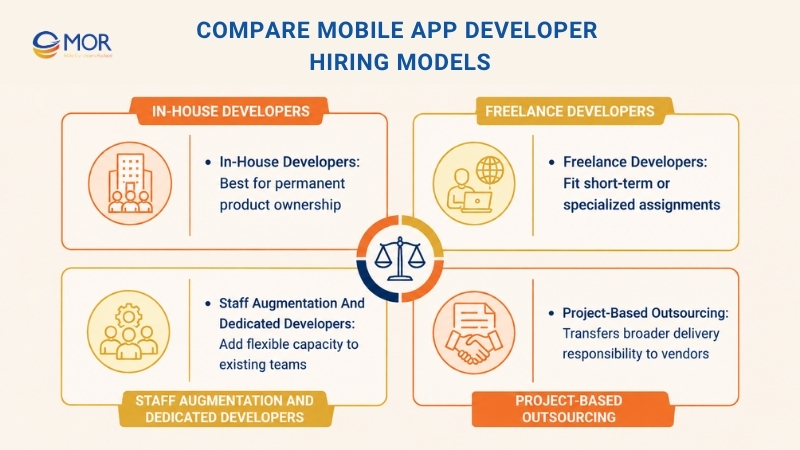
Staff augmentation and dedicated developers
Staff augmentation places external engineers inside your existing delivery process. They join your repository, sprint planning, task board, code reviews, and communication channels while the provider manages recruitment and employment operations.
This approach fits teams that already have a CTO, product owner, engineering manager, or tech lead. You retain day-to-day control and add skills when the roadmap needs them.
Companies may hire mobile apps developers for six months, extend the team for a release cycle, then resize it later. This model also works well when one internal mobile squad suddenly needs extra QA, backend, or platform capacity.
Project-based outsourcing
Project outsourcing moves more delivery responsibility to the vendor. The provider manages staffing, milestones, engineering coordination, QA, and agreed outputs according to the contract.
Choose it when your company doesn’t want to supervise individual engineers. A defined MVP, modernization program, new customer app, or well-scoped internal system fits this model better than a constantly changing backlog.
Project outsourcing needs careful scoping. Product assumptions, exclusions, acceptance criteria, change rules, and maintenance terms should appear before the contract is signed.
What Skills Should Mobile App Developers Have?
Technical interviews should measure production judgment rather than syntax memory. Companies that hire mobile app developers need people who can build, test, release, diagnose, and maintain software after users start depending on it.
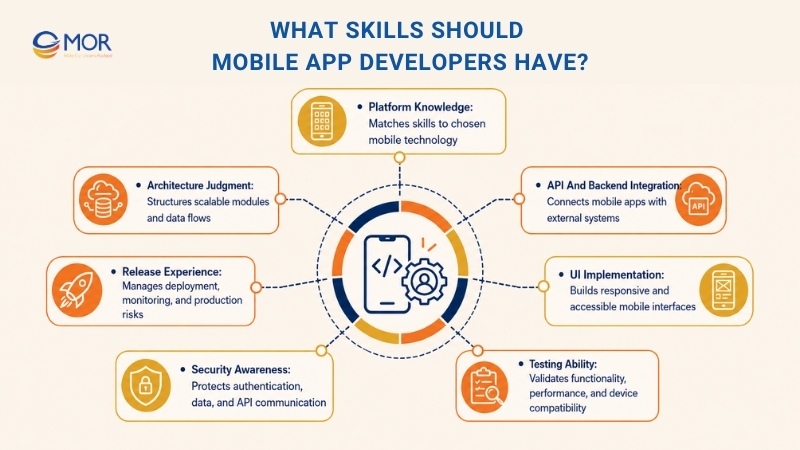
Platform knowledge
Check Swift and SwiftUI for iOS, Kotlin and Jetpack Compose for Android, and Flutter/Dart or React Native/TypeScript for shared-code products. Legacy systems may still require UIKit, Objective-C, Java, or older libraries.
Architecture judgment
Ask how the candidate structures state, modules, data flows, dependencies, offline data, and reusable components. Strong engineers can explain why a design fits the product instead of repeating one preferred pattern.
API and backend integration
Test knowledge of REST, GraphQL, authentication, payments, push messaging, analytics, file uploads, and external business systems. Mobile work often fails at integration boundaries rather than inside the interface.
UI implementation
A developer should translate designs into responsive screens across device sizes. Accessibility, typography, touch states, orientation, loading behavior, and error states belong in the implementation.
Data and offline handling
Check caching, local databases, retry rules, sync queues, conflict resolution, and weak-network behavior. These skills become necessary for field apps, travel apps, logistics products, and other mobile-first systems.
Testing ability
Ask about unit tests, integration tests, UI tests, regression, real-device checks, and performance testing. Senior candidates should explain what deserves automation and what still benefits from manual testing.
Security awareness
Review authentication, token storage, encryption, permissions, API security, certificate handling, secrets, and local user data. Healthcare, finance, HR, and location-based products need stricter controls.
Performance debugging
Engineers should know how to diagnose slow startup, dropped frames, memory leaks, large binaries, battery drain, heavy network use, and background-process problems.
Release experience
Store signing, build configuration, certificates, internal testing, staged rollout, production monitoring, and rollback planning belong on the checklist. A developer who has shipped real applications tends to spot release risks earlier.
Communication
Ask candidates to explain trade-offs in plain language. Good engineers document decisions, estimate tasks, raise risks early, and communicate changes before they become delivery surprises.
One practical interview tactic works well: give the candidate a real product scenario and ask for a technical plan. Their questions often reveal more than their first answer.
How to Hire Mobile App Developers in 7 Steps
A repeatable process keeps technical screening tied to business needs. The 7 steps below show you how to hire mobile app developers without treating recruitment as a CV-ranking exercise.
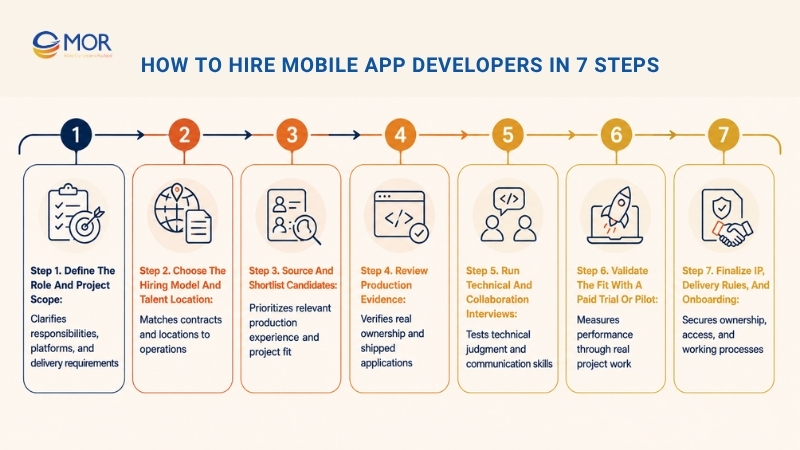
Step 1. Define the Role and Project Scope
Start with the actual work. Document target platforms, business workflows, integrations, current code, expected release date, team structure, security requirements, and post-launch responsibility.
Seniority should follow ownership. A developer implementing approved screens needs a different skill level than someone expected to select architecture, review pull requests, manage releases, and coach other engineers.
Clarify work hours too. Time-zone overlap matters when your product team expects daily pairing, rapid design feedback, or live incident response.
Supporting roles belong in the same plan. UI/UX, backend development, QA, DevOps, business analysis, and product management can become bottlenecks when one mobile developer is expected to cover everything.
Step 2. Choose the Hiring Model and Talent Location
Match the contract to the way your team operates. In-house hiring suits permanent ownership, freelancers fit narrow assignments, staff augmentation works inside an established engineering team, and project outsourcing transfers broader delivery responsibility.
Location changes communication rhythm and cost. Nearshore engineers usually share more working hours with your office, while offshore teams can provide wider talent access and lower regional rates.
Companies that hire remote mobile app developers should define overlap hours rather than asking for vague 'availability.' Two or three agreed collaboration hours can be enough when documentation, task ownership, and review habits are strong.
Don’t use geography as a quality score. Evaluate production history, communication, seniority, security practices, and delivery model before comparing price.
Step 3. Source and Shortlist Candidates
Specialist software companies, staff augmentation providers, professional networks, referrals, talent marketplaces, GitHub, and technical communities can all produce strong candidates. Choose the channel according to project duration and the amount of screening your company wants to handle.
A mobile app developer for hire through a marketplace gives you direct access, but your team usually owns more vetting and management. A development provider adds recruitment, replacement, and team-building support around the engineer.
For procurement teams, a 'hire mobile apps developer' brief should name the target stack, seniority, working hours, contract length, release duties, and existing team. Generic briefs attract generic profiles.
Local access may matter for workshops or strict procurement rules. App developers for hire near me can be a useful filter in that case, yet physical distance should sit behind production evidence and project fit.
Shortlist on relevant work. A candidate who has shipped a booking app with payments and offline sync may be more useful for your booking product than someone with twice as many unrelated portfolio items.
Step 4. Review Production Evidence
Ask what the candidate personally owned. A portfolio screenshot doesn’t tell you who designed the architecture, wrote the core code, fixed production faults, or handled store submission.
Teams that hire mobile app developers should request live App Store or Google Play work when public products exist. Review the app, release history, ratings, update frequency, performance, and supported devices.
Dig deeper during the interview. Ask about the hardest production bug, a technical decision they later changed, a store rejection, a migration, a failed release, or a performance problem.
Case studies can support vendor screening too. Look for project scope, team size, technology, timeline, business requirements, and delivered outcome rather than a logo wall.
Step 5. Run Technical and Collaboration Interviews
Use scenarios tied to your product. Ask a candidate how they’d design authentication, offline sync, push notifications, a large scrolling feed, background location, payment recovery, or real-time chat.
Then change one condition. Give them poor connectivity, ten times more users, a legacy API, or a tight release deadline and see how their reasoning changes.
Code review is another strong signal. Present a small pull request and ask what they’d change, what they’d leave alone, and which problems deserve immediate work.
Communication deserves equal attention. Engineers regularly explain blockers, estimates, architecture, and risk to people who don’t share their technical background.
Step 6. Validate the Fit With a Paid Trial or Pilot
A paid pilot turns assumptions into evidence. Choose a contained task that touches enough of the real codebase to show engineering habits without handing over a major production module.
Set acceptance criteria before work begins. Review code readability, test coverage, estimate accuracy, pull-request quality, documentation, communication, and response to feedback.
Avoid free speculative assignments that take days. Skilled senior developers often have little reason to complete unpaid production-style work.
A short pilot also exposes working-style problems early. One week of real collaboration can reveal more than several rounds of polished interviews.
Step 7. Finalize IP, Delivery Rules, and Onboarding
Put ownership in writing. The agreement should cover source code, repositories, documentation, design files, domains, cloud resources, signing keys, certificates, App Store accounts, Google Play accounts, and third-party credentials.
Set communication rules before the first sprint. Define tools, meeting cadence, pull-request process, branch rules, reporting, escalation paths, and who approves releases.
Security access should follow least-privilege principles. Developers only need the systems required for their tasks, and access should be reviewed when team members change.
Define replacement and scaling terms as well. Knowledge transfer, notice periods, documentation, handover, and access removal protect the project when staffing changes.
How Much Does It Cost to Hire Mobile App Developers?
Developer rate and total app budget are two different numbers. Companies that hire mobile app developers must also account for UI/UX, backend work, QA, DevOps, cloud services, project management, integrations, release work, and maintenance.
Pricing varies sharply by seniority, location, and contract model. Treat the figures below as 2026 planning ranges rather than fixed market prices.
Cost by Developer Experience
Experience changes the amount of supervision a developer needs and the decisions they can own. Public 2026 offshore research places U.S., Western European, Eastern European, Latin American, Indian, and Southeast Asian engineers in very different price bands even at similar seniority.
Developer level | Typical 2026 hourly range | Suitable work | Expected autonomy |
Junior developer | $15-$50/hour | Basic screens, bug fixes, simple API work, test support | Needs frequent review and technical guidance |
Mid-level developer | $25-$100/hour | Complete functions, API integrations, state management, standard mobile architecture | Handles most product work independently |
Senior mobile developer | $40-$200+/hour | Architecture, performance, security, complex integrations, release ownership | Works independently and reviews other engineers |
Tech lead / mobile architect | $60-$200+/hour | Architecture strategy, technical standards, scale planning, cross-team decisions, migration work | Owns major engineering decisions |
A wide range doesn’t mean seniority is meaningless. Geography, hiring channel, domain knowledge, communication overlap, and provider overhead move the rate inside each band.
Senior talent costs more per hour but may require less supervision and create fewer architecture mistakes. Junior engineers fit better when a strong lead already exists and the backlog contains well-defined tasks.
Cost by Hiring Model
The commercial structure changes what sits inside the price. Marketplace freelancer rates exclude much of the management and delivery support included in a full development vendor.
Upwork lists mobile app developers at $18-$39 per hour on its platform in 2026. Its Android specialists commonly sit at $15-$35, iOS developers at $16-$35, React Native developers at $24-$45, and Swift developers at $18-$39.
Hiring model | Typical cost benchmark | Billing basis | Extra cost to budget | Cost predictability |
Freelancer | $18-$39/hour on Upwork; specialist rates can run higher | Hourly or milestone | Platform fees, PM time, QA, replacement risk | Medium |
In-house developer | U.S. software developer median pay reached $135,980/year in May 2025 | Salary | Employer taxes, benefits, recruiting, equipment, training, paid leave | High once hired |
Staff augmentation | Roughly $25-$90/hour depending on region and seniority | Hourly or monthly | Internal management, onboarding, tooling | Medium to high |
Dedicated mobile team | Illustrative offshore team of 3-5 people: about $12,000-$44,000/month at $25-$55/hour | Monthly team fee | Cloud services, external tools, client-side product leadership where needed | High |
Fixed-scope / project vendor | Often $10,000-$49,999 for Clutch-reviewed projects; large custom builds can go much higher | Milestone or agreed project price | Scope changes, maintenance, external services | High when scope stays stable |
A cheap contract can still carry heavy internal cost. Staff augmentation usually expects your team to manage work, while a project vendor includes more coordination and delivery responsibility.
Dedicated-team figures above are simple planning examples based on 3 to 5 people, 160 monthly hours, and a $25-$55 hourly band. The actual team mix might include mobile engineers, backend engineers, QA, a project manager, or a technical lead.
Cost by Developer Location
Location affects labor cost, time-zone overlap, and access to large talent pools. Keep seniority constant during comparison or the table becomes misleading.
Location | Practical 2026 hourly planning range | Approx. monthly cost at 160 hours | Cost profile |
North America | $70-$200+/hour | $11,200-$32,000+ | Highest rate band, especially for senior specialists |
Western Europe | $55-$160/hour | $8,800-$25,600 | Higher labor cost and mature enterprise talent |
Eastern Europe | $30-$80/hour | $4,800-$12,800 | Mid-range outsourcing market with deep engineering pools |
Latin America | $25-$90/hour | $4,000-$14,400 | Strong U.S. workday overlap |
India | $18-$60/hour | $2,880-$9,600 | Very large talent pool and broad quality range |
Southeast Asia | $18-$55/hour | $2,880-$8,800 | Lower offshore rates across mobile, backend, QA, and cloud roles |
These bands match the broad 2026 pattern reported across offshore markets. For example, current research places Southeast Asian mid-level engineers around $18-$35/hour and senior engineers around $25-$55/hour, compared with $100-$180/hour for senior North American agency talent.
Teams planning to hire remote mobile app developers should weigh those savings against work-hour overlap, communication style, internal management time, and candidate screening.
Factors That Change the Final Hiring Budget
Hourly rates explain only part of the total spend. Platform count, backend work, integrations, QA, security, and maintenance can move the final number by tens of thousands of dollars.
Cost factor | 2026 planning benchmark | Example effect on a $100K build | What increases the cost |
Platform count | Separate native iOS and Android apps can approach 2x one native platform | A $100K single-platform scope may approach $200K when the second native app needs comparable work | Separate UI implementation, coding, QA, release, and upkeep |
Native vs cross-platform | Shared-code development can cut duplicated platform work by about 30%-40% in suitable projects | Potential difference of roughly $30K-$40K against an equivalent $100K dual-native benchmark | Native modules and platform-specific behavior can narrow the saving |
Backend complexity | Often a major share of engineering effort | Budget depends on server logic and integrations | Authentication, databases, admin systems, cloud setup, complex rules |
Third-party APIs | Depends on number and difficulty of connections | Simple APIs cost far less than legacy ERP or payment work | Payments, CRM, ERP, maps, messaging, analytics, identity systems |
Real-time functions | Commonly push apps into higher complexity bands | Can move a mid-tier product well above its first estimate | Chat, tracking, live feeds, WebSockets, event processing |
Offline operation | Requires extra data and sync logic | Adds engineering and QA work | Local storage, conflict handling, retries, offline security |
Custom UI/UX | Design depth changes implementation effort | Heavy animation and custom interaction add more engineering time | Design systems, motion, accessibility, unusual interaction states |
Security and compliance | No useful universal percentage | Requires product-specific review | Health data, payment rules, encryption, audit controls, identity |
QA and device coverage | Grows with platform and device breadth | Adds test planning, devices, automation, and regression work | Physical device testing, OS versions, performance, security |
Store release work | Small compared with coding but easy to underestimate | Adds signing, testing, review, and monitoring work | CI/CD, certificates, TestFlight, Play testing, store review |
Maintenance | Often 15%-20% of original build cost each year | Around $15K-$20K/year for a $100K app | OS releases, SDK changes, bug fixes, security patches |
Existing technical debt | No trustworthy flat percentage | Audit before estimating | Old libraries, unstable architecture, poor documentation, missing tests |
Netguru's 2026 cost research puts annual maintenance near 15%-20% of original build cost and notes that two native platforms can approach twice the work of a single native build. It also places cross-platform dual-platform delivery around 1.3 to 1.5 times the cost of one native app in suitable cases.
Project-level pricing shows why rate alone can mislead. Clutch reports that most reviewed mobile projects sit between $10,000 and $49,999, but its current average project cost is $90,780.11 and the usual project timeline is about 11 months.
Questions to Ask Before Hiring Mobile App Developers
A strong interview should expose production habits, ownership, and working style. Before you hire mobile app developers, ask questions that connect directly to the job they’ll perform.
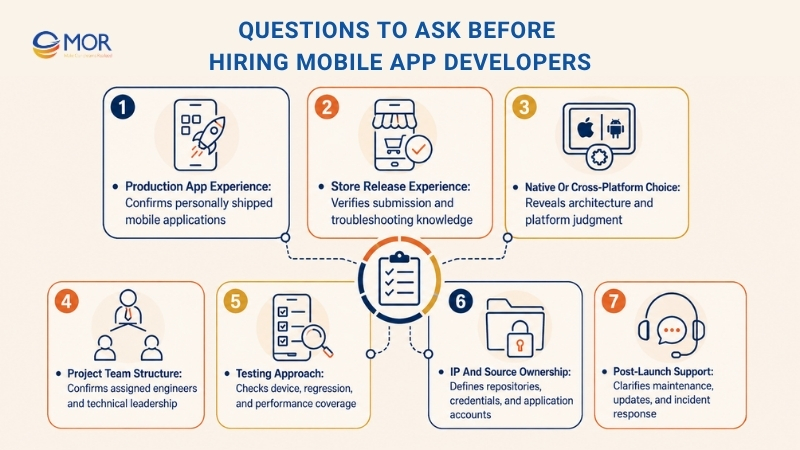
- Which production apps have you personally shipped? Ask candidates to name their own responsibilities rather than describe what the entire team delivered.
- Have you handled App Store or Google Play review? Store submission, signing, privacy rules, rejected builds, and release troubleshooting show experience beyond coding.
- Why would you choose native or cross-platform for our product? A strong candidate ties the answer to device access, performance, budget, existing staff, platform UX, and roadmap.
- Who will actually work on our project? Vendor sales teams should name the engineers, seniority mix, QA roles, and technical leadership expected on the account.
- How will you test across devices and OS versions? Ask about physical devices, simulators, automation, regression, network conditions, accessibility, and performance.
- How do you protect app data and API communication? Candidates should explain authentication, local storage, token handling, permissions, encryption, and secret management in practical terms.
- What does your estimate exclude? Ask about QA, project management, cloud costs, third-party subscriptions, store work, design, support, and change requests.
- Who owns the source code and store accounts? The contract should assign repositories, signing assets, credentials, application accounts, and documentation to the agreed owner.
- What happens if a developer leaves? Ask about replacement time, backup knowledge, handover, documentation, access removal, and transfer of unfinished work.
- What happens after launch? Define crash response, OS compatibility, dependency updates, security patches, store policy changes, analytics, and roadmap work.
The strongest answers usually include examples and trade-offs. Perfect-sounding answers with no production detail deserve more probing.
Red Flags to Avoid When Hiring Mobile App Developers
Bad hiring signals often appear before code is written. Companies that hire mobile app developers should treat vague staffing, thin production proof, and unclear ownership as commercial risks rather than small administrative gaps.
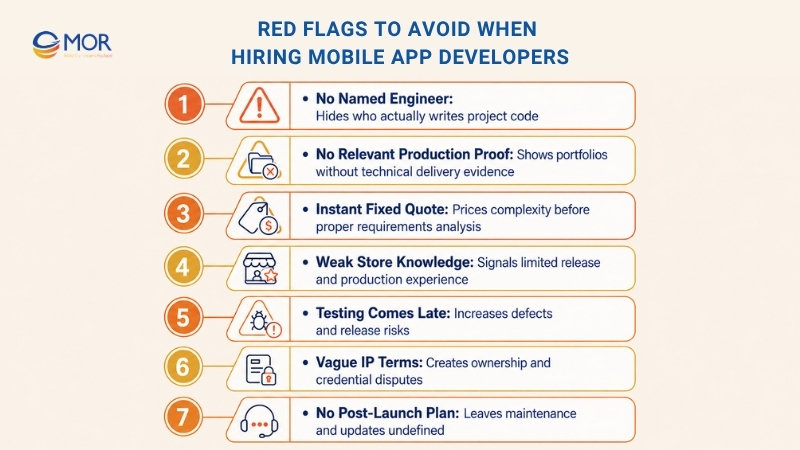
- No named engineer: You receive role labels and headcount, but nobody confirms who will write the code.
- No relevant production proof: The portfolio contains attractive screens without details on architecture, integrations, testing, release, or maintenance.
- Instant fixed quote: A vendor prices a complex product before reviewing workflows, APIs, security needs, existing code, and non-functional requirements.
- Weak store knowledge: The candidate has built mobile screens but hasn’t managed signing, submission, review feedback, staged releases, or production monitoring.
- Testing comes late: No device plan, regression approach, automation scope, performance check, or production diagnostics appear in the proposal.
- Vague IP terms: Repository ownership, signing keys, credentials, store accounts, design assets, and documentation remain undefined.
- Rate-first sales pitch: Every conversation returns to hourly price while team seniority, QA, architecture, and internal management costs stay blurry.
- No replacement or handover process: One developer carries key knowledge and the provider has no documented transfer method.
- No post-launch plan: The contract ends at store approval without defining maintenance, OS updates, dependency changes, or incident response.
A polished proposal can still contain these gaps. Ask for concrete ownership before contract signing, especially when the app will run a core business workflow.
Scale Mobile Delivery With MOR Software's Dedicated Teams
A staffing shortage doesn’t always justify another permanent internal team. MOR Software combines mobile application development with Offshore Development Center services for companies that need extra engineering capacity, specialist skills, or an outsourced mobile product team.
Our mobile services cover consulting, UI/UX design, native and hybrid applications, Progressive Web Applications, wearable and embedded software, modernization, backend integration, third-party connections, QA, maintenance, and support. MOR Software's materials also document native, cross-platform, and hybrid delivery across iOS and Android environments.
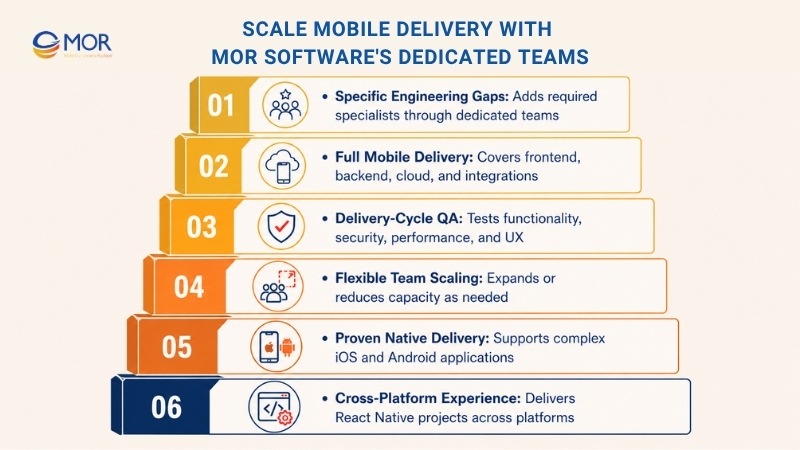
- Fill specific engineering gaps: Our ODC model lets clients compose teams across project management, business analysis, architecture, development, QA, QC, and BrSE/Comtor roles. MOR handles staffing and operating work, while clients can direct the dedicated team's project priorities.
- Build beyond the mobile interface: Mobile products often need server-side systems, APIs, cloud services, testing, and maintenance. Our documented mobile work includes Swift, Kotlin, React Native, FastAPI/Python, .NET, AWS, AI, IoT, and related integration work.
- Apply QA across the delivery cycle: MOR Software documents mobile testing across accessibility, functional behavior, performance, security, and UX. Our mobile service materials also state that ISTQB-certified testers support this work.
- Scale the team as needs change: MOR's dedicated-team process covers requirement definition, proposals, candidate screening, trial evaluation, onboarding, team management, feedback, and later team expansion. Recruitment, payroll, and operating logistics stay on the MOR side.
- Check real mobile delivery evidence: MOR Software built the Dan Tri News App with Swift, Kotlin, .NET, and Python through a 10-engineer team over 24 months. The application supports iOS and Android, customizable layouts, push notifications, and social sharing.
- Match cross-platform work to real operations: A Japanese construction client needed one app for iOS and Android with task lists, images, real-time messaging, reports, and drawing tools. MOR Software used React Native and FastAPI through a seven-person team across an eight-month project.
This combination fits long mobile roadmaps, legacy modernization, integration-heavy products, cross-platform builds, and in-house teams that need more capacity. It also suits companies that want to hire mobile apps developer resources without taking on recruitment and payroll administration themselves.
Share your target platforms, product scope, timeline, current codebase, and team gaps with MOR Software. We can help define the mobile roles and delivery model that fit the actual work rather than pushing a preset team structure.
Conclusion
The best way to hire mobile app developers is to match the right skills, hiring model, and level of technical ownership to your product. Strong screening should cover production experience, architecture, testing, security, release work, IP terms, and post-launch support. MOR Software supports mobile development and dedicated offshore teams for native, cross-platform, modernization, and integration-heavy projects.
Contact MOR Software to discuss your product scope, target platforms, timeline, and current team gaps, and our team can help you define a suitable mobile development setup.
MOR SOFTWARE
Frequently Asked Questions (FAQs)
How much does it cost to hire mobile app developers?
Freelance marketplace rates can start around $18-$39 per hour, while senior specialists and agency talent can cost far more. Location, seniority, platform, contract model, backend work, QA, integrations, and support all change the total.
For a complete product, budget beyond developer hours. Design, testing, cloud services, release work, project management, and annual maintenance belong in the calculation.
Where can I hire mobile app developers?
Software development companies, staff augmentation providers, referrals, professional networks, talent platforms, and technical communities all provide viable sourcing channels. The right one depends on how much vetting and management your team wants to own.
A marketplace gives more direct candidate access. A development company usually adds recruiting, replacement support, team composition, QA, and broader delivery services.
Should I hire freelance or dedicated mobile app developers?
Freelancers fit contained work, prototypes, bug fixes, and specialist tasks. Dedicated developers make more sense for steady roadmaps where product knowledge, recurring releases, and team continuity matter.
Management also differs. Freelancers usually require stronger client-side coordination, while a dedicated-team provider can support staffing and operating tasks around the engineers.
How long does it take to hire a mobile app developer?
Timing depends on seniority, technology, domain requirements, interview stages, location, and talent availability. A common mobile stack can be filled faster than a rare specialist role involving unusual hardware, regulated data, or complex native work.
A provider with available vetted engineers can shorten sourcing time. Internal hiring usually takes longer because recruitment, notice periods, and employment onboarding add extra steps.
What skills should I look for in a mobile app developer?
Match skills to the product. Core areas include Swift/SwiftUI, Kotlin/Jetpack Compose, Flutter/Dart, React Native/TypeScript, API integration, data handling, testing, security, performance diagnosis, and store release experience.
Architecture judgment matters more as seniority rises. Senior engineers should explain technical trade-offs, review code, detect risk early, and guide less experienced developers.
Do I need separate iOS and Android developers?
Two native specialists make sense when the product requires deep platform work, unique UX, heavy device access, or separate native codebases. Swift and Kotlin teams can then work directly with each operating system.
Flutter and React Native can support one shared mobile team for many business products. The right choice depends on platform-specific requirements, existing staff, performance goals, and long-term maintenance.
How do I test a mobile app developer before hiring?
Use a product-based technical interview, code review, architecture discussion, and references from relevant projects. A short paid pilot can test real delivery habits when the engagement is large enough to justify it.
Review communication as part of the trial. Accurate estimates, clear pull requests, useful documentation, and early risk reporting matter in day-to-day product work.
Who should own the source code and app store accounts?
Your agreement should state ownership before coding starts. Cover source repositories, documentation, design assets, signing certificates, domains, cloud resources, Apple accounts, Google Play accounts, and third-party credentials.
Avoid leaving account ownership under one developer's personal email. Company-controlled accounts make staffing changes and future handovers much safer.
Can I scale a mobile development team after the project starts?
Yes. Staff augmentation and dedicated-team contracts are designed for changing capacity when the provider has suitable talent available.
Plan knowledge transfer before adding or removing engineers. Documentation, code review habits, shared architecture decisions, and clear module ownership keep scaling from turning into coordination debt.
What support is needed after a mobile app launches?
Production apps need crash monitoring, OS compatibility work, SDK updates, dependency patches, security fixes, performance checks, store-policy updates, and user-reported bug handling. Backend infrastructure may need ongoing support too.
Roadmap development usually continues alongside this maintenance. Define support ownership before launch so urgent production work doesn't depend on finding the original developer months later.
Share


Make Our-Dreams Realized


© 2023 . MOR Software. All Rights Reserved
Sitemap
Privacy Policy
Terms of Use

Rate this article
0
over 5.0 based on 0 reviews
Your rating on this news:
Name
*Email
*Write your comment
*Send your comment
1