


Hire Web3 Developers: Complete Businesses Guide (2026)
When companies decide to hire Web3 developers, they often run into the same problems, scarce real-world experience, unclear costs, and serious security risks tied to poor hiring choices. Finding blockchain talent who can actually ship production-ready code is harder than it looks. In this guide, MOR Software will walk you through practical ways to source, evaluate, and work with Web3 engineers without costly mistakes.
Inside Today’s Web3 Developer Hiring Landscape
Before you think about sourcing channels or interview questions, you need to understand the environment where top Web3 engineers work and make decisions. This space has changed a lot and has moved far beyond the hype-driven hiring rushes seen in earlier cycles, especially for companies planning to hire Web3 developers in a serious, long-term way.
Today, attention has shifted to real product value, long-term sustainability, and strong security foundations. Developers are far more selective than before. They behave less like traditional job seekers and more like stakeholders, reviewing projects carefully based on technical quality and the strength of the surrounding community.
To stay credible in these conversations, you need a clear grasp of the basics of what blockchain development entails. That includes the blockchain coding language your stack relies on and the security assumptions behind it. This foundational understanding helps you speak the same language as candidates and judge whether their skills truly match what your project requires.
From Hype Cycles To Purpose-Led Hiring
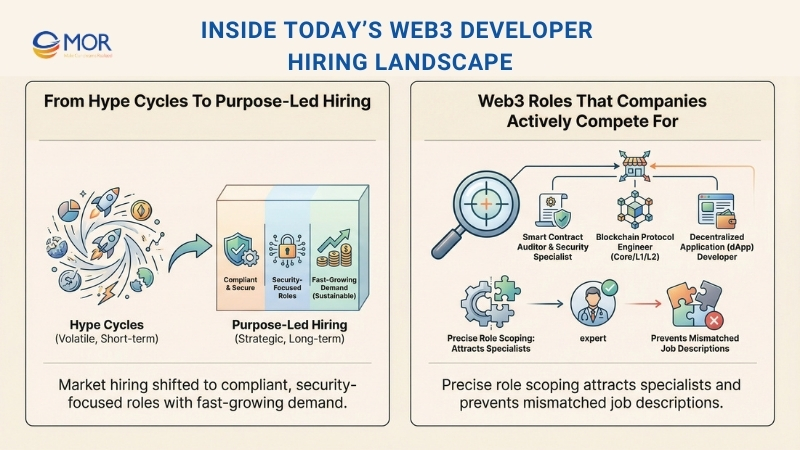
The Web3 job market has reached a more stable and mature stage. Recent data shows a clear move away from speculative hiring toward structured recruitment focused on compliance, reliable product delivery, and long-term viability.
Since 2023, Web3 job listings have increased by 300%, driven by wider adoption of decentralized systems. Demand is especially strong for certain roles:
- Smart Contract Engineers have recorded a 32% year-on-year increase.
- Rust developers, particularly within ecosystems like Solana, have grown by 40%.
- Zero-knowledge proof (zk) Engineers stand out, with a 51% rise in demand and a very limited talent pool.
This shift highlights the need for a clear hiring approach that starts with market understanding and strategy, well before drafting any role description.
As this pattern shows, strong hiring outcomes do not begin with a job post. They begin with a solid understanding of the market you are entering and the expectations of the people you want to attract.
Web3 Roles That Companies Actively Compete For
Clear role definition shapes how you target candidates. Posting for a generic blockchain role no longer works. Precision matters when teams plan to hire Web3 developers with real production experience.
To support that clarity, the list below outlines the roles currently in highest demand, along with the core skills each one requires.
Role Title | Core Languages/Frameworks | Key Responsibilities |
Smart Contract Engineer | Solidity (Ethereum), Rust (Solana), Vyper | Designing and securing on-chain logic. Code carries direct financial risk, so their work requires a security-first mindset. |
Protocol Engineer | Go, C++, Rust | Building the blockchain core, including consensus, networking, and cryptography. These roles demand deep system-level expertise. |
zk-Proof Specialist | Circom, Noir, Rust | Creating zero-knowledge proofs for scalability and privacy. This work sits at the edge of applied cryptography. |
Web3 Frontend Developer | React, TypeScript, Ethers.js, Wagmi | Developing user-facing dApps that connect users to blockchain systems, with a focus on wallets and decentralized data. |
Blockchain Security Auditor | Solidity, Rust, Slither, Mythril | Finding and fixing vulnerabilities in smart contracts and protocols before they are exploited. |
These differences matter. Treating all of these skills as interchangeable usually leads to weak results, even when searching for a single Web3 developer profile.
The most frequent mistake is writing a single job description that combines three distinct roles into one. This signals a lack of market understanding and often pushes experienced specialists away.
When these role boundaries are respected, the rest of the hiring strategy becomes easier to manage. Teams can write clearer job descriptions, engage the right communities, and structure offers that match what experienced Web3 professionals expect.
Where To Hire Web3 Developers And Find Real Talent
Finding qualified blockchain specialists takes more than posting a role and waiting for replies. When companies plan to hire Web3 developers, they often need to combine several channels to reach people with real experience and proven delivery records.
The sections below outline practical places to connect with Web3 engineers, starting with the platforms recruiters rely on most.
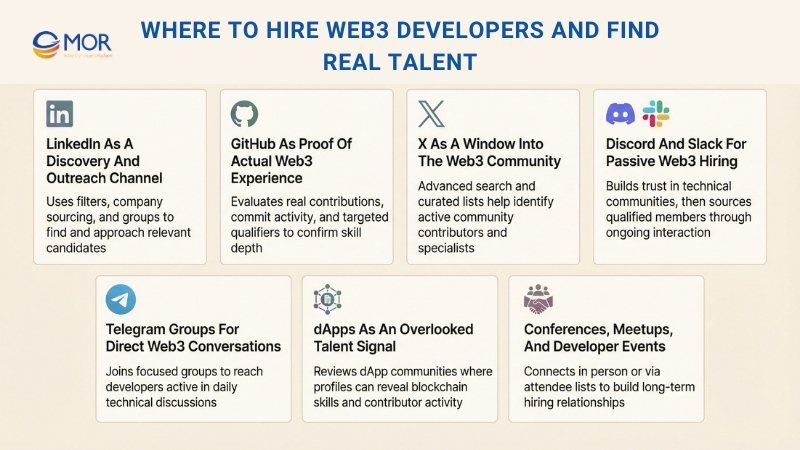
LinkedIn As A Discovery And Outreach Channel
When searching for developers, recruiters usually start with LinkedIn. The most direct step is to use the platform’s search feature. LinkedIn allows you to filter professionals by keyword, company, job title, location, and other criteria. You can begin with blockchain-related terms such as (“Blockchain Developer” OR “Web3 Developer” OR “Smart Contract Developer”) AND (Rust OR Solidity OR Vyper).
Another way to identify blockchain specialists is to look at companies that already employ them. Start by researching teams working on similar products or technologies. After that, visit each company’s LinkedIn page, open the “people” section, and filter employees by location, skills, and function, such as engineering roles.
LinkedIn groups also offer a useful space to connect with professionals in this field. Many blockchain-focused groups allow discussions and, in some cases, job posts, though you should always check the group rules first. Well-known examples include Blockchain Professionals & Developers, Payments; Fintech, Blockchain, Cryptocurrency, MPOS, Mobile Banking, and Web3, Blockchain, Crypto Jobs & Careers.
When you contact potential candidates, personalize your outreach and explain clearly why their background caught your attention. You can also build visibility by commenting on posts, sharing relevant content, and reacting to updates. Since community interaction plays a big role in Web3, this approach helps when you want to hire Web3 developer talent that values open discussion and active participation.
GitHub As Proof Of Actual Web3 Experience
Not every blockchain specialist spends time on LinkedIn, but most of them are active on GitHub. The platform hosts millions of public repositories and gives clear visibility into how developers contribute to open-source work. With a few simple search qualifiers, you can scan this large ecosystem and spot Web3 engineers who are truly active and consistent.
Here are several qualifiers you can use directly on GitHub:
“language:[language]”: This qualifier helps you find repositories written in a specific programming language. For instance, searching for “language:Solidity” will surface repositories built with the Solidity language.
When reviewing repositories, pay attention to the difference between “forks”, which are copies of existing projects, and “commits”, which represent actual code changes. Strong contributors usually show a steady volume of commits, so you should prioritize those profiles.
Make sure to click into user profiles during your search to get fuller results. This view shows developers who mention Solidity or related skills elsewhere on their profile, including their bio or pinned projects. You can also sort users by best match, follower count, join date, or total repositories.
If you need talent in a specific region, adjust location filters carefully. Locations often appear in different formats. Some profiles list both city and country, others show only one, and some use local language spellings. Testing all reasonable variations helps avoid missing relevant candidates.
- “stars:[number]”: This qualifier lets you filter repositories by popularity. Projects with higher star counts are usually well regarded within the GitHub community. Searching for “stars:>100” will return repositories that have earned more than one hundred stars.
- “created:[date]”: This option helps you find repositories created after a certain date. For example, “created:>2024-01-01” displays repositories launched after January 1st, 2024.
- “pushed:[date]”: This qualifier focuses on recent activity. A search like “pushed:>2024-01-01” highlights repositories updated after January 1st, 2024.
Using these filters allows companies to spot developers who consistently contribute to blockchain projects. GitHub also reveals how individuals participate in open-source work, which often reflects real skill depth and hands-on experience.
To narrow results further, you can include blockchain-specific terms in your search. Queries like “Ethereum” or “Smart Contracts” help surface repositories focused on those exact areas.
X As A Window Into The Web3 Community
The Web3 community stays very active on X, so if LinkedIn and GitHub do not deliver the results you expect, this platform can open new paths. This option works especially well when you want to connect with visible contributors or recognized community voices.
X provides an internal advanced search tool that gives you many ways to narrow results and filter profiles based on activity, topics, and engagement patterns.
A useful tactic is to explore public lists and curated groups of accounts built around specific themes. Review both the people who create these lists and those who follow them. This method helps you spot relevant blockchain specialists who may not list exact keywords in their profiles but still play an active role in the ecosystem.
Discord And Slack For Passive Web3 Hiring
Discord and Slack are widely used across the blockchain space. These platforms give Web3 engineers a place to exchange knowledge, collaborate on real projects, and connect with others who share similar technical interests.
To begin passive sourcing on these channels, you need to spend time identifying the right servers and workspaces. Focus on communities centered on blockchain development or groups aligned with the type of product you are building, or something close to it. This approach often supports teams that want to hire remote Web3 developers without relying only on traditional job boards.
After you find the right spaces, start interacting with members through questions, shared resources, and thoughtful replies. Introduce yourself and your company in a respectful way, and avoid messages that feel aggressive or overly promotional.
As relationships grow inside these communities, patterns start to appear around who has the experience and skills you need. You can contact those individuals directly to understand their interest, or keep them in mind for future roles as this hiring approach evolves.
Well-known Discord servers worth exploring include CryptoDevs, Rust, Rust Programming Language Community, and Solidity-Dev.
Telegram Groups For Direct Web3 Conversations
Telegram is a messaging platform where users can create and join groups across many subjects, including blockchain topics. When you join relevant blockchain-focused groups on Telegram, you gain direct access to developers who are active in daily technical conversations.
Telegram hosts a wide range of blockchain communities, from broad discussion channels to highly technical groups centered on a single network or programming language. Popular examples include Solidity Development, Rust-Lang, and Blockchain Headhunter, where many blockchain specialists share updates, questions, and opportunities.
dApps As An Overlooked Talent Signal
Decentralized applications, often called dApps, run on decentralized networks like blockchain. These applications continue to grow in adoption and now play a central role in the wider blockchain ecosystem. Looking at dApp examples can help you define the exact skill mix you need before sourcing candidates.
One well-known social dApp is Mastodon, a decentralized social network built on the ActivityPub protocol. Mastodon operates as an open-source project and allows users to communicate without a central authority. The platform also lets users list their skills on their profiles, which helps recruiters identify people who mention blockchain development as part of their expertise.
Conferences, Meetups, And Developer Events
Industry conferences and in-person events remain strong places to connect with blockchain specialists. These gatherings make it easier to meet Web3 engineers, follow new tools and ideas, and build long-term relationships with people shaping the space. Attending them also helps you keep pace with changes across the blockchain ecosystem as it continues to move quickly.
Start by exploring events listed on Meetup in your local area, or in regions you want to target for talent. If attending in person is not possible, review attendee lists and look for ways to connect with participants on other platforms to continue the conversation.
How To Write A Job Description That Attracts Strong Candidates
When you decide to hire Web3 developers, the job description becomes your first real pitch. A generic, corporate-style post is often the quickest way to lose the attention of the people you want most. Experienced Web3 engineers are not searching for just another role. They want to join a mission they believe in.
Your aim should be to move away from a flat list of technical demands. Instead, focus on a story that aligns with core Web3 values like ownership, impact, and innovation. This document should feel less like a formal directive and more like an open invitation to help build something meaningful.
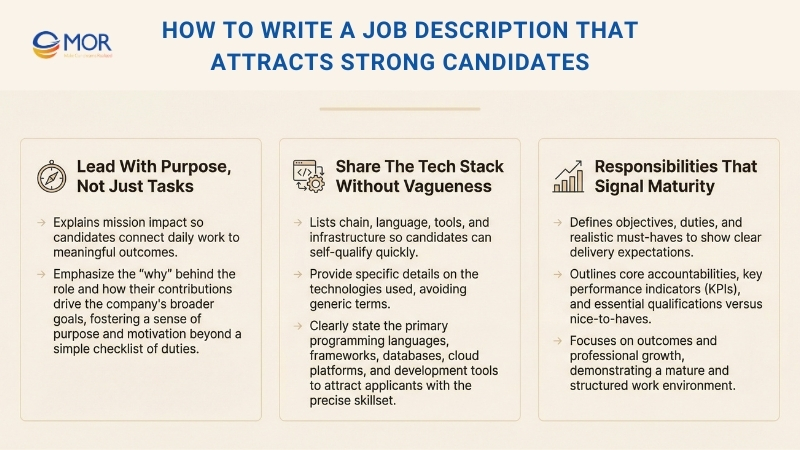
Lead With Purpose, Not Just Tasks
Start by answering the main question every developer asks themselves, “Why should I care about this project?” Strong candidates are rarely driven by salary alone. They care about tackling difficult problems and contributing to work that creates real change.
Open with your purpose. Explain clearly what problem your product addresses in the decentralized space. Are you improving DeFi efficiency, supporting censorship-resistant systems, or shaping new forms of digital ownership? Whatever the focus, be clear about the effect a new team member will have from the start.
For example, instead of writing, “You will build smart contracts,” use a statement with more meaning, like, “You will design the core smart contracts for a decentralized identity system that gives users direct control over their data.” This shift helps link daily work to a broader goal.
Strong job descriptions tell a clear story. They describe the future your product aims to create and show candidates where they fit within that direction. This method attracts people who care about alignment and purpose, not only technical skills.
Share The Tech Stack Without Vagueness
Lack of clarity around your technology stack is a clear warning sign for experienced developers. It suggests that your team may not have a solid technical direction or may not fully understand how the ecosystem works. Clear and specific details help establish trust right away.
You should describe your full stack in detail, including:
- Blockchain Ecosystem: Are you building on Ethereum, Solana, Cosmos, or another L1 or L2 network? This is the most basic and important detail. If you are weighing scalability options, start with layer 1 vs layer 2.
- Smart Contract Language: State clearly whether you need experience with Solidity, Rust, Vyper, or another language.
- Key Frameworks and Libraries: List the core tools in use, such as Hardhat, Foundry, Anchor, Ethers.js, or Wagmi. This is also the point where teams looking to hire Web3.js developers should be specific.
- Infrastructure: Mention other required components like The Graph for indexing, Chainlink for oracles, or IPFS for storage.
This level of transparency helps candidates assess fit on their own. A Rust engineer focused on the Solana ecosystem can quickly tell if your project matches their skills, which saves time for both sides.
Responsibilities That Signal Maturity
Once you have clarified the purpose and the technical setup, you can move on to defining the actual work. Describe the main responsibilities, but focus on results rather than listing tasks without context. Each responsibility should clearly link back to the wider goals of the project.
A clear and effective structure usually includes:
- Core Objective: A short sentence that explains the main goal of the role. Keep it simple and direct.
- Key Responsibilities (3–5 bullet points): Outline the primary duties, such as designing, building, and releasing secure and gas-efficient smart contracts, or working with auditors to maintain strong protocol security.
- Qualifications: This part matters. Split requirements into Must-Haves and Nice-to-Haves. Be realistic with must-haves so you do not create an unrealistic role that discourages strong candidates.
This structure helps candidates understand their daily impact and the skills they need to perform well in the role.
Vetting Web3 Developers Beyond The Resume
Let’s be direct. A resume tells you very little about how a Web3 engineer performs in real conditions. In an environment where one small flaw can empty a protocol treasury overnight, you need to confirm skills through practical checks. The aim is to separate people who know the theory from builders who can deliver secure, stable, and production-ready dApps.
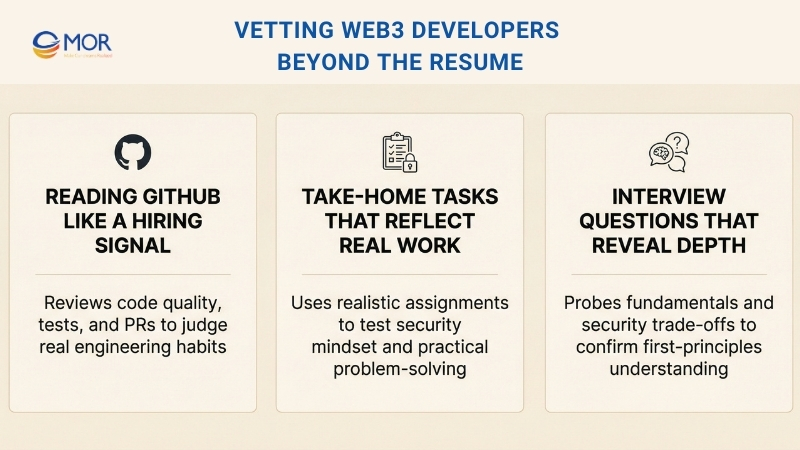
This requires a layered technical review. A strong process combines careful review of public work, a realistic coding task, and a technical interview that tests real understanding of blockchain logic and security. Together, these steps give you a clear view of what a candidate can actually deliver when you hire Web3 developers.
Reading GitHub Like A Hiring Signal
A developer’s GitHub profile works as their public portfolio and should be your first checkpoint. Still, only scanning contribution graphs is a common beginner mistake. You need to study the quality of the work to see how they think and how they build systems.
When reviewing a profile, watch for these clear indicators of strong engineering skill:
- Code Quality and Readability: Is the code easy to follow? Are comments clear and helpful? Do they follow known standards like the official Solidity Style Guide? Clean structure usually reflects disciplined thinking.
- Serious Testing Coverage: Look for a /test directory. Strong candidates write solid test suites using tools like Foundry or Hardhat. When tests are missing, it often signals weak security habits.
- Thoughtful Pull Requests (PRs): Review contributions to other open-source projects. A solid PR explains the problem, outlines the solution, and often includes tests. This shows the developer can work well within distributed teams and shared codebases.
Take-Home Tasks That Reflect Real Work
A carefully planned coding task is one of the clearest ways to see how a candidate works in practice. Try to avoid abstract whiteboard exercises. Instead, give a small and realistic assignment that reflects the type of work they would handle on your team. This approach respects their time and gives you clear insight into how they think through problems.
Here are several challenge ideas that help measure practical Web3 experience:
- Patch A Vulnerable Smart Contract: Share a basic contract that includes a common issue, such as a reentrancy flaw or an integer overflow. Ask the candidate to identify the weakness, explain how it could be exploited, and submit a fixed version with a test that confirms the solution.
- Refine An Inefficient Contract Function: Provide a working but poorly optimized smart contract function. The task is to improve gas usage through refactoring. This helps evaluate their understanding of the EVM and how execution costs work.
- Create A Simple dApp Component: Ask them to build a small group of contracts and a simple script that interacts with them, such as a basic staking feature or a voting setup. This checks their ability to manage on-chain logic from start to finish.
Set clear time limits, often around 3–4 hours. The goal is not to collect free work. It is to understand their approach, code style, and security mindset within a defined scope. In many cases, the discussion during the code review reveals more than the submission itself.
Interview Questions That Reveal Depth
The last step is a live technical interview. This is the stage where you explore how well candidates understand core blockchain concepts and smart contract security. Your questions should push them past simple definitions and encourage clear explanations of reasoning and trade-offs. This is how you identify engineers who truly understand first principles.
Here are several focused questions that help start meaningful discussions:
- Blockchain Fundamentals:
- “Explain the full lifecycle of a transaction, from the moment a user signs it in MetaMask to the point it becomes part of a confirmed block.”
- “Describe the difference between CALL, DELEGATECALL, and STATICCALL. When is DELEGATECALL appropriate, and what security risks does it introduce?”
- “Compare on-chain oracles with centralized price feeds. What trade-offs exist, and where do attack risks appear in each option?”
- Smart Contract Security:
- “How do you prevent a reentrancy attack? Can you reference a past incident where this issue caused real damage?”
- “What is the Checks-Effects-Interactions pattern, and why does it matter for secure contract design?”
- “If you were reviewing a new DeFi protocol, what are the first three areas you would examine in its smart contracts?”
These open-ended questions require candidates to explain how they think, not just what they know. When you combine detailed GitHub review, realistic take-home tasks, and thoughtful interviews, you create a strong evaluation process that greatly improves your chances of selecting the right person.
Designing A Compensation Package That Attracts Web3 Talent
When you plan to hire Web3 developers, compensation becomes far more than a base paycheck. It sends a clear message about your product vision, your level of commitment, and how seriously you view long-term alignment with your team.
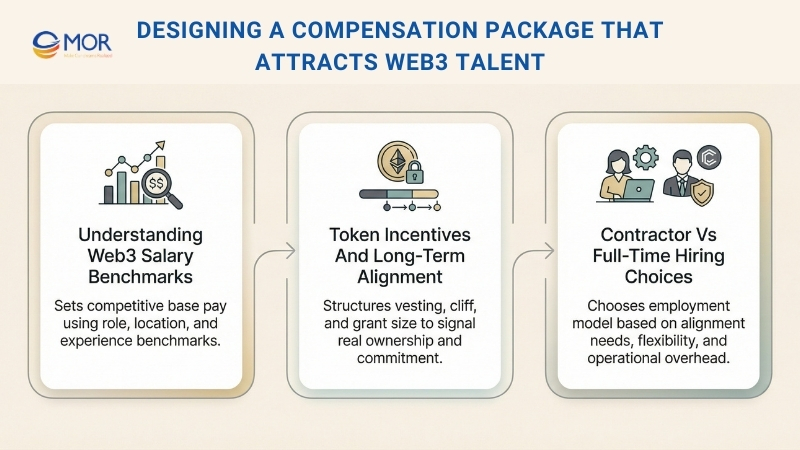
A standard Web2-style offer rarely works in this space. You need a balanced structure that provides short-term financial stability while also sharing part of the future upside. Strong candidates are not focused only on income. They want to support a product they trust and hold a real stake in its growth. Your package needs to match that ownership-focused mindset.
Understanding Web3 Salary Benchmarks
Every solid offer starts with a competitive base salary. This foundation gives Web3 engineers the security they need to focus on building, without constant concern about market swings.
Compensation for blockchain specialists varies widely based on role, experience level, and location. Based on 2025 data, average annual salaries commonly range from $67,000 to over $100,000. In major tech centers like San Francisco and New York, senior engineers with deep Solidity or Rust expertise can reach compensation above $200,000. Broader global benchmarks are available on Web3.career.
Salary research becomes even more important when teams aim to hire polygon developers, since demand within that ecosystem often drives rates higher. For a deeper view of how experience and role type influence pay, a detailed breakdown helps teams plan offers with confidence.
Token Incentives And Long-Term Alignment
A strong salary creates stability, but token incentives are what drive long-term alignment. For many mission-focused Web3 engineers, tokens stand out as the most appealing part of an offer because they represent real ownership in the network they are helping to build.
A carefully structured token grant works as a motivation system, not a simple bonus. To function well, it needs several key elements:
- Vesting Schedule: This defines the period over which tokens are earned. A four-year timeline is common and helps confirm long-term commitment to the project’s success.
- Cliff: The cliff is an initial phase of the vesting period, often one year, during which no tokens are granted. If someone leaves before this point, they receive nothing. This helps protect the project from short-term participation.
- Grant Size: The token amount must feel meaningful. It should represent a real share in future growth rather than a minor add-on.
A common error is pairing a weak salary with a very small token allocation. Experienced candidates quickly see this as a warning sign, suggesting their skills and the project’s future are not fully valued. For the right people, meaningful ownership matters.
Contractor Vs Full-Time Hiring Choices
Web3 teams often operate with a remote-first mindset, which makes it possible to recruit talent from almost anywhere. This flexibility leads to an important strategic decision. Should you work with someone as a full-time employee or engage them as a contractor? Each option comes with different trade-offs, so understanding them matters before you move forward.
To clarify the differences, the table below outlines the main factors to consider when choosing between these two models.
Hiring Model Comparison: Full-Time vs. Contractor
Consideration | Full-Time Employee | Contractor |
Commitment & Alignment | Strong long-term commitment and closer integration into company culture. | Task-focused engagement with limited connection to internal culture. |
Compensation Structure | Usually combines salary, benefits, and a vesting token or equity plan. | Often paid through higher hourly or project-based rates, in fiat or crypto. |
Legal & Tax Obligations | The company manages payroll taxes, benefits, and compliance duties. | The contractor manages their own taxes and does not receive company benefits. |
Flexibility & Scalability | Less flexible, with more steps required for onboarding and exit. | Very flexible, allowing teams to scale up or down with fewer constraints. |
The right choice depends on what your project needs most. For core roles tied closely to long-term goals, full-time hires often make more sense, especially when teams want to hire dedicated Web3 developers who grow with the product. For short-term work or narrow expertise, contractors provide speed and flexibility while keeping overhead lower.
Cost Breakdown When You Hire Web3 Developers
Understanding pricing is a key part of planning when teams decide to hire Web3 developers. Rates vary based on experience, role scope, and engagement model, so having clear benchmarks helps you set realistic budgets and expectations from the start.
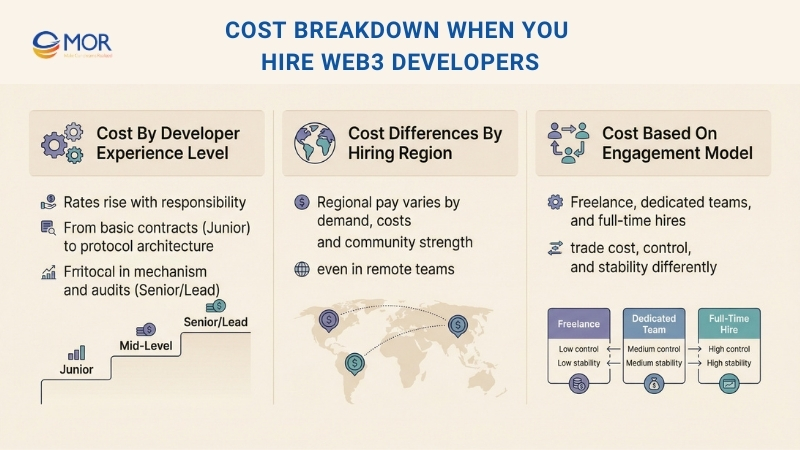
Cost By Developer Experience Level
You can expect rates of $41–$60 per hour for entry-level, $60–$100 per hour for mid-level, and $100–$150+ per hour for senior blockchain professionals with strong protocol expertise.
Experience level is the strongest factor that shapes overall cost. Junior contributors usually handle basic smart contracts, while senior specialists design complex systems like Layer-2 solutions or cross-chain infrastructure. The table below shows what each tier typically delivers:
Experience Tier | Typical Hourly Range | Typical Deliverables |
Entry-Level (0–2 yrs) | $41–$60 | Token standard contracts, unit tests, small dApp updates |
Mid-Level (2–5 yrs) | $60–$100 | DeFi feature development, NFT marketplace components, security checks |
Senior (5+ yrs) | $100–$150+ | Protocol architecture, Layer-2 rollups, cross-chain integration, audits |
Cost Differences By Hiring Region
Pricing changes a lot based on location: North America usually ranges from $90–$150 per hour, Western Europe falls between $70–$110 per hour, Eastern Europe sits around $45–$80 per hour, Asia-Pacific typically runs $40–$70 per hour, and Latin America averages $50–$85 per hour.
Developer hubs tend to form around local living costs, startup density, and the strength of technical communities. In the past, location choices were simple and often limited to onshore or offshore options. Remote work has softened those boundaries. A balanced offshore strategy, like working with senior engineers in Poland or Vietnam, can deliver strong results at more moderate rates. This approach also appeals to teams looking to hire polygon developers in USA while still balancing cost and coverage across regions.
Region | Hourly Range | Cost Drivers |
North America (US, Canada) | $90–$150 | High demand, complex compliance needs, premium benefits |
Western Europe (UK, Germany, France) | $70–$110 | Strong regulatory background, GDPR experience |
Eastern Europe (Poland, Ukraine, Romania) | $45–$80 | Solid cryptography skills, lower living expenses |
Asia-Pacific (India, Vietnam, Philippines) | $40–$70 | Large talent base, competitive pricing |
Latin America (Brazil, Argentina, Mexico) | $50–$85 | US time zone overlap, near-shore advantage |
Cost Based On Engagement Model
Your choice between freelancers, dedicated remote teams, or full-time employees directly affects both total cost and day-to-day management effort. Typical pricing falls around $40–$150 per hour for contractors, $6,000–$12,000 per developer per month for dedicated teams, and $110,000–$180,000 per year in the U.S. for permanent hires. This decision often depends on how long you plan to build, how closely the role ties to core systems, and whether you need flexibility or stability. Always budget for smart contract audit cost alongside development rates, especially for DeFi or custody-related features.
Hiring Model | Typical Cost | Good For |
Freelance / Contract | $40–$150 per hour | Short-term sprints, security audits, MVP work |
Staff Augmentation (via talent network) | $6,000–$12,000 per developer per month | Growth phases, temporary capacity gaps |
Offshore Dedicated Team | $5,000–$9,000 per developer per month | Long-term development, tighter cost control |
Full-Time Employee (US) | $110,000–$180,000 salary plus around 25% overhead | Core intellectual property, deep team integration |
For teams searching for a Web3 developer for hire, these models offer different trade-offs in speed, ownership, and risk. Contract-based roles can suit protocol-specific needs, including cases where companies decide to hire avalanche developers for focused ecosystem work without committing to a permanent structure.
Conclusion
When you hire Web3 developers, the outcome depends on much more than speed or budget. Clear role scope, practical vetting, and a compensation model aligned with Web3 values all shape long-term success. A thoughtful approach helps you avoid costly mistakes and build a team that can scale with confidence. If you are preparing to bring in Web3 specialists effectively, contact us to learn how MOR Software can support your hiring strategy and product delivery.
MOR SOFTWARE
Frequently Asked Questions (FAQs)
What problems does wealth management software solve?
It reduces manual work, centralizes financial data, improves reporting accuracy, and helps firms manage client portfolios and compliance more consistently.
What skills should we look for when we hire Web3 developers?
Strong candidates usually combine blockchain fundamentals with hands-on experience in smart contracts, security practices, and decentralized application logic. GitHub activity matters more than certificates.
Is it better to hire Web3 developers as full-time employees or contractors?
That depends on your roadmap. Core protocol or long-term product work often fits full-time roles, while audits, MVPs, or short builds suit contractors better.
How long does it take to hire Web3 developers?
Hiring timelines are longer than traditional software roles. Expect four to eight weeks when sourcing senior Web3 developers with proven production experience.
Which programming languages are most important for Web3 development?
Solidity and Rust lead the list, depending on the blockchain ecosystem. JavaScript and TypeScript also matter for dApp frontends and tooling.
Where can we find experienced Web3 developers?
Most senior talent is active in developer communities, open-source repositories, Discord servers, and technical forums rather than traditional job boards.
How do we evaluate real Web3 experience during hiring?
Review deployed contracts, security practices, and testing habits. Practical challenges and GitHub code reviews reveal far more than resumes.
What are common mistakes when companies hire Web3 developers?
Vague job descriptions, unrealistic skill combinations, and ignoring security knowledge often push strong candidates away.
How much does it cost to hire Web3 developers?
Costs vary by region, seniority, and engagement model. Senior Web3 developers usually command higher rates due to limited supply and security risk.
Do Web3 developers expect token-based compensation?
Many do, especially in protocol-driven projects. Tokens often work best alongside stable pay, not as a replacement.
Can Web2 developers transition into Web3 roles easily?
Some can, but the learning curve is real. Look for candidates who already understand blockchain mechanics, not just general backend development.
Share


Make Our-Dreams Realized


© 2023 . MOR Software. All Rights Reserved
Sitemap
Privacy Policy
Terms of Use

Rate this article
0
over 5.0 based on 0 reviews
Your rating on this news:
Name
*Email
*Write your comment
*Send your comment
1