


Top 15 Custom Mobile App Development Companies in 2026
Choosing among custom mobile app development companies gets difficult once every shortlist starts to look the same: iOS, Android, Flutter, React Native, cloud, and AI. Those labels reveal little about delivery risk, system integration, security, or long-term support. This MOR Software guide will compare 15 providers using current pricing data, engineering strengths, company size, project fit, and delivery focus.
Key Takeaways
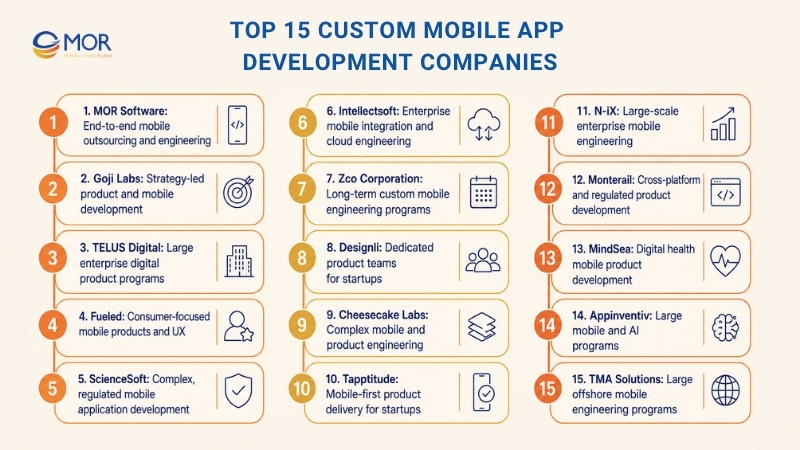
- MOR Software, Goji Labs, TELUS Digital, Fueled, ScienceSoft, Intellectsoft, Zco Corporation, Designli, Cheesecake Labs, Tapptitude, N-iX, Monterail, MindSea, Appinventiv, and TMA Solutions make up our 2026 shortlist.
- The right partner depends on scope, industry rules, internal product skills, platform choice, integrations, team location, and budget. The best custom mobile app development companies for an early MVP can be very different from those suited to a regulated enterprise platform.
- Compare project evidence and team structure before hourly rates alone. A lower rate can lose its advantage when weak discovery, poor QA, unclear ownership, or costly rework enters the project.
Top 15 Custom Mobile App Development Companies in 2026
No vendor fits every mobile product. Some firms work best with startup discovery and UX, some focus on healthcare or enterprise systems, and others provide large offshore engineering teams for long-running programs.
That difference matters across a market where Android held 68.36% of worldwide mobile operating-system share in July 2026 and iOS held 31.6%. Platform reach alone can shape architecture, QA, release planning, and team requirements.
Lists titled 'top app development companies in world' often place boutique studios beside firms with thousands of engineers. Our comparison treats custom mobile app development companies as different delivery models rather than interchangeable names.
Rank | Company | Location | Best fit | Main mobile strength | Typical buyer |
1 | MOR Software | Ho Chi Minh City, Hanoi, Da Nang, Vietnam; offices in Japan | End-to-end mobile outsourcing | Native, hybrid, PWA, integration, QA | SMBs to enterprises |
2 | Goji Labs | Los Angeles, CA, USA | Strategy-led digital products | Product strategy, UX, mobile engineering | Startups, scale-ups, enterprises |
3 | TELUS Digital | Vancouver, BC, Canada | Large digital product programs | Enterprise mobile, UX, AI-led development | Enterprises |
4 | Fueled | New York, NY, USA | Consumer-facing digital products | iOS, Android, UI/UX, product design | Mid-market, enterprises, brands |
5 | ScienceSoft | McKinney, TX, USA | Complex and regulated applications | Mobile, enterprise software, security | Mid-market, enterprises |
6 | Intellectsoft | New York, NY, USA | Enterprise mobile integration | Flutter, React Native, Swift, Kotlin | Mid-market, enterprises |
7 | Zco Corporation | Nashua, NH, USA | Long-term custom mobile programs | Native, hybrid, PWA, enterprise mobile | SMBs to enterprises |
8 | Designli | Greenville, SC, USA | Dedicated product teams | Mobile development, product ownership, UX/UI | Startups, SMBs |
9 | Cheesecake Labs | San Francisco, CA, USA | Complex product engineering | Cross-platform mobile, AI, cloud | Growth companies, enterprises |
10 | Tapptitude | Cluj-Napoca, Romania | Mobile-first product delivery | Native, React Native, UX, backend | Startups, scale-ups |
11 | N-iX | Valletta, Malta | Large enterprise engineering | Mobile, cloud, data, AI, backend | Enterprises |
12 | Monterail | Wrocław, Poland | Product and regulated builds | Flutter, React Native, healthtech | Scale-ups, enterprises |
13 | MindSea | Halifax, Nova Scotia, Canada | Digital health products | Healthcare mobile, UX, privacy | Healthtech companies |
14 | Appinventiv | Noida, India | Large mobile and AI programs | Mobile development, AI, custom software | Mid-market, enterprises |
15 | TMA Solutions | Ho Chi Minh City, Vietnam | Large offshore engineering programs | Native, cross-platform, enterprise engineering | Mid-market, enterprises |
1. MOR Software
- Founded: 2016
- Headquarters: Ho Chi Minh City, Vietnam
- Vietnam offices: Ho Chi Minh City, Hanoi, Da Nang
- Global offices: Tokyo, Osaka, Nagoya, Japan
- Company size: 250-500 employees
- Hourly rate: 25 - 49/hour
Current Clutch data lists MOR Software JSC at 250-999 employees, a 25 - 49 hourly band, and a $5,000+ minimum project size. Our official contact page also lists six offices across Vietnam and Japan, giving us local delivery presence in Vietnam plus direct access to clients in Japan.
About: MOR Software is a Vietnam-based software engineering and outsourcing company serving overseas businesses through project-based development and offshore team models. We handle mobile work as part of a broader engineering practice that also covers web development, custom software, Salesforce, cloud-connected systems, QA, and newer technologies.
That structure fits projects where the mobile app is only one layer of a larger product. We can work on the mobile client alongside admin portals, backend APIs, AWS infrastructure, data synchronization, integrations, and continued QA under the same delivery setup.

Services:
- Mobile consulting: We map business needs, platform requirements, user flows, technical scope, and delivery plans before development starts.
- UI/UX design: Our team covers user journeys, wireframes, interface design, accessibility, and mobile interaction patterns.
- Native and hybrid development: We build mobile products for iOS, Android, and shared-code approaches when they fit the product requirements.
- PWA and connected products: We develop Progressive Web Applications and mobile products linked to web portals, wearables, or embedded devices.
- Integration and backend work: Our engineers connect apps to APIs, internal systems, servers, cloud services, and third-party software.
- QA and maintenance: We test functional behavior, performance, security, accessibility, and UX, then continue supporting the product after release.
These custom mobile app development services cover the full product cycle rather than coding alone. We also apply Agile and Scrum practices across delivery, supported by QA, DevOps, and post-launch maintenance.
Industries served: Our project experience spans healthcare, finance and banking, manufacturing, food and beverage, media, HR management, ecommerce, and enterprise operations. The mobile cases vary widely, giving our teams hands-on experience with high-traffic media products, healthcare workflows, site collaboration, and internal business systems.
Detail: We support native applications, cross-platform products, mobile-only systems, and apps connected to web platforms. Our offshore delivery model can also add developers, QA engineers, business analysts, project managers, and other technical roles as product needs grow.
A clear example is the Dan Tri News App. A 10-person MOR Software team worked for 24 months with Swift, Kotlin, .NET, and Python to build iOS and Android access, customizable layouts, push alerts, and social sharing for a platform serving more than 10 million daily readers.
Best for: MOR Software fits businesses that need a mobile product plus backend engineering, web systems, API integration, QA, modernization, or continued product work. We also fit buyers comparing custom mobile app development companies who want a Vietnam-based offshore model without separating mobile development from the rest of the software stack.
Notable projects:
- Dan Tri News App: We developed a native iOS and Android application with Swift, Kotlin, .NET, and Python across a 24-month engagement.
- Genbastar construction app: Our team built a React Native application connected to FastAPI for job lists, reports, drawing tools, and real-time team communication. The project ran for eight months with seven team members.
- E-Medical: We developed a healthcare application linking patients with doctors, clinics, and pharmacies through mobile and web interfaces, video consultation, AWS, and administration tools.
If your project needs mobile application development solutions tied to backend systems, cloud infrastructure, or long-term engineering support, contact us to discuss the scope, platforms, integrations, and delivery team that fit your roadmap.
Companies often rely on the best mobile app development tools to streamline the development process and ensure high-quality app performance.
2. Goji Labs
- Founded: 2014
- Headquarters: Los Angeles, California, USA
- Company size: 50-249 employees
- Hourly rate: 100 - 149/hour
Clutch currently lists Goji Labs at a $25,000+ minimum project size, 100 - 149 per hour, and 50-249 employees. Its service mix assigns 50% to mobile app development, 40% to custom software, and 10% to UX/UI.
About: Goji Labs is a strategy-led product agency rather than a development shop built around staffing alone. The company combines product strategy, user research, UX/UI, software engineering, and mobile development in one team.
Its own 2026 company information reports more than 500 products launched across 20 industries since 2014. Goji also supports native Swift and Kotlin work as well as cross-platform development when the product case calls for it.
Services:
- Product strategy: Tests scope, product assumptions, priorities, and business goals before a full build.
- Mobile development: Covers native iOS, native Android, and cross-platform products.
- Custom software: Extends app work into APIs, platforms, web products, and back-office systems.
- UX/UI: Combines user research, interaction design, prototyping, and usability work.
- AI product work: Adds AI functions to new or existing digital products where the use case supports them.
Focus areas: Goji Labs reports work across SaaS, fintech, healthcare, education, ecommerce, sustainability, gaming, logistics, nonprofit, insurance, real estate, and media. Its portfolio also spans enterprise, private-equity-backed companies, startups, and public-sector organizations.
Best for: Goji Labs suits teams that need product direction before they commit to architecture and engineering. Buyers seeking a custom mobile app development company in USA may find its Los Angeles base and product-strategy emphasis useful when discovery and UX decisions carry as much weight as coding.
3. TELUS Digital
- Founded: 2005
- Headquarters: Vancouver, British Columbia, Canada
- Company size: 10,000+ employees
- Hourly rate: 100 - 149/hour
TELUS Digital's Clutch profile lists a $50,000+ minimum engagement and 10,000+ employees. Mobile development accounts for 15% of its current listed service mix, alongside generative AI, AI development, web development, strategy, and UX/UI.
About: TELUS Digital sits at the enterprise end of this comparison. The former WillowTree product business now works inside a much larger group that combines digital product engineering, customer experience, AI, data, design, and web development.
TELUS Digital reports more than 700 successful web and mobile projects since the launch of the iPhone. That track record gives large buyers a useful reference point when mobile must fit a wider customer platform rather than operate as a stand-alone app.
Services:
- Mobile development: Covers native iOS and Android products, testing, release work, and continued support.
- Web development: Connects mobile experiences to wider web and customer platforms.
- Experience design: Brings UX/UI and product design into enterprise digital programs.
- AI engineering: Includes generative AI, AI development, and AI agents within broader software work.
- Digital strategy: Supports product planning and customer experience programs across large organizations.
Focus areas: Financial services and telecommunications have a strong presence in its current public profile. TELUS Digital also works across consumer products, hospitality, media, healthcare, retail, insurance, and IT.
Best for: TELUS Digital fits enterprises that need web and mobile app development companies capable of working across customer experience, AI, data, product design, and large organization structures. Its size is less natural for a narrow, low-budget MVP.
4. Fueled
- Founded: 2007
- Headquarters: New York, New York, USA
- Company size: 250-999 employees
- Hourly rate: 150 - 199/hour
Fueled's current Clutch profile shows a $75,000+ minimum project size and a 150 - 199 hourly band. Mobile development represents the majority of its listed service mix.
About: Fueled focuses heavily on consumer-facing digital products where product feel, UX, visual execution, and mobile engineering work together. Its mobile mix includes iPhone, Android, iPad, and hybrid or cross-platform applications.
The company's rate places it near the premium end of this shortlist. That cost profile fits teams that place substantial weight on customer-facing design and product execution rather than development labor alone.
Services:
- iOS development: Builds Apple mobile products with Swift and related native technologies.
- Android development: Supports Kotlin-based Android applications.
- Cross-platform work: Covers shared-code approaches for products that need wider platform reach.
- UX/UI design: Handles interface design and interaction work around consumer products.
- Product strategy: Connects technical execution with user flows, positioning, and release decisions.
- Web development: Supports digital products that extend beyond the mobile application.
Focus areas: Consumer products are Fueled's largest listed industry group. Advertising, entertainment, media, and retail also represent substantial parts of its public industry profile, with smaller work in automotive, education, and hospitality.
Best for: Fueled fits brands and established product organizations where UI quality and consumer experience justify a larger budget. Its current pricing makes it less natural for teams seeking a small proof of concept or low-cost first release.
5. ScienceSoft
- Founded: 1989
- Headquarters: McKinney, Texas, USA
- Company size: 250-999 employees
- Hourly rate: 50 - 99/hour
ScienceSoft currently lists a $5,000+ minimum project size, 250-999 employees, and a 50 - 99 hourly rate on Clutch. The company states that it has more than 750 experts and a history of 4,200+ projects for 1,400 clients.
About: ScienceSoft is broader than a mobile-only agency. Its work spans software engineering, AI, data, cloud, cybersecurity, healthcare systems, financial software, and application support.
That breadth makes the company relevant when a mobile app touches sensitive records, enterprise data, analytics, or back-office systems. ISO 9001, ISO/IEC 27001, ISO/IEC 27701, and ISO 13485 certifications also support work where documented quality, privacy, and medical-software processes carry procurement weight.
Services:
- Mobile engineering: Builds customer and business applications across mobile platforms.
- Custom software: Handles larger platforms that sit behind or beside mobile clients.
- AI and analytics: Adds machine learning, automation, data processing, and reporting when required.
- Cloud work: Supports migration, deployment, infrastructure, and connected services.
- Cybersecurity: Covers security work for systems handling business or regulated data.
- Application support: Maintains and updates software after release.
Focus areas: Healthcare and financial services are two of ScienceSoft's strongest documented sectors. Its public profile also covers insurance, manufacturing, retail, telecom, investment, and other enterprise domains.
Best for: ScienceSoft suits organizations where custom mobile app development companies must understand backend architecture, compliance, security, and data as deeply as the app interface. Its model fits mid-market and enterprise projects better than a simple design-led prototype.
Partnering with an outsourced development team ensures that projects are handled by specialists without the need to expand in-house resources.
6. Intellectsoft
- Founded: 2007
- Headquarters: New York, New York, USA
- Company size: 50-249 employees
- Hourly rate: 50 - 99/hour
Intellectsoft states that it is headquartered in New York, even though Clutch currently displays Miami as its primary directory location. Clutch lists 50-249 employees, a $50,000+ project minimum, and a 50-99 hourly rate.
About: Intellectsoft combines mobile development with custom software, AI engineering, cloud infrastructure, DevOps, UX/UI, data, and staff augmentation. Mobile accounts for 20% of its current Clutch service mix.
Its public stack includes Flutter, React Native, Swift, Kotlin, Node.js, Python, Java, Go, and .NET. That range supports applications where the mobile client needs substantial backend or cloud work rather than a simple API connection.
Services:
- Native mobile: Supports Swift for iOS and Kotlin for Android.
- Cross-platform mobile: Works with Flutter and React Native for shared-code products.
- Custom software: Builds web, backend, and enterprise systems around app workflows.
- Cloud and DevOps: Covers AWS, Azure, GCP, containers, infrastructure, and CI/CD.
- AI/ML: Adds model integration and AI-led product functions.
- QA: Covers testing automation and release quality.
Focus areas: Its current positioning includes automotive, finance, healthcare, construction, energy, hospitality, and manufacturing. Enterprise brands named in the profile include Ernst & Young, Harley-Davidson, Jaguar Motors, and Universal Pictures.
Best for: Intellectsoft works well for mid-market and enterprise teams whose mobile product must connect to cloud platforms, internal systems, ERP or CRM data, and other business services. That broader engineering mix separates it from a narrow mobile app firm.
7. Zco Corporation
- Founded: 1989
- Headquarters: Nashua, New Hampshire, USA
- Company size: 250-999 employees
- Hourly rate: 25 - 49/hour
Zco Corporation lists a $10,000+ minimum project size and a 25 - 49 hourly band on Clutch. Mobile app development represents 40% of its current service mix.
About: Zco is one of the longest-running companies on this list. Its engineering portfolio covers native mobile, hybrid applications, Progressive Web Applications, enterprise systems, custom hardware links, AR/VR, web software, games, and UI/UX.
Its mobile stack includes Swift, Kotlin, React Native, Flutter, Objective-C, Java, and Xamarin alongside backend and cloud technologies. That spread supports projects that need device-level work or connected hardware as well as standard business applications.
Services:
- Native mobile: Supports iOS and Android development.
- Hybrid and PWA: Builds shared-code and web-based mobile products.
- Enterprise solutions: Connects apps with larger operational software.
- Hardware integration: Supports mobile products linked to physical devices.
- AR/VR: Adds immersive interfaces where the product requires them.
- Staff augmentation: Adds engineering capacity to existing client teams.
Focus areas: Current public data points to IT and healthcare as major sectors, followed by consumer products, advertising, business services, gaming, and manufacturing.
Best for: Zco suits organizations that want a long-running engineering provider with broad platform knowledge. Buyers with hardware connections, enterprise applications, or products expected to receive continued development may value that scope more than a highly specialized startup studio.
8. Designli
- Founded: 2013
- Headquarters: Greenville, South Carolina, USA
- Company size: 250-999 employees
- Hourly rate: 50 - 99/hour
Clutch lists Designli at a $10,000+ minimum project size, 50 - 99 per hour, and 250-999 employees. Mobile app development accounts for 60% of its listed service mix.
About: Designli structures projects around small product pods rather than a traditional handoff between disconnected departments. Its current positioning puts product direction, UX/UI, mobile development, and custom software inside one working team.
That model can suit non-technical founders who need guidance around product choices as development moves forward. Its public packages also show a strong focus on MVPs and product validation rather than staff augmentation alone.
Services:
- Mobile development: Forms the largest share of its listed services.
- Custom software: Supports backend and web products around mobile workflows.
- UX/UI design: Covers interfaces, user flows, prototypes, and product interaction.
- React Native: Supports cross-platform mobile products where one shared codebase fits.
- Product planning: Helps founders turn an idea into a buildable scope.
- Dedicated pods: Keeps a focused group assigned to the same product.
Focus areas: Designli reports work across consumer products, construction, education, energy, finance, manufacturing, healthcare, logistics, and other business sectors.
Best for: Designli fits startups and SMBs that want consistent product ownership alongside engineering. Its model can be easier to manage than coordinating a designer, several custom app developers, QA resources, and a project manager separately.
9. Cheesecake Labs
- Founded: 2013
- Headquarters: San Francisco, California, USA
- Company size: 50-249 employees
- Hourly rate: 50 - 99/hour
Cheesecake Labs currently lists a $50,000+ minimum engagement, 50 - 249 employees, and a 50 - 99 hourly rate. Its current public service mix has shifted toward AI consulting, custom software, AI development, and enterprise application modernization.
About: Mobile remains part of Cheesecake Labs' Product Engineering practice, but the company now presents itself as a broader AI, data, cloud, and product engineering partner. Its public framework data lists an even split between Flutter and React Native.
The company reports 300+ delivered products across fintech, healthcare, logistics, and SaaS. Teams can also draw on Python, TypeScript, Swift, Kotlin, Go, DevOps, and UX/UI capability when a mobile application sits inside a larger platform.
Services:
- Cross-platform mobile: Works with Flutter and React Native.
- Product engineering: Connects mobile, web, cloud, and backend software.
- AI consulting: Supports AI planning, deployment, and governance needs.
- AI development: Builds AI functions into existing or new software.
- Cloud modernization: Moves older systems toward current cloud architectures.
- Data engineering: Builds pipelines and data structures for software and AI use.
Focus areas: Fintech, healthcare, logistics, and SaaS appear prominently in its current company profile. Client types range from high-growth product businesses to larger enterprises.
Best for: Cheesecake Labs suits companies where a mobile app forms one piece of a bigger product engineering program. It makes more sense when AI, data, cloud migration, or custom backend development sits on the same roadmap.
10. Tapptitude
- Founded: 2013
- Headquarters: Cluj-Napoca, Romania
- Company size: 50-249 employees
- Hourly rate: 25 - 49/hour
Tapptitude's Clutch profile lists a $5,000+ minimum project size and a 25-49 hourly band. Half of its current service mix is mobile app development.
About: Tapptitude works as a product studio for funded startups and established brands. Its delivery model covers product definition, prototype design, MVP engineering, backend work, QA, launch, and later product growth.
The company also publishes packaged mobile development starting points, which makes its engagement structure easier to scan than vendors that only provide quote-based information. Current service lines include web development, AI, low-code/no-code work, and UX/UI beside mobile.
Services:
- Product definition: Shapes scope and product priorities before development expands.
- Native mobile: Supports platform-specific application work.
- React Native: Builds shared-code applications for iOS and Android.
- Backend development: Connects mobile products to services, data, and business logic.
- UX/UI: Covers user flows, prototypes, and interface design.
- QA and launch support: Tests products and prepares releases for production.
Focus areas: Tapptitude lists health, IoT, proptech, fintech, marketplaces, retail, social platforms, travel, and entertainment among its work.
Best for: Startups and scale-ups that want a product partner across discovery, build, launch, and later iterations are the natural fit. Teams should still check working-hour overlap when day-to-day communication across time zones is a major requirement.
Many businesses prefer to partner with JavaScript Development Companies in Vietnam due to their expertise in delivering top-tier web and mobile app solutions.
11. N-iX
- Founded: 2002
- Headquarters: Valletta, Malta
- Company size: 1,000-9,999 employees on Clutch; 2,400+ engineers reported by N-iX
- Hourly rate: 50 - 99/hour
N-iX lists a $100,000+ minimum project size and a 50-99 hourly rate on Clutch. Its official contact page reports 2,400+ engineers across 10 countries and marks Valletta, Malta, as its headquarters.
About: N-iX is an enterprise software engineering company rather than a specialist mobile studio. Mobile sits beside cloud, data, AI, IoT, embedded systems, managed engineering, custom software, and large team extensions.
That structure fits software programs where the mobile application draws on several technical disciplines. N-iX also maintains partnerships across AWS, GCP, Microsoft, SAP, Snowflake, and other enterprise technology ecosystems.
Services:
- Mobile engineering: Supports apps as part of larger digital products.
- Custom software: Builds platform and backend components around business workflows.
- Cloud: Covers cloud migration, architecture, and engineering.
- Data and AI: Supports analytics, data platforms, machine learning, and AI development.
- IoT and embedded: Connects software to devices and physical systems.
- Managed teams: Supplies long-running engineering capacity for enterprise programs.
Focus areas: Current N-iX materials cover finance, manufacturing, retail, supply chain, telecommunications, healthcare, automotive, and technology products. Its client base skews toward enterprise programs rather than low-budget standalone applications.
Best for: Enterprises that expect mobile development to run beside cloud, data, AI, backend, DevOps, or device engineering are the strongest fit. The $100,000+ public minimum also signals a different buyer profile from smaller custom mobile app development companies.
12. Monterail
- Founded: 2010
- Headquarters: Wrocław, Poland
- Company size: 50-249 employees on Clutch; 130+ engineers and product specialists reported in its profile
- Hourly rate: 25 - 49/hour
Monterail currently lists a $10,000+ minimum project size and 25-49 hourly rate. Its profile reports more than 900 completed projects, including 75+ healthcare applications.
About: Monterail develops web and mobile software for scale-ups and enterprises, with clear strength in healthtech, MedTech, FemTech, fintech, proptech, retail, and ecommerce. Mobile work includes Flutter and React Native alongside custom software and product design.
Its recent acquisitions expanded design and healthtech capability, which gives buyers a broader team than the company's earlier web-heavy profile might suggest. The company also works in US-friendly time zones for overseas clients.
Services:
- Mobile app development: Builds cross-platform applications around product and business requirements.
- Flutter: Supports one-codebase mobile products across iOS and Android.
- React Native: Handles shared-code products tied to JavaScript and React ecosystems.
- Custom software: Extends mobile work into backend and web platforms.
- Product design: Adds UX and interface work to product engineering.
- AI consulting: Supports teams planning or adding AI functions.
Focus areas: Healthcare is the largest sector in its current Clutch profile, followed by finance, retail, real estate, and ecommerce.
Best for: Monterail fits scale-ups and enterprises seeking cross-platform products where mobile must work closely with design and backend engineering. Healthcare teams may value its existing regulated-product work more than a generalist software vendor.
13. MindSea
- Founded: 2007
- Headquarters: Halifax, Nova Scotia, Canada
- Company size: 10-49 employees
- Hourly rate: 150 - 199/hour
MindSea lists a $10,000+ minimum project size and 150 - 199 hourly rate on Clutch. Healthcare represents 75% of its current industry mix.
About: MindSea is the most concentrated digital-health specialist in this shortlist. Mobile and custom software each account for a large share of its work, supported by UX/UI, IoT, product strategy, privacy planning, and React Native development.
Its size creates a different buying experience from large enterprise vendors. A smaller senior team can provide direct access, but the hourly rate sits near the top of this comparison.
Services:
- Mobile strategy: Shapes digital-health product scope and release planning.
- Application development: Builds healthcare-focused mobile software.
- Custom software: Supports backend and connected systems around the app.
- React Native: Provides cross-platform engineering for suitable products.
- UX research: Tests flows and product decisions with healthcare users.
- IoT: Supports connected-device use cases in digital health.
Focus areas: Medical projects represent the clear majority of MindSea's public portfolio, followed by education and dental work. Its internal approach also addresses HIPAA, PIPEDA, encryption, and user privacy.
Best for: MindSea suits digital-health teams that place domain knowledge, UX research, and privacy-aware product decisions high on the vendor checklist. Buyers seeking low hourly cost or a very large engineering pool will find stronger fits elsewhere.
14. Appinventiv
- Founded: 2014
- Headquarters: Noida, India
- Company size: 1,000-9,999 employees
- Hourly rate: 25 - 49/hour
Appinventiv currently lists a $50,000+ project minimum, 1,000-9,999 employees, and a 25 - 49 hourly rate. Its Clutch service mix is split between AI development at 40%, mobile app development at 40%, and custom software at 20%.
About: Appinventiv is a large engineering provider serving mobile, AI, and custom software programs. The company reports more than 1,600 mobility engineers and work for thousands of startups and large organizations.
Its scale gives buyers access to a wide talent pool. Clutch's review summary is mixed rather than uniformly positive, with many clients praising communication and delivery but some reporting issues around project management, timelines, or product quality.
Services:
- iOS and Android: Builds native applications for the main mobile platforms.
- Cross-platform development: Supports shared-code mobile products.
- AI development: Adds recommendation systems, conversational AI, computer vision, and machine learning.
- Custom software: Builds systems around mobile products.
- API work: Connects apps to external and internal platforms.
- Testing and DevOps: Supports release, infrastructure, and post-launch operations.
Focus areas: Appinventiv works across healthcare, finance, retail, education, automotive, transportation, consumer products, and other sectors. Its broad portfolio makes it a generalist at scale rather than an industry-specific provider.
Best for: Mid-market and enterprise buyers that need a large engineering pool for mobile plus AI or wider software work may find a fit here. Procurement teams should still inspect recent comparable projects and verify the assigned team before committing.
15. TMA Solutions
- Founded: 1997
- Headquarters: Ho Chi Minh City, Vietnam
- Company size: 1,000-9,999 employees on Clutch; 4,000 engineers reported by TMA Solutions
- Hourly rate: Below $25/hour
TMA Solutions lists a 50,000+ minimum projects zelanda sub - 25 hourly rate on Clutch. Its official company information reports 4,000 engineers and clients across 30 countries.
About: TMA Solutions is one of Vietnam's largest software outsourcing companies. Mobile development sits inside a broad engineering base covering custom software, telecom, AI, cloud, data, embedded systems, IoT, automotive, testing, and enterprise platforms.
Its company history includes a dedicated Mobile Center established during the 2006-2010 period. Current engineering data reports 800 people across web and mobile capability.
Services:
- Mobile application development: Supports native and cross-platform business products.
- Custom software: Builds enterprise platforms and connected backend systems.
- AI and data: Covers machine learning, analytics, and data engineering.
- Cloud: Supports infrastructure and cloud-based software.
- Embedded and IoT: Connects applications to hardware and connected-device systems.
- Testing: Provides dedicated software testing and quality services.
Focus areas: TMA lists telecom, finance and insurance, ecommerce and retail, media and publishing, healthcare, education, travel, logistics, and transportation among its sectors.
Best for: TMA Solutions fits larger offshore programs where mobile development sits beside backend, cloud, data, embedded, or enterprise engineering. Its team size and project minimum make it a stronger match for mid-market and enterprise buyers than small first-version apps.
What Does a Custom Mobile App Development Company Do?
A custom mobile application development company plans, designs, builds, tests, releases, and maintains mobile software around a defined business process or customer need. The work often covers iOS, Android, backend APIs, UX/UI, integrations, cloud services, security, analytics, and store deployment.
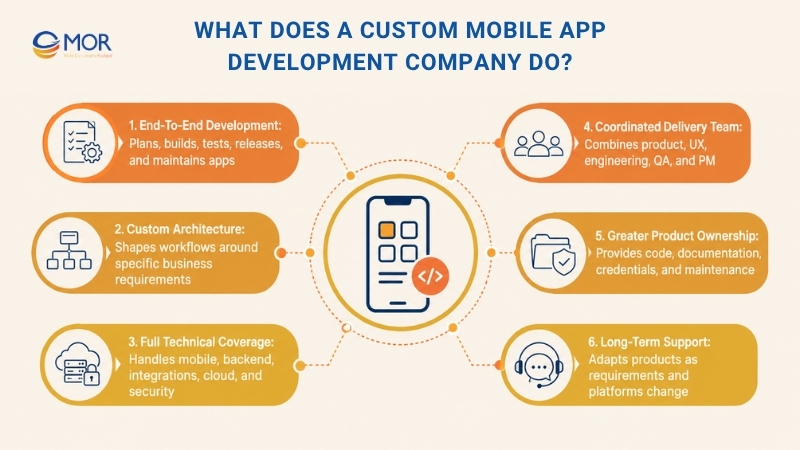
A custom mobile app development company differs from a template builder because the product architecture and workflows can be shaped around your organization. If you need a custom app made for field operations, healthcare consultations, customer commerce, or internal approvals, the system can reflect those rules instead of adapting your process to fixed software.
Approach | Best for | Team structure | Customization | Main limitation |
Custom mobile app company | Complex or long-term products | Product, UX, mobile, backend, QA, PM | High | Higher initial budget |
Freelancer | Narrow scoped work | One specialist | Medium to high | Capacity and continuity risk |
No-code / packaged platform | Simple workflows or validation | Internal team plus platform | Limited | Platform constraints |
The scope also separates a mobile app development service company from a freelancer handling one technical task. An agency can coordinate design, architecture, APIs, QA, release work, and maintenance under one delivery plan.
Custom work also gives you more control over product ownership. Many app creation services can ship a first version, but long-term products need repository access, documentation, test coverage, release credentials, and a clear maintenance path.
For that reason, buyers comparing custom mobile app development companies should look beyond screenshots. The real test is whether the partner can support your product after requirements change, integrations grow, and operating-system updates arrive.
Why Choose Custom Mobile App Development?
Custom mobile app development helps businesses reach their target users and provides solutions that fit specific needs. From there, companies can create optimized applications, supporting sustainable growth.
Benefits of Custom App Solutions
- Tailored to your business needs: Custom applications help meet the business's exact requirements, thereby providing an absolute fit with the operating process and development strategy.
- Better scalability and performance: These applications are easily expanded as the business grows, ensuring stable and uninterrupted performance.
- Enhanced security features: Security is always a top priority when developing custom mobile applications. Solution providers often integrate advanced security layers, minimizing the risk of cyber attacks.
- Improved customer engagement: By integrating unique and user-friendly features, custom applications improve customer interactions and enhance user experience.
Most custom mobile app development companies leverage advanced mobile app development frameworks to ensure seamless functionality across platforms.

When Should You Opt for a Custom Mobile App?
- Complex business requirements: Businesses with complex and specific feature needs often have to choose custom applications to ensure they fit their operations.
- Specific industry demands: Some industries such as healthcare, finance, and e-commerce have strict requirements for features and security, requiring custom solutions.
- Need for personalized features: When businesses want to provide a personalized experience, custom applications are the optimal choice to flexibly meet customer needs.
While native apps offer platform-specific functionality, hybrid mobile app development companies provide a cost-effective solution for businesses looking to develop apps for multiple platforms.
How to Choose the Right Custom Mobile App Development Company?
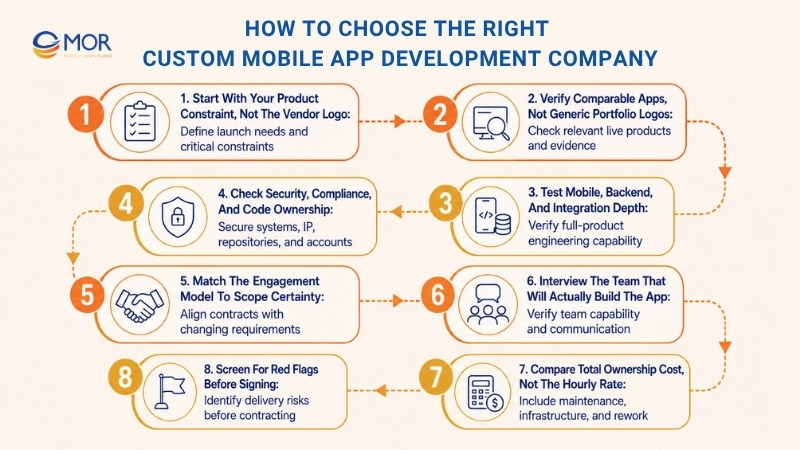
Start with the product constraint that can sink the project. Budget, healthcare rules, old ERP integration, offline operation, App Store deadlines, or access to native hardware usually gives you a better filter than agency awards.
The strongest custom mobile app development companies should be able to explain how those constraints change team composition, architecture, estimate, and delivery risk. A polished portfolio alone doesn't answer that.
Start With Your Product Constraint, Not the Vendor Logo
Define where the product sits now and what must be true at launch. An MVP testing demand needs a different delivery model from an application replacing an existing system used by thousands of employees.
- Product stage: Identify idea validation, MVP, active growth, modernization, or enterprise replacement.
- Primary constraint: Rank budget, deadline, regulation, working-hour overlap, integration, or team availability.
- Platform need: Decide if iOS, Android, or a shared-code approach matches the user base.
- Internal capability: Map which product, architecture, UX, QA, and release skills already exist inside your team.
A vendor should fill a defined gap rather than duplicate skills you already pay for. This also helps you compare proposals on the same scope.
Verify Comparable Apps, Not Generic Portfolio Logos
A recognizable client logo proves a commercial relationship, but it doesn't explain what the vendor actually built. Ask for project detail around the problem, technical scope, team, timeline, stack, and production result.
- Live product: Download public apps and use the core workflow yourself.
- Comparable complexity: Match technical problems, not only industry labels.
- Case evidence: Check architecture, integrations, security, user scale, and delivery responsibilities.
- Recent work: Prefer examples that reflect the vendor's current team and technology practice.
For example, MOR Software's construction application used React Native and FastAPI for real-time collaboration, reports, and drawing tools across iOS and Android. The technical pattern tells a construction buyer more than a logo alone.
Test Mobile, Backend, and Integration Depth
A production mobile app rarely stops at the phone. Authentication, notifications, payments, search, analytics, cloud storage, business data, and admin workflows often live behind the interface.
- Native depth: Check Swift, SwiftUI, Kotlin, Android SDK, and platform API experience.
- Cross-platform depth: Examine real Flutter and React Native releases rather than capability claims.
- Backend capability: Review APIs, databases, authentication, queues, cloud services, and observability.
- Integration work: Ask about Salesforce, ERP, CRM, payment, identity, IoT, and internal data sources.
- Release history: Verify App Store and Google Play submission experience.
This area often separates custom app development companies that build full products from teams focused mainly on front-end screens.
Check Security, Compliance, and Code Ownership
Security questions belong in vendor evaluation, not at the end of UAT. The same applies to intellectual property and production accounts.
- Security process: Ask about access control, code review, dependency checks, encryption, testing, and secret management.
- Compliance: Map HIPAA, GDPR, PCI DSS, SOC 2, ISO requirements, or other relevant standards before architecture work.
- IP ownership: Put code, designs, documentation, and transfer terms in the contract.
- Repository access: Keep client access to source repositories during the engagement.
- Store ownership: Register Apple and Google accounts under the client organization where practical.
If your procurement document uses the phrase 'custom mobile apps development company,' these ownership checks should still apply. Branding a vendor as 'custom' doesn't guarantee that the client controls the source code or deployment accounts.
Match the Engagement Model to Scope Certainty
A fixed-price contract works best when the deliverables and acceptance rules are stable. Products still testing requirements usually need room to change, which makes time and materials or a dedicated team easier to manage.
- Fixed price: Fits defined scope, clear acceptance rules, and limited change.
- Time and materials: Fits discovery-heavy products where priorities may move between sprints.
- Dedicated team: Fits ongoing roadmaps that need retained product knowledge.
- Hybrid model: Can pair paid discovery with a later fixed build or retained team.
Don't choose the contract type from procurement habit alone. The wrong commercial model can turn normal product learning into repeated change requests and contract disputes.
Interview the Team That Will Actually Build the App
Sales presentations tell you what the company knows. Team interviews tell you who will apply that knowledge to your product.
- Named team: Ask for proposed roles, seniority, allocation, and start dates.
- Technical lead: Speak directly with the person responsible for architecture.
- Continuity: Ask what happens when a developer leaves or another project needs staff.
- Communication: Agree on meetings, reporting, escalation, and response expectations.
- Working-hour overlap: Check actual team schedules rather than office locations.
This step is particularly useful when comparing offshore and nearshore vendors. Two firms with the same rate can produce very different communication load for your internal product owner.
Compare Total Ownership Cost, Not the Hourly Rate
Hourly rate matters, but it doesn't capture rework, management load, release support, maintenance, or replacement cost. A lower rate with poor QA can create a more expensive product.
- Build budget: Compare roles, hours, assumptions, and excluded work.
- Maintenance: Include operating-system updates, SDK changes, security work, and fixes.
- Infrastructure: Model cloud and third-party API use at expected user volumes.
- Rework risk: Check discovery, architecture review, automated tests, and UAT planning.
- Scaling cost: Ask how team pricing changes when the roadmap expands.
When you compare custom mobile app development companies, make the vendors price the same scope. Otherwise one proposal may include QA, product management, and release work while another hides those costs outside the headline estimate.
Screen for Red Flags Before Signing
Weak proposals often reveal delivery problems before development starts. The patterns are easy to spot once you know what to ask.
- No discovery: A complex application receives a firm estimate before technical requirements are reviewed.
- No live proof: The portfolio relies on screenshots without production apps or detailed cases.
- Unnamed delivery team: Sales can't tell you who will lead architecture or development.
- Unclear ownership: The contract leaves repository, code, design, or deployment-account ownership vague.
- No difficult examples: The vendor presents every past project as perfect and can't explain a failed assumption or recovery.
- No maintenance plan: Responsibility ends at store release without handover or production support.
- One-number quote: The estimate lacks roles, assumptions, exclusions, or scope detail.
A strong vendor should make the risks easier to see, not hide them. Good procurement gets much simpler once the company can explain trade-offs in plain language.
Working with offshore software development companies allows businesses to access high-quality development services at competitive prices
How Much Does Custom Mobile App Development Cost in 2026?
The price of custom mobile app development can start in the tens of thousands and climb well into six figures. Scope, backend logic, platform count, integrations, security, team location, UX work, and post-release requirements all change the final figure.
Clutch's August 2026 pricing data places most reviewed app projects between $10,000 and $49,999, while the most common agency hourly band is 25-49/hour. Treat those figures as market references rather than a quote for your product.
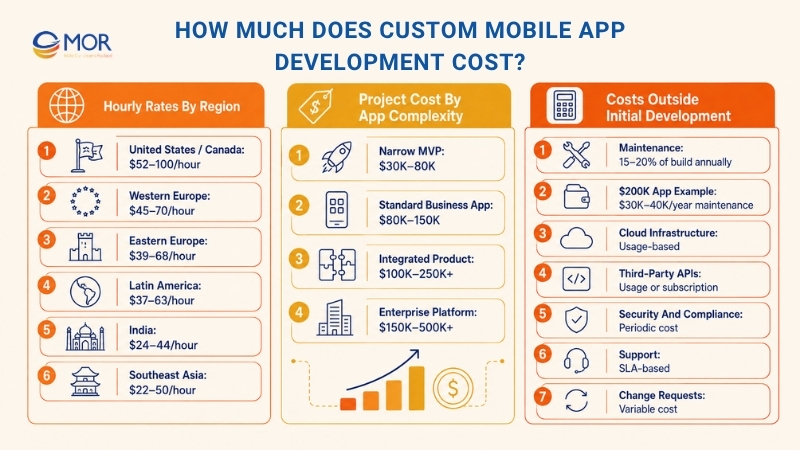
Hourly Rates by Region
Location changes labor cost, but headquarters alone can mislead. A US-headquartered company may deliver through teams in Europe, Latin America, or Asia, while a European vendor may staff senior engineers working US hours.
Second Talent's 2026 dataset separates local and remote developer rates, which makes the regional gap easier to see. Netguru's current guide also places Eastern European mobile engineers below Western European and North American agency levels.
Region | 2026 planning range | Source basis | Main cost factor |
United States / Canada | About 52 - 100/hour for mid-level remote talent | Second Talent | Seniority, local product leadership, US/Canada labor market |
Western Europe | About 45 - 70/hour for mid-level remote talent | Second Talent | Market, seniority, regulation, design depth |
Eastern Europe | About 39 - 68/hour for mid-level remote talent | Second Talent | Country, seniority, nearshore access |
Latin America | About 37 - 63/hour for mid-level remote talent | Second Talent | Country and US working-hour overlap |
India | About 24 - 44/hour for mid-level remote talent | Second Talent | Vendor tier, seniority, team structure |
Southeast Asia | About 22 - 50/hour for mid-level remote talent | Second Talent | Country, offshore model, seniority |
These figures describe developer-market rates, not a guaranteed agency price. Project management, business analysis, QA, design, security, sales overhead, and vendor margin can move an agency quote well above the developer rate.
A Vietnam-based team, for example, can sit in a lower labor-cost market without making every project 'cheap.' Senior Swift work, regulated healthcare logic, complex AWS architecture, or real-time data can still require a high-skill team and a larger budget.
Project Cost by App Complexity
Project scope is a better budget signal than screen count. A clean ten-screen mobile app can contain complex permissions, payment flows, live data, or ERP integrations behind those screens.
Netguru's 2026 baseline ranges put a single-platform MVP at 30,000-80,000, a cross-platform mid-market product at 80,000-150,000, and an enterprise-grade application at 150,000-500,000+. These figures assume professional product work rather than a template or no-code prototype.
App scope | Planning budget | Typical scope |
Narrow MVP | 30,000 - 80,000 | One main workflow, core accounts, basic API, limited backend |
Standard business app | 80,000 - 150,000 | iOS and Android reach, custom UI, backend, analytics, third-party services |
Integrated product | 1000,000 - 250,000+ | Payments, real-time data, many APIs, admin tools, roles, deeper backend logic |
Enterprise or regulated platform | 150,000 - 500,000+ | Compliance, high scale, complex integrations, security controls, many user roles |
Cross-platform tools can lower duplicated mobile work when iOS and Android share the same product logic. Yet native Swift or Kotlin remains reasonable when the app depends heavily on platform APIs, Bluetooth, media processing, background tasks, demanding animation, or device hardware.
The right choice needs technical validation rather than a blanket rule. An experienced custom mobile app development company should explain the trade-off in maintenance, performance, release work, and access to native APIs before recommending a stack.
Costs That Sit Outside the Initial Development Quote
A development quote rarely represents the full ownership cost. Production software continues to consume money after the first App Store or Google Play release.
Cost area | Budget treatment | Why it appears later |
Maintenance | Annual recurring budget | OS changes, SDK updates, bugs, compatibility |
Cloud infrastructure | Usage-based | Traffic, storage, databases, compute |
Third-party APIs | Usage or subscription | AI, maps, messages, payments, identity |
Monitoring and analytics | Recurring | Crash tracking, logs, performance data |
Security and compliance | Periodic | Testing, audits, remediation |
Store accounts | Recurring or one-time | Often paid directly by the client |
Support | SLA-based | Production incidents and user issues |
Change requests | Variable | New requirements after discovery or release |
Maintenance estimates vary by product. Resourcifi's 2026 cost guide uses 15%-20% of initial build cost per year as a planning reference, meaning a $200,000 build may require 30,000-40,000 annually before usage-heavy cloud or API costs.
Compare total ownership cost across custom mobile app development companies, not just the first invoice. A bid that excludes QA depth, deployment work, documentation, analytics, or support can look cheaper until those lines return later.
Features to Look for in a Custom Mobile App Development Company
Experience in Multiple Industries
A company with experience working in a variety of industries will be more flexible in providing solutions that are tailored to your business. Mobile app development companies that have worked with industries such as healthcare, finance, e-commerce, and entertainment can apply their expertise to create apps that meet the specific requirements of each industry.
Full-Cycle App Development Services
A reputable mobile app development company will provide full-cycle app development services, from ideation, strategy, design, development, and testing to post-deployment support. This gives you a total solution without having to look for different service providers for each part of the project.
Expertise in Latest Technologies
The ability to adopt the latest technologies is what sets a top mobile app development company apart. Technologies like cross-platform app development, artificial intelligence (AI), AR/VR, and blockchain will help your app stand out from the competition and deliver a unique user experience.

Conclusion
No shortlist gives one winner for every product. Compare custom mobile app development companies against your platform, integrations, security needs, team structure, budget, and real project evidence before narrowing the field. MOR Software supports end-to-end mobile engineering through Vietnam-based delivery, backend integration, QA, modernization, and post-launch work. Contact MOR Software to discuss your app requirements and identify a delivery model that fits your roadmap.
MOR SOFTWARE
Frequently Asked Questions (FAQs)
How much does custom mobile app development cost?
Custom app development costs typically range from $10,000 to $500,000 depending on the complexity of the project.
How long does it take to develop a custom mobile app?
Development time can range from 3 months to over a year, depending on the requirements and features of the application.
What platforms can custom apps be built for?
Custom apps can be developed for Android, iOS or cross-platform.
How do I ensure the security of my custom mobile app?
You need to choose a company that has experience in integrating advanced security features and adhering to cybersecurity standards.
What is the process of custom mobile app development?
The development process includes ideation, design, development, testing and launch of the application, followed by support and maintenance.
What does a custom mobile app development company do?
A custom mobile app development company handles product planning, UX/UI, mobile engineering, backend/API work, QA, release, and maintenance based on a client's requirements. The exact scope depends on the app, integrations, security requirements, and internal team.
A custom mobile application development company can also take responsibility for cloud services, web portals, analytics, and system connections around the mobile product. That wider scope is useful when the application forms part of a larger business system.
How much does it cost to hire a custom mobile app development company in 2026?
Clutch reports that most reviewed projects fall between $10,000 and $49,999, but professionally built business applications can move far beyond that range. Integrated and enterprise products commonly reach six figures because backend logic, security, platform count, data, and third-party systems add engineering work.
Team location also changes cost. US and Canadian delivery normally sits higher than India or Southeast Asia, while Eastern Europe and Latin America often sit between those ends.
Should I choose native development or Flutter/React Native?
Native Swift and Kotlin provide direct access to platform APIs and can suit hardware-heavy, graphics-heavy, or deeply platform-specific products. Flutter and React Native let teams share more code across iOS and Android, which can lower duplicated work.
Your choice should follow performance needs, device APIs, UI requirements, internal skills, release plans, and maintenance. One stack doesn't win every mobile product.
How can I verify a mobile app development company's portfolio?
Download live applications where possible and test the workflows closest to your project. Then check the case study for the vendor's actual responsibilities, team, stack, timeline, and production result.
Ask about products built during the last two or three years. An old portfolio may reflect developers and technical practices that no longer exist inside the company.
What questions should I ask before signing with a mobile app company?
Ask who will work on the project, who owns architecture decisions, how scope changes are handled, and what QA work is included. Also clarify security, repository access, App Store accounts, documentation, support, and pricing assumptions.
Request one comparable case and one example of a project that ran into trouble. The second answer often reveals more about the vendor's working style.
Who should own the source code and App Store accounts?
The client should normally control the product's source code and business-owned Apple and Google developer accounts once contractual payment and ownership conditions are met. The contract needs to state ownership of code, design files, documentation, build scripts, and other project assets.
Repository access during development also lowers vendor lock-in. If the relationship ends, another engineering team should be able to continue the product without rebuilding basic access.
Which pricing model works best for custom mobile development?
Fixed price works for stable requirements, while time and materials fits products that still need discovery and change. Dedicated teams fit long-running roadmaps where the same engineers need to retain product knowledge.
A hybrid model is also common. Discovery can run on time and materials before the team agrees on a more defined build scope.
How much should I budget for mobile app maintenance after launch?
A planning range of 15%-20% of initial build cost per year is common in 2026 industry guides. The real number depends on release frequency, user volume, cloud usage, security work, third-party SDKs, and product growth.
Keep infrastructure and API usage separate from engineering maintenance. AI services, maps, messaging, media storage, and payment platforms can grow with traffic rather than development hours.
Is an agency better than freelancers or an in-house mobile team?
An agency fits products that need coordinated product, design, mobile, backend, QA, and project management skills. Freelancers fit narrow tasks, while an internal team gives tighter day-to-day control when the company can support permanent hiring.
There isn't one default answer. Product complexity, hiring speed, expected roadmap length, internal leadership, and budget should drive the model.
Share


Make Our-Dreams Realized


© 2023 . MOR Software. All Rights Reserved
Sitemap
Privacy Policy
Terms of Use

Rate this article
0
over 5.0 based on 0 reviews
Your rating on this news:
Name
*Email
*Write your comment
*Send your comment
1