


Make to Order Manufacturing: The Complete Guide for Business 2026
Production delays, excess inventory, and unpredictable demand often make manufacturing operations difficult to manage. Make to order manufacturing offers a smarter approach where production starts only after confirmed customer requests, reducing waste and improving customization. In this guide, MOR Software explains how this order-driven production model works and how modern order management for manufacturing systems help businesses deliver tailored products efficiently.
What Is Make To Order Manufacturing?
Make to order manufacturing (MTO) is a production strategy where manufacturing activities begin only after a confirmed purchase request is received from a customer. This approach explains the MTO meaning, which refers to a system where goods are created in response to real orders rather than predicted demand. Instead of producing items ahead of time, this order-driven production model relies on a pull mechanism where verified orders activate the full workflow, from raw material sourcing to final assembly and shipment.
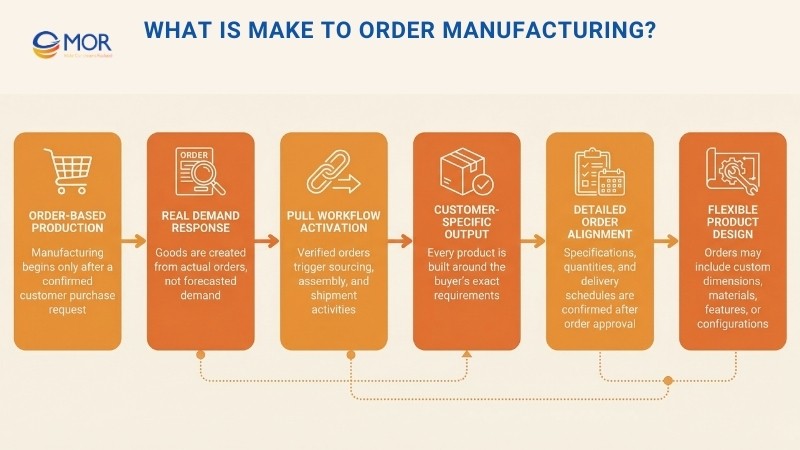
This customer-focused method means manufacturers agree on detailed product specifications, order quantities, and delivery schedules only after the order is confirmed. Every product is created to satisfy the specific needs of the buyer. These requirements may include precise dimensions, customized features, selected materials, or particular product configurations tailored to the customer’s request.
How Does Make To Order Manufacturing Process Work?
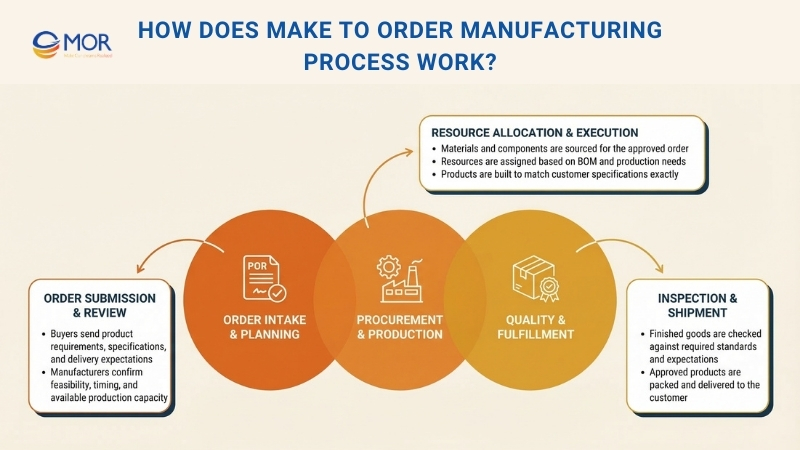
The make to order manufacturing workflow follows a clear sequence that starts with the customer rather than relying on inventory predictions. This order-driven production system connects customer demand directly with order management for manufacturing, ensuring that each stage of production responds to a real purchase request.
Customer Order Submission
The buyer sends a request that includes detailed requirements, technical specifications, and the preferred delivery timeline
Order Review And Production Planning
The manufacturer studies the request, checks feasibility, and confirms a delivery schedule based on available capacity and material supply
Material Procurement Process
Raw materials and required components are sourced from suppliers according to the exact needs of the approved order
Production Schedule Allocation
The order is added to the manufacturing schedule, and resources are assigned based on the Bill of Materials (BOM) and production requirements
Manufacturing Execution
Production begins, and items are built following the exact specifications provided by the customer
Quality Inspection Procedures
Completed goods go through inspection to confirm they meet the required standards and customer expectations
Order Fulfillment And Shipment
Finished products are packed and delivered to the customer according to the confirmed order.
This complete workflow ensures that every product created already has a buyer, which removes the risk of producing inventory that remains unsold.
In practice, Odoo Manufacturing can support this workflow by connecting bills of materials, work orders, procurement steps, and production scheduling in one environment.
What Is The Make To Order Manufacturing Strategy?
The strategy behind make to order manufacturing focuses on producing goods only when a confirmed request exists. This production approach aligns manufacturing activity directly with customer demand and helps companies avoid unnecessary inventory buildup.
Pull Vs Push Supply Chain Operations
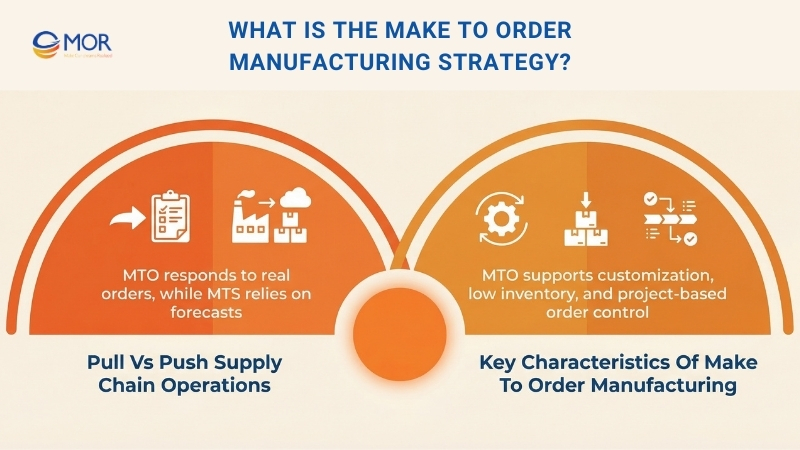
The main difference between make-to-order-manufacturing and conventional production methods appears in how activities start within the supply chain.
Pull Supply Chain (MTO): In a pull-based system, real customer demand activates the manufacturing process. Production steps begin only after confirmed orders appear, and planning moves backward from the customer commitment through each stage of production to build a detailed schedule. This demand-driven method ensures that manufacturing capacity and resources are used only when an actual requirement exists.
Push Supply Chain (MTS): In contrast, a push system creates products according to predicted demand. Goods move through the supply chain based on forecasts that expect future purchases. Manufacturers produce inventory before orders arrive and depend on market projections together with past sales data to determine production levels.
The pull model used in MTO manufacturing helps businesses match production capacity with real market demand more closely, which lowers the financial risk that comes from excess or unsold inventory.
Key Characteristics Of Make To Order Manufacturing
Make to order manufacturing includes several core traits that separate this production model from other manufacturing methods:
- Production Triggered By Customer Orders: Manufacturing activities begin only after an order is officially confirmed, which removes the need for speculative production
- Strong Product Customization Capability: Goods are produced according to the exact specifications requested by the customer, allowing a high level of personalization
- Very Limited Finished Product Inventory: Companies keep little or no stock of completed items because products are created only when orders exist
- Extended Production Lead Times: Manufacturing cycles begin after the order is placed, which leads to longer delivery timelines compared with inventory-based production methods
- Advanced Production Planning Requirements: Every order may involve different materials, manufacturing steps, and scheduling considerations
- Tight Supplier Collaboration: Reliable suppliers play an important role because they must deliver materials that match production schedules and order timelines
- Project-Oriented Order Management: Each order functions as an individual project with clearly defined requirements, deadlines, and deliverables
Advantages Of Make To Order Manufacturing
Make to order manufacturing offers several operational and financial benefits for companies that produce customized goods. This order-driven production system allows manufacturers to align production closely with customer demand while reducing unnecessary inventory risks.
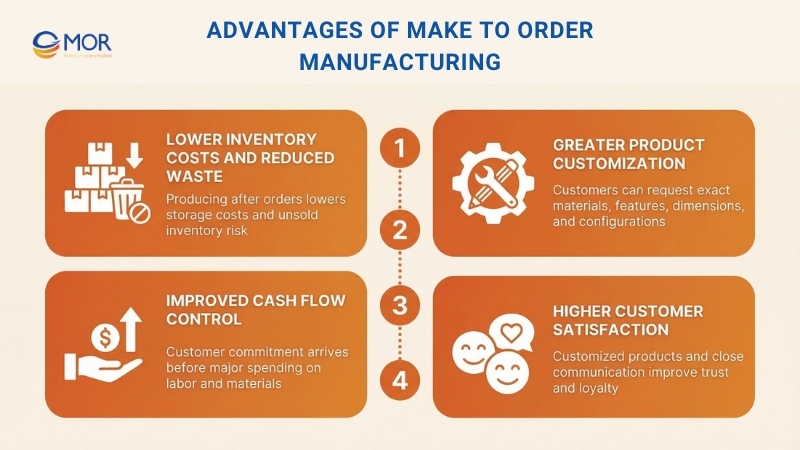
Lower Inventory Costs And Reduced Waste
One of the strongest advantages of make-to-order manufacturing is the significant decrease in expenses connected to inventory management. When companies produce items only after receiving confirmed orders, they remove many of the costs related to storing finished products, including warehouse space, insurance coverage, handling expenses, and the risk that products may become outdated.
When goods remain unsold in storage facilities, company capital becomes tied up in inventory that does not generate revenue. The MTO model releases this locked capital, which improves liquidity and allows businesses to reinvest funds into expansion or operational improvements. Companies also avoid losses related to products that deteriorate, expire, or lose market value over time.
For organizations operating in rapidly changing sectors such as technology or fashion, where product lifecycles are short, this production approach helps prevent financial losses that occur when stored inventory becomes obsolete before customers purchase it.
Tools such as Odoo ERP and Odoo Manufacturing can also help teams track stock levels, material usage, and order status in real time, making it easier to avoid excess inventory and unnecessary storage costs.
Greater Product Customization
This production approach allows businesses to provide extremely high levels of product personalization. Customers may request precise measurements, choose specific materials, add specialized features, or adjust configurations so the product matches their exact needs.
Such flexibility provides an important competitive advantage. Studies indicate that 76% of consumers expect personalized products or services, and companies that offer tailored experiences often achieve higher satisfaction levels, stronger brand loyalty, and a greater chance that buyers accept premium pricing.
Many make to order manufacturing examples appear in B2B industries where customization is essential rather than optional. Buyers of industrial machinery, for instance, often require equipment designed for their own factory layouts, operational requirements, or compatibility with existing production systems.
Improved Cash Flow Control
In many MTO production environments, payment arrangements often take place before manufacturing begins or while production is still in progress. This structure ensures that manufacturers receive financial commitment from customers before spending money on materials and labor. Such an approach supports healthier cash flow compared with MTS systems, where companies invest capital in inventory that may remain unsold for several weeks or even months.
In addition, this order-driven production method lowers the amount of capital tied to stored inventory and related holding expenses. As a result, companies that use this model usually require less working capital to run their operations. Lower capital requirements improve operational efficiency and reduce the need for external funding sources.
Higher Customer Satisfaction
When customers receive products designed exactly according to their specifications, satisfaction levels rise significantly. The make to order production model removes the compromises customers often face when purchasing standardized goods that only partly match their needs.
The collaborative process behind this system also strengthens relationships between manufacturers and their clients. During the order lifecycle, companies communicate closely with buyers to refine specifications, provide progress updates, and confirm that expectations remain aligned. This interaction creates trust and delivers positive experiences that encourage repeat purchases and referrals.
Businesses such as Dell Computer Corporation have shown the effectiveness of this production approach. The company transformed the personal computer industry by allowing customers to configure systems according to their preferred specifications and delivering customized computers within a short period of time.
Challenges Of Make To Order Manufacturing
Although make to order manufacturing offers many benefits, this production approach also introduces several operational difficulties. Companies that use this system must carefully manage planning, timelines, and supply coordination to keep production efficient.
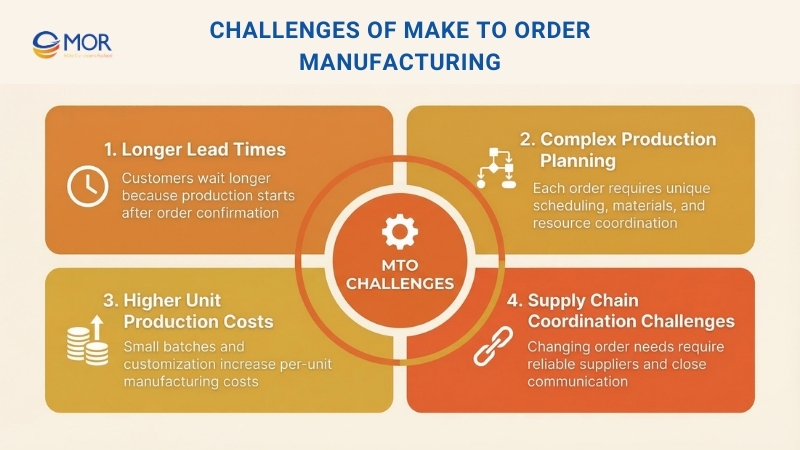
Longer Lead Times
One major limitation of MTO manufacturing is the longer period between the moment an order is placed and the time the finished product reaches the customer. Since production activities begin only after the order is confirmed, customers must wait through the full manufacturing process before delivery occurs.
In markets where rapid delivery is important, these extended timelines can reduce competitiveness. Customers who expect immediate availability may choose suppliers that keep inventory ready for quick shipment. Businesses that use this order-driven production model need to manage expectations carefully, communicate clear delivery schedules, and explain the value that product customization provides.
Some companies address this issue through a hybrid method. They keep stock of components with long supplier lead times while still performing final assembly based on confirmed customer orders. This approach allows manufacturers to maintain customization while reducing overall delivery time.
Complex Production Planning
Every order in make to order operations often functions as a separate project with its own materials, processes, and scheduling requirements. This variation creates much more planning complexity compared with repetitive production systems used in MTS manufacturing.
Production planners must constantly balance multiple customer orders, assign resources efficiently, coordinate material supply from different vendors, and adjust schedules when new orders arrive or priorities change. Without advanced planning systems, these demands may create operational pressure that leads to delays, mistakes, or reduced efficiency.
Forecasting demand also becomes more complicated. Although this production model removes the need to predict finished product demand, manufacturers still need to estimate raw material requirements and maintain enough production capacity to support expected order volumes.
Odoo Manufacturing supports this process through bill of materials control, work center scheduling, and live production updates, helping teams adjust priorities when order requirements change.
Higher Unit Production Costs
Products created through this custom manufacturing strategy often carry higher costs per unit than items produced through mass manufacturing. Smaller production volumes remove the advantages of large-scale production, which means manufacturers must distribute setup expenses, equipment preparation, and operational overhead across a limited number of units.
Customization also increases expenses. Engineering teams may spend additional time interpreting detailed specifications, manufacturers may need specialized materials, and production may involve extra quality inspections or more skilled labor. These added costs typically lead to higher product prices that customers must pay.
Even so, many buyers are willing to accept these higher prices when the final product matches their exact requirements. The important factor is that the benefits of customization provide enough value to justify the price difference.
Supply Chain Coordination Challenges
The success of a make to order supply chain relies heavily on dependable suppliers who can deliver materials that match constantly changing production schedules. Unlike MTS operations that purchase materials according to stable timelines, manufacturers using this order-based system face material requirements that shift with incoming customer orders.
This unpredictability requires stronger supplier partnerships, frequent communication, and sometimes more flexible agreements so suppliers can respond quickly when new orders arrive. Supply chain interruptions that may cause only minor issues for stock-based production can completely stop MTO production if key materials fail to arrive on time.
Managing complex supply networks becomes even more difficult when several supply layers are involved. In many cases, components produced by one supplier must arrive at another facility before final manufacturing begins, which creates interconnected dependencies across the entire supply chain.
Odoo ERP can also connect purchasing, inventory, and supplier data in one place, giving teams clearer visibility into material availability and helping them respond faster when supply issues appear.
Make To Order Manufacturing Vs Make To Stock
Businesses often compare make to order manufacturing with other production approaches when deciding how to organize operations. Understanding the difference between these models helps companies choose the system that best fits their products, customers, and market conditions.
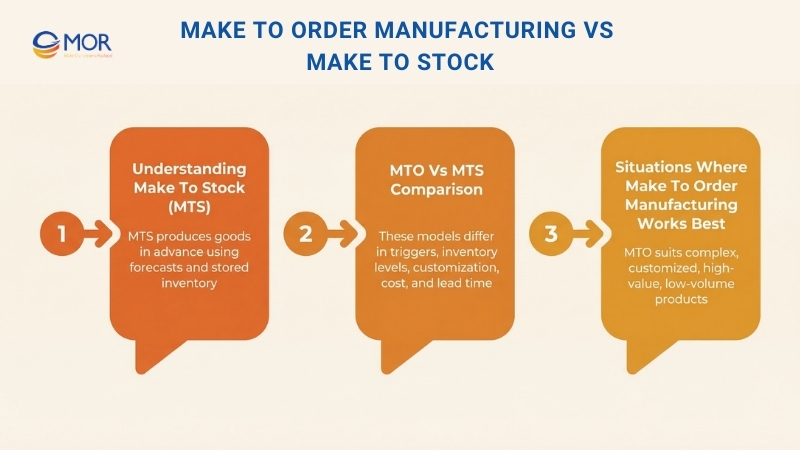
Understanding Make To Stock (MTS)
Make to stock is a production method where companies manufacture products in advance according to demand forecasts and expected market trends. Goods are produced in large batches, stored in warehouses, and then sold from available inventory when customer orders arrive.
MTS manufacturing focuses on fast delivery and the advantages of large-scale production. When products are created in high volumes, manufacturers benefit from lower costs per unit and can ship orders immediately from existing stock. This production method works best for standardized goods with stable and predictable demand patterns.
MTO Vs MTS Comparison
The difference between make to stock vs make to order production becomes clear when examining how each system manages production triggers, inventory levels, and customization capabilities. These two models follow different operational priorities that influence cost structures, flexibility, and delivery speed.
Factor | Make to Order (MTO) | Make to Stock (MTS) |
| Production Trigger | Customer order received | Demand forecast |
| Inventory Levels | Minimal finished goods | High finished goods stock |
| Customization | High – products built to specifications | Low – standardized products |
| Lead Time | Longer – production starts after order | Shorter – immediate from inventory |
| Per-Unit Cost | Higher due to customization | Lower due to economies of scale |
| Inventory Risk | Low – no unsold products | High – potential obsolescence |
| Cash Flow | Better – payment before production | Tied up in inventory |
| Flexibility | High – adapts to customer needs | Low – limited to existing products |
| Demand Predictability | Not required | Essential for planning |
| Production Complexity | High – unique specifications | Lower – standardized processes |
Situations Where Make To Order Manufacturing Works Best
This production approach becomes the most suitable option when your business shows the following characteristics:
- Products With High Customization Requirements: Customers request significant personalization or product variations
- Technically Complex Engineered Products: Goods involve detailed designs, specialized components, or advanced technical specifications
- High-Value Products: Items cost a large amount to manufacture and would be expensive to store in inventory
- Low Production Volumes: Orders usually involve small quantities, from single units to limited batches
- Short Product Lifecycles: Rapid technological or design changes make unsold inventory risky
- Limited Storage Space: Physical warehouse capacity restricts the ability to maintain large stock levels
- Close Customer Collaboration: Businesses work directly with clients to discuss specifications and accept longer delivery timelines
Industries such as aerospace manufacturing, custom industrial equipment, luxury automotive production, and specialized medical device manufacturing frequently benefit from this order-driven production strategy.
Make To Order Manufacturing Variations: MTO Vs ATO
Different production models exist within make to order manufacturing, each offering a different balance between customization, production speed, and engineering effort. Companies often compare these approaches to determine which production structure best fits their operational needs.
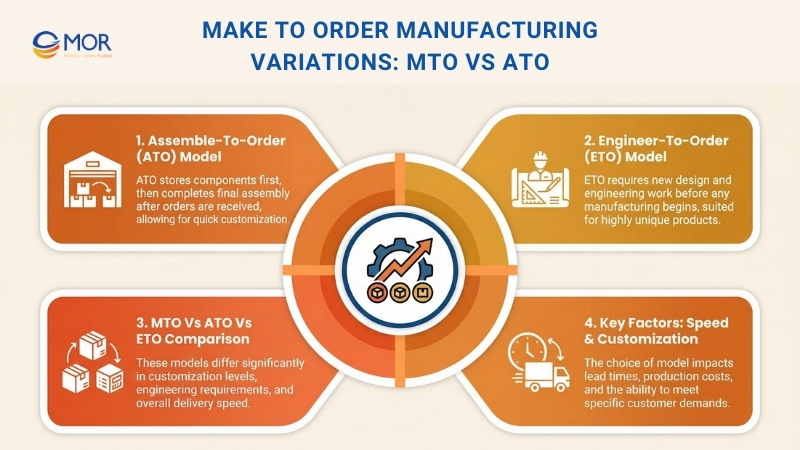
Assemble-To-Order (ATO) Model
Assemble-to-order is a hybrid manufacturing approach that combines elements of make-to-order and make-to-stock production. In ATO operations, manufacturers produce and store standardized subassemblies or components in advance. Once customer orders arrive, they complete the final assembly using configurations requested by the buyer.
This model shortens delivery timelines compared with full MTO production while still allowing a certain level of product customization. Many computer manufacturers use this approach. They maintain inventory of common parts such as motherboards, processors, memory modules, and storage drives, then assemble systems based on the configuration chosen by each customer.
ATO is particularly effective when:
- Products contain many shared components across different product configurations
- Final assembly requires significantly less time than producing the individual components
- Customers expect faster delivery than traditional MTO production can provide
- Component lead times are long but assembly can be completed quickly
Engineer-To-Order (ETO) Model
Engineer-to-order expands customization further than a typical MTO strategy. In this model, products require substantial design and engineering work before manufacturing activities begin. Each order may include new engineering drawings, structural calculations, prototype development, or testing phases.
Examples include:
- Custom industrial equipment designed for specialized operational requirements
- Large construction projects such as bridges or commercial buildings
- One-of-a-kind equipment built for scientific research applications
- Prototype manufacturing for innovative product concepts
ETO operations generally involve longer lead times than MTO because engineering design occurs before production begins. These projects also require strong collaboration, with continuous communication between the manufacturer and the customer throughout both the design and production stages.
MTO Vs ATO Vs ETO Comparison
Each production approach offers different levels of customization, engineering complexity, and delivery speed. The following comparison highlights how these three models differ across key operational factors.
Characteristic | Make-to-Order (MTO) | Assemble-to-Order (ATO) | Engineer-to-Order (ETO) |
Customization Level | High – custom manufacturing | Medium – configurable options | Very High – unique design |
Lead Time | Long (weeks to months) | Medium (days to weeks) | Very Long (months to years) |
Engineering Required | Minimal – standard designs | None – pre-designed modules | Extensive – custom design work |
Inventory Strategy | Raw materials only | Component subassemblies | Raw materials and prototypes |
Production Cost | Medium-High | Medium | Highest |
Order Volume | Small batches | Small to medium batches | Often single units |
Customer Involvement | Specification phase | Configuration selection | Throughout design and production |
Examples | Custom furniture, specialty vehicles | Computers, modular equipment | Industrial machinery, construction projects |
Delivery Speed | Slower than ATO | Faster than MTO | Slowest of all methods |
Product Complexity | Medium to High | Medium | Highest – often unprecedented |
Best For | Customized standard products | Configurable products with common components | Unique, one-of-a-kind solutions |
Industries That Use Make To Order Manufacturing
Make to order manufacturing appears across many sectors, ranging from luxury consumer products to complex industrial equipment. The table below shows how different industries apply this order-driven production model and the advantages they gain from it.
Industry | Example Companies | Product Types | Key MTO Benefits |
Automotive | BMW, Mercedes-Benz, Tesla, Porsche | Luxury cars, customized vehicle configurations, specialty models | Extensive personalization options, lower showroom inventory requirements, premium pricing potential |
Aerospace | Boeing, Airbus, Gulfstream, Bombardier | Commercial airplanes, private jets, helicopters | High-value products, customer-specific designs, reduced risk of unsold inventory |
Industrial Equipment | Caterpillar, Siemens, ABB, Rockwell Automation | Manufacturing machines, industrial automation systems, energy equipment | Detailed technical specifications, facility integration, strict performance requirements |
Furniture | Ethan Allen, Room & Board, Custom Craftsmen | Custom sofas, dining tables, cabinets, office furniture | Flexible sizing options, diverse material selections, personalized design styles |
Medical Devices | Stryker, Zimmer Biomet, 3D Systems | Prosthetic devices, surgical implants, specialized medical instruments | Patient-specific design needs, regulatory compliance, high manufacturing precision |
Construction | Bechtel, Turner Construction, Skanska | Commercial buildings, infrastructure projects, custom residential structures | Unique architectural designs, location-specific requirements, client-defined specifications |
Fashion & Apparel | Indochino, Proper Cloth, Savile Row tailors | Custom suits, made-to-measure clothing, bespoke garments | Accurate fit, fabric selection flexibility, personalized styling |
Technology | Dell, HP Enterprise, Cisco Systems | Configured servers, network hardware, customized workstations | Performance customization, system compatibility, scalable configurations |
Defense | Lockheed Martin, Raytheon, BAE Systems | Military aircraft, defense systems, armored vehicles | Government specification compliance, security requirements, mission-specific engineering |
Printing | Heidelberg, HP Indigo, Komori | Industrial printing systems, packaging equipment | Production volume flexibility, substrate compatibility, specialized finishing capabilities |
Automotive Industry
The automotive sector widely applies MTO manufacturing, especially for premium and specialty vehicles. Brands such as BMW, Mercedes-Benz, and Tesla allow buyers to customize vehicles through detailed configuration choices that include exterior colors, interior materials, wheel designs, technology packages, and performance upgrades.
This level of personalization attracts customers who see their vehicles as expressions of personal identity and are willing to wait several weeks or months to receive their preferred configuration. The model also helps manufacturers control inventory costs for high-value finished vehicles while supporting the large number of possible customization combinations.
Aerospace And Defense
The aerospace sector represents one of the clearest examples of a custom manufacturing model built around order-driven production. Companies such as Boeing, Airbus, and Gulfstream manufacture highly complex and valuable aircraft where each unit is designed and configured for a specific client. These clients may include commercial airlines, cargo transportation companies, or private aircraft owners.
The high level of engineering complexity, cost, and customization requirements makes speculative production impossible in this industry. Orders are typically confirmed several years before delivery, and manufacturing activities require careful coordination among thousands of suppliers that deliver specialized parts and components.
Defense manufacturers follow a similar production structure. Contractors in this sector build military equipment, weapons platforms, and armored vehicles based on strict government specifications and contractual requirements.
Custom Furniture And Home Goods
Many furniture producers use made-to-order production to give customers extensive customization possibilities. Manufacturers allow buyers to select specific dimensions, wood types, surface finishes, fabrics, hardware, and construction features. These options allow customers to design furniture pieces that match their interior space and personal style.
Premium furniture companies often operate showrooms where customers can view sample designs and product variations. Actual manufacturing begins only after the customer confirms an order. This approach allows smaller manufacturers to provide a wide product selection without the financial burden of maintaining large amounts of finished inventory.
Industrial Machinery
Manufacturers that produce industrial machines, factory equipment, and commercial systems usually follow an order-driven production model rather than stock-based manufacturing. Buyers of this equipment often need machines designed for their exact production processes, facility layouts, capacity targets, and compatibility with existing operational systems.
From CNC machines and packaging systems to commercial kitchen equipment and industrial printing presses, manufacturers in this sector often collaborate closely with customers. They work together to design, engineer, and deliver solutions that meet the specific requirements of each business environment.
Fashion And Apparel
Although the fast fashion industry largely relies on MTS manufacturing, an increasing part of the clothing sector now uses made-to-measure production. Custom tailoring services, personalized clothing, and bespoke fashion allow customers to receive garments that match their measurements and individual preferences.
Recent advances in body scanning, 3D printing, and automated cutting technology have made custom clothing easier to produce and more affordable. Companies such as Indochino and Proper Cloth have built successful brands around personalized menswear, combining this order-based production method with the convenience of e-commerce platforms.
Best Practices For Implementing Make To Order Manufacturing
Long delivery timelines, product complexity, and challenges related to supply chain scenario planning can create operational pressure for companies that rely on make to order manufacturing. Organizations that follow this production model often face unpredictable order volumes and changing customer requirements. Clear operational practices can help companies manage these issues more effectively and keep production stable.
Strengthening Planning Processes
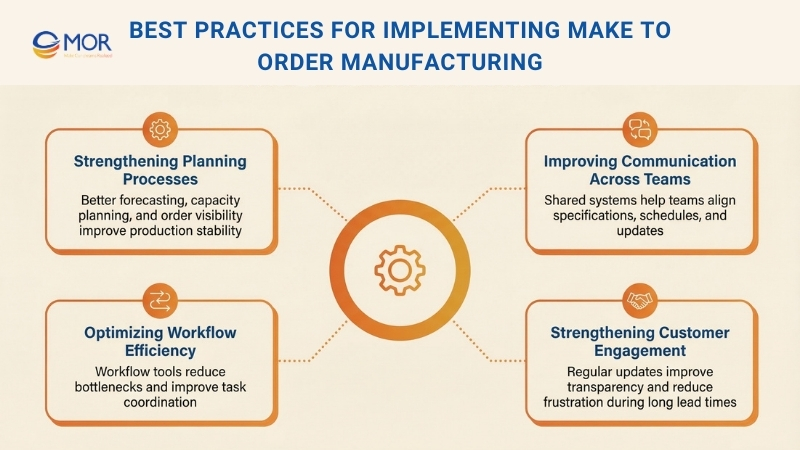
The structure of your supply chain design plays a major role in production planning within an order-driven environment. Companies that rely on custom order manufacturing must maintain a careful balance. They need enough materials available to fulfill incoming orders without accumulating excessive inventory that ties up capital. At the same time, they must deliver products quickly even when demand changes suddenly.
A well-designed supply chain allows manufacturers to prepare for these fluctuations. Several planning elements often shape how companies manage make to order operations:
- Demand forecasting. Demand forecasting estimates future customer demand through analysis of economic indicators and historical sales data. This information helps manufacturers predict order volumes and prepare production resources more accurately.
- Capacity planning. Without sufficient raw materials and production capacity, manufacturers cannot complete orders efficiently. Capacity planning helps companies determine the labor, equipment, and materials required to fulfill expected orders so production can begin without delays.
- Order management. Order management for manufacturing includes every stage of the product journey, from order intake and processing to fulfillment and customer service. Companies must maintain full visibility into these workflows so that each order follows the correct specifications and delivery timeline.
Modern digital platforms also support better planning decisions. ERP software for make-to-order manufacturing, together with advanced MTO software, helps companies coordinate planning tasks across departments. These systems centralize production data, improve forecasting accuracy, and provide clearer operational visibility.
The result is stronger decision-making for organizations that rely on the make-to-order model. A well-coordinated supply chain allows manufacturers to respond to orders efficiently while maintaining production stability.
In this area, Odoo Manufacturing and Odoo ERP can help centralize demand inputs, production schedules, inventory records, and purchasing activities so planners can make faster and more accurate decisions.
Improving Communication Across Teams
Developing products through make to order manufacturing requires strong coordination between every department involved in the process. For instance, the Sales team must clearly communicate all customer customization requirements to the Manufacturing team so that the final product matches the specifications requested by the buyer.
Digital platforms designed for production coordination, such as make to order manufacturing software, provide a centralized environment where departments can collaborate more effectively. When teams operate within the same system, information flows more smoothly across the organization. Fewer operational silos make it easier for employees to share product requirements, production schedules, and supply chain updates, which helps keep all stakeholders aligned.
Odoo ERP supports this coordination by giving Sales, Manufacturing, Purchasing, and Inventory teams access to the same order data, specifications, and production status.
Optimizing Workflow Efficiency
Operational efficiency remains essential for companies that rely on this order-driven production approach. Traditional mass production methods often do not suit custom manufacturing workflows. Manufacturers that follow this model must identify alternative ways to complete production quickly while still maintaining product quality.
Process improvement plays an important role in achieving this goal. Tools such as make-to order manufacturing software help organizations evaluate production steps, identify bottlenecks, and improve task coordination across teams. Workflow management capabilities inside these systems help manufacturers analyze operations and discover opportunities to simplify processes and increase productivity.
Odoo Manufacturing can also support workflow automation through routing, work orders, shop floor tracking, and production status updates, helping teams reduce manual coordination and improve execution speed.
Strengthening Customer Engagement
The make to order manufacturing approach naturally supports stronger customer relationships, especially when companies maintain clear communication throughout the production journey. Customers who receive regular updates about their order status are less likely to feel frustrated about longer delivery timelines associated with customized products.
Supply chain management platforms can notify companies when delays or operational bottlenecks appear. These alerts allow businesses to share timely updates with customers and maintain transparency during the production process.
Advanced planning tools also provide useful data about purchasing patterns and product preferences. Insights from these systems highlight which product features customers request most often. This information helps manufacturers understand customer expectations more clearly and improves demand planning for future orders while using the key features of ERP systems for make-to-order manufacturers.
MOR Software Supports Make To Order Manufacturing Implementation
MOR Software helps manufacturers implement a more connected make to order manufacturing model with Odoo. We support businesses that want to connect production planning, inventory control, purchasing, reporting, and shop floor coordination within one digital environment.
With Odoo Manufacturing, companies can manage bills of materials, work orders, routing, and material planning for custom production workflows. Odoo ERP helps centralize operational data across sales, inventory, purchasing, and finance, while giving managers access to dashboards and reporting that improve visibility across the production cycle.
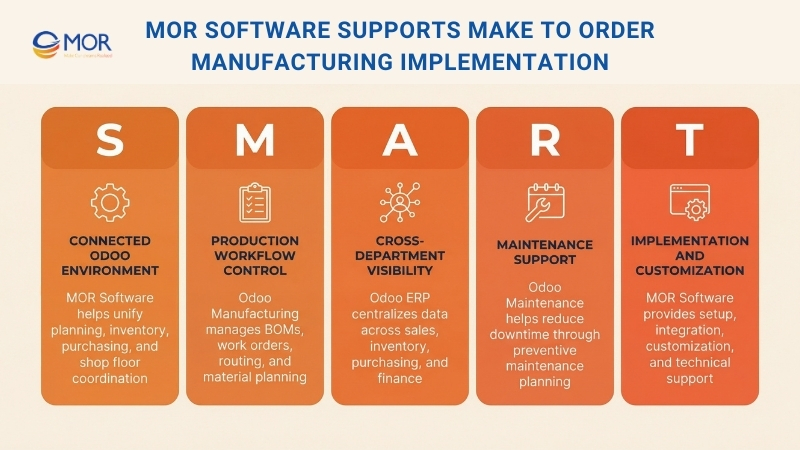
When equipment reliability is a key concern, Odoo Maintenance can also support preventive maintenance planning and machine monitoring. This helps manufacturers reduce unexpected downtime and keep production schedules more stable.
Our team supports Odoo manufacturing planning implementation, customization, integration, and technical support so the system fits your existing operations and business requirements. This approach helps manufacturers improve planning accuracy, strengthen production control, and maintain better visibility across make-to-order operations. Contact us today to discuss how we can help you implement and optimize your make-to-order manufacturing system.
Conclusion
Make to order manufacturing helps businesses align production directly with real customer demand while reducing inventory risks and supporting product customization. When supported by connected planning, inventory, and production systems, this order-driven model can improve operational visibility and decision making across the factory. MOR Software helps manufacturers implement and customize solutions using Odoo to support production workflows, reporting, and supply chain coordination. If you plan to modernize your manufacturing operations, contact us to discuss the right solution for your business.
MOR SOFTWARE
Frequently Asked Questions (FAQs)
What is make to order manufacturing?
Make to order manufacturing is a production approach where goods are produced only after a customer places a confirmed order. Instead of manufacturing items in advance and storing them in inventory, companies start production based on actual demand and customer specifications.
How is make to order different from make to stock?
Make to order manufacturing begins production only after receiving a customer order, while make to stock manufacturing produces goods in advance based on demand forecasts. The make to order model prioritizes customization and reduced inventory, whereas make to stock focuses on faster delivery and large-scale production.
What types of products are commonly produced using make to order manufacturing?
Products that require customization or specialized configurations are often produced using this model. Examples include industrial machinery, custom furniture, tailored clothing, aerospace components, luxury vehicles, and specialized medical equipment.
Why do companies choose make to order manufacturing?
Companies adopt this model to reduce excess inventory, support product customization, lower the risk of unsold goods, and provide customers with products tailored to their exact needs. It also allows manufacturers to align production closely with real market demand.
What are the main advantages of make to order manufacturing?
Key advantages include reduced inventory costs, improved cash flow, greater customization options, and stronger customer relationships. Since products are built specifically for buyers, businesses avoid storing large volumes of finished goods.
What are the challenges of make to order manufacturing?
The main challenges include longer production lead times, complex scheduling, dependency on reliable suppliers, and higher per-unit production costs. Managing customer expectations and coordinating the supply chain are also critical factors.
Which industries use make to order manufacturing the most?
Industries that produce customized or high-value products frequently rely on this model. Common sectors include aerospace, automotive manufacturing, industrial equipment production, construction, luxury goods, and tailored apparel.
How does make to order manufacturing affect inventory management?
Inventory levels are usually lower because finished goods are not stored in large quantities. Instead, companies maintain raw materials or components and initiate production once orders are confirmed.
What role does technology play in make to order manufacturing?
Digital tools help manufacturers manage orders, schedule production, coordinate suppliers, and monitor workflows. Systems such as ERP, manufacturing execution systems, and supply chain software improve planning accuracy and operational efficiency.
When should a business adopt make to order manufacturing?
This model works best when products require customization, demand is unpredictable, production volumes are relatively low, or storage costs are high. Businesses that build specialized or high-value products often benefit the most from this approach.
Share


Make Our-Dreams Realized


© 2023 . MOR Software. All Rights Reserved
Sitemap
Privacy Policy
Terms of Use

Rate this article
0
over 5.0 based on 0 reviews
Your rating on this news:
Name
*Email
*Write your comment
*Send your comment
1