


Manufacturing Planning: The Complete Guide for Business Success
Production delays, material shortages, and poor coordination can quickly disrupt factory operations. Effective manufacturing planning helps businesses organize resources, improve production planning, and maintain stable production schedules. In this guide, MOR Software will explore how this process works, the key elements behind successful factory planning, and practical strategies manufacturers use to keep production efficient and predictable.
What Is Manufacturing Planning?
Manufacturing planning refers to the process of designing and controlling schedules that guide daily or weekly production activities. Its purpose is to complete customer orders and satisfy predicted demand through coordinated tasks that support efficient resource use, stable production timing, and consistent product quality. This approach may also include material coordination to confirm that the necessary resources are available when production begins.
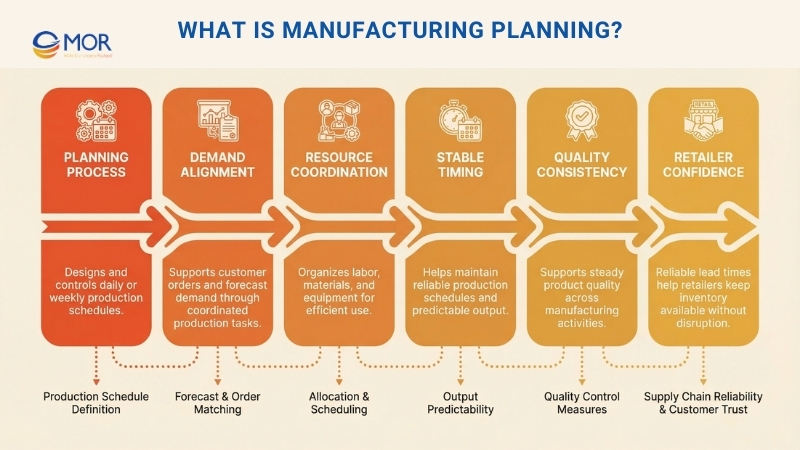
From a retail perspective, companies prefer to work with manufacturers and suppliers that have strong production planning capabilities and can maintain reliable schedules and predictable lead times. When partners manage their operations well, finished goods arrive in inventory on time and retailers can meet market demand without disruption.
>>> Stay ahead of the tech curve. Subscribe to the MOR Blog for weekly updates on ERP, Salesforce, and Cloud solutions.
Why Manufacturing Planning Is Important For Production Success
Production planning is a fundamental activity in manufacturing, and it has a major influence on the performance of any factory operation. Manufacturing planning supports the success of production environments by helping companies organize work, manage resources, and deliver goods according to demand. The following points explain why this approach is valuable for manufacturers.
Efficient Use of Production Resources
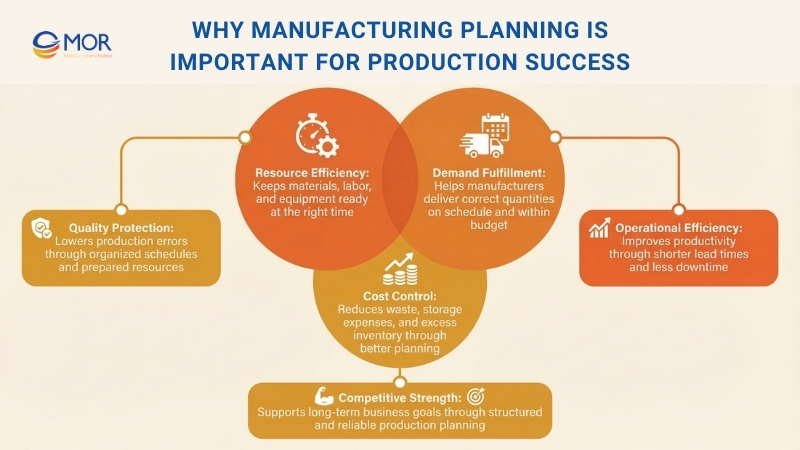
Production planning allows manufacturers to use their resources effectively, including raw materials, labor, and equipment. When companies forecast demand and build a detailed schedule, they can keep the right resources ready at the right moment, which limits waste and improves operational performance.
Ability To Satisfy Customer Demand
Production planning helps manufacturers produce items in the correct quantities, at the correct time, and within the correct cost range, which allows them to respond to customer expectations successfully. When production activities match market demand, businesses can shorten lead times, strengthen delivery performance, and improve customer satisfaction while maintaining a reliable manufacturing plan.
Lower Operational Costs
Production planning supports cost control through better inventory management, reduced waste, and more efficient resource allocation. When companies prevent overproduction, they lower storage expenses and reduce the risk of unsold or outdated inventory.
Stronger Product Quality Management
Production planning allows manufacturers to detect possible quality problems before they appear during production. When resources are prepared correctly and schedules remain organized, factories can lower the chance of production errors and maintain higher product standards.
Higher Operational Efficiency
Production planning improves operational efficiency through shorter lead times, less production downtime, and improved resource utilization. When every stage of the manufacturing process works together under a clear planning structure, companies increase productivity and control costs more effectively.
In conclusion, production planning remains a key element of manufacturing operations because it allows businesses to manage resources efficiently, respond to customer demand, control costs, maintain product quality, and improve operational performance. When companies adopt structured planning practices, they strengthen their competitive position and move closer to achieving long-term business objectives.
Key Elements Of An Effective Manufacturing Planning
To manage factory operations successfully, companies need a clear understanding of the core elements that support manufacturing planning. These components guide how factories organize resources, coordinate schedules, and control production activities. Many modern systems operate as a manufacturing process planner, helping businesses connect forecasting, scheduling, materials, and quality supervision within a single planning structure.
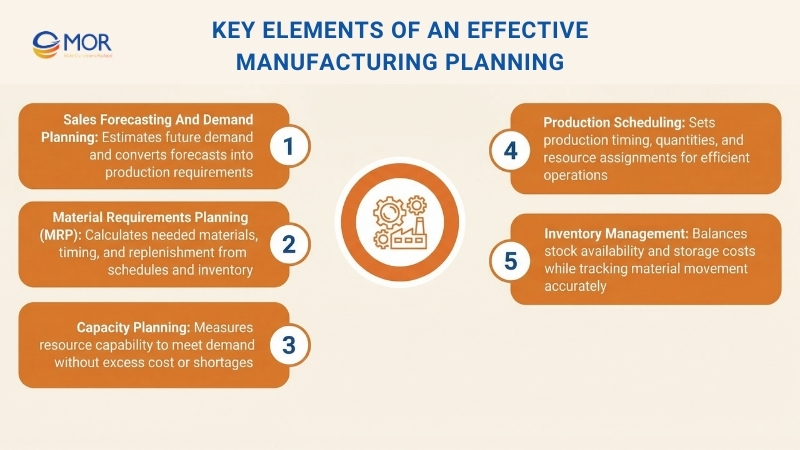
When manufacturers understand these elements and how they work together, they can build stronger operational strategies that support stable output, reduce unnecessary waste, and improve production efficiency.
Sales Forecasting And Demand Planning
Sales forecasting and demand planning play a central role in manufacturing production planning because they provide insight into future product demand. These activities help companies estimate how many goods customers may need in upcoming periods, which allows production teams to prepare resources and schedules in advance.
Sales forecasting refers to the process of estimating future sales volumes for a company’s products or services. This process evaluates historical sales records, market movements, customer purchasing behavior, and other relevant factors to build predictions for future demand. Companies often perform forecasting on a monthly, quarterly, or yearly basis, and the results influence broader business decisions, including production planning activities.
Demand planning converts those sales forecasts into clear production requirements. This stage identifies the resources necessary to produce the projected number of goods or services, including materials, workforce capacity, and manufacturing equipment. The goal is to build a structured manufacturing plan that aligns production activity with expected demand and maintains operational efficiency.
The main difference between sales forecasting and demand planning lies in their focus. Forecasting concentrates on estimating future sales volumes, while demand planning translates those projections into concrete production requirements. Sales forecasting usually acts as the starting point for production planning because it provides the information required to determine production levels.
Both forecasting and demand planning are essential to an effective production strategy. They allow manufacturers to match output with market demand, reduce unnecessary waste, and allocate resources efficiently. Accurate predictions also help companies prevent stock shortages, lower inventory expenses, and improve customer satisfaction.
In short, sales forecasting and demand planning form a fundamental part of production planning. When companies estimate future demand accurately and convert those projections into clear production requirements, they can develop reliable manufacturing management system that improve efficiency, reduce costs, and support stable factory operations.
Material Requirements Planning (MRP)
Material Requirements Planning (MRP) is a software-based system designed for production planning and inventory control. It determines the quantity of materials needed to manufacture a product. Many factories apply this method as part of manufacturing planning, and modern platforms often refer to it as MRP manufacturing resource planning, which connects material calculations with production schedules and inventory data. In practice, Odoo Manufacturing can support this process by linking bills of materials, work orders, and stock data in one connected workflow.
The MRP process usually begins with a Master Production Schedule (MPS). This schedule describes the planned production quantities for each product across a defined time period. The system then uses this schedule to create a detailed list of material requirements. This list identifies the quantities of every raw material, component, and subassembly required to support the planned production schedule.
MRP systems also consider lead times, which represent the time needed for suppliers to deliver materials, and safety stock levels, which indicate the amount of inventory kept available to protect against unexpected demand or supply interruptions. When these factors are included in the calculation process, the system can confirm that materials arrive when required and help prevent shortages or production delays.
Beyond calculating material quantities, MRP systems also generate purchase orders and production schedules. These functions help ensure that materials arrive on time and that production operations continue without disruption. Many systems also connect with other business tools, including inventory management and accounting systems, so manufacturers can view the entire production process within a unified operational environment. In this context, Odoo Manufacturing can also connect material planning with purchasing and inventory records, giving planners a clearer view of replenishment needs.
Companies that adopt MRP systems often experience higher production efficiency, lower inventory costs, and stronger customer service performance. Accurate material calculations and structured planning workflows allow manufacturers to allocate resources effectively, reduce waste, and deliver orders with greater accuracy and reliability.
Despite these advantages, MRP systems also have certain limitations. Their performance depends heavily on accurate data inputs, including production schedules, inventory records, and demand forecasts. If the data is outdated or incorrect, the material calculations may also become inaccurate, which can lead to production delays or excessive inventory. These systems may also be less suitable for environments where product designs change frequently or where production is highly customized.
In summary, Material Requirements Planning (MRP) functions as a software-driven system for managing production planning and inventory control. It calculates the materials required for manufacturing operations and supports accurate production scheduling. When implemented effectively, it helps manufacturers optimize resources, reduce waste, and improve order fulfillment accuracy, though it may not fit every type of production environment.
Capacity Planning
Capacity planning refers to the process of determining the production capability required to meet demand for a product or service. The objective of this activity is to confirm that a company has the resources and operational ability to produce goods according to market demand while avoiding unused capacity that may create unnecessary costs. This activity is closely connected to resource planning for manufacturing, where companies evaluate how machines, labor, and facilities support production goals.
This process requires careful analysis of historical production data, demand forecasts, and other operational information to estimate the capacity needed during a specific time period. The evaluation considers several factors, including production lead times, manufacturing speed, and the resources available to support operations, such as workers and equipment.
After the required production capacity has been identified, companies develop a production schedule that uses available resources efficiently while reducing the risk of producing too many or too few goods. This step may require adjustments to existing production schedules, investments in new machinery or technology, or the recruitment of additional personnel.
Capacity planning plays an essential role in production planning because it helps organizations maintain balance between production capability and expected demand. When capacity levels match market needs, companies lower the risk of product shortages or excessive inventory and make better use of available resources. Effective capacity planning also allows businesses to respond quickly when demand changes due to seasonal shifts or unexpected market trends.
Several techniques support capacity planning activities, including resource forecasting, production rate analysis, and simulation modeling. Resource forecasting estimates the availability of production resources such as equipment and labor and determines the capacity that these resources can support.
Production rate analysis evaluates historical manufacturing performance to measure how quickly products can be produced. Companies then use these findings to create realistic production schedules that match operational capabilities.
Simulation modeling uses computer-based simulations to evaluate different production scenarios. These simulations help companies explore potential production strategies and identify the most efficient approach for managing resources and production capacity.
In summary, capacity planning remains an important component of production planning because it determines the production capability required to meet demand. This activity also supports the creation of structured production schedules that maximize the use of available resources. When companies manage capacity effectively, they improve resource utilization, control operational costs, and deliver customer orders more accurately and on time.
Production Scheduling
Production scheduling refers to the process of determining when products should be manufactured and how many units need to be produced to satisfy customer demand while making efficient use of resources such as labor, equipment, and materials. The objective of production scheduling is to maintain smooth factory operations and improve efficiency while limiting downtime and unnecessary waste. Many modern factories rely on digital factory planning solutions to organize these activities and coordinate production timelines more effectively.
Production scheduling often involves software tools that generate detailed manufacturing schedules. These tools analyze several operational factors, including production capacity, lead times, available inventory, and expected customer demand. The resulting schedule defines when each product should be manufactured, the quantity required, and the resources assigned to the production process. In practical environments, Odoo Manufacturing can help teams review work centers, work orders, and planned quantities in one place, which makes schedule adjustments easier when demand or capacity changes.
A production schedule is usually developed from a Master Production Schedule (MPS). This schedule outlines the planned production quantities for each product during a defined period. The MPS provides a general overview of manufacturing activities, while the detailed production schedule divides those plans into specific time frames and individual production runs.
Production scheduling is a complex activity that requires coordination across multiple departments inside a company. Production teams, procurement specialists, and logistics staff must work together to ensure operations remain aligned. When this coordination functions well, businesses improve production efficiency, reduce inventory costs, and provide better customer service through reliable delivery schedules.
Several techniques support production scheduling activities. These include Material Requirements Planning (MRP), finite capacity scheduling, and Just-in-Time (JIT) scheduling. MRP calculates the materials required for production based on demand forecasts and production schedules.
Finite capacity scheduling evaluates the availability of resources such as labor and machinery when generating the production schedule. This approach helps ensure that schedules reflect real production capabilities.
JIT scheduling focuses on producing goods only when they are needed. This method helps reduce excess inventory, lower storage costs, and minimize production waste.
In short, production scheduling determines when products should be manufactured and how many units are required to meet customer demand while using available resources efficiently.
When companies manage production scheduling effectively, they improve manufacturing performance, control inventory costs, and provide reliable service to customers. Several planning techniques support this process, including MRP, finite capacity scheduling, and JIT scheduling.
Inventory Management
Inventory management refers to the process of controlling and supervising the movement of goods and materials entering and leaving a company’s stock. The objective of this activity is to maintain the correct quantity of inventory needed to satisfy customer demand while reducing the costs associated with storing and handling those goods. Strong inventory control plays an important role in executing effective manufacturing plans, because production activities depend heavily on the availability of materials and finished products.
Effective inventory management includes several essential activities. These activities involve demand forecasting, establishing appropriate stock levels, monitoring inventory movement, and addressing situations where products become unavailable or excessive quantities accumulate. Most companies support these tasks with digital systems that offer real-time visibility into inventory levels and allow businesses to track inventory movement and estimate future demand. When inventory is closely connected to production workflows, Odoo Manufacturing can help teams see stock availability, incoming receipts, and material reservations more clearly.
A major challenge in inventory management is maintaining balance between stock levels and customer demand. When companies store too much inventory, they tie up working capital and increase expenses related to storage and handling. When inventory levels are too low, businesses may experience stock shortages that lead to lost sales opportunities. To manage this challenge, companies often rely on planning techniques such as Just-in-Time (JIT) inventory, Economic Order Quantity (EOQ), and safety stock management.
JIT inventory focuses on producing or purchasing goods only when they are required. This method helps reduce inventory holding costs and limits operational waste.
EOQ determines the most efficient order quantity based on factors such as demand levels, supplier lead times, and ordering expenses.
Safety stock involves keeping a reserve quantity of inventory that protects the company against unexpected changes in demand or supply conditions.
Another important part of inventory management involves monitoring inventory movement and maintaining accurate records. Companies often implement inventory control systems and standardized procedures to ensure stock levels remain accurate within company databases and that all goods are properly recorded and managed.
Inventory management involves controlling the flow of goods and materials entering and leaving company inventory. Effective practices focus on maintaining balance between stock availability and customer demand while applying inventory planning methods such as JIT, EOQ, and safety stock to reduce costs and prevent waste.
Inventory management also includes tracking product movement and maintaining inventory accuracy. These practices ensure that company records correctly reflect available stock and that materials are properly monitored and controlled throughout the supply chain.
Five Types Of Manufacturing Planning Used In Production
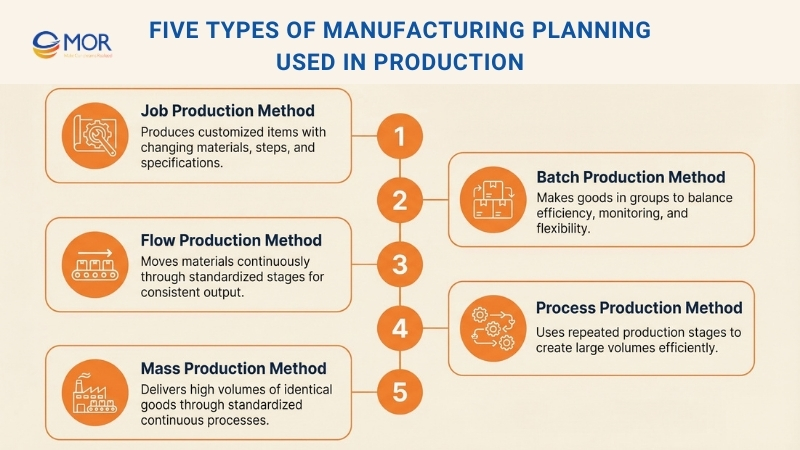
Different production approaches influence how companies build and manage a manufacturing strategy. The structure of your manufacturing planning process often depends on whether your operations follow make-to-order or make-to-stock models. Your approach can also change depending on the type of manufacturing workflow used in the factory. Many companies manage these production models through manufacturing enterprise resource planning platforms that coordinate planning, scheduling, and operational data. The following production methods are commonly used in manufacturing environments.
Job Production Method
The job production method, also known as job shop manufacturing, is commonly applied when companies produce a single product that requires customized processing. This approach is suitable for situations where materials and production steps vary depending on the product being manufactured.
For businesses that offer customized or bespoke manufacturing, production plans often change from one product to another. Each order may involve different materials, processes, or specifications. Small and medium-sized manufacturers frequently rely on this approach, although larger companies may also use it for specialized production needs.
Batch Production Method
The batch production method, often referred to as batch manufacturing, focuses on producing finished goods in groups instead of manufacturing items individually or through continuous processes. Within manufacturing planning, this method allows companies to organize production runs in batches to maintain efficiency while keeping operations flexible.
This production process enables manufacturers to monitor each stage of the manufacturing workflow carefully. Teams can detect issues quickly, adjust processes, and improve operational efficiency when necessary. This method works well for industries such as food production or for businesses that produce large quantities of similar products in organized production cycles.
Flow Production Method
The flow production method, sometimes called discrete manufacturing, follows a demand-driven production structure where materials move continuously from one machine or workstation to the next. During this process, materials gradually transform into finished goods with minimal manual intervention.
This production approach requires standardized procedures and strong quality control practices to ensure that products produced through continuous flow remain consistent and free of defects. Manufacturers that produce a uniform set of products sequentially often rely on this approach because it supports efficient and predictable output.
Process Production Method
The process production method, also known as repetitive manufacturing, reflects the traditional concept many people associate with manufacturing operations. In this method, products move through a sequence of machines or production stages, similar to assembly line systems.
This production structure supports the efficient creation of finished goods through repeated operations and standardized processes. Manufacturers that produce large volumes of similar products often adopt this approach because it allows them to maintain consistent workflows and high productivity levels.
Mass Production Method
The mass production method, also called continuous manufacturing, follows a production strategy similar to the flow method but on a much larger operational scale. Companies use this approach when uniformity is essential and when every product must meet identical design and quality standards.
Manufacturers apply standardized production processes to ensure all items remain consistent in appearance and performance. This method enables companies to produce a large number of goods in a short period of time, which supports high-volume manufacturing environments.
Step-By-Step Manufacturing Planning Process For Factories
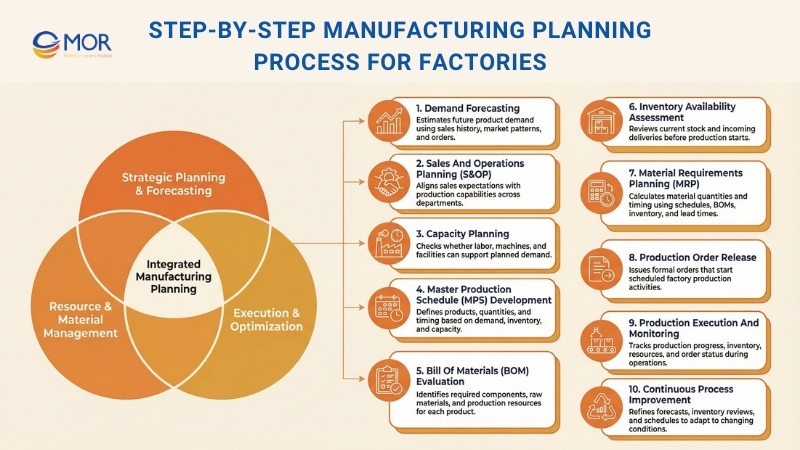
Factories follow a structured sequence of activities to organize production operations effectively. These steps help companies coordinate resources, demand forecasts, and production schedules so manufacturing activities run smoothly. Many modern factories support these activities with manufacturing planning software, which helps teams manage schedules, materials, and production workflows more efficiently. The exact process may vary depending on the production environment, the complexity of the product, and the systems used, but the following outline reflects the typical stages manufacturers follow.
Demand Forecasting
The first stage of manufacturing planning involves estimating future demand for products. Manufacturers often collaborate with sales teams to review historical sales records, market patterns, existing customer orders, and other relevant information. This analysis helps companies estimate future product demand as accurately as possible.
Sales And Operations Planning (S&OP)
Manufacturers frequently organize Sales And Operations Planning (S&OP) meetings to connect sales expectations with production capabilities. These meetings bring together teams from sales, marketing, production, and other departments. The goal is to confirm that production strategies remain aligned with demand forecasts and broader business objectives.
Capacity Planning
Manufacturers conduct capacity planning to confirm that production resources can support the demand outlined in the Master Production Schedule (MPS). This stage evaluates the availability of production resources, including labor, machinery, and facilities. The evaluation helps identify operational constraints or bottlenecks that could affect production performance.
Master Production Schedule (MPS) Development
After reviewing demand forecasts and S&OP discussions, the manufacturer develops a Master Production Schedule (MPS). This schedule provides a detailed plan that outlines which products will be produced and in what quantities. It considers several factors, including customer demand, existing inventory levels, and production capacity limitations.
Bill Of Materials (BOM) Evaluation
The manufacturer then examines the Bill Of Materials (BOM) for each product to determine all components, raw materials, and production resources required for manufacturing. The BOM acts as a reference document that helps production teams identify material requirements and organize production sequences.
6. Inventory Availability Assessment
Manufacturers review the current stock levels of all materials and components required for production activities. This evaluation includes the quantities currently available in inventory as well as incoming deliveries that suppliers have already scheduled.
Material Requirements Planning (MRP)
Using information from the Master Production Schedule (MPS) and the Bill Of Materials (BOM), manufacturers run calculations through a Material Requirements Planning (MRP) system. The system determines the quantities and timing of materials and components required to support the production schedule while also considering inventory levels and supplier lead times. In practical manufacturing environments, Odoo Manufacturing can support this step by connecting MPS data, BOM records, and stock availability within the same production workflow.
Production Order Release
After the production plan is confirmed, manufacturers release production orders according to the scheduled quantities and planned timelines. These orders formally initiate the production activities on the factory floor.
Production Execution And Monitoring
During the production cycle, manufacturers monitor the progress of production activities, inventory levels, and resource usage. Teams may rely on tools such as Manufacturing Execution Systems (MES), Material Requirements Planning (MRP) platforms, or other monitoring technologies to track the status of production orders and confirm that operations follow the established plan within the manufacturing planning process. In this stage, Odoo Manufacturing can help teams follow work orders, review work center activity, and update production status as operations move forward. When managers also need broader reporting and dashboards, Odoo ERP can support centralized operational visibility across production, inventory, and purchasing data.
Continuous Process Improvement
Manufacturers regularly evaluate and refine their production planning processes based on operational performance, internal feedback, and evolving market conditions. Updating demand forecasts, reviewing inventory availability, and adjusting production schedules help ensure that manufacturing planning remains flexible and capable of responding to changing market demands.
Practical Manufacturing Planning Strategies For Modern Factories
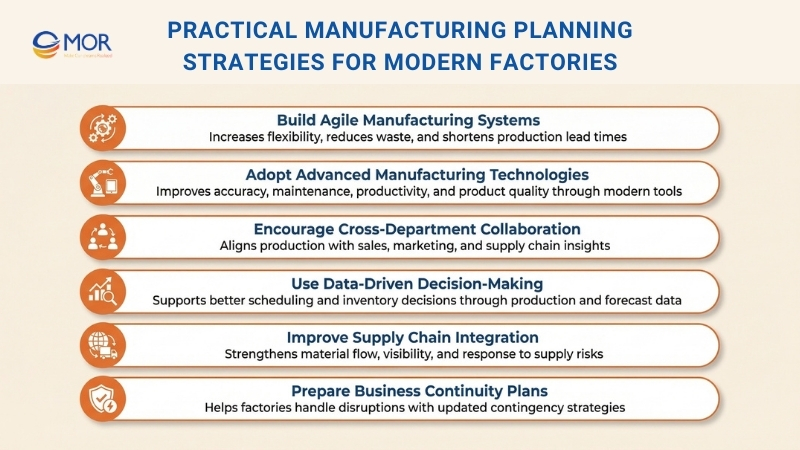
Manufacturers operate in a rapidly changing industrial environment where strategic decisions strongly influence operational performance. Well-structured manufacturing planning helps companies maintain efficiency, respond to market changes, and strengthen their competitive position. Many organizations rely on integrated platforms such as a manufacturing resource planning system to coordinate production data, resource allocation, and operational visibility. The following strategies help manufacturers improve planning activities and address common operational challenges.
Build Agile Manufacturing Systems
Flexible production systems such as lean manufacturing and Just-in-Time (JIT) methods help factories respond quickly to changes in demand. These systems increase operational flexibility, reduce unnecessary waste, and improve the way companies use their resources. When manufacturers apply these approaches, they can react faster to customer demand changes and shorten production lead times, which improves overall production flow.
Adopt Advanced Manufacturing Technologies
Modern manufacturing environments benefit from technologies such as robotics, automation tools, and data analytics platforms. These technologies allow companies to monitor operations in real time, perform predictive maintenance, and manage resources more efficiently. When manufacturers integrate these technologies into their operations, manufacturing planning becomes more accurate, costs decrease, and both productivity and product quality improve.
Encourage Cross-Department Collaboration
Effective manufacturing planning requires strong coordination between departments. Production teams need to work closely with sales, marketing, and supply chain departments so manufacturing activities reflect real market conditions. Collaboration across these teams allows companies to align production schedules with customer insights, market trends, and sales forecasts. This coordination improves demand forecasting accuracy, reduces the risk of stock shortages or overproduction, and helps factories adjust production when demand changes.
Use Data-Driven Decision-Making
Companies can improve operational decisions through data analytics and modern planning tools. These systems analyze information such as historical production records, real-time operational data, and predictive forecasts to support better planning decisions. When manufacturers rely on these insights, they can refine production schedules and manage inventory levels more effectively. In connected manufacturing environments, Odoo ERP can serve as a centralized reporting layer that brings together sales, inventory, purchasing, and production data through shared dashboards.
Improve Supply Chain Integration
Manufacturers benefit from strong partnerships and close coordination with suppliers, distributors, and logistics providers. Integrated supply chain processes help reduce delivery lead times and improve the movement of materials across the production network. Better coordination also increases visibility across the supply chain and lowers operational risks, which strengthens the performance of manufacturing planning. When purchasing, inventory, and production data are connected through Odoo ERP, teams can follow material movement more clearly and respond faster to supply issues.
Prepare Business Continuity Plans
Another important step involves identifying potential operational risks and preparing reliable contingency strategies. Manufacturers must anticipate events such as supply chain disruptions, natural disasters, or unexpected market changes. Backup plans help maintain operational stability and protect production activities. Companies should also review and update risk management strategies regularly to prevent disruptions that could affect manufacturing planning.
Common Issues And Operational Considerations In Manufacturing Planning
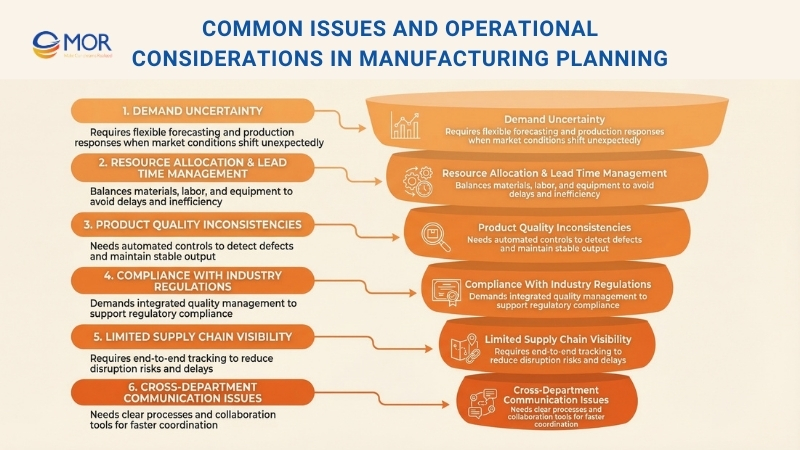
Managing manufacturing planning can become complicated because it requires coordination across multiple departments and constant adjustments to shifting market conditions. Production teams must monitor supply availability, demand patterns, and internal resources while maintaining stable operations. Organizations should understand the following operational issues that may arise during the production planning process.
Demand Uncertainty
Market demand often changes unexpectedly, which makes forecasting more difficult for manufacturers. These fluctuations can affect production volumes, inventory levels, and scheduling decisions.
- Issue: Predicting demand accurately becomes difficult when customer purchasing behavior changes, supply chain interruptions occur, or unexpected external events influence market activity.
- Approach: Use inventory planning platforms that support advanced forecasting techniques such as predictive analytics and flexible production models like Just-In-Time (JIT) or lean manufacturing to respond quickly to changing demand patterns.
Resource Allocation And Lead Time Management
Factories must coordinate raw materials, machines, and workforce capacity to keep production running efficiently. Any imbalance in these resources may lead to delays or reduced productivity.
- Issue: Maintaining the right balance between materials, labor, and equipment while meeting production targets and shortening delivery lead times can be difficult.
- Approach: Implement manufacturing and inventory planning platforms that support structured resource allocation. Lean techniques such as value stream mapping can also help remove waste and improve efficiency. Systems like Inventory Planner provide accurate demand forecasts that help businesses control cash flow and production levels.
Product Quality Inconsistencies
Maintaining consistent product quality remains an important requirement for manufacturing operations. Variations in production conditions may result in defects or inconsistent output.
- Issue: Maintaining stable quality across products is essential to protect brand reputation and ensure consumer safety.
- Approach: Introduce automated quality control testing through process manufacturing ERP platforms. These systems help identify and correct production inconsistencies before finished goods leave the manufacturing line.
Compliance With Industry Regulations
Manufacturers often operate under strict regulatory frameworks that govern product quality, safety standards, and operational procedures. Compliance failures may result in financial penalties and damage to company credibility.
- Issue: Process manufacturers must follow regulations from multiple regulatory organizations, and violations can lead to fines or reputational harm.
- Approach: Use process manufacturing ERP software to integrate quality management into production and distribution activities. This approach supports regulatory compliance across the entire production cycle.
Limited Supply Chain Visibility
Supply chain disruptions can quickly affect manufacturing schedules and material availability. Without proper visibility, it becomes difficult for companies to respond to operational risks.
- Issue: Interruptions in the supply chain may delay production and lead to financial losses.
- Approach: Apply process manufacturing ERP solutions that provide end-to-end supply chain visibility. These platforms track supplier and distributor performance and support better decisions through operational data analysis.
Cross-Department Communication Issues
Successful production operations depend on coordination between teams such as sales, procurement, logistics, and production. Poor communication can slow down planning activities and create conflicting priorities.
- Issue: Manufacturing planning often requires collaboration between multiple departments, which may lead to communication gaps or misaligned priorities.
- Approach: Establish clear communication processes and adopt collaboration tools such as Slack or Microsoft Teams so teams can exchange information quickly and coordinate decisions in real time.
Key Manufacturing Planning KPIs For Measuring Performance
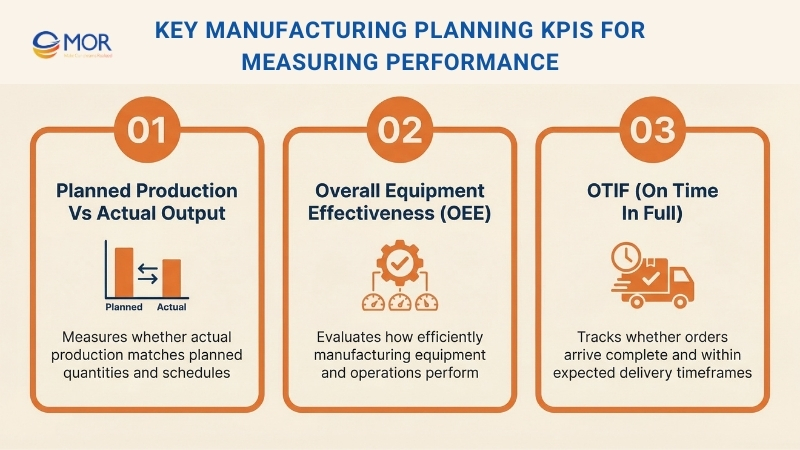
To evaluate how well production planning works, companies rely on several key performance indicators (KPIs). These indicators help managers understand whether production activities follow the established plan and whether factory operations deliver the expected results.
Planned Production Vs Actual Output
One important KPI is the comparison between the planned production quantity and the actual number of units produced. This metric shows whether production plans are realistic and whether manufacturing facilities operate according to the schedule established during the planning process.
Overall Equipment Effectiveness (OEE)
Another useful indicator to consider is OEE (Overall Equipment Effectiveness), which evaluates how efficiently a manufacturing facility operates. A production site can only reach high efficiency when planning activities and operational coordination function properly.
OTIF (On Time In Full)
To evaluate the overall quality of the planning process, organizations can also examine the final outcomes of production operations. Customer satisfaction provides one way to measure these outcomes. A common metric used for this purpose is OTIF (On Time In Full), which tracks how many orders are delivered completely and within the timeframe expected by the customer.
MOR Software Supports Businesses Implementing Modern Manufacturing Planning
MOR Software as one of top IT outsourcing companies in Vietnam helps manufacturers improve manufacturing planning through tailored implementation, customization, integration, and technical support using Odoo. We support businesses that want to connect production planning, material management, shop floor coordination, inventory control, and reporting within one digital environment.
With Odoo Manufacturing, companies can manage MRP, organize production orders, monitor work centers, and supervise material flows in real time. This helps production teams maintain clearer control over manufacturing workflows while keeping schedules and resources aligned.
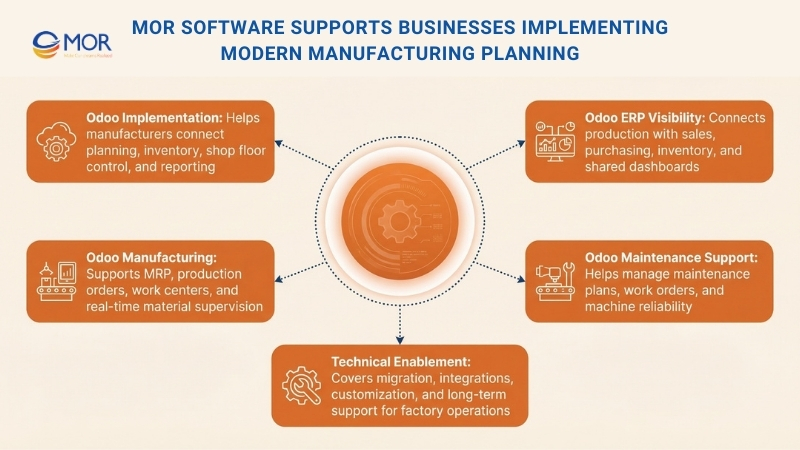
We also use Odoo ERP to connect production data with inventory, purchasing, sales, and centralized reporting. This gives managers a clearer operational view through shared dashboards and structured reports, which supports faster and better planning decisions.
For equipment reliability and service scheduling, Odoo Maintenance can be configured to support maintenance planning, work order tracking, and machine monitoring. This helps factories reduce unexpected downtime and keep production assets in stable operating condition.
Our team also supports salesforce data migration, third-party integration, workflow customization, and long-term technical assistance so the platform fits your existing business processes. Through this approach, MOR Software positions Odoo as a practical implementation layer for manufacturers that want stronger planning accuracy, better production control, and a more connected factory environment. Contact MOR Software today to discuss how our experts can help you implement and optimize Odoo solutions for your manufacturing operations.
Conclusion
Effective manufacturing planning helps factories coordinate resources, manage production schedules, and maintain stable operations in an increasingly complex industrial environment. When manufacturers combine structured planning methods with modern digital tools, they gain clearer operational visibility, stronger production control, and more reliable delivery performance. With the right technology foundation in place, businesses can improve efficiency and adapt to changing market demand more confidently. If you are exploring ways to modernize your production processes, MOR Software can help you implement and customize Odoo-based manufacturing solutions tailored to your operational needs.
MOR SOFTWARE
Frequently Asked Questions (FAQs)
What is manufacturing planning?
Manufacturing planning is the process of organizing production activities so that products can be produced efficiently and delivered on time. It involves forecasting demand, allocating resources, scheduling production tasks, and coordinating materials, labor, and equipment to meet customer requirements.
Why is manufacturing planning important for factories?
Manufacturing planning helps companies maintain stable production, control costs, and avoid delays. A well-structured plan ensures that materials, labor, and equipment are used efficiently while maintaining product quality and meeting customer delivery expectations.
What are the main stages of manufacturing planning?
Manufacturing planning usually includes demand forecasting, sales and operations planning, capacity planning, creation of a master production schedule, material requirements planning, production order release, monitoring of operations, and continuous improvement.
How does demand forecasting support manufacturing planning?
Demand forecasting predicts future product demand using historical data, market trends, and customer orders. These forecasts guide production planning decisions, helping manufacturers determine how much to produce and when to schedule production runs.
What is the role of Material Requirements Planning (MRP)?
Material Requirements Planning (MRP) calculates the materials and components required to manufacture products. It analyzes production schedules, inventory levels, and supplier lead times to determine when and how much material must be ordered.
What is the difference between capacity planning and production scheduling?
Capacity planning focuses on determining whether the factory has enough machines, labor, and facilities to meet demand. Production scheduling focuses on organizing when specific products should be manufactured and how resources will be used during the production process.
What types of production methods influence manufacturing planning?
This process can vary depending on the production method used. Common approaches include job production, batch production, flow production, repetitive process production, and large-scale mass production.
What technologies help improve manufacturing planning?
Modern production planning often uses software systems such as ERP, MRP, Manufacturing Execution Systems (MES), and advanced planning tools. These technologies help manufacturers track inventory, schedule production, analyze performance data, and improve decision-making.
What challenges do companies face when implementing manufacturing planning?
Manufacturers often face challenges such as unpredictable demand, supply chain disruptions, resource constraints, and communication gaps between departments. Addressing these challenges usually requires better forecasting tools, stronger supply chain coordination, and improved production monitoring.
How can companies measure the success of manufacturing planning?
Performance can be evaluated using key indicators such as production output compared with planned targets, equipment efficiency, order fulfillment rates, and on-time delivery performance. These metrics help manufacturers identify areas where planning processes can be improved.
Share


Make Our-Dreams Realized


© 2023 . MOR Software. All Rights Reserved
Sitemap
Privacy Policy
Terms of Use

Rate this article
0
over 5.0 based on 0 reviews
Your rating on this news:
Name
*Email
*Write your comment
*Send your comment
1