


Odoo Manufacturing: The Complete Guide for Manufacturers in 2026
Production teams often struggle to coordinate materials, schedules, and shop floor operations without losing visibility or control. Odoo manufacturing offers a connected system that simplifies planning, execution, and reporting across the entire factory. In this guide, MOR Software will explain how this Odoo manufacturing software works, its key features, and how manufacturers can use it to improve production performance.
What Is Odoo Manufacturing?
Odoo manufacturing refers to the production management environment built within the Odoo ERP ecosystem, powered by the Odoo MRP module that manages materials, work orders, and production planning.
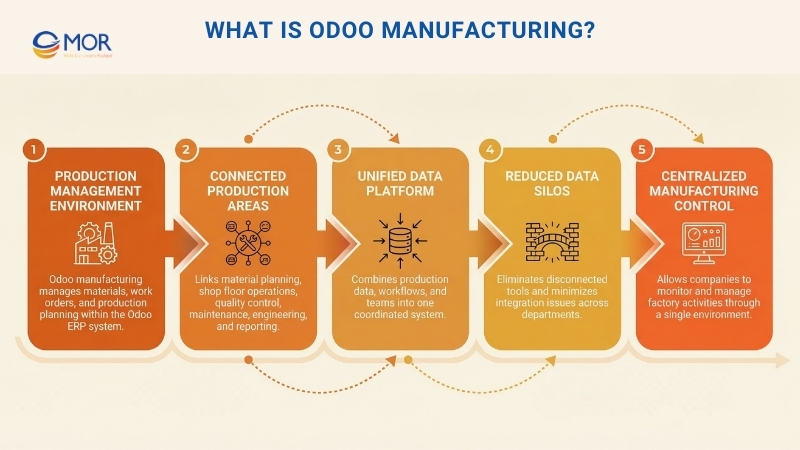
This platform connects all areas of production: material planning, shop floor operations, quality control, equipment maintenance, product engineering, and performance reporting.
The objective is to bring production data, operational workflows, and business teams into a single environment through Odoo manufacturing crm software, eliminating data silos and reducing system integration gaps.
Key Features And Capabilities Of Odoo Manufacturing
Below is a structured overview of the Odoo manufacturing features available in the production module, each created to support planning, execution, monitoring, and continuous improvement across factory operations.
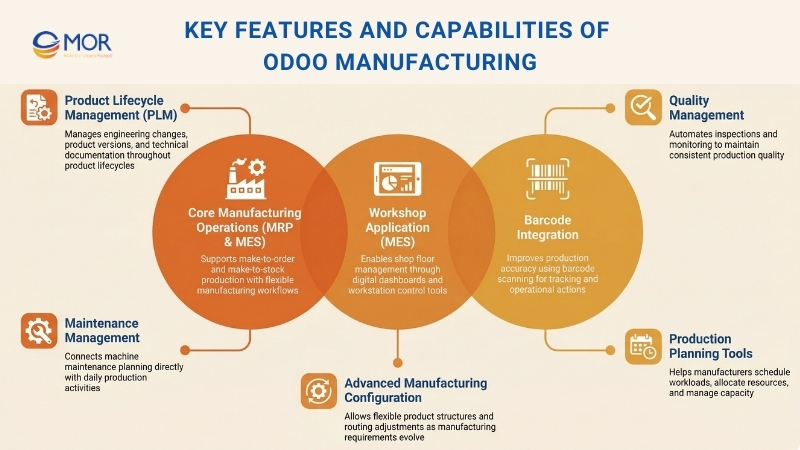
Core Manufacturing Operations (MRP And MES)
The base of the system is its strong support for both Make-to-Order and Make-to-Stock production flows, with flexible controls that help factories manage complex operations through manufacturing MRP processes.
- Manufacturing Orders: Generate and control production runs that start automatically based on customer demand or predefined inventory rules.
- Work Orders: Divide manufacturing tasks into routing stages that can run sequentially or in parallel depending on the process structure.
- Editable Production Orders: Adjust completed production records when corrections or updates are required to maintain accurate historical data.
- Disassembly Orders: Break down finished items and retrieve reusable components whenever required.
- Product Kits: Sell items delivered as individual parts that customers assemble after purchase.
- By-Product Tracking: Monitor secondary outputs or materials created during production.
- Manual And Assembly Line Configuration: Select either discrete workflows or continuous production setups depending on your operational model.
Workshop Application (MES)
The Workshop Application supports Odoo manufacturing on the shop floor through paperless operations, real-time dashboards, and workstation-specific control interfaces.
- Tablet-Based Control Interface: Operators can view assigned tasks, record production progress, and access instructions directly from mobile devices.
- Offline Functionality: Production activities continue even when internet connectivity temporarily fails.
- Paperless Workflow Execution: Replace printed job sheets with digital instructions that appear automatically at the correct stage.
- Real-Time Work Order Steps: Configure and activate step-by-step operations including barcode scans, quality checks, or image verification.
- Continuous Improvement Feedback Tool: Employees can report inefficiencies and submit improvement suggestions directly from the production floor.
Barcode Integration
Barcode technology works across multiple production activities to increase operational speed and reduce mistakes during factory processes.
- Serial Number, Lot, And Product Scanning: Capture product identifiers for traceability, inventory validation, and quality control procedures.
- Automated Action Triggers: Start or pause timers, mark tasks as completed, or generate maintenance requests directly from scanning events.
- Faster Production Execution: Limit manual data entry, support hands-free operations, and lower the risk of human error.
Product Lifecycle Management (PLM)
The Product Lifecycle Management capability in Odoo manufacturing helps ensure that engineering modifications remain organized, traceable, and correctly versioned throughout the product lifecycle.
- Engineering Change Orders (ECOs): Coordinate and supervise updates related to Bill of Materials, production routing, or technical documents.
- Version Management: Maintain and compare earlier product versions to track how designs evolve over time.
- Document Links Within BoM: Attach technical drawings, inspection guidelines, or manuals directly to product records.
- Change History Monitoring: Display the full timeline and approval stages associated with every product modification.
Quality Management
Quality assurance is built directly into Odoo manufacturing workflows. Inspections and alerts appear automatically at the correct stage of the production process.
- Inspection Checkpoints And Alerts: Start quality checks automatically at key stages within the routing process.
- Custom Quality Control Points: Configure inspection steps for each product, operation stage, or production activity.
- Six Sigma Analysis Tools: Apply statistical methods to measure process variation and monitor production stability.
- Statistical Process Control Monitoring: Record and analyze quality indicators over time for every work center.
Maintenance Management
Equipment maintenance is connected with daily production activity. The system allows proactive planning and also supports maintenance requests that originate directly from the shop floor.
- Preventive And Corrective Maintenance Actions: Schedule maintenance based on time intervals, machine usage, or performance conditions.
- Calendar-Based Maintenance Planning: Organize service activities visually while assigning technicians and equipment resources.
- KPI-Triggered Maintenance Events: Automatically create maintenance tasks when specific thresholds are reached, such as temperature levels or machine runtime.
- MTBF And OEE Monitoring: Track Mean Time Between Failures and Overall Equipment Effectiveness to evaluate machine reliability and operational efficiency.
Production Planning Tools
The platform provides flexible capabilities for both short-term scheduling and long-term capacity management. These tools help teams coordinate production workloads across machines, materials, and labor.
- Master Production Schedule (MPS): Plan production volumes according to demand forecasts and expected sales requirements.
- Interactive Gantt Chart Planning: Adjust schedules or change operation priorities within a visual and interactive planning workspace.
- Work Center Capacity And Scheduling: Assign tasks according to machine availability and performance ratings.
- Finite Capacity Planning Simulation: Prevent overload situations through advance workload simulations within manufacturing MRP systems.
- Routing With Optional Workflows: Define main routes and alternative paths to support flexible manufacturing sequences.
Advanced Manufacturing Configuration
These capabilities support expanding operations and evolving production models. The configuration tools allow companies to adapt product structures and operational flows as requirements change.
- Product Version Updates: Control product evolution while initiating new workflows when design changes occur.
- Flexible Reference Data Management: Adjust routings, materials, and configuration options whenever production needs change.
- Multi-Level Bill Of Materials Creation: Structure nested assemblies with full traceability at the component level.
- Custom Routing Sequences: Build conditional workflows that depend on batch size, product type, or order requirements.
- Repair Orders And Reverse Logistics: Handle warranty repairs or product disassembly processes directly within the system.
These capabilities expand with each Odoo release. In Odoo 19, organizations gain improved planning speed, a simplified control panel interface, and stronger offline functionality, improvements that support more agile and real-time production environments.
>>> Ready to transform your traditional manufacturing process into a smart Odoo system? Let MOR Software – one of top IT outsourcing companies in Vietnam – be your partner. Explore our services.
Odoo Manufacturing Workflow: From Product Concept To Delivery
The Odoo manufacturing workflow reflects how modern factories operate. Production today involves several layers and depends heavily on timing, materials, and clear traceability. Whether you run batch production, build products after orders arrive, or coordinate multiple work centers, this platform keeps every step organized under a single control system. The typical workflow of manufacturing in Odoo unfolds through the following stages:
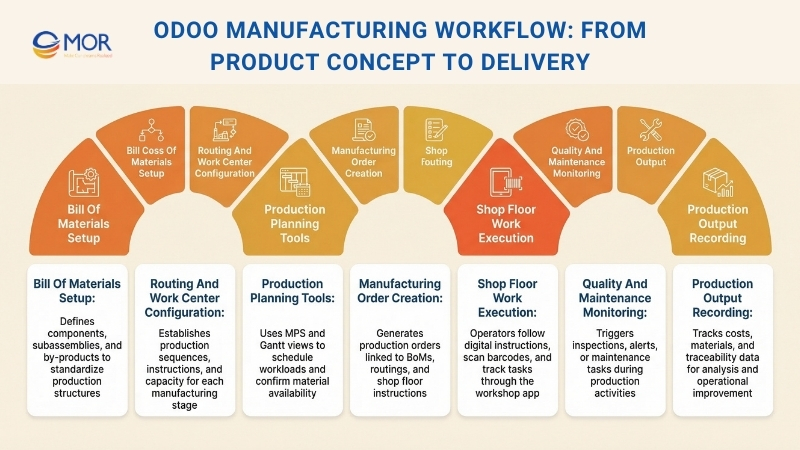
Set Up The Bill Of Materials (BoM)
Start with listing every required component, subcomponent, and possible by-product. Odoo BoMs support version management, hierarchical product structures, and product kits. This structure allows companies to standardize production while also supporting product customization.
Configure Production Routings And Work Centers
Specify where production tasks take place and how each item will be assembled. Routing settings can define operation sequences, work instructions, and estimated processing times. Each work center also tracks its own availability and production capacity.
Plan Production With MPS And Gantt Scheduling Tools
Through the Master Production Schedule (MPS) and interactive planning views, manufacturers can evaluate capacity, confirm material availability, and adjust schedules before production begins. This planning stage helps optimize workloads across machines and teams.
Create Manufacturing Orders (MOs)
Production orders may start manually, from confirmed sales orders, or through inventory replenishment rules. Each order connects directly to BoMs, routings, and work order instructions, which guide teams during shop floor operations.
Carry Out Work Orders On The Shop Floor
Operators access instructions through the Workshop App on tablets. They can view worksheets, scan barcodes, follow predefined task steps, and trigger quality checks. These activities continue even without network access through offline support.
Track Quality And Maintenance During Production
Quality inspections, system alerts, and statistical monitoring can appear at any stage of the workflow. Operator feedback or equipment data may also activate maintenance tasks or corrective actions when issues occur.
Record Output, Production Costs, And Traceability
Each production run captures full cost information, including materials, labor, and overhead. The platform also tracks product batches or serial numbers, which supports compliance reporting, operational analysis, and continuous improvement across the factory.
>>> How can AI be applied to the current Odoo system? Find the answer in our knowledge base of blogs.
Odoo Manufacturing Integration Across The Odoo Ecosystem
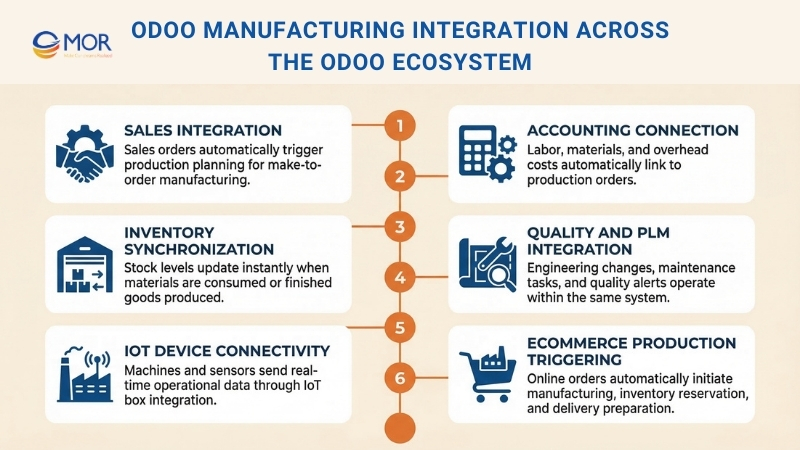
One of the strongest advantages of the Odoo manufacturing platform is its native connection with the broader Odoo ecosystem. Instead of relying on external connectors or separate software tools, manufacturers operate within a unified environment where planning, production, sales, inventory, and finance share the same data structure.
Odoo Sales
Production planning can start immediately after a quotation or sales order is confirmed. For custom items or make-to-order products, the Odoo ERP manufacturing workflow automatically matches production with customer demand, which helps reduce delivery delays and unnecessary overproduction.
Odoo Inventory
Stock levels remain synchronized with production activity in real time. When raw materials are consumed or finished goods are produced, inventory updates occur instantly. The platform also suggests replenishment orders based on supplier lead times, stock availability, and vendor routing preferences.
Odoo Accounting
Manufacturing costs are recorded automatically as operations occur. Labor time, overhead expenses, and material usage link directly to each production order. This connection allows accurate job costing and immediate financial visibility across manufacturing operations.
Maintenance, Quality, And PLM Modules
The manufacturing module connects directly with the Maintenance, Quality, and PLM applications within Odoo. Engineering updates, quality alerts, and equipment maintenance tasks become part of the same operational process without relying on external systems.
Odoo IoT
With the IoT Box integration, factories can connect machines, sensors, and barcode devices directly to the platform. These devices send real-time measurements, activate actions, or record operational events automatically without manual data entry.
Odoo eCommerce And Website
For manufacturers that sell directly to customers, the Website and eCommerce apps allow online purchases to trigger production orders. An order placed on the website can automatically initiate manufacturing, reserve inventory, and prepare delivery within the same system.
Business Benefits Of Using Odoo Manufacturing
Companies that adopt Odoo manufacturing gain stronger operational control across the entire production environment. The platform connects planning, execution, and analysis within one system so teams can manage production activities with greater accuracy and coordination.
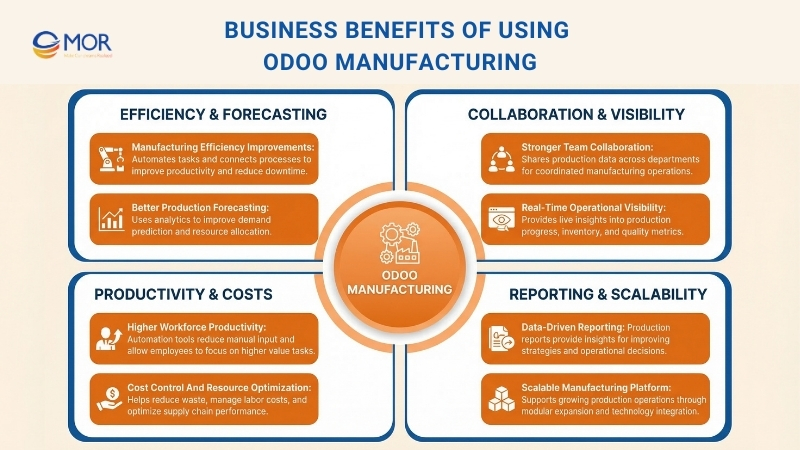
Manufacturing Efficiency Improvements
The Odoo manufacturing system helps automate repetitive tasks, connect different business processes, and deliver real-time operational insights that support better production management. When organizations use these tools, they can keep workflows consistent while reducing downtime, lowering errors, and improving overall productivity, which leads to smoother manufacturing operations.
Better Production Forecasting
Advanced analytics and reporting capabilities inside Odoo manufacturing allow manufacturers to forecast customer demand with higher accuracy. These tools support planning for inventory levels, material availability, and production scheduling. The system also helps allocate resources effectively, reduce unnecessary waste, and improve on-time delivery performance.
Stronger Team Collaboration
The integrated structure of Odoo ERP for manufacturing helps procurement teams, production departments, and quality control staff work together more easily. Centralized communication and shared production data ensure that all teams access the same information. This coordination keeps operations aligned and reduces the risk of misunderstandings or operational mistakes.
Real-Time Operational Visibility
Access to live production data is another major advantage of this system. Managers can quickly review important operational information such as production progress, inventory status, and quality indicators. Clear visibility supports faster decision making and enables teams to solve issues quickly, which helps keep the entire production workflow running efficiently.
Higher Workforce Productivity
The Odoo manufacturing platform includes tools such as Material Requirements Planning (MRP), Shop Floor Management, and IoT Integration that help automate many repetitive production activities. These capabilities reduce the need for manual input, which allows employees to concentrate on higher value tasks, increase productivity levels, and ensure that production goals are completed according to schedule.
Cost Control And Resource Optimization
Another advantage of this solution is its ability to improve how companies manage resources while automating routine operational tasks. The system also supports supply chain optimization, which helps reduce material waste, lower labor expenses, and avoid excessive stock levels that may cause financial loss.
The pricing structure of Odoo also ensures that organizations pay only for the features they actively use. This approach makes the platform a cost efficient option compared with many other manufacturing systems.
Data-Driven Reporting
The Odoo platform includes reporting tools that deliver detailed information about production performance, product quality, resource utilization, and financial results. These reports act as internal Odoo manufacturing news for managers who need to monitor operations closely. Manufacturing teams receive timely insights that help them detect improvement opportunities, refine production strategies, and support better business decisions.
Scalable Manufacturing Platform
Some manufacturers begin with free MRP tools when exploring production planning systems, but many eventually adopt platforms like Odoo manufacturing because they offer deeper integration across inventory, production, and financial data. New applications and features can be introduced when production lines increase or when advanced technologies such as IoT are adopted. This flexibility helps manufacturers improve processes continuously and adjust their systems when operational requirements change.
Real-World Odoo Manufacturing Use Cases
Many organizations across different industries use Odoo for manufacturing to solve operational problems and support business growth. The following examples show how companies apply this platform in practical production environments.
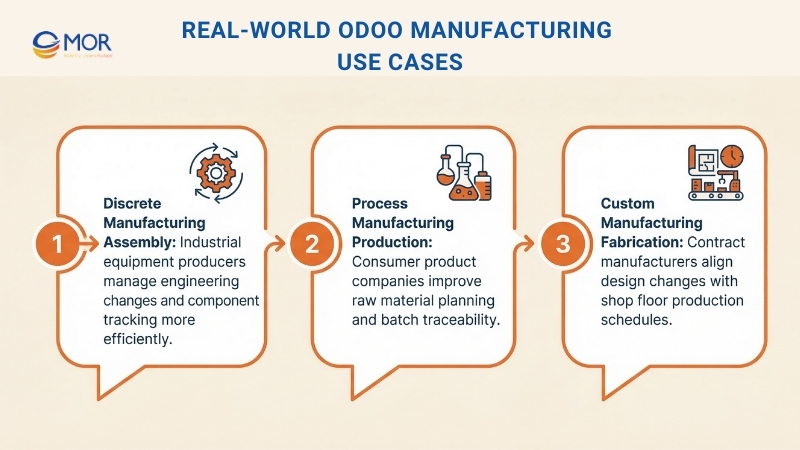
Discrete Manufacturing – Industrial Equipment Assembly
Context: A mid-sized industrial equipment producer that manages high product variety with small production volumes needed stronger control over engineering changes and better tracking of component usage.
Challenges:
- Frequent Bill of Materials (BoM) updates with limited version tracking
- Production delays caused by disconnected Quality and Maintenance systems
- Lack of clear visibility into real-time work center workloads
How Odoo Helps:
- The PLM module records Engineering Change Orders (ECOs) and keeps version history connected to each product
- Maintenance requests can start directly from the shop floor through the tablet-based interface
- The Master Production Schedule and Gantt planning tools improve how teams allocate resources
Outcomes:
- 25% faster implementation of engineering changes
- Maintenance downtime reduced by 18%
- Engineering teams and shop floor staff now rely on a single shared source of production information
Process Manufacturing – FMCG And Consumer Products
Context: A rapidly expanding personal care company that produces many SKUs across seasonal product lines experienced operational issues related to raw material planning and batch traceability.
Challenges:
- Inventory shortages and excess production caused by inaccurate planning
- Manual quality inspections that led to inconsistent compliance standards
- No centralized system to control by-products or packaging kits
How Odoo Helps:
- MRP and Inventory functions connected within Odoo manufacturing to support real-time forecasting of raw material requirements
- Automated quality control points added at every stage of the production process
- Product kits and by-product tracking managed within the same Bill of Materials (BoM) structure
Outcomes:
- Inventory holding costs decreased by 20%
- Quality non-compliance reports reduced by 30%
- Faster SKU configuration and production turnaround during seasonal demand increases
Custom Manufacturing – Contract Fabrication
Context: A contract-based manufacturer that manages design-to-order fabrication projects adopted Odoo for manufacturing company operations but struggled to keep project schedules aligned with shop floor production activities.
Challenges:
- Different systems used for project scheduling and production monitoring
- Difficulty adjusting manufacturing operations when design updates occurred during active projects
- Approval delays caused by inefficient document sharing and tracking
How Odoo Helps:
- Direct connection between Odoo Project, PLM, and the Odoo manufacturing system
- Engineering Change Order (ECO) workflows linked to project tasks and Bill of Materials (BoM) updates
- Documents attached to product records and accessible at each work center through the Workshop App
Outcomes:
- Average project delivery time reduced by 2 weeks
- Faster response to mid-project design modifications
- Clearer audit records for customer approvals and regulatory verification
Common Challenges When Implementing Odoo Manufacturing And How To Solve Them
Adopting a new ERP system such as Odoo in a manufacturing environment often introduces several operational challenges. Organizations may face technical and process-related obstacles during the implementation of Odoo for manufacturing.
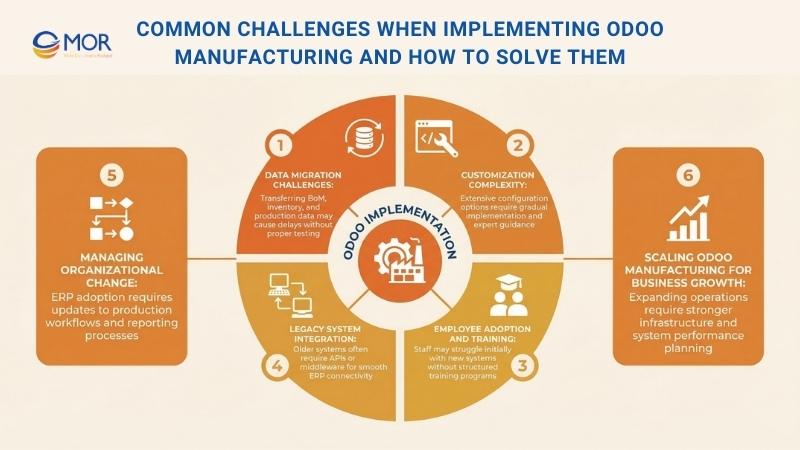
Data Migration Challenges
During implementation, transferring operational data such as inventory records, production schedules, and Bill of Materials (BoM) information into Odoo manufacturing can sometimes create inaccuracies, delays, or disruptions in production activities.
At this stage, companies often rely on Odoo data migration tools or work with specialists who have experience implementing the system. Careful testing and validation during the migration process help ensure that all data transfers correctly and prevent operational issues.
Customization Complexity
The extensive customization capabilities of Odoo can sometimes make it difficult for manufacturers to adapt the platform to their exact operational requirements.
A common approach is to begin with the standard core modules and gradually add customization features that match specific business processes. Collaboration with Odoo-certified partners allows companies to develop tailored modules and workflows based on expert guidance. This approach helps organizations adjust the platform effectively while avoiding unnecessary system complexity.
Employee Adoption And Training
When organizations replace traditional systems or legacy software with this system, employees may initially struggle with unfamiliar interfaces or new operational procedures. These adjustments can temporarily interrupt workflows and reduce operational efficiency.
Organizations can address this challenge by offering structured training programs for employees who will use the platform. The Odoo interface is designed to be user friendly and supports role-based training sessions. Ongoing support also helps teams adapt to the new system and complete the transition smoothly.
Legacy System Integration
Many manufacturers still depend on older software platforms or machinery that do not connect easily with modern systems such as Odoo manufacturing. This lack of compatibility often leads to inefficient data handling, repeated manual data entry, and delays within production operations.
This solution provides multiple connectors and APIs that allow integration with external software platforms, including legacy systems. Manufacturers can also work with experienced Odoo specialists to build custom integrations or middleware tools. These solutions help maintain consistent data flow between older systems and the ERP platform.
Managing Organizational Change
When companies introduce an ERP system like Odoo, major adjustments usually occur across business processes. Production workflows, inventory procedures, and reporting structures often require updates so they can function properly within the new system.
A structured implementation approach helps reduce disruption during this transition. Manufacturers often begin with a specific area such as inventory management or procurement before expanding across the organization. Clear communication and strong collaboration among teams also help businesses explore advanced capabilities available within Odoo.
Scaling Odoo Manufacturing For Business Growth
As manufacturing operations grow, the Odoo manufacturing platform must support additional users, larger data volumes, and expanded production facilities. Without proper preparation, system performance may decline or operational efficiency may slow.
The platform is designed to scale as companies expand, but organizations still need to plan their growth carefully. Manufacturers should confirm that their IT infrastructure, including servers and databases, can manage increased system demand. Regular system performance reviews also help ensure that the ERP environment continues to operate smoothly as the business grows.
How MOR Software Supports Odoo Manufacturing Implementation For Manufacturers
MOR Software assists manufacturers in deploying Odoo manufacturing solutions that unify production planning, inventory tracking, quality control, and maintenance activities within a single connected platform. Our engineering specialists collaborate closely with manufacturing teams to configure the Odoo Manufacturing (MRP) module together with related applications such as Inventory, PLM, and Quality, ensuring the system reflects real production processes.
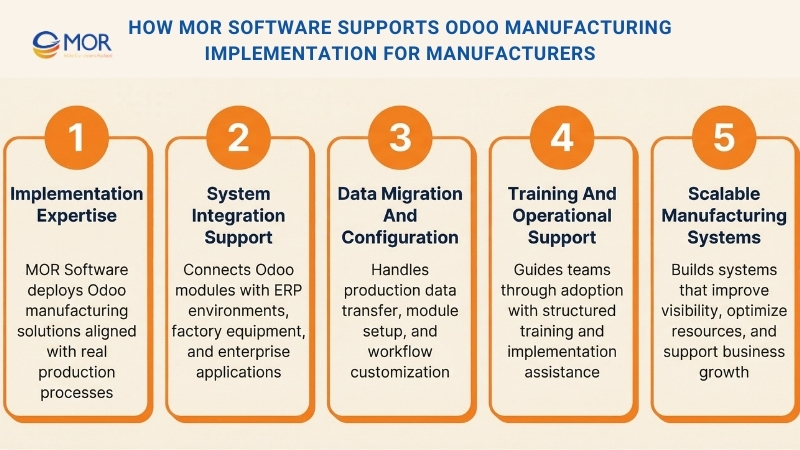
Our support covers the full implementation journey, including system integration, production data migration, module configuration, and employee training. Our teams also create secure integrations with existing ERP environments, factory equipment, and enterprise applications through APIs. This method helps manufacturers move to the system smoothly while maintaining stable daily operations.
With experience delivering enterprise software solutions across industries such as manufacturing, healthcare, and logistics, MOR Software develops practical systems that allow production teams to gain clearer operational visibility, manage resources more efficiently, and scale their manufacturing KPI dashboard as business demand increases. Contact us to learn how MOR Software can support your implementation journey.
Conclusion
Odoo manufacturing gives manufacturers a connected way to plan production, manage materials, control quality, and monitor operations in real time. With integrated planning tools, shop floor management, and strong reporting capabilities, this platform helps companies improve efficiency and make better production decisions. The right implementation strategy also ensures the system adapts to real factory workflows and future growth. If you want to implement or scale Odoo this software for your business, contact us at MOR Software to discuss the best solution for your production environment.
"Mr. Cong’s guiding philosophy is simplicity, believing that the simplest solutions are often the most powerful. He sees trust, empowerment, and the opportunity to demonstrate one’s abilities as the key elements that set MOR apart from traditional IT companies."
Mac Tien Cong


Division Manager (Hanoi Branch)
MOR SOFTWARE
Frequently Asked Questions (FAQs)
What is Odoo Manufacturing?
Odoo Manufacturing is the production management module within the Odoo ERP platform. It allows companies to manage manufacturing orders, Bills of Materials (BoM), work orders, production planning, quality inspections, and equipment maintenance through a single system.
What types of manufacturers use this system?
Companies across many industries rely on Odoo manufacturing, including electronics, automotive parts, food and beverage, consumer goods, pharmaceuticals, and industrial equipment. The platform supports discrete manufacturing, process manufacturing, and custom production environments.
What is a Bill of Materials in the manufacturing module?
A Bill of Materials (BoM) lists all components, raw materials, and operations required to produce a product. The platform allows businesses to create multi-level BoMs, manage product versions, and track changes to maintain production accuracy.
How does the system manage production orders?
Production orders can be created automatically from sales orders, inventory rules, or manual input. Each order connects to BoMs, routings, and work orders so teams can track progress and material usage in real time.
Can the platform support production planning and scheduling?
Yes. Odoo manufacturing includes planning tools such as Master Production Scheduling (MPS), work center capacity planning, and interactive Gantt charts. These tools help manufacturers organize workloads, forecast demand, and avoid production bottlenecks.
Does the manufacturing module integrate with other Odoo applications?
The module connects directly with apps such as Inventory, Sales, Accounting, Quality, Maintenance, and PLM. This integration keeps production, purchasing, stock levels, and financial information synchronized across the company.
How does the system improve product quality control?
Manufacturers can define inspection checkpoints inside production workflows. Alerts, inspections, and statistical quality tools help teams detect issues early and maintain consistent product standards.
Can the platform track manufacturing costs?
Yes. Odoo manufacturing records material, labor, and overhead costs for each production order. This information helps companies evaluate product profitability and monitor manufacturing expenses accurately.
Is this solution suitable for small and mid-sized manufacturers?
The platform works well for small and medium-sized businesses because of its modular design. Companies can start with core manufacturing capabilities and add additional applications as operations expand.
Does the system support barcode scanning and shop floor operations?
Yes. Odoo manufacturing includes barcode functionality and a shop floor interface. Workers can scan components, confirm work orders, record production steps, and update inventory instantly.
Share


Make Our-Dreams Realized


© 2023 . MOR Software. All Rights Reserved
Sitemap
Privacy Policy
Terms of Use

Rate this article
0
over 5.0 based on 0 reviews
Your rating on this news:
Name
*Email
*Write your comment
*Send your comment
1