


Offshoring vs Outsourcing: A Complete Guide for Businesses
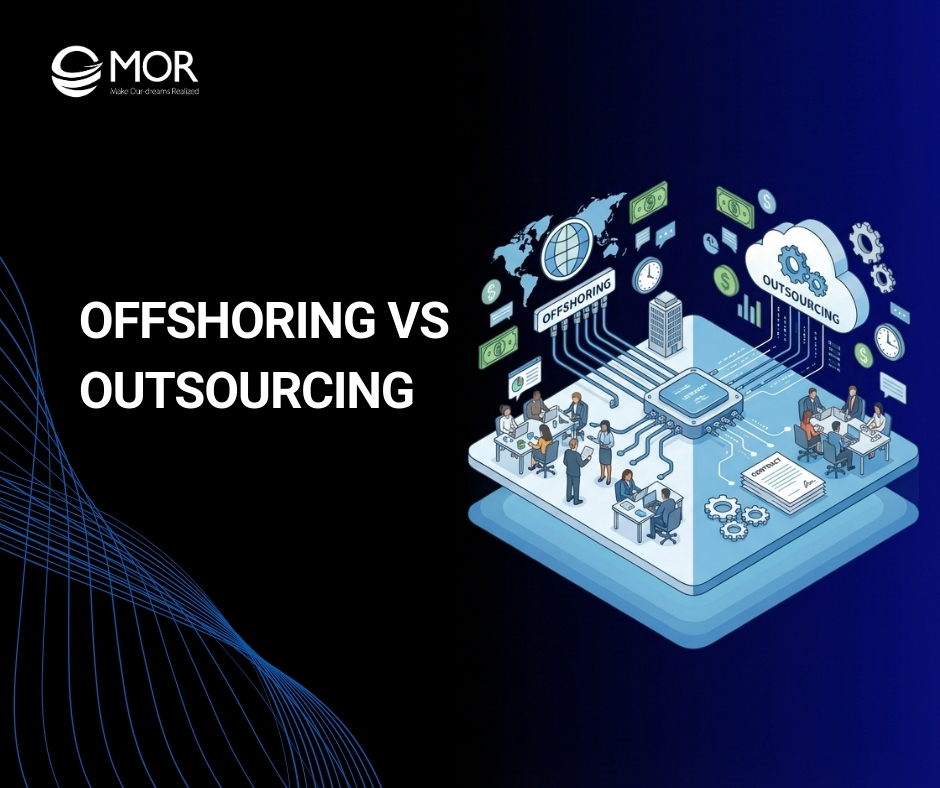
Choosing between offshoring vs outsourcing can feel overwhelming when cost pressure, talent shortages, and speed to market all collide at once. Many leaders struggle to understand the real difference between offshoring and outsourcing, and how it affects long term growth. In this guide, MOR Software will break down each model clearly so you can decide with confidence.
What Is Offshoring?
Offshoring refers to transferring your business operations to another country. You continue to own and manage your company, but the work is carried out abroad instead of in your home market. This may involve setting up a call center overseas, launching a development office in another region, or hiring professionals who live in a different country.
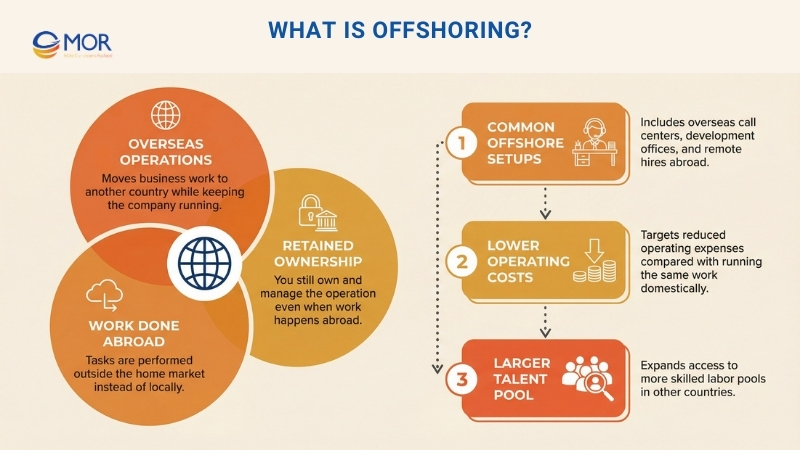
The main reason companies explore this option in the broader offshoring vs outsourcing discussion is to benefit from lower operating expenses and, in some cases, access a larger or more skilled labor pool. Understanding this structure helps clarify the difference between offshoring and outsourcing, especially for businesses comparing these two approaches.
Offshore Example
A technology firm based in the United States decides to establish a software development center in India. This decision gives the company access to a wider talent base and lowers costs, since Indian developers typically earn less than those in the US.
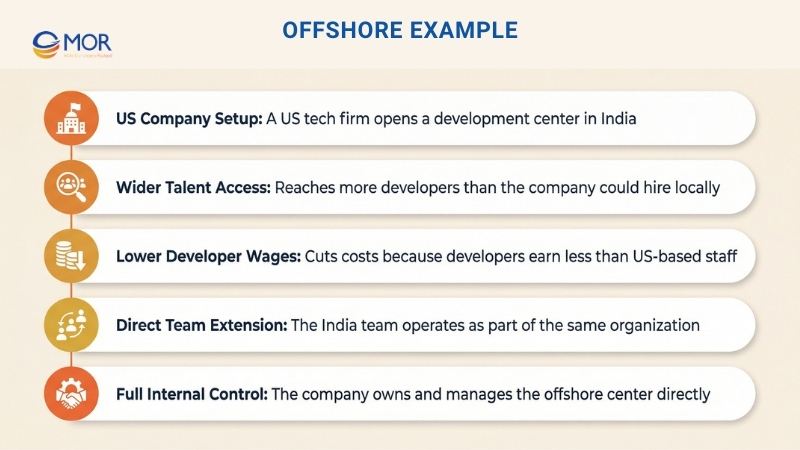
Some executives also compare Vietnam vs India when selecting an offshore location for engineering work. The team in India works as a direct extension of the organization and operates under its full ownership and management.
What Is Outsourcing?
Outsourcing means assigning specific tasks or business functions to a third-party company. The provider you contract takes responsibility for managing and delivering that service. This external partner may operate in your own country or abroad, depending on your needs.
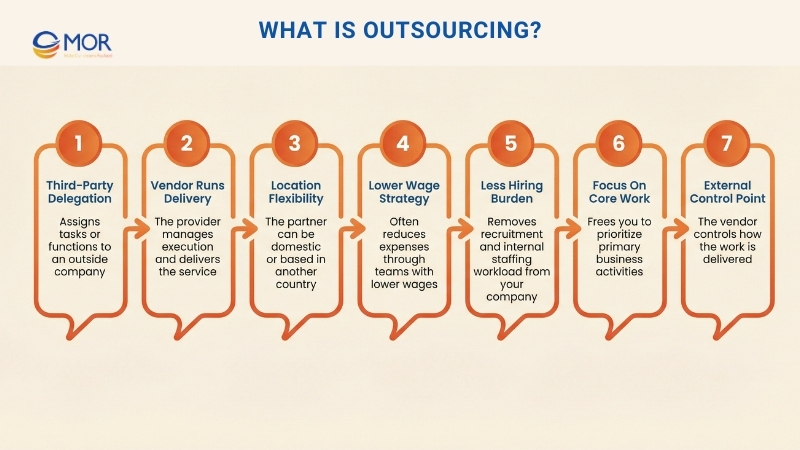
Many businesses believe this approach helps lower expenses by working with professionals who earn lower wages. It also removes the burden of recruitment and internal staffing, which saves your company time and office resources. In discussions around offshoring vs outsourcing, this model is often chosen by organizations that want to focus more on their primary activities rather than managing additional teams. When comparing outsourcing and offshoring, the key point here is that the external vendor controls how the work is delivered.
Outsourcing Example
For instance, a company based in the United States may contract a call center to handle its customer support services, either locally or in Vietnam, which is known as one of the leading destinations for call center operations.
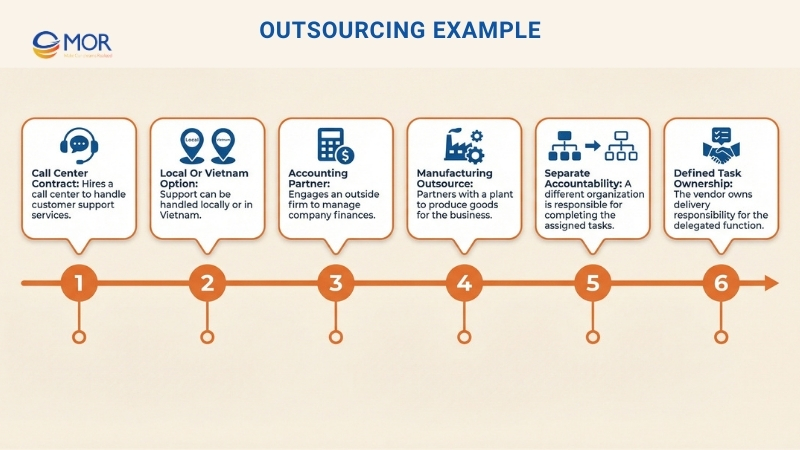
A business may also engage an outside accounting firm to manage its finances or partner with a manufacturing plant to produce goods. In each of these cases, the shared element is that a separate organization is accountable for completing the assigned tasks.
10 Core Differences Between Offshoring Vs Outsourcing
Both models have gained strong traction as practical business strategies. In the broader offshoring vs outsourcing discussion, companies often evaluate them as ways to lower expenses, simplify processes, and support expansion.
The data supports this trend. The global outsourcing services market is expected to grow from $620.38 billion in 2020 to $904.95 billion by 2027. Analysts estimate a 5.54% compound annual growth rate (CAGR) during this period. Staying informed about IT outsourcing trends can also help you benchmark pricing, delivery models, and vendor expectations.
At the same time, leading corporations have already established offices across various regions. Many organizations rely on BPO in Vietnam, while also setting up their own internal centers there. In addition, a rising number of small and midsize businesses have expanded overseas since the pandemic.
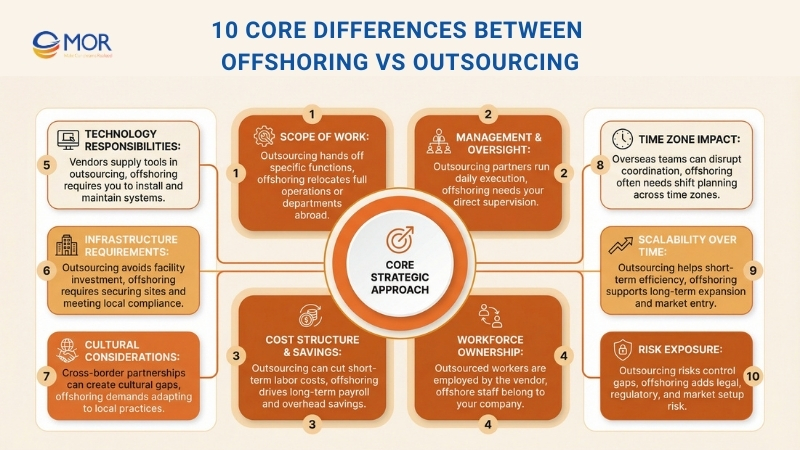
So what exactly sets these two strategies apart? Below are ten core distinctions in the offshore vs outsourcing comparison.
Scope Of Work
One key distinction between these approaches lies in the type of work assigned.
Outsourcing focuses on transferring specific functions or projects to an external service provider. In contrast, offshoring involves relocating full operations, workflows, or departments to another country.
For example, you might choose outsourcing to Vietnam and work with a BPO firm to manage your customer service. However, if you relocate and run your own call center there under your ownership, that reflects internal overseas expansion rather than vendor delegation.
Management And Oversight
When reviewing offshoring vs outsourcing, management control becomes an important factor.
With outsourcing, your BPO partner manages the day-to-day execution of the assigned tasks. You still stay in contact and coordinate through tools such as Flipbooks, email, and employee management platforms. A clear software development contract can further reduce confusion around responsibilities, timelines, and deliverables.
In contrast, offshoring requires you to supervise the entire operation yourself. This includes directing your team, overseeing procedures, and maintaining infrastructure to keep everything running effectively.
Cost Structure And Savings
Many businesses compare the two models by looking at financial outcomes. The cost advantage often explains the difference between relocating operations and delegating tasks.
Offshore outsourcing can be an affordable option for defined or short-term assignments. It may reduce labor costs by up to 70%, especially when work is transferred to regions with lower wage levels. However, if you choose a provider within your own country, lowering expenses might not be your primary goal.
In contrast, internal overseas expansion tends to deliver stronger savings over a longer period. It helps you decrease payroll costs as well as other overhead expenses, including office rent and utility bills.
Workforce Ownership
Staff structure plays a central role when comparing the two approaches.
If you outsource, the professionals performing your tasks are not part of your internal team. They are employed by your BPO partner and work under separate agreements. In an offshore setup, you recruit and manage employees who formally belong to your company.
This distinction carries important implications. Delegating work externally does not require direct investment in personnel, while establishing overseas teams means you commit to hiring, training, and maintaining long-term relationships.
Technology Responsibilities
Technology investment marks another important difference in the offshoring vs outsourcing debate.
When you delegate tasks to a third party, you usually do not need to purchase or manage digital platforms. Your service provider already has the tools and systems required to complete the assigned work.
On the other hand, if you build and operate your own overseas branch, you must invest in up-to-date technologies. You also take responsibility for installing, maintaining, and upgrading those systems to keep operations stable.
Infrastructure Requirements
Infrastructure relates to the physical space and operational setup a company needs to function. It clearly shows how the two approaches differ.
If you outsource, you do not need to invest in facilities or equipment. Your external partner already has the office space, systems, and operational capacity to manage the assigned tasks.
In contrast, relocating operations overseas means you must secure a site, build the required facilities, and allocate resources accordingly. You also need to review local laws and compliance rules before opening and running an office in that country.
If leaders need to travel for setup, plan early for documents such as a Vietnam business visa.
Cultural Considerations
Cultural factors are another point of difference between these two models.
When you work with a provider in your own country, cultural gaps are usually minimal. However, they become more noticeable when you engage a nearby or overseas BPO firm.
If you establish your own branch abroad, you must adapt to local customs and business practices. For example, managing customer service outsourcing in Vietnam requires awareness of national traditions, workplace norms, and public holidays.
Time Zone Impact
Physical distance also plays a role when comparing these two strategies. Time zone gaps can influence how teams coordinate and communicate.
If you collaborate with a domestic BPO partner, time differences rarely disrupt daily operations. The situation changes when you delegate work to a provider located in another region.
In the offshoring vs outsourcing conversation, overseas expansion often demands adjustments to working hours. You may need to arrange rotating shifts to support customers who live in different parts of the world.
Scalability Over Time
Scalability plays an important role when your goal is business growth and expansion. For this reason, many organizations weigh offshoring vs outsourcing before making a decision.
Outsourcing business operations can help you improve efficiency in the short term. It provides access to skilled professionals and advanced tools that can enhance workflows and service quality.
Relocating operations overseas is often more suitable for long-term expansion. It enables you to enter international markets, reach a wider customer base, and strengthen your competitive position.
Risk Exposure
Like any strategic choice, both approaches carry strengths and weaknesses.
Delegating tasks to external providers involves certain risks. You need to assess the pros and cons of outsourcing to Vietnam or any other location you consider. While this model can reduce expenses, it also demands attention to cultural gaps, communication issues, and operational control. Strong outsourcing risk management depends on clear SLAs, security requirements, and escalation paths.
In comparison, setting up your own overseas branch usually involves greater exposure. Offshoring requires careful research, from analyzing local market conditions to following legal and regulatory rules. However, when executed properly, this strategy can deliver meaningful advantages, including strong cost savings and access to global opportunities.
Quick Comparison Table: Offshoring Vs Outsourcing
To make the comparison easier to understand at a glance, the table below summarizes the key differences between the two models. It highlights how offshoring vs outsourcing differs across control, cost, risk, and long term strategy.
Comparison Area | Outsourcing | Offshoring |
Scope of Work | Transfers specific projects or business functions to a third-party vendor | Relocates entire departments or operations to another country |
Management & Oversight | External provider manages daily execution | Company directly supervises and controls operations |
Cost Structure | Lower short-term costs, especially for defined projects | Greater long-term savings through reduced payroll and overhead |
Workforce Ownership | Workers are employed by the vendor | Employees are hired and managed internally |
Technology Responsibility | Vendor provides and maintains required systems | Company invests in and maintains its own infrastructure |
Infrastructure Needs | No need to secure office space or equipment | Requires physical setup, facilities, and local compliance |
Cultural Considerations | Cultural gaps depend on vendor location | Requires deeper adaptation to local business practices |
Time Zone Impact | Minimal if domestic, moderate if offshore | Often requires shift planning across time zones |
Scalability | Flexible for short-term or fluctuating workloads | Better suited for structured, long-term expansion |
Risk Exposure | Vendor dependency and communication risks | Regulatory, legal, and market-entry risks |
Offshoring Vs Outsourcing Advantages And Disadvantages
When reviewing the offshoring vs outsourcing discussion, it is important to examine the strengths and weaknesses of each path. The pros and cons of offshoring and outsourcing can differ depending on the specific tasks or departments involved. Even so, there are common advantages and drawbacks that usually apply across most business situations.
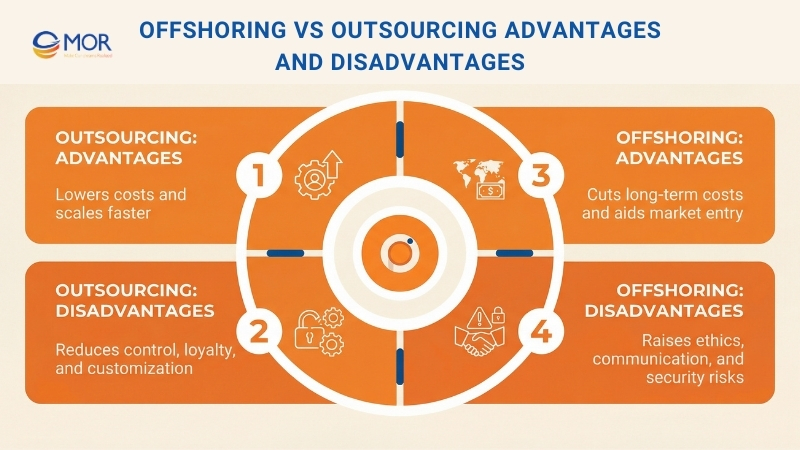
Outsourcing Advantages And Disadvantages
The contrast becomes noticeable when you compare outsourcing vs insourcing. In many cases, the benefits and limitations tend to mirror each other.
Reduced managerial control and narrower flexibility
Keeping operations in house allows you to maintain stronger oversight, encourages employees to feel a deeper sense of responsibility, and gives you more room to adjust processes quickly. In contrast, external providers often cannot offer the same degree of control or adaptability.
Weaker sense of employee loyalty and ownership
Staff members working for an external vendor may not feel the same commitment to your company as your internal team would. Their primary loyalty remains with their own employer rather than your organization. If you partner with a firm that prioritizes customer satisfaction, this issue may be less visible. However, in many cases, it remains a common concern.
Lower responsiveness and limited customization
An outsourcing provider usually supports multiple clients at the same time. As a result, they may not respond as quickly to sudden changes or tailor processes exactly to your preferences. While each provider operates differently, this can create challenges for functions that require high responsiveness and flexibility.
At the same time, handling operations internally also presents challenges. Expenses, training requirements, and scaling difficulties can escalate quickly when your business expands at a fast pace. In such cases, outsourcing often gains the advantage in the insource vs outsource comparison.
Improved cost control and easier scaling
Delegating tasks to external partners can help you manage expenses more effectively over time. Outsourced teams generally have broader resources available, which allows them to scale operations more smoothly than internal departments. Adding 20 extra working hours per week may be manageable for a vendor, but it can heavily burden your in house staff.
No need for in house training programs
Service providers are responsible for preparing and training their own employees. When new tasks arise, you do not have to invest additional time onboarding or upskilling new internal hires.
Access to specialized expertise
External vendors usually focus on a specific function or service. Because of this specialization, they often bring advanced skills and deep industry knowledge. Hiring someone with the same level of expertise internally may exceed your budget. For this reason, many organizations prefer to rely on experienced outsourcing partners instead of building that capability from scratch.
If you are still weighing outsourcing compared to offshoring, or deciding how to apply the most suitable option for your organization, consider reviewing a structured decision guide to support your evaluation process.
Offshoring Advantages And Disadvantages
When reviewing the overall offshoring vs outsourcing comparison, it becomes clear why many organizations decide to relocate certain functions abroad.
Lower operational expenses and financial benefits
One major benefit of moving operations overseas is reduced cost. Running processes in another country is often cheaper than handling them at a domestic site. Labor rates are usually lower, and overhead costs such as facility rent can also decrease significantly.
This explains why many large manufacturing corporations establish production plants outside their home countries. Doing so can improve profit margins and strengthen a company’s position in a competitive market.
In some regions, local governments may offer tax incentives to attract foreign businesses. These incentives can reduce your overall tax burden, especially when domestic tax rates are higher.
Simpler entry into new markets
Another advantage to examine when weighing the pros and cons of offshoring and outsourcing is improved access to international markets. Earlier, we mentioned shifting marketing activities to a team in Latin America. That move can also support expansion into that region and help build a local customer base. This example shows how overseas expansion can make market entry more practical.
Access to local knowledge and expertise
The same scenario highlights another strength of this model, which is regional expertise. A company based in the United States may understand American consumers well. However, it may not fully grasp purchasing habits, cultural factors, or market trends in another region. Hiring professionals from the target country gives you insights that internal teams may not possess.
Higher employee motivation and satisfaction internally
Relocating certain repetitive or routine tasks can also support your internal workforce. When employees spend too much time on monotonous duties, their motivation may decline, especially if they have advanced skills or education.
Transferring those activities abroad can increase job satisfaction among your domestic team. It frees them to focus on strategic and high value work, which can improve productivity and long term results.
After exploring the benefits, it is necessary to consider the drawbacks as well. The offshoring versus outsourcing debate would be incomplete without examining potential risks.
Before applying this strategy, you should carefully assess how these disadvantages might affect your specific business situation, since the impact can be significant.
Ethical issues related to labor practices
One major concern involves ethics. In recent years, some companies have faced criticism over low wages and poor working environments in overseas facilities.
In a highly connected world, news about unfair labor practices can spread quickly and damage your brand image. Modern consumers pay close attention to ethical standards and may avoid companies linked to questionable practices. For this reason, you must ensure that any overseas partner or facility follows safe working conditions and fair compensation policies.
Cultural gaps and communication difficulties
Another challenge relates to culture and communication. Differences in time zones can slow down collaboration with your offshore team. Decisions that once took a single day may now require several days or even longer because working hours do not align.
Communication issues go beyond time differences. If your organization lacks familiarity with local customs, language, and business norms, operations can become complicated.
For instance, in certain countries, offering a small gift to a company leader before signing a contract is considered respectful. Without awareness of this custom, your team might unintentionally harm a potential partnership.
Building strong professional relationships is also harder when language barriers exist. Misunderstandings may occur, and errors can increase. When the overseas branch is located thousands of miles away, maintaining smooth coordination requires additional effort.
Security concerns and political risks
The final disadvantage involves safety and stability. If your overseas site houses valuable machinery or equipment, you must implement adequate security measures to protect these assets. Some countries experience higher levels of crime, unrest, or political instability. Depending on the location you select, investing in advanced security systems may become necessary, which adds extra cost and management responsibilities.
Outsourcing Vs Offshoring Vs Nearshoring
When analyzing strategic options, another concept frequently appears, which is nearshoring. Nearshoring means moving certain operations to a neighboring country, usually within the same geographic region or time zone. This approach blends several advantages of relocating work abroad, including potential cost reductions, while reducing difficulties related to cultural gaps and communication issues.
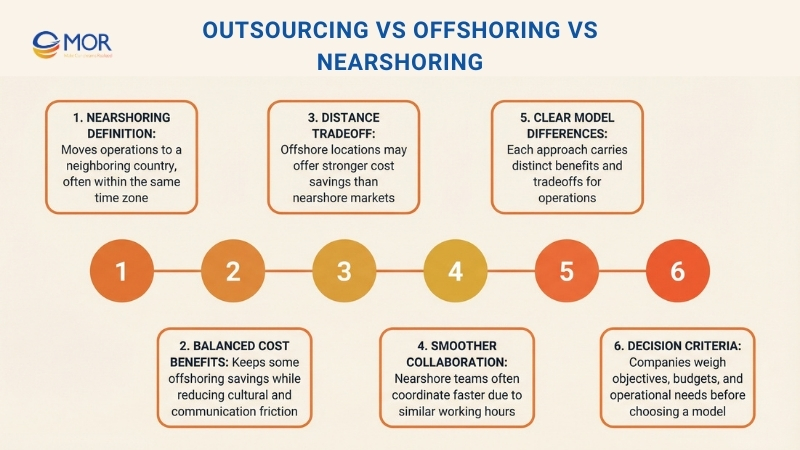
Many businesses compare nearshore vs offshore outsourcing when deciding how far from home they want their external teams to operate. While offshore vs nearshore outsourcing may offer stronger cost benefits in distant markets, nearshore setups often provide smoother collaboration due to similar time zones and closer cultural alignment.
When reviewing outsourcing vs offshoring vs nearshoring, it becomes clear that each model carries distinct benefits and tradeoffs. Companies should evaluate their objectives, financial limits, and operational needs carefully before choosing between offshoring and outsourcing or selecting a nearby alternative.
Offshoring Vs Outsourcing: Choosing The Right Model For Your Business
When evaluating offshoring vs outsourcing, your company should review its objectives, financial capacity, and tolerance for uncertainty. These two approaches deliver different advantages, yet each also presents specific challenges. Many global firms now apply both models together in a blended structure. For example, a United States based software provider may delegate customer support to a third party call center in Vietnam while working with a domestic marketing agency for advertising services. At the same time, its main development team might include internal engineers in the US alongside an offshore group in India. Knowing when each strategy is suitable allows organizations to make well informed and strategic choices.
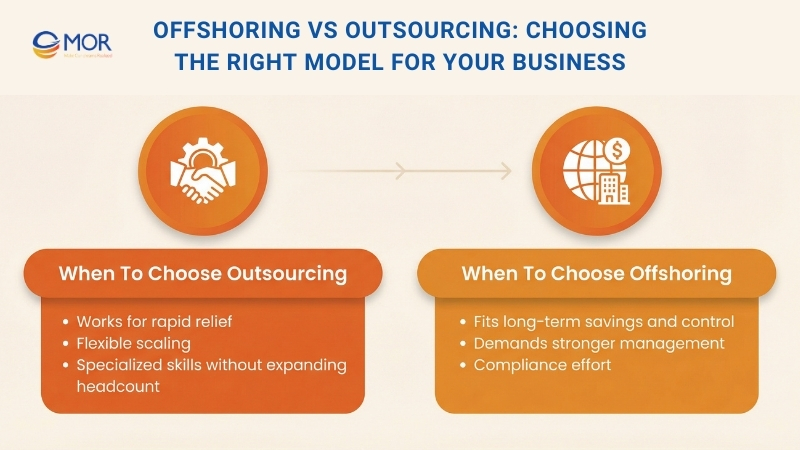
When To Choose Outsourcing
Companies that want to ease pressure on internal departments quickly should consider outsourcing vs offshoring carefully. Assigning responsibilities such as payroll, outsourced IT support, and customer service to external vendors allows you to focus on key functions that support growth.
Because this model supports fast scaling without changing permanent staff levels, it works well for businesses facing seasonal or variable demand. It also provides access to specialized skills and modern technologies that might otherwise be too costly to develop internally. This becomes especially relevant in outsourced software development nearshore vs onshore vs offshore decisions, where companies must balance cost, collaboration speed, and technical depth.
As a result, project quality can improve and delivery timelines may shorten. For small and midsize enterprises, as well as firms operating in competitive markets, outsourcing reduces repetitive workloads so you can stay flexible, manage expenses, and keep your employees motivated.
When To Choose Offshoring
Offshoring fits organizations that aim for significant and lasting cost savings by positioning certain operations in countries with lower labor and resource costs. It also benefits companies that require continuous productivity, since teams across different time zones can support ongoing workflows. In addition, this approach expands access to global talent, helping you find capabilities that may be limited or expensive in your home country. Teams like offshore AI developers can be especially valuable when your roadmap includes data-heavy or AI features. Businesses that value sustained control often prefer this option over outsourcing because it enables them to build and supervise their own teams, protect internal processes, and maintain consistent standards. Sectors such as IT, manufacturing, and engineering commonly adopt this strategy for these reasons, although it demands stronger management oversight and compliance efforts.
Relocating operations abroad can also strengthen international growth plans. Establishing a presence in new markets allows you to benefit from regional knowledge and tailor products or services to local demand. Spreading activities across several countries further reduces exposure to economic, political, or regulatory changes in any single location, which can support long term stability.
How MOR Software Helps Businesses Choose Between Outsourcing And Offshoring
MOR Software works with companies at the decision stage, not after the choice is already made. Some teams need flexibility and speed. Others need long-term control and cost stability. The right model depends on product maturity, budget pressure, and internal capacity. In many cases, organizations seek offshoring consulting support to structure teams correctly and avoid early operational missteps.
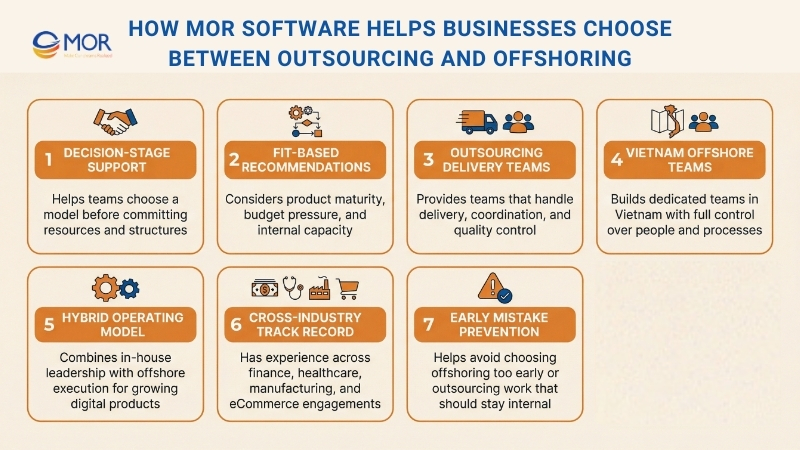
Instead of pushing one approach, MOR Software supports both.
- For software outsourcing, MOR Software provides ready-to-deploy development teams that handle delivery, coordination, and quality control, so internal teams stay focused on core priorities.
- For offshoring, MOR Software helps businesses build dedicated offshore consultancy teams in Vietnam, giving full control over people, processes, and technology while keeping costs predictable.
- For hybrid setups, MOR Software combines in-house leadership with offshore execution, which is common for growing software and digital products.
What makes this practical is experience. MOR Software has delivered long-term offshore teams, project-based outsourcing, and mixed models across industries like finance, healthcare, manufacturing, and eCommerce. That exposure helps businesses avoid common mistakes early, like choosing offshoring too soon or outsourcing work that should stay internal.
Conclusion
Understanding offshoring vs outsourcing helps you align your business structure with your long term goals, budget, and growth strategy. Each model offers clear benefits, but the right choice depends on your control needs, scalability plans, and risk tolerance. If you are still weighing outsourcing compared to offshoring, expert guidance can make the decision clearer. Contact MOR Software today to explore the best strategy for your business transformation.
MOR SOFTWARE
Frequently Asked Questions (FAQs)
What is the main difference between offshoring and outsourcing?
Offshoring moves business operations to another country while keeping ownership in-house. Outsourcing hands work to an external provider that controls delivery.
Is offshoring the same as offshore outsourcing?
No. Offshore outsourcing is a type of outsourcing done overseas. Offshoring means building and managing your own team in another country.
Which option gives more control, offshoring or outsourcing?
Offshoring provides more control because teams are direct employees. Outsourcing limits control since execution is handled by a third party.
Is outsourcing cheaper than offshoring?
Outsourcing is often cheaper in the short term. Offshoring usually delivers stronger cost savings over the long run once teams are established.
What types of tasks are best suited for outsourcing?
Outsourcing works well for support functions, repetitive tasks, short-term projects, and roles that do not require deep internal alignment.
When does offshoring make more sense for a business?
Offshoring fits long-term needs like software development, product engineering, and operations that require tight integration with internal teams.
How do time zones affect offshoring vs outsourcing?
Time zones have less impact with onshore outsourcing. Offshore outsourcing and offshoring require planning around working hours and communication windows.
What are the biggest risks of outsourcing?
Common risks include reduced visibility, communication gaps, limited customization, and dependency on the vendor.
What are the biggest challenges with offshoring?
Offshoring challenges include legal setup, cultural differences, compliance requirements, and the need for strong internal management.
Can a company use both offshoring and outsourcing together?
Yes. Many businesses use a hybrid approach, outsourcing certain functions while offshoring core teams for long-term growth.
Share


Make Our-Dreams Realized


© 2023 . MOR Software. All Rights Reserved
Sitemap
Privacy Policy
Terms of Use

Rate this article
0
over 5.0 based on 0 reviews
Your rating on this news:
Name
*Email
*Write your comment
*Send your comment
1