


Staff Augmentation vs Outsourcing: Identifying The Best Fit
The staff augmentation vs outsourcing decision can feel simple until control, cost, and delivery risk start pulling in different directions. The wrong model may leave your managers overloaded or your project tied to a rigid contract. In this guide, MOR Software will break down how each option works, where it fits, and what businesses should check before making a decision.
Key Takeaways
- Management ownership sets the models apart. Staff augmentation places external specialists under your internal leaders, while outsourcing gives the provider more responsibility for planning, staffing, and delivery.
- Project scope should guide your choice. Team extension suits changing requirements and active product work. Outsourcing works better for clear projects, stable processes, and support functions.
- The lowest rate may not mean the lowest cost. Management time, onboarding, contract changes, vendor oversight, and knowledge transfer can all affect the final project spend.
Staff Augmentation Vs Outsourcing: Key Differences
Staff augmentation vs outsourcing gives companies two different ways to gain outside support. One extends your internal team, while the other places a defined project or business function under a provider’s management.
Comparison Area | Staff Augmentation | Outsourcing |
Service Scope | External specialists join your team and work under your direction | A provider takes responsibility for a full project, service, or business function |
Team Direction | Your managers assign work, change priorities, and assess each person’s results | The provider leads its team and answers for the agreed delivery |
Daily Authority | High, since you decide the tasks, methods, and schedule | Lower, since you set the result and deadline while the provider plans execution |
Pricing Basis | Time-and-materials charges based on hourly, daily, or monthly work | Fixed-price, milestone, or result-based fees |
Team Scaling | Individual roles can be added or removed as demand changes | Team or scope changes often need a revised agreement |
Knowledge Ownership | Project knowledge stays close to your employees through daily teamwork | Much of the working knowledge may remain with the provider |
Strongest Match | Skill shortages, temporary demand, and expert support for an existing team | Clear projects, repeatable operations, and work outside your main business |
Delivery Exposure | Your company owns delivery risk and manages each person’s output | The provider owns more delivery risk, while you manage the commercial relationship |
Common Term | A few weeks to several months for each specialist, with longer use possible | Several months to several years, often under a longer contract |
Workflow Fit | Specialists use your meetings, systems, and internal work methods | The provider usually works through its own team structure and delivery process |
The table shows why the outsourcing vs staff augmentation choice reaches far beyond headcount. It changes who directs the work, carries delivery risk, keeps project knowledge, and handles daily decisions.
Staff augmentation vs outsourcing separates team extension from managed delivery. Augmentation places outside specialists inside your current structure. Outsourcing gives a provider responsibility for a project, function, or agreed service.
Your best fit depends on the control, flexibility, accountability, and internal effort your company wants to keep.
Definition And Service Scope
Staff augmentation adds external developers or specialists to your existing team to fill skill gaps or increase capacity. They work as part of your organization, follow your internal workflows, and report to your managers, while your company keeps full ownership of planning, task assignment, and delivery.
Project outsourcing transfers responsibility for an entire project, product, or defined scope of work to an external vendor. The outsourcing provider builds and manages its own team, oversees day-to-day execution, and delivers the agreed outcomes based on the project requirements, timeline, and service agreement.
The key difference in staff augmentation vs project outsourcing comes down to ownership. Staff augmentation extends your internal team while you remain responsible for delivery. Project outsourcing places both team management and delivery responsibility with the external provider.
Management Responsibility
A staff augmentation vs professional services comparison often comes down to who leads the people doing the work. Under augmentation, your managers distribute tasks, set priorities, assess results, and coordinate daily activity.
Under outsourcing, the provider supervises its own delivery team. You state the goals and check progress, but the vendor controls staffing, schedules, work allocation, and delivery management.
Daily Control And Work Visibility
The staff augmentation vs contractors question often concerns direct access and day-to-day visibility. Augmented specialists work under your leaders, who choose the tasks, methods, deadlines, and changes in priority.
Outsourcing gives the provider more freedom over daily execution. You set the required result and due date, but its managers arrange resources, work steps, and delivery methods.
Billing Model And Pricing Structure
Augmented teams commonly use hourly, daily, or monthly pricing. Your total spend reflects each specialist’s skill level, agreed rate, and recorded working time.
A staff augmentation vs full project outsourcing cost comparison must also review how project fees are set. Outsourced work may follow fixed, milestone, or result-based pricing, which makes budgets easier to forecast when requirements stay stable.
Scalability And Team Flexibility
Augmentation lets you increase or decrease separate roles when demand or skill needs shift. This freedom suits short assignments, urgent delivery gaps, and temporary periods of heavy work.
A nearshore staff augmentation vs offshore outsourcing review also needs to consider location, working-hour overlap, and contract terms. Outsourced team changes are often slower after signing because a new scope, fee, or formal amendment may be needed.
Knowledge Retention And Dependency
In staff augmentation vs outsourcing, knowledge usually stays closer to your company under the team-extension model. External specialists work beside your employees and use the same systems, records, and internal work methods.
Under vendor-managed delivery, much of the project knowledge can remain outside your business. Weak documentation and an unclear handover process may leave you dependent on the provider later.
Best Use Cases
Augmentation suits companies that already have capable leaders but need more people or a missing skill. Common roles include software developers, testers, designers, data analysts, and other specialists who can join an active team.
Outsourcing fits clear projects, repeatable operations, and support work outside your main business. Common uses include IT support, payroll, customer service, accounting, and complete software product delivery.
Delivery Risk And Accountability
In a staff augmentation vs software outsourcing review, augmentation leaves most delivery responsibility with your company because your leaders remain accountable for work quality, output, timing, and team coordination.
An outsourcing provider accepts more responsibility through the contract and agreed service terms. You still need to watch provider results, communication, security, and long-term dependency.
Typical Engagement Duration
An augmented specialist may stay for several weeks or a number of months, based on the role and workload. Some companies keep this staffing model for a longer period when their resourcing needs remain flexible.
Outsourcing agreements often continue for many months or several years, mainly for managed services and business functions that run on a regular schedule.
Team Integration And Working Process
A staff outsourcing vs staff augmentation comparison shows a clear difference in team connection. Augmented specialists join your work tools, meetings, communication channels, and normal procedures.
Outsourced teams tend to work through their own managers, systems, and delivery routines. Your contact usually happens through status reports, planned calls, milestone checks, and formal performance reviews instead of daily teamwork.
>>> Salesforce staff augmentation gives businesses a faster way to add certified Salesforce talent without losing project control. Real full blog HERE!
Staff Augmentation Pros And Cons
The staff augmentation vs outsourcing decision becomes easier once you see the trade-offs behind direct team extension. Augmentation gives you flexibility and close control, but it also adds management work for your internal leaders.
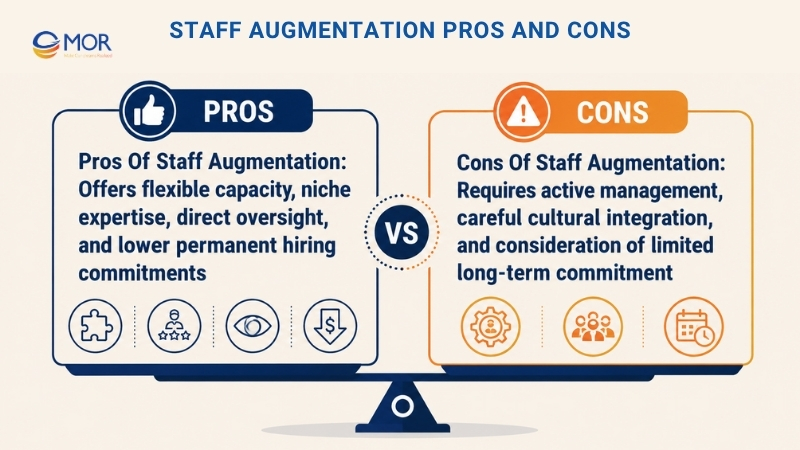
Pros Of Staff Augmentation
Adjustable Team Capacity
Augmentation lets your business expand or shrink the team around current project demand. It works well for short assignments or busy periods when you need extra people for a limited time.
Fast Access To Niche Skills
This model gives you access to specialist knowledge that may be missing inside your company. An external engineer with the right technology or industry background can close that gap without a long hiring search.
Closer Project Oversight
Your managers keep direct control over how outside specialists join the team and follow internal processes. This suits companies that want close project visibility and firm alignment with their own goals.
Lower Permanent Hiring Burden
A staff augmentation vs recruitment review often shows lower long-term employment costs under temporary team extension. You can add experienced people without taking on the full financial duties linked to permanent staff.
Cons Of Staff Augmentation
Extra Work For Managers
Your leaders must spend more time directing, supporting, and reviewing external team members. Since these specialists come from outside the company, cultural fit and strong daily teamwork may take time to build.
Limited Long-Term Commitment
Augmentation is commonly used for short or medium assignments. It may not suit work that needs permanent staffing and a long period of stable team ownership.
Harder Cultural Fit
Temporary specialists may need time to understand your company’s habits and working style. Team relationships can suffer when they do not know your values, communication rules, or normal workflow.
Outsourcing Pros And Cons
The staff augmentation vs outsourcing comparison also requires a close look at managed delivery. Outsourcing can remove daily management pressure, but you give the provider more control over people and work methods.
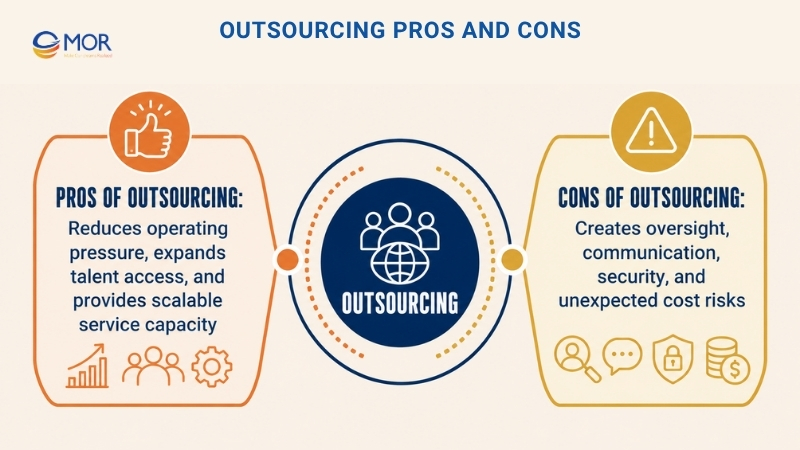
Pros Of Outsourcing
Lower Operating Expense
Outsourcing may cost less than building a permanent internal team, mainly for support work outside your main business. Companies often delegate IT support, customer care, and payroll to limit routine operating expense.
Wider Talent Reach
A provider can connect your business with skilled people across several countries and technical fields. This helps when the right knowledge is hard to find in your local hiring market.
More Time For Main Business Work
Outsourcing moves slow or support-heavy work to an outside team. Your employees can then spend more time on products, customers, and business tasks that need internal knowledge.
Flexible Service Capacity
A provider can increase or decrease assigned resources when service demand changes. This can help companies handle busy seasons without hiring and training a new permanent team.
Cons Of Outsourcing
Lower Direct Oversight
Outsourcing means you lose some control over daily work and internal quality checks. This issue can become more serious when the provider works remotely and uses different management routines.
Communication Gaps
External teams may work in another location or time zone, which can slow discussions. Unclear messages, delayed answers, and different views of project goals may harm the final result.
Data And Security Risk
Giving an outside party access to customer data or internal systems creates added security concerns. Weak access rules or poor provider controls can expose confidential information.
Unexpected Extra Expense
The starting price may look attractive, yet added costs can appear during delivery. Vendor governance, quality checks, scope changes, and contract disputes may all increase the final spend.
When Staff Augmentation Is The Better Fit
In staff augmentation vs outsourcing, team extension is usually the stronger choice when:
- You Want To Keep Daily Control. Work that depends on your current team, codebase, and internal process needs close direction. Augmented specialists let you change priorities quickly, give feedback at once, and keep work aligned with your standards.
- Your Requirements Change Often. This model handles shifting needs well because your managers guide the work each day. Under a fixed outsourced scope, each major change may need a formal request, a new discussion, or an updated agreement.
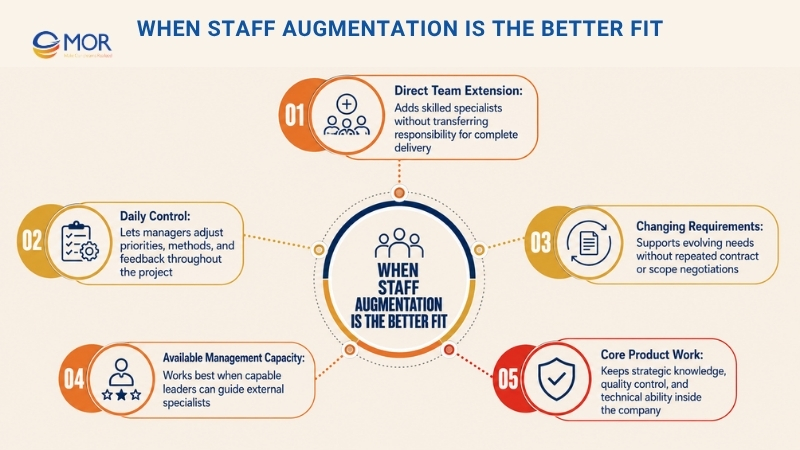
- Your Managers Have Available Capacity. Augmentation needs active leadership from your side. Strong team leads and project managers can guide external specialists well. An overloaded management group may struggle when it must direct more people.
- The Work Shapes Your Main Product. Strategic work often needs to remain close to your company, since direct management helps you keep knowledge, control quality, and build internal ability over time.
When Outsourcing Is The Better Fit
In staff augmentation vs outsourcing, managed delivery is often the better choice when:
- The Scope Is Already Clear. Outsourcing works well when requirements, acceptance rules, and measurable SLAs are agreed before work begins. A provider can plan the route to completion when everyone shares the same view of the finished result.
- The Function Sits Outside Your Main Business. The staff augmentation vs IT outsourcing choice often appears around payroll, infrastructure management, help desks, or customer service. A specialist provider can run these functions while your managers stay focused on business priorities.
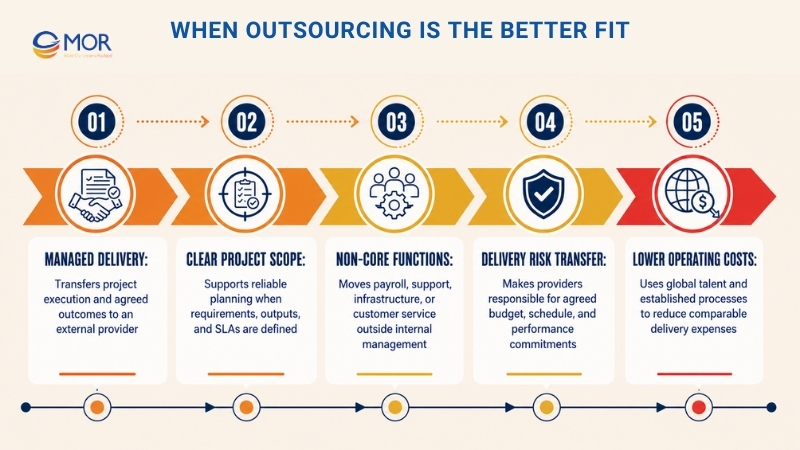
- You Need To Move Delivery Risk. The provider takes responsibility for agreed delivery under the contract. Budget or schedule problems become its duty within those terms, which can help companies that cannot accept high delivery uncertainty.
- Lower Cost Is The Main Goal. Outsourcing work to India, the Philippines, or Eastern Europe may lower comparable labor costs by 40% to 70%. Augmented specialists in these regions can also cost less, but a managed provider may gain further savings through shared systems and established processes.
Staff Augmentation Vs Outsourcing: How To Choose The Right Model
Choosing staff augmentation vs outsourcing takes more than a price check. Your decision depends on the control you want, the strength of your internal leaders, and whether your team will manage execution or pass it to a provider. In addition, depending on project size, companies may hire dedicated teams or leverage top AI data annotation platforms for quick micro-task completion.
Augmentation works better when skilled people must join your current team under direct supervision. Outsourcing fits a clear project or function that an external partner can manage through completion.
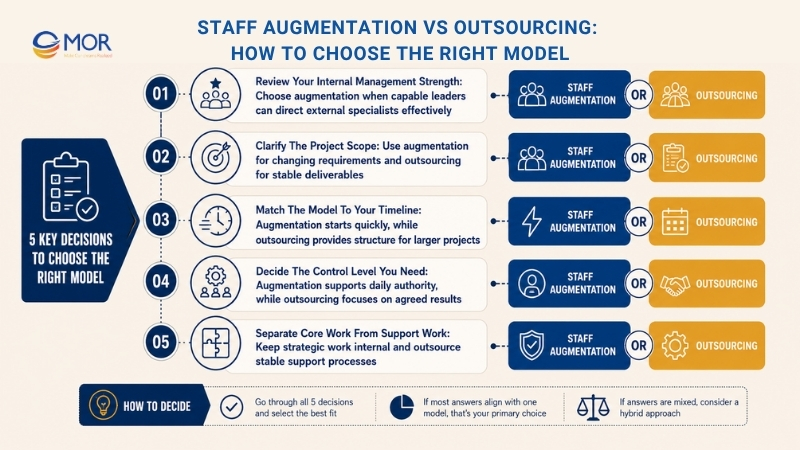
Review Your Internal Management Strength
Begin with the leaders already inside your company. Staff augmentation can work well when you have a CTO, technical lead, project manager, or senior engineer ready to guide outside specialists.
Under this model, developers, designers, QA engineers, and other experts enter your workflow and use your internal process. Your team still needs to control tasks, priorities, feedback, and work quality.
Outsourcing may be safer when your company lacks the leaders or time needed to manage technical delivery. The provider brings the team, work structure, and delivery management.
Clarify The Project Scope
The project outsourcing vs staff augmentation choice becomes clearer once you assess how stable the requirements are. Augmentation suits work that changes often because external specialists can move with the priorities of your internal team.
This approach fits SaaS software development products, startup builds, and product roadmaps that may change after each sprint.
Outsourcing fits work with firm requirements from the start. A provider can plan delivery more accurately when the outputs, schedule, budget, and acceptance rules are already known.
Match The Model To Your Timeline
Augmentation often starts faster when you need one or two roles for an active project. The right specialists can join a sprint, work through a backlog, or support a close deadline.
Outsourcing may need a longer setup period because the provider must study requirements, price the work, form a team, and agree on milestones.
Yet outsourcing can give larger projects a steadier structure through one provider’s delivery leads, engineers, test specialists, and support roles.
Decide The Control Level You Need
Daily authority is one of the clearest differences between these models. Under augmentation, your team leads sprint planning, technical design, code review, and quality rules.
This close working style suits product companies where engineering, product, and design teams must speak often.
Outsourcing shifts attention toward results rather than daily activity. The provider runs execution, while you review milestones, progress reports, and completed outputs.
Separate Core Work From Support Work
Work tied to your main product should usually remain close to your internal team. Augmentation gives you stronger control and better knowledge retention when projects involve private technology, customer data, or intellectual property.
The staff augmentation vs BPO choice is different for stable support processes, where outsourcing can fit help-desk services, customer assistance, scheduled upkeep, payroll work, basic QA, and single-project development.
Many companies use the two models together. They keep product work close through augmentation and place steady support operations with a provider to ease internal workload.
Common Mistakes To Avoid When Choosing Between Staff Augmentation And Outsourcing
Choosing staff augmentation vs outsourcing becomes risky when price or sales claims drive the full decision. A poor match can lead to missed deadlines, extra charges, weak communication, and disappointing results.
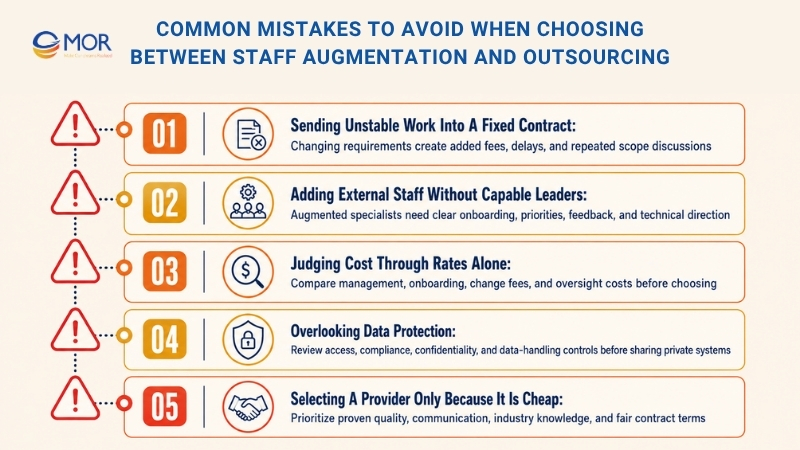
- Sending Unstable Work Into A Fixed Contract: Outsourcing needs clear requirements, outputs, dates, and acceptance rules. A changing product roadmap can bring more change requests, extra fees, and slower decisions.
- Adding External Staff Without Capable Leaders: Augmented specialists still need onboarding, direction, feedback, and clear priorities. If no technical lead or project manager can guide them, provider-managed delivery may be a safer choice.
- Judging Cost Through Rates Alone: A low hourly fee does not always create a lower final bill. Augmentation adds onboarding and management time, while outsourcing may add change fees and vendor oversight work. Review the full cost before you choose.
- Overlooking Data Protection: Giving a provider access to private systems without firm controls creates avoidable risk. Review access rights, compliance duties, confidentiality terms, and data handling rules before work begins.
- Selecting A Provider Only Because It Is Cheap: A reliable partner needs a proven work record, clear communication, relevant industry knowledge, and fair contract terms. Low-cost talent can become expensive when poor quality causes delays and rework.
The right choice comes from matching the engagement model to your real project needs, not chasing the smallest starting price.
What Makes MOR Software the Top Choice for Software Development Solutions?
MOR Software helps businesses build reliable software solutions through flexible engagement models, strong technical expertise, and end-to-end delivery capabilities. As top software development outsourcing company in Vietnam, MOR provides services across web development, mobile app development, custom software development outsourcing, Salesforce development, quality assurance, testing, and offshore software development.
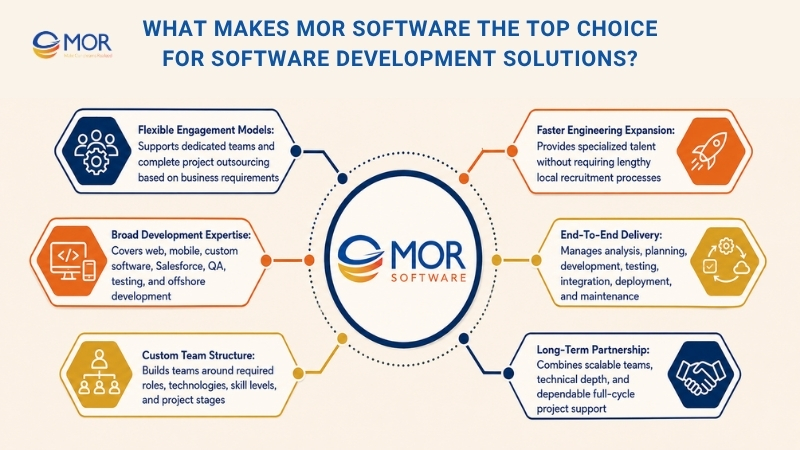
Clients can build dedicated development teams based on specific roles, technologies, skill levels, and project stages. This flexibility allows companies to expand engineering capacity, access specialized talent, and respond to changing project requirements without managing a lengthy local recruitment process.
MOR Software can also take responsibility for the complete software development lifecycle, from business analysis and solution planning to development, testing, integration, deployment, and maintenance. With scalable teams and full-cycle project support, MOR is a strong choice for businesses seeking technical depth, delivery flexibility, and a dependable long-term software development partner.
Conclusion
Choosing between staff augmentation vs outsourcing shapes how much control, risk, and delivery responsibility your team keeps. Staff augmentation works well when you have strong internal leadership and need added skills, while outsourcing suits defined projects that need provider-led delivery. MOR Software supports both needs through dedicated teams and full-cycle software services. Contact MOR Software to discuss your goals, compare the right engagement model, and build a delivery plan that fits your budget and timeline.
"Mr. Cong’s guiding philosophy is simplicity, believing that the simplest solutions are often the most powerful. He sees trust, empowerment, and the opportunity to demonstrate one’s abilities as the key elements that set MOR apart from traditional IT companies."
Mac Tien Cong


Division Manager (Hanoi Branch)
MOR SOFTWARE
Frequently Asked Questions (FAQs)
What are the biggest risks of outsourcing?
Common risks include reduced visibility, communication gaps, limited customization, and dependency on the vendor.
What is the main difference between staff augmentation and outsourcing?
Staff augmentation adds external professionals to your existing team, while outsourcing hands a full project or function to an external provider. In staff augmentation, your team manages the work. In outsourcing, the vendor manages delivery.
Which model gives more control over software development?
Staff augmentation gives more control because external specialists work under your internal managers. You decide tasks, priorities, workflows, and quality standards. Outsourcing gives less daily control because the provider manages execution.
When should a company choose staff augmentation?
A company should choose staff augmentation when it needs specific skills, short-term capacity, or extra support for an existing product team. It works best when the company already has strong internal leadership.
When is outsourcing the better option?
Outsourcing is better when the project scope is clear, the work is non-core, and the company wants the vendor to manage delivery. It also fits teams that do not want to handle daily technical management.
Is staff augmentation cheaper than outsourcing?
Not always. Staff augmentation may look cheaper because rates are clear, but it still needs onboarding, management time, and internal review. Outsourcing may cost more upfront, but it can include project management, QA, and delivery responsibility.
What are the biggest risks of staff augmentation?
The main risks are weak onboarding, poor culture fit, unclear tasks, and lack of internal management. If your team cannot guide external talent well, productivity may drop.
Can companies use both models at the same time?
Yes. Many companies use a hybrid model. They may use staff augmentation for product engineering and outsource stable tasks like customer support, maintenance, or back-office operations.
How do I choose between staff augmentation vs outsourcing?
Start with five questions. Do you need control? Is the scope fixed? Do you have internal managers? Is the work core to your business? How fast do you need the team to start? Your answers will point to the right model.
Which model is better for startups?
Startups often use staff augmentation when they need fast product support and want close control. They may choose outsourcing for fixed-scope work, such as building an MVP, testing a product, or handling non-core operations.
Is outsourcing a dying concept?
No. Outsourcing is evolving, not disappearing. Companies now use it not only to reduce costs but also to access specialized expertise, accelerate delivery, and scale faster. Many businesses also combine outsourcing with staff augmentation to balance control and flexibility.
Share


Make Our-Dreams Realized


© 2023 . MOR Software. All Rights Reserved
Sitemap
Privacy Policy
Terms of Use

Rate this article
0
over 5.0 based on 0 reviews
Your rating on this news:
Name
*Email
*Write your comment
*Send your comment
1