


Salesforce Staff Augmentation: Solve Talent Shortages Rapidly
Salesforce projects rarely wait for hiring teams to catch up. Backlogs grow, releases slip, and internal teams get stuck between daily support and new roadmap work. Salesforce staff augmentation gives businesses a faster way to add certified Salesforce talent without losing project control. In this guide, MOR Software will explain how this model works, when to use it, and how to choose the right partner.
Key Takeaways
- Salesforce staff augmentation helps businesses fill Salesforce skill gaps faster without the cost and delay of full-time hiring.
- This model works best when teams need direct control, flexible capacity, and specialist support for projects like integration, migration, Agentforce, Data Cloud, or custom development.
- Businesses can scale Salesforce teams up or down based on project demands, helping manage costs while maintaining delivery speed and quality.
What Is Salesforce Staff Augmentation?
Salesforce staff augmentation is a hiring model where you add certified Salesforce professionals, including salesforce developers, architects, administrators, and specialists, to your current team on a contract basis while you still guide their daily work.
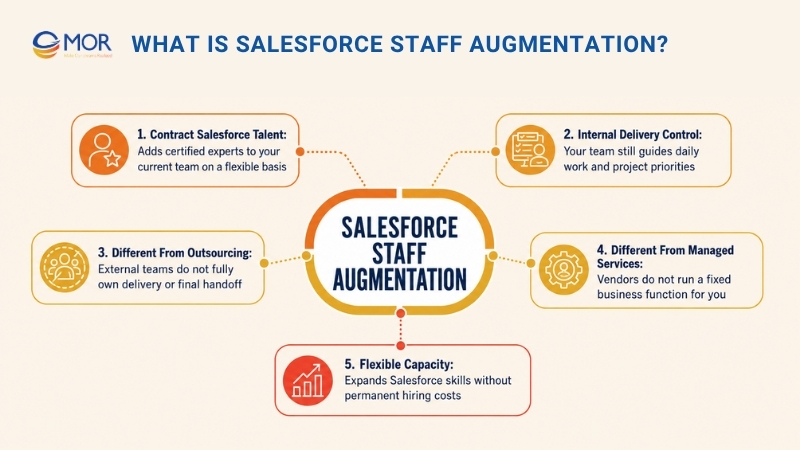
This model is different from outsourcing, where a separate team owns the delivery and sends the finished work back to you. It also differs from salesforce managed services, where a vendor runs a fixed function for your business. It is not the same as full-time hiring either, since you do not carry the full cost of payroll, benefits, equipment, and long-term HR duties. The real strength of this model sits in its mix of speed, control, and flexible capacity, which is why many mid-market and enterprise teams use it instead of adding more staff augmentation employees to permanent headcount.
Salesforce Staff Augmentation Vs Managed Services Vs Dedicated Teams
To pick the right Salesforce delivery model, you need to know how each option affects control, ownership, speed, and long-term knowledge. Salesforce staff augmentation works best when you want skilled people inside your team but still want to manage the project yourself. Managed services make more sense when you need steady Salesforce support handled by an outside partner. Dedicated Salesforce teams are a better fit for large, long-running programs where an external group owns a bigger workstream. This is the core difference in Salesforce managed services vs staff augmentation.
Feature | Salesforce Staff Augmentation | Salesforce Managed Services | Dedicated Salesforce Teams |
Management Control | You direct the work and manage daily tasks. | The provider owns the support scope, results, and service process. | An external pod runs a full project stream or delivery area. |
Primary Goal | Add skilled capacity or close a Salesforce skill gap. | Keep Salesforce stable, supported, and improved over time. | Build larger Salesforce products, tools, functions, or integrations. |
Hiring Speed | Fast, often from 48 hours to 2 weeks. | Timing depends on the SLA, setup scope, and onboarding steps. | Slower than augmentation because the team must be planned and formed. |
Knowledge Retention | Your team keeps more knowledge because the specialist works with your org each day. | Knowledge is shared, but much of it may stay in the vendor’s documents. | Knowledge often stays inside the outside delivery team. |
In simple terms, choose Salesforce staff augmentation when you need speed, flexible skills, and direct project control. Choose managed services when your main goal is stable Salesforce operations. Choose a dedicated team when you want an outside group to run a bigger Salesforce build for the long term.
Salesforce Staff Augmentation Roles Businesses Can Hire
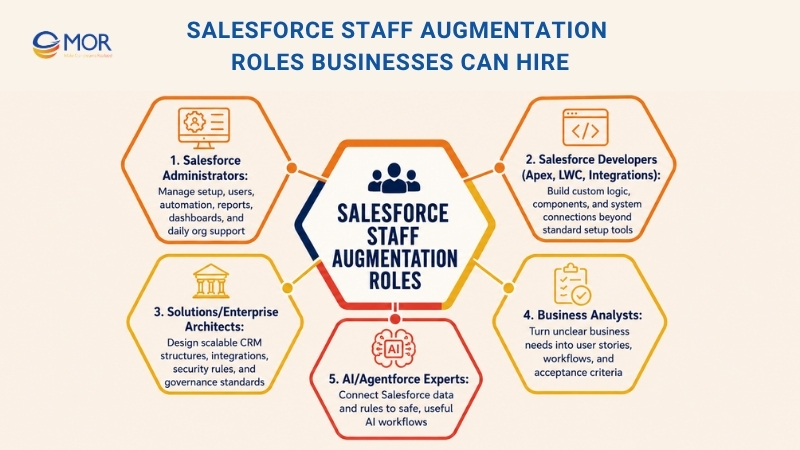
In real projects, Salesforce staff augmentation can cover almost any certified role your business needs. These are the roles companies ask for most often:
Salesforce Administrators
Salesforce Administrators manage setup, users, automation, reports, and dashboards. They support daily org work and keep common admin tasks moving. Augmented admins are useful when your team needs regular coverage but is not ready to hire a full-time employee. Many companies use them together with managed services for small, ongoing support needs.
Salesforce Developers (Apex, LWC, Integrations)
Salesforce developers create custom salesforce Apex logic, build Lightning Web Components, and connect Salesforce with other systems through REST and SOAP APIs. They handle technical work that standard setup tools cannot solve. This role is often added through Salesforce development augmentation when the backlog becomes too large. Without this skill, many projects slow down or stop.
Solutions/Enterprise Architects
Solutions Architects and Enterprise Architects plan CRM structures that match business goals with the right Salesforce setup. Through Salesforce staff augmentation, they can define data models, integration patterns, security rules, access design, and governance standards that keep the org easier to manage over time. You may not need this role every day. But when you plan a multi-cloud rollout, a major system connection, or a long CRM change, a weak foundation can become very expensive.
Business Analysts
Salesforce Business Analysts study workflows, collect requirements, and check that CRM changes solve real business needs. They sit between users, technical teams, and business leaders, then turn unclear requests into user stories, process maps, and acceptance criteria. This role helps when your team knows Salesforce should improve but cannot explain exactly what must change. Augmented analysts help cut rework and keep CRM updates tied to business value.
AI/Agentforce Experts
AI and Agentforce experts help companies set up autonomous agents that work beside human teams. They connect Salesforce data, business rules, approval steps, and user actions so AI can support daily work without creating risk or confusion. This role matters more as companies test AI for sales, service, marketing, and internal tasks. Augmented AI specialists can help teams test use cases, confirm limits, and connect agents with real business workflows.
Key Benefits Of Salesforce Staff Augmentation
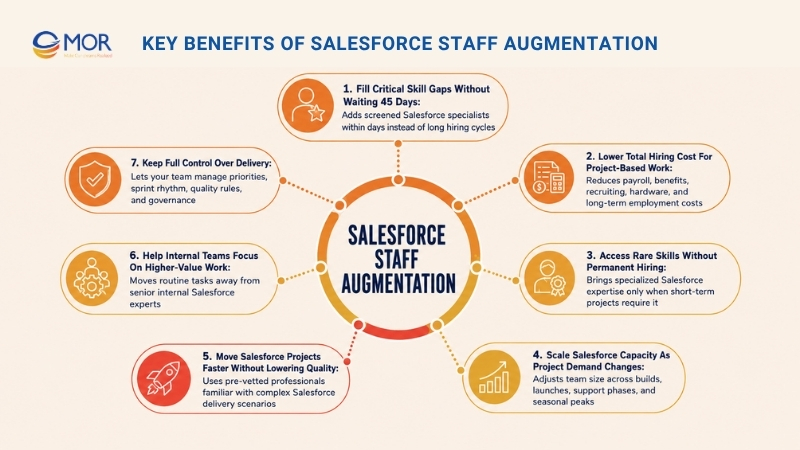
Lists about “flexibility,” “cost savings,” and “access to talent” can sound thin when they do not show business results. The real benefits of Salesforce staff augmentation services are clearer when tied to real project pressure, cost, speed, and control. Each point below explains where this model creates value and why that value matters.
Fill Critical Skill Gaps Without Waiting 45 Days
A normal in-house hiring process for a Salesforce Developer, from job post to the first useful workday, often takes more than 45 days. For senior roles like Technical Architect or MuleSoft Integration Engineer, the timeline can reach 60 to 90 days. This is not a failure by HR. It reflects a tight market where demand for skilled Salesforce talent is much higher than supply.
Salesforce staff augmentation can cut that wait to 48 to 72 hours when the partner has a real bench of screened talent. You send the requirement, review the first matched profile, and move toward onboarding fast. The specialist can join your project, attend standups, and work inside your sprint within a few business days.
Lower Total Hiring Cost For Project-Based Work
The hourly rate may look higher at first. But the full cost of a permanent hire tells a different story. A Salesforce developer in the US with a yearly salary of $130,000 can cost the business around $195,000 to $215,000 after payroll tax, benefits, hardware, recruiting, and onboarding are included.
An augmented Salesforce developer priced at $85 to $100 per hour, working 40 hours per week for 6 months, would cost about $88,400 to $104,000. That price does not add recruiter fees, benefit costs, hardware spend, or extra replacement costs. Many partners also include a replacement window, often around 45 days, if the match does not work.
Access Rare Skills Without Permanent Hiring
Not every Salesforce skill needs a full-time role. A company may need a MuleSoft Integration Engineer for a 90-day ERP-to-Salesforce migration or a Data Cloud Architect for a 60-day CDP build. Keeping either role on payroll all year may not make sense when the need is short and project-based. At $150,000 to $200,000 per year for each role, permanent hiring can be hard to defend.
The augmentation model makes the math easier. You can bring in a Salesforce CPQ Specialist only for the weeks when pricing work needs that skill. You can add an Agentforce Developer for the sprint that needs Agentforce setup. You can bring in a Marketing Cloud Specialist for campaign architecture, then end the engagement when the work is done.
Scale Salesforce Capacity As Project Demand Changes
Salesforce work rarely stays at one steady level. A new implementation may start with a full build team, including 5 developers, an architect, and a QA Engineer. After launch, the support load may need only one or two people. A seasonal peak may add pressure to your Service Cloud setup for 3 months. A board-approved Agentforce pilot may need 2 AI-certified developers for 6 weeks.
Permanent hiring makes every phase change harder. You may keep people on the bench, move them into work they are not trained for, or start another 45-day hiring cycle. With Salesforce team augmentation, the team can change after a short discussion and a clear brief. You add developers during the build phase. You scale down for post-launch support. You bring in the Agentforce specialist when the pilot starts.
Move Salesforce Projects Faster Without Lowering Quality
A professional added through Salesforce staff augmentation should not need half a year to become useful. A strong partner screens them for certifications, project cases, and real delivery scenarios before you review the profile. They have worked in Salesforce orgs close to yours, so they understand common architecture choices, integration patterns, and technical debt issues.
Help Internal Teams Focus On Higher-Value Work
When one internal admin or developer is the only person who understands your Salesforce org, every new change request, connection issue, and user problem reaches that person first. Much of their time can disappear into tickets, fixes, and workarounds. In many teams, 60 to 70% of their week goes to support work, leaving 30% or less for higher-value Salesforce plans.
Adding support through this staffing approach changes that split. Routine build work, admin support, and maintenance tasks can move to the augmented resource. Your senior internal expert can return to architecture choices, roadmap planning, governance, and stakeholder work, where company knowledge matters most.
Keep Full Control Over Delivery
Many businesses do not value this benefit until they have tried another model. When you outsource a Salesforce project, the outside agency often controls the work. They choose the pace, guide architecture choices, set the testing method, and send results back to you. If those results miss the mark, fixing the gap can take time and money you did not plan for.
With staff augmentation for Salesforce projects, you keep control of the delivery. The augmented expert reports to your project manager, follows your sprint rhythm, works with your quality rules, and commits code to your codebase. You assign the work. You set priorities. You review the output. You decide when the specialist is still needed and when the engagement should end.
When Salesforce Staff Augmentation Creates Maximum Business Value
The benefits above show what the model can do. Salesforce staff augmentation is most useful when a clear business trigger appears, and your team needs skills or capacity right away. A common staff augmentation example is a project that cannot move because one certified specialist is missing.
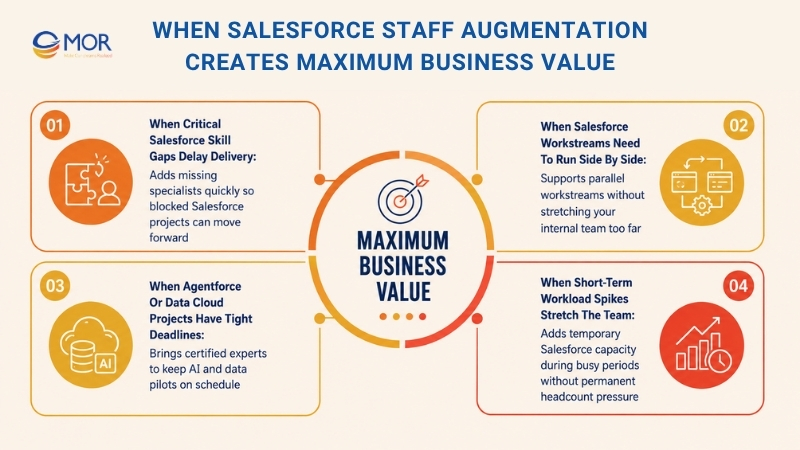
When Critical Salesforce Skill Gaps Delay Delivery
Current Issue: Your project manager keeps holding sprint approvals, the launch date has already changed twice, and one open role keeps blocking progress. It may be a CPQ Specialist, a MuleSoft Engineer, or an Agentforce Developer that your internal team does not have.
How The Model Solves It: This staffing approach can close the gap in 48 to 72 hours. A screened and certified expert joins your sprint on day three or four, the blocker is removed, and the project can return to its timeline without changing the full delivery plan.
When Salesforce Workstreams Need To Run Side By Side
Current Issue: You are rolling out Sales Cloud and need a Service Cloud integration at the same time. Your current team can manage one track well. Two tracks at once need extra people, and hiring them fast is not realistic.
How The Model Solves It: Augmented developers can own the second workstream. Both parts move at the same time. Your launch date comes closer. You avoid a slow step-by-step delivery path that can turn a 6-month rollout into a 12-month project.
When Agentforce Or Data Cloud Projects Have Tight Deadlines
Current Issue: Leadership has approved a 90-day Agentforce AI pilot. Your in-house team knows Salesforce well, but it does not have Agentforce certification yet. That gap is normal because the platform only launched in October 2024.
How The Model Solves It: Salesforce staff augmentation gives your team access to an Agentforce-certified developer from a ready talent bench within 48 hours. The pilot can stay on its planned schedule. Your internal team also gains knowledge during the work, not after it ends.
When Short-Term Workload Spikes Stretch The Team
Current Issue: Q4 system updates, a large data migration, or a year-end reporting rebuild may need three times your normal Salesforce development capacity for 10 weeks. After that, demand returns to its usual level.
How The Model Solves It: You add augmented resources during the busy period. You reduce the team once the pressure drops. You only pay for the weeks when the extra capacity is needed. There are no layoff costs, no forced redeployment issues, and no headcount choice you may regret in Q1.
Salesforce Staff Augmentation Cost Vs Full-Time Hiring
The figures below use 2026 market assumptions for a mid-level Salesforce Developer with Platform Developer I/II certification and 3 to 5 years of experience. The Salesforce staff augmentation cost will change based on seniority. Architects cost more, and admins cost less, but the cost pattern often stays the same across roles.
Cost Area | Full-Time Hire (6 months) | Staff Augmentation (6 months) |
Base salary / billing | $130K annual ÷ 2 = $65,000 | $90/hr × 1,040 hrs = $93,600 |
Recruiting / agency fee | $19,500 to $26,000 (15 to 20% of salary) | $0, included in hourly rate |
Employer payroll tax (FICA, etc.) | Around $10,000 for 6 months | $0, agency acts as employer of record |
Benefits (health, retirement, etc.) | Around $12,000 for 6 months | $0, agency covers benefits |
Equipment and onboarding | $6,000 to $10,000 one time | Low, specialist arrives ready |
Time to first useful workday | 45+ days, not billable to the project | 2 to 5 days, with first profile often in 48 hours |
Delay cost at $15K/week project burn | $96,750 for 6.5 unproductive weeks | Around $5,000 for roughly 4 days of ramp-up |
Replacement if they leave | $19,500 to $26,000 new hiring fee | $0, replacement guarantee |
Real 6-month total | $208,250 to $225,750 | Around $98,600, all included |
Source: 2026 market-rate cost model.
The difference is often larger than finance teams expect before they run the full math. For projects shorter than 18 months, this hiring approach often costs less overall, even when the hourly rate looks higher. The reason is simple: full-time hiring includes many costs that do not show up on a vendor invoice but still hit your P&L.
For a fuller cost view, read our guide on Salesforce staff augmentation benefits and ROI, which breaks down rates by role and shows 12-month cost models.
How Salesforce Staff Augmentation Works: Step By Step
A Salesforce staff augmentation project works best when the business is clear about the missing skill, the delivery setup, and the partner’s role from the start. The process is simple, but each step needs enough detail to avoid delays once the specialist joins your team.
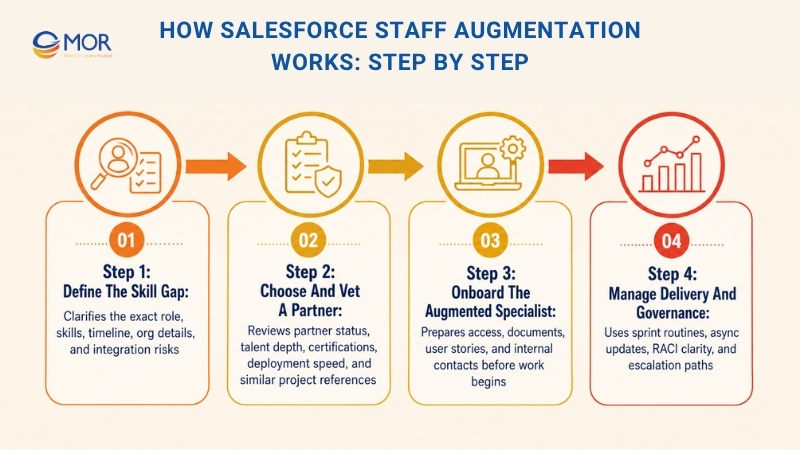
Step 1: Define The Skill Gap
Start with a clear need before speaking with providers. A broad request like “we need Salesforce help” is too vague. A stronger brief would say, “We need a certified CPQ Consultant with Revenue Cloud experience for a 12-week pricing model build, working in 2-week sprints and connecting with our Apex codebase.”
Your request will be stronger when it covers technical needs, timeline, Salesforce org details, and integration risks.
Step 2: Choose And Vet A Partner
Salesforce partner status matters when you compare providers. Summit, once called Platinum, is the top tier and shows a higher level of partner review. Check the real depth of the talent bench, not only the number of people listed. Make sure the certifications match your role needs. Review how fast the partner can deploy talent. Ask how knowledge transfer works. Request references from projects that look close to yours. For teams comparing Salesforce staff augmentation, MOR Software brings Salesforce consulting, development, integration, migration, management, and maintenance experience across business domains.
A 10-point checklist for choosing a Salesforce staffing partner can give you a clear review path.
Step 3: Onboard The Augmented Specialist
Your own onboarding work matters more than many teams expect. Before day one, prepare Salesforce org access, a project brief with user stories, current technical documents, and one named internal contact. Many onboarding delays come from the client side, not from the contractor side. A strong partner has handled this process many times. The weak point is often missing client preparation.
Step 4: Manage Delivery And Governance
After the specialist starts, governance stays with you. Sprint-based work suits distributed augmented teams well. Daily async updates keep everyone aligned without adding too many meetings. RACI clarity helps avoid confusion about who owns each task, which is very useful for teams new to contractor management. Set escalation paths early, before a real issue appears.
How To Choose The Right Salesforce Staff Augmentation Partner
There are many Salesforce staff augmentation companies in the market, so the choice can feel noisy at first. When reviewing Salesforce staff augmentation services, focus on proof of delivery, current certifications, and client feedback that shows how the team works in real projects.
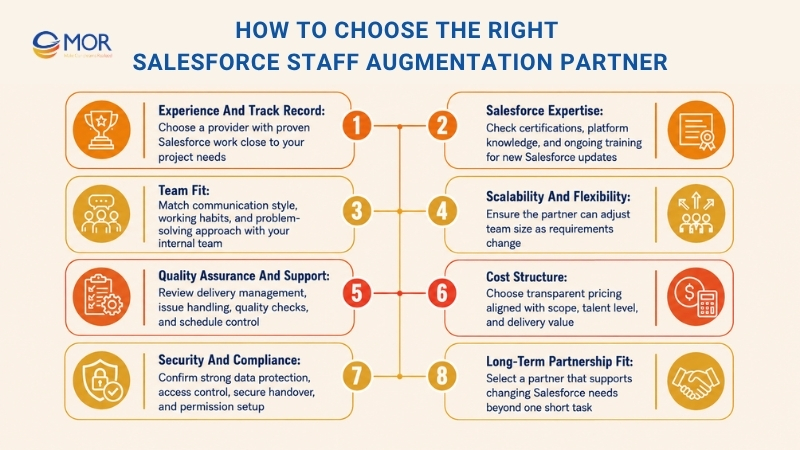
Experience And Track Record
Choose a partner with a strong name in the Salesforce space and a clear record of client work. Review its project history to see whether it has handled work close to your needs.
Salesforce Expertise
Your Salesforce partner should have certified team members who understand the latest Salesforce tools. Look for signs that the provider invests in training, so its team keeps pace with new platform updates.
Team Fit
Your partner’s communication style should match your internal team so work feels clear and easy. Their working style and problem-solving habits should fit your company culture, so the project does not run into avoidable friction. The right staff augmentation Salesforce specialist should feel like part of your team, not a separate outside resource.
Scalability And Flexibility
Pick a partner that can add or reduce people based on your timeline and project load. The team should respond well when requirements change and keep the engagement flexible from start to finish. This is one practical way to grow your business with Salesforce staff augmentation without locking yourself into permanent headcount.
Quality Assurance And Support
Review how your possible partner manages delivery, handles issues, runs quality checks, and keeps the project on schedule.
Cost Structure
Choose a partner with clear pricing that matches your budget and project scope. The cost should reflect the level of talent, support, and delivery value you receive.
Security And Compliance
Your Salesforce partner should have strong data protection practices and follow current legal and industry rules. Salesforce staff augmentation also needs clear access control, secure handover, and careful permission setup.
Long-Term Partnership Fit
Your partner should support your wider business goals, not only one short task. Choose a Salesforce partner that wants to build a steady working relationship and can support your needs as they change over time.
Scale Your Salesforce Team Faster With MOR Software
Building and maintaining a successful Salesforce environment often comes down to having the right expertise available when you need it. Yet many businesses face growing backlogs, delayed releases, and increasing technical debt while waiting to recruit specialized Salesforce talent.
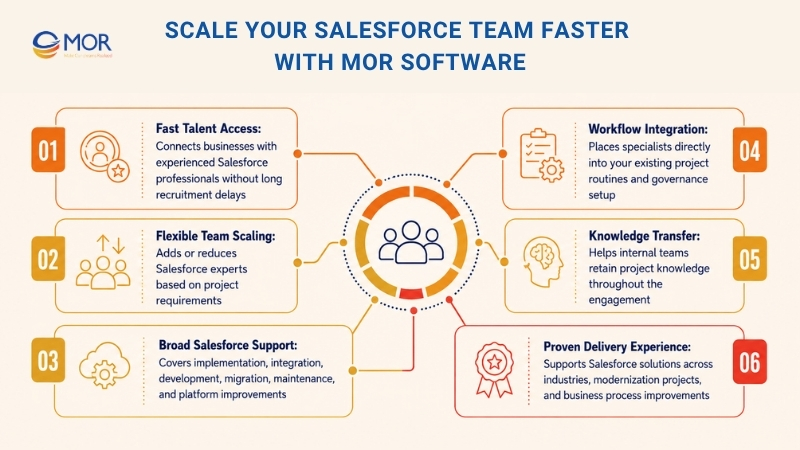
This is where MOR Software can help.
Our Salesforce staff augmentation services give businesses fast access to experienced Salesforce professionals, allowing teams to add capacity without the cost and delays of traditional hiring. Whether you need support for a new implementation, a complex integration, salesforce custom development, data migration, or ongoing platform improvements, we provide specialists who can integrate directly into your existing workflows.
With MOR Software, you can:
- Access certified Salesforce developers, consultants, architects, administrators, and integration specialists.
- Fill critical skill gaps without launching a lengthy recruitment process.
- Scale your team up or down based on project requirements.
- Accelerate Salesforce implementations, upgrades, and enhancement projects.
- Maintain full control over project priorities, workflows, and platform governance.
- Transfer knowledge effectively to your internal team throughout the engagement.
Our experience spans Salesforce development, system integration, contingent workforce management solutions, Customer 360 implementations, and legacy system modernization. We have delivered Salesforce-based solutions for businesses across industries, helping them improve operational efficiency and streamline business processes.
The companies getting the most value from Salesforce are not necessarily the ones with the largest internal teams. They are the ones that know when to bring in specialized expertise, how to scale efficiently, and how to keep projects moving without sacrificing quality. If your Salesforce roadmap is growing faster than your available resources, MOR Software can help you add the right talent at the right time and keep your initiatives on track.
Conclusion
Salesforce staff augmentation gives businesses a practical way to scale Salesforce work without long hiring cycles or heavy permanent costs. It helps teams add the right skills, keep control, and move key projects forward with less delay. For growing Salesforce roadmaps, timing matters. MOR Software can help you bring in certified Salesforce developers, consultants, architects, and administrators who fit your goals. Contact MOR Software to build your Salesforce team with more speed and confidence.
"Mr. Cong’s guiding philosophy is simplicity, believing that the simplest solutions are often the most powerful. He sees trust, empowerment, and the opportunity to demonstrate one’s abilities as the key elements that set MOR apart from traditional IT companies."
Mac Tien Cong


Division Manager (Hanoi Branch)
MOR SOFTWARE
Frequently Asked Questions (FAQs)
What is Salesforce staff augmentation?
Salesforce staff augmentation is a hiring model where external Salesforce experts join your current team for a set period. They work under your direction and help fill skill gaps in development, admin, architecture, integration, or cloud-specific work.
How is staff augmentation different from Salesforce outsourcing?
In staff augmentation, you manage the work and the external specialist joins your team. In outsourcing, the vendor usually owns delivery and sends back the final result. Staff augmentation gives your team more control over tasks, timelines, and quality.
When should a business use Salesforce staff augmentation?
A business should use Salesforce Staff Augmentation when the internal team lacks a specific skill, the backlog is growing, or a project deadline is at risk. It also fits short-term needs like CPQ setup, MuleSoft integration, Data Cloud work, or Marketing Cloud support.
What Salesforce roles can be added through staff augmentation?
Common roles include Salesforce administrators, developers, solution architects, technical architects, QA engineers, business analysts, CPQ specialists, Marketing Cloud experts, MuleSoft engineers, and Data Cloud consultants.
Is staff augmentation better than hiring a full-time Salesforce developer?
It depends on the need. Staff augmentation is often better for short-term projects, rare skills, urgent deadlines, and changing workloads. Full-time hiring makes more sense when the role is permanent and tied to daily Salesforce operations.
How fast can augmented Salesforce specialists join a project?
The timeline depends on the partner, role, and project scope. In many cases, companies can review profiles within a few days and start onboarding shortly after the right fit is approved.
What are the main benefits of Salesforce Staff Augmentation?
The main benefits are faster access to skilled talent, lower hiring pressure, flexible team size, direct project control, and support for time-sensitive Salesforce work. It also helps internal teams focus on planning, governance, and long-term system health.
What should companies prepare before working with augmented Salesforce talent?
Companies should prepare role requirements, project goals, Salesforce org access, user stories, technical documents, sprint process, communication channels, and one internal owner. Clear preparation helps the specialist start work faster.
What are the risks of staff augmentation?
The main risks include weak onboarding, unclear task ownership, poor communication, and choosing a partner with limited Salesforce screening. These risks can be managed with clear requirements, verified certifications, defined workflows, and regular feedback.
How do you choose the right Salesforce staff augmentation partner?
Look at Salesforce experience, certification depth, past project work, communication style, talent screening process, pricing clarity, and security practices. A good partner should understand your project needs before sending profiles.
Share


Make Our-Dreams Realized


© 2023 . MOR Software. All Rights Reserved
Sitemap
Privacy Policy
Terms of Use

Rate this article
0
over 5.0 based on 0 reviews
Your rating on this news:
Name
*Email
*Write your comment
*Send your comment
1