


How to Hire Salesforce Developers: The Ultimate Guide for 2026
Hiring the right Salesforce talent in 2026 is harder than ever. Many teams struggle to hire Salesforce developer profiles who can handle real customization, integrations, and scale, not just basic setup. Delays, mis-hires, and rising costs quickly slow growth. In this guide, MOR Software will share a clear, practical approach to help you hire Salesforce developers with confidence and avoid costly hiring mistakes.
Salesforce Developer Demand Keeps Rising In 2026
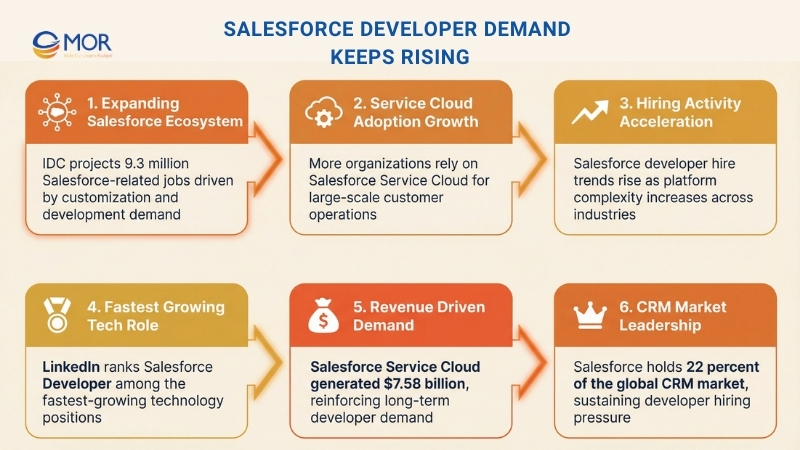
Demand for Salesforce Service Cloud Developers continues to climb as more organizations rely on Salesforce to run customer relationship management systems at scale. This shift toward platform-led operations explains why Salesforce developer hire activity has accelerated across industries. Several data points from trusted sources confirm how strong this trend has become:
- A report from IDC estimates that the Salesforce ecosystem will generate 9.3 million jobs by 2026–27. Many of these positions focus on development and customization, which keeps Service Cloud specialists in high demand.
- LinkedIn’s Jobs on the Rise Report lists Salesforce Developer among the fastest-growing roles, showing rising demand for specialists who work deeply with Service Cloud environments.
- During 2024–25, Salesforce Service Cloud produced $7.58 billion in revenue, showing how central it has become within the broader Salesforce product lineup.
- Holding 22% of the global CRM market, Salesforce continues to lead the space, which increases the need for developers who can implement, extend, and refine the platform.
These signals explain why organizations increasingly choose to bring in experienced salesforce Service Cloud specialists rather than rely on basic configuration alone. Teams that decide to hire Salesforce developer talent gain the technical depth needed to extend platform value, improve process efficiency, and maintain a competitive position as CRM complexity grows.
What Does A Salesforce Developer Do?
When you decide to hire Salesforce developer talent, you bring in a technical specialist who adapts the platform to match real business needs. This role focuses on extending Salesforce beyond default settings so your systems support growth, automation, and complex workflows across teams.
Core Responsibilities Of A Salesforce Developer
Salesforce developers are technical specialists who tailor and expand the Salesforce platform to support specific operational goals. Their day-to-day responsibilities often include the following areas, especially when organizations choose to hire Salesforce sales cloud developer expertise for revenue-focused systems. In projects that rely heavily on modern UI and performance, many teams also choose to hire Salesforce Lightning developers to build scalable, user-friendly interfaces.
- Custom Development: Writing code with Apex and JavaScript to deliver custom features that go beyond standard platform capabilities.
- Integration Work: Linking Salesforce with external systems and third-party tools through APIs and middleware solutions.
- Application Development: Creating custom applications on the platform using Lightning Web Components and Visualforce to support unique workflows.
- Data Migration: Developing scripts and structured processes to move data accurately from legacy systems into Salesforce.
- Automation Development: Designing advanced automation with salesforce Apex triggers, Flow, and Process Builder to support consistent business operations.
- Performance Optimization: Keeping custom solutions efficient by following best practices related to query limits, bulk handling, and governor limits.
- Testing and Deployment: Building full test coverage and managing deployments across different Salesforce environments to maintain system stability.
Salesforce Developer Vs Salesforce Administrator
Many managers and recruiters often mix up these two positions. A Salesforce Administrator mainly handles configuration tasks that do not require coding, including user setup, permission management, dashboard creation, and reporting. In contrast, a Salesforce Developer manages advanced technical needs that involve coding, system integrations, and complex logic salesforce customization. This difference becomes important when you evaluate a Salesforce developer for hire for projects that go beyond standard setup.
If you think of Salesforce as a house, the Administrator focuses on organizing the interior, keeping things clean, and making the space easy to use. The Developer works on the structure itself, redesigning layouts, adding new levels, or connecting the house to external systems like smart power, water, and security services.
Criteria | Salesforce Developer | Salesforce Administrator |
Primary focus | Builds and customizes the system through coding | Manages and configures the system without coding |
Required skills | Apex, Visualforce, Lightning Web Components, API integration | Workflows, Validation Rules, Reports, Dashboards |
Common tools | VS Code, Developer Console, Git, SFDX | Setup Menu, Flow Builder, Report Builder |
Main responsibilities | Coding, system integration, and custom application development | User management, access control, and daily operational support |
Best hired when | For complex customization or third-party integrations | For ongoing system maintenance and user support |
When Do Your Business Need To Hire Salesforce Developer?
Choosing the right moment to hire Salesforce developer support is not always required, especially when your team relies only on basic platform features. That changes once your CRM needs to scale, support heavy customization, or connect with systems like ERP, accounting tools, or payment platforms, where technical expertise becomes necessary.
You may also reach this point when your organization struggles to automate sales workflows, manage complex data structures, or build custom applications on Salesforce. In these cases, many companies decide to hire Salesforce developers to close capability gaps, move faster, and reduce delivery risk. Still, not every implementation needs this role from the start. Below are clear indicators that it may be time to hire a Salesforce developer and expand your technical capacity:
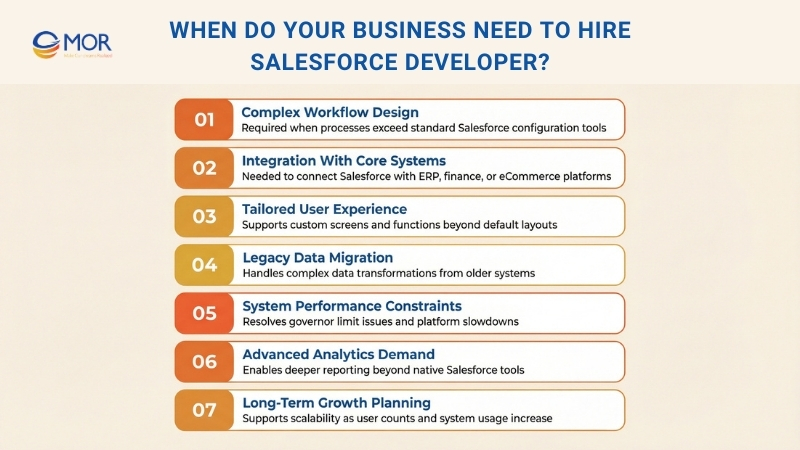
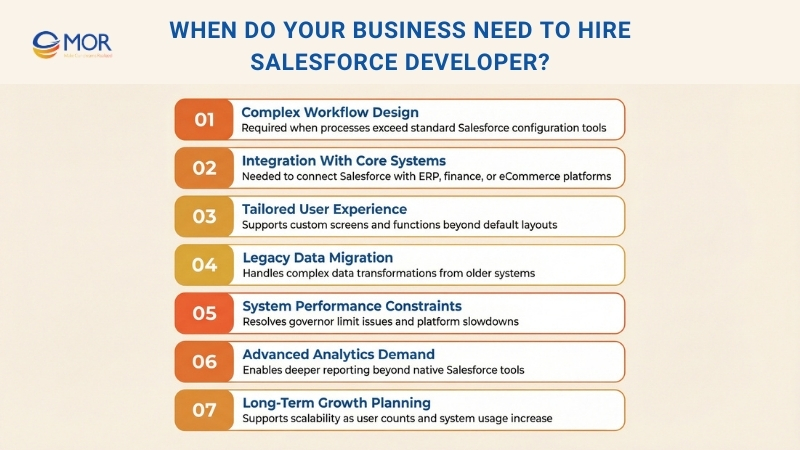
- Complex Workflow Design: When your business processes go beyond what standard Salesforce features or configuration tools can support, salesforce custom development becomes the right option.
- Integration With Core Systems: If your CRM must connect with essential platforms like ERP systems, eCommerce tools, or internal applications, technical integration skills are required.
- Tailored User Experience: When your users need custom screens or functions that standard layouts cannot provide, specialized development helps close that gap.
- Legacy Data Migration: Moving data from older systems often involves complex transformations that require custom logic to avoid errors and data loss.
- System Performance Constraints: If your Salesforce environment slows down or reaches governor limits, technical optimization helps restore stability.
- Advanced Analytics Demand: When built-in reports fail to deliver the insights you need, custom solutions can support deeper reporting and analysis.
- Long-Term Growth Planning: As your user base grows beyond a few dozen Salesforce users, adding a Salesforce developer to your team helps maintain performance and system reliability.
Industry guidance suggests that many organizations gain clear value from developer involvement once they exceed 50 Salesforce users or generate more than $10 million in annual revenue. These benchmarks offer direction, though actual needs vary by business model and system complexity.
>>> Read more topics about Salesforce on MOR Blog!
Types Of Salesforce Developers: How To Find The Right Fit
When you hire Salesforce developer support, selecting the right engagement model and skill level has a direct effect on delivery quality and long-term results. Some organizations also compare this role with a hire Salesforce consultant option, which makes it even more important to understand how different developer types fit specific goals. For long-term ownership and deep system knowledge, many businesses decide to hire dedicated Salesforce developer resources instead of short-term help.
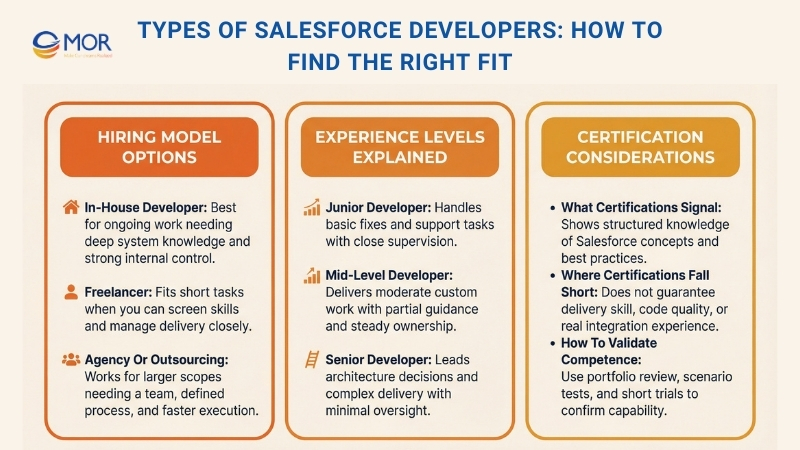
1. Hiring Model Options
Salesforce development can follow several hiring paths, each with trade-offs in cost, flexibility, and execution speed. Your decision should align with how long the work will last and how closely the developer needs to work with internal teams. In distributed teams or global projects, some companies choose to hire remote Salesforce developer talent to access a wider skill pool and control costs.
Criteria | In-house Developer | Freelancer | Agency / Outsourcing |
Level of management control | Strong internal oversight | Partial control | Defined by contract terms |
Cost structure | Higher due to salary and benefits | Flexible pricing per hour or project | Medium to high overall |
Engagement flexibility | Low due to long-term commitment | High and adaptable | Moderate |
Delivery speed | Tied to internal capacity | Quick for small tasks | Fast with a focused team |
Best fit scenarios | Ongoing, large-scale initiatives | Short-term, cost-sensitive work | Medium to large projects needing specialization |
2. Experience Levels Explained
Developer experience plays a major role in how much guidance the role requires and how complex the assigned work can be. Understanding these levels helps you match project needs with the right expertise.
Level | Junior Developer | Mid-level Developer | Senior Developer |
Years of hands-on experience | Under 2 years | 2 to 5 years | More than 5 years |
Level of autonomy | Limited and needs supervision | Works with some autonomy | Leads architecture and teams |
Ideal use cases | Basic tasks and support work | Moderate custom development | Complex systems and planning |
3. Certification Considerations
Salesforce certifications help signal technical knowledge, but they should be reviewed alongside real project experience. Both certified and non-certified developers can deliver value in different scenarios.
Criteria | Certified Developer | Non-certified Developer |
Professional credentials | Holds official Salesforce certifications like PD1 or PD2 | Lacks current or formal certifications |
Skill validation level | Proven through standardized exams | Depends on portfolio and hands-on results |
Most suitable scenarios | Structured hiring for enterprise projects | Flexible work validated through trials |
How To Hire Salesforce Developer: A Step-By-Step Hiring Process
Successfully choosing the right Salesforce specialist calls for a structured hiring approach that reduces risk and improves alignment. A clear process helps you identify candidates who match both your technical goals and business priorities, which makes the decision to hire Salesforce developer talent more predictable and effective.
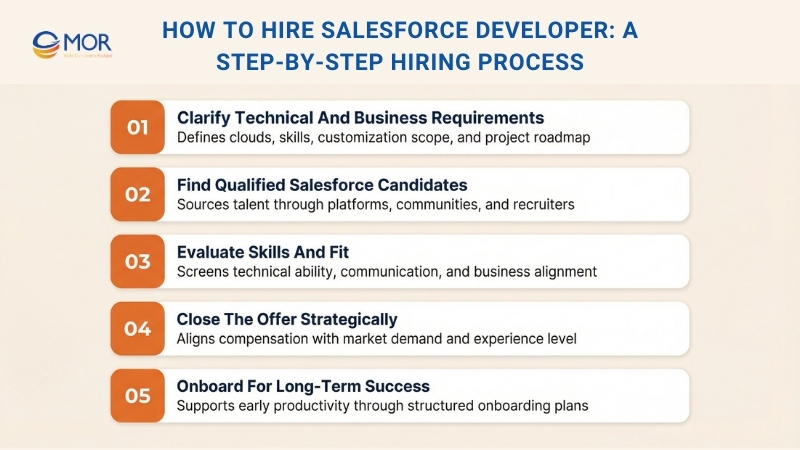
1. Clarify Technical And Business Requirements
The first stage when hiring Salesforce developers involves defining your needs with precision. Prepare a detailed role description that explains which Salesforce clouds your organization uses, the level of customization required, and the overall size of your salesforce implementation. List specific technical skills, including Apex, Lightning Web Components, and system integration experience. You should also outline expected certifications, years of hands-on work, and relevant industry exposure that support your use case.
You should also document the complexity of your current Salesforce implementation, existing custom features, and planned roadmap so candidates know what they will manage. Many teams struggle when expectations are unclear, so this early clarity plays a key role in long-term hiring success.
2. Find Qualified Salesforce Candidates
After you have clear requirements, the next step is to search for candidates through channels that match your hiring goals. Broad platforms like LinkedIn and TechHub Asia provide wide exposure, but Salesforce-focused communities often deliver stronger technical alignment, especially when you need to hire Salesforce API developers for integration-heavy projects.
You can explore the Trailblazer Community, join Salesforce events, and rely on internal referrals to reach experienced professionals. Some teams also choose to work with specialized recruiters who present pre-screened candidates, even though this option usually comes with higher fees.
3. Evaluate Skills And Fit
When you decide to hire Salesforce developer talent, the screening process should balance depth with efficiency. Begin by reviewing resumes for hands-on Salesforce experience, relevant certifications, and project backgrounds that match your needs. Short phone interviews help confirm communication ability and baseline technical understanding.
You can then use practical scenarios or small assignments to test real problem-solving skills within a Salesforce environment. The final stage often includes detailed interviews with both technical staff and business leaders to confirm that the candidate can deliver sound CRM solutions while aligning with business priorities.
4. Close The Offer Strategically
After you select a preferred candidate, prepare an offer that reflects current market rates for their experience level. You should account for regional demand for Salesforce talent and act quickly, since strong candidates often review several offers at the same time. Along with compensation, outline growth paths, meaningful projects, work-life balance, and additional benefits your company provides.
5. Onboard For Long-Term Success
Effective onboarding plays a major role in how well a developer performs and stays with your organization. Build a clear onboarding plan that covers knowledge transfer related to your Salesforce implementation, internal workflows, and existing custom solutions. Assigning a mentor or point of contact helps new hires settle into both technical tasks and team processes, which is especially helpful when teams hire Salesforce mobile app developers who work across systems.
Set clear goals for the first 30, 60, and 90 days, with realistic milestones that encourage early wins and steady progress. Regular check-ins during these early months help answer questions, adjust priorities, and provide timely feedback.
Although this traditional hiring approach can work, many organizations find it slow, costly, and uncertain. Businesses looking for a simpler path sometimes turn to TechHub Asia, which focuses on Salesforce development needs. Their service reduces common hiring challenges and gives access to vetted Salesforce professionals at competitive rates. TechHub Asia builds this advantage through a curated pool of developers who have completed technical testing, communication reviews, and background checks before client engagement.
>>> Thinking about how to become a salesforce consulting partner but not sure where to start Let's breaks down everything you need to know to earn partner status in 2026.
Where To Hire Top Salesforce Developers
When you hire Salesforce developer support, the best sourcing option depends on how fast you need results, how complex your Salesforce environment is, and whether you prefer short-term help or a long-term team. Each channel below serves a different purpose and carries its own level of risk and control.
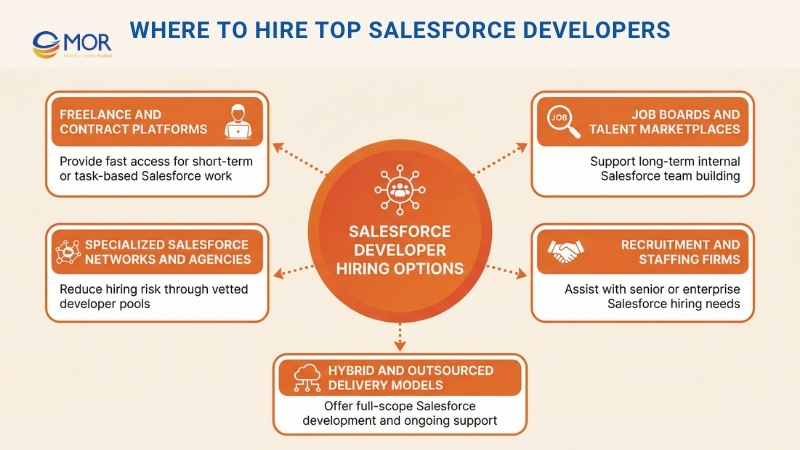
Freelance And Contract Platforms
Freelance platforms are often a good fit for short engagements, urgent fixes, or clearly defined Salesforce tasks. This option offers speed and flexibility, though quality can vary, so careful screening is important when working with a freelance Salesforce developer.
- Toptal is known for its strict vetting process, which makes it suitable for advanced Apex work, integrations, or architecture tasks where errors can be costly.
- Upwork gives access to a wide range of Salesforce professionals with different experience levels, which works well when budgets differ or when testing candidates through smaller assignments.
- Braintrust links companies with experienced Salesforce developers without standard recruiter fees.
- Pangea offers access to pre-screened Salesforce engineers and is often chosen by startups and mid-sized businesses.
These platforms work best for teams that can handle technical interviews and code reviews on their own.
Job Boards And Talent Marketplaces
Job boards are more suitable when you plan to build an internal Salesforce team or bring in long-term contributors who will manage your CRM system.
- LinkedIn continues to be one of the strongest channels for reaching senior Salesforce developers and architects with enterprise-level experience.
- Indeed and Glassdoor help attract a broader pool of candidates, ranging from junior developers to administrators moving into development roles.
This approach usually takes more time to screen candidates, but it often leads to stronger retention and deeper system knowledge over time.
Specialized Salesforce Networks And Agencies
Specialized networks lower hiring risk by screening candidates in advance and matching Salesforce professionals to your technical and industry requirements. Many businesses rely on Salesforce recruitment agencies in this category to balance speed with quality.
- DevTeam.Space delivers managed Salesforce development with defined processes, clear ownership, and delivery accountability.
- Proxify prioritizes quick access to vetted remote Salesforce developers for teams that need fast onboarding.
- Ideamotive connects Salesforce experts based on project scope, industry needs, and technical stack.
- Tecla focuses on nearshore Salesforce talent and is often selected for time zone alignment and smoother communication.
These options work well for teams that need quick results without lowering technical standards.
Recruitment And Staffing Firms
Recruitment firms become valuable when you need senior Salesforce expertise or when internal human resource development teams lack platform-specific hiring experience. This approach supports structured developer staffing for complex or long-term initiatives.
- Valintry and similar providers maintain pools of certified Salesforce professionals for contract and full-time roles.
- Smart IT Staff specializes in fast placement of Salesforce developers for large-scale enterprise projects.
- nCube builds dedicated hiring pipelines to support ongoing Salesforce development programs.
These agencies usually involve higher costs, but they help shorten hiring timelines and lower the risk of mismatched hires.
Hybrid And Outsourced Delivery Models
Outsourced Salesforce becomes a strong option when Salesforce plays a central role in daily operations and requires steady development, integrations, and platform oversight over time.
Managed Salesforce partners provide full-scope services that cover solution design, custom development, system integrations, testing, and ongoing support.
This approach fits organizations that plan to expand Salesforce across sales, service, marketing, and analytics without creating a large internal team.
Selecting the right channel to hire Salesforce developers depends on your delivery timeline, available budget, and long-term platform goals. The best choice may involve a short engagement, a dedicated delivery team, or a long-term partner based on how critical Salesforce is to your business.
A proven example of this hybrid approach is MOR Software. We work with companies that treat Salesforce as a core system and require more than isolated development tasks. Our teams manage continuous customization, Apex and Lightning development, salesforce ERP integration system, data migration, and long-term support while working closely with internal stakeholders. This model allows businesses to scale Salesforce across departments without the cost and complexity of building and managing a large in-house development team.
Cost To Hire Salesforce Developer In 2026
In 2026, the cost to hire Salesforce developer talent depends on skill depth, geographic location, engagement model, and project scope. Teams planning CRM customization, system integrations, data migration, or long-term platform support should budget according to regional salary trends and the level of expertise required. As competition increases across global markets, Salesforce developer hire decisions often require balancing cost efficiency with long-term delivery stability. Rates differ widely across regions, with the United States and Western Europe at the higher end, while Asia and Eastern Europe remain more cost-efficient.
Working with a trusted talent partner to hire a Salesforce developer or consultant can simplify recruitment and help control expenses. Flexible models, including hourly, part-time, full-time, or project-based contracts, allow businesses to match cost structure with project duration and budget limits.
Location | Typical Hourly Rate | Annual/Full-Time Equivalent |
| USA | $60 to $150 per hour, junior to senior | $80K to $160K per year |
| Canada | $65 to $75 per hour | $90K to $150K per year |
| UK and Western Europe | $35 to $60 per hour | $60K to $100K per year |
| Australia | $45 to $66 per hour | $70K to $130K per year |
| Eastern Europe | $25 to $50 per hour | $40K to $80K per year |
| India | $30 to $50 per hour | $20K to $50K per year |
| Vietnam | $25 to $40 per hour | $50K+ per year |
Common Pitfalls When You Hire Salesforce Developer
When you hire Salesforce developer talent, growth can slow down, not because the need is unclear, but because execution risks add up across each stage of hiring. Once delivery timelines tighten, even small staffing errors can push projects back by months.
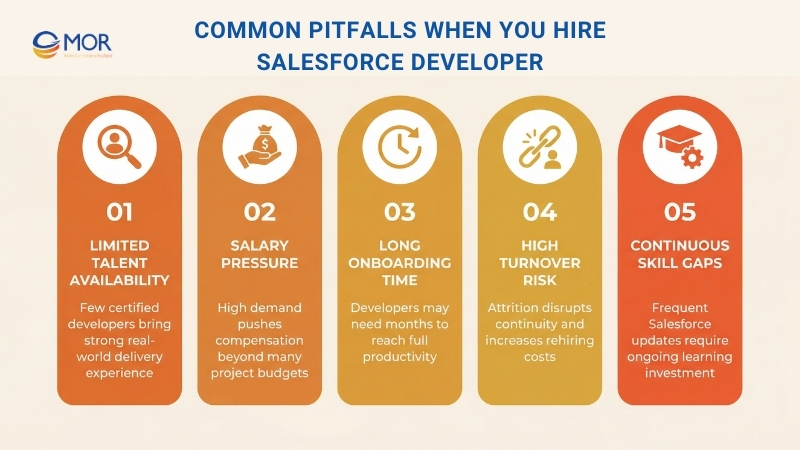
Below are the most frequent challenges organizations encounter when they build or expand Salesforce teams:
- e instead of basic platform familiarity.
- Strong salary pressure as enterprise demand drives compensation beyond what many project budgets can support.
- Extended onboarding periods, where developers need 3 to 6 months to reach full productivity, which delays short-term delivery goals.
- Turnover risk that disrupts continuity, especially in competitive markets. In some regions, attrition can reach up to 40%, forcing repeated hiring and knowledge transfer resets.
- Ongoing learning demands caused by frequent Salesforce updates, where skill gaps return quickly if training and support are not consistent.
These challenges often lead teams into repeated cycles of recruitment, ramp-up, partial delivery, and replacement rather than steady progress. Without clear processes or reliable partner support, these cycles drain budgets and test leadership patience.
Side note: These patterns align with broader trends discussed in the biggest tech recruitment challenges that continue to shape hiring outcomes in 2025.
With these risks in mind, the next step is to focus on practical ways to select the right Salesforce specialist from the start.
Practical Tips To Hire Salesforce Developer Talent Successfully
Success in efforts to hire Salesforce developer talent depends more on precision than speed. Once delivery risk increases, every hiring decision should strengthen execution instead of creating more uncertainty.
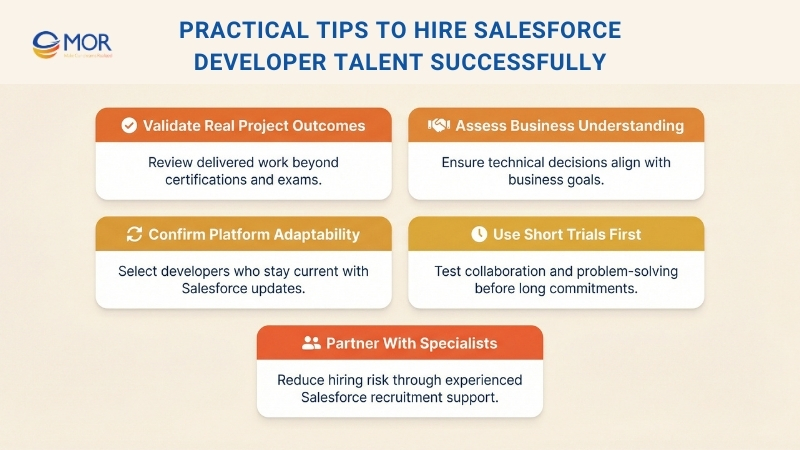
Below are practical actions we recommend to help teams avoid repeated hiring mistakes:
- Production work related to integrations, automation launches, or performance improvements.
- Review technical skills alongside business awareness. Pay attention to how candidates link technical choices to business results, not just how they solve isolated problems.
- Confirm ability to adapt to platform updates. Choose developers who regularly refresh their skills as Salesforce releases change instead of relying on outdated practices.
- Start with short trials or test assignments. Use these to see how candidates document tasks, work within sprint cycles, and respond to feedback before long-term commitments.
- Work with a specialized recruitment partner. Use expert screening, ecosystem knowledge, and faster shortlisting to reduce risk while keeping timelines and budgets under control.
Conclusion
Choosing the right Salesforce talent in 2026 requires clarity, planning, and realistic expectations. From defining requirements to managing cost and risk, every decision affects long-term system performance. When you hire Salesforce developer support with the right approach, Salesforce becomes a growth engine, not a bottleneck. MOR Software helps businesses build stable, scalable Salesforce teams without hiring overhead. Ready to move forward? Contact us to discuss your goals, timeline, and the right delivery model.
MOR SOFTWARE
Frequently Asked Questions (FAQs)
What does it mean to hire a Salesforce developer?
Hiring a Salesforce developer means working with a specialist who builds, customizes, and integrates Salesforce using code. This role focuses on Apex, Lightning components, automation logic, and system integrations that go beyond standard setup.
When should a company hire a Salesforce developer instead of an administrator?
You should hire a Salesforce developer when configuration tools are no longer enough. Typical reasons include complex automation, custom user interfaces, third-party integrations, or performance issues tied to governor limits.
What skills should I look for when I hire a Salesforce developer?
Strong candidates usually have experience with Apex, Lightning Web Components, APIs, data modeling, and deployment workflows. Hands-on work with specific Salesforce clouds also matters.
Is it better to hire a freelance Salesforce developer or a full-time one?
Freelancers fit short-term or well-defined projects. Full-time developers make more sense when Salesforce is central to daily operations and requires continuous improvement and ownership.
How long does it usually take to hire a Salesforce developer?
The timeline depends on experience level and hiring method. It often takes a few weeks to screen candidates, run interviews, and finalize an offer. Pre-vetted networks can shorten this process.
Do Salesforce developers need certifications to be effective?
Certifications help confirm platform knowledge, but they are not the only measure of skill. Real delivery experience, code quality, and problem-solving ability often matter more.
How much does it cost to hire a Salesforce developer in 2026?
Costs vary by region, seniority, and engagement model. Hourly rates differ widely across global markets, while full-time salaries scale with experience and demand.
What are common mistakes when companies hire a Salesforce developer?
Common issues include unclear requirements, relying only on certifications, skipping technical tests, and underestimating onboarding time. These mistakes often lead to delays or re-hiring.
Can I hire a Salesforce developer for a short-term project?
Yes. Many companies hire Salesforce developers for migrations, integrations, or specific feature builds. Clear scope, milestones, and deliverables are key to success.
How can I tell if a Salesforce developer is the right fit?
Review past projects, use scenario-based questions, and assess how the developer explains technical decisions. A strong fit connects technical choices to real business needs.
Share


Make Our-Dreams Realized


© 2023 . MOR Software. All Rights Reserved
Sitemap
Privacy Policy
Terms of Use

Rate this article
0
over 5.0 based on 0 reviews
Your rating on this news:
Name
*Email
*Write your comment
*Send your comment
1