


Offshore Software Development Services: 2026 Strategic Guide
Hiring offshore teams can cut cost, but the wrong partner can slow releases, create rework, and blur ownership. Offshore software development services help companies access global talent, offshore software outsourcing models, and flexible delivery without building every role in-house. In this guide, MOR Software will break down services, costs, risks, process, and top destinations for 2026.
Key Takeaways
- Offshore software development services work best when companies match the right destination, partner, and engagement model to their product goals.
- Vietnam, India, China, Singapore, Eastern Europe, and Latin America each bring different strengths in cost, talent, governance, and time-zone fit.
- Strong offshore results depend on clear requirements, stable communication, code quality control, security readiness, and a small pilot before scaling.
What Are Offshore Software Development?
Offshore software development is the practice of hiring a software development team or technology partner in another country to build, test, maintain, or support digital products. Instead of relying only on an in-house team, companies work with offshore developers to access global tech talent, reduce development costs, and speed up project delivery.
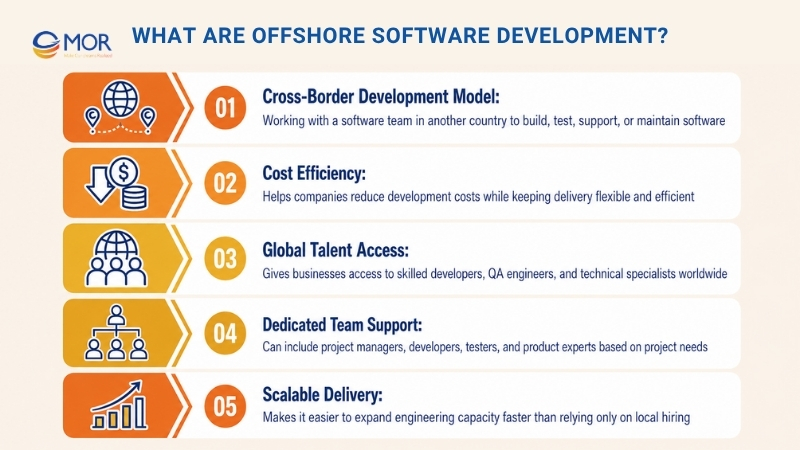
This model is commonly used for agile web development, mobile app development, offshore software testing, UI/UX design, cloud solutions, IT support, and long-term product maintenance. For many businesses, offshore software development offers a flexible way to scale engineering capacity without the cost and complexity of building a full local team.
A Comprehensive Look At Offshore Development In 2026
In 2026, offshore software development services are no longer viewed as a basic cost-cutting choice. A model once used mainly to lower expenses has grown into a way for businesses to build stronger global tech teams.
Offshore teams now work as connected delivery partners. They support not just coding, but also product planning, cloud work, and AI adoption.
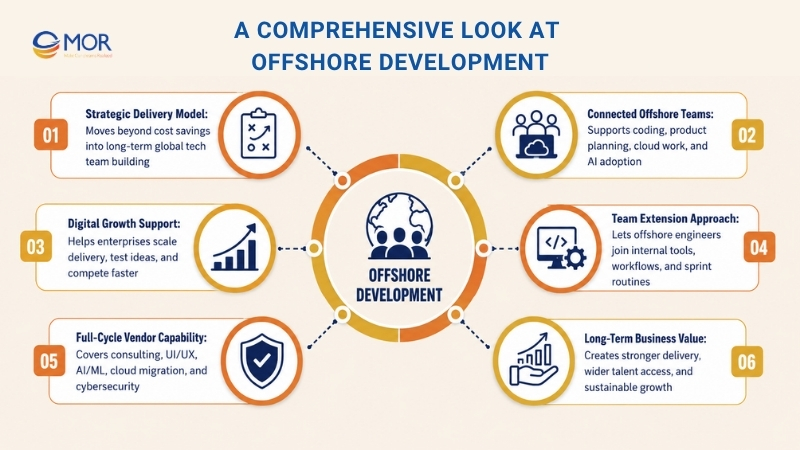
This model is becoming part of long-term digital planning. It helps enterprises grow their delivery capacity, test new ideas, and compete across markets with more speed.
- Offshore teams are now involved in system design, product planning, and DevOps work.
- Many businesses use a team extension model, where offshore engineers join the internal team and use the same tools, workflows, and sprint habits.
- Skilled offshore custom software development vendors now go beyond hiring support. They handle full-cycle development, including consulting, UI/UX design, AI/ML integration, cloud migration, and cybersecurity.
For that reason, offshore IT outsourcing is no longer just a way to cut spending. It has become a practical path to stronger delivery, wider talent access, and long-term business growth.
Core Offshore Software Development Services For Businesses
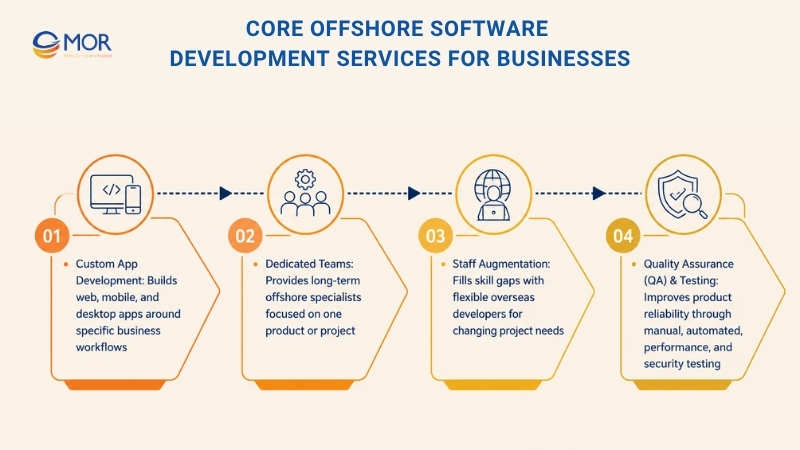
Offshore software development companies usually offer several service models, depending on what a business wants to build, improve, or scale. Some companies need a full product built from scratch, while others only need extra engineers, QA specialists, or long-term technical support. The right choice depends on product goals, existing systems, available budget, timeline, and future growth plans.
Custom App Development
Custom app development covers the end-to-end creation of web, mobile, and desktop applications. Offshore teams can support everything from product discovery, UI/UX design, architecture planning, frontend and backend development, integrations, testing, deployment, and maintenance. This service is suitable for businesses that need software built around specific workflows, customer needs, or operational requirements.
Dedicated Teams
A dedicated offshore team works as a long-term extension of your in-house staff. This model gives businesses access to developers, QA teams, project managers, business analysts, and other specialists who focus on one product or project over time. It is useful for companies that need stable development capacity without building a large internal team immediately.
Staff Augmentation
Staff augmentation helps businesses fill specific skill gaps with overseas developers. For example, a company may need React developers, cloud engineers, mobile app developers, DevOps specialists, or agentic AI developers for a limited period. This model is flexible because businesses can scale resources up or down based on project demand.
Quality Assurance (QA) & Testing
Quality assurance and testing services help companies improve product reliability before and after release. Offshore QA teams can handle manual testing, automation testing, regression testing, performance testing, security testing, and compatibility testing across devices and platforms. This is especially valuable for businesses that need faster release cycles while reducing bugs, downtime, and user experience issues.
Offshore, Nearshore, And Onshore Development Models Compared
Companies comparing offshore software development services with nearshore or onshore teams need to look beyond hourly rates. A good offshore software development service should also be judged by hidden costs, delivery risk, team growth, and access to the right skills.
Model | Definition | Pros | Cons | Best For |
Onshore | A development model where the software team is based in the same country as the client. | • Real-time collaboration: Easier meetings, faster feedback, and fewer time zone issues. • Strong cultural alignment: Shared language, work habits, and business expectations. • Simpler compliance: Easier legal, data residency, and regulatory management. • Closer control: Internal teams can work directly with developers more often. | • Highest cost: Development rates are usually the most expensive. • Limited talent pool: Hiring specialized developers locally can take longer. • Slower scaling: Building a large team may be difficult due to local market competition. | Companies that need close collaboration, strict compliance control, sensitive data handling, or frequent live interaction with internal teams. |
Nearshore | A development model where the software team is located in a nearby country or region with similar time zones. | • Lower cost than onshore: Usually more affordable while keeping coordination easier. • Better time zone overlap: Daily meetings and Agile ceremonies are easier to manage. • Regional talent access: Strong engineering talent in nearby markets. • Moderate collaboration effort: Communication is usually smoother than offshore delivery. | • Smaller talent pool than offshore: Access to niche skills may still be limited. • Cost savings vary: It may not deliver the same level of savings as offshore software development. • Regional compliance still matters: Contracts, tax rules, and security requirements still need careful review. | Businesses that want a balance between cost savings, easier Agile collaboration, and lower communication gaps. |
Offshore | A development model where the software team is located in a distant country, often in a lower-cost technology market. | • Greatest cost advantage: Often delivers the strongest savings compared to onshore hiring. • Large global talent pool: Access to specialized developers, niche technologies, and enterprise engineering skills. • High scalability: Teams can grow quickly from a few developers to large delivery units. • Flexible delivery capacity: Useful for long-term product development, modernization, and support. | • Time zone differences: Requires structured communication and clear delivery processes. • Higher governance needs: Security, IP protection, quality control, and compliance must be managed carefully. • Possible communication gaps: Without strong project management, misunderstandings can affect delivery quality. | Companies that need fast team growth, lower development costs, rare technical skills, large-scale modernization, or long-term product engineering capacity. |
Hybrid | A blended development model that combines onshore, nearshore, and offshore teams in one delivery structure. | • Balanced control and cost: Strategic roles can stay onshore while development work is handled offshore or nearshore. • Flexible team structure: Companies can place product owners, architects, or project managers closer to the business while scaling engineers globally. • Better risk management: Critical tasks can remain local, while execution-heavy work is distributed. • Improved scalability: Businesses can expand delivery capacity without losing direct oversight. | • More complex coordination: Requires clear roles, communication rules, and delivery ownership. • Higher management effort: Multiple locations may create process gaps if not well organized. • Inconsistent team culture: Different working styles can affect productivity without strong leadership. | Companies that want the control of onshore teams, the collaboration advantages of nearshore teams, and the scalability and cost benefits of offshore software development. |
Key strengths
- Local development: Best for projects that require tight compliance control, sensitive data handling, and constant live collaboration with internal teams.
- Regional outsourcing: A balanced choice for companies that want lower costs while keeping Agile communication relatively simple.
- Global offshore delivery: A strong option for large modernization projects, niche technical skills, and fast engineering team expansion.
- Hybrid delivery: Ideal for businesses that want to keep strategy, product ownership, or governance close to home while using offshore or nearshore teams to scale development efficiently.
Key Benefits Of Offshore Software Development Services
Offshore software development services bring more value than lower hourly rates. For enterprise teams, the main benefit comes from mixing cost control, wider talent access, and flexible delivery in a way that supports business growth.
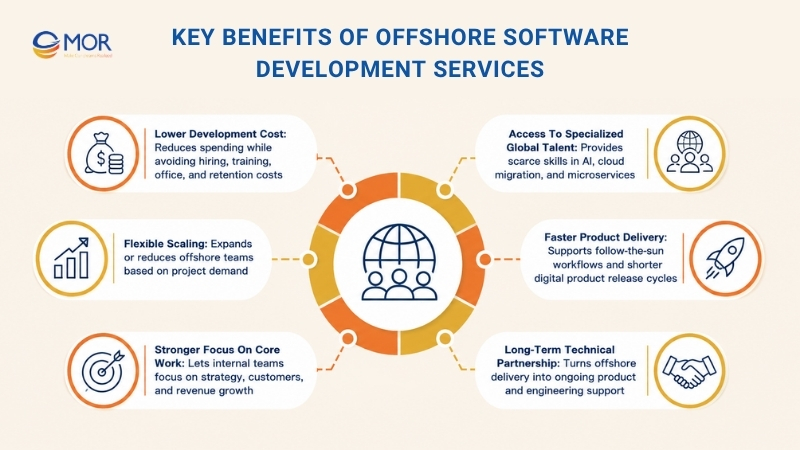
Lower Development Cost
Offshore outsourcing can cut development spending by 40–70%, but the bigger value often comes from a lower total cost of ownership. Enterprises avoid many costs linked to hiring, training, office setup, and long-term retention. A partner may also manage HR, tools, and operations, which gives internal teams more budget for product work and new ideas.
Access To Specialized Global Talent
Hiring engineers with skills in AI, cloud migration, or microservices can be hard in local markets. Offshore development partners give companies access to deeper talent pools with skills that may be scarce at home. This helps modernization work move faster and makes new technology adoption less painful.
Flexible Scaling
Retail and enterprise projects often grow in stages, starting with discovery and moving into large rollouts. Offshore software teams can expand during busy phases and shrink when demand slows. This flexibility helps companies avoid overhiring while still keeping delivery power ready when needed.
Faster Product Delivery
Offshore software development services can support a follow-the-sun workflow, where progress continues across different time zones. For companies under pressure to ship digital products faster, this can shorten release cycles and help new features reach users sooner without exhausting internal teams.
Stronger Focus On Core Work
When offshore partners handle delivery work, business leaders can spend more time on strategy, customer experience, new revenue ideas, and supply chain plans. This split allows internal teams to focus on work that shapes the business, while the remote team handles day-to-day build tasks.
Long-Term Technical Partnership
Strong offshore relationships often grow beyond task delivery. Experienced partners bring domain knowledge, engineering habits, and product thinking into the work. Over time, this turns outsourcing into a true technical partnership, not just a source of extra developers.
Offshore Software Development Services Process From Discovery To Release
A clear delivery process helps offshore software development services stay on schedule, keep product quality steady, and support better work across distributed teams. Instead of loose, untracked tasks, strong offshore delivery uses a clear process that keeps work visible, ownership clear, and improvement active through the full software lifecycle.
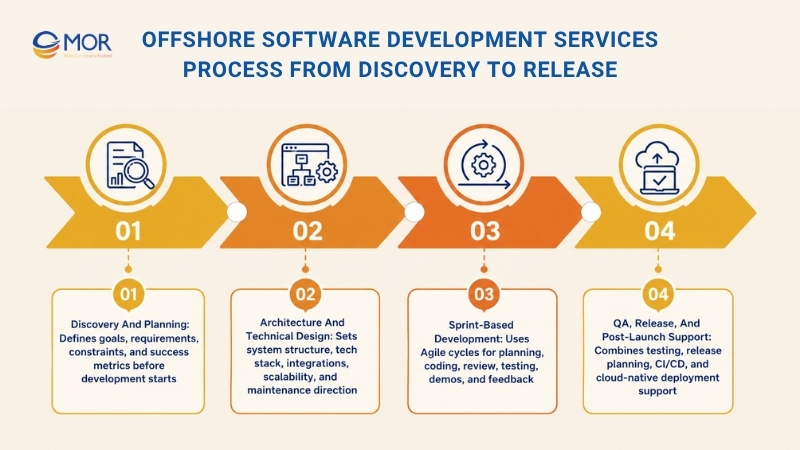
Discovery And Planning
The process starts with discovery and planning. At this stage, teams define business goals, map functional and technical needs, check possible limits, and agree on success metrics. When teams align early, development work stays tied to business goals and fewer mistakes turn into expensive fixes later.
Architecture And Technical Design
After the requirements are clear, the team moves into architecture and technical design. Engineers choose the right system structure, select the tech stack, plan links with current systems, and check how the product can grow over time. Solid technical planning gives the product a stronger base for maintenance, speed, and system stability.
Sprint-Based Development
Once the technical direction is set, offshore software development services move through short Agile sprint cycles. Each sprint often covers backlog planning, coding, code review, testing, demos, and stakeholder feedback. Regular sprints help teams catch issues early, adjust to new business needs, and keep delivery steady.
QA, Release, And Post-Launch Support
Before software goes live, it passes through a full QA and release stage. Good QA work mixes automated checks, manual testing, performance reviews, and security testing to confirm that the product works as planned. A clear release plan also lowers deployment risk and helps teams launch with more control. For modern products, offshore engineering can add CI/CD pipelines, automated release flows, and cloud-native setup to make releases more stable, faster, and easier to manage.
Top Offshore Software Development Destinations In 2026
Picking an offshore software development destination takes more than comparing the lowest hourly cost. Companies also need to review talent depth, technical skill, communication habits, time-zone fit, market stability, and long-term team growth. In 2026, the best countries are the ones that mix fair pricing with steady delivery, modern engineering skills, and smooth daily work.
Country | Cost Range (2026, USD/hour) | Best Fit For | Main Strength | Watch Point |
Vietnam | Approx. $18-45/hr | ODC setup, web apps, mobile apps, Salesforce custom development, QA automation, Japan-facing BrSE delivery | Fair cost, strong engineering talent, Japan collaboration | Pick teams with clear BrSE, PM, and QC support |
India | Approx. $15-50/hr | Large delivery pods, ERP/CRM modernization, data engineering, AI/ML, DevOps, L2/L3 support | Scale, talent depth, broad tech coverage | Vendor quality can vary a lot |
Philippines | Approx. $15-40/hr | Support-heavy SaaS maintenance, QA testing, API integration, web/mobile product squads, documentation-heavy projects | English communication, remote work fit, support culture | Senior engineering depth may be smaller than India or Vietnam |
China | Approx. $30-60/hr | AI platforms, data platforms, IoT systems, hardware-software integration, high-traffic eCommerce systems | Strong technical depth and R&D capacity | Communication, culture fit, IP terms |
Singapore | Approx. $35-85+/hr | Fintech, RegTech, cloud strategy, security architecture, data governance, regional PMO | Business setting, legal clarity, trust | Cost is much higher |
Poland | Approx. $40-90/hr | SaaS, fintech, cloud-native systems, microservices, DevSecOps, data platforms | Senior engineers, mature delivery | Higher rates than Asian markets |
Ukraine | Approx. $35-60/hr | Product engineering, DevOps, cloud-native backend, QA automation, custom software | Strong engineering mindset | Business continuity planning matters |
Romania | Approx. $35-75/hr | EU-facing enterprise apps, QA automation, fintech systems, healthcare software, embedded software | Good technical skill and EU work habits | Talent market can be competitive |
Mexico | Approx. $25-55/hr | Agile product squads, customer portals, eCommerce systems, API integration, L2/L3 support | Time-zone overlap with the US | Cost may be higher than Asia |
Brazil | Approx. $20-60/hr | Fintech platforms, eCommerce systems, cloud data tools, mobile apps, enterprise integrations | Big talent pool and growing tech market | English level varies by team |
Colombia | Approx. $20-50/hr | Web apps, mobile apps, SaaS support, QA, API-based systems, support-linked engineering | Good overlap with US work hours | Senior talent may need careful screening |
Vietnam
Vietnam has become a leading offshore development country in Asia because of its fair development cost, growing tech workforce, and strong record with global clients. The country works well for companies that want cost control without losing technical quality or delivery discipline.
Vietnam is also a natural match for Japanese businesses due to long-term Japan-Vietnam tech cooperation. Many local outsourcing firms support Japanese clients through BrSEs, Comtors, bilingual project managers, and delivery teams that understand Japanese work habits. This helps teams lower communication gaps and keep better control over long-term offshore work.
MOR Software is a Vietnam-based global outsourcing company that works with startups, growing businesses, and enterprises. With offices in Ho Chi Minh City, Hanoi, Da Nang, Tokyo, and Osaka, MOR Software supports offshore development, software outsourcing, web and mobile development, Salesforce development, QC and testing, AI development, blockchain development, IoT application development services, and IT consulting. This makes Vietnam a strong choice for companies that need steady delivery, flexible team growth, budget control, and Japan-Vietnam cooperation.
India
India remains one of the biggest and most mature offshore software development countries worldwide. Scale is its main strength. Companies can find developers, QA engineers, cloud specialists, AI engineers, DevOps experts, business analysts, and project managers across many industries and tech stacks.
India is often a good fit for businesses that need large teams, quick hiring capacity, and broad technical coverage. The country is also known for competitive pricing, mature outsourcing models, and long experience with clients in North America, Europe, the Middle East, and Asia-Pacific.
But the Indian outsourcing market is very large, so vendor quality is not always the same. Businesses should review case studies, communication flow, security practices, project management skill, and client feedback before choosing a partner.
Philippines
The Philippines is a strong offshore software development destination for companies that care about English communication, remote teamwork, and support-heavy delivery. Typical market rates sit around $15-40 per hour, which keeps the country in the lower-cost tier for offshore engineering.
The country works well for SaaS maintenance, QA testing, API integration, mobile app development, web product squads, DevOps consulting service, and documentation-heavy projects. Many teams are also used to working with US clients, so communication habits often feel familiar for North American businesses.
The main watch point is senior engineering depth. The Philippines has strong talent, but the pool for senior architects, machine learning engineers, and complex backend specialists can be smaller than in India, Vietnam, Poland, or China. Companies should test technical depth early through code reviews, system design tasks, and pilot sprints.
China
China is another major offshore software development country, mainly for companies that need deep technical skills, enterprise platforms, hardware-software work, fintech systems, eCommerce tools, AI products, data platforms, or large digital infrastructure.
Chinese engineering teams often work on complex systems, high-traffic platforms, and demanding technical builds. This makes China a strong choice for businesses that care most about technical depth, system speed, and enterprise delivery.
At the same time, companies need to watch communication style, cultural fit, compliance needs, documentation quality, and project visibility. China can work well, but both sides should set clear workflows, ownership rules, reporting habits, and security terms from the start.
Singapore
Singapore is a high-end technology country in Asia for companies that want strong governance, legal clarity, IP protection, and regional business control. It works well for enterprise buyers that need trust, compliance, and senior consulting support.
Singapore-based software partners often fit projects in fintech, enterprise software, cloud migration, digital strategy, cybersecurity, and regulated sectors. The country also works well as a regional base for companies growing across Southeast Asia.
Cost is the main trade-off. Singapore is often more expensive than Vietnam, India, and many other offshore countries. For that reason, many companies use Singapore for consulting, strategy, governance, or project leadership, then pair it with delivery teams in nearby lower-cost markets.
Poland
Poland is one of the strongest software development countries in Europe. It is known for senior engineers, good product thinking, and mature work with European and North American clients.
Polish teams are a strong fit for SaaS platforms, fintech products, cloud systems, data tools, AI development, cybersecurity, and enterprise software upgrades. Many teams are used to Agile delivery, DevOps, CI/CD, automated testing, and long-term product work.
Poland is not the cheapest option. Still, it gives strong value to companies that need senior talent, clear communication, and stable engineering habits.
Ukraine
Ukraine has built a strong name in custom software development, product engineering, DevOps, cloud platforms, and QA. Many Ukrainian engineers have deep technical skill and a direct work style, which makes daily delivery easier for product teams.
The country fits companies that need strong engineering talent at a cost below many Western European markets. Ukrainian teams often work well with startups, SaaS development companies, fintech firms, and enterprise clients that need flexible product development.
Business continuity should be part of vendor review. Companies should ask about backup teams, delivery locations, data security, communication plans, and risk control before starting long-term work.
Romania
Romania is a solid choice for companies that want EU-based software talent with good technical skill and familiar work habits. It has a growing pool of developers, QA engineers, cloud specialists, and enterprise software teams.
Romania works well for web applications, enterprise systems, QA automation, fintech, healthcare software, and internal business tools. Its time zone also makes daily work easier for many European clients.
The market can be competitive, especially for senior developers. Companies should check team stability, hiring plans, and delivery history before signing a long-term contract.
Mexico
Mexico is a practical choice for North American companies that want nearshore software development with better time-zone overlap. Teams can join meetings during normal US business hours, reply faster, and work closely with product managers and stakeholders.
Mexico fits Agile product teams, web apps, mobile apps, customer platforms, eCommerce systems, and support-heavy software projects. Its location makes it easier for US companies to build close working routines without late-night calls.
Costs can be higher than some Asian offshore markets. Still, Mexico gives strong value when speed, communication, and real-time teamwork matter more than the lowest rate.
Brazil
Brazil has one of the largest tech talent pools in Latin America. It is a strong choice for companies that need software teams for fintech, eCommerce, cloud platforms, data tools, mobile apps, and enterprise systems.
Brazilian teams often bring strong product thinking and good experience with high-volume digital systems. This makes the country useful for companies that need both coding skill and practical business sense.
English level can vary by team. Companies should test communication quality early, review delivery processes, and confirm who will join daily meetings.
Colombia
Colombia has become a popular software development country for North American companies that want good time-zone overlap and steady collaboration. Its tech market has grown fast, especially in cities like Bogotá and Medellín.
Colombia works well for web apps, mobile apps, product teams, QA, support-heavy projects, and ongoing maintenance. Teams can often work with US stakeholders during the same business day, which helps projects move with less waiting.
The senior talent pool is smaller than in larger countries like India or Brazil. Businesses should screen technical skill, English level, and project leadership before building a long-term team.
Offshore Software Development Services Costs And Rates
For enterprises looking at offshore software development services, a clear view of the cost structure matters. Savings of 40–70% are common, but rates change based on region, role, and engagement model. The points below break down the main cost factors behind offshore software development.
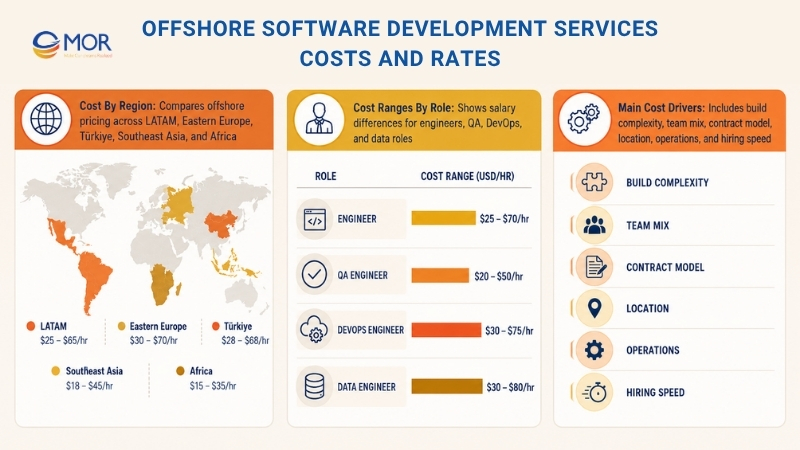
Cost By Region
- LATAM delivery hubs: Latin America, including Mexico, Brazil, and Argentina, gives good cost value with strong cultural fit and time-zone overlap. Mexico has around 500 IT outsourcing companies across tech hubs like Guadalajara and Monterrey.
- Eastern European markets: Poland, Romania, and Ukraine are known for a strong cost-to-quality balance. Poland has about 525K IT specialists and a mature vendor base, while Romania and Ukraine add large talent pools at competitive rates.
- Türkiye as a bridge market: Türkiye is growing as a tech outsourcing hub with around 140K developers. Its pricing is competitive, and its time zone works well for many European clients.
- Southeast Asian teams: Vietnam and the Philippines are attractive for lower costs, support work, and scalable engineering teams, though time-zone and culture gaps may be larger for Western clients.
- African tech hubs: Egypt, Nigeria, and South Africa are growing as secondary outsourcing locations. Costs are low, but their vendor ecosystems are still less mature than Eastern Europe or Latin America.
Cost Ranges By Role
Developer pay changes a lot between markets because of labor cost, talent supply, local demand, and economic conditions. These benchmarks help companies plan budgets for offshore outsourcing software development services and compare destinations that balance cost with engineering quality. The table below shows rough yearly salary ranges for experienced software roles across major hiring markets, though actual pay can change based on seniority, skill, company size, and city.
Country | Software Engineer | QA Automation Engineer | DevOps Engineer | Data Engineer |
United States | $120K-180K | $105K-155K | $130K-185K | $125K-180K |
Canada | $90K-135K | $80K-120K | $95K-145K | $95K-145K |
United Kingdom | $75K-120K | $65K-100K | $85K-130K | $80K-125K |
Germany | $70K-110K | $60K-90K | $80K-120K | $75K-115K |
Poland | $72K-102K | $60K-72K | $84K-102K | $72K-90K |
Romania | $78K-102K | $66K-78K | $90K-102K | $84K-90K |
Ukraine | $60K-78K | $48K-66K | $72K-84K | $60K-78K |
Türkiye | $60K-84K | $48K-66K | $72K-84K | $60K-78K |
Mexico | $67K-78K | $56K-71K | $66K-80K | $56K-84K |
Vietnam | $24K-48K | $18K-36K | $28K-50K | $24K-48K |
India | $18K-40K | $16K-32K | $24K-45K | $22K-42K |
Philippines | $20K-38K | $18K-32K | $24K-42K | $22K-40K |
Note: Salary ranges show rough annual gross pay for experienced professionals. Actual pay depends on seniority, technical depth, industry, company size, and local hiring conditions. These figures are drawn from public salary reports, recruitment firms, and developer pay surveys, including Levels.fyi, Glassdoor, Robert Walters, ITviec, and regional market research.
Main Cost Drivers
- Build difficulty: Complex integrations, strict compliance needs, or AI-heavy work require senior engineers and usually raise project rates.
- Team mix and experience level: A team with senior engineers and mid-level developers can balance quality and cost. An all-senior team may raise output quality, but it costs more.
- Contract model: Offshore Development Centers can lower costs at long-term scale, while team extension gives more room for short-term needs.
- Delivery location: Wage gaps between countries remain the largest factor behind offshore pricing.
- Internal operating cost: In-house teams often add around 45% in extra cost for benefits, office space, taxes, and admin work, which offshore software development services can help avoid.
- Hiring speed: Offshore software vendors help reduce recruitment delays, which lowers the lost business value tied to late product launches.
Risks In Offshore Software Development Services And How To Manage Them
Offshore software development services can lower cost and help teams scale, but leaders still need to manage risk early. Poor risk control can turn savings into extra costs, slow release plans, and expose the business to compliance issues. The risks below are common, along with practical ways to handle them.
- Message gaps: Weak English skills, unclear notes, or poor documentation can cause teams to build the wrong thing.
- Delivery quality risk: Without strong review habits, offshore software outsourcing can lead to uneven quality and more defects.
- Data and compliance exposure: Customer and business data must follow rules like GDPR, HIPAA, and PCI DSS.
- Work culture mismatch: Different views on feedback, decisions, and urgency can slow team trust.
- Time-zone distance: 6–12 hour gaps can reduce shared working hours and slow feedback.
- Contract, law, and IP risk: Weak contracts or limited local legal knowledge can put intellectual property and project control at risk.
Risk control matrix
Risk | Business Effect | How To Manage It |
Message gaps | Wrong requirements, rework, and delays | Set standard documentation rules, use tools like Jira and Confluence, and assign bilingual project coordinators when needed. |
Delivery quality risk | Uneven output and higher defect rates | Use continuous QA, automated tests, and coding rules that match enterprise standards. |
Data and compliance exposure | Fines, brand damage, and data loss | Work with partners that support GDPR, ISO 27001, or HIPAA needs, set clear SLAs, and run regular compliance checks. |
Work culture mismatch | Confusion, low trust, and weaker output | Run cross-cultural onboarding, mix nearshore and offshore teams when useful, and assign product owners to close gaps. |
Time-zone distance | Slower Agile cycles and blocked decisions | Set shared working hours and use clear handoff rules for distributed teams. |
Contract, law, and IP risk | IP loss, disputes, or project stoppage | Use clear contracts with IP terms, NDAs, and legal safeguards, and work with counsel who knows the local market. |
>>> Explore the global offshore software development cost landscape and the factors influencing these differences.
Best Practices For Managing Offshore Software Development Services
Managing offshore software development services effectively requires a structured approach that balances communication, quality control, and team alignment. By applying proven practices, businesses can reduce risks, improve collaboration across distributed teams, and ensure consistent delivery outcomes that align with both technical and business goals.
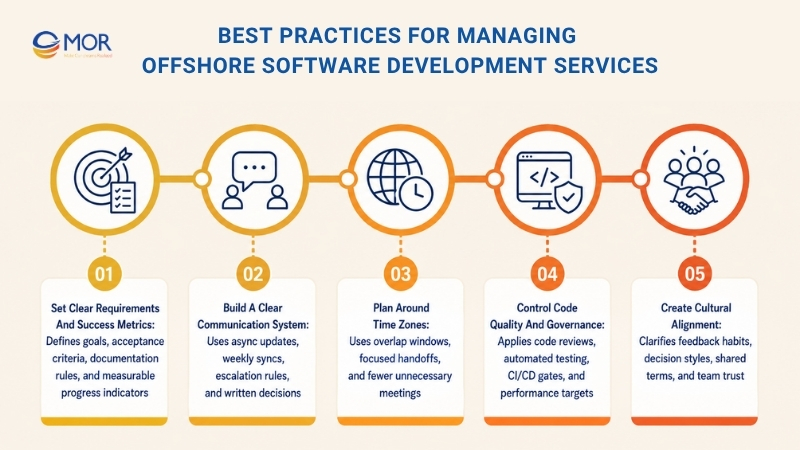
Set Clear Requirements And Success Metrics
Every offshore project should start with three documentation layers: product goals, acceptance criteria, and technical notes.
Product goals explain the business result you want. "Users should complete checkout faster" gives some direction. "Cut cart abandonment by 15%" gives the team a measurable target. Write goals that offshore development teams can use when they need to make product decisions.
Acceptance criteria define what 'done' means. "Login button appears" is not enough. "Login button loads within 2 seconds, accepts email and password, shows errors for invalid details, and sends users to the dashboard after login" removes guesswork.
Documentation rules keep work steady. Each feature should include user stories, API contracts, database schemas, and UI mockups. Use templates. The offshore team should not need to guess your meaning.
Track metrics that show real progress. Code coverage, sprint velocity, bug escape rate, and deployment frequency show team performance. Customer satisfaction and feature use rates show business value.
Build A Clear Communication System
Offshore team communication needs a system because it replaces quick chats in the office.
Daily async updates can replace live status calls. Each developer writes what they finished, what they are doing, and what is blocking them. Use written updates in Slack or project tools. Video is often not needed for status updates and can make scheduling harder.
Weekly sync meetings help teams align on strategy and solve harder issues. Schedule them during shared working hours. Keep the group small. Record meetings for people who cannot join. Use these calls for architecture choices, not routine status notes.
Escalation rules stop small blockers from becoming large problems. Define what needs urgent attention and what can wait for the next sync. Create clear routes for technical blockers, requirement questions, and staffing needs.
Write decisions down. Spoken agreements are easy to forget. Decisions stored in tickets, wikis, or shared docs give everyone a reference when memory fades or team members change.
Plan Around Time Zones
Time-zone planning matters because offshore software development services often depend on limited shared hours. Find the window when both teams are online. A team in Vietnam and a team in New York may share only a small late-night or early-morning window, so those hours need careful use.
Put high-value work inside the overlap window. Code reviews, architecture talks, and sprint planning need live input. Save focused work like coding or documentation for non-overlap hours.
A follow-the-sun workflow can keep progress moving across the day. The in-house team finishes its part and hands work to the offshore team with clear notes. The offshore team continues the build and returns finished work or updates. Each handoff needs a clear record of what changed and what should happen next.
Good handoff notes include current status, next actions, open questions, and useful links. Weak handoffs can waste the next work cycle. A developer may spend hours rebuilding the background instead of writing code.
Do not turn every issue into a meeting. Each meeting costs time across countries. Ask whether a written update can solve the issue before booking a call.
Control Code Quality And Governance
Code review rules create shared quality standards. Require review before merge. Define the checks clearly: style guide fit, test coverage, error handling, and documentation. Automate simple checks and leave people to review logic and architecture.
Automated testing catches broken work before it reaches production. Unit tests check single functions. Integration tests check how parts work together. End-to-end tests copy user paths. Offshore QA should include all three layers.
CI/CD rules make every commit pass quality gates. Builds, tests, and deployment checks run automatically. A developer pushes code. Tests run. If something fails, the merge stops. This keeps bad code from spreading.
Performance targets matter as much as function checks. Set page load needs. Watch memory use. Test database query speed. Offshore teams may work in different network settings and miss speed issues that affect real users.
Create Cultural Alignment
Feedback habits differ across cultures. Some teams expect direct comments. Others prefer softer notes. Set a shared way to give and receive feedback. Make expectations clear.
Decision styles also vary. Some teams expect group agreement. Others look for firm direction from a lead. Clarify who makes final calls on technical choices, feature order, and timeline changes.
Clear terms prevent quiet disagreement. Does "end of day" mean your time zone or theirs? Does "best effort" mean staying late or working within planned hours? Does "minor bug" mean fix now or add to the backlog? Define phrases that can mean different things.
Build real team bonds. Offshore developers are not just resources. They are people with goals, strengths, and work styles. Learn their names. Recognize good work. Know what each person does best. This pays back through stronger trust and better effort.
Conclusion
Offshore software development services can help companies cut hiring pressure, reach stronger tech talent, and ship products faster when the model is planned well. The real value comes from choosing the right destination, setting clear work rules, and working with a partner that understands your goals. MOR Software brings Vietnam-based offshore teams, Japan-ready delivery, and full-cycle software development support to help you build with more control and less risk. If you want to explore how this model fits your business, contact us today.
MOR SOFTWARE
Frequently Asked Questions (FAQs)
What are offshore software development services?
Offshore software development services involve hiring a software team in another country to build, maintain, test, or modernize applications. Companies often choose this model to access specialized talent, expand engineering capacity, and manage development costs.
What is the difference between offshore, nearshore, and onshore development?
Offshore development uses teams in distant countries, nearshore development works with neighboring or nearby countries, and onshore development keeps the team in the same country. Each model differs in cost, time-zone overlap, communication, and talent availability.
Which countries are best for offshore software development in 2026?
Popular destinations include Vietnam, India, Poland, Romania, the Philippines, and Mexico. The right choice depends on your budget, required technical expertise, language proficiency, time-zone preferences, and industry regulations.
Is offshore software development suitable for startups?
Yes. Startups often use offshore teams to launch products faster without hiring a large in-house engineering department. It also gives founders access to experienced developers while keeping early-stage costs under control.
Which engagement model should I choose for an offshore project?
A dedicated team works well for long-term product development, staff augmentation fits companies that need extra engineering capacity, and fixed-price projects are usually better for work with clearly defined requirements and timelines.
What are the biggest risks of offshore software development services?
The most common risks include communication gaps, time-zone differences, inconsistent code quality, security concerns, and changing project requirements. These issues can usually be managed with clear documentation, regular communication, and well-defined development processes.
How do I choose the right offshore software development partner?
Evaluate technical expertise, industry experience, communication practices, security standards, client reviews, delivery methodology, scalability, and the ability to provide long-term support. Running a small pilot project before committing to a larger engagement is also a practical way to assess the partnership.
Share


Make Our-Dreams Realized


© 2023 . MOR Software. All Rights Reserved
Sitemap
Privacy Policy
Terms of Use

Rate this article
0
over 5.0 based on 0 reviews
Your rating on this news:
Name
*Email
*Write your comment
*Send your comment
1