


Hire Machine Learning Developer: The Ultimate 2026 Guide
Hiring the right AI talent is getting harder as demand keeps rising and expectations grow. Many teams struggle to hire machine learning developer profiles or hire AI and machine learning developers who can move beyond experiments and deliver real business value. In this guide, MOR Software will share a practical approach to hire the top candidates effectively in 2026, avoid costly mistakes, and choose talent that truly fits your goals.
Why Hiring Top Machine Learning Talent Is Harder Than Most Roles?
Hiring is rarely simple, no matter the position. But when you try to hire machine learning developer talent, the difficulty rises fast. Several factors explain why this role stands apart.
Some reasons hiring machine learning engineers is such a big challenge.
First, the core foundations keep changing. Artificial intelligence and machine learning move at high speed, and techniques seen as leading edge two years ago may already feel outdated today. At the same time, the number of professionals who can build, deploy, and maintain production systems remains limited and highly specialized, which makes it hard to hire machine learning engineers with real-world experience.
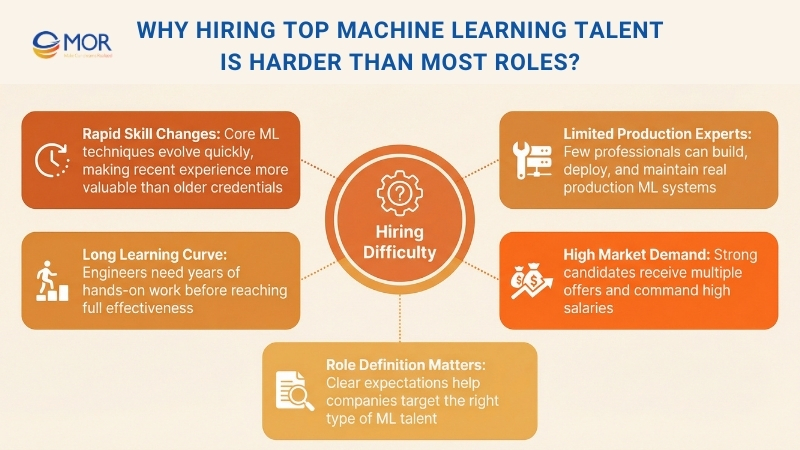
The challenge grows because many ML positions demand years of hands-on work before someone reaches full competence, let alone deep expertise. With demand far outpacing supply, strong candidates are usually already employed, paid well, and balancing several job offers at once.
Even so, the situation is not impossible. The key is understanding which type of ML talent you truly need and where that talent is most likely available. The next section explains how to define the position clearly and set realistic expectations before you begin the sourcing process.
What Does A Machine Learning Developer Do?
It can help to view a machine learning developer as someone who blends the skills of data scientists and software programmers into one role. Strong candidates usually have a solid grasp of statistics and a strong interest in working with data. They pair this knowledge with technical ability to build machine learning models that process data, detect patterns, and produce reliable predictions.
As noted earlier, these specialists design conversational bots on websites that interact with customers, respond to questions, and gather inputs. They also develop machine learning models, which are structured algorithms created to recognize patterns in data. These models process very large datasets to surface the most relevant insights.
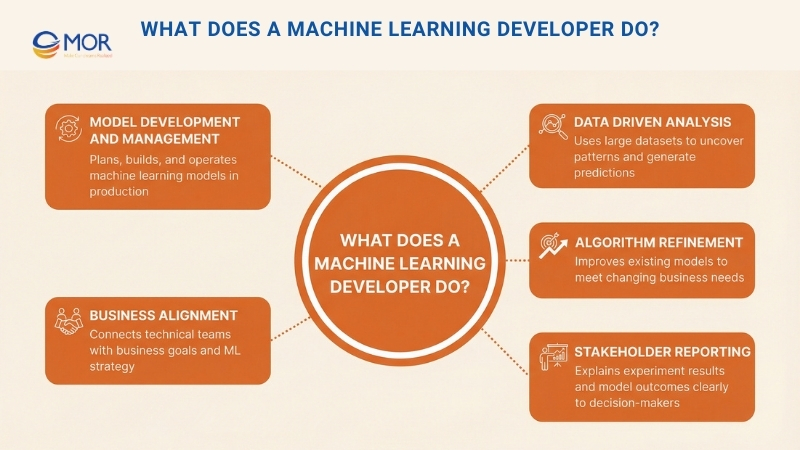
A machine learning developer’s core responsibilities often include:
- Planning, building, and managing the operation of machine learning models
- Performing data-driven analysis aligned with your business goals
- Refining existing machine learning algorithms to match changing business needs
- Reporting experiment outcomes and model results to business stakeholders
- Working with stakeholders to shape and adjust your machine learning strategy
In many organizations, this role connects technical teams with non-technical decision-makers. The engineer helps identify where machine learning can add value, confirms correct implementation, and keeps communication clear so stakeholders know whether the initiative is meeting its objectives.
Key Roles Of Machine Learning Developer
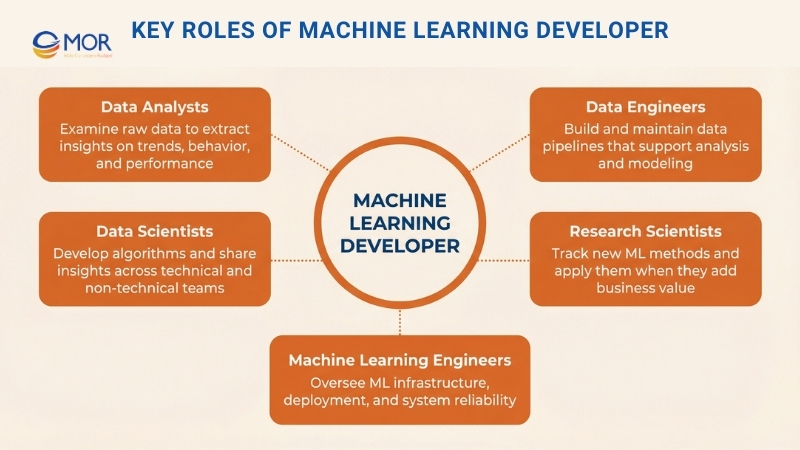
Before you start the ML developer hiring process, you need a clear view of the different roles within a typical machine learning team. The positions below appear most often when companies plan to bring in machine learning engineering talent.
Advanced Research and Deep Learning Systems
The foundation of any sophisticated AI ecosystem rests on the ability to interpret complex, high-dimensional data pools. Rather than relying on rigid, off-the-shelf software, our engineering teams focus on designing custom, highly tailored deep learning models from the ground up.
- State-of-the-Art Frameworks: We utilize industry-leading neural network architectures, building our custom architectures on top of robust frameworks like PyTorch and TensorFlow.
- Bespoke Problem Solving: This research-driven approach is explicitly engineered to handle highly complex data challenges, including custom computer vision processing and intricate natural language processing (NLP) pipelines.
- Enterprise Application: By tailoring the mathematical algorithms to your specific business rules, we empower industries like Advanced Manufacturing, Healthcare, and Finance to automate high-stakes visual inspections, analyze behavioral diagnostics, and uncover hidden patterns within vast repositories of unstructured data.
Enterprise MLOps and Production Engineering
An AI prototype only delivers tangible business value when it successfully transitions out of the data science laboratory and into a live, scalable production environment. At MOR Software, our MLOps (Machine Learning Operations) workflows are designed to automate, monitor, and secure the entire lifecycle of your machine learning models.
- Seamless Cloud Architectures: We specialize in migrating, hosting, and optimizing data models across premier cloud environments, utilizing specialized platforms such as AWS SageMaker and Google Cloud AI.
- Containerization & Resilient Pipelines: By leveraging technologies like Docker and continuous integration pipelines, we ensure that your models are completely containerized, platform-agnostic, and capable of scaling horizontally to meet shifting computational demands.
- Institutional Governance: Operating under strict ISO/IEC 27001:2013 information security compliance, our MLOps frameworks embed automated data validation, rigorous model version control, and real-time performance auditing. This guarantees that your live AI applications operate with absolute uptime, zero data contamination, and ironclad defense against security vulnerabilities.
Generative AI and Large Language Model (LLM) Integration
The emergence of generative technologies has opened new frontiers for automated corporate intelligence. We enable global enterprises to capitalize on this paradigm shift by designing custom conversational interfaces and autonomous knowledge-retrieval systems.
- Elite Model Optimization: Our capabilities encompass the customization of industry-defining models like OpenAI's GPT, alongside the optimization of high-performance, open-source alternatives tailored to your exact operational parameters.
- Context-Aware Architecture: We build advanced Retrieval-Augmented Generation (RAG) frameworks that securely unify your proprietary, structured customer data with unstructured team discussions and knowledge bases. This allows the LLM to provide highly accurate responses rooted exclusively in your company's factual telemetry, completely mitigating the risk of AI "hallucinations."
- Advanced Prompt Engineering & Fine-Tuning: Through meticulous prompt optimization and deep-tier parameter fine-tuning, we build specialized corporate assistants capable of interpreting complex technical documentation, automating multi-step customer service pipelines, and serving as intelligent touchpoints across your Salesforce CRM or enterprise communication ecosystems.
>>> Discover more topics about AI and machin learning on MOR Blog right now!
What Is A Typical Machine Learning Developer Salary? (Updated 2026)
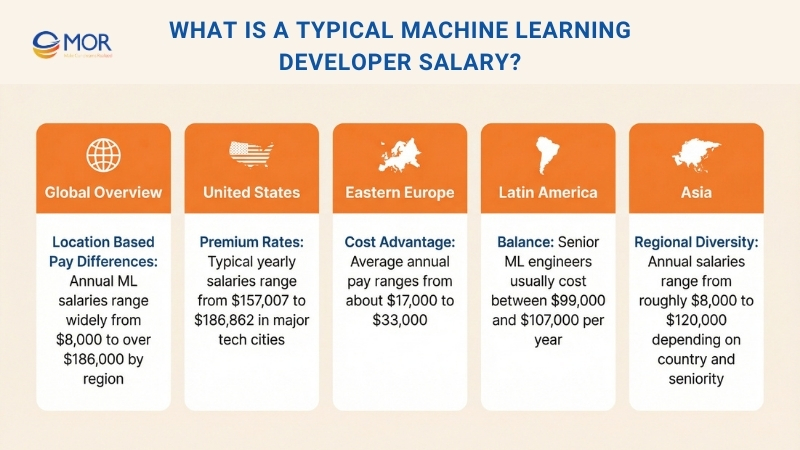
Machine learning developers earn different salary levels depending on where they are based. For this reason, many companies choose to hire machine learning developer talent remotely from other regions.
Salaries In The United States
The average yearly salary for a machine learning engineer in the United States is $157,007.
This number varies by location. In New York City, the average annual salary reaches $186,862. In Cupertino, CA, a machine learning engineer typically earns around $182,962.
Indeed.com also reports that many machine learning engineers in the United States receive benefits that include health insurance, dental and vision coverage, 401K plans, and gym memberships. Depending on the role, relocation support and additional perks may also apply.
Salaries In Eastern Europe
Professionals in Eastern Europe usually earn less than those based in the United States or Western Europe. In Romania, for instance, the average machine learning engineer salary is about RON 79,200, or $17,222.
In Poland, pay levels are higher than in Romania but still well below US rates. Machine learning engineers there often earn PLN 136,668, which equals roughly $32,880 in US dollars.
Salaries In Latin America
Machine learning engineers usually earn lower salaries in Latin America, mainly because living costs are lower than in the United States. In Brazil, the average yearly cost to hire senior machine learning engineers is about $99,692.
In Colombia, the typical annual cost to hire a senior machine learning engineer is close to $101,264.
In Chile, the average yearly cost to hire a senior machine learning engineer reaches roughly $106,960.
Salaries In Asia
Machine learning engineer salaries across Asia differ widely based on local technology maturity, demand for talent, and living costs. Many companies turn to this region when they hire machine learning developer talent remotely because it offers a strong balance between skill level and compensation.
In India, machine learning engineers usually earn between $8,000 and $25,000 per year, depending on experience and location. Senior engineers working with global firms or product-focused teams may earn higher pay.
In Vietnam, annual salaries often range from $15,000 to $60,000, with higher figures concentrated in Ho Chi Minh City and Hanoi. Engineers skilled in deep learning, computer vision, or large-scale data systems tend to sit at the upper end of this range.
In Singapore, salaries rank among the highest in Asia. Machine learning engineers commonly earn between $64,000 and $120,000 per year, reflecting strong demand and a highly competitive market.
Other countries like Malaysia, Thailand, and Indonesia generally fall between India and Singapore in pay levels. This makes Asia an appealing region for companies seeking capable machine learning talent without US-level salary costs.
Technical Skills To Look For When You Hire Machine Learning Developer
As with most areas of artificial intelligence, the abilities of machine learning engineers go far beyond what appears on the surface.
This part describes the core skill set a machine learning engineer should ideally bring to the role. At the same time, it is important to remember that this field continues to change, and many specialists grow deeper expertise in selected areas rather than covering everything.
In practical terms, these high-demand skills form the base of strong machine learning knowledge. Even so, it is uncommon for one engineer to master every domain listed below.
Python As The Core ML Language
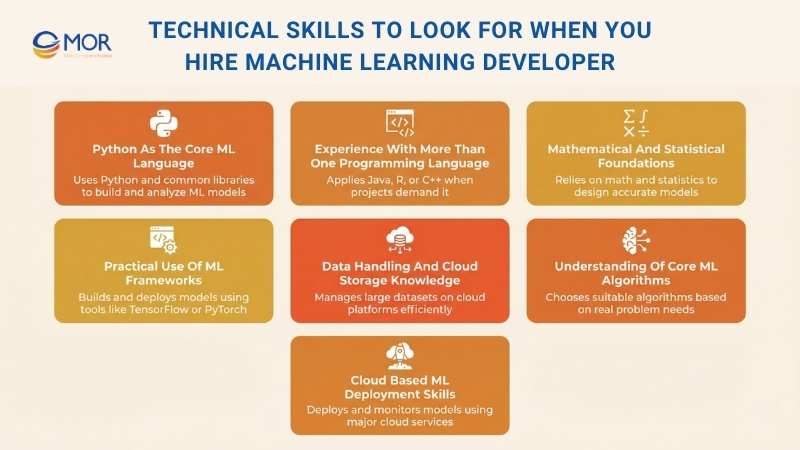
At the center of effective machine learning work sits a strong foundation in Python, supported by statistical knowledge and hands-on experience with common industry frameworks.
For ML engineers, Python is more than a helpful tool. It is essential. In 2024, Python became the most-used language on GitHub, moving ahead of Java, largely driven by rapid growth in machine learning projects. The rise of Jupyter Notebooks followed the same trend, as ML professionals increasingly relied on Python for data analysis and visualization.
Core Python libraries every capable ML engineer should understand include:
- TensorFlow and PyTorch: Pytorch vs Tensorflow frameworks support the creation of advanced neural networks used in image recognition, speech processing, recommendation systems, and Natural Language Processing (NLP).
- Scikit-learn: This open-source library works well for smaller ML projects and remains popular for predictive modeling and statistical analysis due to its approachable design.
- Pandas: This tool allows engineers to clean, transform, and analyze large datasets efficiently so data remains structured and usable.
Because Python is so widely adopted, working with engineers who genuinely understand these libraries gives your team a clear advantage.
When local talent is limited, expanding your search to international markets can help. Bringing in a nearshore machine learning engineer may give you access to specialized skills while keeping collaboration practical and aligned with business goals.
Experience With More Than One Programming Language
Python leads the machine learning space and supports most ML initiatives, yet it is still useful to consider additional programming languages that can strengthen your overall solution.
Languages like Java, R, and C++ each contribute different advantages. Java works well for large-scale systems where reliability and stability matter. R plays a key role in statistical modeling and data analysis, which makes it common in research-focused environments like data science. C++ provides strong performance for compute-heavy workloads, including real-time use cases in autonomous systems or game development.
When your project calls for an engineer who can operate across several languages, specialized staffing agencies can help you find adaptable candidates who align with both your technical needs and business goals.
Mathematical And Statistical Foundations
Strong mathematical and statistical foundations sit at the core of reliable ML models. When you hire machine learning developer talent, the right candidate should understand probability, statistics, linear algebra, and calculus. These skills are not abstract theory. They directly shape how the engineer designs, improves, tunes, and deploys accurate models.
Deep knowledge of statistics allows the engineer to test assumptions and read complex data patterns correctly. At the same time, calculus plays a key role in model optimization, especially in processes like gradient descent and effective training workflows.
Choosing someone with solid strength in math and statistics lowers the chance of expensive mistakes. It also supports faster development cycles and produces predictions you can trust.
Practical Use Of ML Frameworks
When you hire machine learning developer talent, hands-on experience with ML frameworks like TensorFlow, PyTorch, or Keras should be a priority. These tools simplify both model creation and deployment, which helps ML engineers build advanced neural networks and put models into use with less friction.
TensorFlow and PyTorch are known for flexibility and scalability, which allows the engineer to test ideas and improve models at a steady pace. Keras stands out for ease of use and works well for quick prototyping, which suits agile workflows and early proof-of-concept efforts.
Selecting candidates who already work comfortably with these frameworks reduces onboarding time. It also shortens the path between development and deployment, which helps your project reach production sooner when you need to hire a machine learning app developer for real-world products.
Data Handling And Cloud Storage Knowledge
Strong data management skills play a key role in successful machine learning projects. When you hire machine learning developer profiles, look for people who can manage large datasets and work confidently with cloud platforms like AWS, Google Cloud, and Amazon S3.
ML engineers who know these platforms can build data pipelines, set up secure storage systems, and access large datasets efficiently, which helps keep development work moving faster.
Cloud storage provides scalable, cost-aware, and dependable data management options. If it proves difficult to find candidates with these cloud skills, working with data analyst recruitment agencies that focus on talent experienced with AWS or Google Cloud can help fill that gap.
Understanding Of Core ML Algorithms
An engineer’s knowledge of machine learning algorithms has a direct effect on model quality and accuracy. When you hire machine learning developer talent, strong candidates should understand core methods like decision trees, regression models, clustering algorithms, and neural networks. They also need to explain clearly when each approach fits a specific problem.
They should speak with confidence about both the advantages and the limits of different algorithms. This helps you select solutions that align with real business needs rather than theory alone.
Strong statistical skills support this algorithmic understanding. Together, these abilities allow ML engineers to read results correctly, extract meaningful insights, and adjust models to improve accuracy or efficiency.
When you bring in someone who combines solid statistical reasoning with sound algorithm design, your machine learning efforts are more likely to deliver stable and dependable results over time.
Cloud-Based ML Deployment Skills
Strong experience with major cloud platforms like AWS, Google Cloud with Vertex AI, or Microsoft Azure can greatly improve ML outcomes. These platforms provide built-in tools that support model development, training, deployment, and ongoing monitoring.
Familiarity with these cloud services saves time, lowers system complexity, and makes it easier to manage large machine learning initiatives at scale.
Engineers who understand cloud platforms and modern development practices often perform well in remote or offshore setups. This expands your options when you hire machine learning developer talent and simplifies global sourcing. When you assess remote candidates, your remote hiring process should include focused interview questions that allow the engineer to demonstrate real experience with cloud-based deployments.
Where To Find And Hire Machine Learning Developer?
Once you define the machine learning roles you need, the next step is to build your team. Several channels can help you find qualified talent, depending on seniority, budget, and how fast you need to move.
Specialized Job Boards
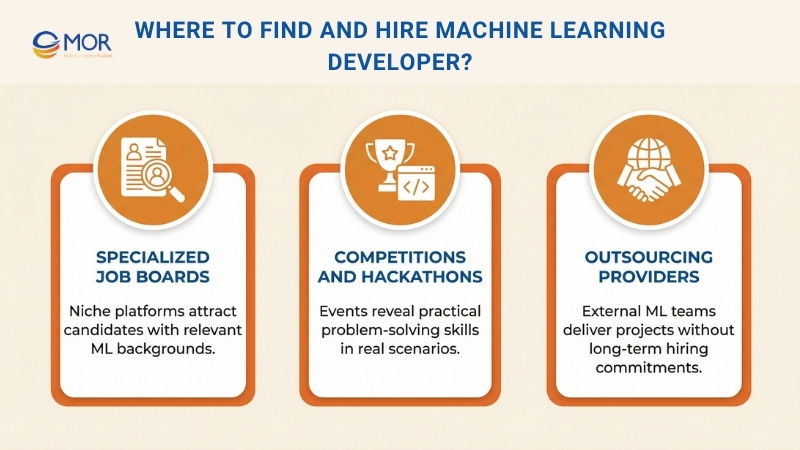
Job boards may sound traditional, yet they still work well for sourcing engineers. Keep in mind that many boards attract early-career profiles. If you want junior hires for entry-level roles like data analyst, this option often makes sense. When the goal is to hire machine learning developer talent at a senior level, you may need to combine boards with other sourcing methods.
If you use job boards, focus on niche platforms rather than broad job sites. General platforms often bring in a large number of applicants who do not match your requirements. In contrast, industry-specific platforms give you access to candidates with relevant backgrounds. This is also where companies often look for hire remote machine learning developers or even a machine learning freelancer for short projects. These platforms are widely seen as some of the best sites to hire machine learning developers with technical focus.
Using job boards also requires time and effort. You should expect to review many resumes, verify experience, and run several interviews. Posting a role often leads to a high volume of responses, which means careful screening is necessary to identify the right engineer for hire among many applicants.
Competitions And Hackathons
Some organizations search for strong technical talent by hosting competitions. Often called hackathons, these events continue to gain attention, especially among large employers, universities, and public institutions.
Companies organize hackathons to challenge participants to solve real problems or suggest new approaches for a project. The team or individual behind the strongest solution may receive a job offer. Another benefit is that people who join these events often feel more connected to the company. This can help if you struggle to attract and keep skilled engineers.
At the same time, running a hackathon has clear drawbacks. Like many hiring activities, it requires a large time commitment. Your team must spend many hours planning the event, promoting it, and reviewing submissions before choosing a winner.
Outsourcing
In some cases, companies see strong results when they outsource work to a provider that focuses on machine learning and artificial intelligence. At its best, this approach eases internal pressure by moving delivery to an external team. It can also lower costs since you do not need to cover benefits or long-term incentives. Depending on the partner you choose, project rates may still vary and can be higher in certain cases.
This option works best when your project scope is clear and success criteria are well defined. It also helps when you have internal staff who can track progress and confirm that the work meets expectations. Many teams choose this path when they want to hire dedicated machine learning developers or use machine learning temp staffing for short or medium-term needs.
Outsourcing is less effective if your goal is to build a long-term machine learning strategy that depends on continuous involvement from a trained engineer. It may also fall short if you want direct control over daily workflows or close involvement in how the machine learning team operates.
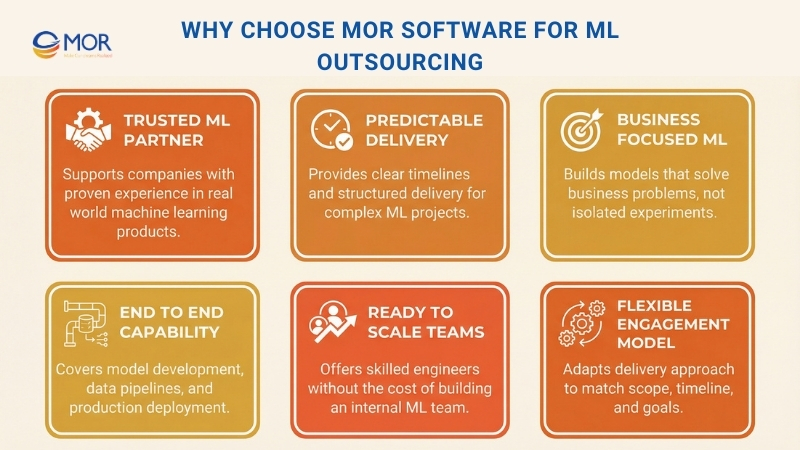
For teams that see outsourcing as a practical way to move faster, MOR Software stands out as a trusted partner for machine learning outsourcing projects. We support companies that need clear delivery, predictable timelines, and engineers who already understand how ML works in real products. Our teams handle model development, data pipelines, and deployment with a strong focus on business goals, not experiments that stay on paper. This makes software outsourcing with us a solid option when you want results without building an internal ML team from scratch.
If you are planning your next ML initiative, contact us to discuss your scope, timeline, and the right delivery model.
The Correct Way To Evaluate And Hire Machine Learning Developer
Once you build a pool of candidates, you need a clear and structured way to choose the best fit. This evaluation phase plays a major role when you hire machine learning developer talent and want reliable results.
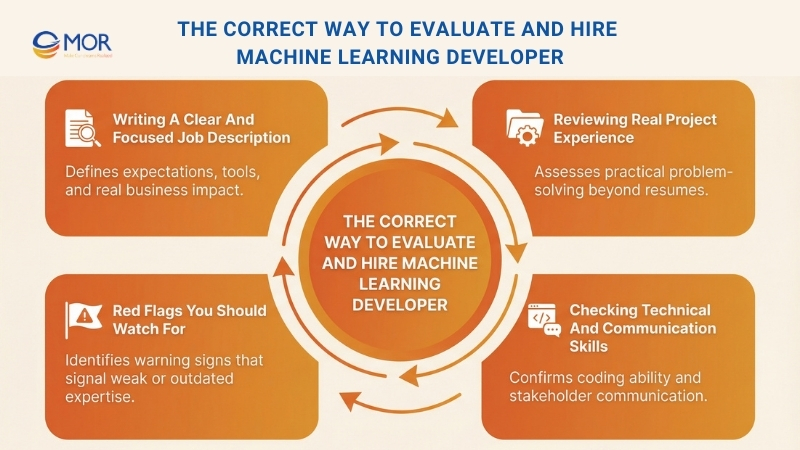
Writing A Clear And Focused Job Description
Your job description sets the tone for the entire process. Clarity matters.
- Avoid long and unclear lists of skills.
- Replace broad phrases like “must know machine learning” with clear expectations, for example, “will build predictive models using Python with Scikit-learn or TensorFlow, and deploy them through AWS SageMaker.”
- Explain the impact of the role, such as “you will manage the recommendation system used by millions of users.”
- Prioritize practical skills and responsibilities over formal titles or degrees.
Reviewing Real Project Experience
Do not rely on resumes alone. Real experience often matters more than theory.
- Portfolio Review: Ask candidates to explain a project they value. What issue did they solve? What steps did they follow? How did they respond to obstacles?
- Practical Assessments: Use take-home tasks or scenario-based interviews that reflect real work situations the engineer would face on the job.
Checking Technical And Communication Skills
You need to confirm that the candidate can handle the work and fit well within your team.
- Technical Validation: This may include an algorithm-focused coding task, a scenario interview where the engineer sketches a solution, or a hands-on assessment using a real dataset.
- Assessing Soft Skills: Technical ability alone is not enough. Strong engineers also communicate well, collaborate smoothly, and solve problems effectively. Use behavior-based questions that ask for real examples from past work. For instance, you might ask, “Tell me about a time you explained a complex technical idea to a non-technical stakeholder.” This helps show how clearly they communicate and adjust their approach for different audiences.
Red Flags You Should Watch For
Certain warning signs can appear during interviews and assessments. Paying attention to these signals can help you avoid costly hiring mistakes later.
- Buzzword Heavy, Detail Light: Candidates who mention many popular algorithms but struggle to explain basic concepts in simple terms.
- Focus on Accuracy Alone: A strong engineer knows that model quality involves more than one number. They should discuss metrics like precision, recall, inference speed, and overall business value.
- Lack of Curiosity: The field changes quickly. Someone who does not keep learning new methods or tools is likely to fall behind over time.
Conclusion
Hiring ML talent in 2026 requires more than filling a role. You need clear expectations, the right skill mix, realistic salary planning, and a sourcing model that fits your goals. When you hire machine learning developer teams with proven experience, projects move faster and deliver measurable value.
For companies that prefer speed without building everything in-house, MOR Software provides a reliable outsourcing path with clear delivery and production-ready ML systems. Contact us to discuss your scope, timeline, and delivery model.
"Evolution is not a destination, it is a disciplined journey of innovation."
Phung Van Tu


CEO MOR AI
MOR SOFTWARE
Frequently Asked Questions (FAQs)
What does it mean to hire a machine learning developer?
It means bringing in an engineer who builds, trains, deploys, and maintains machine learning models that solve real business problems, not just experiments.
When should a company hire a machine learning developer?
You should hire one when your product relies on predictions, automation, pattern detection, or data-driven decisions at scale.
What skills should I look for when I hire a machine learning developer?
Strong Python skills, experience with ML frameworks, solid statistics knowledge, and hands-on deployment experience are the basics to check.
How is a machine learning developer different from a data scientist?
A data scientist focuses on analysis and experimentation, while a machine learning developer focuses on production systems and long-term model performance.
How long does it take to hire a machine learning developer?
It often takes longer than standard software roles, usually several weeks, because experienced ML engineers are in high demand.
Is it better to hire locally or remotely?
Remote hiring often gives access to a wider talent pool and more flexible cost options, especially for well-defined machine learning projects.
What interview process works best for machine learning roles?
A mix of project walkthroughs, practical ML tasks, and discussions about real deployment challenges works better than theory-heavy interviews.
What are common mistakes when hiring a machine learning developer?
Focusing only on algorithms, ignoring deployment experience, and skipping data quality discussions are frequent hiring mistakes.
Can one machine learning developer handle an entire ML project?
For small or early-stage projects, yes. Larger systems usually require support from data engineers, backend developers, or cloud specialists.
Share


Make Our-Dreams Realized


© 2023 . MOR Software. All Rights Reserved
Sitemap
Privacy Policy
Terms of Use

Rate this article
0
over 5.0 based on 0 reviews
Your rating on this news:
Name
*Email
*Write your comment
*Send your comment
1