


How Much Does It Cost to Build a Mobile App in 2026? Average Cost
Building an app sounds simple until the first budget estimate arrives. So, how much does it cost to build a mobile app in 2026, and what makes one product cost $40,000 while another reaches $400,000+? This MOR Software’s guide will break down the cost to develop a mobile app, from features and platforms to hidden fees after launch.
Key Takeaways
- App development cost in 2026 usually ranges from $40,000 to $400,000+, based on complexity, features, platform, design, backend, and team location.
- Hidden costs matter. QA, cloud hosting, maintenance, security work, app store fees, and marketing can change the real budget after launch.
- An MVP helps you control the first build cost. Start with core features, test user demand, then add new functions when the product proves its value.
How Much Does It Cost To Build A Mobile App In 2026?
So, how much does it cost to build a mobile app? In 2026, most projects sit between $40,000 and $400,000+, based on the product’s size, logic, and feature list. These ranges are easier to read when you compare them with current mobile app needs, such as business use, user retention, and long-term product spend.
Complexity Level | Estimated Cost | Development Time |
Basic App | $40,000 - $100,000 | 3 - 6 months |
Moderate App | $100,000 - $200,000 | 6 - 9 months |
Complex App | $200,000 - $400,000 | 9 - 12 months |
Enterprise-Grade App | $400,000+ | 12 - 18 months or longer |
Why does the price gap look so large? Building an app is a bit like planning a home. A small studio is far cheaper than a smart villa with many rooms, connected devices, and custom systems. The more ‘layers’ your app needs, the higher the final budget becomes.
How To Estimate The Cost To Develop A Mobile App
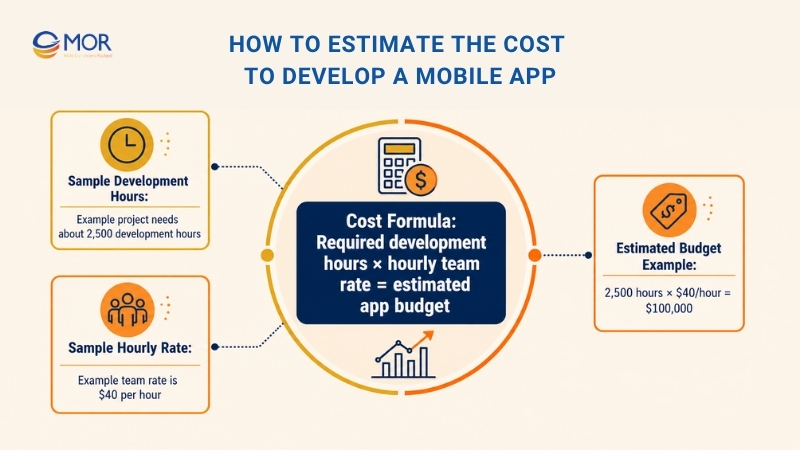
The cost to develop a mobile app usually comes from two core numbers: the hours your team needs and the hourly rate they charge. This basic formula gives you a quick way to plan your budget before the first sprint starts:
Required Development Hours × Hourly Team Rate = Estimated Mobile App Budget
Say a software team charges $40 per hour, and your product needs about 2,500 development hours. Your first build estimate would be:
2,500 hours × $40/hour = $100,000
This number usually covers the first build only. After launch, you still need to budget for maintenance, new functions, cloud systems, security checks, and support.
Once you know the formula, budget planning becomes less vague. The harder part is knowing what changes the hours and rates, since those details shape the final price.
>>> Explore the latest mobile app development trends and what they mean for your next product plan.
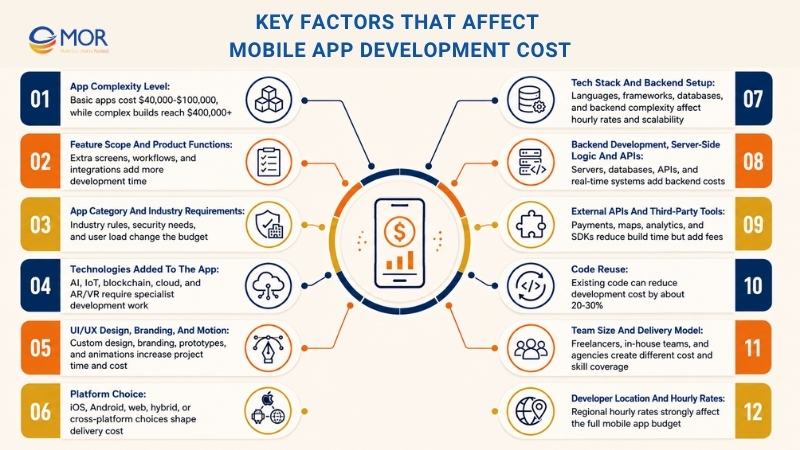
Key Factors That Affect Mobile App Development Cost
Your app budget is never one flat number. Many parts work together, and each one can push the cost up or bring it down. Knowing these cost drivers helps you plan better, spend smarter, and avoid paying for work your product does not need yet.
It also lowers the risk of surprise bills during development. Let’s walk through the main items that shape mobile app development cost.
App Complexity Level
Complexity plays a big role in app budget planning. A basic app with sign-in screens and simple actions costs far less than an enterprise platform with AI, many user roles, deep data rules, and real-time updates. The average cost to build a mobile app changes a lot across these levels:
- Basic Product: This type of app includes simple functions like sign-in, user profiles, a clean dashboard, and a small admin area.
- Typical Budget: $40,000 - $100,000
- Common Use Cases: Simple calculators, flashlight apps, basic content apps, and other tools with limited screens and functions.
- Mid-Level Product: These apps go beyond basic use. They may include social login, payments, audio or video content, privacy settings, and better user interaction around the main product flow.
- Typical Budget: $100,000 - $200,000
- Common Use Case: A food delivery or restaurant app may need product lists, order status, customer accounts, payment methods, and a cleaner UI/UX flow. Those parts make the app more useful and easier to use.
- Large-Scale Product: These apps rely on high-end tech like Augmented Reality, Virtual Reality, Artificial Intelligence, Machine Learning, real-time reports, many programming languages, complex data rules, strong security, and heavy backend systems.
- Typical Budget: $200,000 to $400,000 and above.
- Common Use Cases: Enterprise hiring systems, large marketplace apps, fintech platforms, AI automation tools, and products built for millions of users. These builds often need a bigger team, longer timeline, more testing, and stronger backend planning.
The cost range below shows how complexity can change the full development budget:
App Complexity | Level Of Complexity | Average Timeline | Average Cost |
Simple app | • MVP functions • Basic UI | 3 - 6 months | $40,000 - $100,000 |
Medium-complexity app | • Rich product functions • Custom UI | 6 - 9 months | $100,000 - $200,000 |
Complex app | • High-end functions • Tailored UI • Two platforms | 9 - 12+ months | $200,000 - $400,000 |
Feature Scope And Product Functions
A product’s feature list has a clear effect on the final price. When teams review the cost to build mobile app features, every extra screen, workflow, and integration adds more time.
That is why the first release should focus on the core product only. A lean first version gives users a good experience without draining the budget too early, and this is where a Minimum Viable Product (MVP) works well. An MVP gives early users enough value, then helps your team collect feedback for later versions.
This table gives a rough view of time and cost for common feature groups:
Complexity Level | Features | Estimated Cost ($) | Estimated Timeline |
Basic Features | • User profiles • Account registration/login • Basic content display/listings • Basic dashboard • Contact form or help center | $10,000 - $20,000 | 3 - 6 weeks |
Moderate Features | • In-app messaging • Push notifications • Payment gateway integration • Analytics dashboard • Social media integration • Multi-language or currency support | $20,000 - $30,000 | 6 - 10 weeks |
Complex Features | • AI-based recommendations • AR/VR integration • Real-time data sync or streaming • Custom animations/gamification • Voice commands or chatbot • Strong security layers • Role-based user access | $30,000 - $50,000+ | 10 - 16 weeks |
App Category And Industry Requirements
Your app’s business purpose can strongly affect the cost to build a phone app. A change in industry can also change the user load, required functions, data rules, security needs, and legal checks.
Look at these common app categories and the cost items that usually come with them:
- Online Shopping Apps: Apps like Amazon and Wayfair stay popular because they support real-time activity, huge traffic, and safe payment flows.
- Social Network Apps: These products are often harder to build because they need many third-party connections, camera and audio access, and high scale for large user groups. That is why social app budgets are often higher than simpler mobile products.
- On-Demand Service Apps: Even a small on-demand app can become complex. It usually needs one app for customers, one app for service providers like drivers or delivery staff, and one admin panel for the business.
- Healthcare Apps: Apps in this space need strict privacy controls, safe data handling, and sometimes links to Electronic Health Records (EHR) or medical devices. Accuracy, trust, and patient data protection matter a lot.
- FinTech Apps: Finance apps deal with money and private user data, so they need strong security, real-time processing, and compliance with rules like PCI DSS and AML. They often include secure payments, investment views, budget tools, and safe login steps.
The table below shows rough app cost ranges by category:
App Category | Average Cost (USD) | Approx. Hours | Development Timeline |
eCommerce/M-Commerce | $30,000 - $250,000 | 1,200 hrs | 3 - 6 months |
Social Media | $50,000 - $300,000 | 1,200 hrs | 4 - 6 months |
EdTech, like Duolingo | $60,000 - $225,000 | 900 hrs | 3 - 6 months |
Dating, like Tinder | $50,000 - $400,000 | 1,400 hrs | 4 - 9 months |
Gaming, AR/3D | $80,000 - $250,000+ | 1,800+ hrs | 6 - 12 months |
On-Demand Services | $60,000 - $200,000 | 1,000 hrs | 4 - 8 months |
Healthcare/HealthTech | $60,000 - $400,000 | 1,200+ hrs | 6 - 12 months |
FinTech, like Mint | $50,000 - $300,000+ | 1,500+ hrs | 6 - 12 months |
Note: HealthTech, FinTech, and AI-heavy apps now need higher budgets because of compliance checks, explainable AI logic, and secure APIs.
Technologies Added To The App
The technology inside your app can also change the timeline and budget. These parts often need specialist skills, deeper architecture work, and care after launch.
- AI And ML Functions: Adding AI/Machine Learning (ML) tools like predictive reports, Natural Language Processing (NLP), computer vision, recommendation engines, or smart task handling can raise the build cost. These tools need large data flows, model logic, and skilled AI/ML engineers.
- Use Case: A personal finance app can use AI to show tailored money tips and wealth planning ideas.
- IoT-Based Apps: Internet of Things (IoT) apps connect with real devices to collect sensor data or send commands to hardware. They need software work, firmware skills, device links, and hardware knowledge.
- Use Case: An eScooter app shows this well, since it connects the mobile app with vehicles, devices, and live mobility data.
- Blockchain Features: Apps with blockchain tools for safe records, payments, or decentralized systems need cryptography skills and more complex infrastructure. That raises both the build effort and technical risk.
- Use Case: A hotel booking app can use blockchain to create clear booking records that are harder to change.
- Cloud Systems And Scalable Servers: Cloud tools like AWS, Google Cloud, and Azure are common in modern apps. Cost depends on storage, traffic, computing power, and server setup. A cloud setup built for millions of users needs careful backend planning.
- Use Case: A social app with live interaction and 3D avatars needs strong cloud systems to support heavy user activity.
Technologies | Average Cost (USD) | Approx. Hours | Development Timeline |
IoT-driven Apps | $45,000 - $500,000+ | 1,800+ hrs | 8 - 12 months |
Blockchain | $40,000 - $300,000+ | 2,000+ hrs | 12+ months |
AR/VR Apps | $30,000 - $300,000+ | 1,500+ hrs | 6 - 12 months |
AI-powered Apps | $50,000 - $500,000+ | 1,200+ hrs | 6 - 12 months |
Cloud-powered Apps | $30,000 - $300,000+ | 1,000+ hrs | 8 - 12 months |
UI/UX Design, Branding, And Motion
Another cost driver is User Interface (UI) and User Experience (UX) work. A clean and pleasant design keeps users inside the app longer and can support better business results.
Most app projects choose between standard UI and custom UI. Standard UI uses familiar components and common layouts, which are faster to build. Custom UI takes more time because the design, testing, and implementation are shaped around the product, but it can make the app feel more distinct.
- Use Case: A food ordering and delivery app with a custom interface can make ordering faster and easier. Good design and motion can also help more users finish checkout.
- Wireframes And Prototypes: Designers and developers first map user flows, layouts, and screen paths to build a smooth product experience. Tools like Marvel, Balsamiq, and Photoshop may support this stage.
- Motion Design: Animation can make an app feel more natural and fun to use. Games, social apps, and visual-heavy products often use motion to guide user actions and improve engagement.
You may also compare Android and iOS design rules before finalizing your design budget.
App Process | Design Tasks | Average Development Time | Average Development Cost (Approx) |
App design research | • Market research • Competitor review • Market trend review • Choosing suitable design directions | Based on the niche and available resources | $100 - $350 |
UX design | • Rough sketches • Low-fidelity wireframes • High-fidelity wireframes | • Simple: 10 - 14 hours • Medium: 50 - 60 hours • Complex: 150+ hours | $2,000 - $8,000 |
UI design (visuals) | • Mood boards • UI sample screens • Final UI mockups | • Simple: 14 - 20 hours • Medium: 80 - 90 hours • Complex: 100+ hours | $10,000 - $40,000 |
Branding | • Building brand identity | Logos, icons, and social media assets | $5,000 - $20,000 |
Animations and illustrations | • Showing user actions and screen content • Direct manipulation • Visual response to user actions | Based on the motion level | $1,000 - $20,000 |
Platform Choice
Choosing the right platform is one of the first calls in a mobile app project. Based on your target users, you may build for iOS, Android, the web, or use a cross-platform app. If your budget is tight, it often makes sense to launch on one platform first, then add more platforms when the product gains traction.
These are the common platform choices for app projects:
- Native Mobile Platforms (iOS And Android): iOS apps are often built with Swift and Objective-C. Android apps are usually created with Java and Kotlin.
- Web-Based App Platform: Progressive Web Apps (PWAs) and browser-based apps often cost less than fully native mobile apps.
- Shared-Code App Build: One codebase can support iOS and Android at the same time. This option can lower repeated work and make delivery faster.
- Mixed Native And Web Build: Hybrid apps bring together native app parts and web app parts. Users install them like native apps, but much of the app may run through a webview.
Suggested Reading: Hybrid vs Native, Which App Development Option Fits Better
MOR Tip: If your budget is limited and you still want to reach iOS and Android users, a cross-platform build is often the smarter first move.
Tech Stack And Backend Setup
Your app’s technology stack includes the programming languages, frameworks, libraries, and databases used to build it. This choice affects cost because each technology has its own learning curve, talent pool, community support, build speed, and hourly rate.
Backend Complexity | Estimated Cost ($) |
Basic Architecture, simple database, user authentication | $5,000 - $15,000 |
Moderate Architecture, data storage, real-time updates, API integrations | $20,000 - $40,000 |
Advanced Architecture, scalability for millions of users, AI-driven analytics | $40,000 - $90,000+ |
Backend Development, Server-Side Logic And APIs
The app screens are only one side of the product. Any app with user actions needs backend systems that handle servers, databases, APIs, and cloud setup. Backend cost depends on how much data the app must process, how users are managed, and how many real-time actions it needs.
Backend Complexity | Description | Estimated Cost Range |
Simple Backend | Stores basic profile and content data, with simple sign-in and account access. | $5,000 - $25,000 |
Complex Backend | Handles live data, detailed reports, outside integrations, AI model setup, strong security rules, and high user scale. | $50,000 - $200,000+ |
Hosting & Server Costs | Covers ongoing cloud and server spend, based on storage, traffic, computing needs, and service tiers. | Variable monthly/annually |
External APIs And Third-Party Tools
Many modern apps connect to outside tools, SDKs, and services for payments, maps, social sharing, analytics, push alerts, and other tasks. These tools can shorten build time because the team does not need to create every part from zero. Still, license fees, setup work, and technical limits can add more cost.
Integration Type | Estimated Cost |
Basic Integration, payment, maps, user authentication | $2,000 - $10,000 |
Advanced Integration, multiple APIs, real-time analytics | $10,000 - $50,000 |
Code Reuse
Reusing code can lower the full mobile app development cost. If a business already has an app and only needs changes to branding, layout, or a few small parts, the new build can cost less.
Still, code reuse works best for common pieces. These often include contact pages, login flows, and standard navigation. For custom business rules, complex product functions, or brand-specific logic, a fresh build is often safer because it gives the product more control and fewer limits.
Existing code can cut app development cost by about 20-30% compared with a fully new build.
Team Size And Delivery Model
The cost to build a mobile app depends a lot on who builds it. You may work with a skilled mobile app development company, a local or offshore partner, an in-house team, or a freelance developer.
Freelancers may charge less per hour, but they may not cover the full skill set your project needs, such as design, QA, project management, backend work, and a clear delivery process. A mobile app development company with proven work, like MOR Software, can support business apps through mobile consulting, UI/UX design, development, integration, testing, and maintenance with a full team model.
The table below gives a rough view of team cost across simple, medium, and complex app projects.
Cost Factors and Requirements | Simple App | Medium App | Complex App |
Development Time | 2-6 months | 6-9 months | 9-15 months+ |
Developers | $30,000-$60,000 | $60,000-$150,000 | $150,000-$400,000+ |
UI/UX Designer | $4,000-$8,000 | $7,000-$20,000 | $15,000-$50,000+ |
Project Manager | $5,000-$10,000 | $10,000-$25,000 | $20,000-$60,000+ |
QA Specialist | $8,000-$15,000 | $15,000-$30,000 | $25,000-$70,000+ |
Business Analyst | $2,000-$5,000 | $5,000-$15,000 | $10,000-$30,000+ |
DevOps Engineer | $2,000-$5,000 | $5,000-$15,000 | $10,000-$30,000+ |
Solution Architect | $1,000-$5,000 | $5,000-$15,000 | $10,000-$40,000+ |
Total Team Cost Estimate | $50,000-$100,000 | $100,000-$250,000 | $250,000-$700,000+ |
Developer Location And Hourly Rates
Developer hourly rates can change a lot from one region to another. This affects the full budget because all work hours for design, coding, testing, and management are multiplied by the team rate. Mature tech hubs often charge more, while newer outsourcing markets may give you lower prices with strong skills.
This table gives a quick look at average hourly rates by region for 2026, including the cost to develop a mobile app in India and the cost to develop a mobile app in Australia:
Region | iOS (Avg. $/Hr.) | Android (Avg. $/Hr.) | Cross-platform (Avg. $/Hr.) |
India | 22-90 | 15-25 | 20-30 |
Southeast Asia | 23-55 | 30-45 | 30-45 |
Asia | 25-35 | 20-30 | 25-35 |
Middle East | 30-70 | 35-60 | 30-70 |
Europe | 35-55 | 35-55 | 30-50 |
Ukraine | 40-78 | 38-60 | 40-78 |
South Africa | 45-80 | 40-80 | 40-80 |
Latin America | 28-90 | 28-90 | 40-160 |
USA | 60-120 | 60-120 | 60-130 |
UK | 60-75 | 60-75 | 55-75 |
Canada | 90-120 | 80-140 | 90-120 |
Australia | 90-120 | 100-120 | 90-120 |
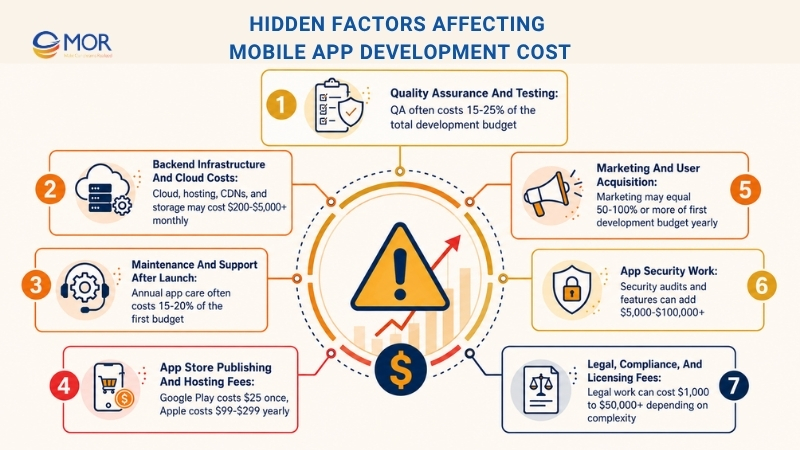
Hidden Factors Affecting Mobile App Development Cost
Some app costs do not show up clearly in the first quote, but they still affect the real budget. When you know these items early, you can lower project risk, save time, and avoid costly gaps later.
Quality Assurance And Testing
Estimated Cost: 15-25% of total development budget
A reliable app needs careful testing before users touch it. Quality Assurance (QA) should run during development, not just before release, so the team can find bugs, fix poor flows, and check that each function works as planned. Based on the app’s size, you may need one QA specialist or a full testing team.
This work covers functional checks, usability reviews, speed tests, security checks, and device compatibility across different operating systems. If you skip this step, you may pay more after launch through urgent fixes, bad reviews, and long-term trust issues.
Backend Infrastructure And Cloud Costs
Monthly Cost: $200-$5,000+ depending on user base
Backend development may be part of the first build, but the systems behind your app keep creating monthly costs. These costs can include data storage, Content Delivery Networks (CDNs), server care, and app hosting. As your traffic grows and the app moves more data, the bill will rise as well. Common cost items include AWS, Google Cloud, Azure, database services, and paid tools or libraries that charge ongoing fees.
Maintenance And Support After Launch
The budget does not stop once the app goes live. A strong app needs regular care to keep up with market needs, new devices, new OS versions, security updates, and speed fixes. So, what usually takes money after the first release?
- Post-Launch Bug Repair: No app stays perfect after real users start using it. Small errors and odd device issues can appear once downloads begin. You need developers ready to fix these problems fast.
- Design Refresh And New Functions: App design can feel old after a while, and users often expect new tools. Brands need to update screens and add useful functions so users stay interested.
- Device And OS Updates: Apple and Google release new iOS and Android versions often, and phone brands keep adding new models. If you do not update the app, parts of it may stop working well.
- Server And Database Spend: A larger user base puts more pressure on the backend. As the app grows, you may need stronger servers and larger databases.
- Security Updates: Online threats do not stop. Regular audits and patches help protect user data and keep user trust.
Annual App Care Cost is often around 15% to 20% of the first mobile app development budget.
App Store Publishing And Hosting Fees
Annual Cost: About $25 once for Google Play, $99-$299 per year for Apple
Before users can download your app, you need to pass through the app stores. Google Play and the Apple App Store charge fees to publish and keep your app listed. These costs are small beside the full build budget, but they are still required.
Marketing And User Acquisition
Estimated Cost: Often 50-100% or more of the first development budget each year
A great app will not grow if nobody knows it exists. Even a well-built product can sit unnoticed without a clear marketing plan. This cost can become one of the biggest hidden items because it depends on your market, goals, and competition.
App marketing can include many tasks that help bring in users and keep them active:
- Early Launch Promotion: Create interest with teaser posts, landing pages, email sign-ups, and early media outreach.
- App Store Search Work: Improve the app title, keywords, descriptions, screenshots, and store content so users can find it more easily.
- Paid Download Campaigns: Run ads on Google Ads, Apple Search Ads, social channels like Facebook, Instagram, TikTok, and mobile ad networks.
- Content Production: Create blog posts, short videos, and social posts that show why the app is useful.
- Media Outreach: Get press mentions, review coverage, and trusted public comments.
- Social Channel Management: Keep active social profiles where your users already spend time.
App Security Work
Estimated Cost: Specific audits or security functions can add $5,000-$100,000+
App Security needs serious planning. Users must feel safe when they share personal data with your app. That is why the project should include security work from the start. If you plan testing, code checks, and audits early, the process stays easier to control. If security comes late, the cost can rise fast, and the damage can affect money, trust, and brand name.
Legal, Compliance, And Licensing Fees
Estimated Cost: From $1,000 for basic terms to $50,000+ for complex products
Legal work matters as much as technical work. If you ignore it, your business may face disputes, IP issues, or fines. These costs are easy to underestimate during planning. Still, they help protect your users, your product, and your company.
Mobile App Development Cost By Platform
After seeing the full estimate, many teams ask: how much does it cost to build a mobile app for each platform? In 2026, the answer changes based on whether you choose iOS, Android, or a shared-code build with Flutter or React Native. Each option can support strong apps, but the cost, speed, and testing needs are not the same.
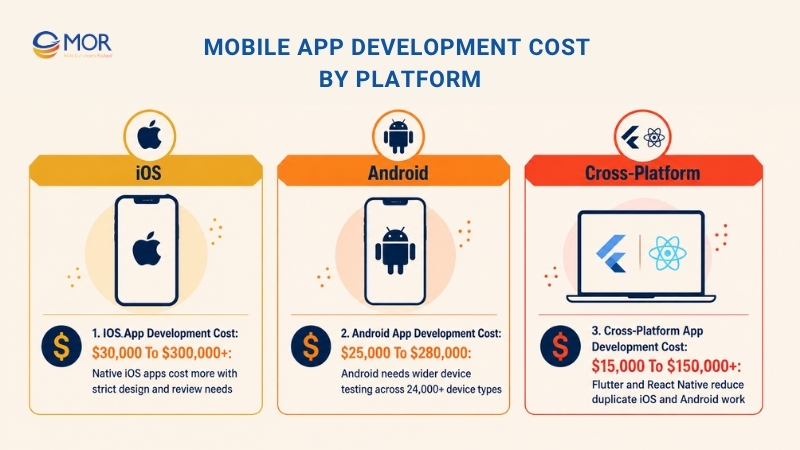
IOS App Development Cost: $30,000 To $300,000+
A native iOS app often costs between $30,000 and $300,000+. iOS developer rates can be high, yet the build can move faster because Apple has fewer device types, screen sizes, and supported system versions. Still, polished layouts and strict interface rules can raise the design budget.
A simple iOS app may cost about $35,000-$65,000, while an AI-based or complex product can reach $500,000. The biggest cost factors are Apple’s Human Interface Guidelines, strict review rules, and strong design expectations.
Android App Development Cost: $25,000 To $280,000
Android app development can cost less than iOS in some markets because hourly rates are often lower. Still, Android must work across 24,000+ device types and screen sizes, and that spread can raise the budget by 20-30%.
A basic Android app may cost around $18,000-$45,000, while a large enterprise app can go beyond $600,000. Since Android reaches a huge user base, the app needs deeper testing across many devices to keep performance steady.
Cross-Platform App Development Cost: $15,000 To $150,000+
Cross-platform apps built with Flutter or React Native can run on iOS and Android from one shared codebase. This often costs less than building two separate native apps because the team writes and maintains less duplicate code.
A mid-level cross-platform app often costs around $25,000-$80,000. This route can lower first-build and maintenance costs, though some high-performance native apps may still run better. The gap keeps getting smaller in 2026, as cross-platform tools become stronger.
Most Popular Mobile App Examples And Their Development Costs
The examples below show how famous apps changed customer experience across different markets. Exact first-build budgets are rarely public, but we can estimate how much similar mobile apps cost to build based on their core features, product logic, and technical depth.
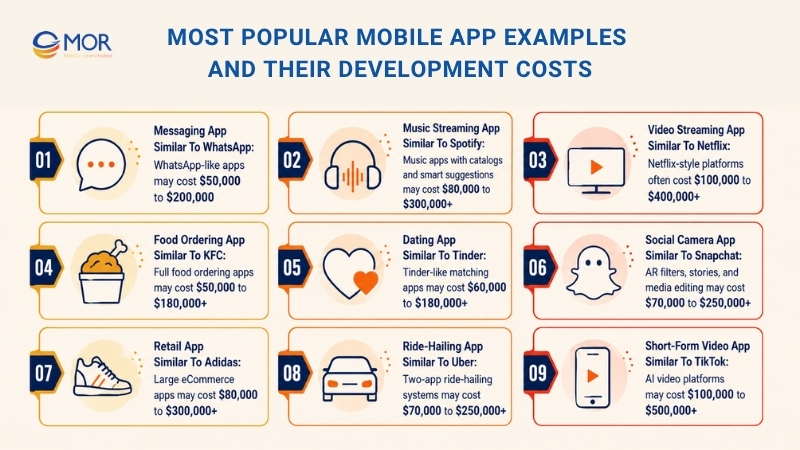
Messaging App Similar To WhatsApp
WhatsApp made global messaging easier through simple, free, and fast communication. Its core product includes text chat, voice calls, video calls, group conversations, media sharing, and status posts. Users adopted it quickly because it felt simple, stable, and easy to access.
Estimated Build Budget For A Similar App: A messaging app with WhatsApp-like functions may cost around $50,000 to $200,000.
Music Streaming App Similar To Spotify
Spotify changed music listening with on-demand streaming and a huge content library. Its main functions include song suggestions, playlist building, offline access, and a freemium plan with ads plus paid subscriptions.
Estimated Build Budget For A Similar App: A music app with a large catalog, smart suggestions, offline mode, and user account control may cost between $80,000 and $300,000+.
Video Streaming App Similar To Netflix
Netflix reshaped home entertainment with a large on-demand library of shows and films. Its platform uses user profiles, tailored content suggestions, adaptive video quality, support across devices, and strong content delivery systems.
Estimated Build Budget For A Similar App: A video streaming app with Netflix-style core functions often falls between $100,000 and $400,000+.
Food Ordering App Similar To KFC
A food ordering app similar to KFC should let customers view menus, adjust orders, find nearby stores, and choose delivery or pickup. Common features include location tools, safe payment setup, loyalty points, and push alerts for order updates or promotions.
Estimated Build Budget For A Similar App: A full food ordering app with rich menus, live order tracking, many payment choices, and restaurant backend links may cost from $50,000 to $180,000+.
Suggested Reading: Cost To Develop An App Like KFC, A Practical Guide
Dating App Similar To Tinder
Tinder made the swipe model famous in online dating, helping people match based on nearby location and shared interest. Its core functions include profile setup, location-based matching, direct chat, and paid plans that give users better visibility and more tools.
Estimated Build Budget For A Similar App: A Tinder-like dating app with profiles, matching logic, chat, push alerts, and basic location tools may cost from $60,000 to $180,000+.
Social Camera App Similar To Snapchat
Snapchat changed social media with short-lived posts called Snaps that vanish after viewing. It also grew through Augmented Reality (AR) filters, Stories, Spotlight, and a camera-first flow for quick visual sharing. Other functions include Snap Map and Bitmoji.
Estimated Build Budget For A Similar App: A Snapchat-style app with disappearing messages, AR filters, media editing, stories, and location tools may cost around $70,000 to $250,000+.
Retail App Similar To Adidas
The Adidas app acts as a full mobile shopping channel where users can browse products, buy items, manage accounts, and access special drops or brand content. Its experience depends on sharp product images, safe checkout, tailored product suggestions, and clear order handling.
A retail app at Adidas scale needs careful mobile engineering, strong shopping flows, and tight system integration. These are areas where MOR Software supports businesses through mobile development, eCommerce systems, UI/UX design, backend integration, and QA.
Estimated Build Budget For A Similar App: The cost for an eCommerce app like Adidas, with large catalogs, search and filters, AR try-on tools, and secure payment flows, may range from $80,000 to $300,000+.
Ride-Hailing App Similar To Uber
Uber pushed the on-demand ride-hailing model by linking riders and drivers through one mobile system. Its product needs separate apps for riders and drivers, live GPS tracking, payment setup, fare logic, dispatch tools, and ratings.
Estimated Build Budget For A Similar App: A ride-hailing app with an Uber-like two-app model and real-time features may cost from $70,000 to $250,000+.
Short-Form Video App Similar To TikTok
TikTok changed online content with short vertical videos and a smart recommendation engine, often tied to the For You Page. Its core tools include easy video creation, editing, a large sound library, filters, effects, duet and stitch functions, and livestreaming.
Estimated Build Budget For A Similar App: A TikTok-like short-video app with editing tools, audio assets, AI content suggestions, and scalable video hosting may cost between $100,000 and $500,000+.
How To Optimize Mobile App Development Costs?
Business owners can lower the cost to develop a mobile app for startups and growing companies with the right planning habits. A few smart product choices can cut waste, reduce rework, and keep the first release focused.
Mobile App Cost Control Method | |
Focus On Must-Have Features | 20-50% reduction in unnecessary costs |
Add QA From The Start | 5x reduction in bug-fixing costs and prevention of costly reworks and delays. |
Design For Later Growth | Minimizes future maintenance costs and rework |
Choose Cross-Platform When Suitable | 20-40% reduction in costs |
Work With Cost-Friendly Regions | 30-60% lower hourly rates |
Start With Core Features
When you build an app, feature order matters a lot. The best move is to launch the functions that create business value first. Extra items can wait for later releases. For that reason, a Minimum Viable Product (MVP) is often the safest first step.
Add QA Early In The Project
Your app can face bugs, broken flows, and odd user issues. QA should join early so the team can catch serious problems before heavy development starts. This helps you avoid large repair costs later in the project.
Build With Future Changes In Mind
The app you build today may change a lot later. If you launch an MVP, user feedback may lead to new features or a different product direction. Your market can also shift, so the product may need updates.
That is why short-term and long-term goals should sit together in your app plan. This can save a lot of money over the product’s life.
Compare In-House And Outsourced Development
Your development team model is a key part of project planning. It affects cost, workflow, communication, and long-term maintenance. So, many businesses ask whether they should build in-house or work with an outsourcing partner.
When you outsource app development, you can access skilled specialists without hiring a full internal team. It can also cut office costs, equipment spending, and daily management load. MOR Software supports this model with mobile consulting, UI/UX design, development, testing, integration, and maintenance teams.
In-house development gives you direct control and closer daily communication. Yet it often needs a larger budget, more hiring work, and higher long-term team costs.
Use Cross-Platform Development When It Fits
Every founder faces the same platform choice: build for Android, iOS, or both. Two separate native apps can cost a lot. A single-platform release can also leave out many users on the other side.
A practical answer is cross-platform development that works across iOS and Android. Twitter is a well-known cross-platform mobile app example. Common technologies for this route include Flutter, Unity 3D, and React Native.
Suggested Reading: Tips To Reduce App Development Cost For Startups
No matter if you run a small business or an enterprise that wants to refresh its mobile product, MOR Software can help you plan a build that fits your goals. The process below shows how a structured team can move from idea to launch with clear cost checkpoints.
Step-By-Step Mobile App Development Journey With Cost Estimates
Building a mobile app takes many careful steps, but the work does not need to feel confusing. From research to launch, each stage shapes the product and the budget. If you are asking how much does a mobile app cost to build in 2026, this breakdown gives you a practical way to plan.
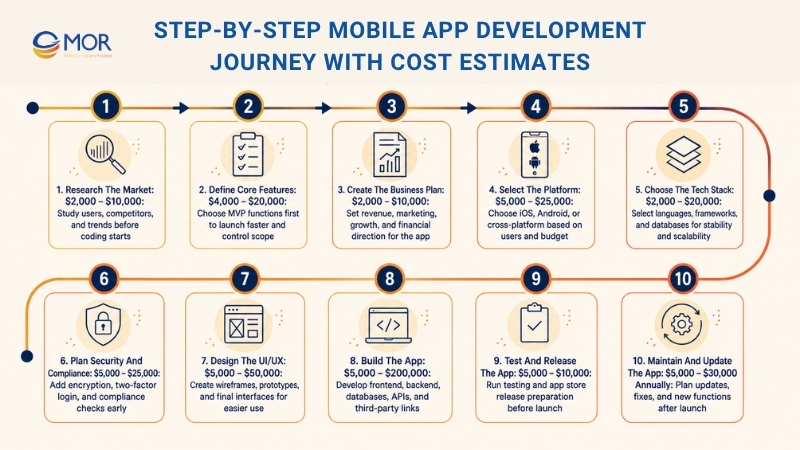
Research The Market: $2,000 – $10,000
Before coding starts, you need to understand your market well. Market research helps you learn about your users, competitors, and new trends. You review user behavior, existing app feedback, and app store comments so the product solves a real need. Without this work, the project can cost more later because the team may build the wrong thing.
- Task: Review competing apps, study user needs, and find gaps in the market.
- Result: A clear view of your target users and a product roadmap for app functions.
Define Core Features: $4,000 – $20,000
After research, the next step is choosing the features that make your app useful. You should focus on MVP features first, so you can launch faster and collect user feedback with lower cost. A simple profile page or an AI-based workflow can change the budget, so clear scope helps control spending.
- Task: Choose must-have functions first, then plan future upgrades.
- Result: A feature list that gives users value without pushing costs too high.
Create The Business Plan: $2,000 – $10,000
A business plan matters for every app. It is not only a technical note, but also a guide for revenue, marketing, and growth. It helps you decide if the app should use paid downloads, in-app purchases, ads, or subscriptions. Without a clear plan, the budget can grow faster than expected.
- Task: Set business goals, pick a revenue model, and prepare financial forecasts.
- Result: A clear plan that supports the app’s growth path.
Select The Platform: $5,000 – $25,000
Platform choice has a strong effect on app cost. Native iOS or Android apps often cost more because they use separate codebases. Cross-platform tools like Flutter or React Native can lower cost and reach Android and iOS users at the same time.
- Task: Choose iOS, Android, or cross-platform based on your users and budget.
- Result: A platform choice that balances performance and cost.
Choose The Tech Stack: $2,000 – $20,000
The tech stack affects how stable and scalable your app will be. At this stage, the team selects programming languages, frameworks, and databases based on the platform and product needs. A good stack helps prevent scaling issues and makes later updates easier.
- Task: Select languages and frameworks that match the app’s goals.
- Result: A strong technical base that can support future growth.
Plan Security And Compliance: $5,000 – $25,000
If your app handles personal, health, or payment data, security and compliance cannot be skipped. This work helps the app meet rules like GDPR or CCPA and protects users from risk. Weak security can create much higher costs later.
- Task: Add encryption, two-factor login, and compliance checks.
- Result: A safer app that users can trust.
Design The UI/UX: $5,000 – $50,000
UI/UX design plays a major role in the app budget. A clear and attractive interface can improve engagement and retention. Good UX helps users move through the app without confusion, which can lead to better reviews and more downloads.
- Task: Work with designers on wireframes, prototypes, and the final interface.
- Result: A simple, clear, and pleasant app design that supports user satisfaction.
Build The App: $5,000 – $200,000
This is the main production stage where the product becomes real. Depending on app complexity, the team may need frontend work, backend work, databases, APIs, and third-party links. Development takes the largest share of the budget, but quality work here pays off later.
- Task: Code the frontend and backend so the app works well across devices.
- Result: A working app that matches the planned product vision.
Test And Release The App: $5,000 – $10,000
Before release, the app needs deep testing to find bugs and poor flows. The team runs unit tests, integration tests, and User Acceptance Testing (UAT) to clean up issues. After it passes review, the app can be sent to the app stores and launched.
- Task: Test the app across devices and platforms to check stable use.
- Result: A polished app ready for public release.
Maintain And Update The App: $5,000 – $30,000 Annually
Launch is not the end of the app journey. Regular updates, bug fixes, and new functions keep the product useful and stable. Ongoing maintenance often costs 20% to 25% of the first development budget each year.
- Task: Plan regular fixes and updates so the app keeps up with users and OS changes.
- Result: A product that stays useful as the market and user needs change.
Mobile App Development Cost Breakdown By Stage
Mobile app development has many phases. Each phase adds to the full app budget, from early planning to long-term support. So, it is smart to understand the cost and timeline for each step before work begins.
Step | Estimated Cost | Development Timeline |
Research The Market | $2,000 – $10,000 | 1–2 weeks |
Define Core Features | $4,000 – $20,000 | 2–4 weeks |
Create The Business Plan | $2,000 – $10,000 | 1–2 weeks |
Select The Platform | $5,000 – $25,000 | 2–4 weeks |
Choose The Tech Stack | $2,000 – $20,000 | 1–2 weeks |
Plan Security And Compliance | $5,000 – $25,000 | 2–3 weeks |
Design The UI/UX | $5,000 – $50,000 | 4–6 weeks |
Build The App | $5,000 – $200,000 | 8–12 weeks |
Test And Release The App | $5,000 – $10,000 | 3–5 weeks |
Maintain And Update The App | $5,000 – $30,000 per year | Ongoing (Annual Updates) |
Total | $40,000 – $400,000 | 18–34 weeks (initial) |
Build Your Mobile App With MOR Software
Estimating app cost is easier when the scope is clear. But turning that scope into a stable product takes the right team, process, and technical choices.
MOR Software helps businesses plan and build mobile apps across iOS, Android, cross-platform, hybrid, and web-connected systems. Our team can support business analysis, UI/UX design, frontend and backend development, API integration, offshore QA testing, and post-launch maintenance.
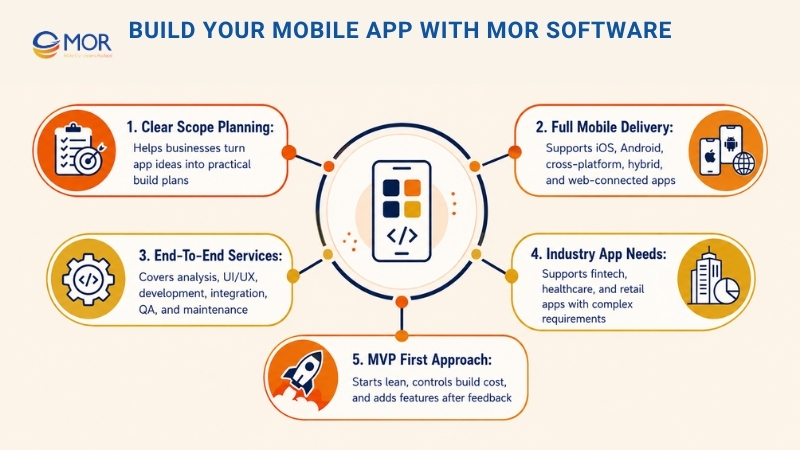
This matters when your app needs more than basic screens. A fintech app may need secure payments and compliance checks. A healthcare app may need data privacy and stable video calls. A retail app may need smooth checkout, inventory links, and push notifications.
With the right plan, you can start with an MVP, control the first build cost, and add new functions when users prove what they need.
Conclusion
So, how much does it cost to build a mobile app? Most projects fall between $40,000 and $400,000+, but the real number depends on complexity, features, platform, design, backend, and long-term support. The best way to control cost is to start with a clear scope and build around real user needs. If you need a practical cost estimate for your next app, contact MOR Software and share your project idea with our team.
MOR SOFTWARE
Frequently Asked Questions (FAQs)
How much does it cost to build mobile app?
A mobile app usually costs between $40,000 and $400,000+, depending on its complexity, features, platform, design, backend, and development team. A basic MVP costs less, while apps with AI, payments, real-time data, or strict security need a much larger budget.
What is the cheapest way to build a mobile app?
The cheapest way is to start with an MVP. Focus only on core features, use cross-platform development, and avoid custom design or complex backend logic in the first version. This helps you test the idea before spending more money.
Why do mobile app development costs vary so much?
Costs vary because every app has a different scope. A simple app may only need login, profiles, and basic content. A complex app may need payments, maps, chat, video, AI, admin panels, cloud hosting, and stronger security.
Is it cheaper to build an app for iOS or Android?
Android development may cost less in some regions, but testing can take longer because Android runs on many device types. iOS can be simpler to test, but developer rates and Apple design standards can raise the cost.
How much does an MVP app cost?
A mobile app MVP often costs between $40,000 and $100,000. The final cost depends on the number of screens, user roles, backend needs, payment setup, and whether the app is native or cross-platform.
What app features cost the most to build?
The most expensive features often include AI recommendations, real-time chat, video streaming, AR/VR, payment systems, GPS tracking, advanced analytics, multi-user roles, and high-security data handling.
Does app design affect the total cost?
Yes. Standard UI costs less because it uses familiar layouts and common patterns. Custom UI/UX costs more because the team needs extra time for research, wireframes, prototypes, visual design, testing, and frontend work.
How much does app maintenance cost after launch?
App maintenance often costs around 15% to 20% of the original development cost each year. This can include bug fixes, OS updates, security patches, server monitoring, performance checks, and small feature updates.
Can cross-platform development lower app costs?
Yes. Cross-platform tools like Flutter and React Native let teams build one codebase for iOS and Android. This can lower upfront cost and maintenance work, especially for MVPs and business apps.
What should I prepare before asking for an app cost estimate?
Prepare your app idea, target users, main features, preferred platforms, design expectations, user roles, monetization plan, and any third-party integrations. A clear scope helps the development team give a more accurate estimate.
Share


Make Our-Dreams Realized


© 2023 . MOR Software. All Rights Reserved
Sitemap
Privacy Policy
Terms of Use

Rate this article
0
over 5.0 based on 0 reviews
Your rating on this news:
Name
*Email
*Write your comment
*Send your comment
1