


Vibe Coding vs Agentic Coding: Which Fits Your Project in 2026?
AI can produce working code faster than many teams can review its structure, security, and maintenance needs. The 2025 Stack Overflow Developer Survey found that 84% of respondents use or plan to use AI tools, and 51% of professional developers use them daily. In this guide by MOR Software, we’ll compare vibe coding vs agentic coding to help you decide when to validate an idea quickly and when to use a controlled AI development workflow.
Key Takeaways
- Vibe coding works best for disposable prototypes, interface concepts, narrow scripts, and early user testing where speed matters more than long-term maintenance.
- Agentic coding suits defined engineering tasks backed by repository rules, automated tests, approval gates, and a qualified owner.
- Human accountability remains necessary because your team still owns architecture, security, access controls, code review, and release approval.
Vibe Coding vs Agentic Coding At A Glance
The fastest way to compare the two methods is to look at responsibility. Vibe coding keeps the user close to each prompt and often treats visible output as the main signal. Agentic coding gives an AI agent a bounded goal, access to tools, and rules for completing the work.
Comparison area | Vibe coding | Agentic coding |
Main input | Conversational prompts | Defined goal, project knowledge, limits, and success criteria |
Human role | Continuous prompt steering | Planning, guardrails, review, and approval |
AI role | Generate code after each request | Plan and run a multi-step task |
Task scope | Small functions or isolated apps | Work across several files, modules, or services |
Architecture | Often forms during prompting | Set before major code changes |
Project knowledge | Chat history and supplied files | Repository rules, documents, tickets, and memory |
Testing | Manual or added later | Part of the work and checking loop |
Failure handling | Re-prompt and retry | Diagnose, revise, escalate, or roll back |
Code review | Light or inconsistent | Diff, pull request, and test review |
Security controls | Depend on the user | Added through rules, tools, and quality gates |
Documentation | Often incomplete | Produced and checked during delivery |
Best fit | Experiments and temporary tools | Long-lived products and defined production tasks |
Main risk | Hidden technical and security debt | Weak goals or excessive agent permissions |
The phrase agentic coding vs vibe coding can sound like a contest between tools. It’s better read as a comparison between operating methods. One favors speed and direct prompting; the other favors delegation under a controlled process.
For business leaders researching vibe coding vs agentic coding vs AI, the split is simple. Agentic coding handles broader work, yet good results still depend on current project knowledge, automated checks, clear ownership, and firm action limits.
What Are Vibe Coding And Agentic Coding?
A clear definition prevents tool names and marketing labels from muddying the decision. Vibe coding vs agentic coding describes two ways of working with AI-generated code, rather than two fixed product categories.
What Is Vibe Coding?
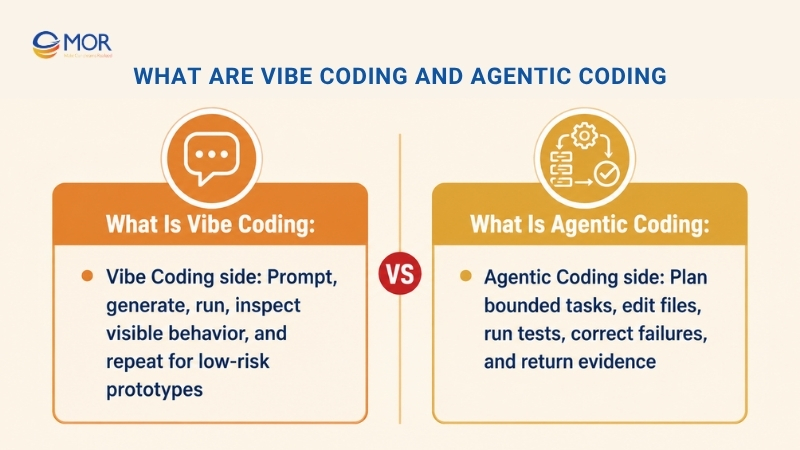
Vibe coding means describing a desired result in natural language, running the generated output, and prompting again when something looks wrong. The user may read little of the source code and judge progress through the interface, logs, or visible behavior.
Its usual loop is short: describe, generate, run, report the error, then try again. Founders, designers, learners, and business users like this style because it removes much of the syntax work and produces something tangible fast.
Use vibe coding for low-risk work with a short lifespan and no sensitive production data. A clickable demo can fit. An authentication service or payment flow does not.
The comparison of vibe coding vs traditional coding centers on direct source ownership. Traditional development asks engineers to design, write, test, and understand the implementation. Vibe coding moves much of the implementation into a prompt loop and places more trust in generated output.
What Is Agentic Coding?
Agentic coding delegates a bounded development goal to an AI agent. The agent can inspect files, form a plan, edit code, run terminal commands, execute tests, read failures, and revise its changes before returning the result.
A typical loop follows five actions: read the project, plan the task, act through tools, observe results, and correct failed work. Human owners still define the objective, approve architecture, set access limits, and review the final diff.
Autonomy exists on a range. One agent may update several files and run tests; a larger setup may assign separate planning, coding, security, documentation, and release roles.
Why The Terms Are Often Confused
Modern coding products often support conversational prompts and autonomous task execution in the same interface. The product doesn’t decide the working method. Your behavior, review depth, and controls do.
A developer can use an agent carelessly and create a form of agentic vibe coding. The same product can support strict planning, tests, pull requests, and approval gates when an engineering team sets those rules.
The phrase vibe coding vs prompt engineering also compares different ideas. Prompt engineering improves the instructions given to a model. Vibe coding describes how much the user relies on generated code without deep inspection.
Discussions about agentic engineering vs vibe coding add another label for supervised production work. ‘Agentic engineering’ stresses that a human remains responsible for the specification, architecture, checks, and final release.
How Vibe Coding vs Agentic Coding Moves Through The Software Development Lifecycle
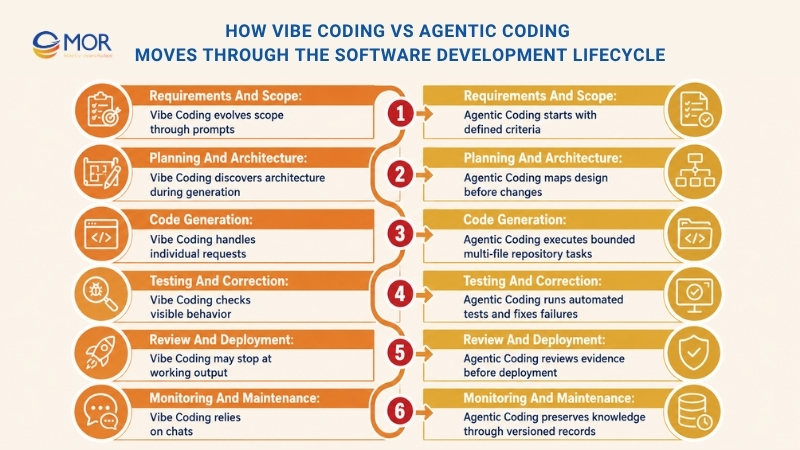
The difference becomes easier to see when each method follows the same delivery stages. Vibe coding vs. agentic coding changes who defines each step, what evidence marks completion, and how errors return to the workflow.
Requirements And Scope
- Vibe coding: Work often starts with an informal request. Scope changes through repeated prompts as the user sees each result.
- Agentic coding: The task has acceptance criteria, limits, dependencies, and a completion rule before execution begins.
A request like ‘build an employee dashboard’ leaves too much open for a production agent. A bounded ticket states the user roles, API contract, data fields, error cases, and tests that must pass.
Planning And Architecture
- Vibe coding: The model often chooses folders, libraries, data structures, and component links during generation.
- Agentic coding: A human architect or planning agent maps modules, interfaces, data flow, and task order before code changes.
The comparison of vibe coding vs spec coding sits here. Spec-led work starts with an approved contract for behavior and design. Vibe coding starts with intent, then discovers many technical choices during the prompt cycle.
Code Generation
- Vibe coding: The AI responds to individual requests, and the user steers every round.
- Agentic coding: The agent completes a defined task across several files under repository rules.
For example, a vibe-coded request may add a button and its click action. An agentic ticket may update the React component, Node.js API, PostgreSQL query, OpenAPI file, and tests under one approved change plan.
Testing And Correction
- Vibe coding: Users test visible behavior and return error messages to the model.
- Agentic coding: Agents run unit tests, integration tests, lint checks, builds, and security scans, then revise failed work.
Tests give the agent an objective target. Without them, ‘done’ may mean that the app loaded once. That’s a weak standard for data handling, permissions, and failure recovery.
Review And Deployment
- Vibe coding: Review may stop when the function appears to work.
- Agentic coding: Teams inspect code diffs, test evidence, security findings, architecture rules, and release readiness.
Production deployment should remain a separate approval step. Passing tests supports the decision, but a qualified engineer still checks the change against the business requirement and possible failure paths.
Monitoring And Maintenance
- Vibe coding: Later maintenance may depend on the original builder and saved chat history.
- Agentic coding: Git history, tickets, decision records, repository rules, and CI/CD checks preserve working knowledge.
Long-lived software needs maintainers who can understand why a decision was made. Prompts alone rarely provide that record. Structured logs and versioned documents give later teams a usable trail.
Vibe Coding vs Agentic Coding: Architecture, Context, And Multi-Agent Orchestration
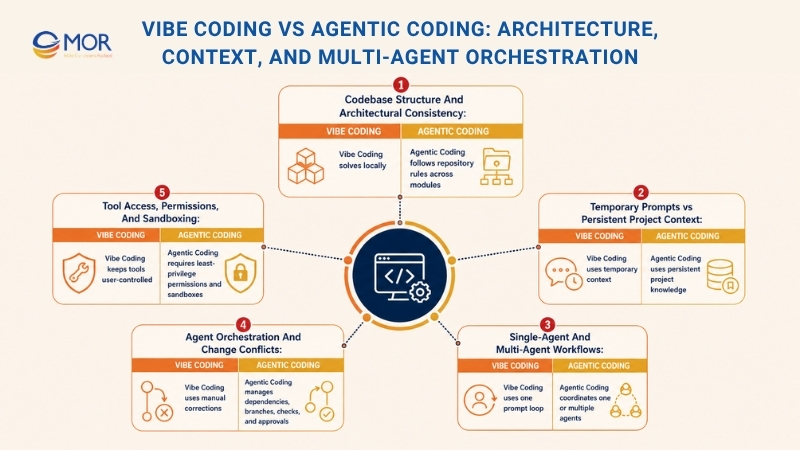
Architecture separates a convincing demo from software a team can own for years. In vibe coding vs agentic coding, the main difference lies in how each method receives project knowledge, follows design rules, and coordinates changes across a codebase.
Codebase Structure And Architectural Consistency
Vibe coding often builds one request at a time. Each prompt may solve the immediate task, yet the model may repeat logic, add a new library for an existing capability, or connect modules in a way that creates hidden coupling.
Agentic coding can read approved design documents, repository rules, module boundaries, and API contracts before it edits files. That broader view supports consistent changes, but only when the documents match the actual system.
Comparison point | Vibe coding | Agentic coding |
Main guidance | Current prompt and chat history | Repository rules and approved documents |
Architecture awareness | Local and task-based | Can span modules and dependencies |
Common failure | Duplicate or inconsistent code | Faithfully following outdated rules |
Human responsibility | Inspect and restructure output | Set architecture and approve wider changes |
Temporary Prompts vs Persistent Project Context
Temporary chat history creates a fragile memory. A user may explain the database rules in one session, then forget to repeat them when requesting a related API change days later.
Agentic workflows can draw from repository files, coding standards, architecture decision records, issue history, dependency maps, test results, and tool state. Still, a large input window may contain old or conflicting information. More material can produce more confusion.
The comparison between agentic AI vs vibe coding becomes sharper at this point:
- Vibe coding layer: Current prompt, uploaded files, and recent conversation.
- Agentic coding layer: Source repository, documents, tickets, architecture rules, tests, and execution state.
- Shared failure layer: Old requirements, conflicting standards, missing permissions, and irrelevant files.
Project knowledge must be current, relevant, and safe. An agent working on an invoice screen doesn’t need payroll records or production credentials.
Single-Agent And Multi-Agent Workflows
Vibe coding usually connects one user with one AI coding interface. The user submits a prompt, checks the output, and sends another request. The simplicity supports fast experimentation.
Agentic coding may run through one autonomous agent. That agent can plan a task, edit several files, run checks, and revise its work. Larger programs may divide the job across planning, implementation, testing, security, documentation, and release agents.
Workflow | How it runs | Main trade-off |
Vibe coding | User prompts, AI generates, user checks | Fast and simple, with weak built-in control |
Single agent | Agent plans, edits, tests, and revises | Broader task coverage, with review still required |
Several agents | Specialist agents work under an orchestrator | Clear role separation, with higher coordination cost |
Extra agents add token use, shared-state needs, and more chances for task meaning to drift. Add a specialist only when the role creates a measurable checking or delivery benefit.
Agent Orchestration And Change Conflicts
Manual prompt control works well when one person changes one small area. Agent orchestration becomes useful when tasks have dependencies, can run in parallel, or need retries and escalation rules.
Vibe coding flow: Prompt → Generated change → Manual check → Correction prompt
Agentic coding flow: Task plan → Dependency check → Agent assignment → Isolated branch → Automated checks → Conflict review → Human approval
Take a simple API change. One agent updates a response field from customerName to displayName. Another agent updates the React screen using the old contract. Each change may pass its local tests and still break the end-to-end path.
Use branch isolation, file ownership, contract tests, and merge queues. Human checkpoints should block destructive data changes, payment logic edits, infrastructure replacement, and production releases.
Tool Access, Permissions, And Sandboxing
Vibe coding assistants often generate text or edit files under direct user control. Agentic systems may reach terminals, APIs, databases, cloud accounts, CI/CD pipelines, and issue trackers. Wider action rights create a larger failure area.
Tool or resource | Vibe coding access | Agentic coding access | Required control |
Source code | Copied or manually edited | Direct repository access | Protected branches |
Terminal | Usually run by the user | May run commands alone | Command allowlists |
Database | Rare or manual | May query or change data | Read-only roles and sandboxes |
CI/CD | Triggered by a developer | May start pipelines | Approval gates |
Production | Human-controlled | High risk if accessible | No default access |
Apply least privilege at task level. Use temporary credentials, separate development and staging systems, restricted commands, and complete access logs. Production should remain outside the default agent workspace.
Vibe Coding vs Agentic Coding: Speed, Cost, And Productivity Trade-Offs
Early output often favors vibe coding. Production delivery can favor agentic coding when tests, repository rules, and review gates already exist. The useful comparison is agentic vs vibe coding across the whole delivery cycle, not the first visible screen.
Why Vibe Coding Delivers Faster Early Results
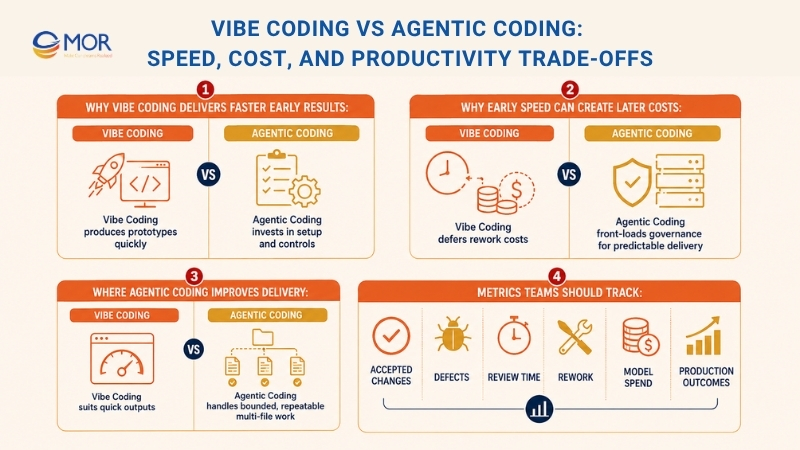
Vibe coding cuts setup, boilerplate, syntax work, and early technical research. A founder can describe a booking flow in plain English and get a clickable concept within hours.
Agentic coding needs more preparation. Repository indexing, acceptance criteria, permissions, test setup, and execution rules can slow the first cycle. That effort starts paying back when tasks span several files or must meet a fixed quality bar.
First 24 hours | Vibe coding | Agentic coding |
Setup effort | Low | Moderate to high |
First visible output | Very fast | Slower |
Architecture work | Often limited | Usually required |
Best early result | Prototype or concept | Structured implementation plan |
Why Early Speed Can Create Later Costs
A prototype can look finished long before it’s ready for real users. Missing tests, unclear data rules, and duplicated code often surface during production preparation.
Vibe coding keeps the starting cost low, but review and rebuilding costs may rise later. Agentic work spends more time early on rules and checking, then reuses those controls across future tasks.
Project phase | Vibe coding cost pattern | Agentic coding cost pattern |
Prototype | Low | Moderate |
Production preparation | Can rise quickly | More predictable |
Maintenance | Costly when structure is weak | Lower when rules and tests stay current |
Governance | Often added late | Designed into the workflow |
Count refactoring, security checks, documentation, handover, and support before comparing total cost.
Where Agentic Coding Improves Delivery
Agentic coding fits repetitive work and bounded changes that cross files. Dependency updates, regression tests, migration scripts, API implementation, and documentation changes give agents clear targets and checkable results.
The latest GitLab AI Accountability Report found that 78% of surveyed organizations reported faster code output. Yet 85% said AI had shifted the bottleneck toward review and validation, and 79% said developer productivity had risen faster than the overall delivery process.
Task | Vibe coding fit | Agentic coding fit |
UI mockup | Strong | Acceptable |
One-time script | Strong | Often excessive |
Dependency upgrade | Limited | Strong |
Multi-file change | Risky without deep review | Strong with repository knowledge |
Regression tests | Moderate | Strong |
Controlled migration | Weak | Strong with approval gates |
The difference between vibe coding vs agentic AI appears in follow-through. Vibe coding produces a requested change. An agent can plan the work, run checks, fix failures, and prepare a reviewable pull request.
Metrics Teams Should Track
Generated code volume has little business value on its own. Teams need measures tied to accepted, production-ready work.
- Speed metrics: Lead time per accepted change, implementation time, and release frequency.
- Quality metrics: Test pass rate, escaped defects, rollback rate, and security findings.
- Control metrics: Rejected changes, review time, rework hours, and verified code coverage.
- Cost metrics: Model spend, tool spend, review cost, and cost per released function.
Weak metric | Better metric |
Lines of generated code | Production-ready changes |
Completed prompts | Accepted pull requests |
Agent task count | Business outcomes delivered |
Track implementation time saved against validation time added. A team that writes code 40% faster but doubles review work hasn’t solved the delivery problem.
Vibe Coding vs Agentic Coding: Security, Code Quality, And Governance Risks
Security risk grows when generated code reaches real data, real users, or systems that can act. Vibe coding vs agentic coding creates different failure paths, but neither method removes the need for human review and automated checks.
Security Risks In Unreviewed Generated Code
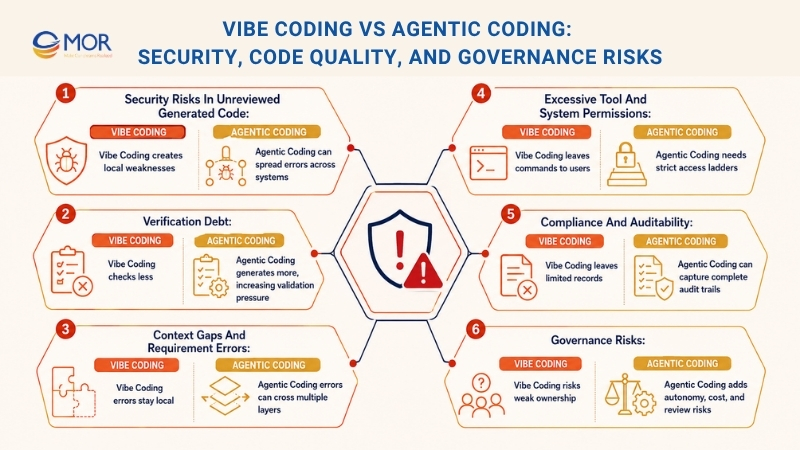
Vibe coding may produce weak authentication, broad database rules, exposed secrets, or vulnerable packages when the prompt omits security requirements. Agentic coding can spread the same mistake across more services because the agent can edit wider areas and call tools.
Risk | Vibe coding | Agentic coding |
Weak authentication | Built from an incomplete prompt | Repeated across connected services |
Exposed secrets | Added to generated files | Read, copied, or moved through tools |
Vulnerable packages | Installed without review | Installed and included in a broader change |
Unsafe data access | Limited to generated logic | May extend to databases and cloud services |
Functional output isn’t proof of production safety. Authentication, authorization, secret scanning, dependency review, and abuse tests must pass before release.
Verification Debt
Verification debt is the gap between how fast AI creates code and how fast your team can prove that code is correct, safe, and maintainable. Parallel agents can make that gap grow quickly.
Sonar’s 2026 State of Code Developer Survey reported that 96% of developers don’t fully trust AI-generated code, yet only 48% always check AI-assisted code before committing it. The same survey says AI now accounts for 42% of committed code.
- Vibe coding: Moderate output volume and limited built-in checking.
- Agentic coding: Higher output volume and stronger checking potential, plus heavier review pressure.
- Required balance: Generation speed must stay below the team’s validation capacity.
Verification capacity ratio = Verified changes ÷ Total generated changes
Unit tests, integration tests, static analysis, dependency scanning, secret scanning, and architecture checks create evidence. A green interface alone doesn’t.
Context Gaps And Requirement Errors
Prompt mistakes tend to stay near one function. Agent mistakes can travel farther across the frontend, API, data model, and documents.
Take one requirement: only account owners may download customer records. Vibe coding may show the export button to every signed-in user. An agentic workflow may also update the API and export service with that incorrect rule.
Trace the requirement to its code changes, tests, and approval record. Stop execution when the source rule can’t be confirmed.
Excessive Tool And System Permissions
Vibe coding usually leaves commands to the user. Agentic systems may access repositories, terminals, databases, cloud accounts, CI/CD, credentials, and customer data.
Use a simple access ladder:
- Low access: Read source files.
- Moderate access: Edit code and run tests.
- High access: Change infrastructure or database schemas.
- Restricted access: Deploy to production or access sensitive records.
Keep agents at the lowest task level. Use read-only roles, temporary credentials, isolated environments, command limits, and approval gates.
Compliance And Auditability
Vibe coding may leave little evidence beyond Git history and saved chats. Agentic workflows can record prompts, model versions, tool calls, file changes, tests, access history, and approvals.
Healthcare, banking, fintech, insurance, and HRM systems need traceable decisions. Neither method creates compliance automatically. Your audit trail must show what changed, why it changed, who approved it, and which checks ran.
Governance Risks
Governance failures look different across the two methods. Vibe coding often fails through weak ownership and prototypes that quietly enter production. Agentic coding adds broader risks around access, cost, review capacity, and autonomous action.
Governance area | Vibe coding failure pattern | Agentic coding failure pattern |
Ownership | No clear maintainer | No owner for agent decisions |
Scope | Prototype grows beyond its purpose | Agent follows vague or old goals |
Cost | Rework appears late | Model and orchestration spend grows |
Review | Generated code gets light review | Parallel changes exceed review capacity |
Failure area | Usually one app or function | Can cross services and environments |
Gartner predicts that more than 40% of agentic AI projects will be canceled by the end of 2027 due to rising costs, unclear business value, or weak risk controls. The forecast covers enterprise agentic AI projects broadly, yet the warning applies directly to coding programs that lack owners, budgets, and measurable completion rules.
When To Use Vibe Coding And When To Use Agentic Coding
Project risk, lifespan, data sensitivity, and review capacity should guide the choice. The table below summarizes where vibe coding, agentic coding, and human-led development fit best.
Approach | Good Fits | Poor Fits | Required Control |
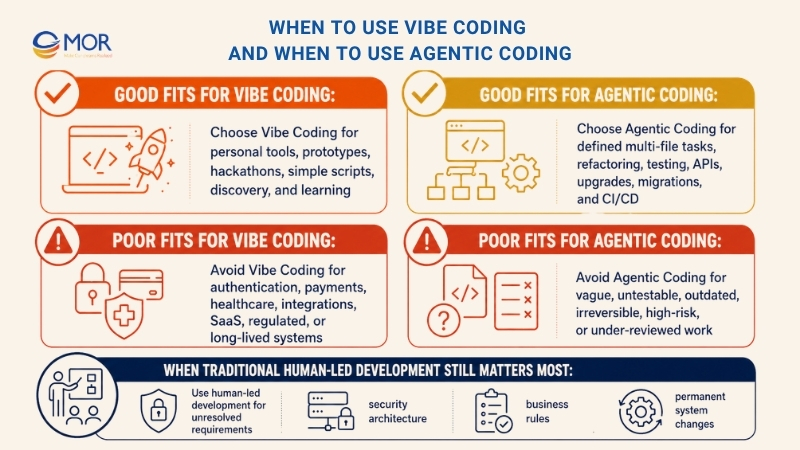
Vibe coding | Personal tools, disposable prototypes, hackathon work, one-time scripts, product discovery, and learning exercises | Authentication, payments, healthcare data, enterprise integrations, multi-tenant SaaS, audited software, and long-lived products | Use mock data, isolate the prototype, and review generated code before reuse |
Agentic coding | Defined multi-file tickets, legacy analysis, controlled refactoring, test generation, API work, package upgrades, migrations, documentation, and CI/CD tasks | Vague goals, outdated repositories, untestable tasks, small manual fixes, irreversible production actions, and high-risk design decisions | Set acceptance criteria, repository rules, tests, permission limits, approval gates, and a qualified reviewer |
Good Fits For Vibe Coding
- Personal tools: Use mock or non-sensitive data and keep the scope narrow.
- Disposable prototypes: Test demand, navigation, or interface ideas before funding a full build.
- Hackathon work: Focus on learning, experimentation, and demonstration rather than long-term ownership.
- One-time scripts: Automate a small task that has clear inputs and an easy manual check.
- Product discovery: Put a concept in front of users and identify weak assumptions early.
- Learning exercises: Review the generated code afterward rather than treating it as a black box.
Poor Fits For Vibe Coding
- Authentication systems: Login, identity, and permission rules require detailed security review.
- Payment workflows: Transaction logic, refunds, billing, and financial records need strict validation.
- Healthcare software: Patient data and clinical workflows require controlled access, audit records, and privacy safeguards.
- Enterprise integrations: ERP, CRM, payment gateways, and legacy systems need stable API contracts and error handling.
- Multi-tenant SaaS: Weak data separation can expose one customer’s records to another account.
- Uptime-dependent systems: Products with service commitments need monitoring, rollback plans, and tested recovery procedures.
- Long-term products: Software maintained by several developers needs clear architecture, documentation, and ownership.
- Regulated software: Audits and compliance reviews require traceable decisions, approvals, and test evidence.
Keep vibe-coded prototypes separate from production systems and real data. Treat them as design experiments until a qualified team reviews the architecture, code, and security controls.
Good Fits For Agentic Coding
- Multi-file tickets: Assign defined work that spans frontend, backend, tests, and documentation.
- Legacy code analysis: Let agents map dependencies, identify repeated logic, and prepare reviewable findings.
- Controlled refactoring: Use clear tests and module boundaries to guide code changes.
- Regression testing: Generate tests for existing behavior and run them against proposed changes.
- Documentation updates: Keep API files, setup guides, and technical notes aligned with code changes.
- API implementation: Build against approved contracts, schemas, permission rules, and acceptance criteria.
- Dependency upgrades: Update packages, fix compatibility issues, run tests, and prepare a pull request.
- Migration scripts: Handle repeatable data or system changes under staging checks and rollback rules.
- CI/CD tasks: Update pipelines, build rules, test stages, and release checks within defined permission limits.
- Large repositories: Use agents when architecture documents, ownership rules, and coding standards remain current.
Every agent still needs a bounded task, reliable checks, and a qualified reviewer. Agent autonomy works best when the completion standard can be measured.
Poor Fits For Agentic Coding
- Small manual fixes: Agent setup, project loading, execution, and review may take longer than editing the code directly.
- Vague project goals: Agents can’t make reliable decisions when the desired outcome remains unclear.
- Changing product concepts: Early discovery work may shift after every user test, which makes long execution plans wasteful.
- Outdated repositories: Old documentation and conflicting standards can guide agents toward incorrect changes.
- Unclear module ownership: Agents may edit connected files without knowing which team controls each component.
- Untestable outcomes: Tasks without tests, static checks, or measurable acceptance criteria are difficult to verify.
- Irreversible production actions: Database deletion, schema replacement, and infrastructure changes need manual approval and rollback plans.
- High-risk security decisions: Threat models, permission structures, and identity architecture require expert judgment.
- Low review capacity: Teams that can’t inspect, reject, or correct generated changes shouldn’t increase agent autonomy.
Keep agent access narrow and task-based. Production credentials, customer records, destructive commands, and deployment permissions should remain outside the default agent environment.
When Traditional Human-Led Development Still Matters Most
Human-led work should lead when requirements remain unresolved or success can’t be measured through tests and checks. It also remains the safest choice for high-risk security decisions, poorly documented business rules, and permanent infrastructure or data changes.
AI can support research and drafts, but a qualified engineer must own the design and final decision.
Vibe Coding Or Agentic Coding: Which Approach Should You Choose?
The right route depends on responsibility. A vibe vs agentic coding decision should start with data risk, lifespan, maintainers, integrations, and review capacity.
Ask these questions before assigning work:
- Will the system handle customer or employee data?
- Does it include authentication, payments, healthcare, or finance?
- Will several developers maintain the code?
- Does it connect to ERP, CRM, cloud, payment, or legacy platforms?
- Will it stay active for more than a few months?
- Are automated tests and CI/CD checks available?
- Can the team define measurable completion criteria?
- Can every agent action be logged and reviewed?
- Are development and production systems separated?
- Does a qualified engineer own the release decision?
Answer pattern | Recommended route |
Mostly no, concept still unclear | Start with vibe coding |
Low risk, task well defined | Use a supervised agent |
Real users and long-term ownership | Use agentic development under architecture and test gates |
Sensitive data or regulated work | Keep design human-led and agent access narrow |
High risk and unclear scope | Complete discovery before choosing an AI workflow |
A blended path often works best. Test the idea through vibe coding, then write the specification, review the architecture, add tests, and move bounded tasks into agentic execution.
Turn AI-Generated Concepts Into Production Software With MOR Software
A fast prototype may confirm demand, but production work needs architecture review, secure integrations, testing, cloud planning, and maintainers. MOR Software helps teams decide what to retain, refactor, or rebuild.
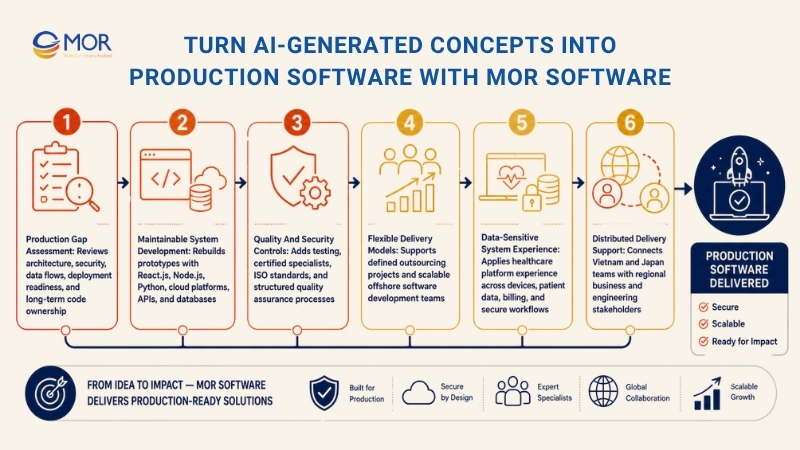
- Assess the production gap: MOR supports business analysis, IT consulting, custom development, system integration, testing, maintenance, and modernization. Reviews can cover code structure, security, data flow, deployment, and ownership.
- Build web and backend systems: MOR’s web development services cover React.js, Vue.js, Angular, Python, Node.js, Google Cloud, AWS, and Microsoft Azure. Teams can replace temporary logic with maintainable frontend, API, database, and cloud components.
- Add quality controls: MOR lists QC, testing, security work, engineers with AWS, Salesforce, ISTQB, Java, PMP, PSM, and Google Cloud certifications, plus ISO 9001/27001 certification and CMMI appraisal.
- Choose a delivery model: Your company can outsource a defined project or form an offshore team with project management, business analysis, software architecture, development, QA, and QC roles. MOR’s team model covers requirements, screening, onboarding, management, feedback, and scaling.
- Apply experience in data-sensitive systems: MOR built the I-Medisync healthcare platform through a 24-month project with 12 team members, Java Spring, ReactJS, and AWS. The system connects medical devices, patient data, billing, and operational workflows under defined security requirements.
- Support distributed delivery: MOR’s materials list teams and offices across Vietnam and Japan, which supports ongoing work with regional business and engineering stakeholders.
Share your prototype, repository state, business rules, security concerns, and release plan with MOR Software. A technical assessment can identify reusable code, required corrections, and a suitable delivery model.
Conclusion
Vibe coding vs agentic coding isn’t a choice between speed and AI. It’s a decision about project risk, lifespan, verification, and ownership. Use vibe coding to test low-risk ideas quickly. Use controlled agents for defined work that has current project knowledge, tests, access limits, and expert review. When your prototype needs production architecture, secure integrations, and long-term support, contact MOR Software for a technical assessment and delivery plan.
"Evolution is not a destination, it is a disciplined journey of innovation."
Phung Van Tu


CEO MOR AI
MOR SOFTWARE
Frequently Asked Questions (FAQs)
What is the main difference between vibe coding and agentic coding?
Vibe coding relies on repeated prompts and light source review. Agentic coding gives an AI agent a bounded goal, tools, and completion checks. The human steers each vibe coding round, whereas an agent can run several steps before returning a result.
Is agentic coding simply a more developed form of vibe coding?
No. Vibe coding describes a trust-heavy working style. Agentic coding describes an execution method that can plan, use tools, test, and revise. Autonomy alone doesn’t create engineering discipline.
Can vibe-coded software be used in production?
It can, but only after full engineering review. Teams need to inspect architecture, dependencies, data rules, security, tests, deployment, and maintenance. Many prototypes need major refactoring or a partial rebuild.
Does agentic coding still require human code review?
Yes. Agents can run tests and static checks, but they may misunderstand the requirement or take a shortcut. A qualified engineer must review the diff, test evidence, architecture fit, and release risk.
Which approach is better for building an MVP?
Vibe coding fits early concept tests and disposable demos. An MVP with real users, login, payments, or stored data needs stronger controls and qualified review.
How do teams convert a vibe-coded prototype into production software?
Start with a code and architecture assessment. Map business rules, remove unsafe dependencies, define APIs, add tests, separate environments, and document ownership. Retain only code that meets the production standard.
What security risks come with AI-generated code?
Common risks include weak authentication, broad permissions, exposed credentials, unsafe inputs, vulnerable packages, and public database rules. Tool-enabled agents add terminal, cloud, deployment, and production-data risks.
Can agentic coding replace software developers?
No. It changes where developers spend time. Engineers do less repetitive implementation and more work on specifications, architecture, review, security, tests, and incident analysis.
What tools and infrastructure are needed for agentic coding?
Teams need repository access, isolated execution, tests, CI/CD checks, protected branches, logging, permission controls, and rollback paths. Larger setups may also need orchestration, cost limits, and agent identity management.
How should a company measure the ROI of AI-assisted development?
Measure accepted production work, not generated code. Track lead time, review hours, rework, defects, security findings, rollback rate, model spend, tool spend, and cost per released function.
Share


Make Our-Dreams Realized


© 2023 . MOR Software. All Rights Reserved
Sitemap
Privacy Policy
Terms of Use

Rate this article
0
over 5.0 based on 0 reviews
Your rating on this news:
Name
*Email
*Write your comment
*Send your comment
1