


Vibe Coding vs Traditional Coding: What Works Best in 2026?
AI can now turn prompts into apps, but speed alone does not make software ready for real users. The debate around vibe coding vs traditional coding matters because teams need to know when quick testing is enough and when skilled engineering is safer. In this guide, MOR Software will explain what works best in 2026.
Key Takeaways
- Vibe coding is best for quick prototypes, simple tools, and early idea testing when speed matters more than deep control.
- Traditional coding works better for secure, scalable, and custom systems that need clean architecture and long-term support.
- Many teams can use both methods together, starting with AI coding assistant drafts and moving to expert development when the product grows.
Quick Comparison: Vibe Coding Vs Traditional Coding Methods
This table gives you a quick view of vibe coding vs traditional coding, so you can compare purpose, workflow, and fit before choosing traditional coding vs vibe coding for your next product.
Aspect | Vibe Coding | Traditional Coding |
Speed For Building And Testing Ideas | Lets teams shape and adjust prototypes fast through plain-language prompts. | Needs more time since developers write, test, and repair the code by hand. |
Control And Product Fit | Gives less direct control because AI often builds much of the logic. | Gives developers close control over each layer of the codebase. |
Code Quality And Structure | Usually needs review because AI-made code may follow mixed patterns. | Often creates stronger quality through code reviews, clear rules, and human checks. |
Skills Required | Works well for founders, early teams, and users without deep technical skills. | Needs stronger knowledge of programming ideas, tools, and development methods. |
Best Project Fit | Suits fast MVPs and early proof-of-concept work. | Fits complex platforms, long-term products, and enterprise systems. |
Both methods bring real value. A clear comparison of vibe coding and traditional coding depends on what you plan to build, how far it needs to grow, and how stable the final product must be.
Main Differences Between Vibe Coding Vs Traditional Coding
Once you understand the basic idea behind each method, vibe coding vs traditional coding becomes easier to judge in real product work.
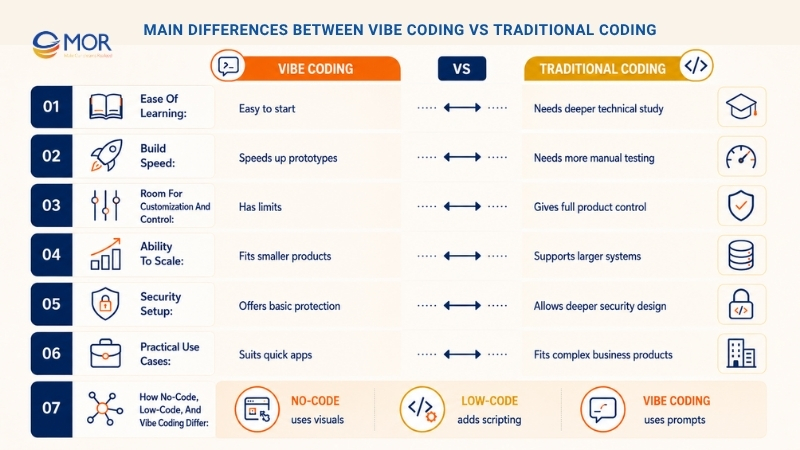
The biggest differences between these two development styles usually involve:
- Learning curve
- Development speed
- Flexibility and control
- Scalability
- Security
- Use cases
Ease Of Learning
Vibe coding feels simple for new users to test, so people can begin without a background in software development. Its main strength is that users can explain tasks in normal language, then the AI automation turns those instructions into working code. This opens app creation to people who cannot program and helps them go from rough idea to usable product in less time.
Traditional coding has a steeper learning path. Developers must learn programming languages like Java, Python, or C++, work with frameworks, and understand how software logic runs. That knowledge gives them more freedom and strength, but it also takes real study and practice for anyone entering software development.
Build Speed
Vibe coding can move at a much faster pace, which is one of the clearest vibe coding advantages vs traditional coding. AI can take care of code writing, screen setup, and simple logic, so teams can build earlier versions with less delay. This makes AI-based coding tools useful for prototypes or minimum viable products when speed matters.
Traditional coding often takes a slower route because developers need to create, test, and fix each part of the system themselves. Frameworks and reusable tools can speed up some tasks, but the process still takes longer than an AI-supported workflow. It fits better when the product needs deep engineering, long-term care, and careful debugging.
Room For Customization And Control
Custom changes have real limits in vibe coding. Many tools depend on set flows and built-in structures, so your choices are tied to what the platform can support. That works for simple apps, but it can become hard when you need to tune every small part of the product.
Full control is a major strength of traditional coding. Developers can shape the software around a very exact product idea, which makes this method useful for custom business systems. Your team may need a special function, a complex connection, or a unique user journey, and manual coding gives the freedom to build it properly.
Ability To Scale
Vibe coding is well suited to small and mid-size products that do not need complex architecture or heavy custom work. It runs well for MVPs, personal tools, and simple apps, but it can feel limited when the product starts growing into a larger system. As scope, data, and users increase, vibe coding vs traditional coding becomes an important choice because AI automation tools may not give enough long-term capacity.
Traditional coding is usually better for large software products with complex needs. It can support systems that must grow, handle more users, and manage heavy traffic or large data sets. Enterprise apps, rich databases, and busy websites often need the scale that hand-written development can create.
Security Setup
Built-in platform security is common in vibe coding, which can help but may also limit your options. Many tools include basic protection like encryption and access control, but they may not allow deeper security rules for sensitive systems. That makes vibe coding less suitable when security sits near the top of the project list.
Traditional coding gives teams more control over protection design. Developers can build security around exact product needs, including access rules, encryption choices, and security protocols. This makes manual development a safer fit for finance platforms, healthcare systems, and enterprise apps.
Practical Use Cases
Vibe coding works best for fast prototypes, personal tools, and small apps, mainly when you need a working product quickly and do not have coding skills. It fits internal tools, early MVPs, and simple products where speed and ease matter most. A comparison vibe coding vs traditional programming becomes clearer when you look at the project size and risk level.
Traditional coding works better for full applications, enterprise software, and high-performance systems. It is the safer path when a product needs deep custom work, strong scale, or links with current business systems. This makes it a better choice for larger products that must run well and meet clear business needs.
How No-Code, Low-Code, And Vibe Coding Differ
The main gap between no-code, low-code, and vibe coding vs traditional coding sits in how people build and what each method is meant to do:
- Drag-and-drop no-code tools let users build apps with visual blocks and no manual coding.
- Low-code builders with custom options also use visual tools, but they support some scripting when teams need more control.
- Prompt-led vibe coding tools move away from visual builders and use natural language prompts to create code or app logic with AI.
This also helps separate vibe coding vs agentic coding, since agentic coding often lets AI agents plan and act through more steps, while vibe coding usually starts with human prompts and feedback.
In short:
- No-code: build through a visual interface
- Low-code: build through a visual interface with some coding
- Vibe coding: build through written prompts
What Is Vibe Coding?
Vibe coding is the idea of getting all the talk right now, so it makes sense to start here. It means you build software through a plain-language chat with an AI model. You do not begin with long syntax rules, you explain what your app should do. The AI creates the code behind it, and you guide the result like a product lead, based on how the app works and feels.
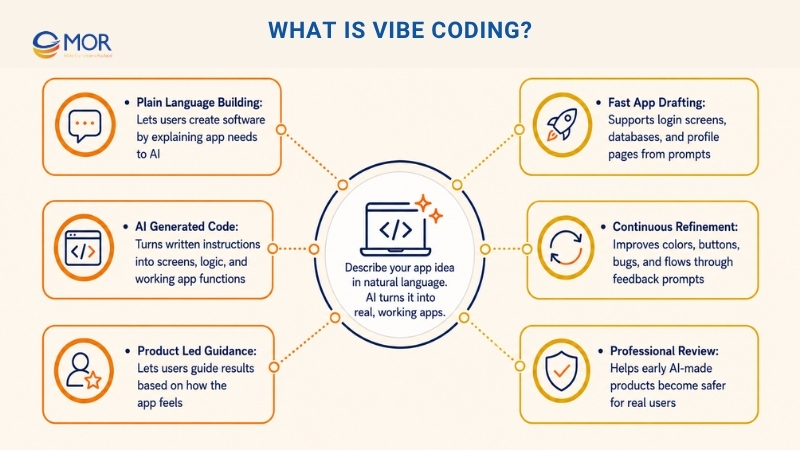
In app development, you can ask AI to draft a login screen, connect a database, or create a user profile page from written directions. Some teams call this vibe programming, and the term can sound like a vibe programming language, but it is really a prompt-led way to shape code through coding vibes and feedback. You refine the app through prompts for color changes, button moves, or bug fixes, and MOR Software can help turn an early AI-made product into a safer web or mobile app for real users.
What Is Traditional Coding?
Traditional coding means giving a computer direct instructions through a set programming language, which is the manual side of vibe coding vs traditional programming. You build each part of the app yourself, including how data moves, how screens appear, and how buttons respond to user actions. This method gives your team full control over each small part of the project.
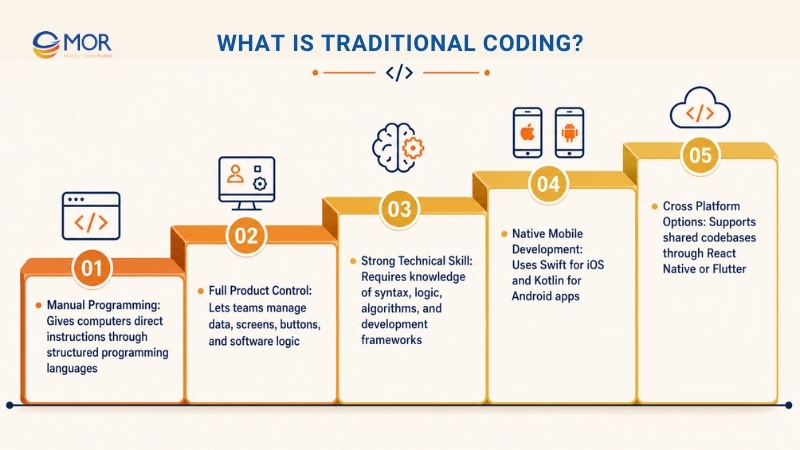
To create an app this way, you need to understand logic, algorithms, and syntax well. Developers often spend months or years learning mobile app frameworks before they can build native experiences with confidence. Say you want an iOS app, the usual language is Swift, and Android often uses Kotlin. For one codebase across the two platforms, teams may choose React Native or Flutter.
When To Use Vibe Coding Vs Traditional Coding
The best answer to vibe coding vs traditional coding 2026 depends on what you want to build, how fast you need it, and how much control your product needs. Vibe coding fits projects where fast testing, simple execution, and early user feedback matter most. Traditional coding is stronger when your product needs deep logic, strict security, high performance, or a stable base for long-term growth.
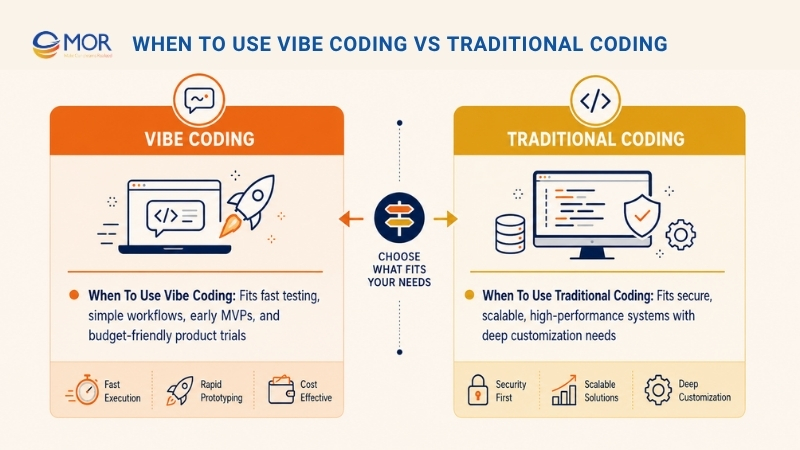
When To Use Vibe Coding
Vibe coding makes sense when your main goal is to turn an idea into a working draft quickly. Rather than spending weeks mapping every technical detail, you can describe your needs in simple words and let AI create the first version. This works well for founders, small teams, marketers, creators, and business users who want to test an idea before paying for full custom development.
- Quick concept checks: Vibe coding is useful when you want to see if an idea is worth more time and money. A local delivery app, booking tool, simple dashboard, or customer request form can often start as a basic AI-made version.
- Fast prototype builds: This method fits situations where you need a working demo, wireframe, or MVP in a short window. You can make the first version, show it to users, gather feedback, and improve the idea before larger development costs begin.
- Small work tools: Vibe coding can support simple tools for daily team tasks, including task boards, light CRM systems, reporting dashboards, content plans, approval forms, and stock checklists. These tools may not need deep architecture, but they can still cut down manual work.
- Budget-friendly trials: When a company is not ready to spend thousands of dollars on custom software, vibe coding can lower the cost of early testing. It gives teams a low-risk way to test product ideas before choosing a larger build.
- Creators without coding skills: Vibe coding helps people who know the business problem but cannot write code. They can describe the function they need, adjust the prompt, and work with AI to create a simple product flow.
- Clear, limited workflows: This approach fits projects with simple and well-defined tasks. Common examples include calculators, landing pages, form-based apps, basic automation tools, content generators, and small database screens.
- Testing before custom development: Vibe coding can act as the first step before you work with a professional software team like MOR Software. After the idea proves useful, a development team can review the flow, improve the architecture, strengthen security, and prepare the product for real users.
When To Use Traditional Coding
Traditional coding is the better choice when your product must be stable, safe, scalable, and deeply tailored. The choice around vibe coding vs traditional software engineering becomes clearer when the system must serve many users, connect with different tools, or follow strict business rules. It needs more time, but it gives serious products a stronger base.
- Large business platforms: Traditional coding fits products with many functions, user roles, data paths, and business rules. This can include enterprise platforms, ERP systems, CRM systems, finance tools, logistics systems, and healthcare apps.
- Strict data protection needs: When your product handles sensitive data, traditional coding gives your team more control over access rules, encryption, login checks, audit logs, and security testing. This matters for banking apps, insurance tools, medical systems, and enterprise software.
- Heavy performance demands: Traditional coding is stronger when your system must support high traffic, large databases, or many users at once. A high-performance 3D game, a busy eCommerce site, or a platform with millions of users needs careful engineering.
- Deep product tailoring: Some products cannot work well inside the limits of AI-made code or basic platform templates. Traditional coding lets developers build custom functions, special user journeys, detailed machine learning algorithms, and unique system logic.
- Growth over many years: If your product will keep growing, traditional coding gives it a steadier base. Developers can plan the architecture, write clean code, manage technical debt, and prepare the system for future functions.
- Connections with existing systems: Many companies need software that works with payment gateways, ERP platforms, CRM systems, warehouse tools, HR software, or third-party APIs. Traditional coding gives developers the freedom to build and maintain these links properly.
- Formal quality checks: Traditional development supports code review, testing, documentation, DevOps workflows, and quality assurance. This helps limit bugs and makes the product safer to release, mainly when the software touches customers, money, operations, or business data.
- Enterprise software delivery: For companies that need a reliable and scalable system, traditional coding is often the safer path. A software outsourcing partner like MOR Software can design the architecture, build custom functions, test the product, and maintain it after release.
Can Vibe Coding And Traditional Coding Work Together?
Yes, vibe coding vs traditional coding can work together when your team uses each one at the right stage. The vibe coding philosophy vs traditional coding philosophy is simple: one helps you test ideas fast, and the other turns useful ideas into stable software. You can use vibe coding to move through the early app stage, where AI can draft boilerplate logic, basic screens, and simple database setup. When a working prototype reaches real users, you may shift to traditional coding, though that step depends on product risk, scale, and the quality of the AI-made build. A human developer, or a team like MOR Software, can then clean the architecture, protect the data, and prepare the product for agile growth.
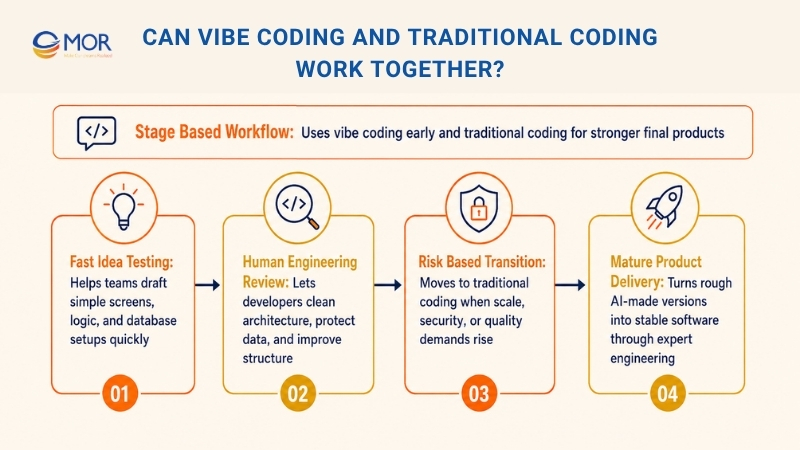
Many strong apps begin with a rough AI-made version, then mature through traditional engineering that adds structure, security, and expert review.
Conclusion
Vibe coding and traditional coding solve different problems. One helps you test ideas fast. The other gives your product the structure, security, and control it needs to grow. The right choice depends on your goal, timeline, budget, and risk level. If your AI-made prototype is ready for the next step, MOR Software can help turn it into a stable, scalable product built for real users. Contact us to get started.
"Evolution is not a destination, it is a disciplined journey of innovation."
Phung Van Tu


CEO MOR AI
MOR SOFTWARE
Frequently Asked Questions (FAQs)
What is the main difference between Vibe Coding Vs Traditional Coding?
Vibe coding uses natural language prompts to help AI create software. Traditional coding requires developers to write code manually with programming languages. The main difference is how much control, skill, and time each method needs.
Is vibe coding the same as no-code?
No. No-code usually uses drag-and-drop tools. Vibe coding uses written prompts to guide AI in creating code, logic, screens, or app flows. It feels more flexible, but the output still needs review.
Is vibe coding good for beginners?
Yes. Vibe coding is easier for beginners because they can describe what they want in plain language. It helps non-technical users test ideas without learning syntax first.
Can vibe coding build real apps?
Yes, vibe coding can build real apps, especially simple tools, MVPs, dashboards, landing pages, and internal workflows. For larger apps, developers still need to review the code, fix weak parts, and improve the structure.
When should a business use traditional coding?
A business should use traditional coding when the product needs strong security, custom logic, high performance, or long-term growth. It is also better for systems that connect with ERP, CRM, payment, or other business tools.
Is vibe coding cheaper than traditional coding?
Vibe coding can be cheaper during the early idea-testing stage. It helps teams create a quick version before spending money on full development. Yet the final cost can rise if the AI-generated code needs major cleanup.
Does vibe coding replace developers?
No. Vibe coding can speed up simple work, but it does not replace skilled developers. Developers are still needed for architecture, security, testing, integrations, performance, and long-term product quality.
Which is better for startups?
Startups can use vibe coding to test ideas fast and collect early feedback. Once the idea proves useful, traditional coding is often better for building a stable product that real users can trust.
Is traditional coding safer than vibe coding?
In most serious projects, yes. Traditional coding gives developers more control over security rules, data handling, testing, and system design. Vibe coding may depend on the AI tool or platform being used.
Can vibe coding and traditional coding work together?
Yes. Many teams use vibe coding to create a quick prototype, then use traditional coding to rebuild the product properly. This gives them speed at the start and stronger quality before launch.
Is vibe coding easy?
Yes, vibe coding is easy to start because users can describe an app, feature, or workflow in plain language instead of writing code from scratch. However, building a reliable product still requires clear prompts, testing, code review, and technical judgment.
Share


Make Our-Dreams Realized


© 2023 . MOR Software. All Rights Reserved
Sitemap
Privacy Policy
Terms of Use

Rate this article
0
over 5.0 based on 0 reviews
Your rating on this news:
Name
*Email
*Write your comment
*Send your comment
1