


AI Customer Experience: Driving Personalization and Efficiency
AI customer experience is no longer a 'nice idea' for service teams. Customers expect quick replies, personal support, and smooth handoffs across every channel, but many businesses still deal with scattered data and slow workflows. In this guide, MOR Software will show you how AI in customer experience helps teams serve faster, personalize better, and work with less manual effort.
Key Takeaways
- AI customer experience helps businesses reply faster, personalize service, connect support channels, read live customer signals, and make smarter revenue decisions from customer data.
- The 13 proven ways include handling high support volume, 24/7 support, faster agent training, less manual work, personal interactions, early issue detection, AI quality checks, risk prediction, relevant offers, better staffing, lower costs, consistent brand voice, and easier knowledge base upkeep.
- Successful AI adoption depends on clean customer data, clear human handoffs, reliable models, ethical data use, team readiness, and ROI tracking through CSAT, response time, first-contact resolution, retention, and lifetime value.
What Is AI Customer Experience?
AI in customer experience means using information sets used in machine learning to improve, tailor, and organize customer interactions across different channels. It applies tools like agentic AI in customer experience and machine learning to read customer intent and adjust responses in real time. Today’s AI CX does more than answer simple questions, since it can take action and solve customer needs before, during, and after a purchase.
Think back to the last time you contacted a brand for help. You wanted a quick reply, a useful answer, and a chat that felt simple and pleasant.
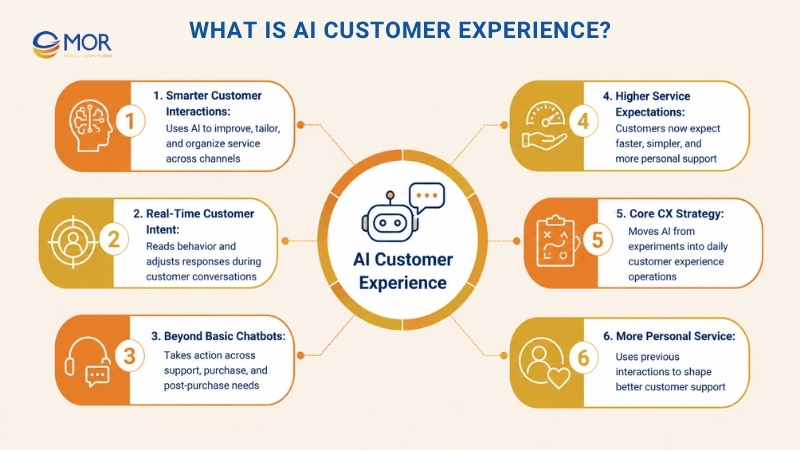
That need is now common. As AI becomes part of daily life, customers expect the same level of service at every touchpoint. According to the Zendesk CX Trends Report, 67 percent of consumers now expect more personal service because AI automation can study their previous interactions.
For companies, this change has pushed AI from a test project into a core part of customer experience. The real issue is no longer whether AI should be used, but how to use it well. In this guide, we’ll look at how AI is changing CX, what benefits it brings, and how businesses can create faster, more useful, and more personal customer experiences.
Key Benefits Of AI Customer Experience
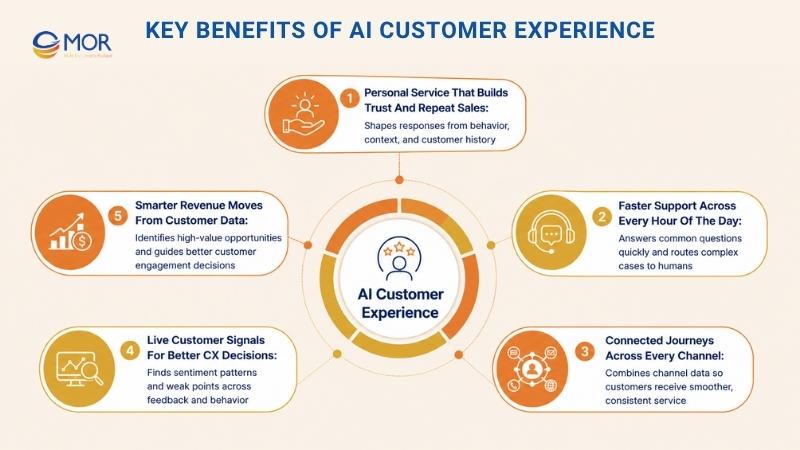
AI customer experience is changing how strong service feels to customers. It helps businesses reply faster, shape each interaction around the person, and serve more people without adding too much manual work. The result is deeper customer relationships, stronger retention, and steadier business growth.
Personal Service That Builds Trust And Repeat Sales
AI helps companies move away from the same reply for every customer. It reads behavior, context, and previous conversations, then predicts what a customer may need and shapes the response in the moment. This makes each interaction feel more useful, which builds trust, lifts conversion rates, and supports repeat sales through AI for personalized customer experiences.
Faster Support Across Every Hour Of The Day
AI customer service helps teams give quick support without lowering service quality. It can answer common questions, walk customers through next steps, and send harder cases to human staff when needed. This type of customer experience automation cuts waiting time, lowers pressure on support teams, and gives agents more room for high-value work.
AI also makes ticket routing and priority setting sharper through intelligent triage and smart assist, so customers reach the right team sooner and autonomous AI agents get the context they need to solve issues well.
Connected Journeys Across Every Channel
Customers want one clear journey, no matter where they contact a brand. AI customer experience brings data from different channels into one view, so conversations feel linked instead of broken. Customers do not need to repeat the same details, and teams can reply with full context, which makes service smoother and more consistent.
Live Customer Signals For Better CX Decisions
AI reviews chats, feedback, and behavior at scale to find patterns that teams may miss. Through tools like AI customer feedback, service teams can read sentiment, spot weak points, and act before small issues grow. This helps companies raise service quality over time and respond faster when customer needs change.
Smarter Revenue Moves From Customer Data
AI helps teams see which actions matter most. It can find high-value chances, suggest the next best step, and guide better decisions. This supports stronger customer engagement, cleaner workflows, and better business results over time.
How AI Customer Experience Improves Customer Service
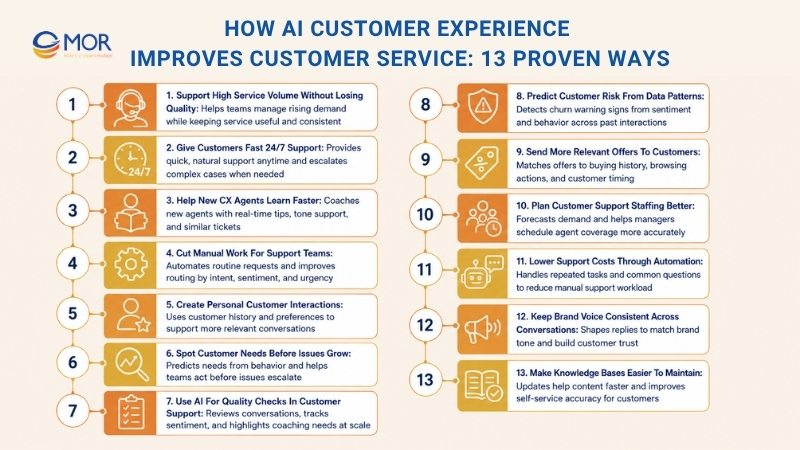
The value of AI in CX is easy to see, from stronger loyalty to lower manual effort, but results depend on how teams use it. AI customer experience can raise customer satisfaction and help service teams work smarter in these 13 practical ways.
Support High Service Volume Without Losing Quality
AI helps companies handle more support requests without losing control. It also supports customer satisfaction and helps build customer loyalty.
A simple case is how AI gives agents useful context for each customer conversation. Liberty London, a well-known UK luxury department store, uses Zendesk AI to detect and tag:
- Customer intent, or the main reason behind the issue
- Sentiment, or whether the message feels positive or negative
- Language
This helps agents understand each customer’s needs with less guesswork.
Companies can also use AI across email, social media, live chat, messaging apps, and other channels to serve customers at scale. These tools help teams manage rising demand and solve requests with less friction. This is useful during busy periods, like holiday sales or new product launches.
Give Customers Fast 24/7 Support
Customers now expect 24/7 support that is quick and easy to access. As expectations grow, fast and correct replies are no longer a bonus, since they are now the basic standard.
AI makes this possible because it can support customers at any hour. An AI customer service agent can read intent, reply in natural language, and guide people through the next step during the day, at night, or on weekends. It can solve common issues on its own and move complex cases to human agents when needed.
This is a big step beyond old chatbot flows. Modern tools use conversational AI to create more flexible, context-aware exchanges that feel natural and useful.
AI also helps human agents answer with more speed and care. Smart tools can suggest replies based on the current conversation, which lowers the time spent writing messages. Generative AI can turn a short note into a full response that is ready to send. These features help teams shorten response time, lower handle time, and close issues faster.
Help New CX Agents Learn Faster
AI can help new customer service agents get ready for live work much faster. It works like a real-time coach, giving new hires tips and feedback while they move through customer service training and real conversations. It can also adjust the tone of replies so they sound warmer or more formal. On top of that, AI can pull up similar support tickets so agents can learn how teammates handled the same type of question. This helps them build confidence and answer customers with less delay.
Cut Manual Work For Support Teams
AI customer experience helps teams work with less manual effort through cleaner workflows and fewer repeated tasks. It can answer routine requests and handle repeat processes, so agents can spend more time on complex cases and valuable work. In many service teams, chatbots support agents by taking care of common questions and helping customers reach answers faster.
AI also improves how work moves across the team. It can read incoming messages to detect intent, sentiment, and urgency. This helps send each request to the right agent sooner and cuts down on needless escalations. Teams can then respond faster and handle more volume without adding extra workload.
Create Personal Customer Interactions
AI can work like a personal helper for each customer. It understands customer history and preferences, which helps agents see what the person may need.
The sustainable e-commerce brand Grove Collaborative uses AI-based insights to support more personal service. AI does not replace human contact here, but gives agents the context they need to reply faster and shape better customer experiences.
Spot Customer Needs Before Issues Grow
AI reads signals like order history, behavior, and preferences to predict what customers may need next. AI powered customer experience solutions can also spot possible issues before they become bigger problems. This gives teams more time to act early and improve customer retention.
Fashion retailer Motel Rocks uses AI to make customer service easier through intelligent triage and sentiment analysis. Incoming messages are sorted by intent and emotional tone, helping agents understand the case faster and decide what to handle first.
AI can also add a simple emoji that shows the general sentiment, from negative to very positive. This gives agents a fast visual cue and helps them prepare for the conversation.
Use AI For Quality Checks In Customer Support
Many CX teams still depend on human reviewers to check support quality. AI-powered quality assurance makes that work faster and steadier because it reviews customer conversations across a much larger volume.
AI can rate agent work, read customer sentiment, and point out coaching needs as conversations happen. This helps teams see service patterns, fix weak spots earlier, and keep raising support quality over time. It also helps companies give customers a steadier service experience and shape agent training around real needs.
Predict Customer Risk From Data Patterns
AI-based tools help support teams find customers who may leave by reading sentiment and behavior across past interactions. AI customer experience makes these warning signs easier to catch early, so teams can act before the issue gets worse.
AI can scan many customer conversations and bring up patterns that show stress, anger, or low satisfaction. It can also send alerts and suggest actions, helping teams focus on customers who need attention and reply with better timing.
Sentiment analysis also gives teams a clearer view of how customers feel about the service they receive. This helps them find service gaps, make better support changes, and lower churn over time.
Send More Relevant Offers To Customers
AI helps companies send offers that match the right time and the right customer based on customer behavior and preferences. It studies buying history, browsing actions, and other signals to find products or services a customer is more likely to care about.
AI may suggest items close to past purchases or show products a customer viewed before. It can also start a promotion at the right moment. A left-behind cart, for instance, can trigger a personal discount that helps the customer finish the order.
Plan Customer Support Staffing Better
AI is now used more often to support workforce planning in customer service. It helps teams handle repeated tasks, find useful signals, and plan agent coverage with better accuracy.
It can study past data and customer behavior to forecast demand and suggest how many agents are needed at a certain time. It also supports scheduling and gives managers a live view of agent activity. This helps an AI customer experience specialist keep teams productive, cut manual work, and protect service quality as demand shifts.
Lower Support Costs Through Automation
AI helps lower support costs because it takes care of repeated tasks and answers common questions through self-service. This cuts the number of incoming support requests and lowers the amount of manual work needed.
It can also show suggestions and useful signals that help teams complete work faster. When AI predicts customer needs and organizes support workflows, teams can handle more requests without adding more people. This matters most during growth periods or tougher market conditions.
Keep Brand Voice Consistent Across Conversations
Generative AI for customer experience helps companies keep the same tone and voice in customer chats. It can shape replies to fit brand style, so each conversation feels connected to the same company. This steady voice helps build brand identity and customer trust.
Agents can also change tone during live conversations. Tone tools can make messages sound warmer or more formal based on the case. This helps teams communicate with more care and still follow brand rules.
Make Knowledge Bases Easier To Maintain
Self-service plays a major role in strong digital customer service.
AI-powered knowledge management tools help keep help center content correct and current. They find weak articles and suggest changes, which makes it easier for teams to keep resources useful. This helps customers get answers without waiting and lowers new support requests.
Content work also becomes faster and easier. Generative AI can turn a few short notes into a complete help center article in seconds. It can also adjust tone to match brand rules, helping teams create clear and steady content with less effort.
AI Customer Experience Case Studies From Real Brands
AI customer experience examples show how real companies use AI to make service faster, easier, and more useful for customers.
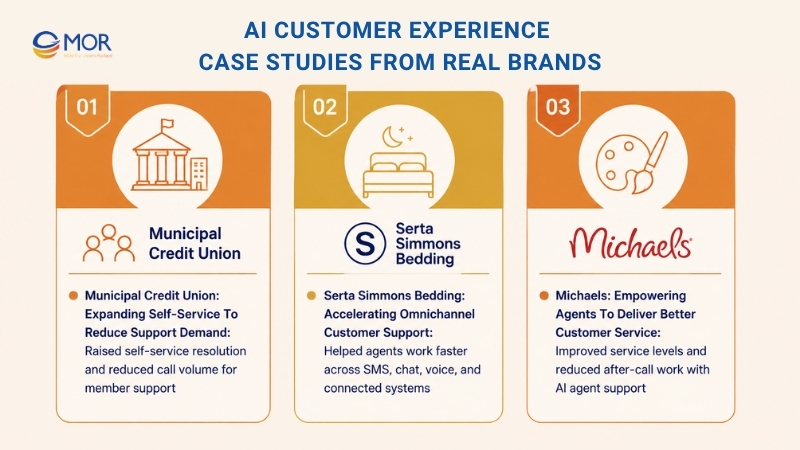
Municipal Credit Union: Expanding Self-Service To Reduce Support Demand
Serving more than 600,000 members across 15 branch locations, Municipal Credit Union (MCU) has changed financial services support through AI-based self-service tools. These tools help members fix issues on their own, making problem solving faster and lowering their need to contact live agents. The result was strong: self-service issue resolution rose by 25%, and call volume also dropped, giving agents more time for complex and high-priority cases.
Serta Simmons Bedding: Accelerating Omnichannel Customer Support
Major mattress brand Serta Simmons Bedding made agents faster and more productive with AI-powered tools from Talkdesk. With Talkdesk Digital Engagement for SMS, chat, and voice, plus Talkdesk Interaction & Quality Analytics and Talkdesk Copilot, agents could find the right information faster and spend less time on manual work. Talkdesk also connected with Salesforce, Confluence, and ServiceNow, bringing core systems into one workspace so agents did not need to switch between tools during AI customer experience work.
Michaels: Empowering Agents To Deliver Better Customer Service
With over 1,200 stores, Michaels is one of the largest arts and crafts retailers in North America. Michaels worked with Talkdesk to upgrade its customer experience through AI tools. Talkdesk Copilot became a key part of Michaels’ AI plan, giving agents stronger support for customer conversations. The company raised service levels from 20% to 89% year over year and cut after-call work by 93%.
Common Pitfalls In AI Customer Experience Adoption
AI customer experience brings clear value, but real adoption still comes with work. Data gaps, trust issues, and internal change can slow teams down when AI is not planned with care.
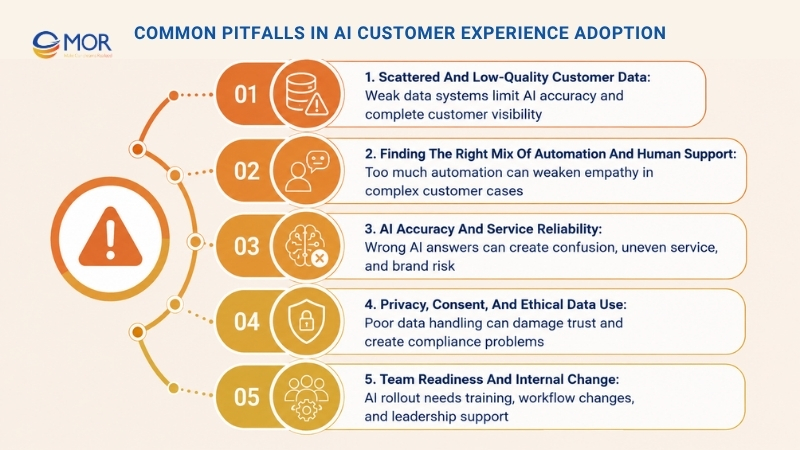
Scattered And Low-Quality Customer Data
Good AI needs clean, joined-up data from the full customer journey. Yet many companies still keep customer data in separate systems, with records spread across CRM systems, e-commerce platforms, call centers, and marketing tools. This makes it hard for AI to build a complete customer view.
Mixed formats and missing fields also make AI models less accurate, which can lead to weak insights or poor automation results. To solve this, companies need shared data systems, clear data rules, and stronger teamwork across departments. Those steps often require budget, time, and real internal effort.
Finding The Right Mix Of Automation And Human Support
AI is strong at speed and scale, but too much automation can make customers feel pushed away, mainly in emotional or complex cases. Customers still want empathy, care, and flexible thinking from human agents. The right balance between digital ease and human support matters when using AI for customer experience.
AI can hurt service quality when customers cannot reach a real person at the right moment. Brands need mixed service models where AI handles routine work, and people step in when judgment, emotion, or deeper thinking is needed. This keeps automation useful without removing the human side of support.
AI Accuracy And Service Reliability
AI tools need to give correct answers in real time, mainly in high-risk fields like financial services, healthcare, or legal support. AI customer experience can suffer when large language models give wrong answers or make up details, since this may create confusion, uneven service, or brand risk.
Reliable AI needs regular training, feedback loops, and human review. Companies should use monitoring systems that let AI learn in a safer way and keep control over what it says and does. This becomes more important as AI-driven decisions shape customer trust.
Privacy, Consent, And Ethical Data Use
AI-led customer experience depends on large amounts of personal data, which raises questions about consent, privacy, and data safety. Rules like GDPR and CCPA set strict limits on how companies collect and use customer data, mainly for live personalization.
Poor handling of private data can damage trust and bring legal risk. Companies need to be open with customers, ask for clear consent, and use strong safeguards for responsible AI. A clear AI governance plan is not only about compliance, since it also protects long-term business trust.
Team Readiness And Internal Change
Many companies do not fully see how much internal change AI rollout needs. AI adoption is not just a tool upgrade, because it changes workflows, team roles, and success metrics. Without leadership support and shared direction across teams, AI projects often slow down or fail to grow.
Success takes more than buying a chatbot or analytics platform. Teams need training, process changes, and a culture that supports testing and learning. Companies that invest in change management and digital skills have a better chance of turning AI into long-term business value.
Measuring ROI From AI Customer Experience
AI customer experience needs clear measurement, not guesswork. Leaders should track service speed, customer response, cost changes, and revenue signals before they decide whether an AI project is working.
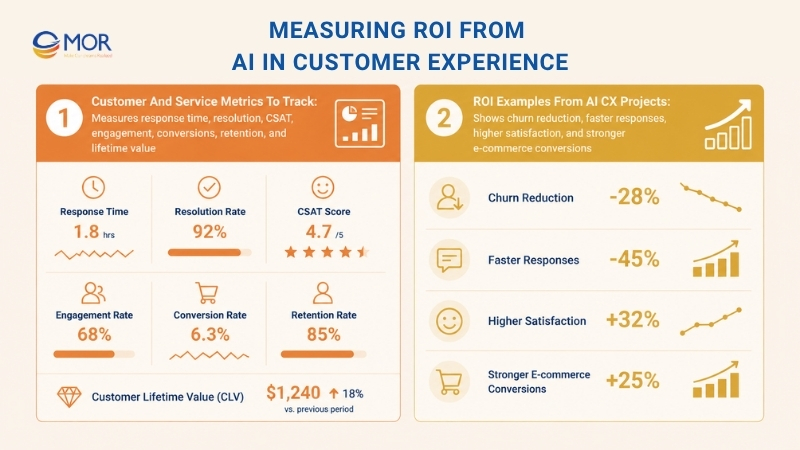
Customer And Service Metrics To Track
To calculate returns from AI-powered CX, companies need to watch the right performance numbers. These numbers often include shorter average response time, better first-contact resolution, and higher customer satisfaction (CSAT) scores. Automated support tools, including chatbots and live FAQ systems, can lower service costs and cut daily work for human agents.
AI-driven personalization can also raise core marketing results. Metrics like click-through rate (CTR), time spent engaging with content, and conversion rate show how well AI matches recommendations to each customer. Tracking retention and lifetime value gives teams a clearer view of the long-term value created through AI customer experience management.
ROI Examples From AI CX Projects
A telecom company used AI-based sentiment analysis and chat support to lower customer churn. After six months, response time dropped by 40%, and customer satisfaction increased by 25%, which helped improve retention. The system gathered customer signals in one place and gave agents more time to handle complex escalations.
A global fashion brand added AI recommendation engines to its e-commerce website to guide shoppers using live browsing and purchase data. This led to a 35% rise in average order value and a 28% increase in conversions. AI-based personalization made the buying journey easier and helped strengthen customer loyalty.
Future Of AI Customer Experience
AI tools in CX are moving fast. These trends will shape customer experience AI in the near future and show AI in customer experience how to stay ahead:
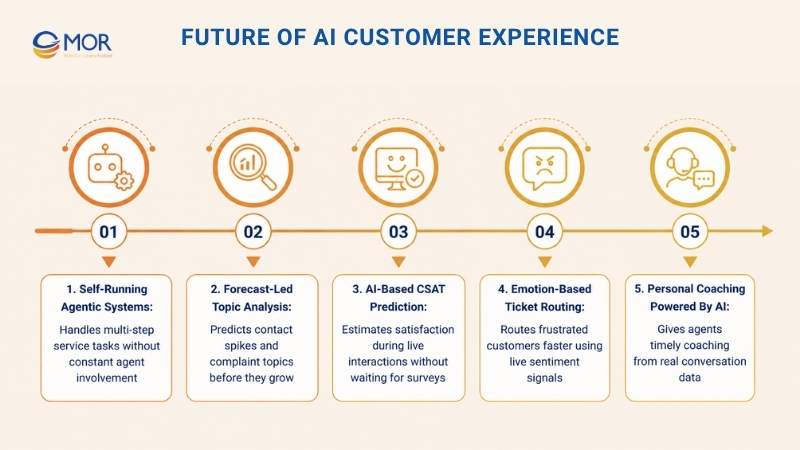
- Self-running agentic systems. The next wave of AI agent for customer support will handle multi-step tasks from start to finish, including return processing, record updates, follow-up scheduling, and escalation. Agents will not need to step in at every small stage.
- Forecast-led topic analysis. AI will do a better job of predicting contact spikes and new complaint topics before they appear in large numbers. Operations teams will have more time to prepare instead of rushing to react.
- AI-based CSAT prediction. Predictive satisfaction tools will study live interaction patterns and estimate scores without waiting for customers to answer surveys. As these models get better, teams can step in during weak moments and save risky conversations before they close.
- Emotion-based ticket routing. Routing rules will move past issue type and include live customer sentiment. Frustrated customers can reach skilled agents faster, while simple requests can go to self-service.
- Personal coaching powered by AI. Instead of waiting for planned QA reviews, AI will give agents steady coaching based on live conversation data. It can show clear coaching points when agents need them most.
How MOR Software Helps Improve AI Customer Experience
AI customer experience works best when it removes real pain from the customer journey. A chatbot alone will not solve slow replies, broken data, or support teams that cannot see customer history. Businesses need custom AI development solutions that works with CRM, web, mobile, support, and analytics systems.
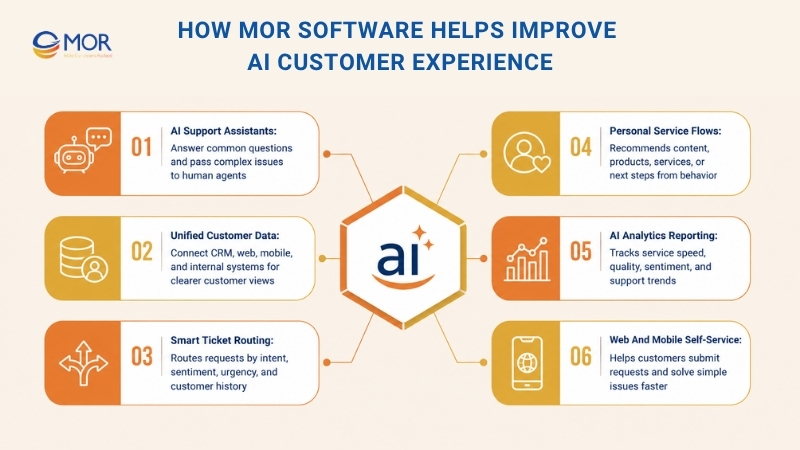
MOR Software helps companies improve customer experience with AI through custom software development outsourcing, Salesforce services, web applications, mobile apps, and AI development services. The team can build customer-facing platforms, internal support workflows, data connections, and CX analytics based on each business model.
MOR Software can support AI-powered customer experience through:
- AI support assistants: Answer common questions, collect customer information, and pass harder cases to human agents.
- Unified customer data: Connect CRM, websites, mobile apps, and internal systems to build a clearer customer view.
- Smart ticket routing: Move requests to the right team using intent, sentiment, urgency, and customer history.
- Personal service flows: Recommend content, products, services, or next steps based on customer behavior.
- AI analytics reporting: Track response time, service quality, customer sentiment, and support trends.
- Web and mobile self-service: Help customers check information, submit requests, and solve simple issues faster.
For companies building intelligent customer experience systems, MOR Software works as a custom software outsourcing development partner. The goal is to make service faster, more personal, and more connected across every touchpoint.
Conclusion
AI customer experience helps businesses turn slow, scattered support into faster and more personal service. The real value comes when AI connects customer data, support workflows, web apps, mobile apps, CRM, and analytics into one working system. MOR Software can help you build custom AI-powered customer experience solutions that fit your service model and business goals. Contact MOR Software to discuss your next AI CX project.
"Evolution is not a destination, it is a disciplined journey of innovation."
Phung Van Tu


CEO MOR AI
MOR SOFTWARE
Frequently Asked Questions (FAQs)
What is AI customer experience?
AI customer experience means using artificial intelligence to support, personalize, and automate customer interactions. It helps businesses understand customer intent, respond faster, route requests efficiently, and provide support teams with better data for each interaction.
How does generative AI enhance customer service in businesses?
Generative AI helps businesses create faster responses, summarize long conversations, draft support messages, and update help center content. It can also adjust tone, suggest next steps, and help agents handle more tickets without making replies feel robotic.
How can AI improve customer experience?
AI improves customer experience by delivering quicker responses, more personalized support, and smoother interactions across channels. It can predict customer needs, detect frustration, recommend relevant products, and route complex issues to the right human agent.
What are common examples of AI in customer service?
Common examples include AI chatbots, voice assistants, smart ticket routing, sentiment analysis, automated email responses, customer feedback analysis, and self-service knowledge bases. These tools help teams handle routine questions faster and focus on more complex cases.
Can AI replace human customer support agents?
AI should not fully replace human agents. It works best when handling simple, repetitive tasks while providing agents with better context. Human support is still essential for sensitive issues, complaints, complex cases, and situations that require empathy.
What data does AI need to improve CX?
AI requires clean and structured customer data from CRM systems, support tickets, chat logs, purchase history, surveys, website behavior, and app activity. Higher data quality leads to more accurate and useful AI outputs.
Is AI safe for handling customer data?
AI can be safe when businesses establish clear data policies, restrict access, protect personal information, and comply with privacy regulations. Teams should also evaluate how AI tools store, process, and use customer data before deployment.
What is the difference between AI chatbots and conversational AI?
AI chatbots typically respond to common questions using predefined flows or trained responses. Conversational AI is more advanced, capable of understanding context, remembering previous interactions, and managing more natural, dynamic conversations.
How can businesses measure AI success in CX?
Businesses can measure AI success using metrics such as response time, first-contact resolution, customer satisfaction (CSAT), ticket volume, agent workload, churn rate, customer retention, and conversion rate. These indicators show how effectively AI supports both customers and service teams.
What challenges do companies face when using AI for CX?
Common challenges include poor data quality, weak system integration, privacy concerns, inaccurate AI responses, and low staff adoption. To overcome these issues, businesses need clean data, clear workflows, human oversight, and proper team training.
Share


Make Our-Dreams Realized


© 2023 . MOR Software. All Rights Reserved
Sitemap
Privacy Policy
Terms of Use

Rate this article
0
over 5.0 based on 0 reviews
Your rating on this news:
Name
*Email
*Write your comment
*Send your comment
1