


Annotation Services: Complete Guide for 2026

Annotation services turn raw images, video, text, audio, LiDAR, and model responses into structured training signals. Weak labels push errors into training, add review work, and delay release. Stanford’s 2026 AI Index reports that organizational AI use reached 88% in 2025, so data preparation now sits on more product roadmaps than ever. This MOR Software guide will explain service types, quality, cost, outsourcing, and vendor checks.
Key Takeaways
- Match the method to the model. Classification, segmentation, tracking, NER, transcription, and preference ranking solve different learning tasks.
- Measure accepted output. Unit price means little without QA rules, class-level results, review time, and rework rates.
- Test before scale. A representative pilot exposes unclear guidelines, weak security, hidden costs, and poor provider fit.
What Are Annotation Services?
Searches for annotation services meaning ask how raw data becomes usable for machine learning. Specialists add labels, boundaries, attributes, timestamps, or relationships so a model can learn from it. An annotation service may handle one narrow task, like image classification, or manage the full path from taxonomy design to validated dataset delivery.
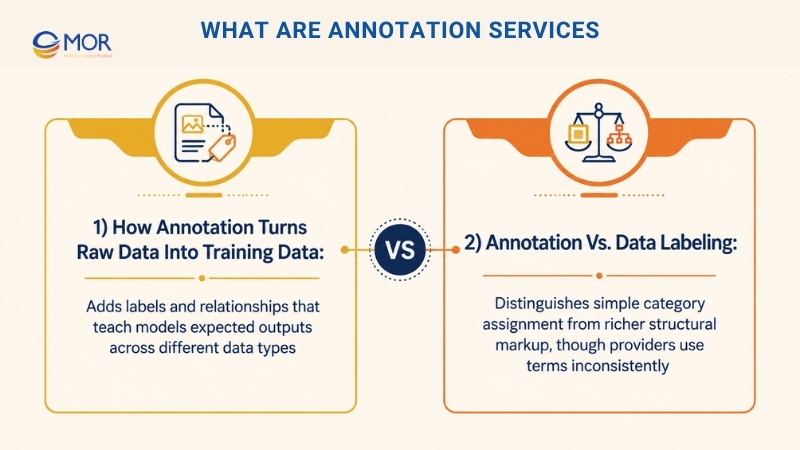
Raw files contain information, but models need a target. A street image becomes training data after annotators mark cars, lanes, cyclists, and lights. A support message becomes useful for NLP after someone assigns intent, entities, or a response-quality score.
How Annotation Turns Raw Data Into Training Data
Supervised learning depends on examples paired with expected outputs. Labels act as the answer key: a bounding box tells an object detector where an item sits, and an intent tag tells a classifier what a sentence means.
The task changes with the data. Computer vision teams mark objects and pixels. Speech teams transcribe words, identify speakers, and tag sound events. LLM teams rank answers, check factual support, or score responses against a written rubric.
Scale can become immense. Meta’s SA-1B dataset contains 11 million images and 1.1 billion segmentation masks, collected through a data engine that mixed model assistance with human review. The case shows why large projects need clear tools, repeatable rules, and controlled QA rather than a loose labeling queue.
Annotation continues after release. Error analysis reveals missed classes and rare cases, then those samples return to the labeling queue. The dataset grows around real model failures.
Annotation vs. Data Labeling
Teams often use data annotation and data labeling as the same term. A practical distinction treats labeling as basic category assignment and annotation as richer markup, but that rule isn’t universal.
Comparison area | Data labeling | Data annotation |
Common scope | Assigns a class or category | Adds detailed structure and meaning |
Typical tasks | Image classification, text categorization | Bounding boxes, segmentation, NER, relationships, RLHF |
Output complexity | Low to moderate | Moderate to high |
Common use cases | Basic supervised learning | Computer vision, NLP, speech AI, and LLM training |
A data annotation service may still call basic classification ‘annotation,’ and a labeling platform may support complex segmentation. Review the actual task list, output format, and QA method instead of judging the provider by wording alone.
The Importance of Annotation Services
Machine learning models learn the patterns present in their training examples, including mistakes. Professional AI annotation services control those mistakes through written rules, trained reviewers, measurable acceptance criteria, and repeated checks.
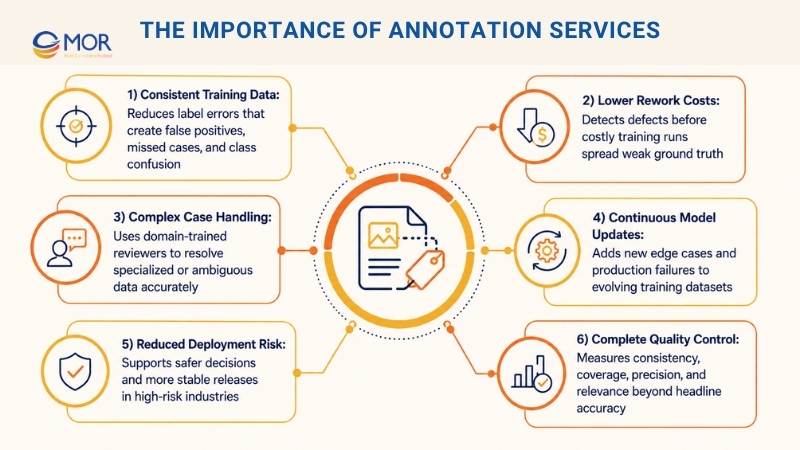
- Improve model accuracy: Reliable labels give the model consistent examples during training and testing. Wrong boundaries, missing objects, or mixed class rules create false positives, false negatives, and class confusion.
- Cut costly rework: Early QA catches defects before a training run consumes time and compute. More low-quality data won’t repair weak ground truth; it spreads the same problem across a larger set.
- Handle complex cases: Domain-trained annotators understand medical terms, contract language, financial records, industrial parts, and unclear scenes. An AI annotation service needs reviewers who can resolve uncertainty instead of guessing through it.
- Support model updates: New products, locations, users, and failure cases change the data distribution. Annotation services for AI keep the training set aligned with real production inputs and newly found edge cases.
- Lower deployment risk: Errors carry a higher cost in healthcare, autonomous systems, finance, manufacturing, and robotics. Strong ground truth supports safer decisions, shorter debugging cycles, and more stable releases.
Accuracy alone doesn’t define annotation service quality. Consistency, completeness, class coverage, boundary precision, and task relevance also shape model results. A dataset can reach a high headline score and still fail on rare classes that matter most to the business.
How Annotation Services Work From Scope to Delivery
A managed AI data annotation service follows a controlled production path. Each stage removes uncertainty before the next batch moves forward, which keeps guideline changes and rework visible.
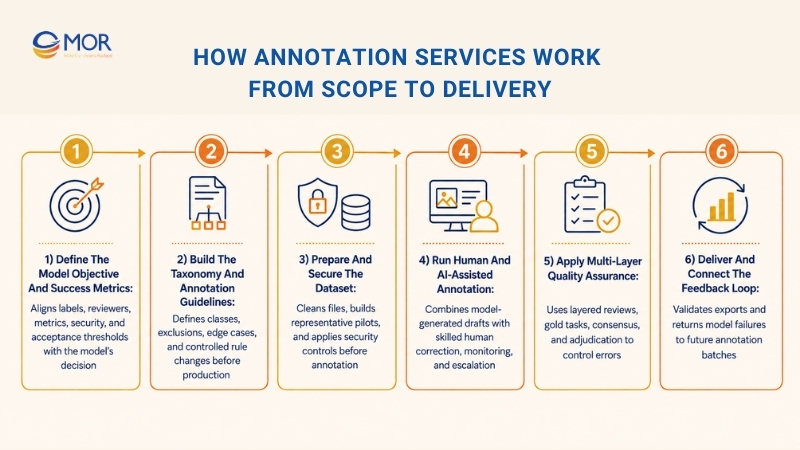
Define the Model Objective and Success Metrics
Start with the model decision. A retail vision system may need to detect an empty shelf, while a medical model may need a pixel-level boundary around a lesion. Those goals require different labels, reviewers, metrics, and acceptance thresholds.
Document the data type, volume, classes, output schema, delivery schedule, and review rules. Separate model metrics from annotation metrics: model precision measures predictions, while label accuracy and agreement measure the training data.
Flag sensitive information at this stage. Patient records, faces, financial documents, customer calls, and internal video need access controls, retention rules, and a clear data path before any sample reaches an annotator.
Build the Taxonomy and Annotation Guidelines
Map every class, attribute, relationship, and exclusion. A strong taxonomy explains where one class ends and another begins, which objects count, and which uncertain samples should be skipped or escalated.
Guidelines need examples of normal cases and edge cases. For an occluded vehicle, the document should state the expected treatment: mark the visible area, estimate the full box, or assign an occlusion flag.
Treat the guide as a controlled document. Record each change, the affected batches, and the reason behind it. Silent edits create mixed rules inside one dataset.
Prepare and Secure the Dataset
Clean duplicate files, broken media, unsupported formats, and empty records before production. Create a pilot set that includes common items, rare classes, poor-quality files, and known edge cases.
Apply masking or de-identification when the task doesn’t require personal details. Then set role-based access, storage locations, transfer methods, and deletion dates. The security design must match the sensitivity of the data, not the convenience of the tool.
Run Human and AI-Assisted Annotation
Pre-labeling models can draft boxes, masks, transcripts, or classes. Human annotators then correct those drafts and flag uncertain cases. This setup works when the model saves more review time than it creates.
Assign workers based on language, domain knowledge, and task difficulty. An annotator who understands radiology or legal clauses will resolve cases that a general crowd may misread.
Track throughput, correction time, disagreement, rejected items, and guideline questions. Those signals show where the workflow is slowing down or where the instructions need repair.
Apply Multi-Layer Quality Assurance
Combine self-checks, peer review, senior review, and statistical sampling. Gold-standard tasks test workers against known answers, while consensus labeling compares independent judgments on the same item.
Route disputed cases to an adjudicator. Repeated disagreement often points to a weak taxonomy or unclear rule, not a careless annotator. Fix the source rather than correcting the same error one item at a time.
Deliver and Connect the Feedback Loop
Validate the schema, filenames, class IDs, metadata, and export format before delivery. Include a QA report that lists sample size, error types, class-level results, rejected items, and open assumptions.
Model failures should feed later batches. This loop keeps the dataset tied to product behavior and prevents annotation from becoming a one-time handoff with no learning after release.
How to Measure Annotation Quality Beyond Accuracy
One headline percentage can hide serious defects. Quality review needs metrics tied to the task, business risk, and label type.
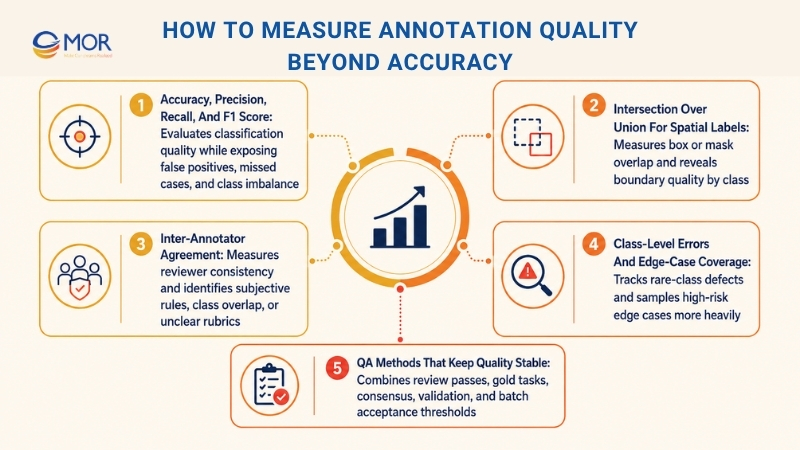
Accuracy, Precision, Recall, and F1 Score
Accuracy measures the share of correct labels across all reviewed items. It works for balanced, clear classification tasks, but it can mislead when one class dominates the dataset.
Precision asks how many labels assigned to a class were correct. Low precision creates false positives. A fraud model may flag too many normal transactions, and a defect detector may reject healthy products.
Recall checks how many true items the annotations captured. Low recall means missed cases. In a safety task, a missed pedestrian or medical finding may carry more risk than an extra review alert.
F1 score balances precision and recall through their harmonic mean. Report these metrics by class whenever rare categories have a different business cost from common ones.
Intersection Over Union for Spatial Labels
Intersection over Union, or IoU, compares the overlap between an annotated box or mask and a reference label. The score divides the overlapping area by the total combined area.
Set thresholds around the real model need. A loose vehicle box may work for broad detection, but a surgical mask or manufacturing defect often needs tighter boundaries. Mean IoU gives a broad view, while per-class IoU reveals where performance slips.
Object presence and boundary quality deserve separate checks. A label may identify the right object yet draw a poor shape around it, which can still weaken segmentation training.
Inter-Annotator Agreement
Inter-annotator agreement, or IAA, measures how often independent annotators reach the same judgment. Cohen’s kappa fits two raters, while Fleiss’ kappa supports larger groups and adjusts for chance agreement.
OpenAI’s InstructGPT research used about 40 screened contractors for demonstrations, comparisons, and evaluation. Training labelers agreed 72.6 ± 1.5% of the time, and held-out labelers reached 77.3 ± 1.3%, a useful reminder that subjective language tasks rarely produce perfect agreement.
Low IAA can signal a subjective task, an incomplete rubric, or class overlap. Review disagreement samples before blaming worker performance. Often, one revised rule resolves hundreds of later disputes.
Class-Level Errors and Edge-Case Coverage
Track missing labels, wrong classes, duplicate labels, boundary errors, and unsupported attributes by class. Aggregate averages tend to hide weak rare-class results.
Maintain an edge-case library that includes occlusion, poor lighting, unusual accents, damaged documents, conflicting clauses, and uncommon user requests. Each new production failure should enter this library when it can improve later training.
Stratified sampling helps here. Sample rare and high-risk classes at a higher rate than easy, common items so the QA set reflects business risk rather than raw volume.
QA Methods That Keep Quality Stable
A stable process uses several checks rather than one final review:
- Multi-pass review: A second annotator checks the first pass against the same rules.
- Gold-standard tasks: Known answers test worker performance during production.
- Consensus labeling: Independent labels reveal disagreement on subjective items.
- Adjudication: A senior reviewer resolves disputes and records the decision rule.
- Stratified sampling: Review focuses on risky classes and difficult files.
- Automated validation: Scripts catch missing IDs, invalid shapes, duplicate records, and schema errors.
- Batch acceptance: Each batch must meet agreed thresholds before delivery.
In-House vs. Outsourced Annotation Services
The right delivery model depends on volume, data sensitivity, domain knowledge, and internal management capacity. A small research set may stay in-house, but production work can pull engineers away from model design and error analysis.
Delivery model | Best fit | Cost structure | Time to scale | QA ownership | Main limitation |
In-house team | Early research, small datasets, highly restricted data | High fixed cost | Slow | Internal | Hiring and management load |
Managed annotation provider | Production-scale or domain-heavy projects | Per task, hour, item, or managed contract | Fast | Provider under agreed metrics | Requires vendor governance |
Crowd platform | Simple, high-consensus tasks | Low variable cost | Fast | Platform-dependent | Quality drift on complex work |
Hybrid model | Sensitive or expert work kept internally | Mixed | Moderate | Shared | Split accountability |
AI-assisted internal workflow | Teams with strong MLOps and review capacity | Tooling plus specialist labor | Moderate | Internal | Automation still needs validation |
Data scientists should stop labeling routine batches when the work blocks experiments, creates a queue, or lacks repeatable QA. Their time is usually better spent on taxonomy decisions, error analysis, and model evaluation.
A managed provider brings trained staff, project management, review layers, and production reporting. Open crowds cost less for simple tasks, but quality can drift when classes overlap or domain knowledge shapes the answer.
Hybrid work sounds safe because the company keeps control of sensitive decisions. Yet split ownership can create different rules, separate tools, and unclear accountability. One shared guideline, one version log, and one acceptance process are necessary.
Run a paid pilot before a long contract. Compare accuracy, accepted-label cost, response time, guideline handling, and security. A cheap first pass can become expensive after correction.
What Do Annotation Services Cost?
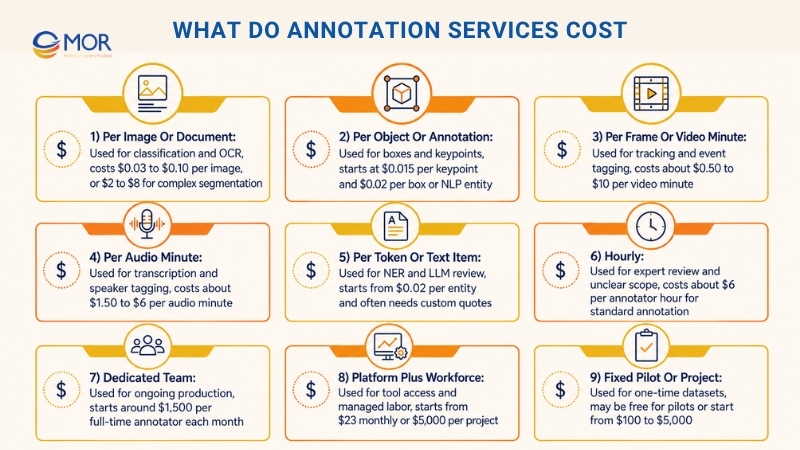
Pricing depends on the billable unit and the work needed to make that unit acceptable. Buyers should ask for the complete cost of annotation, review, project control, tooling, and revisions rather than comparing a single unit rate.
Common Pricing Models
Providers price work around data volume, labor time, or reserved capacity. The right model depends on how predictable the task and workload are.
Pricing model | Common use | Real cost benchmark (USD) | Main buyer check |
Per image or document | Classification, OCR, document tagging | $0.03–$0.10 per basic image; complex image segmentation can reach $2–$8 per image | Define one billable item and confirm whether OCR fields or objects incur separate charges |
Per object or annotation | Boxes, polygons, keypoints, cuboids | From $0.015 per keypoint, $0.02 per bounding box, and $0.02 per NLP entity | Confirm charges for dense scenes, attributes, and overlapping objects |
Per frame or video minute | Tracking, event tagging, action recognition | Around $0.50–$10 per video minute; detailed frame-level work may use a custom per-frame rate | Check frame sampling, interpolation, object count, and track length |
Per audio minute | Transcription, speaker tags, sound events | Around $1.50–$6 per audio minute for transcription, event tagging, or speaker diarization | Confirm whether silence, timestamps, accents, and overlapping speakers count |
Per token or text item | NER, LLM scoring, content review | From $0.02 per entity; token-based LLM review and reasoning tasks usually require a custom quote | Define one task, entity, response, token block, and required reviewer skill |
Hourly | Expert review, taxonomy work, unclear scope | Around $6 per annotator hour for standard annotation; specialist and LLM review costs more | Require separate reporting for annotation, QA, adjudication, and idle time |
Dedicated team | Ongoing production | From about $1,500 per full-time annotator per month in lower-cost delivery regions | Check whether the price includes team leads, QA, training, tooling, and project management |
Platform plus workforce | Tool access and managed labor | CVAT Online starts at $23 per month; CVAT Enterprise starts at $12,000 per year; managed labeling starts at $5,000 per project | Separate platform licenses, seats, storage, APIs, cloud costs, and annotation labor |
Fixed pilot or project | Defined sample or one-time dataset | Some vendors provide a free pilot; managed production projects may start at $5,000, while smaller providers may accept projects around $100–$3,000 | Lock the sample size, QA threshold, revisions, output format, and production pricing after the pilot |
One current market example gives buyers a useful anchor. CVAT lists a $5,000 minimum budget for its labeling service and advertises discounts of up to 30% for large datasets, though your final quote still depends on task type and data state.
Factors That Change the Final Cost
The same file count can produce very different bills. Complexity sits inside each item.
- Data modality: Video, LiDAR, and multimodal records demand more time than basic text or image classification.
- Object density: Crowded scenes create more boxes, tracks, or masks per file.
- Boundary precision: Polygons and pixel masks require finer work than broad rectangles.
- Taxonomy size: More classes increase training time and confusion risk.
- Domain knowledge: Medical, legal, technical, and multilingual work needs skilled reviewers.
- QA depth: Consensus, expert adjudication, and large samples raise cost but control rework.
- Turnaround: Short deadlines may require extra staffing and management.
- Security: Dedicated environments, private cloud, and strict access controls add setup work.
- Integration: Custom exports, APIs, and MLOps connections require engineering effort.
Hidden Costs Buyers Often Miss
A low quote may exclude necessary production work. Ask for a line-by-line scope before comparing vendors.
- Taxonomy design: Class definitions and edge-case rules need expert time.
- Guideline changes: New rules may trigger batch review or relabeling.
- Project control: Staffing, reporting, communication, and issue tracking carry a cost.
- Senior review: Adjudicators and domain experts often sit outside the base rate.
- Rework: Rejected batches can erase the apparent saving of a cheap unit price.
- Data conversion: Cleaning and format changes may arrive as separate charges.
- Storage and transfer: Large video and point-cloud sets create cloud and network fees.
- MLOps connection: Delivery into training pipelines may need custom development.
Use a Pilot to Build a Reliable Budget
A good pilot represents production, not the easiest sample. Include normal items, rare classes, poor media, and uncertain cases.
- Measure active time: Track annotation, review, discussion, and correction time.
- Record disagreement: Frequent disputes point to more guideline and adjudication work.
- Calculate accepted-label cost: Divide total pilot spend by labels that pass QA.
- Test delivery: Validate file structure, schema, naming, and integration steps.
- Forecast staffing: Use real throughput and rework data to plan team size and schedule.
How to Choose an Annotation Service Provider
Good data annotation service providers prove fit through comparable work, measurable pilots, and clear operating controls. Sales claims matter less than the evidence behind them.
Evaluation area | Questions to ask | Evidence to request | Warning sign |
Modality fit | Has the provider handled this data type and task? | Comparable sample or project summary | Generic portfolio only |
Domain knowledge | How are annotators trained for the industry? | Training plan and reviewer qualifications | Tool skills without domain training |
Quality system | Which metrics and review layers are used? | QA workflow, sample report, SLA | One headline accuracy figure |
Pilot performance | Can the provider label a representative sample? | Accuracy, latency, disagreement, rework | Refusal to run a measurable pilot |
Security | Where is data stored and who can access it? | Policies, certifications, access diagram | Unclear data flow |
Workforce model | Dedicated team, crowd, or subcontractors? | Staffing model and escalation path | Hidden outsourcing layers |
Scalability | How quickly can the team expand? | Ramp-up plan and volume evidence | Unverified capacity claims |
Technology | Can the workflow connect to current tools and cloud storage? | API, export, platform, and integration details | Manual-only handoffs |
Communication | Who owns daily delivery and issues? | Reporting cadence and named roles | No accountable owner |
Pricing | What does the rate include? | Full cost breakdown | Low unit rate with undefined QA |
Lock-in | Can data, schemas, and audit records be exported? | Exit and handover plan | Closed format with no migration path |
Treat claims about the highest quality data annotation services with care. Ask for class-level results, sample size, acceptance thresholds, reviewer qualifications, and the definition of an error. A 99% figure has little value when the provider can’t explain what was measured.
Security needs the same proof. IBM’s 2024 Cost of a Data Breach report placed the global average breach cost at USD 4.88 million, which makes vague statements about ‘secure handling’ a weak basis for vendor approval. Request access diagrams, encryption details, retention rules, incident procedures, and certification scope.
Score the pilot against thresholds agreed before work starts. Review accepted-label cost, turnaround, disagreement, security practice, and issue response. Scale in controlled batches only after the provider passes those checks.
A partner delivering AI and ML data annotation services should also support change. New classes, model-generated pre-labels, retraining batches, and output formats will appear during the project. The contract and workflow need room for controlled revisions without turning every change into a fresh negotiation.
Where Businesses Use Annotation Services
Useful annotation services examples appear anywhere a model must connect raw data with a defined meaning. The work changes by industry because the data, error cost, and reviewer knowledge differ.
Industry | Data involved | Common annotation work | Main delivery concern |
Autonomous vehicles | Camera, LiDAR, radar, GPS | Cuboids, lane marking, tracking, segmentation, sensor fusion | Safety and edge cases |
Healthcare | Medical images, clinical text, audio | Segmentation, classification, entity extraction, transcription | Privacy and domain knowledge |
Retail and e-commerce | Product images, catalogs, video, reviews | Product tagging, OCR, shelf detection, sentiment | Scale and taxonomy consistency |
Finance and insurance | Documents, transactions, calls | Entity extraction, document classification, fraud labels | PII and audit records |
Manufacturing | Factory images, sensor data, video | Defect detection, component segmentation, activity recognition | Precision and rare defects |
Robotics | Egocentric video, depth, LiDAR | Pose, manipulation, scene understanding, tracking | Multimodal synchronization |
Agriculture and geospatial | Drone and satellite imagery | Crop, weed, boundary, land-use, and object labels | Seasonal variation |
Legal and compliance | Contracts, records, messages | Clause classification, entity linking, risk flags | Subjectivity and confidentiality |
Autonomous systems depend on image annotation services for lanes, pedestrians, vehicles, signs, depth, and drivable space. Temporal tasks add video annotation services for object tracks, actions, events, and visibility across frames.
Healthcare work may require radiologists, clinicians, or trained medical reviewers. A missed boundary in a scan and a wrong entity in a clinical note create different risks, so the taxonomy and QA method must match the model task.
Retail teams use online data annotation services for product matching, catalog attributes, visual search, OCR, shelf checks, and review classification. The hard part is often consistency across thousands of similar products and changing catalog rules.
Finance and legal projects depend on traceable decisions. Annotators may classify documents, extract entities, link clauses, flag risk, or label transactions. Access logs, reviewer credentials, and version records become part of the deliverable.
Manufacturing, robotics, and agriculture mix visual data with sensor records. Rare defects, changing light, motion, weather, and device variation make edge-case coverage a major planning task.
How AI-Assisted Annotation Changes the Delivery Model
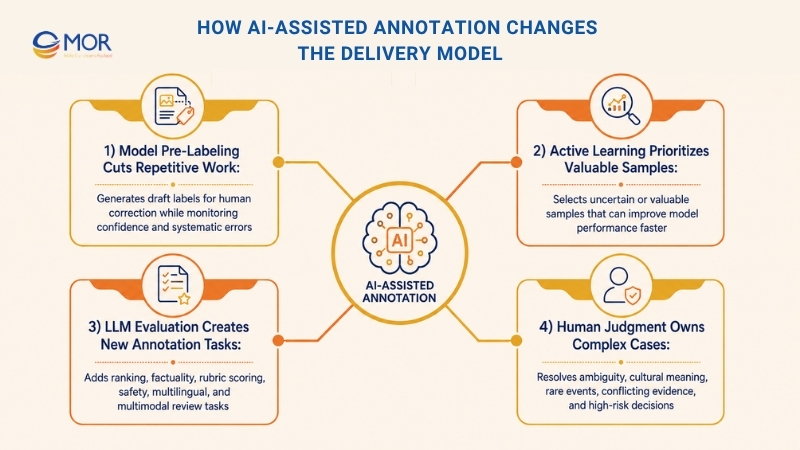
AI assistance shifts people away from repetitive clicks and toward correction, review, and difficult decisions. The model handles obvious items first; humans take the uncertain cases and keep the training signal under control.
Model Pre-Labeling Cuts Repetitive Work
A trained model can draft boxes, masks, classes, transcripts, or entities before a human opens the task. The reviewer accepts correct labels, fixes errors, and flags uncertain items.
Measure correction time rather than raw automation rate. A draft that looks complete but needs slow, careful repair may cost more than manual work. Systematic pre-label errors also spread quickly when reviewers start trusting the model too much.
Set confidence thresholds and route low-confidence items to experienced staff. Sample high-confidence labels as well, since confident models can still repeat the same mistake across a large batch.
Active Learning Prioritizes Valuable Samples
Active learning ranks unlabeled data by uncertainty or expected training value. Teams then label the samples most likely to improve the model rather than processing every item in order.
This method works well when the unlabeled pool is large and many records repeat easy patterns. Production monitoring can send new failure cases back into the queue, keeping annotation tied to real model behavior.
LLM Evaluation Creates New Annotation Tasks
LLM work includes response ranking, factuality checks, rubric scoring, prompt classification, tool-use review, and safety testing. These tasks rely on written judgment, so guidelines need examples, tie rules, and escalation paths.
OpenAI’s InstructGPT process shows the pattern: humans wrote demonstrations and ranked model outputs, then those preferences trained a reward model. An LLM labeling partner needs strong language skills, domain reviewers, and clear agreement checks rather than fast clicking alone.
Multilingual and multimodal evaluation adds another layer. A reviewer may judge text, images, audio, and tool actions inside one task.
Human Judgment Owns Complex Cases
Humans still resolve ambiguity, cultural meaning, rare events, conflicting evidence, and high-risk labels. Domain experts also decide when a class definition needs revision.
Automation works best as a routing layer. It sends easy items through a fast path and difficult items to the right reviewer. Complete human removal creates blind spots where the model is least reliable.
How MOR Software Can Help Annotation Operations
MOR Software supports companies that need the engineering layer around annotation: custom portals, data pipelines, AI-assisted review, system integration, cloud setup, and dedicated development teams. MOR isn’t presented as a managed labeling workforce in the supplied materials; its verified role is software and AI delivery.
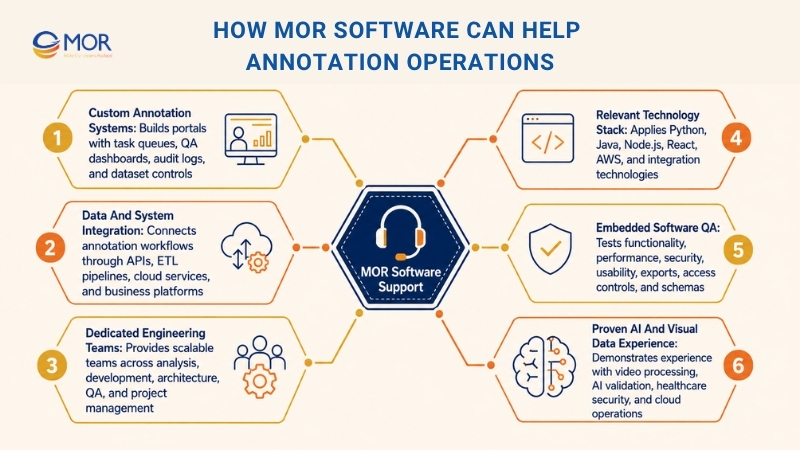
- Build custom annotation systems: MOR Software develops web and custom mobile app products, artificial intelligence app development systems, and custom business software. A project may include taxonomy controls, task queues, review screens, QA dashboards, dataset versions, audit logs, and client portals.
- Connect data and business systems: MOR has worked with API Gateway, ETL, AWS services, Salesforce, Slack, and legacy platforms. Its time-attendance project synchronized internal data with Salesforce and supported Slack-based operations, which maps well to annotation workflows that need controlled data movement and role-based actions.
- Form a dedicated engineering team: MOR’s Offshore Development Center model supports project managers, business analysts, developers, QA team, architects, and bridge engineers. The process covers requirements, candidate review, onboarding, team management, feedback, and scaling.
- Apply a relevant stack: Verified MOR materials list Python, Java, Node.js, React, React Native, C++, .NET, AWS, API integration, and cloud infrastructure. These tools fit annotation portals, validation services, model APIs, data pipelines, and MLOps connections.
- Bring QA into delivery: MOR’s QC and Testing Services cover functional, performance, security, and usability testing. Annotation software needs the same discipline because broken exports, slow review screens, access gaps, and schema defects can damage an otherwise sound labeling process.
- Use related project evidence: MOR built the N-CLOUD CCTV management system with C++, Python, and QT for camera control, real-time video processing, and object-activity logging. It also trained multimodal AI models for spam filtering in a Japanese healthcare platform running on AWS. These cases prove experience with visual data, AI validation, security, and cloud-based operations.
MOR Software fits companies that have annotators, a labeling vendor, or an internal data team but lack software for scaled operations. Share your data types, current workflow, platform limits, integrations, and quality targets. MOR’s discovery team can map the system, roles, delivery phases, and technical design.
Conclusion
Strong annotation services connect model goals, clear taxonomies, trained reviewers, measurable QA, secure handling, and realistic cost controls. Select the method around your data and test the workflow through a representative pilot before scaling. MOR Software can build the platforms, pipelines, AI review tools, integrations, and dedicated engineering teams behind that operation. Contact MOR Software to map your annotation workflow and technical delivery plan.
"Evolution is not a destination, it is a disciplined journey of innovation."
Phung Van Tu


CEO MOR AI
MOR SOFTWARE
Frequently Asked Questions (FAQs)
What does an annotation provider do in AI and machine learning?
They add structured labels to raw data so AI models can learn a target. Work may cover images, video, text, audio, LiDAR, documents, model responses, or linked multimodal records. Providers may also manage taxonomy design, annotator training, QA, secure processing, export, and delivery into a model pipeline.
What is the difference between annotation and data labeling?
The terms often mean the same thing. Some teams use labeling for simple classes and annotation for boxes, masks, entities, relationships, timestamps, or rankings. Buyers should compare the real task scope and output format.
Which types of data can teams annotate?
Common inputs include images, video, text, documents, speech, environmental audio, LiDAR, radar, sensor data, and LLM outputs. One project may also combine several sources, including camera frames and point clouds. Each modality needs a suitable tool, guideline, reviewer skill set, and QA metric.
How much does data annotation cost?
Pricing may follow images, objects, frames, audio minutes, tokens, hours, or a dedicated-team fee. Complexity, object count, domain knowledge, QA depth, security, and delivery speed change the final bill. A representative pilot gives the best estimate because it exposes real annotation time, disagreement, and rework.
How long does a data annotation project take?
A small pilot may take days; production can run for weeks or months. Timeline depends on volume, task difficulty, reviewer availability, guideline maturity, and acceptance rules. Ask the provider for measured pilot throughput and a staffing plan rather than a schedule based only on file count.
How is annotation quality measured?
Teams use accuracy, precision, recall, F1, IoU, inter-annotator agreement, class-level error rates, and batch acceptance thresholds. The metric must fit the task. Spatial labels need boundary checks, subjective labels need agreement measures, and rare high-risk classes need separate reporting.
Can AI fully automate data annotation?
AI can pre-label easy items, rank uncertain samples, and run schema checks. Human review remains necessary for ambiguity, rare cases, domain decisions, and subjective evaluation. The best workflow measures correction effort and routes difficult items to skilled reviewers instead of assuming every model-generated label is correct.
Should a company build an in-house team or outsource annotation?
Keep work in-house for small research sets, highly restricted data, or tasks tied closely to internal experts. Outsource when volume grows, management becomes a burden, or specialist skills are missing. A hybrid model can work, but the teams need one taxonomy, one version history, and one acceptance process.
How do annotation providers protect sensitive data?
Strong providers use role-based access, encryption, audit logs, NDAs, controlled devices, retention rules, and secure delivery. Some projects need private cloud, on-premise, or region-locked processing. Request proof, including access diagrams, policy documents, certification scope, and incident procedures.
What should a company prepare before starting an annotation pilot?
Prepare a representative data sample, draft taxonomy, class definitions, edge cases, output format, and acceptance metrics. Add security requirements and a named reviewer who can answer guideline questions. The pilot should test normal cases, rare classes, poor files, delivery format, and rework, not just easy samples.
Share


Make Our-Dreams Realized


© 2023 . MOR Software. All Rights Reserved
Sitemap
Privacy Policy
Terms of Use

Rate this article
0
over 5.0 based on 0 reviews
Your rating on this news:
Name
*Email
*Write your comment
*Send your comment
1