


Dedicated Development Team Model: A 2026 Comprehensive Guide
Hiring developers one by one can slow product plans, raise costs, and leave teams stuck when scope changes. The dedicated development team model gives you a full-time software team that works around your roadmap, keeps product knowledge inside the project, and scales with demand. In this guide, MOR Software will explain how this setup works, when to use it, and how to choose the right partner.
Key Takeaways
- The dedicated development team model works best for long-term products, changing roadmaps, MVPs, SaaS development platforms, and enterprise modernization programs.
- This setup gives you strong delivery control while the vendor handles hiring, payroll, operations, replacement support, and team scaling.
- A trusted partner like MOR Software can build a dedicated software development team model around your goals, tech stack, timeline, and budget.
What Is The Dedicated Development Team Model?
A dedicated team definition refers to a full-time group of software experts assigned to one product for a long period. This group often brings together developers, QA engineers, and delivery leads like a project manager or Scrum Master. In a dedicated development team model explained clearly, the same team stays focused on your product instead of moving between different clients.
Rather than building a full in-house department, you partner with a vendor, which manages hiring, HRM models, payroll automation software, and team replacement. You still keep ownership of the roadmap, scope, priorities, and final results.
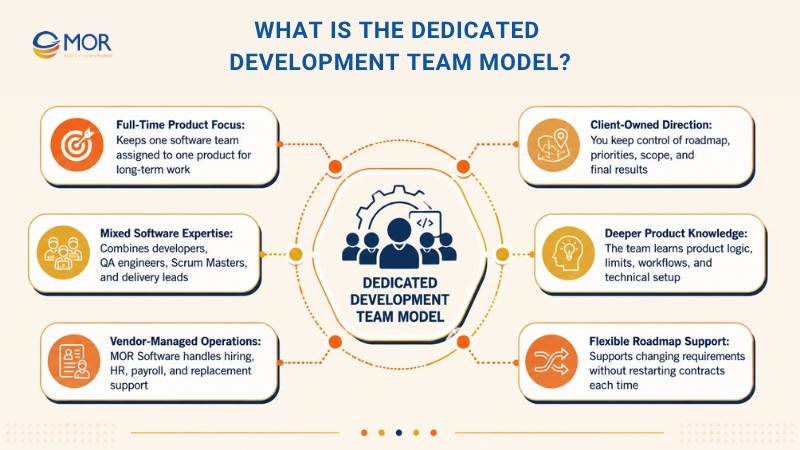
Since one team works with your product over time, they gain deeper product knowledge, cut repeated work, and make planning more accurate. Many dedicated team arrangements last 12 to 24 months or more, with team retention often staying above 85%. As the work continues, the group learns your product limits, business logic, and technical setup in detail.
This setup is made for projects where change is normal. Requirements may move, priorities may shift, and roadmaps may change without a new contract every time. Team capacity stays steady, while the direction can move with business needs.
How The Dedicated Development Team Model Works In Practice
In this setup, each side has clear duties so you can keep control without taking on extra daily work.
You own the product vision and decide what matters most. The team turns those priorities into planned work, joins planning sessions, estimates tasks, and delivers at a steady pace. At the same time, the vendor takes care of hiring, HR, and team operations.
The dedicated development team model works because the delivery group follows your priorities closely. They join sprint planning, size the work, spot risks, and release work on a clear rhythm. Daily teamwork feels close to an internal setup, with shared tools, clear documents, and agreed communication habits.
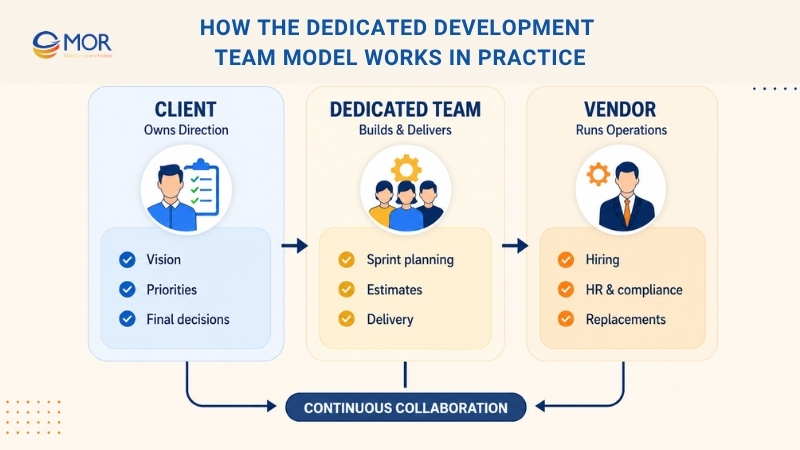
The vendor handles the operating side of the partnership. Recruitment, salary, staff performance, compliance, and replacement support stay with us. From your side, this lowers admin work while you still guide product delivery.
Onboarding often takes around one to two weeks. Since the team starts together instead of joining as separate people, the ramp-up feels smoother and easier to plan. Many teams reach a steady pace within the first month, though the final cost depends on location, tech stack, and seniority level.
Key Benefits Of The Dedicated Development Team Model
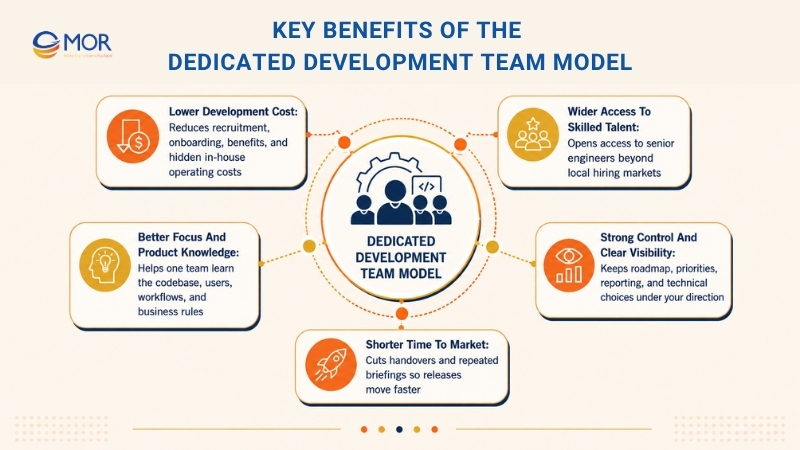
Companies often choose the dedicated development team model because it gives them a practical mix of flexibility, control, and steady delivery. This balance suits growing businesses that need product work to keep moving without building every role in-house. Let’s look at the main benefits in more detail.
Lower Development Cost
With this dedicated delivery model, you avoid heavy spending on recruitment, onboarding, benefits, office tools, and internal setup. Instead, you pay a clear monthly cost linked to the real development capacity you use. Rates can still change based on several points. Location is one clear factor. Working with skilled engineers in regions like Vietnam can lower software development costs when compared with building the same team in the US or Western Europe.
You do not need to lower quality just to control spending. Cost gains often come from different labor markets and lighter operating costs. The vendor manages HR, compliance, and team retention, which helps cut hidden costs that many in-house teams miss. For companies with tight budgets, this leaves more room for product quality and business growth.
Wider Access To Skilled Talent
Finding strong software developers has become harder as demand grows, mainly in areas like cloud architecture, data engineering, and cybersecurity. Korn Ferry has estimated that the worldwide tech talent gap may pass four million roles by 2030.
A dedicated team model gives businesses access to a wider talent pool without fighting only for local hires. This makes it simpler to find engineers with the right industry background or technical skill set. For small and mid-sized companies, it makes the market feel fairer. You can work with senior talent that may be difficult to hire directly, without adding them as permanent staff.
Strong Control And Clear Visibility
A dedicated development team model still works under your direction, even though the team is external. You set priorities, approve the roadmap, and stay close to major technical choices. Communication usually happens daily or weekly, with shared tools for planning, task tracking, and reports.
This level of visibility lowers the risk of a ‘black box’ outsourcing setup. You can see progress as it happens, and issues can be raised early. You can also change direction in real time. Since weak visibility often damages technology partnerships, this model builds reporting and communication into the delivery process.
Better Focus And Product Knowledge
Dedicated teams stay with one product. They do not jump between your project and other client work. That focus helps improve quality and lowers mistakes. As months pass, the team learns the codebase, users, workflows, and business rules. This knowledge remains inside the project instead of disappearing when a short contract ends. For products that will grow over time, this continuity creates a real business edge.
Shorter Time To Market
Software delivery often slows down because of poor coordination, not because developers write code slowly. Dedicated teams cut delays caused by repeated handovers, new briefings, and contract changes.
The dedicated development team model helps teams decide faster because the same people understand the product. Release plans become easier to predict, and feedback moves through the team more quickly. Product updates can continue without heavy admin work. For startups and growing companies, shorter time to market means faster validation, earlier revenue signals, and lower market risk.
Dedicated Development Team Structure And Core Roles
The size of a dedicated application team can change based on project scope and technical depth, but a dedicated software development team model usually includes these main roles:
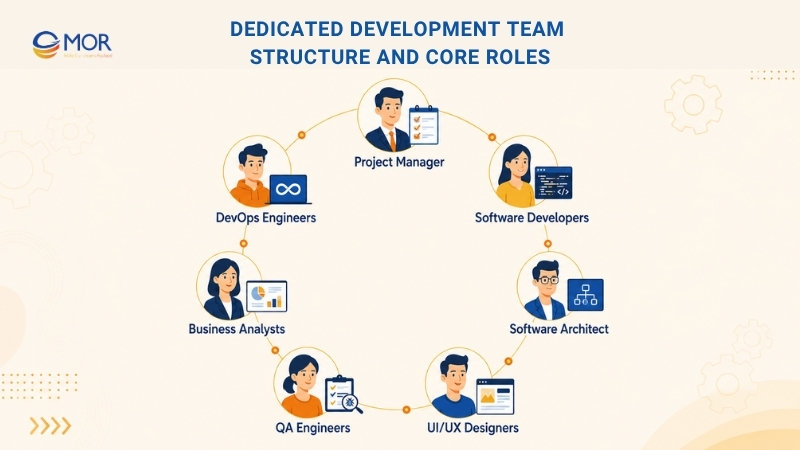
Project Manager
A Project Manager leads the delivery process and keeps the team aligned from planning to timeline control and team coordination. This role helps the project stay on track, follow the agreed plan, and remain within the approved budget.
Solution Architect
A Solution Architect plans and guides the technical structure of the software product. This person makes sure the architecture fits business goals and technical rules. Their work covers system design, component connection, and complex technical problem solving so the product can grow and run well.
Software Developers
Software Developers form the main build force of the dedicated development team model because they create and apply the code behind the application. Their main work includes building product functions, fixing bugs, and improving system performance so the software can support future growth.
QA Engineers
In a dedicated team, QA Engineers check the product for defects and possible issues before release. Their work includes writing test cases, running tests, recording errors, and working with developers to improve final product quality. They help confirm that the product meets functional and non-functional requirements.
UI/UX Designers
The UI/UX Designer role connects user needs, brand style, and product expectations. These specialists design screens that help users work with the application easily. They make sure the interface looks clear, feels simple, and supports smooth use.
Business Analysts
A Business Analyst connects the client side with the technical team so the final output supports real business goals. They collect and study requirements, then record development processes so useful results can be repeated and weak steps can be avoided. They turn client goals into clear tasks that developers can follow. Business analysts also translate technical updates into simple business language for the client.
DevOps Engineers
DevOps Engineers focus on automation across software development, release, and system operation. They manage infrastructure and set up CI/CD pipelines so software can be released in a stable way at scale.
Dedicated Teams Vs Other Software Development Engagement Models
Picking the right software development engagement model depends on your desired control level, project scope, start speed, and the amount of ownership you expect from an outside partner. A dedicated development team model fits best when you need long-term product focus, flexible capacity, and close involvement in delivery. Other setups, including staff augmentation, fixed price outsourcing, time and materials, end-to-end development, or in-house hiring, may suit other project needs.
The table below gives a quick view before we compare each option in more detail.
Aspect | Dedicated Team | Turnkey Outsourcing | Staff Augmentation | End-To-End Development |
| Control Level | High | Low | High | Low |
| Flexibility | Very High | Low | Medium | Medium |
| Cost Predictability | Medium | Very High | Medium | Medium |
| Quality Control | High | Medium | High | Medium |
| Time To Start | Medium | Fast | Medium | Fast |
| Best For | Long-Term Projects | Small, Clear Scope | Filling Skill Gaps | Full Product Delivery |
Dedicated Team Vs Staff Augmentation
Staff augmentation mainly means adding single specialists to your current team. You might bring in one backend engineer, one QA specialist, or one DevOps engineer to cover a skill gap. Your internal staff still manages architecture, delivery, product choices, and quality checks.
A dedicated team covers a wider need. Rather than hiring separate people one by one, you get a steady group that can work as a product delivery unit. The team can include developers, QA engineers, designers, DevOps engineers, business analysts, and a project manager, based on your goals.
Staff augmentation works well when your internal leadership is already strong and you only need more hands. A dedicated team fits better when your team is busy, your roadmap keeps growing, or you need an outside group to own a product stream for the long run.
In simple terms, staff augmentation adds people by role. A dedicated team adds delivery strength by function.
>>> Understand these staff augmentation vs managed services, compare them, and provide guidance for choosing the most suitable model for your business.
Dedicated Team Vs Fixed Price Outsourcing
Fixed price outsourcing fits projects where the scope, timeline, and outputs are clear from the beginning. You agree on the work, price, and delivery date before the project starts. This setup gives strong budget certainty, but it becomes less flexible when requirements change.
This is where dedicated teams give you more room to move. With a dedicated team, you pay for ongoing team capacity instead of a locked list of outputs. You can change priorities, add functions, remove weak ideas, and react to user feedback without rewriting the full contract.
Fixed price outsourcing suits small websites, landing pages, basic apps, or well-documented features. The dedicated development team model vs fixed price project outsourcing comparison is different when a product grows through research, testing, market response, and ongoing improvement.
When the project is short and stable, fixed price may feel easier. When the roadmap may still change, a dedicated team gives you more flexibility.
Dedicated Team Vs Time And Materials
Time and materials gives you room to change because you pay for the vendor’s real working time. It works when the scope is still unclear, but it may not always keep the same people on your project. Based on the vendor setup, team members may join or leave at different points.
A dedicated team also supports changing scope, but it gives stronger long-term continuity. The same engineers stay with your product, learn the architecture, understand business rules, and build stronger product knowledge over time.
Time and materials can be useful for consulting, discovery work, technical reviews, or short-term development support. A dedicated team is a better choice when you need a steady delivery group for many months or years.
The main gap is commitment. Time and materials centers on paid working hours. A dedicated team centers on long-term product care and stable delivery capacity.
Dedicated Team Vs End-To-End Product Development
End-to-end product development means the vendor manages the full delivery process, from discovery and design to coding, testing, launch, and support. This option works when you want to pass most execution work to a partner and receive a finished solution.
A dedicated team gives you stronger control, and the dedicated development team model keeps you close to planning, backlog priorities, roadmap choices, technical direction, and release timing. The vendor supports hiring, team setup, HR, operations, and sometimes delivery management, but the product vision remains with you.
End-to-end development is useful when you do not have internal product or technical leadership and want a vendor to manage most details. A dedicated team is stronger when you already know the product direction and want an outside team to work closely with your people.
If you want the vendor to build the full product for you, end-to-end delivery may fit. If you want a team that works beside you for the long term, a dedicated team is often the better option.
Dedicated Team Vs In-House Development
An in-house team gives you full control over staff, culture, workflows, and long-term knowledge. For companies where technology is part of their core identity, this can be a strong benefit. The trade-off is higher cost, slower hiring, recruitment work, employee benefits, retention pressure, and daily management load.
A dedicated team gives a similar product focus without asking you to hire each role yourself. The vendor manages recruitment, payroll, HR, infrastructure, and replacement support, while you keep control of product priorities and technical direction.
In-house development makes sense when technology sits at the center of your business and you want to build permanent internal knowledge. A dedicated team is stronger when you need faster scaling, wider talent access, less hiring pressure, or long-term development support without growing permanent headcount too fast.
Many companies use both models together. They keep product leadership, architecture, or core engineering in-house, then use dedicated teams to grow delivery capacity, build new modules, modernize systems, or release faster.
When Should You Choose A Dedicated Development Team Model?
The dedicated development team model does not fit every project. It works best when certain business signals are already clear. The strongest sign is not just budget or location. It is long-term uncertainty. When your roadmap may change over time, this engagement structure usually makes more sense.
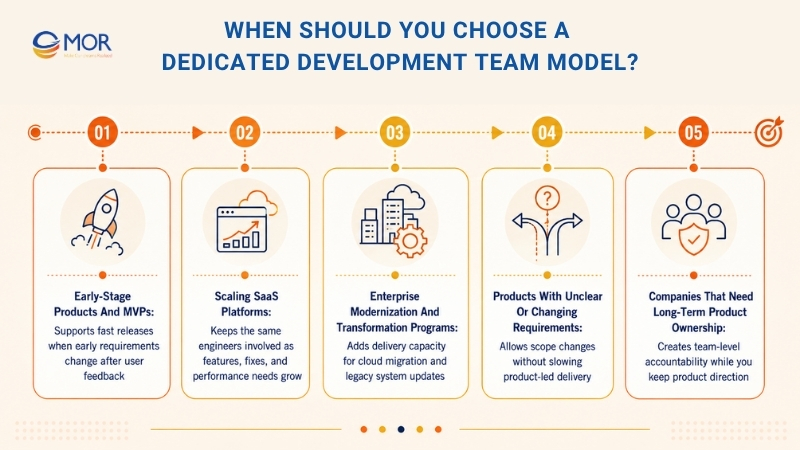
Early-Stage Products And MVPs
Early-stage products often move fast because requirements shift after each user call. A plan that looks right this month may no longer fit after the first test release.
Fixed contracts can slow you down because each change needs a new discussion. Freelancers may start quickly, but product memory often breaks when the work changes hands.
A dedicated project team example works better when you need speed and shared product knowledge. The team learns the product with you as priorities change. Many startups choose this model when they need outside delivery support without losing product context.
Scaling SaaS Platforms
When a product starts gaining users, stable delivery becomes more important. New features, fixes, and performance work begin to compete for the same engineering time.
Changing developers too often slows progress because important product details disappear with each handover. Dedicated teams avoid this issue because the same engineers stay involved, which makes the setup useful for many SaaS development programs.
Enterprise Modernization And Transformation Programs
Enterprise systems rarely change as a single small task. Existing dependencies, compliance needs, and legacy limits can make each change slower than expected.
Internal teams often have to balance daily maintenance with new business programs. Dedicated teams add delivery capacity without increasing permanent headcount, which makes them useful for cloud migration and system modernization work.
Products With Unclear Or Changing Requirements
Some products do not follow a fixed path. In these cases, the ability to adjust matters more than staying close to the first plan.
Market signals change. Business priorities move. What looked clear at the start can become unclear fast. The dedicated development team model handles this pressure well because scope is not locked, so product-led work can continue without losing pace.
Companies That Need Long-Term Product Ownership
Software needs ownership when it becomes a long-term business capability. Project-based work often stops once the agreed output is delivered. Staff augmentation can split responsibility across too many people. A dedicated team gives you a useful middle path. The team drives delivery, while you keep control of direction.
This setup works best when you build a product over time. It creates accountability at team level. It keeps the partner connected to product results. The structure matches how real products grow. Software is a living business asset, not a one-time task.
How Much Does It Cost To Hire A Dedicated Development Team Model?
After the core roles, cost is usually the next question. For a dedicated development team model, MOR Software will compare common role rates in North America, Latin America, and Central and Eastern Europe so you can see how location affects budget.
This view can help you choose a hiring region before you build a dedicated team.
The table shows that Latin America and Central and Eastern Europe can cost less than in-house staffing in North America. For an Asia-based delivery setup, MOR Software can prepare a project estimate based on your scope, seniority needs, and delivery timeline. You can contact us for a quote that fits your project goals.
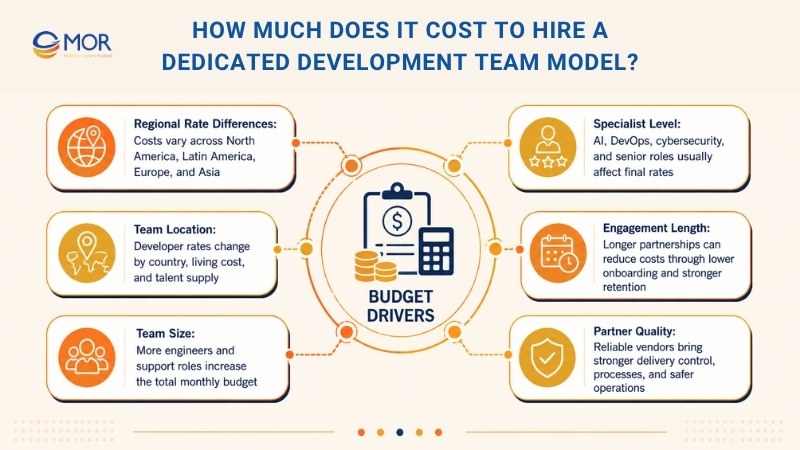
Generally, the cost of a dedicated team depends on the following:
- Team location: Developer rates change by country, living cost, and local talent supply. Rates in Poland, Romania, or Brazil are often lower than in the US or Canada, but they can still be higher than some markets in Asia.
- Specialist level: The final rate depends on the skill area, like AI, DevOps, cybersecurity, or standard web technologies, and also on whether you need junior, mid-level, or senior talent.
- Team size: Your total budget rises with the number of engineers and support roles, including QA teams, project managers, and DevOps specialists.
- Engagement length: Short projects often come with higher hourly rates, but long-term dedicated teams can cost less over time because onboarding drops, turnover stays lower, and product knowledge stays inside the team.
- Partner quality: A trusted software outsourcing partner like MOR Software may cost more than the cheapest provider, but it brings stronger delivery control, clearer processes, scalable team setup, and safer operations. Low-cost vendors may rely on shared resources, weak compliance, and hidden costs that appear later.
Role | Hourly Rate, North America | Hourly Rate, Latin America | Hourly Rate, Central & Eastern Europe |
Project Manager | $96–$123 | $59–$82 | $53–$78 |
Business Analyst | $109–$154 | $56–$68 | $57–$81 |
Software Architect | $139–$182 | $72–$96 | $71–$95 |
UX/UI Designer | $79–$100 | $48–$75 | $53–$71 |
Senior Developer | $143–$172 | $65–$82 | $68–$76 |
Intermediate Developer | $119–$144 | $53–$66 | $47–$65 |
Junior Developer | $75–$91 | $41–$53 | $35–$53 |
QA Automation Specialist | $167–$74 | $35–$72 | $32–$74 |
Manual QA Specialist | $117–$139 | $53–$66 | $47–$61 |
DevOps Engineer | $114–$148 | $59–$82 | $62–$79 |
How To Choose The Right Dedicated Development Team Vendor
Choosing a vendor for a dedicated development team model calls for a steady review across technical skill, business health, and delivery habits.
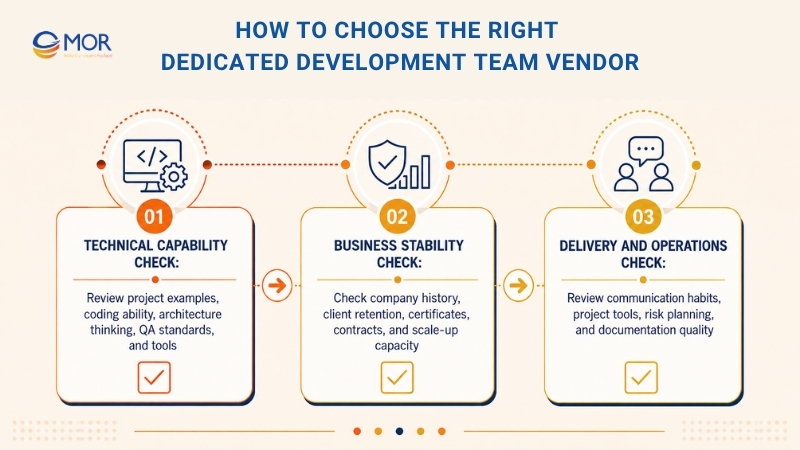
Technical Capability Check
Review similar work, validate coding ability, check architecture thinking, confirm QA standards, and assess the team’s delivery method and tools.
- Portfolio checks with project examples that match your needs
- Coding tests or technical reviews to confirm real skill
- Architecture and design review to test solution thinking
- QA standards and testing process checks
- Development method and tool review
Business Stability Check
Check company background, client retention, long-term work, industry certificates, contract record, and the ability to scale the team when needed.
- Financial health and company history review
- Client retention rate and long-term partnership examples
- Industry certificates and compliance records
- Legal standing and past contract delivery check
- Resource availability and scale-up capacity review
Delivery And Operations Check
Look at communication habits, project tools, risk planning, documentation quality, and knowledge transfer before you make a decision.
- Communication rules and response time standards
- Project management methods and tool setup
- Risk planning and backup process
- Knowledge transfer and documentation habits
Dedicated Development Team Model Case Study And Success Patterns
The dedicated development team model shows its value when the same team keeps learning the product, users, risks, and business goals over time.
MOR Software’s project record shows how dedicated teams support different needs, from MVP delivery to enterprise integration and large-scale product growth. The pattern is clear: understand the business problem, build the right team, choose the right technology, and keep delivery close to real users.
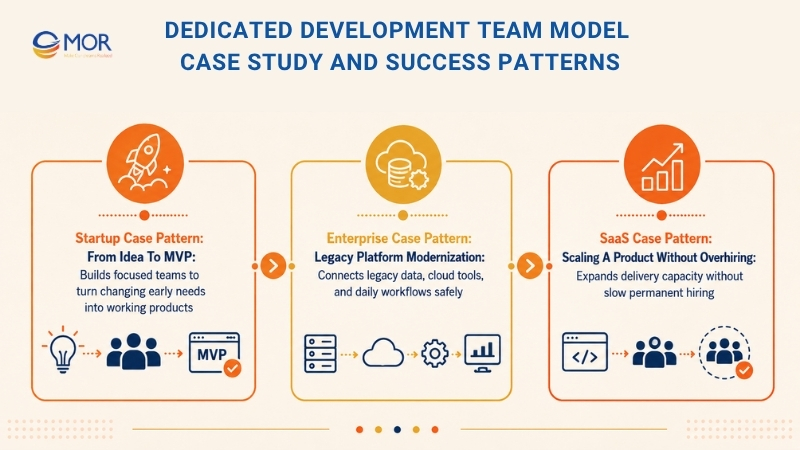
Startup Case Pattern: From Idea To MVP
Business need: A new digital product often needs to reach users fast, but early requirements can change after each pilot, user test, or market signal.
MOR Software’s approach: MOR Software can form a focused team with business analysis, UI/UX, developers, QA, and delivery support. In projects like the gym exercise SDK, MOR Software studied the client’s needs, built the counting algorithm, created a modular SDK, tested it, and prepared clear documents for integration.
Delivery result: The client received a working solution that could be added to fitness applications with less friction. The SDK counted exercise repetitions accurately, supported easier integration, and gave the client a stronger base for product growth.
Enterprise Case Pattern: Legacy Platform Modernization
Business need: Enterprise systems often need to connect old data, new cloud tools, and daily workflows without stopping normal operations.
MOR Software’s approach: In workforce management projects, MOR Software connected legacy attendance data with Salesforce and Slack through API Gateway, ETL migration, and AWS services. The team worked with Agile Scrum over five months, covering development, integration, and testing.
Delivery result: The client gained real-time workforce visibility, easier check-in and check-out flows, and less manual admin work. Managers could track attendance more clearly, while employee data moved between systems with better accuracy.
SaaS Case Pattern: Scaling A Product Without Overhiring
Business need: Growing software products often need more delivery capacity, but permanent hiring can move too slowly or create too much long-term cost.
MOR Software’s approach: For large-scale platforms like KCON and PEOPLE, MOR Software supported product growth with dedicated engineering capacity. The KCON project used NodeJS, ReactJS, and React Native over 16 months, with a team of 26 members built to support up to 100,000 users in low-bandwidth conditions.
Delivery result: KCON launched with stable event check-ins, stronger fan engagement, and smooth app performance under heavy use. PEOPLE gained long-term engineering support to scale product functions, expand system capacity, and grow across Japan and Vietnam.
Future Trends In Dedicated Development Team Models
The dedicated development team model is moving from a hiring workaround to a long-term delivery strategy as software teams become more distributed, automated, and skill-focused.
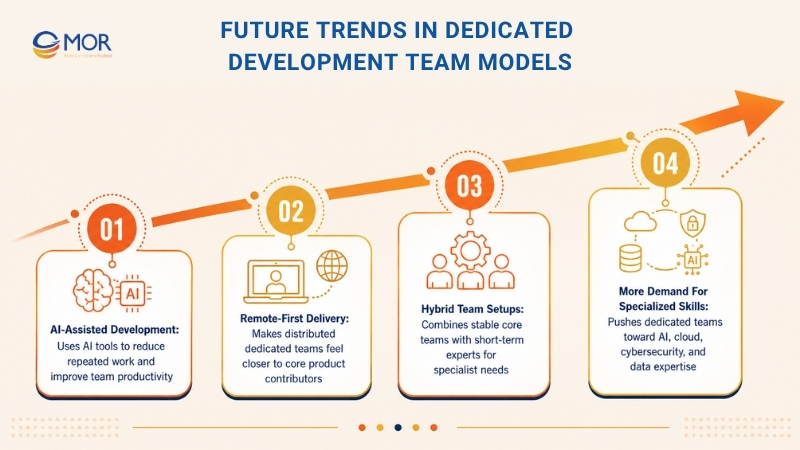
AI-Assisted Development
AI-assisted development is pushing this shift forward. Tools for code support, automated testing, and AI-made documentation are part of dedicated development team model agile delivery because they help teams spend less time on repeated work. Some industry forecasts point to productivity gains of 30% to 40% by 2026, which allows smaller dedicated teams to create more output while still protecting quality.
Remote-First Delivery
Remote-first work has become a normal part of software delivery. Deloitte reports that more than 80% of companies now treat remote work as a long-term model, not a short-term fix. This makes distributed teamwork easier to accept, so dedicated teams now act more like core contributors than outside support.
Hybrid Team Setups
Hybrid engagement models are also becoming more common. Many companies now combine a stable core team with short-term experts for AI, security review, or performance work. This dedicated development team model gives businesses continuity and specialist help without adding too much long-term cost.
More Demand For Specialized Skills
Demand for skills in AI, cloud, cybersecurity, and data engineering keeps rising. Dedicated team models are moving away from general staffing and toward domain-focused partnerships tied to clear business outcomes.
Taken together, these trends show that outsourcing is becoming part of how product teams operate. The future points toward steady collaboration, not one-off delivery.
Build Your Dedicated Development Team With MOR Software
If this guide shows one clear point, it is this: the dedicated development team model works best when you need stable talent, clear delivery, and room to scale without the challenges of local hiring. That is where MOR Software can help.
We work with companies that need more than short-term development support. We help define the right team structure, select the necessary skills, establish efficient workflows, and maintain consistent delivery throughout the project lifecycle. Our team handles recruitment automation, payroll, administration, performance management, and scaling, while your team remains focused on product strategy, priorities, and business goals.
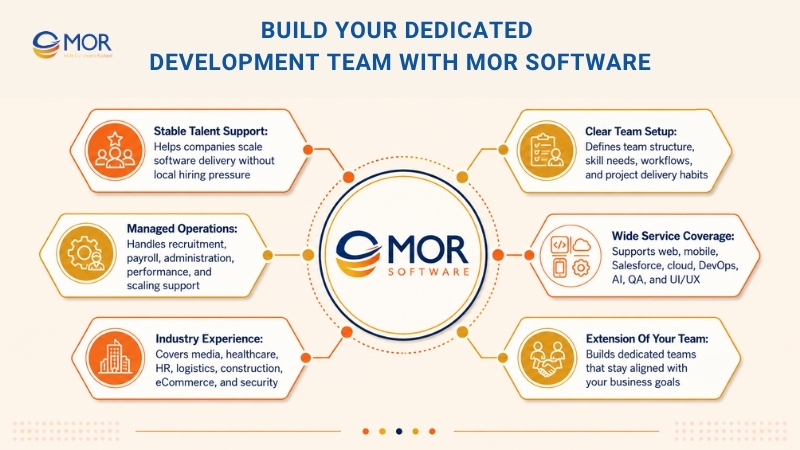
Our dedicated teams support a wide range of services, including web and web application development, outsource mobile app development for iOS, Android, and cross-platform solutions, Salesforce development, custom software development, offshore development center setup, quality assurance and testing, cloud services, DevOps, AI, IoT, digital transformation, UI/UX design, business analysis, and system architecture.
With experience across industries such as media, healthcare, HR, logistics, construction, eCommerce, and security, we understand that every business has unique requirements. Our approach is to build teams that align with your objectives, adapt to changing priorities, and contribute as an extension of your organization.
A dedicated team should feel like part of your business, not a distant vendor. That is the standard we strive to deliver. Whether you need to accelerate development, expand your technical capabilities, or build a long-term product team, MOR Software is ready to support your journey.
Contact MOR Software to discuss your dedicated development team and find the setup that best fits your project goals.
Conclusion
A dedicated development team model gives businesses a practical way to scale software delivery without the heavy load of local hiring. It works well when you need steady talent, clear ownership, and room to adjust as product needs change. MOR Software can help you build a dedicated team that fits your roadmap, technology needs, and long-term goals. Contact MOR Software to discuss your project and choose the right team setup.
MOR SOFTWARE
Frequently Asked Questions (FAQs)
What is a dedicated development team model?
A dedicated development team model is a long-term collaboration where an external team works exclusively on your project while you retain control over goals and priorities, and the vendor manages recruitment, HR, and operations.
How much does it cost to hire a dedicated development team?
Costs vary based on team size, expertise, technology stack, location, and project duration, with most vendors charging a monthly fee that often includes recruitment and operational expenses.
What’s the difference between a dedicated team and staff augmentation?
Staff augmentation adds individual specialists to your existing team, while a dedicated team functions as a complete unit responsible for delivering and supporting a product or project over time.
How long does it take to set up a dedicated team?
Setting up a dedicated team typically takes a few weeks to over a month, depending on the required skills, team size, and complexity of the hiring process.
What roles should be included in a dedicated team?
A dedicated team commonly includes developers, QA engineers, designers, DevOps specialists, and a project manager, with additional roles added based on project requirements.
How do I manage a remote dedicated development team?
Effective management requires clear goals, regular communication, defined responsibilities, and agile practices such as sprint planning, progress reviews, and feedback sessions.
What are the main challenges of working with dedicated teams?
Common challenges include communication gaps, time zone differences, unclear responsibilities, and onboarding issues, which can be minimized through clear processes and regular collaboration.
How do I protect my intellectual property?
Protect intellectual property through contracts, NDAs, ownership agreements, secure access controls, and proper management of code repositories and project assets.
Can I scale my team up or down easily?
Yes, the dedicated development team model offers flexibility, allowing you to increase or reduce team size based on project demands and business needs.
What’s the minimum engagement duration?
Although requirements vary, dedicated teams are generally most effective for projects lasting six months or longer, where ongoing development and continuous improvement are needed.
Share


Make Our-Dreams Realized


© 2023 . MOR Software. All Rights Reserved
Sitemap
Privacy Policy
Terms of Use

Rate this article
0
over 5.0 based on 0 reviews
Your rating on this news:
Name
*Email
*Write your comment
*Send your comment
1