


Crypto Exchange vs Wallet: What is The Key Differences?
Crypto storage can feel simple until you realize one choice controls who holds the keys. The crypto exchange vs wallet decision affects access, privacy, recovery, trading speed, and long-term safety. In this guide, MOR Software will break down crypto wallet vs exchange differences so you can choose the right setup with less guesswork.
Key Takeaways
- A crypto exchange is best for fast buying, selling, and trading, but the platform often controls your private keys through a custodial wallet setup.
- A crypto wallet gives you stronger control over your assets, yet you must protect your seed phrase, private keys, and recovery process yourself.
- The safest approach for many users is to keep a small amount on an exchange for trading and move long-term holdings to a personal wallet.
What Is The Key Differences Between Crypto Exchange Vs Wallet?
Many people asking what is a crypto exchange vs wallet are really trying to understand two different ways to hold and manage digital assets. A wallet and an exchange do not serve the same main purpose, so the comparison can feel strange at first. Yet crypto exchange vs wallet matters because many centralized trading platforms let users keep coins inside built-in custodial wallets. In that setup, your balance may appear in a wallet, but the platform still controls the private keys.
Factor | Exchange-Based / Custodial Wallet | Self-Custody Crypto Wallet |
Basic Meaning | An exchange is an online service used to buy, sell, swap, and trade crypto. Its custodial wallet keeps user funds on the platform while the exchange controls the keys. | A self-custody wallet is a software or hardware tool where you hold the private key or seed phrase yourself. This gives you direct access to your assets. |
Control Over Private Keys | The platform stores and manages the keys for you. | You keep the private keys or seed phrase yourself. |
Asset Access | You depend on the exchange to let you withdraw, trade, or move funds. | You can access and move your crypto directly from your wallet. |
Main Security Risk | Risks can include exchange hacks, account freezes, downtime, or platform failure. | Platform risk is lower, but key loss or poor backup can still lead to lost funds. |
Ease Of Use | It is simpler for beginners because trading, deposits, and payment tools are in one place. | It takes more setup because you need to manage keys, networks, and backups. |
Trading Options | It supports quick buying, selling, swapping, and portfolio tracking. | Trading often happens through wallet tools, DeFi apps, or connected protocols. |
Privacy Level | It usually asks for KYC and identity checks. | Basic wallet use normally does not require account registration or identity review. |
Access Recovery | Password resets and support teams may help restore account access. | Losing the seed phrase or private key usually means the funds cannot be recovered. |
Transfer Speed | Internal platform transfers can be quick and low-cost. | Blockchain transfers may take more time and include network fees. |
Supported Assets | You can use the coins, tokens, and pairs listed by the exchange. | You may access many chains and tokens, but some assets need manual setup. |
Best Fit | It suits beginners, frequent traders, and users who want simple access. | It suits long-term holders, DeFi users, NFT users, and people who want full control. |
The real choice is about how you want to store and access crypto. One option is an exchange-managed wallet, where the platform handles custody for you. The other is a non-custodial wallet, where you manage access on your own. For anyone comparing a bitcoin exchange vs wallet, the main question is simple: do you prefer easier trading and account support, or do you want stronger control over your keys and assets?
Key Control And Asset Ownership
Control is the biggest point in any crypto wallet vs exchange discussion. The private key decides who can move the funds, so key ownership affects your real level of control.
- With an exchange-managed wallet: The trading platform stores and controls the private keys for your account, so you do not directly manage access to the assets. You depend on the exchange to protect your balance, process withdrawals, and keep the account available.
- With a self-custody wallet: You manage your own private keys or seed phrase, which gives you direct authority over the crypto. No outside company can transfer, block, or freeze those funds unless you give access.
Security And Risk
Security looks very different when funds sit on a trading platform rather than in a wallet you control. The safer choice depends on how well the platform protects users and how carefully you protect your own keys.
- With exchange storage: Centralized platforms often attract hackers because they hold large amounts of user funds. If the service suffers a breach, withdrawal freeze, or internal failure, users may lose access to assets even when their own login details were safe.
- With personal wallet storage: Your assets can be harder to attack from a platform level, especially in a crypto exchange vs cold wallet comparison. A cryptocurrency exchange or hard wallet choice often comes down to trust, since a hardware wallet lowers online risk but makes you fully responsible for key safety.
Convenience And Daily Use
Convenience is where exchanges often feel easier, especially for new users. Wallets give more freedom, but they ask you to handle more details on your own.
- With exchange storage: The process is simple because buying, selling, swapping, fiat deposits, and portfolio tracking sit in one account. This makes buying crypto on exchange vs wallet easier for beginners and active traders who need quick access.
- With personal wallet storage: You need to manage seed phrases, wallet addresses, and network choices yourself. Yet a crypto exchange vs hot wallet comparison shows why many users still choose wallets for direct access to DeFi development service, dApps, and NFT platforms.
KYC And Privacy
Privacy is another clear difference in crypto exchange vs wallet decisions. Exchanges often need personal data, while wallets usually let you start without creating an account.
- With exchange storage: Most centralized platforms ask users to pass KYC checks before full use. This can help with account safety and legal rules, but it also means your identity is linked to the account.
- With personal wallet storage: You do not need to share personal details for basic wallet use. You can create a wallet and manage assets without signing up, submitting documents, or verifying your identity.
Recovery And Backup
Recovery can feel safer on an exchange, but that support comes with less control. Wallets give you full ownership, but they also place the backup duty on you.
- With exchange storage: If you forget your password or lose account access, the platform may help through email checks, reset tools, or customer support. Recovery is usually possible as long as you can prove account ownership.
- With personal wallet storage: You carry the full backup burden yourself. If the seed phrase or private key is lost, there is usually no support team, reset link, or recovery path to restore the wallet.
Transaction Speed And Access
Speed depends on whether the transfer stays inside one exchange or moves across a blockchain platform. This is where the two storage methods can feel very different in daily use.
- With exchange storage: Transfers between users on the same platform can happen quickly and may cost little or nothing. Users can also access their accounts through web dashboards or mobile apps with little setup.
- With personal wallet storage: Each transfer is sent through the blockchain, so speed and cost depend on the network. This may take longer and include gas or network fees, but it removes the need to rely on a central platform.
Asset Support And Tool Connections
Asset access can vary a lot between exchanges and private wallets. Exchanges focus on listed markets, while wallets often connect with wider Web3 tools.
- With exchange storage: Many platforms support popular coins, tokens, and trading pairs with strong liquidity. Swaps can happen fast with low slippage, but you can only use the assets, networks, and tools the exchange decides to list.
- With personal wallet storage: Many wallets work across several blockchains and connect to decentralized apps, giving you wider control. Common exchange wallet examples include platform wallets inside trading apps, but non-custodial options may need manual token setup and liquidity depends on the protocol you use.
>>> Let's highlight the top asset tokenization companies to invest in 2026, helping you find trusted partners to turn your assets into digital value.
Why Knowing Difference Between Crypto Exchange Vs Wallet Is Important?
People often use the terms crypto wallet and crypto exchange as if they mean the same thing, but they point to different tools. A wallet, in simple terms, is software or hardware that helps you access crypto held on the blockchain. An exchange is a trading platform where users can buy, sell, and swap digital assets. For anyone comparing crypto exchange vs wallet, this difference affects control, safety, privacy, and daily access. The same idea also applies when readers search for crypto wallet vs crypto exchange and want a clear answer without technical noise.
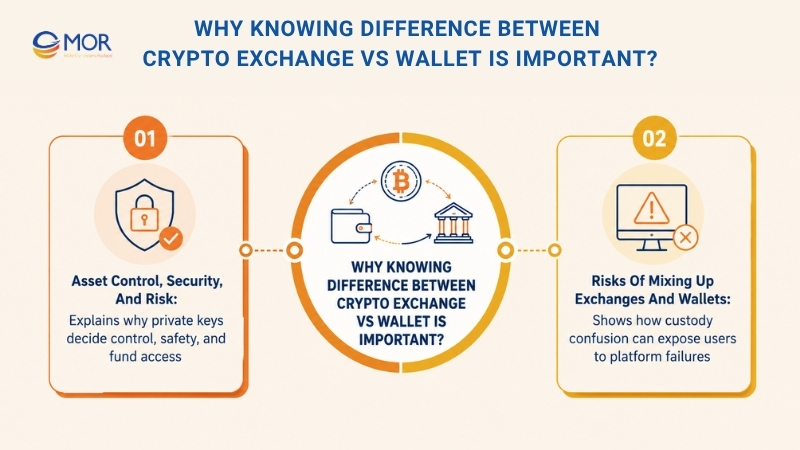
New users can get mixed up because many exchanges also give customers a wallet-like account. These are custodial wallets, which means the exchange keeps the private keys while users access funds through their platform account.
Asset Control, Security, And Risk
A custodial wallet inside an exchange can store your crypto keys and help you manage balances, but the platform still has technical control over that wallet. In an exchange vs wallet crypto comparison, a private crypto wallet gives you more direct control because you keep and protect your own private keys.
Risks Of Mixing Up Exchanges And Wallets
Keeping crypto on an exchange for long periods can bring risks because your funds stay inside a custodial setup. A self-custody wallet gives you direct key control, but a custodial exchange wallet asks you to trust the platform with fund security, access, and withdrawals. If the company has technical issues, enters bankruptcy, or blocks withdrawals, users may not be able to move their assets. If the exchange suffers a hack, customer balances may also be at risk. This is why users often search the difference between exchange and wallet in Binance when trying to understand account storage, wallet apps, and who controls the keys.
>>> Break down the key considerations and step-by-step cryptocurrency wallet development process to help your business make decisions in building a crypto wallet.
Crypto Exchange Vs Wallet: Why Storing Everything On An Exchange Is Risky
History has shown many times that keeping every asset on a trading platform can create serious exposure. The FTX collapse in 2022 and the Mt. Gox breach both led to major user losses, and these cases still shape how people think about holding crypto on exchange vs wallet. They show why self-custody matters, mainly when the rules around crypto platforms become more complex.
Regulators in many countries are also placing tighter controls on the crypto sector. As a result, users may run into frozen accounts, withdrawal limits, or extra checks that slow access to funds. That makes keeping crypto on exchange vs wallet a real storage decision, not just a matter of convenience.
When Should You Use Crypto Exchange Vs Wallet?
The right choice depends on what you want to do with your assets:
- For fast buying, selling, or trading crypto, an exchange is usually the better fit because it gives you order tools, fiat payment options, and quick market access in one place.
- For long-term storage or Web3 use, a crypto wallet is the stronger choice, mainly if you want to hold your own keys, connect to DeFi, or use a hardware wallet for safer storage.
Many users use a mixed wallet vs exchange crypto setup. They keep a smaller balance on an exchange for daily trades, then move most of their assets into a personal wallet for better control and long-term storage.
How To Transfer Crypto From An Exchange To A Wallet
If you want to move coins from an exchange account into a personal wallet, the process shifts your assets from custodial storage to self-custody. This crypto exchange vs wallet step is common for users who want more control over their funds and private keys.
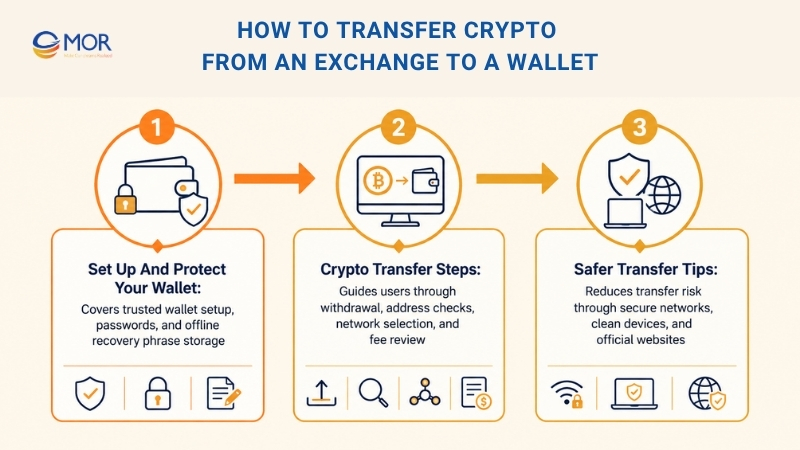
Set Up And Protect Your Wallet
Wallet setup depends on the wallet type you choose. In most cases, you will need to:
- Choose a trusted wallet: Download a well-known software wallet or buy a reliable hardware wallet from an official source.
- Install the right app: Use the official wallet app or desktop software, and avoid third-party download links.
- Create a fresh wallet: Start a new wallet inside the app and check that you are not importing an unknown or unsafe wallet file.
- Build a strong password: Use a long, unique password that is not used for your email, exchange, or other accounts.
- Store your recovery phrase offline: Write your seed phrase on paper or another durable offline material, then keep it away from screenshots, cloud storage, and chat apps.
Crypto Transfer Steps
The process may change based on the exchange, coin, wallet, and network. Most transfers follow these steps:
- Open your exchange account: Sign in to the exchange and check that your account, balance, and withdrawal access are ready.
- Find the withdrawal page: Go to the “Withdraw,” “Send,” or transfer area for the asset you want to move.
- Copy the right wallet address: Open your wallet, select the same crypto asset, and copy its public receiving address.
- Enter the address with care: Paste the wallet address into the exchange withdrawal form and compare the first and last characters before moving forward.
- Select the matching network: Pick the correct blockchain network because sending assets through the wrong network can cause permanent loss.
- Review fees and confirm: Check the amount, address, network, and withdrawal cost before approval. Users moving assets from Coinbase should also review coinbase withdrawal fees before sending.
Safer Transfer Tips
For safer crypto exchange vs wallet transfers, you should:
- Stay off public networks: Do not send crypto while using public Wi-Fi, since shared networks can expose you to extra risk.
- Keep devices clean: Use updated devices with trusted security tools, and avoid transfers from phones or laptops that may contain malware.
- Protect your private details: Never send your private key or seed phrase to anyone, even if they claim to be support staff.
- Save official websites: Bookmark exchange and wallet websites yourself so you do not click fake links from ads, emails, or messages.
Mistakes To Avoid When Managing Crypto Exchanges And Wallets
Users often make simple errors when dealing with crypto exchanges vs wallets. These mistakes can lead to lost access, stolen funds, or failed transfers, so it helps to know the risks before moving assets around.
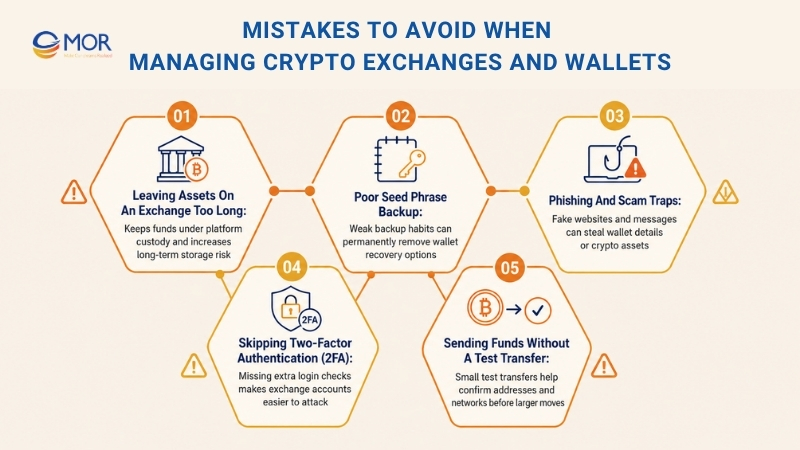
Leaving Assets On An Exchange Too Long
It is common to buy crypto on an exchange and then leave the balance inside the platform’s hot wallet. That may feel easy, but it also means the assets remain under the exchange’s custody. This is not always dangerous, but your holdings may face more platform risk than they would in a private wallet you control.
Poor Seed Phrase Backup
A weak or missing seed phrase backup is one of the most damaging wallet mistakes. The seed phrase works like the master access key for your wallet, and without it, you usually cannot recover your funds if your phone, computer, or hardware wallet is lost or damaged.
A safer backup should be written on durable offline material, such as paper stored well or a fire-resistant metal plate. It also helps to keep copies in separate safe places, so one accident does not remove your only recovery option.
Phishing And Scam Traps
Crypto exchange vs wallet safety also depends on avoiding fake websites, false support messages, and scam links. Phishing attacks and crypto scams try to trick users into sharing wallet details or sending assets to criminals. To lower that risk, be careful with free token offers, promises of guaranteed returns, strange emails, and links in random messages. Always check the full website address before logging in or approving any wallet action.
Skipping Two-Factor Authentication (2FA)
Extra login checks can feel annoying, but skipping Two-Factor Authentication (2FA) can make an exchange account much easier to break into. If someone gets your password, a missing second step may give them a clearer path to your account and funds.
Sending Funds Without A Test Transfer
Crypto transfers cannot usually be reversed once the network confirms them. Funds sent to the wrong address or through the wrong network are often gone for good. A small test transfer helps you confirm the address and network before sending a larger amount. Once that test arrives safely, you can move the rest with more confidence.
Common Crypto Exchange Vs Wallet Misunderstandings
A lot of crypto exchange vs wallet confusion comes from the way modern platforms mix trading, storage, and Web3 access in one product. The points below clear up the most common myths so users can make safer choices.
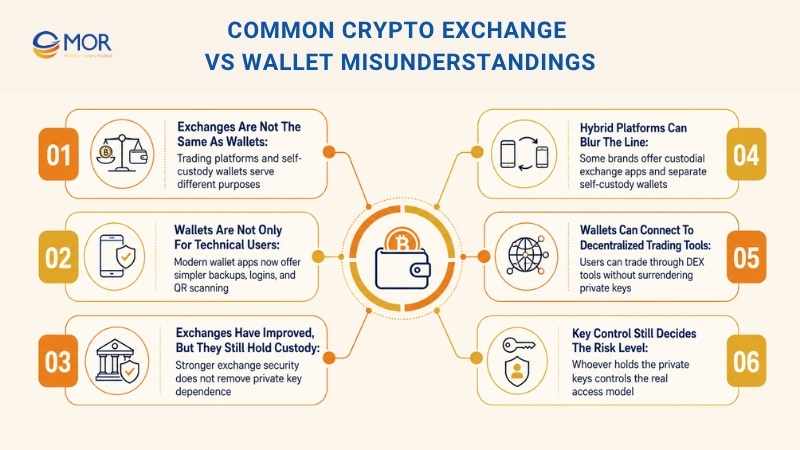
Exchanges Are Not The Same As Wallets
An exchange helps users trade digital assets, while a wallet helps users access and manage crypto on the blockchain. Some exchanges add wallet-like tools, but the main service is still trading. In many cases, the platform keeps the private keys, so users do not have full control over their assets. A real self-custody wallet, whether software or hardware, gives the user direct key control. Mixing these tools up can make users think their funds are safer or more private than they really are.
Wallets Are Not Only For Technical Users
Older crypto wallets were harder to use, so many beginners avoided them. Newer wallets are much easier, with clean mobile apps, simple backup flows, biometric login, and QR code scanning. These tools make private wallet management more practical for everyday users. Some wallets also connect to exchanges or swap tools, so users can move or trade assets without leaving the wallet app.
Exchanges Have Improved, But They Still Hold Custody
Many trading platforms now use stronger login protection, fraud checks, withdrawal allowlists, and custodial asset protection. These updates make exchanges easier and safer for new users. Still, safer design does not remove the custody issue when the platform controls the private keys.
Hybrid Platforms Can Blur The Line
Services like Coinbase and Crypto.com let users trade crypto and also use wallet products. The key detail is whether the wallet is custodial or non-custodial. Coinbase has a main exchange app where Coinbase controls the keys, and it also has Coinbase Wallet, where users control their own keys. Crypto.com also supports trading wallets and a separate DeFi wallet for users who want self-custody.
Wallets Can Connect To Decentralized Trading Tools
DEX aggregators like 1inch and Zapper, along with tools like WalletConnect, let users trade through decentralized platforms from their own wallets. This means users can interact with markets without handing private keys to a centralized exchange. It also shows why the line between wallet tools and exchange tools can feel less clear in daily use.
Key Control Still Decides The Risk Level
Hybrid services can look similar on the surface, but the real question is who holds the private keys. If a platform controls them, your access depends on that platform. If you control them, the responsibility sits with you. Understanding this split helps users choose the right storage method for trading, long-term holding, and Web3 activity.
How MOR Software Can Support Crypto Wallet And Exchange Development
The crypto exchange vs wallet comparison shows one thing clearly: crypto products need careful planning before any code is written. A wallet must protect private keys, recovery flows, and user access. An exchange needs fast trading logic, account checks, transaction records, admin tools, and strong risk controls.
MOR Software can support businesses that want to build crypto wallet apps, exchange-related modules, or blockchain-based financial products. We work across web development, mobile app development, blockchain software development, QC and testing, and IT consulting. This helps teams shape the product from the first idea to release and long-term maintenance.
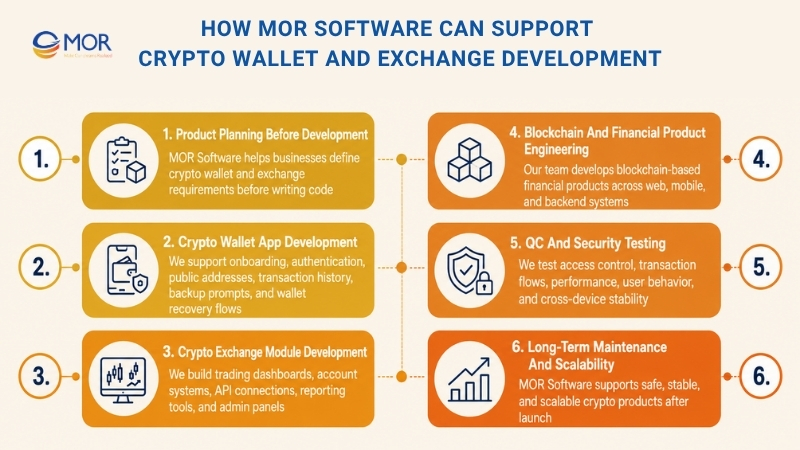
For a wallet project, we can help design user flows for onboarding, authentication, public addresses, transaction history, backup prompts, and wallet recovery. For an exchange project, we can build trading dashboards, user account systems, API connections, reporting tools, and admin panels.
Security testing also matters in crypto token development. One small gap can create serious loss for users and damage trust fast. Our QC team can test performance, access control, transaction flows, and user behavior across devices.
MOR Software is a strong blockchain development outsourcing partner for startups and enterprises that need a practical team to build safe, stable, and scalable crypto products.
Conclusion
The crypto exchange vs wallet choice comes down to control, convenience, and risk. Exchanges make trading easier, but wallets give you stronger ownership over your assets. Once you know how private keys, recovery, fees, and security work, it becomes easier to choose the right storage method. Need help building a secure crypto product? Contact MOR Software to discuss your wallet, exchange, or blockchain development project.
MOR SOFTWARE
Frequently Asked Questions (FAQs)
What is the main difference between a crypto exchange and a crypto wallet?
A crypto exchange is used to buy, sell, and trade digital assets. A crypto wallet is used to store private keys and manage access to assets on the blockchain.
Why does crypto exchange vs wallet matter for beginners?
It matters because the two tools give users different levels of control. An exchange is easier for trading, but a personal wallet gives stronger control over private keys.
Is it safe to keep crypto on an exchange?
It can be safe for short-term trading, but it carries platform risk. If the exchange is hacked, freezes withdrawals, or shuts down, users may lose access to their funds.
Is a crypto wallet safer than an exchange?
A non-custodial wallet can be safer for long-term storage because users control their own keys. The risk is that losing the seed phrase may mean permanent loss.
Should I use a hot wallet or cold wallet?
A hot wallet is better for regular transactions because it stays online. A cold wallet is better for larger holdings or long-term storage because it keeps keys offline.
How should I choose in the crypto exchange vs wallet debate?
Use an exchange when you need quick trading, fiat deposits, or market access. Use a wallet when you want to hold assets with more control and less platform risk.
Can I use both an exchange and a wallet?
Yes. Many users keep a small amount on an exchange for trading and move the rest to a personal wallet for safer storage.
What happens if I lose my wallet seed phrase?
If you use a non-custodial wallet, the seed phrase is your recovery tool. Without it, you may not be able to recover your wallet or funds.
Do crypto wallets charge fees?
Most wallets do not charge a basic storage fee. But blockchain network fees may apply when sending crypto, swapping tokens, or using certain wallet services.
What is the safest setup after comparing crypto exchange vs wallet?
A balanced setup works best for many users. Keep trading funds on a trusted exchange, then store long-term holdings in a secure wallet, preferably a cold wallet.
Share


Make Our-Dreams Realized


© 2023 . MOR Software. All Rights Reserved
Sitemap
Privacy Policy
Terms of Use

Rate this article
0
over 5.0 based on 0 reviews
Your rating on this news:
Name
*Email
*Write your comment
*Send your comment
1