


DeFi Development Services: Complete Guide for Businesses in 2026
Decentralized finance is changing how businesses build and run financial products, yet many teams struggle with complexity, security, and scalability. This guide on DeFi development services breaks down what matters most for businesses planning real adoption in 2026. In this guide, MOR Software will explain how companies can turn DeFi ideas into secure, scalable, and market-ready solutions.
What Are DeFi Development Services?
DeFi (Decentralized Finance) development services focus on creating blockchain-based financial applications, including staking platforms, lending dApps, decentralized exchanges (DEXs), and defi yield farming platform development. This approach removes traditional intermediaries like banks and enables transparent, open, and permissionless financial activity through smart contracts and blockchain technology. As part of DeFi platform development, these solutions support end-to-end financial systems that operate without centralized control while maintaining reliability and trust. In late 2021, DeFi platforms hit a record high of US$191 billion in total value locked, and the number of wallets linked to DeFi protocols grew from about 200,000 to about 5 million. This shows how fast this space can scale when the tools work well.
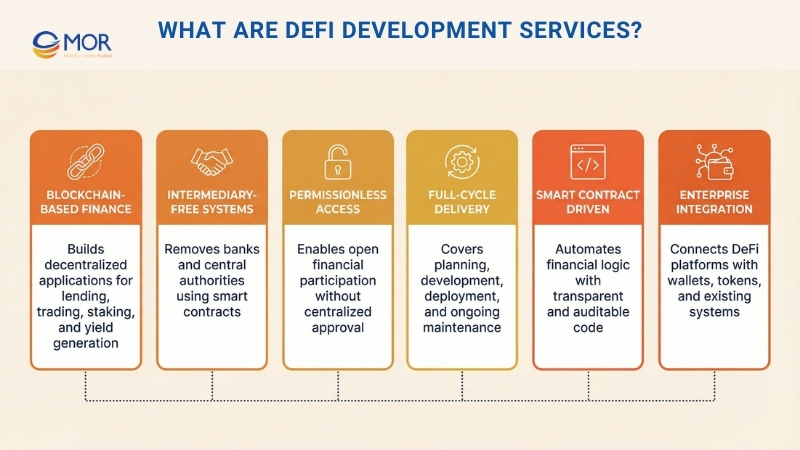
These offerings typically span strategy planning, contract engineering, token creation, wallet setup, security audits, and system integration. In 2024 alone, crypto platforms lost $2.2 billion to theft, across 303 hacking incidents, which is why many teams treat audits and secure code as core parts of DeFi development, not extras. Businesses rely on DeFi development services to introduce new models across asset management, insurance, and peer-to-peer lending. Providers often deliver full-cycle support, guiding projects from early concept through deployment and continued maintenance.
Key DeFi Development Services
Decentralized finance keeps growing and is reshaping how people borrow, trade, invest, and manage assets. It introduces alternatives to traditional financial systems and changes how financial value moves across digital networks. Below are several common use cases supported by DeFi development services.
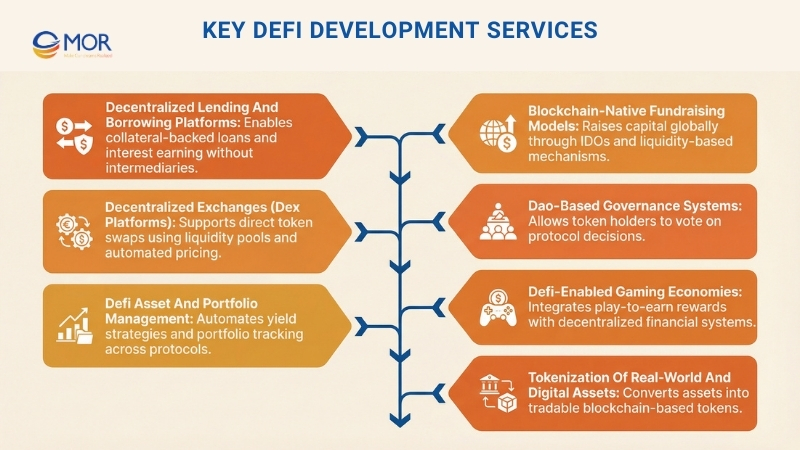
Decentralized Lending And Borrowing Platforms
Decentralized lending and borrowing platforms let users earn interest on deposited assets or access collateral-backed loans without relying on intermediaries. Smart contracts control loan conditions and collateral rules, which lowers the risk of default. This structure opens credit access to a wider audience, while lenders often see returns that exceed traditional savings and lending blockchain platforms through DeFi development services.
Decentralized Exchanges (Dex Platforms)
Decentralized exchanges support direct token swaps between users without centralized oversight, using automated market makers and shared liquidity pools. Users keep full control of their assets during each transaction, which strengthens security and transparency. In 2024, the top 10 spot DEXes recorded $1.76T in trading volume, showing that on-chain trading is no longer a small side activity.
With chains focused on speed and cost efficiency, Solana DeFi development services often support high-volume trading, lower fees, and continuous global access for many digital assets. As one real-world example, Uniswap reported it passed $2 trillion in total trading volume by early April 2024. This highlights how far decentralized exchange software development platforms have come
Smart Contract Development
Creating self-executing code that automatically enforces agreement terms for lending, borrowing, and yield generation.
DeFi Asset And Portfolio Management
Asset and portfolio management tools within decentralized finance help users monitor holdings, improve yield strategies, and automate investment actions. The best platforms combine data from several protocols, which makes decision-making easier for individuals and institutions. Capabilities like yield farming, portfolio rebalancing, and analytics give investors more control, while experienced DeFi developers design these systems to reduce reliance on traditional wealth management through DeFi development services.
Blockchain-Native Fundraising Models
Fundraising within decentralized finance relies on structures like Initial DEX Offerings (IDOs) and liquidity bootstrapping pools. These approaches give startups and protocols a way to raise capital directly from participants around the world. Through DeFi crypto token development services and structured DeFi token development, these models remove the need for venture capital firms and banks, which improves access, transparency, and community-led involvement during early project growth.
DAO-Based Governance Systems
DAO-based governance systems enable community-led control over decentralized finance initiatives. Token holders take part in voting processes that guide protocol upgrades, treasury use, and key strategic choices. This governance model supports openness and shared participation while lowering dependence on centralized management. Deep DAO’s dashboard shows a total DAO treasury of $12.3B in “Liquid” assets. This is why governance and treasury controls are important in real terms. Such systems align incentives and give users a real voice in shaping long-term direction through DeFi development services.
DeFi-Enabled Gaming Economies
Gaming ecosystems powered by decentralized finance introduce play-to-earn mechanics that reward players with tokens or digital assets for in-game actions. These rewards can move across platforms where they are traded, staked, or reused within other applications. One well-known case is Axie Infinity, which DappRadar reported had surpassed 2.5 million daily active users in 2021 after starting the year around 20,000. The rapid growth of this token-based game economy is evident.
Supported by DeFi dApp development services, this mix of gameplay and financial value drives engagement, builds active communities, and creates new forms of digital ownership.
Tokenization Of Real-World And Digital Assets
Tokenization transforms physical or digital items into blockchain-based tokens that operate within decentralized finance environments. Assets like real estate, bonds, or artwork become more liquid and can be owned in fractional shares. McKinsey estimates that tokenized market capitalization across asset classes could reach about $2 trillion by 2030 (excluding cryptocurrencies and stablecoins). As a result, more teams are integrating tokenization tools and on-chain settlement into DeFi products.
This method lowers investment barriers, increases market efficiency, and connects traditional asset classes with modern financial systems through DeFi development services.
Benefits of Using DeFi Development Services
Businesses choose decentralized finance because it provides clear advantages over traditional financial systems. Through blockchain networks and smart contracts, this type of development helps companies lower costs, automate complex workflows, reach wider audiences, and build trust through transparent operations. These strengths position DeFi development solutions as a practical path for organizations that want to modernize financial operations and enter new digital markets.
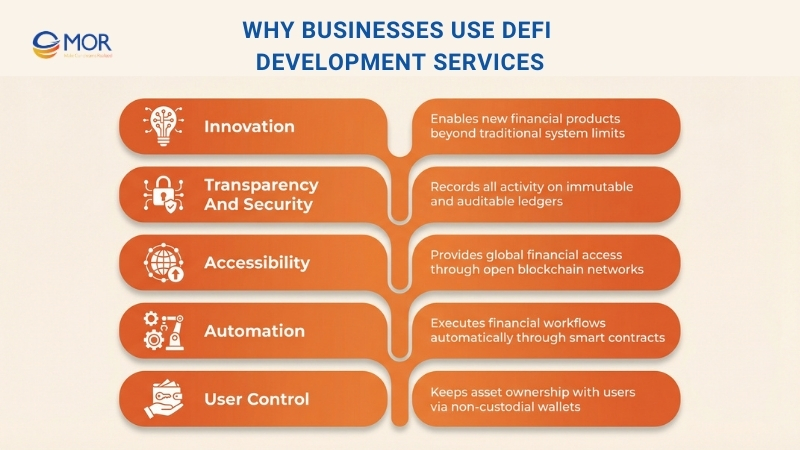
- Innovation: Supporting new financial products and business models that traditional finance cannot deliver. Decentralized systems make room for services like peer-to-peer lending, asset tokenization software, and programmable money that help a business stand out in competitive markets.
- Transparency & Security: Using blockchain records every transaction on an immutable and auditable ledger. This improves trust and visibility for businesses and users, while lowering dependence on unclear or closed intermediaries.
- Accessibility: Providing open financial services that work globally and remain available to anyone with an internet connection. The World Bank estimates 1.4 billion adults were still unbanked in 2021. Tools that require only a mobile phone and an internet connection therefore play an important role in regions where access to traditional banking is limited.
- Automation: Smart contract platforms follow preDeFined rules without manual handling. Payments, settlements, interest calculations, and compliance checks rely on code rather than human approval. This lowers operating effort, reduces mistakes, and accelerates transactions with more predictable costs.
- User Control: Most decentralized applications rely on non-custodial wallets where users keep control of their own assets. Businesses avoid holding customer funds, which reduces custodial risk and regulatory pressure. For users, this builds stronger trust since ownership stays with them instead of a central authority.
DeFi Development Services Process
Building decentralized finance applications follows clear and structured stages, with each phase centered on stability, compliance, and operational efficiency. This DeFi development services process helps teams move from ideas to reliable products through an organized delivery path.
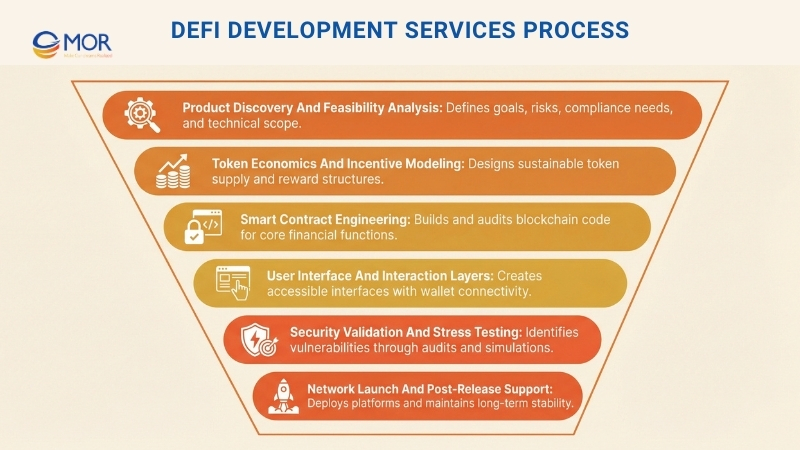
Product Discovery And Feasibility Analysis
The discovery phase focuses on DeFining project goals, understanding the target audience, and reviewing regulatory or compliance needs. Teams examine technical demands, possible risks, and market potential. This step aligns business objectives with technical capacity and sets a strong foundation for a solution that meets user needs and industry expectations.
Token Economics And Incentive Modeling
Token economics explains how a platform’s native token works, including supply rules, distribution methods, and incentive structures. Thoughtful design balances usefulness with long-term stability, supporting liquidity, participation, and fairness. A solid model encourages governance activity, rewards early users, and supports growth through a sustainable economic system that keeps participants engaged over time.
Smart Contract Engineering
Smart contract engineering turns planned features into working blockchain programming language. Through DeFi smart contract development services, teams design, test, and improve contracts that support lending, trading, or staking functions as part of a broader DeFi development services strategy.
Security audits take place during this phase to reduce the risk of exploits. A successful deployment delivers dependable automation and transparency, which removes the need for intermediaries in core financial operations.
User Interface And Interaction Layers
This stage centers on building easy-to-use web or mobile interfaces that connect smoothly with smart contracts. Clear navigation, responsive layouts, and integrated wallet support receive strong attention. Through a well-designed DeFi wallet development service, this step lowers complexity, makes decentralized platforms easier to access, attracts a wider user base, and improves overall experience across the ecosystem.
Security Validation And Stress Testing
Security validation checks that weaknesses are found and fixed before the platform goes live. This phase covers code audits, penetration tests, and simulations that measure performance in different scenarios. When risks are handled early, teams strengthen trust and credibility, giving users confidence that their assets and data stay protected within DeFi development services.
Network Launch And Post-Release Support
The launch phase marks the official release of the platform on a selected blockchain network. It includes deploying smart contracts, enabling the interface, and connecting user wallets. After release, ongoing monitoring and updates remain important for system stability. With a complete DeFi development service, continuous refinement helps the platform adjust to new demands while supporting long-term stability and growth.
>>> Let's take a closer look on Blockchain topics on MOR Blog!
Common DeFi Development Challenges And Practical Solutions
Decentralized finance presents strong growth potential, yet it also introduces clear challenges. Handling these issues with practical methods is important for building trusted and scalable platforms through DeFi development services.
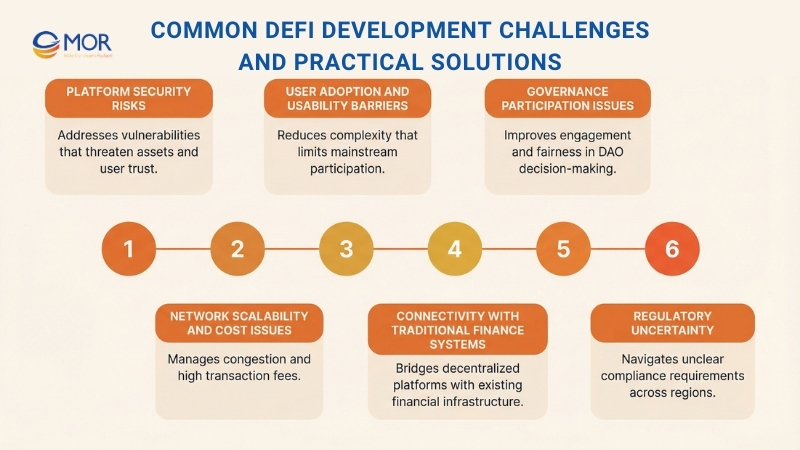
Platform Security Risks
Decentralized platforms remain exposed to smart contract flaws, flash loan attacks, and hacking attempts. These threats weaken user confidence and may lead to serious financial damage. Without proper protection, security gaps can slow adoption and reduce trust in decentralized finance as a safe alternative to traditional systems.
Approaches:
Reducing security risks calls for thorough tech audit smart contract, bug bounty programs, and constant monitoring of deployed code. Layered protection methods, including insurance mechanisms and risk controls, add extra strength. When security stays a top priority, projects gain credibility and encourage users and investors to take part with greater confidence.
Network Scalability And Cost Issues
Heavy network traffic and high transaction fees often restrict usability. When blockchain capacity is limited, users face delays, lower efficiency, and rising costs. These limits make it harder for platforms to support high activity levels and reduce their ability to compete with traditional financial infrastructure, even with advanced DeFi development services.
Approaches:
Layer 2 technologies like rollups, sidechains, and sharding help lower costs and speed up transactions. Improving smart contract structure also supports better performance. With scalable system design, platforms manage higher demand and deliver faster, more affordable services that appeal to broader audiences and institutional participants.
User Adoption And Usability Barriers
Complicated wallet setup, technical interfaces, and unclear instructions often push everyday users away. Many people find decentralized platforms hard to use without prior technical knowledge, which slows mass adoption. When designs are not clear or intuitive, growth stays limited to a small group of experienced users, even when strong DeFi crypto wallet development services are in place.
Approaches:
Improving usability focuses on clear dashboards, simpler wallet connections, and built-in learning resources. Mobile-first decentralized apps and smooth onboarding flows help more users get started with confidence. When simplicity and guidance lead the design process, platforms attract wider audiences and support broader participation without reducing security or core functionality.
Connectivity With Traditional Finance Systems
Connecting decentralized platforms with traditional banking systems remains difficult. Limited interoperability affects features like fiat on-ramps, credit checks, and compliance requirements at an institutional level. Without strong links to existing financial networks, platforms risk isolation and struggle to compete with established systems or form larger partnerships, even with advanced DeFi development services.
Approaches:
One approach involves hybrid models that blend decentralized transparency with existing regulatory structures. Partnerships with payment providers and regulated exchanges support fiat access and compliance needs. When platforms align with accepted financial standards, they build trust, widen their reach, and operate as complementary systems rather than direct replacements for traditional finance.
Governance Participation Issues
Many DAO communities face low voting turnout and a concentration of decision-making power. Limited engagement and influence from large token holders create inefficiencies in governance. Weak consensus mechanisms slow protocol updates and reduce the democratic value of decentralized organizations, which can result in stalled progress or directions that no longer match community goals.
Approaches:
Stronger governance depends on encouraging participation through incentives, adding delegation options, and setting up fair voting structures. Open and transparent processes help communities stay active and involved. Well-designed governance models reflect shared interests, preserve decentralization, and support steady growth and innovation across decentralized ecosystems.
Regulatory Uncertainty
Unclear global rules around decentralized finance present major challenges for teams and users. Common concerns include anti-money laundering (AML) requirements, Know Your Customer (KYC) processes, and tax obligations. Without DeFined guidance, projects face the risk of penalties, limitations, or loss of access to traditional partnerships, which makes long-term planning difficult within DeFi development services.
Approaches:
Early compliance efforts, including KYC and AML integration and cooperation with regulators, help reduce legal exposure. Clear reporting and alignment with changing standards build confidence among users and institutions. When compliance becomes part of the development approach, platforms gain legitimacy and move closer to wider adoption and stable growth.
>>> Let's review the top web3 development company options for businesses in 2026 and what sets them apart.
Industries Benefiting From DeFi Development Services
Decentralized finance is changing how organizations across many industries operate, using blockchain to automate processes, strengthen security, and open access to financial services in ways traditional systems cannot match. These advances help companies remove barriers, improve transparency, and serve customers more effectively. Use cases supported by DeFi development services reach far beyond crypto trading and show real impact across finance, asset management, real estate, insurance, and supply chain operations.
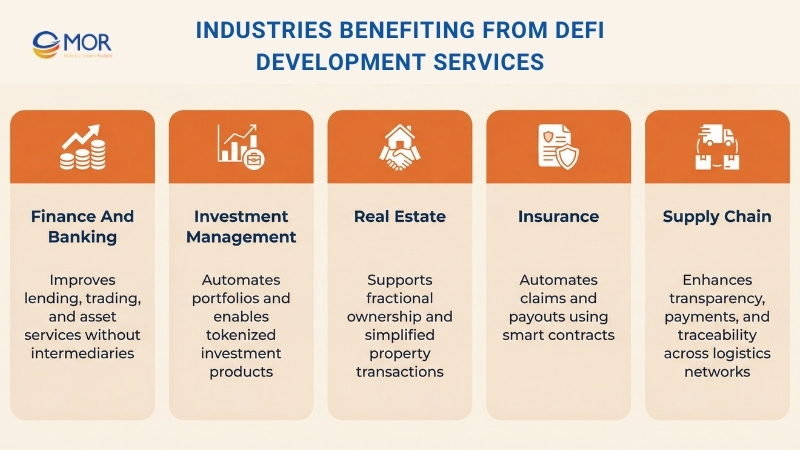
Finance & Banking
Banks and financial institutions adopt decentralized tools for peer-to-peer lending, automated credit models, and digital asset services that reduce reliance on intermediaries and cut operating costs. These systems improve how lending, borrowing, and trading activities run.
Investment Management
Asset managers and investment platforms benefit from tokenized assets and automated portfolio strategies enabled through decentralized systems. Tokenization increases liquidity and allows fractional ownership, while smart contracts handle many investment tasks automatically.
Real Estate
Decentralized finance supports fractional ownership and property tokenization, which allows investors to buy and sell partial interests in real estate. This improves access to property markets and simplifies transactions through smart contract-based settlement.
Insurance
Insurance providers use smart contracts to automate claims and payouts once preDeFined conditions are met. This reduces manual work, speeds up settlement times, and increases transparency for policyholders.
Supply Chain
Blockchain in supply chain systems bring automated payments, traceability, and transparent tracking across supply chains. Businesses gain better control over provenance, lower fraud risk, and maintain accurate records from production through delivery.
The Future Of DeFi Development Services
Decentralized finance continues to move toward broader adoption and deeper technical maturity. As infrastructure improves, DeFi development services will support more connected systems, smarter automation, and stronger participation from global markets.
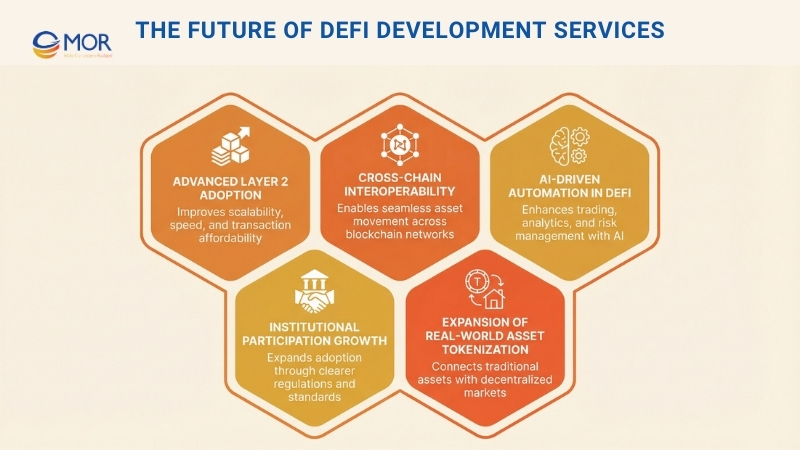
Advanced Layer 2 Adoption
Layer 2 technologies like rollups, state channels, and sidechains continue to improve performance. These enterprise blockchain solutions ease network congestion and lower transaction costs, which makes decentralized platforms faster and more affordable. Wider use of these tools allows applications to scale services to millions of users without sacrificing efficiency or accessibility.
AI-Driven Automation In DeFi
Artificial intelligence and automation improve efficiency across decentralized systems through smarter trading logic, predictive analytics, and stronger risk controls. Automated processes support better decisions for both individual users and institutions. With DeFi development services, this combination leads to more personalized financial products and smoother operations across ecosystems.
Institutional Participation Growth
Clearer regulatory guidance encourages banks, asset managers, and large investors to explore decentralized finance. With DeFined rules in place, institutional players gain confidence in adopting these systems. Their involvement brings stronger liquidity, higher standards, and broader recognition, which helps move decentralized finance closer to mainstream adoption.
Looking For A Trusted DeFi Development Services Partner?
MOR Software as a trusted software outsourcing company in Vietnam, works with businesses that want DeFi platforms built for real use, not experiments that stall after launch. We focus on turning decentralized finance ideas into stable, secure systems that operate reliably at scale.
Our teams handle the full scope of DeFi development services, also web3 development services from early product planning and token design to smart contract engineering, security audits, and live deployment. Every solution is designed to fit existing business workflows, compliance needs, and long-term growth plans.
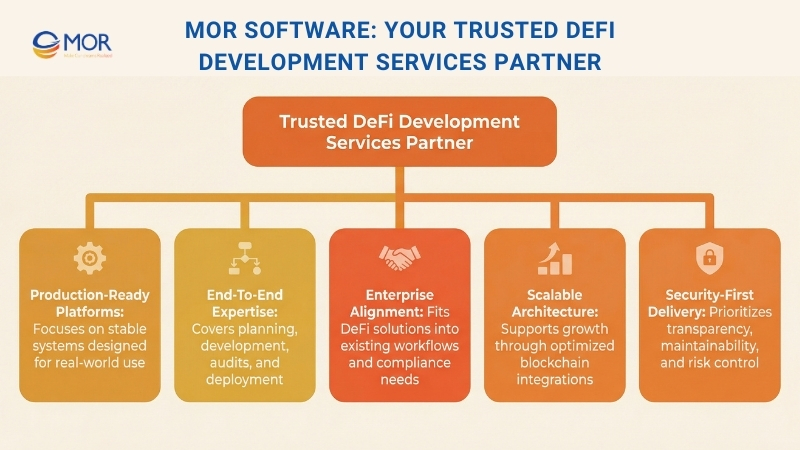
We bring hands-on experience with complex blockchain architectures, integrations, and performance optimization. Blockchain security, transparency, and maintainability guide every stage of delivery. With MOR Software, DeFi development becomes a controlled, measurable step toward new financial products and digital markets, not a risky leap into the unknown.
Conclusion
Decentralized finance has moved beyond early testing and now plays a real role in modern business models. Success depends on choosing the right approach, technology, and delivery partner. With DeFi development services, businesses can build secure, scalable financial products that support long-term growth.
MOR Software works with teams ready to move from concept to production. If you want a clear, reliable path forward, contact us to start the conversation.
MOR SOFTWARE
Frequently Asked Questions (FAQs)
What are DeFi development services?
DeFi development services focus on building decentralized financial applications using blockchain and smart contracts. These services support platforms like decentralized exchanges, lending protocols, staking systems, and tokenized assets without relying on traditional financial intermediaries.
Which blockchain networks are commonly used for DeFi development?
Ethereum remains the most widely used network, but many projects also use BNB Chain, Polygon, Arbitrum, Optimism, Solana, and Avalanche. The right choice depends on transaction costs, scalability needs, and ecosystem maturity.
What types of applications can be built with DeFi development services?
DeFi development services support lending and borrowing platforms, decentralized exchanges, yield farming protocols, DAOs, asset tokenization systems, fundraising mechanisms, and DeFi-based gaming models.
How long does it take to build a DeFi platform?
Timelines depend on scope and complexity. A basic DeFi application may take three to four months, while larger platforms with audits, governance, and integrations often require six months or more.
How is security handled in DeFi development?
Security typically includes smart contract audits, code reviews, penetration testing, and continuous monitoring. Many projects also use bug bounty programs and layered security controls to reduce risk.
Can DeFi platforms support regulatory compliance?
Yes. DeFi platforms can be designed to support compliance features like KYC, AML, transaction monitoring, and reporting. Requirements vary by region, so compliance planning usually starts early in the development process.
What is tokenomics and why does it matter?
Tokenomics DeFines how a platform’s token is created, distributed, and used. Well-designed token models support governance, encourage participation, and help maintain long-term platform stability.
Can DeFi platforms integrate with traditional finance systems?
Many DeFi platforms integrate fiat on-ramps, payment processors, and regulated exchanges. These integrations help bridge decentralized systems with traditional financial infrastructure.
What are the main challenges in DeFi development?
Common challenges include smart contract vulnerabilities, scalability limits, complex user experience, regulatory uncertainty, and governance participation. Each challenge requires careful technical and design planning.
Is DeFi suitable for enterprise use cases?
DeFi is increasingly used for asset tokenization, automated settlements, cross-border transactions, and programmable financial workflows. Enterprise adoption depends on security, compliance readiness, and scalability design.
Share


Make Our-Dreams Realized


© 2023 . MOR Software. All Rights Reserved
Sitemap
Privacy Policy
Terms of Use

Rate this article
0
over 5.0 based on 0 reviews
Your rating on this news:
Name
*Email
*Write your comment
*Send your comment
1