


Top Custom Computer Vision Software Development Company In 2026
Choosing a custom computer vision software development company can feel risky when every vendor promises the same thing, yet few can prove real delivery. In this MOR Software guide, we will break down who stands out in 2026, what services matter most, and how to spot a partner that can turn visual AI into practical business results.
Top Custom Computer Vision Software Development Company In 2026
This ranking looks at providers through six factors: depth in live deployment, real-time and edge delivery, sector knowledge, custom model work, integration skill, and long-term support. No vendor paid to appear in this list.
Enterprise-Level And End-To-End Providers
This group includes teams that can take visual AI work from planning to release. They are a strong fit when image or video analysis must connect with a wider product, workflow, or business system.
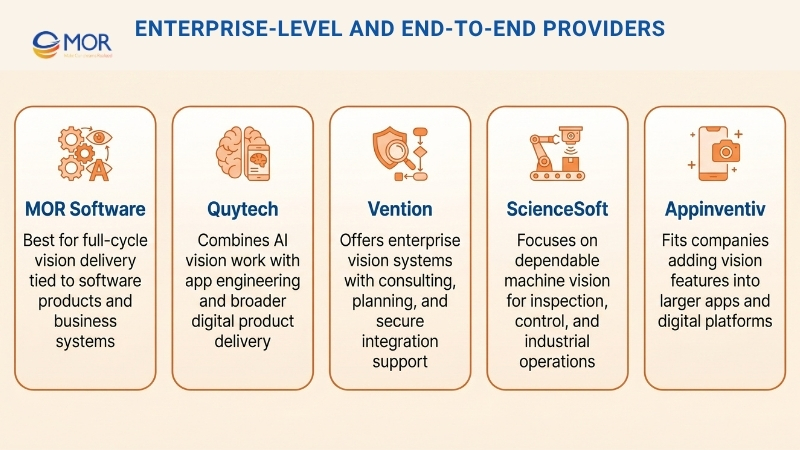
MOR Software
End-to-end visual AI delivery with solid strength across software engineering, AI/ML, and connected business systems.
We place MOR Software first because this provider goes far beyond building the vision layer alone. Its public case materials show computer vision and deep learning development services, wide software delivery ability, offices across Vietnam and Japan, and the N-CLOUD CCTV Management System, a project centered on camera control, recording, and detected object activity, which makes it a strong custom computer vision development company when vision features are part of a broader product instead of a stand-alone engine.
What we build:
- Computer vision and AI/ML systems
- Video surveillance and activity detection
- Defect detection and safety monitoring
- Enterprise software engineering around AI workflows
- Cloud-connected web and mobile products
Industries: Manufacturing, healthcare, telco, finance
HQ: Ho Chi Minh City, Vietnam
Best for: Enterprises that want one partner for model work, product engineering, system connection, and long-term delivery support.
A strong example is MOR’s N-CLOUD CCTV management system, which used C++, Python, and QT to support monitoring, recording, and detected object activity in one environment.
Quytech
An AI-led product team with wide service coverage in vision-based software work.
Quytech presents vision engineering as a core part of its AI offering, with work focused on image understanding, automation, and business-ready visual intelligence. It also describes itself as a global AI app builder, which makes this computer vision development company useful when visual features need to sit inside a larger digital product rather than remain inside a narrow R&D setup.
Core capabilities:
Image analysis and visual intelligenceCustom computer vision applicationsAI-led automation workflowsBusiness-focused CV integrations
- Image analysis and visual intelligence
- Custom computer vision applications
- AI-led automation workflows
- Business-focused CV integrations
Industries: Retail, healthcare, enterprise apps
HQ: Noida, India
Best for: Teams that want vision work delivered together with app engineering and AI in product development.
Vention
Enterprise-focused custom vision engineering backed by strong consulting support.
Vention stands out for building secure, scalable, and well-connected vision systems for complex business environments. Its official materials highlight tailored image and video analysis, solid infrastructure fit, and planning support that covers discovery, stack selection, and rollout roadmaps, which makes it a credible custom computer vision software development company for firms that need senior guidance as well as hands-on engineering.
Core capabilities:
Custom image and video analysisComputer vision consulting and roadmap planningCloud-based CV architectureSecure enterprise integrations
- Custom image and video analysis
- Computer vision consulting and roadmap planning
- Cloud-based CV architecture
- Secure enterprise integrations
Industries: Healthcare, finance, enterprise software
HQ: New York, USA
Best for: Fast-growing firms that need senior vision engineers and flexible team expansion.
ScienceSoft
Machine vision delivery with a clear focus on inspection-heavy industrial work.
ScienceSoft describes its vision offering in a more practical, machine vision way instead of leaning on broad AI claims. Its official pages point to custom machine vision work since 2013 for automated inspection, process control, robot guidance, and visual inspection flows, and that makes it especially relevant for industrial buyers who care about dependable computer vision techniques in daily operations.
Core capabilities:
Machine vision for inspectionProcess control and robot guidanceAutomated visual inspectionIndustrial CV software
- Machine vision for inspection
- Process control and robot guidance
- Automated visual inspection
- Industrial CV software
Industries: Manufacturing, medical, industrial operations
HQ: McKinney, Texas, USA
Best for: Enterprises that value industrial dependability more than customer-facing AI features.
Appinventiv
Product engineering that places vision features inside larger digital systems.
Appinventiv comes at the market from a product-build angle rather than a pure research angle. Its public service pages point to computer vision software development across manufacturing, healthcare, logistics, and automotive, while the company profile stresses large-scale digital delivery, so it suits companies where vision is one part of a wider app or platform effort.
Core capabilities:
- Custom AI software development solutions
- Cloud-enabled CV systems
- Vision features for manufacturing and healthcare
- Computer vision inside mobile and enterprise products
Industries: Manufacturing, healthcare, logistics, automotive
HQ: Noida, India
Best for: Businesses creating AI-enabled apps where vision matters a lot, but does not define the full project.
Specialized And Boutique Computer Vision Firms
This set is better for buyers who want sharper specialization or a more focused delivery style. These teams often fit best when the use case is narrow, technical, or tied to a specific workflow.
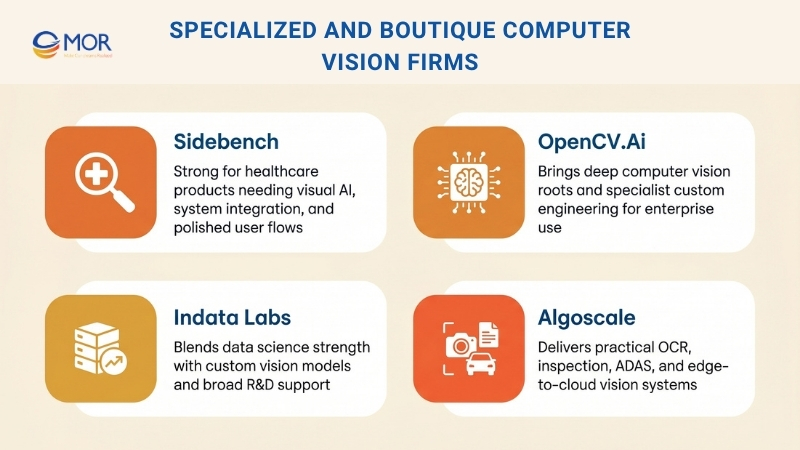
Sidebench
A design-led software studio that fits healthcare products with visual AI and complex user flows.
Sidebench is not the most purely technical vision specialist in this ranking. Even so, it earns a place because its public positioning in healthcare and tech centers on AI-driven products, connected systems, and medical imaging and diagnostics, which makes it a valid custom computer vision software development company for health products where user flow, adoption, and product logic matter as much as the model.
Core capabilities:
AI-enabled health product designMedical imaging and diagnostics workflowsComplex systems integrationUX-heavy software delivery
- AI-enabled health product design
- Medical imaging and diagnostics workflows
- Complex systems integration
- UX-heavy software delivery
Industries: Healthcare, medtech, enterprise software
HQ: Los Angeles, California, USA
Best for: Healthcare teams that need a polished product layer around AI or vision-based functions.
OpenCV.ai
A specialist with deep roots in the computer vision field through the team behind OpenCV.
OpenCV.ai brings rare technical weight to this list. The company says it created and maintains OpenCV, and its public materials connect that background to real delivery for startups and Fortune 500 clients, which makes it one of the clearest examples of a custom computer vision software development company built on deep computer vision technologies.
Core capabilities:
- Custom computer vision software
- Real-world CV for enterprise and startups
- Manufacturing and smart city AI
- On-premise and secure AI deployments
Industries: Manufacturing, smart cities, medical, enterprise
HQ: Dover, Delaware, USA
Best for: Buyers who want a specialist team with strong roots in the core vision ecosystem.
InData Labs
A data science-led provider with broad model variety and strong R&D support.
InData Labs blends data science consulting with tailored AI delivery, and its vision pages cover object detection, segmentation, visual search, logo detection, facial recognition, pose estimation, and motion analysis. That breadth makes it a good choice for teams that need careful data work and a custom computer vision model, not just ready-made APIs.
Core capabilities:
- Object detection and segmentation
- Visual search and logo detection
- Pose estimation and motion analysis
- Custom machine learning model development with R&D support
Industries: Retail, marketing, logistics, healthcare
HQ: Nicosia, Cyprus
Best for: Companies that need tailored vision models shaped by a strong data science team.
Algoscale
A production-minded provider with a useful mix of OCR, inspection, and edge-to-cloud delivery.
Algoscale presents its vision work in a direct and usable way. The company highlights production projects in inspection, OCR, ADAS, and retail analytics, and it clearly mentions both edge and cloud rollout, which makes it a good mid-sized option for companies that want working systems instead of research-heavy demos.
Core capabilities:
- Visual inspection and OCR
- ADAS-related vision systems
- Retail analytics
- Edge and cloud computer vision
Industries: Manufacturing, automotive, retail, enterprise
HQ: Newark, New Jersey, USA
Best for: Teams that want production-ready vision systems without enterprise-platform pricing.
Platform-Led And Infrastructure-Focused Providers
Some buyers do not need a full custom computer vision software development company. They need a platform layer, managed tooling, or cloud-based building blocks that help internal teams move faster.
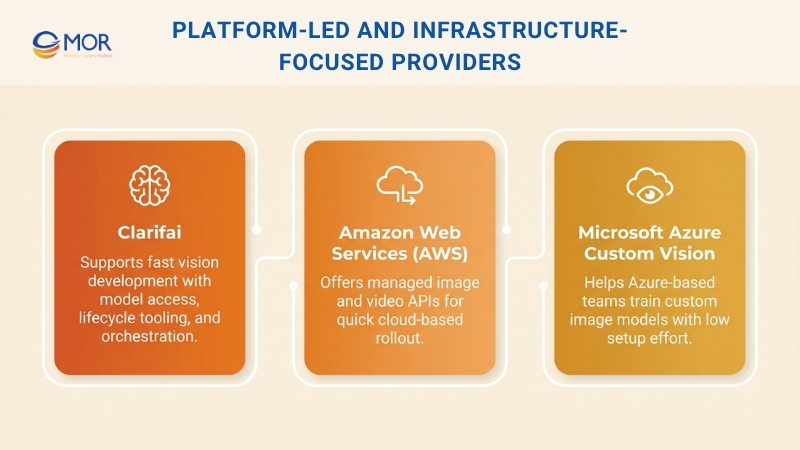
Clarifai
A vision platform for teams that want speed, model access, and orchestration support.
Clarifai fits this list more as infrastructure than as a classic services firm. Its official pages describe a full AI lifecycle system for image, video, text, and audio, with recognized vision capability and support for training and rollout at scale.
Core capabilities:
- Pre-trained and custom vision multimodal AI models
- AI lifecycle support
- Training and deployment workflows
- Compute orchestration for scale
Industries: Cross-industry platform use
HQ: United States
Best for: Internal ML teams that want a platform layer to build, manage, and release vision systems more quickly.
Amazon Web Services (AWS)
Cloud-based vision APIs designed for quick rollout and low setup effort.
Amazon Web Services (AWS) earns its place here through Amazon Rekognition. Its official product pages focus on ready-made image and video analysis APIs that teams can add without deep machine learning skill, so while it is less tailored than a specialist consultancy, it works very well for teams that want speed and cloud alignment.
Core capabilities:
Image recognition APIsVideo analysis APIsPretrained and customizable vision servicesCloud-scale deployment
- Image recognition APIs
- Video analysis APIs
- Pretrained and customizable vision services
- Cloud-scale deployment
Industries: Cross-industry platform use
HQ: United States
Best for: Teams already using AWS that want to launch vision features fast with managed services salesforce.
Microsoft Azure Custom Vision
A good match for fast custom image model training inside the Microsoft ecosystem.
Microsoft Azure Custom Vision is built for teams that want to train custom image models without creating every layer from zero. Microsoft’s official materials focus on speed, usability, and domain-based image analysis, which makes it especially appealing for internal business cases and companies already centered on Azure.
Core capabilities:
Custom image model trainingDomain-specific vision classificationEasy model building inside AzureEnterprise cloud integration
- Custom image model training
- Domain-specific vision classification
- Easy model building inside Azure
- Enterprise cloud integration
Industries: Manufacturing, marketing, enterprise operations
HQ: Redmond, Washington, USA
Best for: Microsoft-centered teams that want custom vision models with low setup effort.
Quick Comparison Of Custom Computer Vision Software Development Company
This table gives you a fast view of where each provider fits. It is most useful when you already know your delivery model, rollout needs, and internal team strength.
Company | Core Focus | Deployment | Best For |
MOR Software | Full-cycle vision delivery, AI product work, and software integration | Edge, cloud, hybrid | Enterprises that want one partner from model to finished product |
Quytech | AI-led vision delivery linked to app development | Cloud, hybrid | Teams connecting visual features to larger digital products |
Vention | Custom enterprise vision systems with consulting support | Cloud, hybrid | High-growth businesses scaling custom vision work |
ScienceSoft | Machine vision for inspection and industrial control | On-prem, edge, hybrid | Industrial buyers that need reliable machine vision |
Appinventiv | Vision work inside wider digital product engineering | Cloud, hybrid | Companies building AI-enabled apps and software products |
Sidebench | UX-led AI and healthcare software delivery | Cloud | Health and medtech teams that need strong product design |
OpenCV.ai | Specialist vision engineering | On-prem, edge, cloud | Buyers that want deep technical pedigree and custom work |
InData Labs | Data science-led custom vision models | Cloud, hybrid | Teams that need tailored model work and strong R&D backing |
Algoscale | Production vision with OCR, inspection, and ADAS | Edge, cloud | Mid-sized firms that want practical production systems |
Clarifai | Vision platform and model lifecycle tooling | Cloud, hybrid | Internal teams building and releasing vision faster |
Amazon Web Services (AWS) | Managed image and video analysis APIs | Cloud | AWS customers that want fast rollout and managed scale |
Microsoft Azure Custom Vision | Fast custom image model training in Azure | Cloud | Microsoft-based teams building custom vision models |
Key Services Offered By Custom Computer Vision Software Development Company
The right vendor does more than train a model and hand it over. A strong team helps shape the idea, build the system, connect it to daily work, and support it after launch.
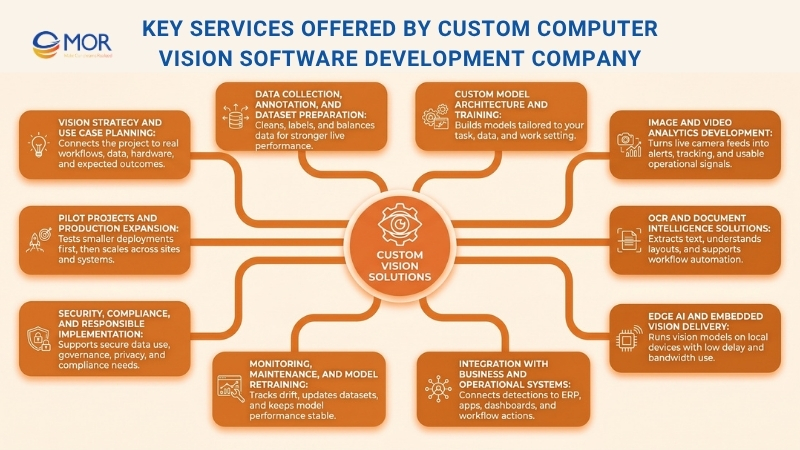
Vision Strategy And Use Case Planning
Most computer vision development services begin with use case planning before any model work starts. At this point, the team studies your workflow, the images or video you already collect, the setting where the system will run, and the level of accuracy you expect. The aim is to tie the project to a real business need, whether that means finding defects on a factory line, reading package labels, checking identities, or following movement in store areas.
This stage can also stop costly wrong turns at the start. Rather than moving straight into build work, the provider reviews technical fit, data needs, hardware choices, rollout paths, and likely results. That gives you a more direct route from early idea to live use.
Data Collection, Annotation, And Dataset Preparation
The quality of data has a huge effect on how well computer vision systems work, so this part of the job matters a lot. A development team gathers images, video files, or scanned records from your real work setting. It then cleans, sorts, and labels that material so the model can learn in the right way.
This work may cover tags for bounding boxes, segmentation masks, object classes, landmarks, text areas, or event labels. A capable provider also improves dataset balance, removes weak samples, and deals with hard cases like low light, motion blur, changing camera views, or overlapping objects. Better prep at this stage often leads to stronger results once the system goes live.
Custom Model Architecture And Training
After the data layer is ready, the next step is to design and train models that suit your exact task. This is where custom computer vision development services come in for work like object detection, image classification, semantic segmentation, pose estimation, facial recognition, OCR, or video event detection.
This kind of model work matters because ready-made tools often fall short in niche settings. A model trained on general images may struggle with X-rays, factory parts, store shelves, farm crops, or shipping labels. A skilled team changes model design, training flow, and testing methods to match the shape of your data and the needs of your work setting. That gives you a system shaped around your process instead of making your process adapt to a generic tool.
Image And Video Analytics Development
Many companies need more than one-time image analysis. They need tools that read live video, follow motion, spot events, and send alerts right away. That is why image and video analytics sits at the center of computer vision development.
This work can cover people counting, vehicle tracking, intrusion alerts, queue checks, behavior review, workplace safety watching, and activity recognition. In industrial settings, video analytics can point out unusual actions near equipment or reveal slow points in a process. In retail, it can show footfall, shelf activity, or checkout crowding. In logistics, it can follow loading, unloading, and parcel movement. These systems turn camera feeds into signals your team can use.
OCR And Document Intelligence Solutions
Another major area is text reading and document intelligence. The work goes far past basic text capture. A provider can build tools that read document layouts, find fields, sort document types, pull out handwritten or printed text, and check the data against business rules. That makes it a valuable computer vision application for document-heavy operations.
This is especially useful for invoices, IDs, shipping labels, forms, receipts, insurance files, bank records, and medical documents. In many cases, the real value comes when OCR is linked with workflow automation. Instead of only reading text, the system can route files, flag missing items, compare values, or send extracted data into your ERP, CRM, or internal platform.
Edge AI And Embedded Vision Delivery
Some vision systems need to run on cameras, factory machines, handheld devices, or local hardware instead of a cloud service. For that reason, Edge AI delivery is a key part of the work many providers handle.
This service covers model compression, hardware choice, delay reduction, and smooth rollout on devices with limited resources. It is very useful when your operation needs quick response, low internet reliance, better privacy, or lower bandwidth use. Common cases include quality checks on assembly lines, driver monitoring, smart kiosks, in-store tracking, and modern surveillance. A good team keeps the model accurate while making sure it still runs well in real work settings.
Integration With Business And Operational Systems
A model on its own rarely gives much business value unless it links to the tools your people already use. Strong computer vision software development company teams provide integration work that connects outputs from vision systems with ERP tools, warehouse platforms, manufacturing systems, mobile apps, POS setups, dashboards, and alert systems.
That means a detection can start an action on its own. A failed inspection may open a quality ticket. A scanned parcel can change shipment status. A recognized file can fill in a workflow. A detected safety issue can send a notice to supervisors. Integration is what turns vision software from a stand-alone tool into part of your daily operation.
Monitoring, Maintenance, And Model Retraining
Launching the system is only the first step. Real conditions shift over time. Lighting changes, products change, camera positions move, and user behavior changes too. Because of that, a custom vision AI development firm can bring strong value through ongoing checks and retraining.
This work includes watching model accuracy, spotting drift, reviewing false positives and false negatives, refreshing datasets, and retraining models when results start to weaken. Providers may also keep dashboards, alerts, version control, and rollback steps in place so the platform stays steady after release. That long-term support helps protect your spend and keeps the system useful as your business moves forward.
Security, Compliance, And Responsible Implementation
In fields like healthcare, banking, manufacturing, retail, and public services, vision projects often carry security, privacy, and compliance needs. A custom provider may support secure data use, access control, model governance, audit logs, infrastructure planning, and local or regional rule requirements.
This work becomes even more serious when the system deals with facial data, private documents, or surveillance video. A dependable partner builds the solution with technical quality in mind, while also putting in the safeguards needed for real business use.
Pilot Projects And Production Expansion
Many companies do not want to roll out a full system on day one. They would rather test one workflow, one site, or one camera setup first. That is why pilot work is often offered as a separate service. The provider creates a smaller trial, measures results, checks business value, and finds what should change before wider rollout.
When the pilot works well, the same team can grow the system across more sites, devices, business units, or product lines. This step-by-step method lowers risk and gives you better proof before a larger launch.
Benefits Of Working With A Custom Computer Vision Software Development Company
Working with the right partner can change more than one process. It can improve quality, speed, visibility, safety, and customer experience across the business.
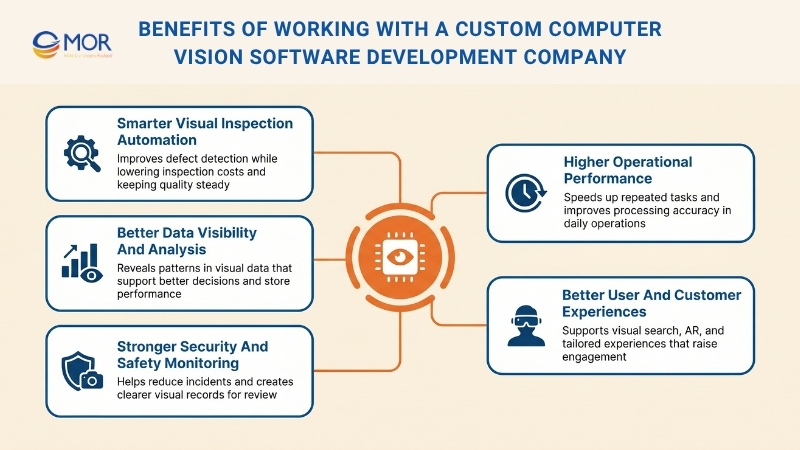
Smarter Visual Inspection Automation
Computer vision is very good at taking over inspection work that people once had to do with their eyes. Manufacturers using these systems have reported defect detection gains of up to 90%, while also cutting inspection costs by around 30% to 50%. These systems keep checking without getting tired or losing focus, which helps maintain stable quality.
Better Data Visibility And Analysis
Visual data is still one of the biggest unused sources of business insight. Teams that build image and video analysis tools help companies pull useful patterns and signals from visual content that people often miss. Retailers that put vision analytics into store planning have reported conversion lifts of around 15% to 25% after improving layouts and product placement through traffic analysis.
Stronger Security And Safety Monitoring
From facial recognition to unusual-event detection, a custom computer vision software development company can help businesses improve security rules in a very clear way. Some organizations report security incidents dropping by as much as 60% after they add AI-based vision systems, and those systems also create a fuller visual record when something does happen.
Higher Operational Performance
Custom computer vision solutions improve daily work by taking over repeated visual tasks. Logistics teams using these systems for parcel sorting and quality checks have cut processing time by up to 40% while pushing accuracy above 99%. That better performance often leads straight to lower costs and a stronger market position.
Better User And Customer Experiences
Leading AI companies in this field are changing how customers interact with digital products through tools like visual search, augmented reality shopping, and tailored visual suggestions. Businesses that adopt these ideas often report customer engagement gains of around 30% to 45%, along with stronger satisfaction scores.
You can explore more about vision use cases here:
With those gains in mind, we can look at the companies helping businesses put these systems into real use.
How To Choose The Right Custom Computer Vision Software Development Company
With so many providers in the market, choosing the right one takes careful review across several areas.
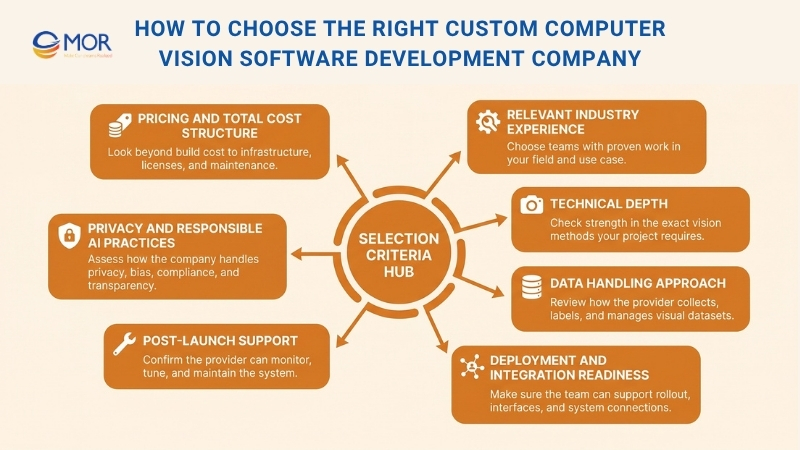
Relevant Industry Experience
Look for teams that have real experience in your field and your type of use case. Review case studies, ask for references, and check whether earlier projects match the vision work you need. The best partners bring lessons from similar jobs that they can apply to your business problem.
Technical Depth
Check whether the right vendor has strength in the exact areas your project needs. Different systems rely on different methods, including object detection, semantic segmentation, pose estimation, or text reading. A custom computer vision software development company should show clear depth in the parts that matter most for your use case.
Data Handling Approach
Ask how the company handles collection, annotation, and dataset management. The outcome of many vision projects depends more on data quality than on model design alone. Good providers usually have clear steps for helping clients build and maintain strong visual datasets.
Deployment And Integration Readiness
Think about how the company delivers systems in live environments. Will it give you only a model, or will it also provide hardware links, user interfaces, and workflow integration? The best custom computer vision software development services usually cover end-to-end rollout or have clear partner support where gaps exist.
Post-Launch Support
Computer vision systems need care and adjustment after launch. Review what kind of ongoing support, monitoring, and tuning the provider can give once the first version is live. A custom computer vision software development company should be treated as a long-term partner, not only a one-time supplier.
Privacy And Responsible AI Practices
As visual AI becomes stronger, responsible use matters more. Review how possible partners deal with privacy, bias control, and system transparency. Good providers should be able to explain their approach to ethics, compliance, and safe deployment in a clear way.
Pricing And Total Cost Structure
Last, make sure you understand the full cost of ownership. Beyond the first build cost, think about license fees, infrastructure costs, and long-term maintenance. The cheapest option at the start may not give the best return if another option performs better or costs less to maintain over time.
The Future Of Custom Computer Vision Software Development In 2026 And Beyond
As 2026 moves forward, several shifts are shaping this field and opening new chances for businesses.
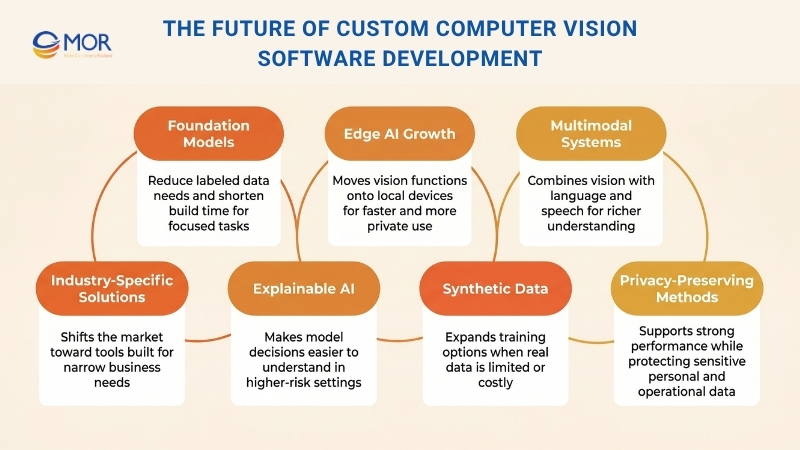
Foundation Models and Vision Transformers
Large foundation models trained on huge datasets are making vision systems more flexible and more capable. These models can be adapted to focused tasks with less labeled data, which can shorten build time and lower cost.
Edge AI and On-Device Processing
Edge computing is moving vision functions onto devices with limited resources, which opens the door to new uses in IoT, mobile products, and self-running systems. Companies are building leaner models that work well on local hardware without losing too much accuracy.
Multimodal AI Systems
Vision is now being combined with language, speech, and other inputs to create systems that understand more of the full situation. These tools can answer harder requests that mix visual and text-based information.
Privacy-Preserving Computer Vision
Stronger concern around data protection is pushing companies toward privacy-first methods, including federated learning, differential privacy, and on-device processing. These methods support strong vision systems while helping protect personal data.
Synthetic Data Generation
Better simulation tools and generative AI are helping teams deal with limited data and lower labeling costs. Synthetic data is becoming more realistic, which makes it more useful for training stable vision systems.
Explainable AI
As these systems move into higher-risk settings, more buyers want models that can show why they made a choice. Companies are working on ways to make deep learning systems easier to understand and trust.
Industry-Specific Solutions
Instead of broad-purpose vision tools, the market is moving toward products shaped for one field or one type of task. That sharper fit often leads to better accuracy and closer alignment with business needs.
The companies in this guide are helping businesses move through this fast-changing market and make use of the next wave of opportunity.
Conclusion
Finding the right custom computer vision software development company takes more than comparing feature lists. You need a team that understands your data, your systems, and the real pressure of production deployment. This guide has shown which providers stand out, what services to expect, and what trends will shape the market next. If you are planning a visual AI project, contact MOR Software to discuss a solution built around your business goals.
MOR SOFTWARE
Frequently Asked Questions (FAQs)
What does a custom computer vision software development company actually do?
A custom computer vision software development company builds systems that can understand images and video. These systems detect objects, read text, track movement, and trigger actions inside your business workflows.
When should a business consider custom computer vision instead of off-the-shelf tools?
Off-the-shelf tools work for simple use cases. Custom solutions fit better when your data is unique, your environment is complex, or accuracy needs to stay high in real conditions.
How long does it take to build a computer vision solution?
Small pilots can take a few weeks. Full production systems often take three to nine months, depending on data readiness, system complexity, and integration needs.
What industries benefit the most from computer vision solutions?
Manufacturing, healthcare, retail, logistics, and security see strong results. Each uses visual data differently, from defect checks to customer tracking or document processing.
How important is data quality in computer vision projects?
It matters more than most teams expect. Poor data leads to weak models. Clean, labeled, and well-balanced datasets usually decide how well the system performs.
Can a custom computer vision software development company integrate with existing systems?
Yes, integration is a core part of the work. Vision outputs can connect to ERP, CRM, warehouse systems, mobile apps, or dashboards to trigger real actions.
What are the common challenges in computer vision development?
Teams often struggle with messy data, changing environments, and edge cases. Lighting, camera angles, and real-world noise can affect accuracy if not handled well.
Is it possible to run computer vision on devices instead of the cloud?
Yes, many solutions run on edge devices. This helps when you need faster response, better privacy, or stable performance without relying on internet connections.
How do companies maintain and improve models after deployment?
Models need regular checks. Teams monitor accuracy, review errors, update datasets, and retrain models to keep performance stable over time.
How much does it cost to work with a custom computer vision software development company?
Costs vary based on scope, data complexity, and deployment scale. A small pilot costs less, while full systems with integration and long-term support require a larger budget.
Share


Make Our-Dreams Realized


© 2023 . MOR Software. All Rights Reserved
Sitemap
Privacy Policy
Terms of Use

Rate this article
0
over 5.0 based on 0 reviews
Your rating on this news:
Name
*Email
*Write your comment
*Send your comment
1