


Top 10 Odoo Development Companies in Germany (Updated 2026)
Germany has one of Europe’s larger Odoo ecosystems, supported by strong demand across manufacturing, wholesale, logistics, IT, and the Mittelstand. Odoo began as TinyERP in 2002, and Grand-Rosière, Belgium remains its headquarters. This MOR Software’s guide will compare ten Odoo development companies in Germany by market presence, service scope, industry focus, relationship with Odoo, and project fit, including MOR as a global offshore option for German businesses.
Key Takeaways
- Germany has a broad Odoo ecosystem, but vendor size, industry knowledge, local finance support, custom development depth, and post-launch services vary sharply between providers.
- The top Odoo development Companies in Germany covered here are MOR Software, OBS Solutions, openfellas, Intero Technologies, much. Consulting, manaTec, SH Digital Starten, ODION, braintec Deutschland, and Hucke Media.
- A useful shortlist should match your actual project profile. Manufacturing ERP, DATEV accounting, eCommerce integrations, custom Python modules, large-user deployments, and offshore engineering each point toward different teams.
Germany's Odoo Market: What Buyers Should Know
The German market gives ERP buyers far more choice than a small local ecosystem would. A recent OdooGuide snapshot counted 92 certified partners in Germany: 9 Gold, 21 Silver, 62 Ready, and 419 certified experts. Those figures move as certifications and directory records change, so every vendor review needs a clear date attached to it.
That scale makes Odoo Germany relevant across several business models. Manufacturing, wholesale and retail, IT, professional services, construction, science, food, and logistics appear repeatedly in German reference portfolios.
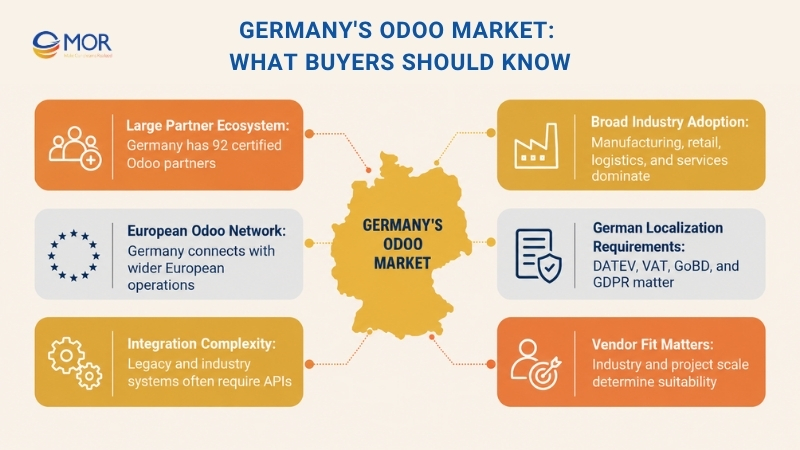
Odoo itself also reports more than 28 million users worldwide, covering businesses that range from very small teams to organizations with more than 300,000 users. Germany sits inside a broader European network that includes Odoo offices in Belgium, Spain, Italy, Luxembourg, and Berlin.
That European base helps explain why ERP consulting around Odoo has become dense across the region. Yet location alone tells you little about fit. An Odoo company in EU procurement may still lack the manufacturing, migration, API, or German finance experience your rollout needs.
German deployments also bring local requirements into the technical plan. DATEV exchanges, VAT processes, GoBD-related exports, GDPR, German-language consulting, EU hosting, and multi-company accounting may sit beside MRP, Inventory, Purchase, CRM, eCommerce, or warehouse integrations.
For buyers comparing Odoo development companies in Germany, these factors change the vendor decision:
Market Factor | Why It Matters When Selecting an Odoo Company |
Partner ecosystem | A large provider pool gives you local specialists, larger delivery teams, and focused industry firms |
Manufacturing strength | MRP, Inventory, Purchase, Quality, PLM, and production planning need real process knowledge |
DATEV and finance | German accounting setup may require DATEV exchanges, local tax flows, and finance-specific configuration |
GDPR and hosting | Data location, access control, hosting, backup, and processing agreements affect deployment design |
Custom integrations | Legacy ERP, eCommerce, logistics, CRM, payment, BI, and industry systems often need API work |
Delivery model | Local, offshore, and hybrid teams differ in cost structure, staffing depth, language coverage, and on-site access |
The main lesson is straightforward. The strongest vendor on paper can still be a poor match if its typical work differs from your project size, industry, or customization level.
Top 10 Odoo Development Companies in Germany in 2026
The companies below represent different types of Odoo delivery. Some focus on large DACH rollouts, others have deep manufacturing references, and several stand out for technical development or integration work.
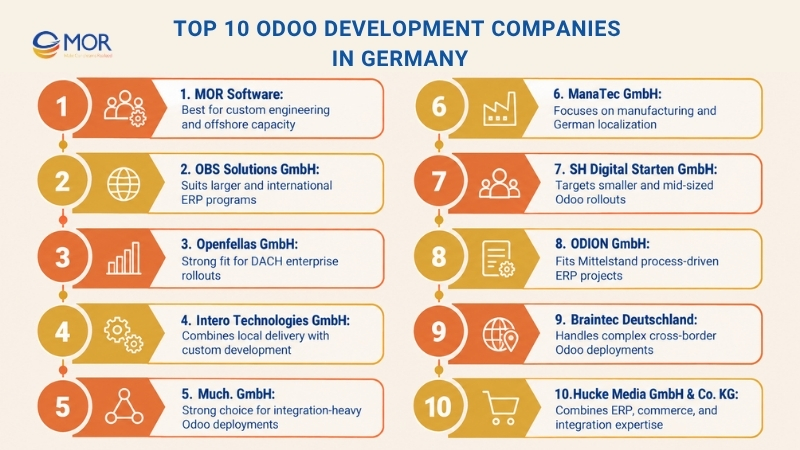
This shortlist of Odoo development companies in Germany supports vendor research rather than a strict best-to-worst ranking. MOR Software appears first as the offshore and custom-engineering option, while the other nine have direct German operations.
Company | German Market Presence | Odoo Relationship | Industry Strength | Best Fit For |
MOR Software | Global/offshore delivery for German clients | Official Odoo partner in Vietnam, Ready | Manufacturing, distribution, logistics, retail | Custom development and extended engineering |
OBS Solutions GmbH | Olpe, Germany | Gold | Manufacturing, IT, logistics | Larger ERP programs |
openfellas GmbH | Munich plus DACH offices | Gold | Manufacturing, IT, wholesale | DACH mid-market and enterprise |
Intero Technologies GmbH | Several German offices | Gold | IT, wholesale, manufacturing | Local delivery plus custom development |
much. GmbH | Munich, Berlin and wider European presence | Gold | Commerce, manufacturing, services | Integration-heavy deployments |
manaTec GmbH | Dresden | Gold | Manufacturing, IT, wholesale | Manufacturing and German localization |
SH Digital Starten GmbH | Fulda | Gold | IT services, SMEs | Small and mid-sized rollouts |
ODION GmbH | Saarbrücken | Gold | IT, manufacturing, construction | Mittelstand projects |
braintec Deutschland | Several German offices | Gold | Manufacturing, healthcare | Large and cross-border deployments |
Hucke Media GmbH & Co. KG | Oldenburg | Silver | Manufacturing, wholesale, eCommerce | Mid-market ERP and commerce projects |
1. MOR Software
- German Market Presence: Global/offshore delivery for German businesses
- Year Established: 2016
- Headquarter: Ho Chi Minh City, Vietnam
- Odoo Relationship: Official Odoo partner in Vietnam, Ready status
- Core Odoo Services: Consulting, implementation, module development, customization, integration, migration, AMS, and dedicated development teams
- Industry Focus: Manufacturing, distribution, logistics, retail, financial services, and education
- Best Fit For: German companies that need custom Odoo engineering, integrations, offshore capacity, or long-term development
MOR Software gives German buyers a different option from the local consultancies in this list. We started in Vietnam in 2016 and work across custom software, enterprise systems, QA, cloud, mobile, web, APIs, and offshore delivery, which becomes useful when an Odoo rollout reaches beyond standard configuration.
Our Odoo scope covers consulting and implementation, module development, migration, Application Management Services, and ongoing system work. MOR materials also list manufacturing, distribution, logistics, and retail among the industries addressed through its Odoo practice.
German companies may shortlist MOR when custom engineering forms a large part of the ERP program. For example, a project that needs Odoo connected to a legacy platform, mobile application, external API, custom workflow, or separate cloud service requires broader software skills alongside functional ERP work.
This makes MOR a distinct entry among Odoo development companies in Germany. Buyers can also review our odoo development services at MOR Software before comparing the engagement model against a fully local German team.
2. OBS Solutions GmbH
- German Market Presence: Olpe, Germany, plus international offices
- Year Established: 2016
- Odoo Relationship: Gold
- Core Odoo Services: Consulting, implementation, customization, international rollout, support, and industry solutions
- Industry Focus: Manufacturing, IT, services, wholesale, real estate, and logistics-related operations
- Best Fit For: Mid-market and larger organizations planning high-user or international Odoo programs
OBS Solutions is one of the most visible German names in the official directory. Odoo currently records 262 references and 77 certified experts, while the company profile states experience across more than 500 projects and deployments above 100 users.
The firm’s reference base is strongest in manufacturing, IT, services, wholesale, and other operational sectors. Its international network also makes OBS relevant for German organizations that need common Odoo processes across subsidiaries outside Germany.
Among Odoo development companies in Germany, OBS fits projects where formal rollout planning, functional consulting, international coordination, and a larger certified team carry weight. A company replacing several ERP tools across business units would have a different staffing need than a 15-user CRM implementation, and OBS is positioned toward the larger side of that range.
OBS Solutions GmbH was founded in 2016 and reached Gold status in Germany in 2017. Its group later expanded into Switzerland, the US, Belgium, the Netherlands, Austria, and other markets.
3. openfellas GmbH
German Market Presence: Munich, Freiburg, Ulm, Hanover, plus Austrian offices
Year Established: 2010
Odoo Relationship: Gold since 2014
Core Odoo Services: Consulting, ERP implementation, customization, development, finance setup, training, and support
Industry Focus: Manufacturing, IT, wholesale, retail, services, and DACH businesses
Best Fit For: Mid-market and enterprise organizations seeking broad DACH coverage
openfellas has worked on Odoo implementations since 2010 and became Gold in 2014. Its public company data reports more than 280 customers, over 350 Odoo projects, and delivery across more than 20 countries.
The company combines local German consulting with functional and technical delivery. Finance work covers German requirements, and its Odoo profile also points to manufacturing, wholesale, IT, and larger business environments.
Businesses comparing Odoo development companies in Germany may place openfellas high on the shortlist when DACH coverage and long Odoo tenure sit near the top of the brief. Its offices across Germany and Austria also support companies that want a regional team close to several sites.
Project fit still matters. A large DACH rollout may justify that footprint, but a narrow custom-module assignment could favor a smaller specialist or offshore engineering team with less account overhead.
4. Intero Technologies GmbH
- German Market Presence: Hamburg, Stralsund, Berlin, Cologne, Stuttgart and other German locations
- Year Established: 2006
- Odoo Relationship: Gold
- Core Odoo Services: Requirements analysis, implementation, custom apps, integration, upgrades, hosting, training, and support
- Industry Focus: IT, wholesale, manufacturing, services, science, and logistics
- Best Fit For: German businesses that want local delivery and substantial custom development capability
Intero was founded in 2006 and started working with Odoo in 2010, reaching Gold status in 2016. The company has built its business around process digitization, implementation, custom applications, and long-term ERP work rather than basic module setup alone.
Its current Odoo record lists 173 references, including 38 in IT and communication, 31 in wholesale and retail, and 17 in manufacturing. The largest listed reference falls in the 500+ user range, which makes Intero relevant to organizations planning larger environments.
Intero stands out among Odoo development companies in Germany when buyers want German office coverage and software engineering in the same engagement. That combination works well for projects with proprietary modules, non-standard workflows, integrations, or upgrades that need developers close to the functional team.
The firm also develops its own Odoo apps, which signals hands-on platform work beyond consulting. Buyers should still ask which developers and functional consultants will actually join their project, especially when the rollout covers several departments.
5. much. GmbH
- German Market Presence: Munich and Berlin, plus European delivery offices
- Year Established: 2017
- Odoo Relationship: Gold
- Core Odoo Services: ERP consulting, implementation, custom development, integration, managed services, and international rollout
- Industry Focus: Commerce, manufacturing, IT, services, finance, and healthcare
- Best Fit For: Businesses whose Odoo instance must connect to a broad existing technology stack
much. Consulting started in 2017 and has grown into an international ERP consulting and implementation business. Its Odoo reference mix covers wholesale and retail, manufacturing, IT, healthcare, and service organizations.
The company is particularly relevant when integration work dominates the technical backlog. Its published Odoo material covers commerce platforms, payment systems, logistics providers, DATEV-related workflows, third-party systems, and managed services.
That puts much. in a distinct position among Odoo development companies in Germany. A retailer connecting Odoo to Shopify or Magento, payment services, a 3PL provider, and external reporting has a very different project from a company deploying standard Sales and CRM.
The official Odoo directory currently lists its largest project in the 1,000+ user range. Buyers planning a larger deployment can use that public reference signal when checking whether the proposed project team has handled comparable scale.
6. manaTec GmbH
- German Market Presence: Dresden, Germany
- Year Established: 2015
- Odoo Relationship: Gold
- Core Odoo Services: Consulting, implementation, hosting, training, integrations, accounting setup, and custom interfaces
- Industry Focus: Manufacturing, IT, wholesale, services, food, and utilities
- Best Fit For: German manufacturers and SMEs that need local process knowledge and technical implementation
manaTec has focused on Odoo since its foundation in 2015. Its own company material reports more than 250 Odoo projects, and the current official directory shows manufacturing as its largest industry group, followed by IT and wholesale.
That manufacturing orientation gives the company a useful position in production-heavy ERP work. MRP, inventory, procurement, reporting, accounting setup, and operational interfaces often require consultants who understand the process behind each configuration choice.
Among Odoo development companies in Germany, manaTec suits buyers that want a German team close to daily ERP operations. Its service scope also covers hosting, training, support, and integration, allowing one provider to stay involved after the initial rollout.
German localization is another useful point. manaTec references a Germany Starter Pack and DATEV-related capabilities in its public Odoo materials, which deserves attention when finance processes form a large part of the project.
7. SH Digital Starten GmbH
- German Market Presence: Fulda, Germany
- Year Established: 2021
- Odoo Relationship: Gold
- Core Odoo Services: Consulting, implementation, customization, training, hosting, and support
- Industry Focus: IT service companies, SMEs, healthcare, manufacturing, and construction
- Best Fit For: Smaller and mid-sized firms that value a focused German consulting team
SH Digital Starten entered the German commercial register in December 2021 and operates from Fulda. Its current Odoo profile shows a strong concentration in IT and communication, with additional references in healthcare, manufacturing, construction, and services.
The team positions its delivery around consulting, implementation, customization, training, and ongoing support. Its public Odoo description also states a preference for keeping custom changes limited when standard Odoo already covers the business requirement.
That approach can work well for SMEs that want to control custom-code growth. Heavy customization often brings more testing, upgrade work, documentation, and maintenance, so a standard-first policy can keep the system easier to run.
Compared with larger Odoo development companies in Germany, SH Digital Starten fits a narrower buyer profile. Its current directory data shows an average reference size of eight users and a largest reference around 50+ users, which points toward smaller and mid-sized environments.
8. ODION GmbH
- German Market Presence: Saarbrücken, Germany
- Year Established: 2017
- Odoo Relationship: Gold
- Core Odoo Services: Consulting, implementation, custom modules, process digitization, DATEV-related connections, and support
- Industry Focus: IT, manufacturing, construction, utilities, science, and wholesale
- Best Fit For: Mittelstand businesses that need Odoo shaped around established operational processes
ODION was established in Saarbrücken in 2017 and focuses on digitizing mid-sized German companies. Its reference mix is strongest across IT, manufacturing, and construction, while its public Odoo material also covers DATEV interfaces and custom software modules.
The company makes sense for Mittelstand projects where ERP change has to fit established operations rather than a greenfield startup process. Production workflows, project accounting, reporting, construction processes, or department-specific approvals often need careful Gap analysis before configuration starts.
Its current directory profile includes projects up to the 400+ user range. That gives ODION a wider project-size spread than many boutique providers, without placing it in the same organizational category as very large international integrators.
For German buyers evaluating the middle of the market, ODION provides a mix of local business knowledge and custom development. A good discovery call should test how much of the proposed design uses standard Odoo and how much depends on ODION-specific modules.
9. braintec Deutschland
- German Market Presence: Böblingen, Hamburg, Berlin, Munich, Düsseldorf, Heidelberg, and Stuttgart
- Year Established: 2000
- Odoo Relationship: Gold
- Core Odoo Services: Consulting, implementation, customization, support, hosting, training, migration, and global rollout
- Industry Focus: Manufacturing, healthcare, IT, food, utilities, and enterprise operations
- Best Fit For: Larger organizations planning complex or cross-border Odoo deployments
braintec has operated since 2000 and has worked as a certified Odoo provider since 2009. The company has German offices across several major business centers and covers consulting, implementation, migration, hosting, support, training, custom extensions, and global rollout.
Its strongest signal is project history. braintec states that it has supported more than 400 companies with Odoo-related digitization, backed by over 80 staff across its wider organization.
Manufacturing and healthcare appear among the largest industry groups in its German Odoo reference record. German finance work also includes DATEV-related exchange and GoBD-oriented export capabilities.
This makes braintec relevant when comparing Odoo development companies in Germany for larger, cross-department projects. Buyers managing several legal entities, German localization, complex permissions, migration work, and international rollout may value its broader DACH delivery structure.
10. Hucke Media GmbH & Co. KG
- German Market Presence: Oldenburg, Hanover, and Münster
- Year Established: 2004
- Odoo Relationship: Silver
- Core Odoo Services: ERP implementation, migration, customization, upgrades, eCommerce integration, hosting, training, and support
- Industry Focus: Manufacturing, wholesale, IT, eCommerce, services, and renewable energy
- Best Fit For: Mid-market businesses combining ERP, commerce, migration, and integration work
Hucke Media was founded in 2004 as an eCommerce-focused company and later built a substantial Odoo practice. Its work spans ERP, online commerce, custom development, migration, hosting, and integrations with systems including Shopify, Magento, and WooCommerce.
Odoo currently lists Hucke Media as Silver, while its company profile states more than 300 completed Odoo projects and around 30 specialists across Oldenburg, Hanover, and Münster. The firm also provides German hosting options for organizations with stricter data-location requirements.
Hucke Media fits mid-market businesses where ERP and eCommerce belong in the same project. An online distributor, for instance, may need product, order, inventory, finance, and customer data connected across Odoo and the storefront.
Its commerce background is the main differentiator. Buyers with manufacturing-heavy or enterprise-wide programs should still compare the proposed team’s reference depth against firms whose portfolios lean more heavily toward those environments.
How We Selected These Odoo Companies
A useful vendor list needs more than recognizable names. We reviewed market presence, current certification records, service scope, industry references, delivery scale, technical work, and the type of customer each provider appears built to support.
General rankings of the top software development companies in Germany aren't enough for ERP procurement. Odoo projects mix business process design, configuration, Python development, migration, finance, testing, and long-term system ownership, so our selection criteria stay focused on those requirements.
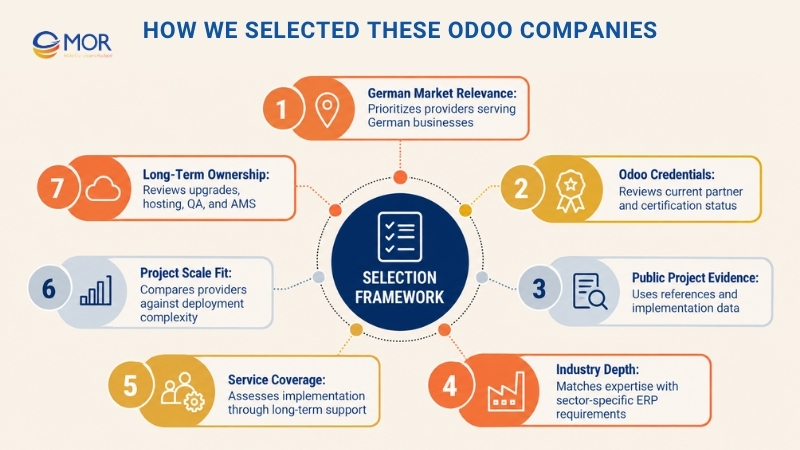
- German market relevance: We included German-based providers plus MOR Software as a global engineering option for German businesses.
- Odoo relationship: Current directory status and documented work give buyers a starting signal. MOR, for example, is an official Odoo partner in Vietnam, while nine German entries carry current Gold or Silver status.
- Public project evidence: Customer references, Odoo directory records, project size, company case material, and public implementation data carry more weight than broad marketing claims.
- Certified expertise: Certification counts show current platform knowledge. We treat them as evidence of team training, not as a guarantee that the assigned consultants know your industry.
- Industry depth: Manufacturing, wholesale, logistics, IT, finance, healthcare, construction, and commerce each create different Odoo requirements.
- Service coverage: We checked consulting, implementation, custom development, integration, migration, training, hosting, support, and managed application work.
- Project-scale fit: A team built around 10-user deployments shouldn't automatically be compared with one handling 500 or 1,000-user programs.
- Long-term system work: Upgrade planning, Application Management Services, hosting, documentation, QA, and post-go-live development affect the total value of an ERP relationship.
The order makes the article easier to scan. It doesn't represent a mathematical score, and readers should shortlist providers based on their own project profile.
For a broader vendor assessment model, read what makes a reliable Odoo development company before sending an RFP.
How to Choose an Odoo Development Company in Germany
The strongest Odoo development companies in Germany usually look less similar once you examine the project details. A manufacturing rollout with DATEV, MRP, three warehouses, legacy migration, and custom APIs needs a different team from a 20-user CRM and Sales deployment.
Use the criteria below to turn a long vendor list into a workable shortlist.
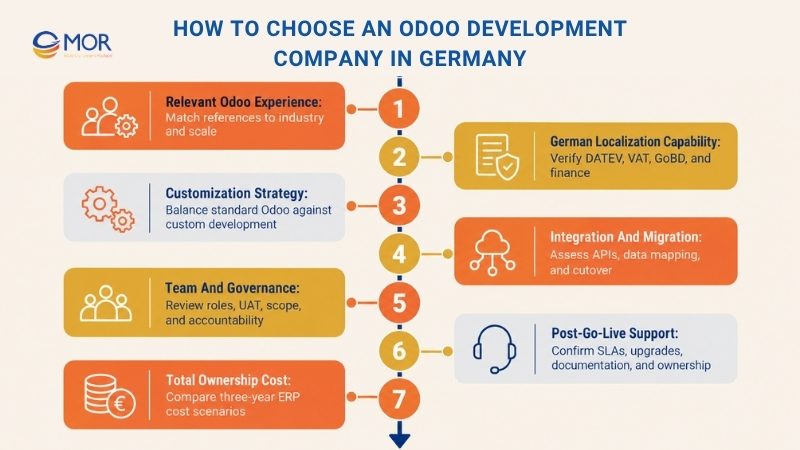
Check relevant Odoo references
Match references to your industry, user count, module scope, and operating model. A 300-user manufacturing case says more about production ERP capability than five small CRM projects. Ask for a comparable customer story and the actual role the vendor played. Some firms lead analysis, implementation, development, and support, while others mainly supply technical resources.
Treat certification tier as one signal
Gold, Silver, and Ready status help you confirm activity inside the Odoo ecosystem. They don't tell you whether the assigned team has delivered your type of project before. Check the consultants and developers proposed for your account. Certification at company level means little if your project gets a junior team with limited MRP, accounting, or migration experience.
Verify DATEV and German localization
Finance should enter the discussion early when Germany-specific accounting sits inside scope. Ask how the vendor handles DATEV data exchange, VAT, account mapping, tax workflows, GoBD-related exports, and finance testing. Don't accept a simple 'yes, we support DATEV.' Request the planned data flow, supported direction, file or API method, reconciliation approach, and ownership when mapping errors appear.
Review standard versus custom strategy
Good teams can explain which requirements belong in standard Odoo and which ones justify custom Python code. Excess custom work raises the future test and upgrade burden. A short Gap analysis helps here. Map the current process, target process, Odoo standard behavior, required change, business value, and maintenance cost before approving a module build. If custom work becomes a major part of your roadmap, our guide to Odoo ERP customization options covers the decisions worth reviewing.
Examine integration architecture
List every system that must exchange data with Odoo. Typical connections include eCommerce, WMS, 3PL, payment gateways, banks, CRM, BI, product systems, marketplaces, and proprietary applications. Then ask about APIs, authentication, queues, retry logic, monitoring, error logs, master-data ownership, and connector maintenance. Integration failure often looks like an Odoo problem to users, even when the actual fault sits in an external service.
Audit migration planning
Data migration deserves its own workstream. Map which customers, suppliers, products, BOMs, orders, invoices, stock records, attachments, opening balances, and historical transactions need to move. Ask for cleansing rules, mapping templates, trial migrations, reconciliation, user validation, cutover steps, and rollback planning. A rushed migration can make a technically correct ERP feel unreliable on day one.
Check upgrade discipline
Custom modules need a clear path to future Odoo releases. Ask which parts depend on standard extension points, which modify core behavior, and how regression testing works during upgrades. The answer should also cover third-party modules. A dependency abandoned by its original developer can block future release work just as easily as your own custom code.
Review team composition
ERP projects need business and technical skills in the same delivery model. Look for functional consultants, developers, a project lead, QA, migration ownership, and support capacity. If your internal team already owns functional design, a dedicated engineering model may make more sense. This is where knowing how to hire an experienced Odoo developer helps you compare skills at individual level.
Evaluate project governance
Ask who approves scope, how change requests enter the backlog, and when users see working software. Define UAT ownership, acceptance rules, release gates, escalation paths, and documentation before development expands. You also need visibility into project progress. Sprint demos, milestone reviews, issue logs, decisions, and a shared backlog make problems easier to catch before they turn into expensive rework.
Understand post-go-live support
Clarify support hours, SLA, ticket priority, incident escalation, warranty, monitoring, release management, and upgrade work. Odoo systems tend to grow after launch as users request reports, automation, new modules, and integrations. A vendor that disappears after go-live pushes technical knowledge back onto your internal team. Long-term projects should define who owns code, documentation, environments, credentials, and deployment pipelines.
Request proof instead of claims
Ask for architecture samples, customer references, project numbers, demo modules, code-review practices, or a small paid discovery. Specific evidence makes vendor comparison much easier. The same rule applies when assessing professional Odoo implementation services. Process descriptions are useful only when you can connect them to named deliverables and accountable roles.
Compare total ownership cost
The initial implementation quote covers only part of ERP spending. Add migration, custom modules, integrations, cloud infrastructure, training, support, internal project time, future changes, and upgrades. The lowest initial bid can become expensive if it creates maintenance debt. Compare three-year scenarios using the same assumptions for every shortlisted vendor.
Conclusion
Choosing among Odoo development companies in Germany comes down to project fit, proven Odoo work, German localization, technical depth, and long-term ownership. Compare vendors against the same scope, then test their claims through references and a detailed discovery session. MOR Software supports German businesses that need custom development, integrations, migration, AMS, or offshore Odoo capacity.
Ready to build your ERP team? Review our Odoo development services at MOR Software and or contact us to discuss your project.
"Mr. Cong’s guiding philosophy is simplicity, believing that the simplest solutions are often the most powerful. He sees trust, empowerment, and the opportunity to demonstrate one’s abilities as the key elements that set MOR apart from traditional IT companies."
Mac Tien Cong


Division Manager (Hanoi Branch)
MOR SOFTWARE
Frequently Asked Questions (FAQs)
How many Odoo partners are there in Germany in 2026?
The number changes as companies enter the program, move between tiers, merge, or update certifications. A recent OdooGuide check showed 92 German providers, split across Gold, Silver, and Ready levels, so the safest approach is to attach an 'as of' date whenever you cite the total.
For procurement, the raw number has limited value after the first market scan. Your realistic shortlist should shrink quickly once you filter for industry references, project size, local accounting knowledge, required integrations, and delivery model.
What is the difference between Odoo Gold, Silver, and Ready partners?
These labels come from Odoo's partner program and provide a useful signal of activity, certifications, customer work, and relationship level inside the ecosystem. Gold firms tend to have larger Odoo practices or stronger current commercial activity, while Silver and Ready providers may operate at smaller scale or focus on narrower markets.
Tier alone shouldn't decide your contract. A focused Silver team with strong eCommerce migration experience may fit a retailer better than a large Gold firm whose portfolio centers on industrial manufacturing.
How do I choose among Odoo development companies in Germany?
Start with your project rather than the vendor list. Define modules, user count, legal entities, locations, data migration, integrations, German finance requirements, custom development, go-live timing, and post-launch ownership.
Then compare Odoo development companies in Germany against the same brief. Keep three to four firms that can show relevant references, the right team structure, a sensible standard-versus-custom approach, and support that matches your operating hours.
Do German Odoo companies support DATEV and local accounting requirements?
Many German providers publish DATEV-related capabilities, but implementation methods differ. Some support exports or imports, some develop connectors, and others work with finance partners or separate accounting processes.
Ask your shortlisted firm to demonstrate the actual flow needed by your accounting team. Account mapping, VAT treatment, reconciliation, error handling, export format, and audit requirements should appear in the scope before UAT begins.
How much does Odoo implementation cost in Germany?
There isn't one reliable flat price for a German Odoo rollout. Cost changes according to users, modules, legal entities, workshops, data migration, custom Python work, interfaces, reports, training, hosting, project management, and post-launch support.
A mostly standard Sales and CRM setup for one company can sit far below an ERP program covering Accounting, MRP, Inventory, Purchase, eCommerce, and several external systems. Ask vendors to separate discovery, configuration, development, migration, training, and support in the estimate so you can compare quotes on the same basis.
How long does an Odoo implementation usually take?
Project scope controls the timeline. A focused deployment using standard modules can move quickly, while manufacturing, finance, migration, interfaces, and custom modules add analysis, development, testing, and user validation.
Don't judge the schedule only by the promised go-live date. Ask what must be ready before each milestone, how many UAT cycles are planned, which data must be migrated, and what happens when a high-priority process fails acceptance.
Should I choose a German Odoo provider or an offshore development company?
A local German team gives easier access to German-language workshops, local finance knowledge, on-site meetings, and same-time-zone communication. Offshore teams become attractive when the project needs a larger development pool, custom modules, API work, QA, or sustained engineering capacity.
Several Odoo development companies in Germany also mix local consulting with distributed delivery. MOR Software fits the offshore side of this decision, particularly when German stakeholders can own business requirements while our engineering team handles custom development, integrations, testing, and ongoing product work.
Which industries do German Odoo providers work with most often?
Manufacturing, wholesale, retail, IT, services, construction, healthcare, science, food, and logistics appear throughout current German partner references. The strongest concentration varies by company: manaTec leans toward manufacturing, SH Digital Starten has a large IT-service base, and braintec shows substantial healthcare and manufacturing work.
A practical answer to which company use Odoo can therefore be found in the public reference directory. German users span factories, distributors, technology companies, healthcare organizations, construction firms, service businesses, and many other operating models.
What should I ask an Odoo company before signing a contract?
Ask for comparable references, named project roles, seniority, implementation method, custom-code policy, migration plan, UAT process, documentation, deployment ownership, source-code access, IP terms, SLA, and upgrade approach. Then ask the team to walk through one difficult process from discovery to production support.
Pay attention to who answers technical questions during sales. If the proposed architect, functional lead, or senior developer never joins the discussion, request a session before signing.
Can one company handle implementation, customization, integration, migration, and support?
Yes. Several companies in this list cover the full cycle, including discovery, implementation, technical work, migration, training, and support. The real issue is whether each capability sits at the depth your project requires.
Large programs sometimes use a hybrid structure instead. A German functional team may lead localization and user workshops, while an offshore engineering group handles custom modules, interfaces, testing, and maintenance. That model can work well when responsibilities, technical ownership, communication, and acceptance rules are defined early.
Share


Make Our-Dreams Realized


© 2023 . MOR Software. All Rights Reserved
Sitemap
Privacy Policy
Terms of Use

Rate this article
0
over 5.0 based on 0 reviews
Your rating on this news:
Name
*Email
*Write your comment
*Send your comment
1