


Odoo for Healthcare: Full Guide to Features, Costs & Setup 2026
Managing patient records, billing, pharmacy stock, lab results, and staff schedules across separate tools can slow healthcare teams down fast. Odoo for healthcare helps bring these workflows into one connected ERP system, giving clinics and hospitals better control over daily operations. In this MOR Software guide, we’ll explore its features, modules, costs, and setup steps for 2026.
Key Takeaways
- Odoo for healthcare helps medical teams manage patient data, appointments, billing, inventory, pharmacy, lab work, HR, and reporting from one system.
- The platform can replace scattered tools with connected workflows, real-time stock alerts, role-based access, and cleaner data for daily decisions.
- A well-planned Odoo healthcare ERP setup can support smoother implementation, safer data migration, better staff adoption, and long-term system scalability.
What Is Odoo For Healthcare?
Odoo for healthcare is a central ERP setup that helps medical facilities run daily work from one shared platform. An Odoo ERP for healthcare can support core areas like:
- Appointment booking software
- Billing and finance
- Medicine and medical stock control
- Staff planning and workforce tasks
- Reports and performance tracking
Odoo health works well for medical teams because the platform is open source, modular, and easy to adapt to different care workflows.
Healthcare Management Problems Odoo For Healthcare Can Solve
Odoo for healthcare helps solve many daily problems linked to operations, patient data, and team coordination. An Odoo healthcare management system can address issues like:
- Disconnected Department Tools: Different teams may use separate systems for booking, billing, stock, and HR, which creates data gaps and weak handoffs.
- Paper-Based Tasks: Many hospitals still depend on manual files and repeated data entry, which can raise mistakes and slow teams down.
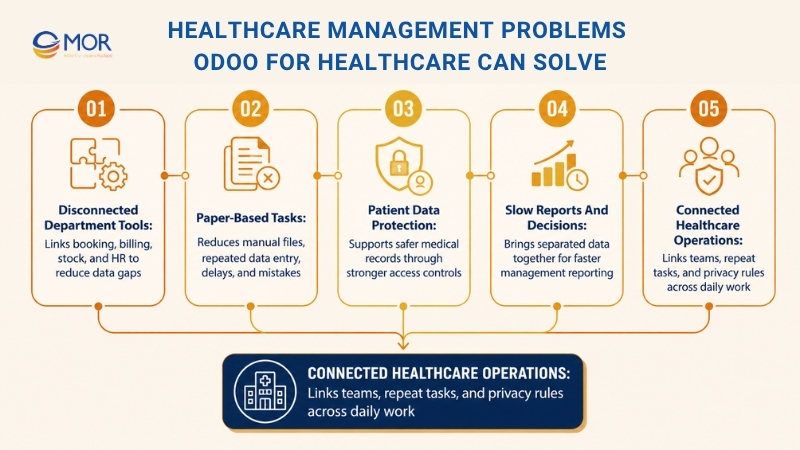
- Patient Data Protection: Keeping medical records safe under HIPAA and GDPR rules can be hard without the right access controls.
- Slow Reports And Decisions: When data sits in separate tools, managers spend too much time collecting reports before making choices.
Healthcare providers need one connected platform that links teams, handles repeat tasks, and supports privacy rules across daily operations.
>>> Explore the top solutions available, understand must-have features, and choose the right visitor management system for hospitals in 2026.
Why Odoo Is A Strategic Fit For Healthcare
Odoo is an open-source ERP platform that can fit many business types, including medical services. For Odoo for healthcare industry needs, its module-based design lets clinics and hospitals choose the apps they need without paying for tools they will not use.
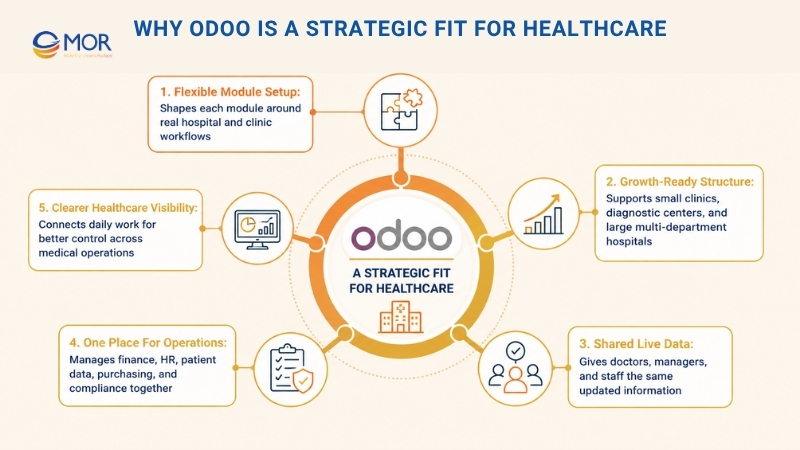
Flexible Module Setup
Each module can be shaped around your hospital’s real workflow, from patient records and appointments to billing, HR, stock, and reporting. This helps healthcare teams build a system that matches their daily operations instead of forcing staff to follow rigid software rules.
Growth-Ready Structure
The platform can support small clinics, diagnostic centers, and large hospitals with many departments. As patient volume, service lines, or branch locations grow, healthcare companies can add more modules and users without rebuilding the whole system.
Shared Live Data
Doctors, managers, and staff can work from the same updated information, which reduces confusion between departments. When patient details, stock levels, billing records, and schedules stay connected, teams can make faster and more accurate decisions.
One Place For Operations
Finance, HR, patient data, purchasing, and compliance can be managed in one system. This gives healthcare leaders a clearer view of daily performance and helps reduce the time spent switching between separate tools.
When healthcare teams connect their daily work in one platform, Odoo for healthcare gives them better control and clearer visibility.
>>> Explore more Odoo topics on MOR Blog right now!
Main Odoo Functionalities For The Healthcare Industry
Odoo for healthcare supports the daily work that keeps medical teams moving, from patient visits to billing, stock, lab updates, pharmacy tasks, reporting, and staff planning. For teams looking at Odoo for medical operations, these functions help connect care, admin, and back-office work in one practical system.
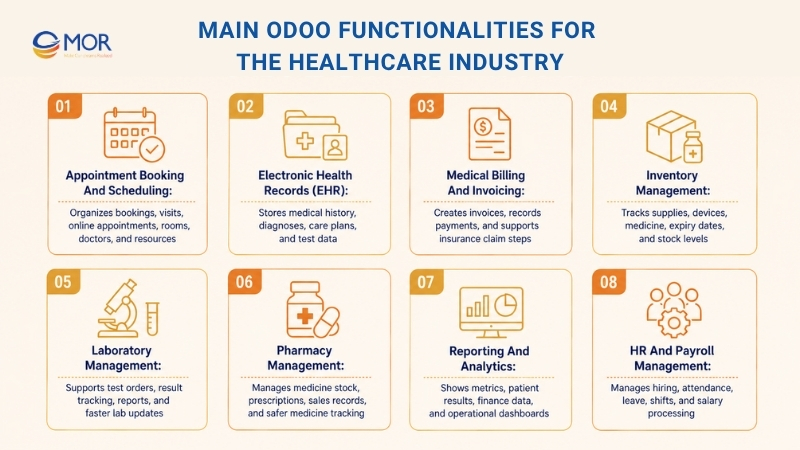
Appointment Booking And Scheduling
Odoo scheduling tools help medical teams organize bookings, visits, and patient appointments in one place. Patients can also book online, which helps teams use rooms, doctors, and other resources more wisely.
Electronic Health Records (EHR)
Digital patient records in Odoo help teams create and update Electronic Health Records (EHR) with medical history, diagnoses, care plans, and test data. This keeps patient information more accurate and easier for approved staff to find.
Medical Billing And Invoicing
Odoo billing tools let healthcare providers create service invoices, record payments, and manage insurance claim steps. Odoo ERP for billing and invoicing healthcare helps billing teams process charges and payments with less delay.
Inventory Management
Odoo inventory tools help medical teams track supplies, devices, and medicine across locations. They can manage safe stock levels, watch expiry dates, and avoid shortages of Odoo for healthcare products.
Laboratory Management
Odoo for healthcare can support lab teams with test orders, result tracking, and report handling. It also helps doctors and lab staff share updates with fewer delays.
Pharmacy Management
Odoo for healthcare helps pharmacies manage medicine stock, prescription handling, and sales records. It also supports better medicine tracking, which lowers the chance of dispensing errors.
Reporting And Analytics
Odoo reporting tools help healthcare leaders view key metrics, patient results, and finance data. These dashboards give managers clearer numbers for planning and daily control.
HR And Payroll Management
Odoo HR and automated payroll processing tools help medical organizations manage hiring, attendance, leave, shifts, and salary processing. This supports better staff planning across busy care teams.
Together with Odoo’s open-source flexibility, these tools make the platform a practical ERP choice for healthcare teams.
Key Odoo For Healthcare Modules To Build A Connected System
As healthcare teams grow, daily work across departments becomes harder to control. Patient records, finance, stock, and staff tasks all need careful handling and clear coordination. Odoo for healthcare answers this need through a modular ERP structure, letting providers choose, set up, and connect only the tools they need. These healthcare ERP modules are often used to build a more connected care system.
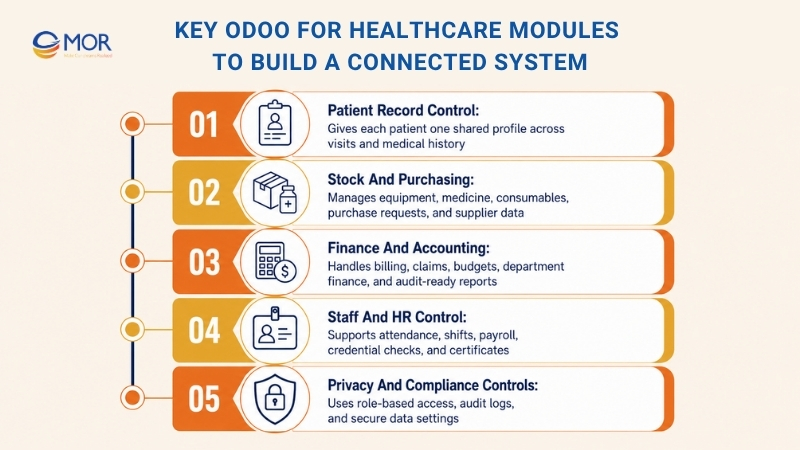
Patient Record Control
The Odoo healthcare module for patient management gives each patient one shared profile, including personal details, visits, and medical history. It can connect with lab, pharmacy, and billing tools, so teams work from consistent data and avoid repeated records.
Stock And Purchasing
Good stock control matters in medical settings. Odoo can handle stock checks, purchase requests, and supplier data for equipment, medicine, and daily consumables. This helps hospitals keep enough stock, lower waste, and manage buying costs.
Finance And Accounting
Odoo’s manufacturing financial software helps hospitals manage billing, claims, budgets, and department-level finance. They also give finance teams cleaner records and easier access to audit-ready reports.
Staff And HR Control
Healthcare work depends on the right people being in the right place. Odoo’s HR tools support attendance, shift planning, payroll, and credential checks. Admin teams can also review staff output and track required certificates.
Privacy And Compliance Controls
Odoo supports role-based access, so private medical data is only visible to approved users. Audit logs, secure data settings, and custom rules help hospitals meet local and global healthcare standards.
Business Benefits Of Odoo For Healthcare Companies
Using Odoo for healthcare can bring clear gains for clinics, hospitals, and healthcare companies. The value is not only in having one system. It also comes from fewer data gaps, faster admin work, better stock control, and stronger visibility across care and business teams.
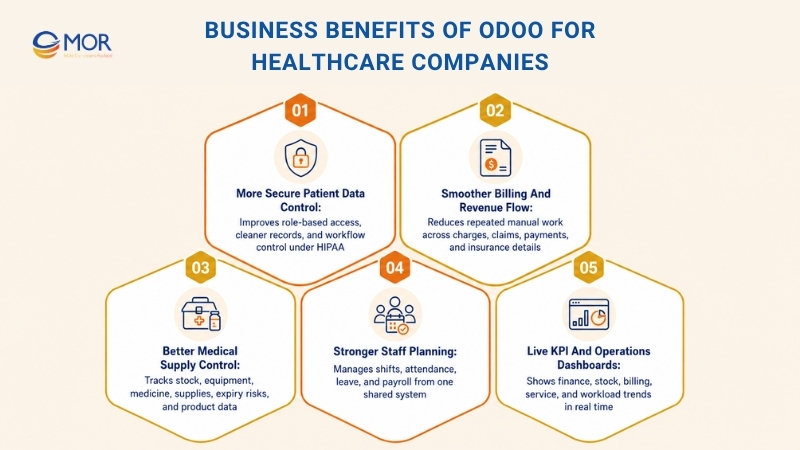
More Secure Patient Data Control
Odoo’s connected platform helps healthcare teams manage patient information with role-based access, cleaner records, and stronger workflow control under HIPAA rules. This matters because healthcare remains a high-risk sector for data exposure, and the average breach cost across all industries reached $4.88 million in IBM’s 2024 report period. Better access rules and cleaner data trails help reduce weak points in daily operations.
Smoother Billing And Revenue Flow
This ERP model helps healthcare companies manage charges, insurance details, claims, and payment steps with less repeated manual work. Billing accuracy matters because claim denials still create real pressure for providers. Optum’s 2024 Revenue Cycle Denials Index reported that national denial rates remained around 12%, while Experian Health found that 38% of providers in 2024 said at least one in ten claims was denied.
Better Medical Supply Control
Odoo ERP for healthcare manufacturers and providers can support stock, equipment, medicine, and supply tracking from one shared system. This helps teams avoid stock gaps, overbuying, expired items, and missing product data. Better inventory control also supports safer medicine use, which is a serious issue because the World Health Organization estimates medication errors cost about US$42 billion worldwide each year.
Stronger Staff Planning
The platform helps healthcare companies plan shifts, attendance, leave, and payroll from one place, so workforce tasks become easier to manage. This is useful for busy hospitals and clinics where staffing gaps can affect service quality. With shared schedules and cleaner attendance data, managers can plan coverage better and spend less time fixing last-minute conflicts.
Live KPI And Operations Dashboards
Odoo gives healthcare leaders real-time data on operations, finance, stock, billing, and service performance. Instead of waiting for manual reports, managers can track trends earlier and make faster decisions. These dashboards help teams spot delayed payments, low stock, high patient volume, and staff workload issues before they turn into larger business problems.
Why Odoo For Healthcare Outperforms Traditional Systems
Healthcare teams often deal with scattered tools, paper-heavy tasks, slow reporting, and weak handoffs between departments. Older hospital software may fix one problem but create another, mainly when records stay across many separate platforms. Odoo for healthcare brings these workflows into one shared ERP space, helping hospitals, clinics, labs, and pharmacies improve Odoo healthcare management, visibility, and patient service.
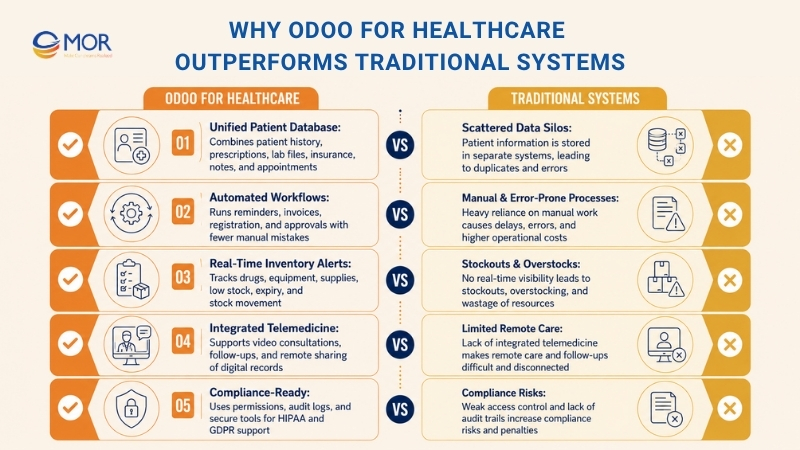
Key advantages of this connected healthcare ERP include:
Unified Patient Database
Odoo builds one patient database where approved care teams can view medical history, prescriptions, lab files, diagnoses, treatment notes, insurance details, and appointment records from one dashboard. This removes repeated files and lowers the chance of missing or old patient data. Doctors, nurses, pharmacists, and admin staff can use the same live records, which supports better teamwork and quicker care decisions.
Automated Workflows
Many medical facilities still handle routine admin work by hand, including appointment reminders, invoices, patient registration, and prescription approvals. Odoo can run these repeated tasks with custom workflows and system triggers. Hospitals may cut manual mistakes by up to 60%, speed up processing, and keep operations more consistent. Automation also gives staff more time for patient care instead of paperwork and repeated data entry.
Real-Time Inventory Alerts
Medical stock control matters because shortages or expired medicines can put patient safety at risk. Odoo for healthcare gives teams live stock tracking for drugs, equipment, and daily medical supplies. Healthcare teams can receive alerts for low stock, near-expiry items, and stock movement. This helps pharmacies and supply teams prevent medicine shortages, lower waste, and keep stock data accurate across locations.
Integrated Telemedicine
Remote care and online consultation now play a bigger part in modern medical services. Odoo can support telemedicine functions that let providers hold secure video consultations, manage follow-ups, and share digital records from a distance. Patients get easier access to care, and clinics can serve more people without adding more rooms or physical sites.
Compliance-Ready
Healthcare providers must follow strict privacy rules and data standards, including HIPAA and GDPR. Odoo includes access controls, audit logs, user permission settings, and secure data tools that support compliance work. Sensitive patient records can stay limited to approved users, while managers still track system actions and report histories.
When healthcare work sits in one scalable system, Odoo helps medical teams move away from scattered tools and build a more connected, clear, and data-led way to work.
Our Implementation Process For Odoo Healthcare ERP
At MOR Software, we use a practical setup method shaped around real healthcare work, not fixed ERP templates. Hospitals, clinics, labs, and medical groups often face scattered systems, manual files, slow reports, and strict compliance duties. Our team works with stakeholders from the start to build an Odoo for healthcare setup that matches real daily workflows.
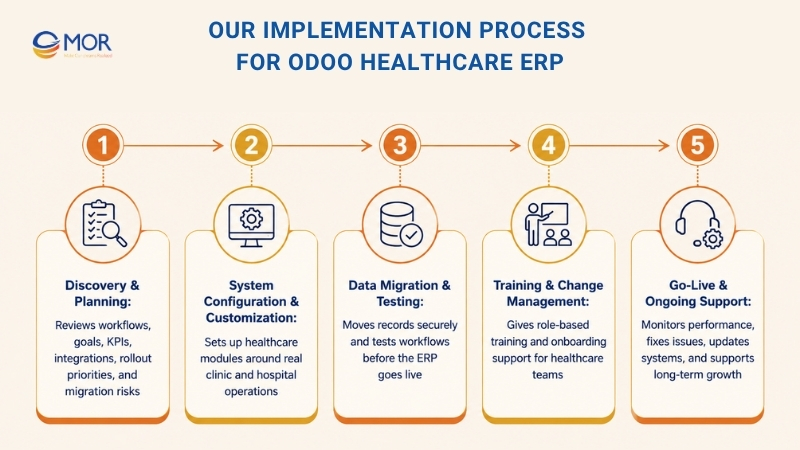
Our process focuses on stable delivery, room to grow, and long-term value. We bring together business analysis, healthcare knowledge, cloud skills, system links, and ongoing support to help medical teams upgrade operations with fewer disruptions.
Discovery & Planning
The first step is learning how your healthcare organization works today. Our consultants and engineers meet stakeholders to review patient flows, billing steps, stock control, appointment handling, reporting needs, and compliance rules. This shows us where work slows down, where tools are disconnected, and where automation can save time for medical and admin teams.
We also set project goals, KPIs, system integration needs, rollout priorities, and launch timelines. For healthcare providers still using old platforms, our team checks current infrastructure and builds a migration plan that lowers risks during the change.
System Configuration & Customization
After planning, MOR Software sets up the Odoo healthcare ERP environment around your operating model. We adjust modules for patient records, electronic medical files, pharmacy work, billing, accounting, stock tracking, HR, and appointment scheduling so they fit real clinic or hospital workflows.
Many healthcare groups also need custom tools beyond default ERP functions. Our development team can create tailored solutions like telehealth portals, patient mobile apps, lab interfaces, insurance claim flows, AI reporting tools, and links with third-party medical systems. We aim to build a system staff can use naturally, instead of making teams follow rigid software rules.
Data Migration & Testing
Healthcare data migration needs care, security, and clear checks. MOR Software moves patient files, finance data, staff records, stock information, and operating documents from older systems into the new ERP environment. At this stage, our engineers review data quality and fix migration errors before launch.
Testing runs across several layers, including functional checks, performance checks, integration testing, user acceptance testing (UAT), and compliance review. We test real work scenarios so hospitals and clinics can confirm the system works under normal daily pressure before it goes live.
Training & Change Management
A strong healthcare ERP can still fail when users do not feel ready to use it. MOR Software gives role-based training for administrators, doctors, nurses, accountants, pharmacists, HR staff, and operations teams. Each team gets practical guidance tied to its real tasks inside Odoo for healthcare.
We also guide healthcare organizations through the change period with onboarding support, workflow documents, and live practice sessions. This helps staff adapt faster and lowers resistance to new work habits. Our goal is to help teams feel ready before the official launch.
Go-Live & Ongoing Support
When the system goes live, MOR Software tracks performance, user activity, system links, and operating stability. Our support engineers stay ready to handle issues, fix errors, and adjust workflows during the early launch stage.
Healthcare work keeps changing after deployment, so our support continues after go-live. We provide system updates, cloud support, security patches, function upgrades, and long-term maintenance to help providers grow over time. This ongoing work helps medical organizations keep improving operations while keeping patient services stable.
How MOR Software Customizes Odoo For Healthcare
Odoo gives medical teams a solid ERP base, but each clinic, hospital, and healthcare group runs differently. Patient intake, billing, pharmacy stock, lab work, claim handling, and staff planning all follow their own rules. MOR Software shapes Odoo for healthcare around these workflows, giving providers a customized setup that fits how they work instead of asking teams to change everything.
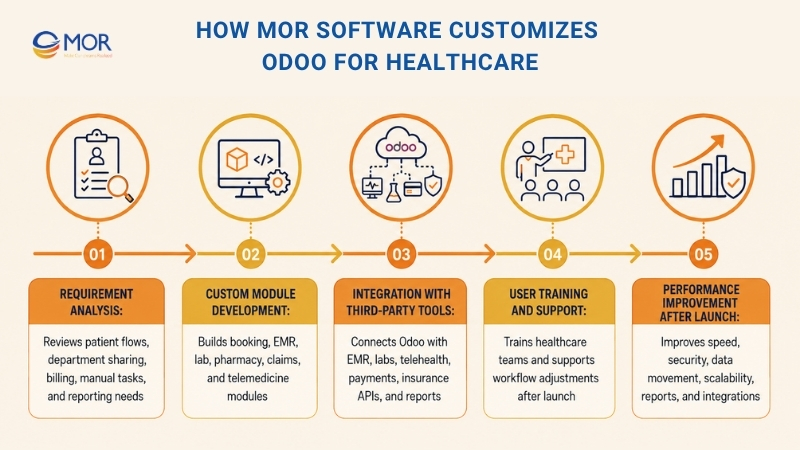
Requirement Analysis
MOR Software begins with a clear review of your current operations. We study patient movement, department data sharing, billing steps, and manual tasks that slow teams down. This helps us plan the right Odoo setup, covering patient records, stock, finance, HR, and reporting.
Custom Module Development
Healthcare providers often need more than ready-made ERP modules. MOR Software can create or adjust Odoo modules for booking, EMR workflows, lab requests, pharmacy tasks, insurance claims, and telemedicine support. Each module reflects staff roles, approval steps, and daily service needs.
Integration With Third-Party Tools
Most healthcare organizations already depend on other tools for records, tests, payments, or communication. MOR Software connects Odoo with EMR systems, lab platforms, telehealth tools, payment gateway integration, insurance APIs, and reporting tools. This keeps data moving between teams with less repeated entry and fewer missing links.
User Training And Support
A healthcare ERP works best when staff know how to use it well. MOR Software trains doctors, nurses, admin teams, finance staff, pharmacy teams, and managers with practical sessions. We also support teams after launch, helping users solve issues, adjust workflows, and get used to the platform step by step.
Performance Improvement After Launch
After deployment, MOR Software keeps reviewing system speed, security, data movement, and scalability. As your healthcare organization grows, we can add modules, refine reports, adjust integrations, and improve the user journey. This keeps your Odoo setup stable, useful, and ready for future service needs.
With this approach, MOR Software turns Odoo into a healthcare ERP that supports smoother operations, safer data handling, and better patient service. It also gives teams comparing Odoo healthcare options a strong Vietnam-based partner for custom ERP delivery.
Odoo For Healthcare Implementation Considerations
When you plan Odoo for healthcare, several points need early review:
- Project Duration: A standard Odoo rollout for healthcare companies usually takes 1–6 months, based on module scope and the level of customization needed.
- Legacy Data Transfer: Healthcare teams often manage complex data across finance, revenue cycles, and supply chains, so each data field must be mapped and moved with care.
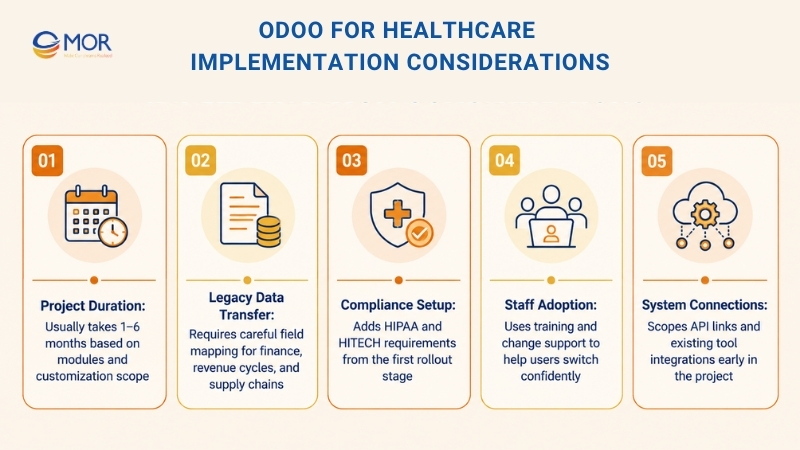
- Compliance Setup: Rules like HIPAA and HITECH require the healthcare ERP rollout to include compliance settings from the first stage.
- Staff Adoption: Training and change support matter because users need to feel ready. Odoo’s simple interface and community resources can make the switch easier for end users.
- System Connections: Many healthcare companies need Odoo to connect with existing tools. The platform supports this with open APIs and ready connectors, but integration work should be scoped early.
Odoo For Healthcare Pricing And Cost Considerations
Odoo pricing for healthcare organizations can start with the free Community edition, while Enterprise often ranges from $7.25 to $11.25 per user/month under the Standard plan. The final cost depends on your healthcare business size, user count, integration needs, custom work, and long-term support model.
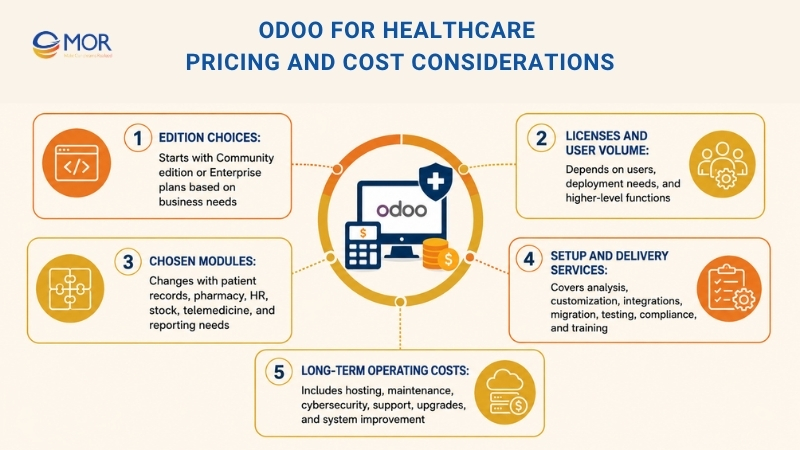
- Licenses And User Volume: Costs may range from $0 for the Community edition to about $24.90/user/month for the Enterprise Custom plan, based on deployment needs and higher-level functions.
- Chosen Modules: Healthcare providers may need extra modules for patient records, accounting, pharmacy work, revenue cycle tasks, HR, stock tracking, telemedicine, and reporting, which can change the total cost.
- Setup And Delivery Services: Most healthcare organizations also pay for expert help with business analysis, workflow customization, third-party links, data migration, testing, compliance setup, and staff training.
- Long-Term Operating Costs: Annual maintenance, cloud hosting, cybersecurity checks, technical support, version upgrades, and ongoing system improvement should be part of healthcare ERP cost planning.
Healthcare ERP budgets can change a lot based on operating needs and compliance scope. For a clearer estimate, you can contact MOR Software for a custom Odoo for healthcare consultation and pricing plan.
Conclusion
Odoo for healthcare gives medical organizations a practical way to connect care delivery, finance, inventory, staff planning, and reporting without relying on too many separate tools. The right setup can improve daily control, support safer data handling, and make future growth easier to manage. If your clinic, hospital, or healthcare group needs a tailored ERP setup, contact MOR Software to discuss your Odoo healthcare ERP project.
MOR SOFTWARE
Frequently Asked Questions (FAQs)
What is Odoo For Healthcare?
Odoo For Healthcare is an ERP setup that helps clinics, hospitals, labs, and medical groups manage daily work in one system. It can support patient records, appointments, billing, inventory, HR, accounting, and reporting.
Can Odoo manage patient records?
Yes. Odoo can store patient profiles, visit history, prescriptions, test results, insurance details, and treatment notes. Access can be limited by user role, so only approved staff can view sensitive records.
Does Odoo support appointment scheduling?
Yes. Medical teams can use Odoo to manage bookings, doctor schedules, room availability, reminders, and follow-up visits. Patients may also book appointments online if a patient portal is added.
Can Odoo handle medical billing and insurance claims?
Yes. Odoo can manage invoices, payments, claim records, and accounting data. Healthcare teams can connect billing with patient visits, prescriptions, lab tests, and pharmacy sales.
Is Odoo For Healthcare suitable for small clinics?
Yes. Odoo For Healthcare can start with basic modules for appointments, patient records, billing, and inventory. More modules can be added later as the clinic grows.
How does Odoo help with healthcare inventory?
Odoo tracks medicines, medical supplies, equipment, expiry dates, stock movement, and reorder points. This helps pharmacies and supply teams avoid stockouts and reduce waste.
Can Odoo connect with EMR, lab, or telemedicine systems?
Yes. Odoo can connect with EMR software, lab tools, telehealth platforms, payment gateways, insurance APIs, and reporting systems. The level of integration depends on the existing system and project scope.
Is Odoo For Healthcare secure enough for patient data?
Odoo For Healthcare can support secure data handling through role-based access, user permissions, audit trails, backups, and encrypted hosting. Healthcare providers still need proper setup to meet privacy rules in their region.
How long does an Odoo healthcare ERP implementation take?
A simple setup may take a few weeks. A larger hospital project with custom workflows, data migration, integrations, and staff training may take several months.
How much does Odoo For Healthcare cost?
Odoo For Healthcare cost depends on user count, selected modules, hosting, customization, data migration, integrations, support, and training. The free Community edition can lower license cost, but healthcare projects often need paid setup and technical work.
Share


Make Our-Dreams Realized


© 2023 . MOR Software. All Rights Reserved
Sitemap
Privacy Policy
Terms of Use

Rate this article
0
over 5.0 based on 0 reviews
Your rating on this news:
Name
*Email
*Write your comment
*Send your comment
1