


Semantic Search vs RAG: Key Differences and When to Use Each
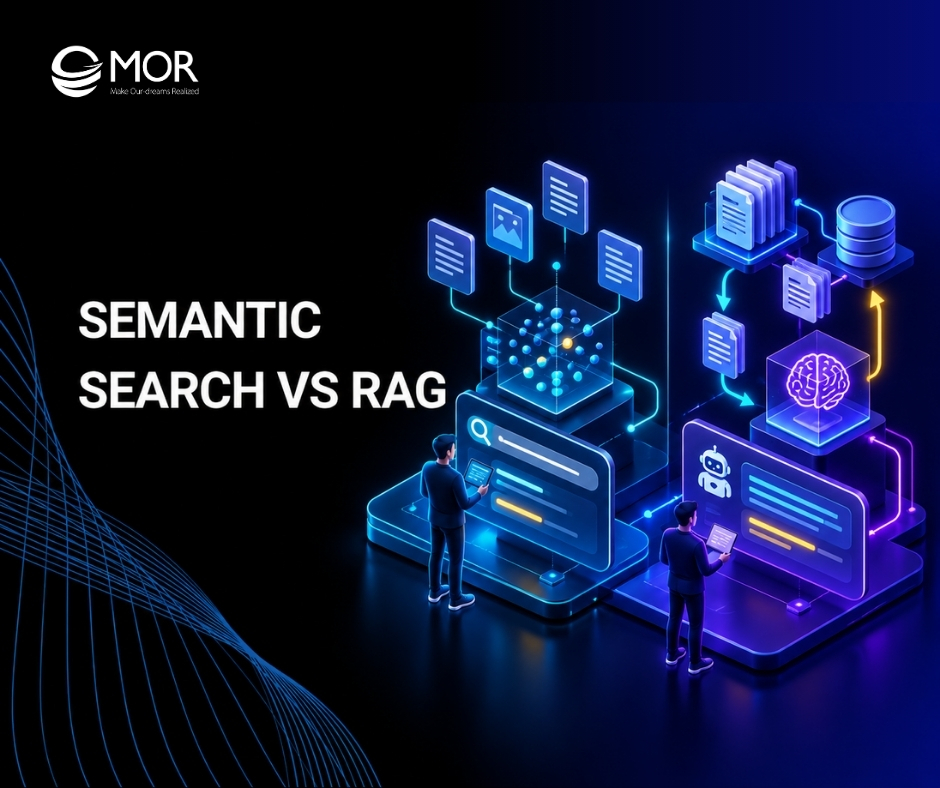
Semantic search vs RAG comes down to what users receive. Semantic search finds relevant documents based on meaning, while Retrieval-Augmented Generation (RAG) retrieves information and generates answers using large language models. They can also work together in one system. Which approach fits your business needs? This MOR Software guide will compare their architecture, costs, accuracy, limitations, and real-world applications to help you make an informed decision.
Key Takeaways
- Semantic search retrieves and ranks existing information based on meaning, while RAG adds an LLM to generate answers grounded in retrieved sources.
- Semantic search generally has lower query costs and latency. RAG supports conversational answers and knowledge synthesis but requires more infrastructure and quality checks.
- The right choice depends on user expectations, data quality, budget, and accuracy requirements. Many enterprise applications benefit from combining both approaches.
Semantic Search vs RAG: What Are the Key Differences?
The main distinction in semantic search vs RAG lies in the output and processing architecture. Semantic search delivers relevant existing information, whereas RAG uses retrieved evidence to generate a response. These differences affect development costs, system performance, and how users interact with information.
Comparison factor | Semantic search | RAG |
Primary purpose | Finds and ranks existing information based on meaning | Generates answers grounded in retrieved information |
Core functionality | Information retrieval and relevance ranking | Retrieval, context assembly, and response generation |
Output format | Ranked documents, passages, or records | Generated natural-language answers |
Main technologies | Embedding models, vector indexes, similarity search | Retrieval systems, LLMs, prompt orchestration |
LLM requirement | Doesn't require a generative LLM | Requires a generative model |
Knowledge synthesis | Users or downstream systems combine source information | LLM combines evidence across retrieved sources |
Source traceability | Results link directly to original documents | Source citations require generation and validation logic |
User interaction | Search queries and result browsing | Natural-language questions and conversational responses |
Data freshness | Depends on source updates and indexing frequency | Depends on retrieval freshness and source selection |
Core failure risk | Irrelevant, missing, or poorly ranked results | Retrieval errors and unsupported generated claims |
Best suited for | Document discovery, product search, content retrieval | Enterprise assistants, contextual Q&A, knowledge synthesis |
What Is Semantic Search?
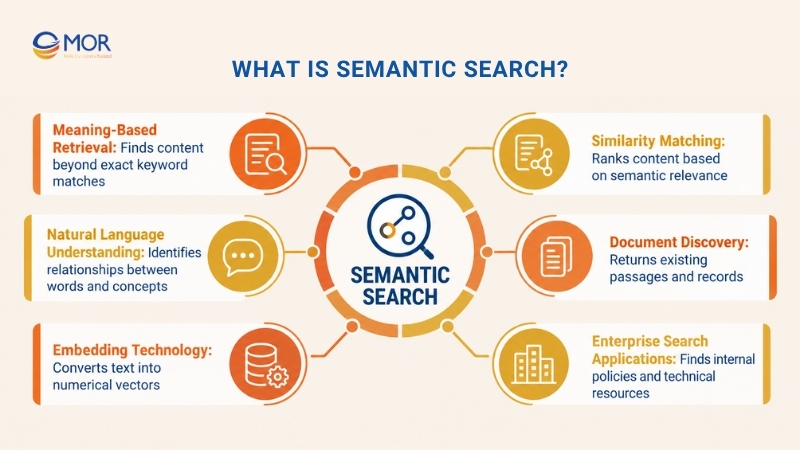
Semantic search is an information retrieval technique that identifies relevant content based on the meaning of a query. It uses natural language processing (NLP), machine learning, and semantic representations to understand relationships between words and concepts.
The keyword search vs semantic search distinction becomes apparent when users describe a problem differently from the source document. For example, a search for 'laptop battery won't charge' can retrieve a support article titled 'Troubleshooting notebook power issues' because the underlying meaning is similar.
Google demonstrated the value of language understanding through BERT, which initially affected 1 in 10 English-language search queries. BERT's role in Google's search system differs from a standalone vector retrieval engine, but the example highlights the value of interpreting language beyond exact word matches.
Modern semantic retrieval often relies on embeddings, which convert text into numerical vectors. These representations allow search engines to calculate similarity between queries and indexed content, then rank the closest matches.
For example, a reference page explaining semantic satiation meaning could match a question about why repeated words temporarily sound unfamiliar. The query and document don't need identical wording to share the same intent.
In business applications, semantic search vs RAG starts with this retrieval capability. Semantic search normally returns existing documents, passages, or records for users to inspect. It doesn't independently compose new answers.
This approach is common in enterprise search, where employees need access to company policies, product records, technical documents, and other internal resources.
What Is Retrieval-Augmented Generation (RAG)?
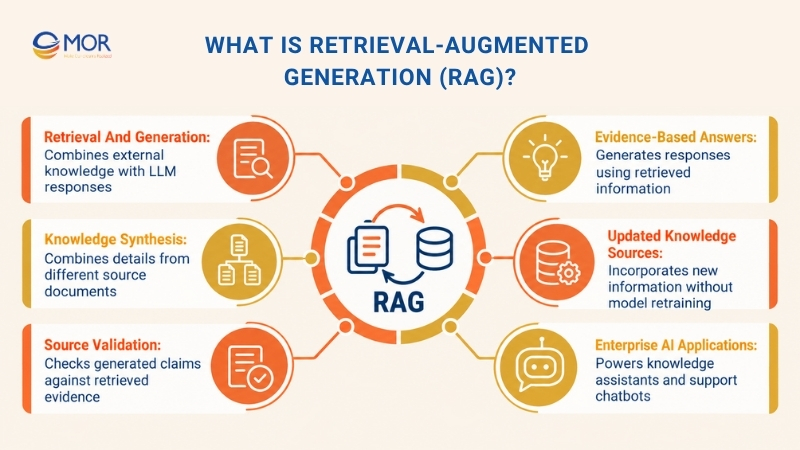
Retrieval-Augmented Generation, commonly called RAG, is an AI architecture that combines information retrieval with text generation. It connects a large language model (LLM) to external knowledge sources, allowing the model to generate answers based on retrieved information.
A typical RAG system searches relevant documents before presenting selected passages to an LLM. The model then interprets the supplied information and creates a natural-language response tailored to the user's question.
Consider an employee asking, 'Can I carry unused annual leave into next year?' A retrieval system finds the relevant HR policies, and the LLM generates an answer based on the applicable rules, ideally citing the original documents.
For semantic search vs RAG, this generation step changes the user experience. Instead of reading several retrieved passages, users receive a composed answer that may combine details across different documents.
RAG also lets businesses update their knowledge sources without retraining the entire LLM. New policies, product manuals, and internal records become available after the retrieval system processes the updated information.
Still, retrieved evidence doesn't guarantee factual accuracy. The model may misinterpret passages or introduce unsupported claims, making source validation necessary.
These capabilities support enterprise knowledge assistants, research applications, and chatbot services that need access to organisation-specific information.
How Does Semantic Search Work?
AI powered semantic search typically follows a retrieval pipeline that transforms documents and queries into comparable semantic representations. The process focuses on finding relevant information and returning it in a useful order.
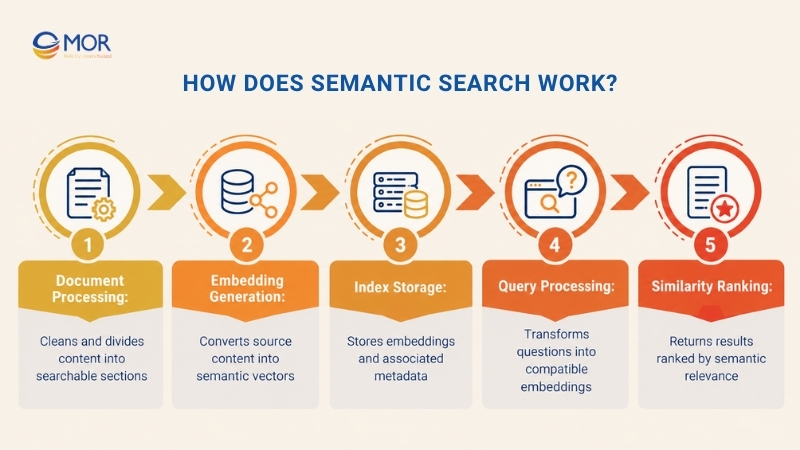
The semantic search vs RAG architecture comparison begins with five retrieval stages:
- Document processing: Collect content from databases, documents, websites, or internal applications. Clean the text, preserve useful metadata, and divide long documents into searchable sections when needed.
- Embedding generation: Convert source content into numerical vectors using an embedding model. Related concepts receive representations that allow the system to identify semantic similarities.
- Index storage: Store embeddings and associated metadata in a searchable index. Technologies like Elasticsearch, Qdrant, Pinecone, and PostgreSQL with pgvector can support vector retrieval.
- Query processing: Convert the user's question into a compatible embedding and apply relevant filters. These may include language, department, document type, or access permissions.
- Similarity ranking: Compare the query representation against indexed content and return the most relevant results. Applications may apply reranking to improve the final result order.
The retrieval pipeline can also combine semantic matching with other methods. This is common in enterprise AI search, where users enter natural-language questions alongside product names, document titles, and exact identifiers.
An embedding-based system works well for meaning-based queries, but the quality of its results depends on the source data, embedding model, and ranking settings.
How Does RAG Work?
RAG extends the retrieval process with evidence selection and LLM generation. Its architecture can use semantic search, keyword retrieval, or a combination of methods to find the information needed for each answer.
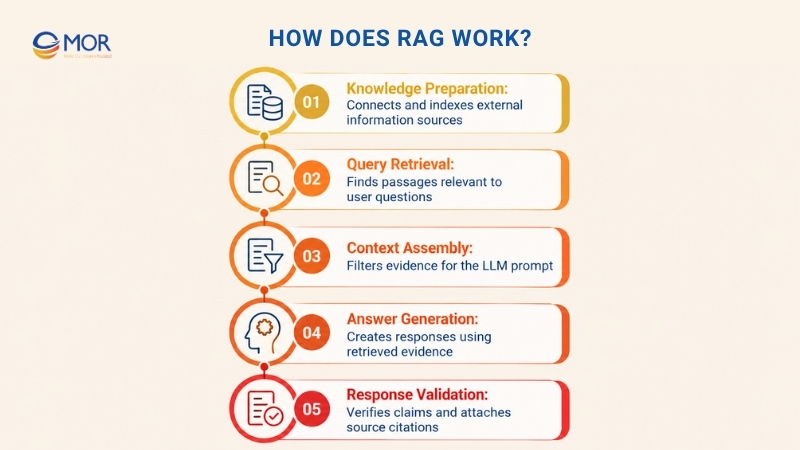
In the semantic search vs RAG workflow, RAG adds the following stages:
- Knowledge preparation: Connect company documents, databases, and external sources to a retrieval system. Prepare content, preserve source details, and build indexes appropriate for the application's data.
- Query retrieval: Search relevant information using embeddings, keyword matching, metadata filters, or hybrid retrieval. Select passages that address the user's question.
- Context assembly: Rank and filter retrieved material before adding it to the LLM prompt. Remove unrelated passages and account for the model's token limits.
- Answer generation: Send the user's question, relevant evidence, and response instructions to the LLM. The model creates an answer based on the supplied material.
- Response validation: Check generated claims against the retrieved evidence, attach source citations, and handle questions that lack sufficient information.
A real deployment demonstrates this architecture. Orion Health built Oribot using Amazon Bedrock, combining semantic retrieval with RAG to search more than 500,000 internal records. According to AWS, employees could retrieve answers in under a minute, and the system helped the support team reclaim about 50 staff hours per day.
The underlying retrieval technology varies across deployments. An AWS vector database setup may support semantic retrieval, but vector storage isn't mandatory for every RAG architecture.
Teams considering AI bot development should test retrieval quality before adding generation. Poor source selection can produce convincing answers based on incorrect evidence.
When Should You Use Semantic Search or RAG?
The choice between semantic search vs RAG depends on what users expect from the application. Some tasks require quick access to original documents, while others require a written answer assembled from several information sources.
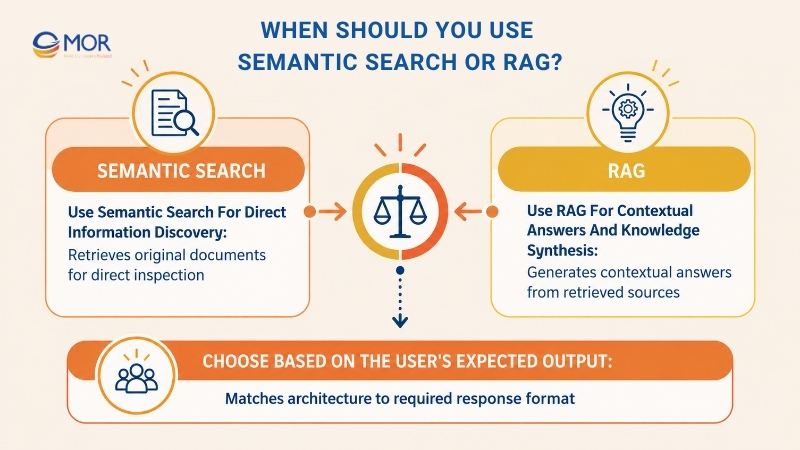
Use Semantic Search for Direct Information Discovery
Semantic search fits applications where users need to find and review existing content. It keeps source documents visible and avoids the cost of generating an answer for every query.
Common applications include:
- Enterprise document search: Find internal policies, reports, contracts, and technical documents based on natural-language queries. Users can open original files to verify details.
- E-commerce product discovery: Match product descriptions to customer requirements, even when shoppers use different terms from those stored in the catalogue.
- Content recommendation: Identify related articles, support resources, and relevant knowledge-base entries based on semantic similarity.
- Research applications: Retrieve academic papers, legal documents, or reference materials for users who need to inspect original sources and evaluate evidence.
Organisations assessing enterprise search software should pay attention to ranking quality, metadata filters, permissions, and indexing speed. These factors directly affect how useful the retrieved documents are.
Use RAG for Contextual Answers and Knowledge Synthesis
RAG fits applications where users expect a direct response instead of a list of search results. It can combine relevant passages and present information in a conversational format.
Common applications include:
- Customer support assistants: Retrieve approved product documentation and support policies to answer customer questions with relevant references.
- Enterprise knowledge assistants: Answer employee questions across internal documents, departmental resources, and knowledge bases.
- Technical support systems: Combine troubleshooting manuals, product documentation, and historical incidents to explain possible solutions.
- Research summarisation: Gather relevant passages from several documents and produce a focused answer covering the requested topic.
- Policy question answering: Generate responses based on approved company rules, with citations and review controls for sensitive decisions.
Morgan Stanley provides a practical example. According to OpenAI's Morgan Stanley case study, more than 98% of the firm's wealth-management advisor teams actively use its internal AI assistant. Reported access to relevant documents increased from 20% to 80%, supporting faster information retrieval and client service.
The deployment also relies on continuous evaluation to identify incorrect or unsupported responses. Enterprise RAG systems need the same attention to reliability after launch.
Choose Based on the User's Expected Output
The right architecture becomes easier to identify when teams define the result each user needs. Search accuracy alone cannot determine the value of a generated answer.
- Document-first experiences: Select semantic search when users must inspect source material, compare documents, or make their own decisions.
- Answer-first experiences: Select RAG when users need explanations, summaries, or direct answers supported by retrieved evidence.
- Risk-sensitive environments: Consider source-first retrieval or RAG with strict citation rules, validation, and human review.
- Mixed workloads: Combine search results with optional generated answers, allowing users to choose how they access information.
A RAG vs semantic search comparison should also account for usage patterns. If most users simply need to locate a file, the additional generation layer may create costs without improving task completion.
Can Semantic Search and RAG Work Together?
Yes. Semantic search can serve as the retrieval layer of a RAG system, allowing one search infrastructure to support document discovery and generated answers.
The semantic search vs RAG relationship is therefore complementary in many enterprise architectures. Several design patterns make this combination practical.
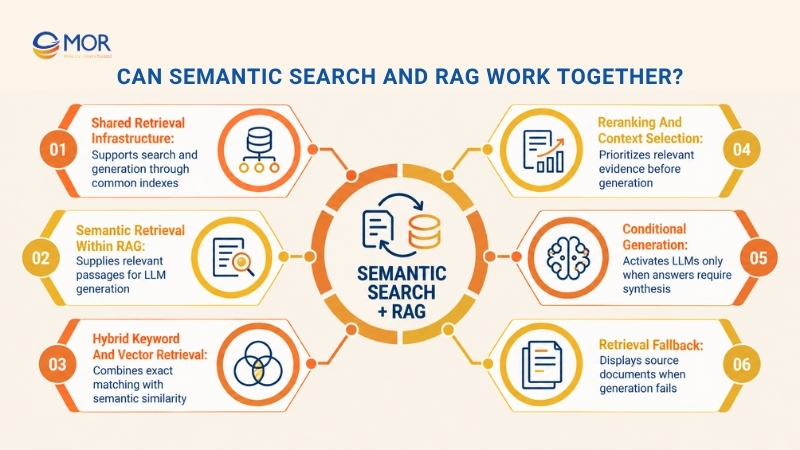
- Shared retrieval infrastructure: Use a common document index for search interfaces and RAG applications. The same indexed information can support document browsing and AI-generated answers.
- Semantic retrieval within RAG: Apply embedding-based similarity to retrieve passages that match a user's question. These passages then become evidence for LLM generation.
- Hybrid keyword and vector retrieval: Combine BM25 keyword matching with vector similarity. The lexical search vs semantic search distinction becomes useful when queries mix exact identifiers and conceptual language.
- Reranking and context selection: Reorder retrieved passages based on relevance before passing them to the LLM. This limits unrelated information in the generation prompt.
- Conditional generation: Return ranked documents for straightforward queries and activate an LLM when users request explanations or synthesis across sources.
- Retrieval fallback: Display source documents when generation fails, times out, or lacks sufficient evidence. Users can still access the information without relying on a generated response.
Hybrid retrieval and combined search-generation architectures serve different purposes. Hybrid search combines retrieval methods, whereas RAG adds generation to a retrieval pipeline.
For organisations building custom AI solutions, a shared retrieval layer creates flexibility. Teams can start with document search and add generation to selected workflows without rebuilding every data connection.
Limitations of Semantic Search
Semantic search improves information discovery, but it still depends on the quality of indexed information and retrieval logic. In the semantic search vs RAG debate, its main limitations concern finding and presenting relevant source material.
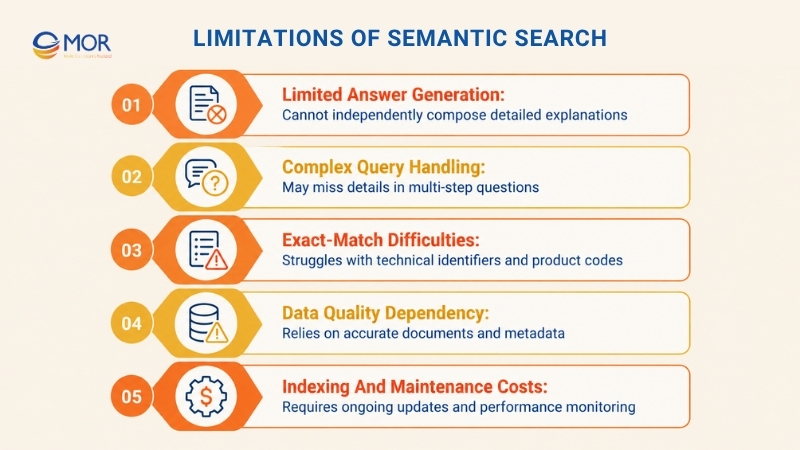
- Limited answer generation: The system returns relevant documents or passages but doesn't independently create detailed explanations. Users must combine information when answers span several sources.
- Complex query handling: Multi-step questions and ambiguous requests can produce incomplete results. Search engines may retrieve related passages without identifying every detail required to answer the question.
- Exact-match difficulties: Embeddings can treat similar product codes or technical identifiers as related concepts. Exact matching and structured filters are often better for SKU numbers, error codes, and dates.
- Data quality dependency: Missing metadata, outdated documents, and poorly divided text affect retrieval relevance. The system cannot reliably return information absent from its accessible sources.
- Indexing and maintenance costs: Large collections require embedding generation, index storage, updates, and performance monitoring. Changing embedding models may also require rebuilding existing vector indexes.
These limitations make retrieval testing necessary. Track precision, recall, ranking quality, and failed queries to identify gaps before users encounter them.
Limitations of RAG
RAG adds language generation to the retrieval pipeline, which introduces new technical and operational risks. The semantic search vs RAG cost difference becomes more apparent as query volume and answer length increase.
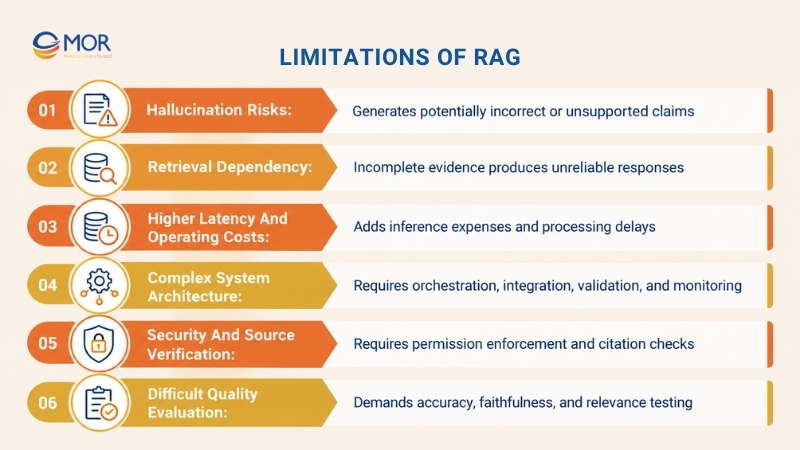
- Hallucination risks: LLMs may generate incorrect or unsupported statements despite receiving relevant documents. Retrieved evidence improves grounding but doesn't guarantee accurate answers.
- Retrieval dependency: Missing or conflicting passages can lead to incomplete responses. If an outdated policy ranks above the current version, the model may generate an answer using obsolete information.
- Higher latency and operating costs: RAG adds prompt processing and model inference to retrieval expenses. Token usage, model choice, and answer length affect cost per query. Architecture decisions can change these economics. For example, Ring reported a 21% decrease in the cost of scaling each additional locale after redesigning its RAG support chatbot.
- Complex system architecture: Production applications need prompt orchestration, source management, model integration, validation, and monitoring. Each component creates additional maintenance work.
- Security and source verification: Retrieval systems must respect document permissions before passing information to an LLM. Generated citations also need checks against the actual source passages.
- Difficult quality evaluation: Teams must measure retrieval relevance, answer correctness, faithfulness, and citation accuracy. A fluent response may still contain errors that aren't immediately visible.
What Are the Latest Trends in Semantic Search and RAG?
Recent advances in semantic search vs RAG focus on retrieval quality, more complex questions, and stronger source verification. Teams are expanding beyond basic vector similarity and single-step question answering.
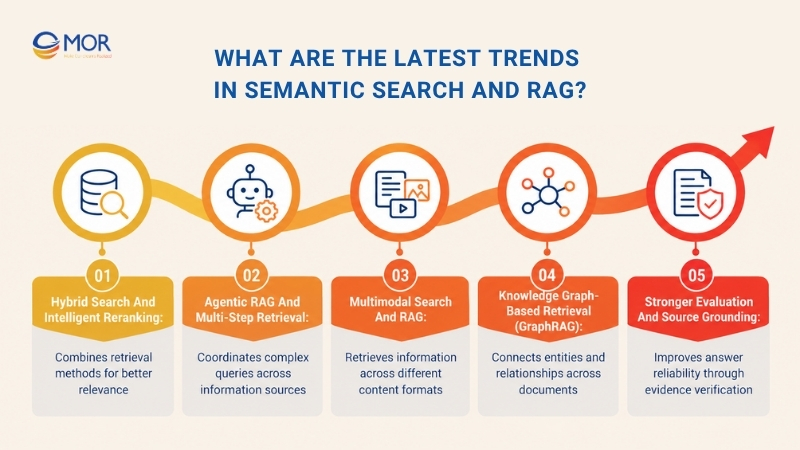
Several developments are shaping enterprise AI search:
- Hybrid search and intelligent reranking: Search platforms increasingly combine BM25, vector similarity, and second-stage ranking. Azure AI Search supports hybrid retrieval through Reciprocal Rank Fusion (RRF), while MongoDB added native reranking capabilities in 2026. These tools address the weaknesses of relying on one retrieval method.
- Agentic RAG and multi-step retrieval: AI agents can divide complex questions into smaller queries, retrieve evidence across sources, and refine results before generation. Microsoft's agentic retrieval supports query planning, parallel retrieval, and combined evidence for enterprise assistants.
- Multimodal search and RAG: Retrieval is expanding beyond text to images, diagrams, audio, and video. Amazon Bedrock Knowledge Bases supports multimodal retrieval, allowing applications to locate information across different content types when supported by the chosen configuration.
- Knowledge graph-based retrieval (GraphRAG): Knowledge graphs connect entities and relationships across documents. The graph RAG vs vector RAG distinction concerns graph-based relationships versus embedding similarity. Microsoft Research's GraphRAG addresses broad questions requiring information across an entire document collection.
- Stronger evaluation and source grounding: Retrieval metrics are increasingly paired with answer faithfulness, citation checks, and quality monitoring. Teams can identify whether an incorrect response originated in document retrieval, evidence selection, or model generation.
The direction is toward better retrieval controls and selective generation. Companies still need to match each architecture to their data and user requirements rather than adopt every new AI search technique.
MOR Software's Approach to Semantic Search and RAG Development
MOR Software supports businesses developing AI-based search, knowledge retrieval, and generative AI applications. Our services cover feasibility assessment, data engineering, custom model development, system integration, and deployment.
For companies evaluating semantic search vs RAG, we focus on technical feasibility and measurable business requirements before selecting an architecture.
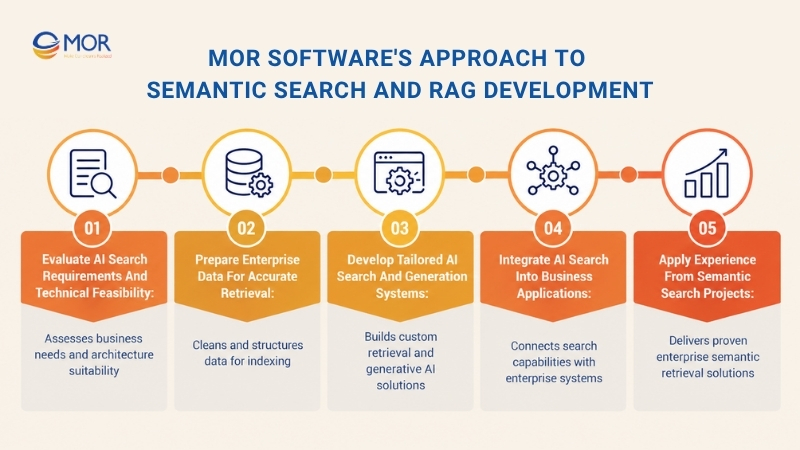
- Evaluate AI search requirements and technical feasibility: Our AI Feasibility Assessment service reviews business goals, source data, system dependencies, and expected results. This assessment helps teams decide if retrieval-only search meets their needs or if generation adds value.
- Prepare enterprise data for accurate retrieval: Our Data Engineering capabilities cover data acquisition, cleaning, and annotation. We assess document quality, structure, and data access requirements to support accurate indexing and information retrieval.
- Develop tailored AI search and generation systems: MOR Software's Custom Model Service and Generative AI Integration capabilities support search and knowledge-based AI projects. Our documented technology stack includes Python, FastAPI, Qdrant, and LLM technologies that can form part of a proposed retrieval or RAG architecture.
- Integrate AI search into business applications: Our engineering teams support API integration, backend development, and cloud deployment. Companies can connect search capabilities to internal knowledge bases, business applications, and customer-facing AI assistants.
- Apply experience from semantic search projects: One documented example is an AI-powered semantic search transformation we delivered for a Japanese enterprise. Over 12 months, our team completed 40 man-months of engineering work, combining full-text and semantic retrieval through Python, FastAPI, Elasticsearch, and Databricks. The project addressed Japanese-language processing and search relevance across large product catalogues.
Our project experience supports discussions about retrieval design, data preparation, and system integration. RAG architecture and performance requirements are assessed separately for each proposed application.
Businesses looking for a top consultant for semantic search strategy should review project evidence, technical capabilities, and testing methods before choosing a partner. MOR Software's AI consulting services for enterprises provide a starting point for assessing these requirements.
Conclusion
Choosing between semantic search vs RAG starts with the user's task. Semantic search supports fast, source-based information discovery, while RAG adds natural-language answers and knowledge synthesis. Their costs, risks, and maintenance needs should guide your decision. MOR Software supports businesses assessing AI search requirements, preparing enterprise data, and building tailored solutions.
If you're planning an AI search project, contact us to discuss your technical needs and identify a practical development approach.
"Evolution is not a destination, it is a disciplined journey of innovation."
Phung Van Tu


CEO MOR AI
MOR SOFTWARE
Frequently Asked Questions (FAQs)
Is semantic search the same as RAG?
No. Semantic search vs RAG describes two related approaches. Semantic search retrieves existing information based on meaning, whereas RAG adds a generative model to create responses using retrieved evidence. Semantic search can form part of a RAG system.
Does RAG always use semantic search?
No. RAG can retrieve information through keyword search, vector similarity, structured queries, or hybrid methods. Semantic retrieval is common because it helps match questions to related content when the wording differs.
Can RAG work without a vector database?
Yes. RAG can use BM25 search, SQL databases, knowledge graphs, or API-based retrieval. Vector databases are useful for embedding similarity, but they're not a mandatory component of every RAG system.
Does semantic search require a large language model?
Semantic search doesn't require a generative LLM. Many implementations use embedding models and ranking algorithms to identify relevant documents. Generative models become necessary when the application must produce original natural-language answers.
What is the difference between vector search and RAG?
The semantic search vs vector search vs RAG distinction concerns retrieval goals, retrieval methods, and generation. Vector search compares numerical representations, semantic search aims to retrieve meaning-related content, and RAG generates answers using external information.
Can semantic search generate answers like RAG?
A retrieval-only semantic search system doesn't generate new answers. Applications can add an LLM or another generation component to produce explanations based on search results, creating a retrieval-augmented generation workflow.
Is RAG more accurate than semantic search?
They require different accuracy measures. Semantic search is judged on retrieval relevance and ranking quality, while RAG requires checks for generated answer correctness and grounding. Neither architecture automatically produces better results for every task.
Which is faster, semantic search or RAG?
Semantic search generally responds faster because it returns retrieved results without waiting for an LLM to generate text. RAG introduces extra processing, though caching, smaller models, and response design can improve its performance.
Does RAG eliminate AI hallucinations?
No. RAG gives LLMs external evidence, which can lower unsupported generation in some cases. Errors still occur when retrieval returns irrelevant documents, the model misreads sources, or the available information is incomplete.
When should a business upgrade from semantic search to RAG?
Consider RAG when users regularly need explanations, summaries, or answers drawn from several documents. Evaluate retrieval quality, generation costs, response accuracy, and user demand before adding an LLM to an existing search system.
Share


Make Our-Dreams Realized


© 2023 . MOR Software. All Rights Reserved
Sitemap
Privacy Policy
Terms of Use

Rate this article
0
over 5.0 based on 0 reviews
Your rating on this news:
Name
*Email
*Write your comment
*Send your comment
1