


13 Best AI Chatbot Solutions for Customer Support [2026 Review]
Customer support teams often struggle with rising ticket volumes, slow response times, and inconsistent service across channels. AI chatbot solutions promise faster replies, lower costs, and smarter automation, but choosing the right conversational AI platform can feel overwhelming. In this guide, MOR Software will introduce the top AI-powered chatbot solutions for customer service and help you compare the leading platforms to find the right fit for your business.
What Is An AI Chatbot Solution?
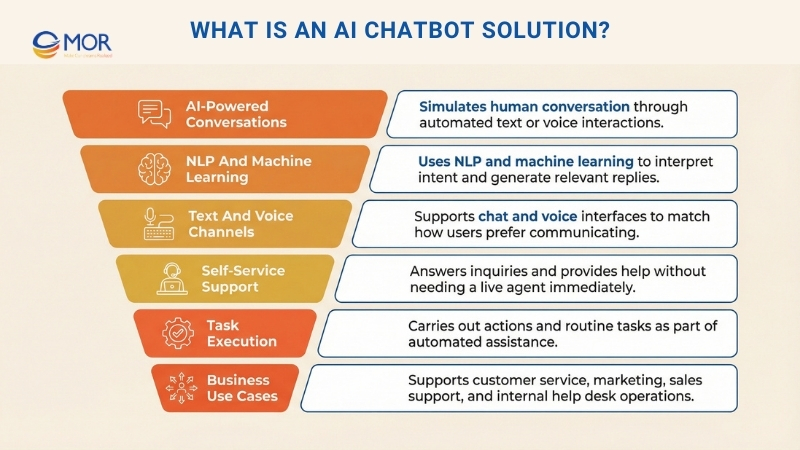
An AI chatbot is a software application powered by artificial intelligence, particularly natural language processing (NLP) and machine learning, that can replicate human conversations through text or voice interactions. An AI chatbot solution allows these systems to respond to inquiries, carry out tasks, and deliver support without requiring a live agent at that moment. Businesses commonly rely on this technology for AI chatbot customer service, as well as for marketing activities, sales support, and internal help desk operations.
If you want a quick primer on how does AI work , it helps to start with how NLP models learn from data.
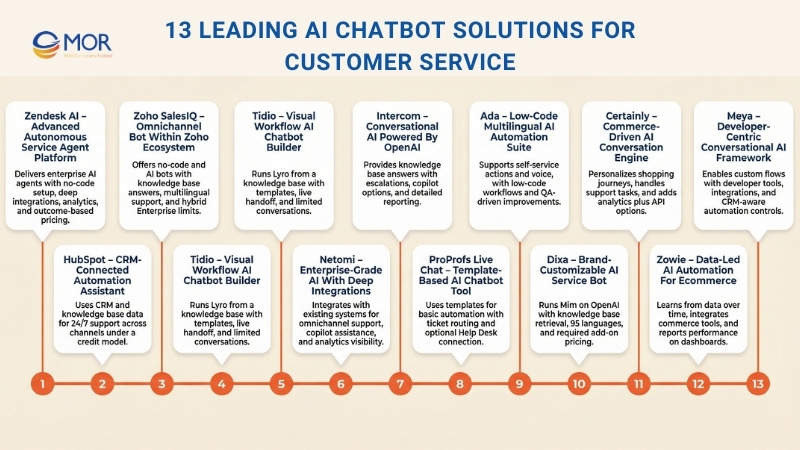
13 Leading AI Chatbot Solutions For Customer Service
Below is a curated list of the top AI-powered chatbot solutions designed to strengthen customer service operations in 2026.
1. Zendesk AI – Advanced Autonomous Service Agent Platform
Starting price | Free trial | Key features |
From $1.00 per automated resolution View full Zendesk pricing plans | 14 days | • Agentic AI • Context-aware reasoning • Hybrid conversation flows • Knowledge base connectivity • Goal-driven automation • Business process procedures • System-level actions and integrations • Multi-agent framework • Real-time reasoning oversight • No-code AI agent builder using natural language • Custom personas and brand voice • AI-powered quality assurance • Omnichannel engagement • Outcome-based pricing model |
Zendesk AI agents are among the most independent customer support bots available today. They are trained on more than 18 billion real conversations to manage complex inquiries and understand customer experience nuances from day one, without requiring technical resources. As an enterprise AI chatbot solution, this platform enables you to deliver 24/7 multilingual assistance across your preferred communication channels while tailoring a chatbot persona that aligns with your brand identity.
To launch your AI agent, you only need to connect your knowledge base, and the system becomes operational within minutes. If you need deeper control, you can rely on the intuitive no-code builder to design engaging, interactive, and personalized conversation workflows. These AI systems also connect with your internal business tools, allowing them to access extensive data for highly tailored responses that increase customer loyalty. In addition, the platform scales smoothly to support your automation goals both now and as your organization grows.
The platform’s analytics and QA capabilities provide valuable insights to refine performance. It automatically reviews conversation data and produces clear reports that highlight what to automate or adjust next. Built-in issue detection helps maintain service standards, and sentiment analysis improves conversation paths to create a stronger customer experience.
Pricing: Plans begin at $1.00 per automated resolution. A 14-day free trial is available.
Pros | Cons |
• Resolution-focused approach • Transparent pricing structure • High configurability • Quick deployment and strong scalability • Native Zendesk integration • Low-code customization • AI-enhanced knowledge management • Unified customer experience ecosystem • Advanced analytics and QA tools • Strong data protection standards • Global infrastructure • Centralized support management | • Trial period limited to 14 days |
Customer feedback highlights:
- "The platform includes strong automation capabilities and reusable macros, allowing fast and consistent replies to frequent customer questions."
- "Zendesk provides AI-powered support bots and smart ticket routing to accelerate issue resolution."
- "The AI IT Agents functionality automates repetitive requests and improves response speed."
2. HubSpot – CRM-Connected Automation Assistant
Starting price | Free trial | Key features |
$9 per user/month billed annually (limited functionality) | 14 days | • Knowledge base integration • Seamless handoff to live agents • Multichannel support |
HubSpot delivers software for marketing, sales, content management, operations, and customer service. The company reports that its AI service agent, Breeze, automatically handles more than 65% of conversations and remains active 24/7 as part of its broader AI chatbot solutions.
The chatbot draws on existing HubSpot CRM data and connected knowledge base content to deliver responses that are accurate and tailored to each user. In addition, customers can interact with the AI agent across multiple channels, including Facebook, WhatsApp, and email.
You should note that customer agents operate under a credit-based model, which means you may need to buy extra credits beyond your monthly or annual plan.
Pricing: A free plan with limited features is available. Paid subscriptions begin at $9 per user per month, billed annually.
Recommended reading: Discover how HubSpot connects with Zendesk and review a comparison between Zendesk and HubSpot.
Pros | Cons |
• Built-in CRM connectivity • Flexible scaling options • Simple and modern interface | • Higher pricing tiers • Initial learning curve |
Customer feedback highlights:
- "The automation capabilities save our team many hours each week, and AI tools like Breeze help us respond to customers faster and more intelligently."
- "Some advanced capabilities, including custom reporting and deeper automation, require higher-tier subscriptions."
- "It does not provide the same level of flexibility or depth as dedicated support platforms such as Zendesk or Freshdesk."
3. Zoho SalesIQ – Omnichannel Bot Within Zoho Ecosystem
Starting price | Free trial | Key features |
$7 per operator license/month (includes 1 custom chatbot) | 15 days | • No-code chatbot templates • Answer Bot powered by Zia or OpenAI • Multilingual chatbot support |
Zoho SalesIQ offers several chatbot options, including fully custom bots, AI-powered bots called Answer Bot, and a hybrid combination of both. For custom bots, the visual builder includes a drag-and-drop interface that lets you design predefined replies and structured conversation flows without writing code. These AI chatbot platforms support up to 30 languages and can automatically recognize the language of incoming messages.
The Answer Bot integrates directly with a company’s knowledge base to retrieve answers, help articles, and internal documentation. Users can expand the bot’s vocabulary with additional responses to better reflect visitor terminology and build a structured library of frequently used terms.
For more advanced needs, the Answer Bot can connect with Zia or OpenAI to generate replies that require information beyond the existing knowledge base. Zoho also provides a hybrid model that combines standard custom chatbot flows with AI-driven responses. However, access to both AI and hybrid chatbot automation systems is limited to the Enterprise plan.
Pricing: Paid subscriptions begin at $7 per month, billed annually. A free plan for three operators and a 15-day free trial are available.
Recommended reading: Explore how Zoho connects with Zendesk and compare Zendesk versus Zoho features.
Pros | Cons |
• Simple setup process • Direct integration with Zoho CRM • Social media connectivity | • AI and hybrid bots restricted to Enterprise plan • Some users report bugs |
Customer feedback highlights:
- "It is an excellent tool for monitoring leads, sales activity, quotes, and many additional functions."
- "The no-code chatbot builder makes it easy for non-technical users to create a bot."
- "Sometimes bots activate at incorrect times, and the chat may prevent responses when a bot is triggered."
4. Tidio – Visual Workflow AI Chatbot Builder
Starting price | Free trial | Key features |
$32.50 per user/month (includes 50 AI conversations) | 7 days | • Real-time performance analytics • Smooth handoff to live agents • Knowledge base–restricted data source |
Tidio’s Lyro AI agent stands out with a 67% automated resolution rate and seamless connections with other systems, including Zendesk. Its visual chat flow builder is another strong point, allowing users to begin quickly with ready-made templates that can be modified without difficulty. For businesses exploring AI chatbot marketing solutions, this tool provides structured conversation flows that support lead capture and engagement.
The company emphasizes that Lyro pulls information strictly from its internal knowledge base, which improves response accuracy and reduces the risk of AI-generated errors. At the same time, this limitation may restrict the chatbot automation system when delivering a broader and more dynamic customer experience.
Lyro is available as a standalone product with a set number of AI conversations that renew each month. It can also be included within other subscription plans, though the Starter and Growth packages provide only 50 AI conversations as a one-time allocation.
Pricing: The standalone Lyro AI Agent plan begins at $32.50 per user/month and includes 50 AI conversations.
Pros | Cons |
• 67% automated resolution rate • User-friendly chat flow builder • Integration with Zendesk | • AI chat capabilities restricted in lower-tier plans • Pricing may be considered high |
Customer feedback highlights:
- "Lyro handles most routine questions, and I appreciate the ability to design custom flows that support keyword-based searches."
- "The system allows you to route conversations to specific team members, which helps with account-related issues and sensitive requests."
- "Compared with some competing tools, the pricing feels relatively high, especially when advanced features are required."
5. Gorgias – Retail-Focused AI Support Assistant
Starting price | Free trial | Key features |
$10 per agent/month billed monthly | 7 days | • AI agents tailored for ecommerce chatbot solutions • Shopify integration • Automated handling of routine requests |
Gorgias provides two AI agents built for online retailers: a shopping assistant and a support agent. These AI-driven chatbot tools manage common tasks such as processing return inquiries and responding to FAQs, while also taking actions like escalating sensitive cases and issuing refunds. For brands reviewing AI chatbot solutions for customer support in ecommerce, this platform focuses heavily on retail workflows and aligns closely with B2B solutions AI chatbots user search data related to order status, refunds, and product questions.
The platform makes it simple to match the AI agent vs chatbot with your brand tone, as the software analyzes your company policies and internal rules to prevent misinformation. If the intelligent chatbot system cannot locate the correct information, it transfers the conversation smoothly to a human representative.
To meet shopper expectations, Gorgias operates across several channels, including social media, email, and SMS, though SMS requires an additional purchase. It also connects with ecommerce platforms such as Shopify, WooCommerce, and Magento, with some integrations reserved for higher-tier plans.
Pricing: The Starter package costs $10 per agent per month and includes 50 helpdesk tickets.
Pros | Cons |
• Strong ecommerce capabilities • Unified support environment • Easy to use interface | • Certain features require add-ons or premium plans • Performance may slow with high ticket volumes |
Customer feedback highlights:
- "What stands out most is how intuitive and straightforward the platform feels to use."
- "Some automation options could offer more flexibility to better match specific workflows."
- "If you handle a large number of tickets, the system may become unstable and integrations can crash frequently."
6. Netomi – Enterprise-Grade AI With Deep Integrations
Starting price | Free trial | Key features |
Contact sales team | 14 days | • AI copilot assistance • Omnichannel coverage • Customer intelligence insights |
Netomi connects directly with existing backend customer service systems such as Zendesk, which allows businesses to continue using tools they already know. For example, this platform can retrieve customer and order details from a CRM to check and communicate order status accurately.
The chatbot supports omnichannel communication, enabling companies to launch the AI agent across email, social media, live chat, and messaging applications. This feature allows customers to receive help through their preferred channel. It also preserves conversation context when users switch between platforms during a single interaction.
Offering real-time visibility into customer conversations, the AI copilot assists human agents in resolving complex cases faster and more effectively. In addition, the platform includes analytics and reporting capabilities that help teams track patterns, evaluate performance, and identify opportunities for improvement. As one of enterprise AI chatbot solutions, it focuses strongly on deep system integrations and operational visibility.
Pricing: Contact Netomi directly for pricing details.
Pros | Cons |
• Detailed analytics capabilities • Broad system integrations • Supportive customer success team | • Setup process can be slow • Pricing is not publicly disclosed |
Customer feedback highlights:
- "Training our AI to resolve and deflect thousands of tickets has saved our company millions of dollars."
- "The out-of-the-box integration with various customer service management tools such as Zendesk and Gladly is very useful."
- "The initial implementation requires significant time and focus, so for a small team like ours, it took longer than expected to see results."
7. Intercom – Conversational AI Powered By OpenAI
Starting price | Free trial | Key features |
$29 per user/month and $0.99 per resolution billed annually | 14 days | • Advanced conversational AI capabilities • Deep integration with Intercom tools • Reporting and analytics |
Intercom developed the Fin chatbot in partnership with OpenAI to enhance its customer service ecosystem. Beyond handling repetitive tasks, this conversational AI chatbot solution can interpret complex questions, ask follow-up clarifications, and simplify difficult topics for users. Businesses can connect Fin with other Intercom products, including messaging, help center, and live chat.
Fin retrieves information strictly from your company’s existing knowledge base and transfers more advanced issues to trained team members when needed. Human agents can also collaborate with Fin in copilot mode, though unlimited copilot usage requires an additional purchase.
Fin also includes analytics and reporting features that provide visibility into customer interactions. These insights allow businesses to evaluate chatbot performance, measure customer satisfaction, and uncover opportunities for improvement. With data from conversations, companies can adjust their support strategies and refine Fin’s responses.
Pricing: Plans begin at $29 per seat/month, billed annually, plus $0.99 per resolution. A 14-day free trial is available.
Recommended reading: Discover how Intercom connects with Zendesk and review a comparison between Zendesk and Intercom.
Pros | Cons |
• Strong handling of routine tasks • Easy setup process • Modern and clean interface | • Copilot functionality requires add-on purchase • Pricing can be high |
Customer feedback highlights:
- "It responds very well to simple questions when relevant content is available."
- "The implementation is straightforward, and agents need very little additional training."
- "Compared to other AI chatbot solutions we reviewed, Fin’s pricing appears expensive, particularly for teams managing large ticket volumes."
8. Ada – Low-Code Multilingual AI Automation Suite
Starting price | Free trial | Key features |
Contact sales team Explore additional pricing details | 14 days | • Omnichannel communication • Autonomous AI responses • Integration with business systems |
Ada is an automated assistant powered by artificial intelligence and natural language processing, which allows it to interpret and respond to everyday language in a conversational way. Its functionality also includes voice support, enabling it to manage phone calls and address common customer questions. The system reduces repetitive tickets through a self-service experience that lets customers update personal details, upgrade subscriptions, book appointments, and complete payments.
This conversational AI platform delivers tailored replies based on a customer’s information, intent, and preferences, including proactive offers and recommendations in more than 50 languages. Businesses can design their bots using a low-code interface, building customized workflows without technical expertise.
After deployment, you can continue adjusting the bot’s tone and operational rules to improve performance. Companies can also create variations of the same intelligent chatbot system to compare results and measure differences. In addition, built-in quality assurance tools analyze customer transcripts to uncover improvement opportunities.
Pricing: Contact Ada for detailed pricing. A 14-day free trial is available.
Recommended reading: Discover how Ada connects with Zendesk.
Pros | Cons |
• Support for multiple languages • Integration with Zendesk • Onboarding assistance | • Limited customization in some cases • Pricing not publicly listed |
Customer feedback highlights:
- "Ada helped our small support team handle most easy-to-resolve requests, giving agents more time to focus on backlog tasks."
- "The platform is user-friendly and gives autonomy to users without programming knowledge."
- "It works well as a chatbot, but customization can feel limited, especially for businesses managing several product lines."
9. ProProfs Live Chat – Template-Based AI Chatbot Tool
Starting price | Free trial | Key features |
$0 per user/month (single user) | Not available | • Ticket assignment and routing • Smooth transfer to human agents • No-code chatbot builder |
As one of the few completely free options for a single user, ProProfs Live Chat provides the essential features required to build a functional AI assistant. The ready-made chatbot templates are grouped by purpose and can be adjusted to match your business requirements.
The platform focuses on improving customer experience through simple automation of routine requests and easy transitions from AI agents to human representatives. For a more complete setup, the company suggests connecting the chatbot to ProProfs Help Desk, which allows automated ticket creation and routing to the appropriate team members.
These AI-powered support bots are trained using your company’s data and can be tested before going live. After launch, the chatbot automation system operates 24/7, delivering accurate responses based on the resources you configure.
Pricing: ProProfs Live Chat is free for individual users. Team plans begin at $39.99.
Pros | Cons |
• Free entry-level plan • Flexible and editable templates • Comprehensive core features | • Basic chatbot capabilities • Occasional performance delays |
Customer feedback highlights:
- "I appreciate the team management features that allow us to monitor and supervise chats easily."
- "It enables us to connect with customers more quickly and provide immediate support."
- "For a short period, we were unable to track accurate performance data for our support representatives through the system."
10. Certainly – Commerce-Driven AI Conversation Engine
Starting price | Free trial | Key features |
Contact sales team | 14 days | • Automation of routine support tasks • Conversation performance analytics • Customer sentiment tracking |
Certainly builds AI agents specifically for ecommerce teams that want to automate and personalize customer interactions. These AI-driven chatbot tools connect directly with an online store and integrate with systems such as a CRM to retrieve and share customer information.
The chatbot can suggest products, support upselling, guide shoppers through checkout, and handle requests related to complaints, returns, refunds, and order tracking. It also collects zero-party data, which is information customers intentionally provide during conversations. Support teams can use this data to tailor shopping experiences and increase long-term customer value.
The platform includes analytics features that monitor user interactions, giving businesses insight into customer behavior and chatbot effectiveness. These reports help teams refine conversation flows and improve performance over time. In addition, it provides multiple APIs and webhook options, which allow automated communication between applications for reporting and data exchange.
Pricing: Contact the sales team for a customized quote. A 14-day free trial is available.
Recommended reading: Discover how Certainly connects with Zendesk.
Pros | Cons |
• Detailed KPI tracking • User-friendly interface • Flexible API and webhook support | • Limited customization options • Performance may slow with large data volumes |
Customer feedback highlights:
- "Their webhook configuration tools allow us to provide an intelligent bot that supports customer self-service."
- "The chatbot development quality is excellent, and the integration with Zendesk works smoothly."
- "The system can freeze when processing large amounts of data, which increases the risk of incorrect changes."
11. Dixa – Brand-Customizable AI Service Bot
Starting price | Free trial | Key features |
$89 per agent/month billed annually | Available | • Autonomous AI replies • Multilingual capabilities • Brand-level customization |
Dixa’s customer support chatbot, Mim, runs on OpenAI and is designed for businesses across industries such as retail, travel, and financial services. This platform is part of broader AI chatbot solutions for customer support, and it can manage up to 60% of conversations independently. When it encounters more complex questions, it transfers the interaction smoothly to a human representative.
Mim retrieves answers directly from your company knowledge base, which keeps responses aligned with your latest documentation. When connected with other systems like a CRM or ecommerce platform, this AI-powered support bot can also perform actions such as updating customer information. In addition, interactions remain consistent with your brand voice through customized instructions and defined personas.
The system understands conversational context, allowing it to deliver personalized assistance and respond in more than 95 languages. To activate the Dixa chatbot, you must subscribe to a base plan and add the AI agent option at $0.40 per conversation. The company also requires a minimum of seven seats.
Pricing: Plans begin at $89 per agent/month, billed annually. A free trial is available.
Pros | Cons |
• Broad language coverage • Advanced brand customization • Easy-to-use interface | • AI agent requires add-on purchase • Higher pricing structure |
Customer feedback highlights:
- "The platform runs reliably and offers a clean, user-friendly interface that is simple to navigate."
- "The AI features perform well, especially for case summaries and translations, and provide strong support."
- "Setting up different chat workflows has sometimes been challenging and time-consuming for our technical team."
12. Zowie – Data-Led AI Automation For Ecommerce
Starting price | Free trial | Key features |
Contact sales team | Not available | • Omnichannel coverage • Chatbot analytics and customer insights • Autonomous AI responses |
Zowie’s AI agent relies on data to determine how to answer customer inquiries, using machine learning to improve accuracy over time. This solution is widely adopted by ecommerce brands that sell products in categories such as cosmetics, fashion, home appliances, and electronics.
The customer service chatbot gathers information from various sources, including past conversations, knowledge bases, FAQ sections, and active chat sessions. It also integrates with ecommerce platforms, CRM systems, and other business tools to exchange data and maintain consistency across channels.
Zowie includes analytics and reporting capabilities that give businesses insight into chatbot effectiveness, customer satisfaction levels, and improvement opportunities. These insights use generative AI to highlight revenue impact, identify shopper preferences, and update a real-time dashboard.
Pricing: Contact Zowie directly for pricing details. No free trial is available.
Recommended reading: Discover how Zowie connects with Zendesk.
Pros | Cons |
• Simple user experience • Smooth automation workflows • Clear and intuitive interface | • Pricing not publicly listed • Some limits in integrations and customization |
Customer feedback highlights:
- "Zowie demonstrates that AI can genuinely deliver efficient customer support."
- "The analytics provide very detailed data, but I would like more practical and easily accessible insights for instant feedback."
- "We feel the user interface could improve, especially since our previous provider allowed direct access to Shopify features, which we would like to see here."
13. Meya – Developer-Centric Conversational AI Framework
Starting price | Free trial | Key features |
$99 per month | 14 days | • Custom conversation flows • Automation of routine tasks • Advanced developer toolkit |
Meya positions itself as an automation environment built around three main elements: Grid, Orb, and Console. The Grid functions as the backend layer, where developers can code conversational workflows using several programming languages. The Orb acts as a ready-made chatbot interface that businesses can adapt and embed into their application, platform, or website. Meanwhile, teams design, manage, and launch conversational experiences through the Console. For organizations seeking AI chatbot development solutions, this framework offers a high level of control and flexibility.
The platform allows businesses to create and host complex bots that integrate directly with backend services. Meya also includes a web-based IDE, which simplifies the development process within an online integrated coding environment.
Your chatbot can monitor all incoming messages connected to your CRM and reply automatically when it has the correct answer. You can configure the bot to pause when a conversation is assigned to a human agent and resume once it is unassigned.
Pricing: Plans begin at $99 per month. A 14-day free trial is available.
Pros | Cons |
• Strong business system integrations • High customization flexibility • Clean and modern interface | • Higher pricing tier • May be complex for beginners |
Chatbots For Customer Service Comparison Chart
To help you compare leading AI chatbot solutions quickly, the table below summarizes pricing, free trial availability, and each platform’s core strength. This overview allows you to evaluate different AI chatbot platforms side by side before making a decision.
Software | Best for | Starting price | Free trial |
Zendesk | Autonomous AI agents | As low as $1.00 per automated resolution | 14 days |
HubSpot | Handling routine tasks | $9 per user/month billed annually (limited tools) | Unavailable |
Zoho SalesIQ | Integration within Zoho ecosystem | $7 per operator license/month (1 custom chatbot) | 15 days |
Tidio | Simple flow builder | $32.50 per user/month (includes 50 AI conversations) | 7 days |
Gorgias | Ecommerce integrations | $10 per user/month (50 tickets/month) | 7 days |
Netomi | Deep system integrations | Contact sales | Unavailable |
Intercom | Natural AI conversations | $29 per user/month and $0.99 per resolution billed annually | 14 days |
Ada | Low-code chatbot tools | Contact sales | 14 days |
ProProfs Live Chat | Drag-and-drop templates | $0 per user/month (single user) | Unavailable |
Certainly | Ecommerce-focused teams | Contact sales | 14 days |
Dixa | Advanced customization | $89 per agent/month billed annually | Available |
Zowie | Analytics and reporting | Contact sales | Unavailable |
Meya | Developers | $99 per month | 14 days |
How Do Modern AI Chatbot Solutions Work?
Early chatbots functioned mainly as interactive FAQ tools that depended on a fixed list of common questions paired with prewritten answers. These basic systems could not interpret natural language, so users had to choose from simple keywords or preset phrases to continue the conversation. Such traditional bots were unable to manage complex requests and often failed to answer even simple questions if they were not programmed in advance.
As technology advanced, chatbot algorithms evolved to support more detailed rule-based logic and natural language processing, which allowed customers to ask questions in a conversational style. This progress introduced a new generation of intelligent chatbot systems that understand context and use machine learning to improve over time. With exposure to more human language, these AI systems refine their ability to recognize patterns and predict user needs more accurately.
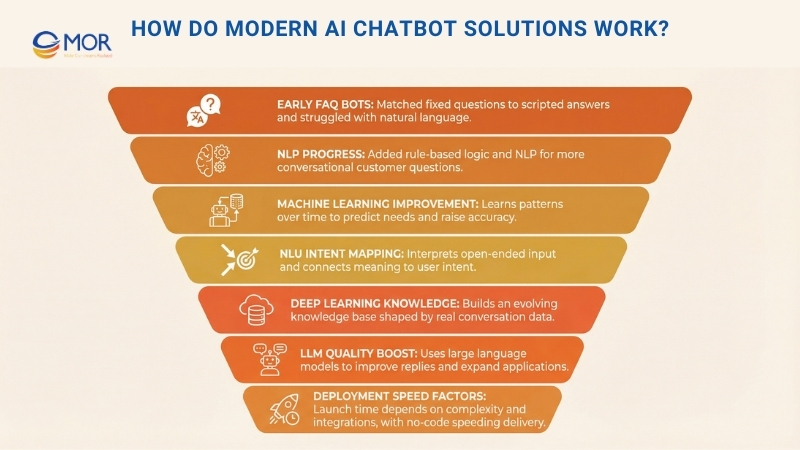
Today, modern AI chatbot solutions rely on natural language understanding (NLU) to interpret open-ended user input, handling everything from spelling mistakes to translation challenges. Advanced conversational AI tools then connect that meaning to the specific intent behind the request and generate an appropriate reply. These systems combine machine learning and deep learning, which are related but distinct elements of artificial intelligence, to build a detailed and evolving knowledge base shaped by real interactions. For a clearer breakdown of AI vs ML vs DL, it is useful to look at how each layer contributes to recognizing user intent and generating appropriate responses. Recent progress in large language models (LLMs) has further increased response quality, leading to higher customer satisfaction and broader applications for AI-powered chatbot technology.
The time required to develop an AI chatbot solution depends on several factors, including the AI tech stack, development tools, chatbot complexity, required features, data availability, and integration with other systems or databases. When using user-friendly no-code or low-code AI chatbot platforms, businesses can launch intelligent assistants much more quickly.
Key Benefits Of AI Chatbot Solutions For Customer Support
As artificial intelligence continues to advance, the advantages of using AI chatbot solutions grow as well. Below are some of the key benefits businesses experience when adopting AI bots for customer service.
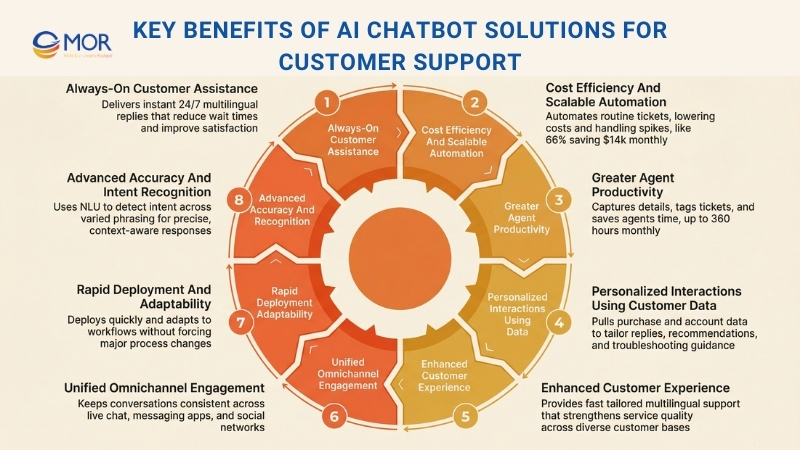
Always-On Customer Assistance
Chatbots allow companies to deliver responses to global and multilingual audiences at any time of day, so business hours, holidays, and time differences no longer create barriers. Unlike human representatives who may face limits in language skills and availability, these AI systems reply instantly, which shortens wait times and improves customer satisfaction and loyalty.
Cost Efficiency And Scalable Automation
Support departments can manage higher volumes of interactions while reducing expenses when conversational AI tools handle common inquiries, support routine tasks, and route incoming requests. AI-powered support bots shield service teams from sudden increases in inbound support tickets, which gives agents more time to focus on complex and high-impact responsibilities. Beauty brand HelloSugar automates 66 percent of customer questions with AI agents and saves $14k per month, enabling it to expand to twice as many locations without increasing staff numbers.
Greater Agent Productivity
Intelligent chatbot systems improve agent productivity when they take over repetitive duties and support everyday service tasks, which reduces manual effort and simplifies workflows. Along with handling many requests independently, these AI-driven chatbot tools can gather important details for human agents and direct each case to the most suitable representative.
Cosmetics company Lush relied on its AI assistant to manage routine questions, which allowed support staff to dedicate more attention to complicated cases that demand human expertise. In addition, the bot collects customer details at the start of the interaction and automatically applies tags and labels to new tickets, giving agents the background they need to resolve problems more quickly. These improvements help Lush save around 5 minutes per ticket and approximately 360 agent hours each month.
Personalized Interactions Using Customer Data
AI chatbot solutions can greatly improve personalization when they integrate with backend systems and retrieve useful data during conversations. This capability enables the system to access details such as purchase records, preferences, and account information, and then adjust replies and suggestions for each individual. For instance, an AI-powered support bot might recommend items based on a customer’s past orders or provide tailored guidance when helping resolve a technical issue.
Enhanced Customer Experience
The multilingual capabilities of chatbot automation systems enable them to support a broad and diverse customer base, providing timely and reliable multilingual assistance across different regions. Advanced AI-powered support bots take this further by offering quick and tailored replies that reflect each user’s needs. This fast and personalized interaction plays a key role in strengthening the overall customer experience.
Unified Omnichannel Engagement
AI chatbot platforms help organizations deliver true omnichannel support through smooth and consistent communication across multiple touchpoints. These tools can interact with users on their preferred channels, including live chat, messaging applications, and social networks, so customers receive assistance within the platforms they already use.
Rapid Deployment And Adaptability
Even though they rely on advanced technology, modern conversational AI tools are surprisingly simple to deploy and connect with your existing systems. Their flexible and configurable design makes it easy for support teams to adjust the system to match operational needs, ensuring the technology works for your processes rather than forcing changes to them.
Advanced Accuracy And Intent Recognition
Sophisticated natural language understanding (NLU) significantly improves the performance of intelligent chatbot systems. It enables them to interpret customer messages accurately, identify intent, and understand meaning regardless of phrasing or grammar variations. Combined with large volumes of data drawn from connected business platforms, this capability allows AI agents to provide highly precise and context-aware responses.
Essential Features In Modern AI Chatbot Solutions
To gain the advantages described above, AI chatbot solutions must include several fundamental capabilities:
- Simple deployment and low-code flexibility: The most effective AI chatbot platforms reduce time to value as much as possible. They should not require long training programs or complex onboarding processes. Your support team needs to launch AI agents within minutes rather than spending days on setup.
- AI-driven analytics and insights: Intelligent chatbot systems can deliver meaningful data about which customer service workflows should be automated next, helping you improve operations step by step. It is also important to select an enterprise chatbot software option that measures its influence on overall service performance, tracking indicators such as response speed, cost per interaction, and customer retention across every channel.
- Multilingual and omnichannel capabilities: There should be no limits related to supported languages or communication channels. Conversational AI tools must engage users in the language they prefer and operate across all major platforms, including your website and social messaging applications. This guarantees consistent service across every customer touchpoint.
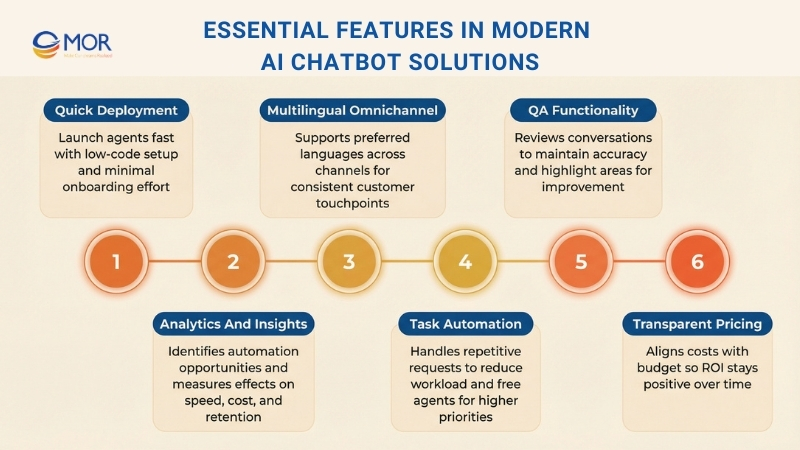
- Automation of repetitive tasks: Chatbot automation systems provide significant savings in both time and resources. The solution should reduce pressure on your support staff by handling common and repetitive activities, allowing agents to focus on higher-priority responsibilities.
- Quality assurance (QA) functionality: These features review and assess chatbot conversations to maintain consistent and accurate replies. They support high service standards and highlight areas where performance can be improved.
- Affordable and transparent pricing: AI chatbot solutions for customer support deliver strong returns only when initial costs align with your budget. You should compare pricing carefully against expected savings in support expenses to ensure the investment makes financial sense.
If you are planning to build your own chatbot, explore our detailed guide on how to create AI chatbot to understand the full development process step by step.
Common Use Cases Of AI Chatbot Solutions Across Industries
With ongoing advancements in automation and artificial intelligence, AI chatbot solutions now serve a wide range of purposes across many sectors.
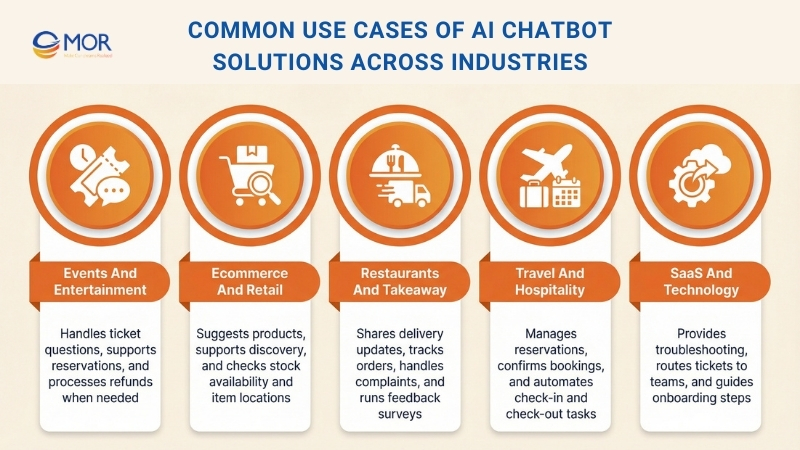
Below are some of the most frequent applications of conversational AI tools in customer service environments:
- Events and entertainment: Handling customer questions, assisting with ticket reservations, and processing refunds when needed.
- E-commerce and retail: Suggesting products, supporting product discovery, and verifying stock availability and item locations.
- Restaurants and takeaway services: Sharing delivery updates and order tracking details, addressing customer complaints, and conducting feedback surveys.
- Travel and hospitality: Managing flight and hotel reservations, providing booking confirmations, answering traveler questions, and automating check-in and check-out processes. AI-driven support in travel continues to expand as demand increases.
- SaaS and technology: Offering troubleshooting assistance, directing support tickets to the correct teams, and guiding customers through onboarding steps.
How To Choose The Right AI Chatbot Solutions For Your Business
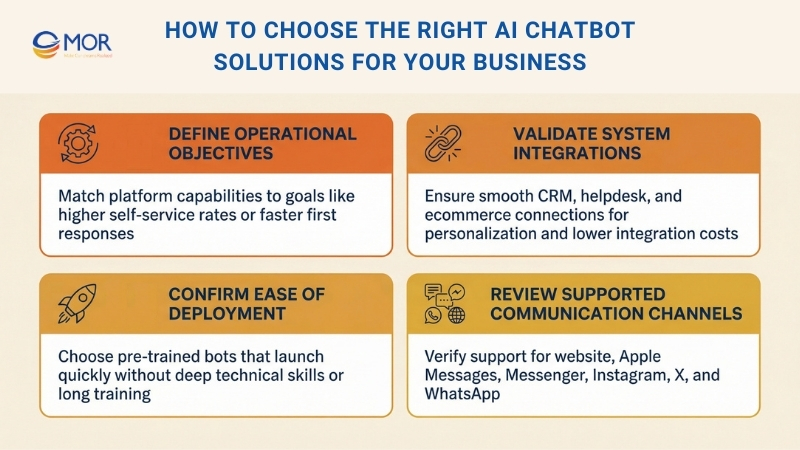
There are several important factors to evaluate before choosing chatbot software for your customer support operations.
Define Operational Objectives
When you assess AI chatbot solutions, you need to make sure their capabilities match your specific business objectives so the system can support your needs effectively. Knowing exactly how you plan to use the chatbot, whether to raise self-service rates or shorten first response times, helps you choose a platform that aligns with your service processes. Advanced AI-driven chatbot tools, such as those offered by Zendesk, can handle these responsibilities and more, giving your team stronger flexibility and scalability for automation goals.
Validate System Integrations
The chatbot automation system you select should connect smoothly with your CRM, customer support software, e-commerce platforms, and any other systems your organization relies on to access customer data and deliver personalized interactions. Ready-made integrations provide a clear benefit because they reduce expenses and eliminate the need for extensive developer involvement.
Confirm Ease Of Deployment
An AI-powered support bot that launches quickly and is designed specifically for customer experience can deliver strong operational benefits. Choose a solution that comes pre-trained with real customer service data so it can manage complex questions and subtle issues from the start. This approach provides immediate impact without requiring advanced technical skills, which reduces the time and cost usually associated with setup and training.
Review Supported Communication Channels
You should implement AI chatbot solutions across every digital channel where customers interact with your business. The exact channels depend on your industry and audience preferences.
Common deployment options include:
- Custom-built or Shopify websites
- Apple Messages for Business
- Messenger for Business
- X (Twitter) for Business
- WhatsApp Business
Pricing Breakdown Of AI Chatbot Solutions
The price of AI chatbot solutions can differ widely based on system complexity, included features, and the chosen deployment approach. Your overall AI development cost will depend on factors such as integrations, data readiness, security requirements, and expected conversation volume. For small companies with simple requirements, entry-level AI chatbot platforms generally begin at around $0 to $100 per month. These packages usually support basic FAQ handling, limited automation capabilities, and a fixed number of monthly interactions.
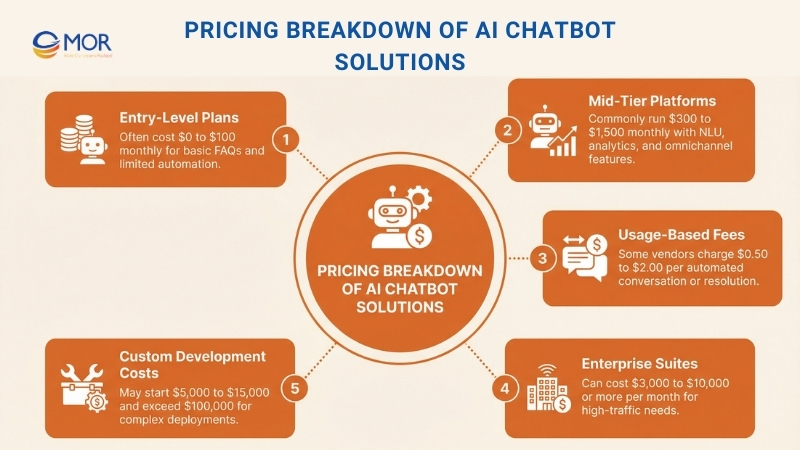
Mid-tier AI-driven chatbot tools that include natural language understanding, CRM connectivity, analytics, and omnichannel messaging typically range from $300 to $1,500 per month. Some vendors apply usage-based pricing, with charges between $0.50 and $2.00 per automated conversation or resolution, depending on total volume.
Enterprise-grade chatbot software built for high-traffic operations can cost between $3,000 and $10,000 or more per month. These platforms often provide advanced artificial intelligence functions, extensive integrations with internal systems, compliance support, and dedicated account management.
If you decide to develop a custom AI chatbot solution, expenses will be higher. A simple custom implementation may start at approximately $5,000 to $15,000, while complex enterprise deployments can reach $25,000 to over $100,000, depending on technical requirements and system integrations.
When reviewing pricing, you should weigh both the initial investment and the long-term savings in operational costs.
Why Partner With MOR Software For AI Chatbot Solutions?
Choosing the right vendor for AI chatbot solutions is not just about features. It is about execution, integration, and long-term reliability. That is where MOR Software stands out.
If you need an AI chatbot development service that covers strategy, build, integration, and ongoing optimization, our team can deliver an end-to-end implementation.
We build AI-driven systems that go beyond scripted automation. Our team designs conversational architectures powered by natural language understanding, ai and machine learning development services, and scalable backend infrastructure. The goal is simple. Deliver automation that feels natural, fast, and accurate.
We start with your business logic. Support workflows, CRM data, ticket routing rules, escalation policies, knowledge base structure. Then we design chatbot flows that align with real operational needs, not generic templates.
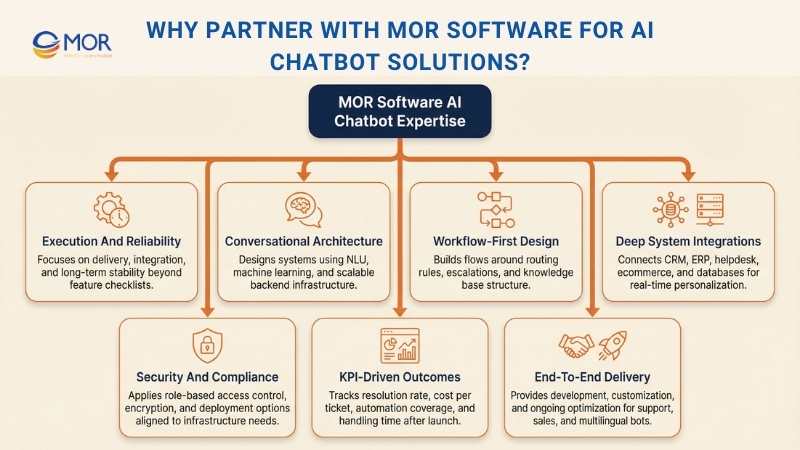
Integration is where many projects fail. We connect AI as a service chatbot platforms directly with your CRM, ERP, helpdesk, eCommerce platform, and internal databases. That means real-time customer data, personalized responses, and unified reporting across systems.
Security and compliance are built in from day one. Role-based access control, encrypted data exchange, and deployment options tailored to your infrastructure requirements.
Our delivery approach focuses on measurable outcomes. Resolution rate, cost per ticket, automation coverage, average handling time. We define KPIs early and track them continuously after deployment.
Whether you need a customer support assistant, sales automation bot, multilingual service agent, or enterprise-grade conversational AI coding assistant, MOR Software provides end-to-end development, customization, and long-term optimization.
These tools should reduce workload, improve service speed, and create consistent customer experiences. With MOR Software, you get a partner who builds with that outcome in mind.
Some case studies about AI you can take a look for reference:
AI-Powered Semantic Search Transformation
AI Person Counter & Demographic Detection: Level up Retail Analytics
Conclusion
AI chatbot solutions are no longer optional for modern support teams. From reducing costs and improving response times to enabling personalized, omnichannel service, the right conversational AI platform can transform how you engage customers. The key is choosing a system that aligns with your goals, integrates with your tools, and scales with your growth. Ready to implement the right solution? Contact MOR Software today to explore tailored AI automation strategies for your business.
"Evolution is not a destination, it is a disciplined journey of innovation."
Phung Van Tu


CEO MOR AI
MOR SOFTWARE
Frequently Asked Questions (FAQs)
What are AI chatbot solutions?
AI chatbot solutions are software systems powered by artificial intelligence that simulate human conversations through text or voice. They use technologies like natural language processing and machine learning to understand questions and provide automated responses.
How do AI chatbot solutions differ from traditional chatbots?
Traditional chatbots rely on predefined scripts and keyword matching. These solutions use intent recognition and contextual understanding, allowing them to handle more complex and varied conversations.
Can AI-powered chatbot solutions replace human customer service agents?
They can automate repetitive and routine inquiries, but they do not fully replace human agents. Most businesses use them to handle high-volume questions while routing complex issues to live representatives.
How much do intelligent chatbot systems typically cost?
Pricing varies depending on features and scale. Entry-level plans may start under $100 per month, while enterprise platforms can cost several thousand dollars monthly or charge per automated conversation.
Are AI chatbot solutions secure for handling customer data?
Most reputable providers implement encryption, role-based access controls, and compliance standards to protect sensitive information. Security levels depend on the vendor and deployment model.
Can AI-driven chatbot tools integrate with CRM and e-commerce platforms?
Yes. Modern solutions commonly integrate with CRM systems, helpdesk software, payment platforms, and online stores to access customer data and provide personalized responses.
How long does it take to implement an AI chatbots platform?
Implementation time depends on complexity. Simple bots can be deployed within days using low-code tools, while enterprise-level setups with integrations may take several weeks or months.
Do AI chatbot solutions support multiple languages?
Many platforms offer multilingual capabilities, allowing businesses to communicate with customers in different regions and languages without hiring additional support staff.
What industries benefit most from intelligent chatbot systems?
Industries such as e-commerce, healthcare, travel, SaaS, financial services, and hospitality frequently use chatbots to automate support, manage bookings, and improve response times.
How can businesses measure the ROI of AI chatbot solutions?
ROI can be evaluated by tracking metrics such as resolution rate, cost per interaction, reduction in support tickets, response time improvements, and customer satisfaction scores.
Share


Make Our-Dreams Realized


© 2023 . MOR Software. All Rights Reserved
Sitemap
Privacy Policy
Terms of Use

Rate this article
0
over 5.0 based on 0 reviews
Your rating on this news:
Name
*Email
*Write your comment
*Send your comment
1